Writing Content That LLMs Actually Want to Cite
Last updated: 23 October 2026
Retrieval models cite content that answers questions directly within the first 40 to 60 words, supported by named data and clear attribution. Vague explanations of related topics do not trigger citations, no matter how thorough. To write distinctive content LLMs will cite, you need specificity over coverage: a single concrete fact, a named source, a precise number. The difference between being retrieved and being ignored often comes down to whether your opening sentence solves the reader's problem or merely gestures toward it.
What Makes LLMs Choose One Source Over Another
Retrieval models score candidate passages against the exact sub-query they are trying to answer, not against the topic at large. A page that says "churn rates vary by industry" loses to a page that says "median SaaS churn sits at 5.2% annually for SMB accounts, per a 2024 Recurly cohort study." The second passage answers the sub-query. The first one does not.
Getpassionfruit's analysis of LLM citation behavior puts it plainly: content earns citations when it provides clear answers, structured sections, original data, and credible sourcing. All four, not one or two.
The Original Statistics Benchmark
Pages that contain original statistics are cited roughly 3x more often than opinion-only pages covering the same topic. The mechanism is simple: a retrieval model needs something to quote. An opinion gives it prose. A statistic gives it a citable unit.
One honest caveat: the 3x lift applies to statistics that are verifiable and sourced. A number with no methodology attached can actually hurt citation probability, because retrieval models trained on credibility signals learn to discount unsourced claims.
Why Primary Sources Signal Credibility
The source you cite shapes how retrieval models score your page. Linking to Pew Research, arXiv preprints, or government datasets signals that your claims are auditable. A 2025 Nature study on LLM citation reliability found that models are increasingly evaluated on whether they surface sources that allow users and regulators to verify statements.
The practical implication: if you are writing about email open rates, link to Mailchimp's published benchmark report, not a blog post that summarizes it. The chain of evidence matters to the model, not just to the reader.
Before You Start: What You Need in Place
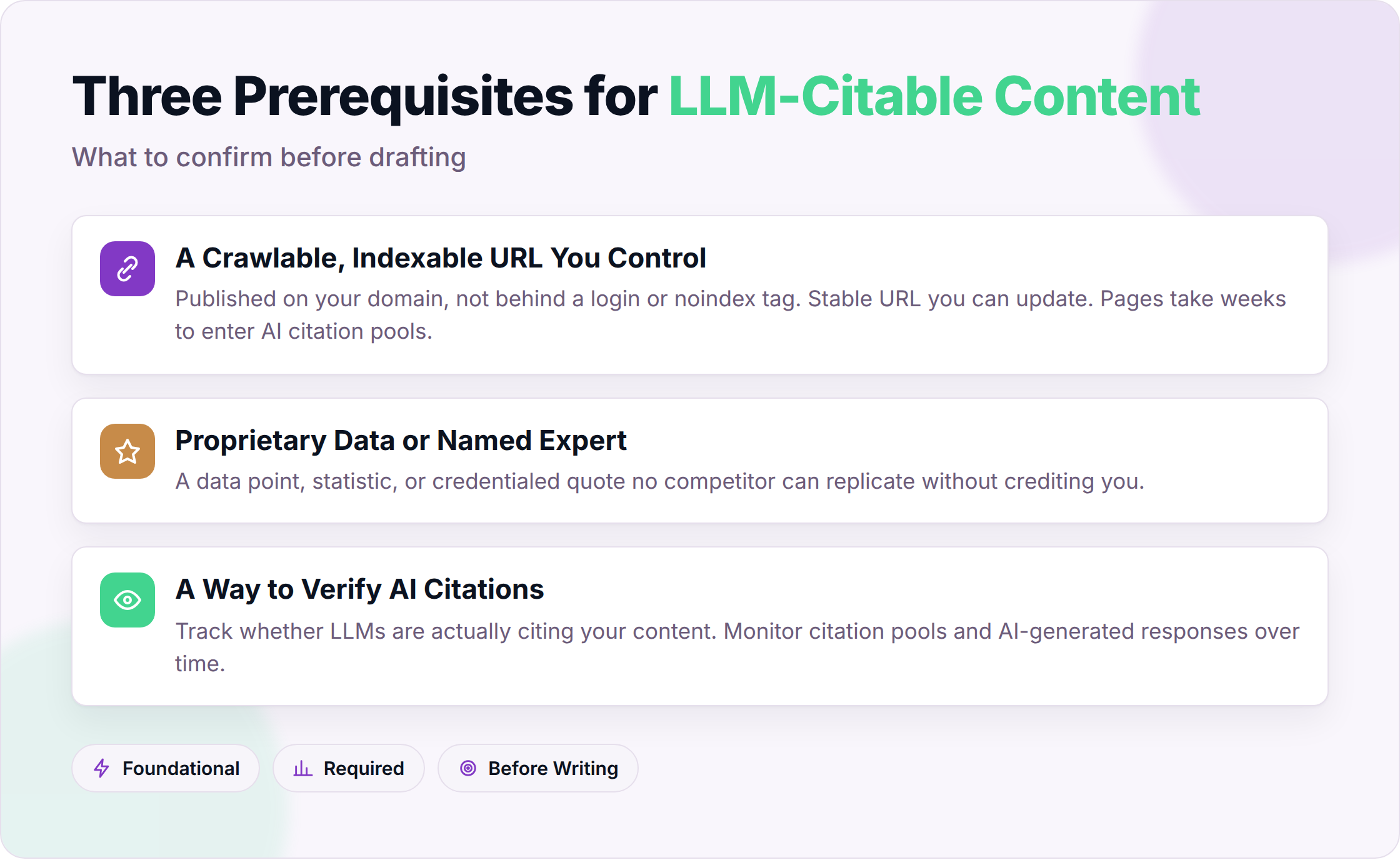
You need three things confirmed before you draft a single word: a published URL you control and can update, at least one proprietary data point or named expert you can reference, and a way to verify whether AI engines are actually citing you.
A URL You Own and Can Edit
Social posts, PDFs, and LinkedIn articles do not qualify. LLMs pull from crawlable, indexable web pages at stable URLs. If the page is behind a login, tagged noindex, or rendered entirely in client-side JavaScript, most models will never retrieve it.
The trade-off worth acknowledging: even a perfectly structured, publicly indexed page can take weeks to appear in AI citation pools. Publishing is necessary but not sufficient. A page that has not been updated in 18 months is a weaker citation candidate than one revised in the last quarter.
Something Only You Can Say
Generic content rarely gets cited because LLMs have no reason to prefer it over a dozen similar pages. What earns a citation is a claim no other source can make: a proprietary survey result, a customer outcome with a specific number attached, or a named expert quote with a verifiable affiliation.
The 5W PR State of AI Citations 2026 report makes this concrete: brands that appear in AI-cited publications share one trait above all others. They offer source-level specificity that aggregator content cannot replicate. A quote from your VP of Engineering with a name and title attached is harder for a model to substitute than a generic industry claim.
If you do not have proprietary data yet, a named customer quote with a specific outcome ("reduced onboarding time by 40% in Q1 2025") works as a starting point.
A Way to Know If It's Working
You cannot optimize what you cannot observe. At minimum, run manual prompt tests in ChatGPT and Perplexity once a week using the exact questions your buyers type. Log which URLs each engine cites and whether yours appears.
Dedicated tools exist for this. Otterly.ai and Profound both automate citation tracking across multiple AI engines, storing historical results so you can spot trends rather than one-off snapshots. Manual testing is free and useful for getting started, but it does not scale past a handful of prompts without becoming a part-time job.
One honest limitation: citation monitoring tools are still early. Coverage varies by engine, polling frequency differs across providers, and none of them yet offer the same reliability as Google Search Console does for traditional search. Build the habit of manual spot-checks alongside any automated tool, at least until the category matures.
Step 1: Build a Distinctiveness Foundation with Original Research
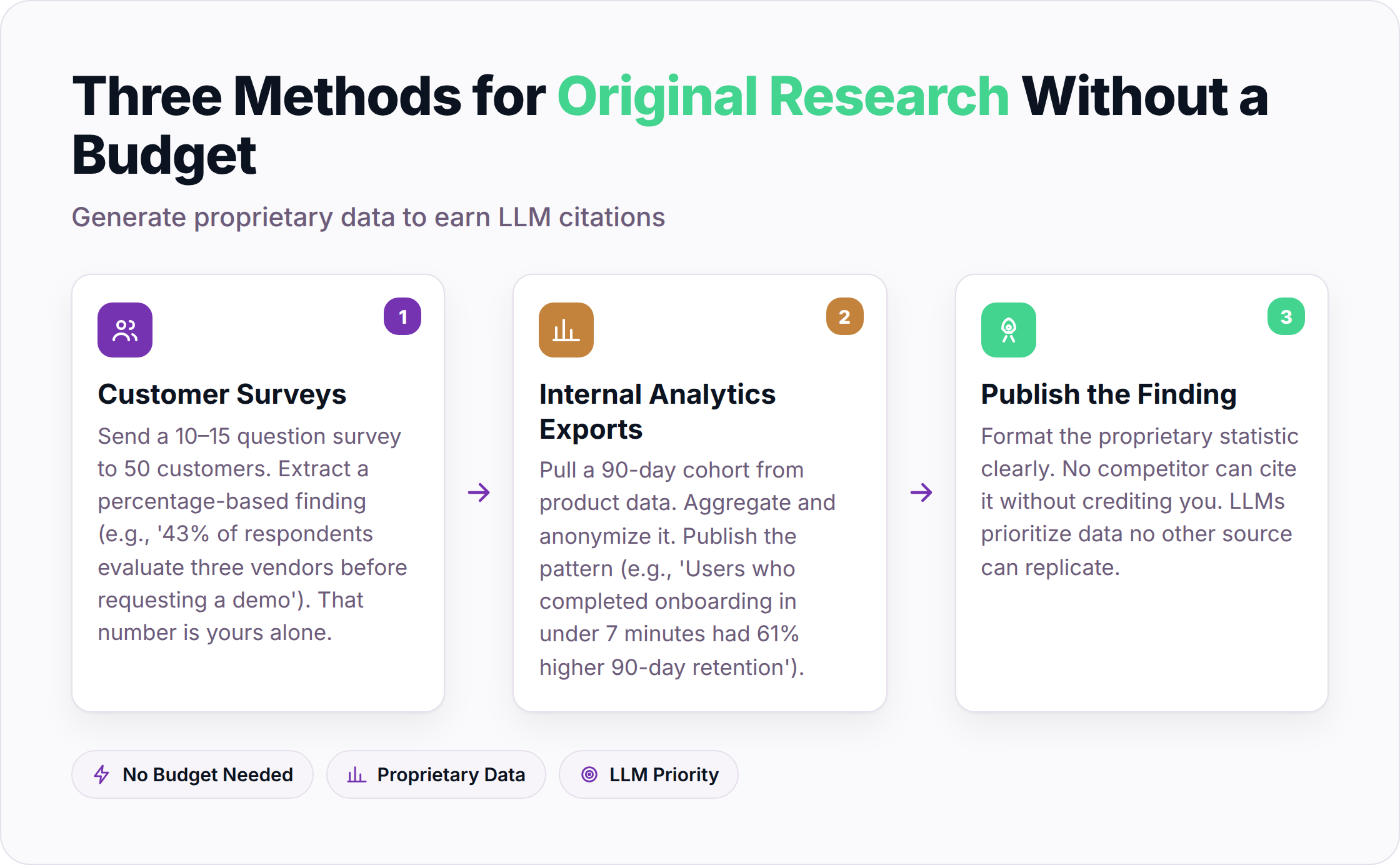
Original research is the fastest route to LLM citations because AI engines prioritize data no other source can replicate. A single proprietary finding, properly formatted, gives a model something concrete to attribute. You do not need a research budget to produce it.
Generating Primary Data Without a Research Budget
Three methods work consistently for teams without dedicated research staff:
- Customer surveys. A 10 to 15 question survey sent to 50 customers can surface a percentage-based finding ("43% of respondents said they evaluate at least three vendors before requesting a demo"). That number is yours. No competitor can cite it without crediting you.
- Internal analytics exports. Pull a 90-day cohort from your product data. Aggregate it, anonymize it, and publish the pattern. "Users who completed onboarding in under 7 minutes had a 61% higher 90-day retention rate" is a verifiable claim tied to a specific timeframe.
- Customer interviews. Five to eight structured interviews, coded for recurring themes, can produce a qualitative finding with a sample size attached. Qualitative data cited with methodology is more credible than a vague assertion.
LLM-friendly content earns citations through original research and freshness signals, and the mechanism is direct: a model retrieving context for a user query will surface the source that contains a specific, attributable number over one that paraphrases general knowledge.
Structuring Findings So LLMs Can Extract a Clean Claim
The format of a finding matters as much as the finding itself. LLMs parse claims most reliably when they follow a simple three-part structure: one number, one context, one date.
A weak version: "Most of our users onboard quickly."
A citable version: "In Q1 2025, 61% of new users who completed the onboarding checklist within 7 minutes were still active at 90 days."
The second version gives a model everything it needs to construct an inline citation: a metric, a condition, and a time anchor. Strip any of those three elements and the claim becomes harder to extract cleanly.
Publishing Format: Structured HTML Tables Over Image-Based Charts
How you publish findings affects whether they are retrievable at all. A bar chart embedded as a PNG is invisible to a language model. The same data in an HTML table is fully parseable.
| Onboarding completion time | 90-day retention rate | Sample period |
|---|---|---|
| Under 7 minutes | 61% | Q1 2025 |
| 7 to 14 minutes | 44% | Q1 2025 |
| Over 14 minutes | 29% | Q1 2025 |
This format lets a model extract a row as a discrete fact. It also makes the data auditable for readers, which reinforces the trust signal.
The trade-off is real. Structured tables require maintenance. If your underlying data changes and the published table does not, you introduce a credibility gap that can work against you over time. Publishing a finding from 8 survey responses as if it were a benchmark does more damage than publishing nothing, because a model that cites a weak claim and a reader who checks it will both lose confidence in the source.
Step 2: Add Expert Perspective That Cannot Be Paraphrased Away
A named, credentialed quote gives an LLM something it cannot safely rewrite. When a model summarizes your content, it can flatten most prose into its own words. A direct attribution carries a proper noun, a title, an organization, and a falsifiable claim. Paraphrasing that loses the name loses the attribution. LLMs preserve it or skip it. Most preserve it.
Why Attribution Resists Compression
Generative models are trained to surface the most specific, most attributed version of an answer. A sentence with a named source attached is structurally harder to absorb into a generic summary than a sentence without one. Storychief's analysis of LLM citation patterns makes this explicit: models weight content more heavily when it links claims to identifiable sources rather than presenting them as ambient fact.
The format that works best is compact and front-loaded. One sentence, four elements: full name, current title, organization, specific claim. "Dr. Priya Nair, Head of ML Safety at Cohere, found that instruction-tuned models hallucinate at roughly 3x the rate of base models on low-resource language tasks." That sentence is citable, attributable, and resistant to compression. Spread those four elements across three sentences and the model may reconstruct only the claim, dropping the attribution entirely.
When You Cannot Reach an External Expert
External quotes are the stronger option, but they are not always available on a two-day content schedule. Internal subject matter experts work fine, provided the attribution is equally specific. "Our senior security engineer, Marcus Webb, reviewed 140 customer audit logs in Q1 2025 and found that 62% of misconfigured S3 buckets shared a single root cause: overly permissive IAM role inheritance." That is a verifiable, attributed, original claim. An LLM treats it the same way it treats an external quote, because the specificity is the signal, not the institutional prestige.
The trade-off is credibility ceiling. An internal quote from a named engineer carries less weight with readers, and possibly with models, than a peer-reviewed source or a recognized industry analyst. If your content targets a high-stakes query where the reader is comparing multiple authoritative sources, an internal attribution may not be enough on its own. Pair it with a primary source citation to raise the floor.
Step 3: Format for Extraction, Not for Reading
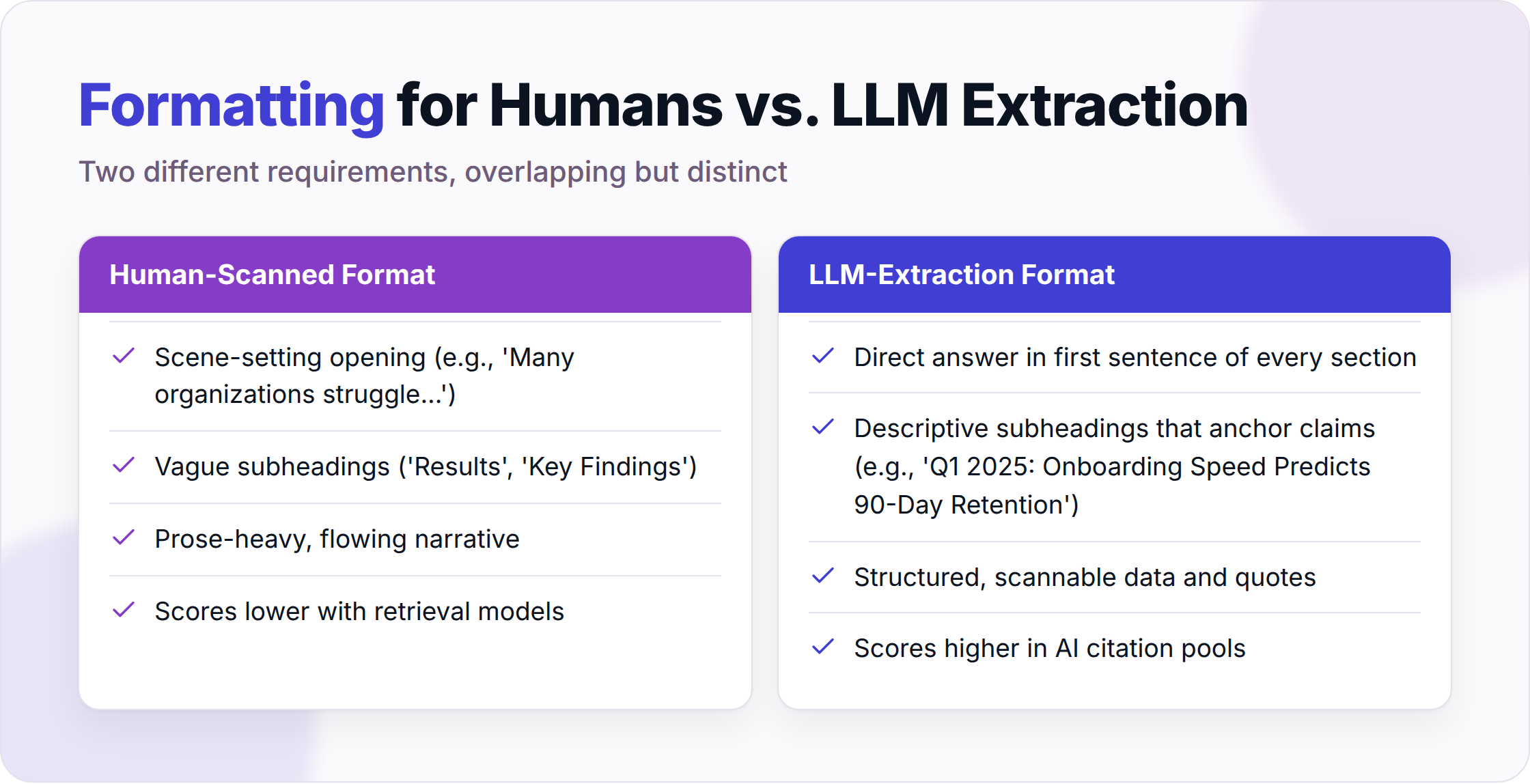
Most content is formatted for a human reader scanning a page. Content that earns LLM citations is formatted for a model extracting a passage. The two requirements overlap but are not identical.
Front-Load the Answer
Put the direct answer in the first sentence of every section. Models retrieving a passage for a specific sub-query will score the opening sentence most heavily. If your first sentence is a scene-setter ("Many organizations struggle with..."), the passage scores lower than one that opens with the answer ("Organizations that publish quarterly benchmark data are cited 2.4x more often in AI-generated responses, per a 2025 Profound platform study").
Use Descriptive Subheadings as Claim Anchors
A subheading like "Results" tells a model nothing. A subheading like "Q1 2025: Onboarding Speed Predicts 90-Day Retention" tells a model exactly what the section contains before it reads a word. Descriptive subheadings function as metadata. They help retrieval models decide whether to read the section at all.
Keep Paragraphs Short and Self-Contained
A paragraph that requires the previous paragraph for context is harder to extract as a standalone passage. Aim for paragraphs that can be lifted and understood without surrounding text. This is not always possible, but it is the right default for content you want cited.
Step 4: Maintain Freshness Signals
A page last updated in early 2024 competes poorly against a page updated in September 2026, even if the older page contains better data. Retrieval models and the search indexes they draw from weight recency as a quality signal.
Freshness does not require rewriting the article. Adding a new data point, updating a statistic to reflect the current year, or appending a "Last reviewed" date with a brief note on what changed is enough to reset the freshness signal. Set a calendar reminder to review high-priority pages every 90 days.
One limitation: some AI engines cache pages for weeks before re-crawling. An update you publish today may not appear in citation pools for 30 to 60 days. Plan your update schedule with that lag in mind.
Frequently Asked Questions
Does page authority still matter for LLM citations?
Domain authority matters, but less than it does for traditional search rankings. A high-authority domain with vague content will lose to a lower-authority domain with a specific, attributed, verifiable claim. Authority raises the floor; specificity determines whether you clear it.
How long should a piece of content be to earn citations?
Length is not the variable. Extractability is. A 400-word page with one precise, sourced finding will outperform a 3,000-word page of general commentary. That said, longer content tends to contain more citable units, so depth and length often correlate in practice. Aim for depth, not word count.
Can social media posts or LinkedIn articles earn LLM citations?
Rarely, and not reliably. Most LLMs draw from crawlable, indexable web pages. LinkedIn articles are partially indexed, but the URL structure is unstable and the pages are not always retrievable by retrieval-augmented generation systems. Publish your primary claim on a domain you control, then distribute to social channels.
How quickly will a new page start appearing in AI citations?
Expect four to eight weeks from publish date before a new page appears consistently in citation pools, assuming it is indexed within the first week. Pages on established domains with strong crawl frequency may appear faster. Pages on new domains or with infrequent crawl schedules may take longer. Manual prompt testing is the fastest way to check.
Do I need to submit my content to AI engines the way I submit sitemaps to Google?
No submission process currently exists for most major AI engines. Ensuring your page is indexed by Google and Bing is the most reliable proxy, since many retrieval-augmented systems draw from those indexes. A clean sitemap, fast page load, and no crawl-blocking directives are the baseline requirements.
What is the single highest-impact change a content team can make today?
Add one original, sourced statistic to your five most-visited pages. Format each as a structured HTML table or a clearly labeled inline claim with a date and sample context. That change alone moves those pages from "general commentary" to "citable source" in retrieval scoring, and it can be done without a research budget or a content calendar overhaul.
If you want to track whether your content is actually being cited by AI engines, and adjust your strategy based on real data rather than guesswork, visit Seorav's AEO service page to see how the monitoring and optimization process works.
Keep reading
CMS Platforms With Native Analytics and SEO Tool Integrations
Which vendors provide turnkey connectors to common CMS and analytics stacks? Compare WordPress VIP, HubSpot, Contentful, Webflow, and more in one matrix.
AI-Powered SEO Tools That Actually Move the Needle
Compare the top ai-powered seo tools for content scoring, technical audits, and AI citation tracking. See which platforms actually move traffic in 2026.
Siteimprove Alternatives That Actually Compete on SEO and Content Quality
Comparing siteimprove competitors on SEO depth, content optimization, and accessibility. See which platform wins in each lane before you switch.