Siteimprove Alternatives That Actually Compete on SEO and Content Quality

Last updated: 20 October 2026
Siteimprove competitors fall into specialized categories rather than direct replacements. Semrush dominates SEO depth with superior keyword research and rank tracking. Frase accelerates content workflows from keyword discovery to draft optimization. Deque Axe provides more detailed WCAG compliance reporting at lower cost. Each tool sacrifices breadth for strength in one area, so your choice depends on whether you prioritize search visibility, content production speed, or accessibility auditing as your primary need.
Siteimprove's "all-in-one" positioning is real, but it creates a specific problem for SEO-focused buyers. The platform spreads its feature surface across accessibility, content quality, and SEO simultaneously, so none of those layers runs as deep as a dedicated tool. Keyword research, backlink analysis, and SERP tracking are noticeably thinner than what Semrush or Ahrefs offer at comparable price points.
The numbers reflect this. Gartner's verified reviews for Siteimprove show buyers consistently rating it as a governance and compliance tool first, with SEO capability listed as a secondary consideration rather than a core reason to buy. Specialist platforms tend to score higher with teams that have a single, well-defined priority.
One honest caveat: if your team genuinely needs accessibility auditing, content governance, and basic SEO scoring inside one login, switching to three separate tools introduces real coordination overhead. The specialist route wins on depth; Siteimprove still wins on consolidation. Tools like SEORav address the content and SEO side of that gap, but no single alternative replicates the full governance stack.
At a Glance: Siteimprove vs. Top Competitors
Siteimprove is a digital governance platform covering accessibility, on-page SEO, and content quality in one contract. Its closest competitors each outperform it in one of those lanes while leaving the others to a second tool. The table below maps where each platform actually wins.
| Platform | Pricing | Best For | Deployment | Key Feature | Winner At |
|---|---|---|---|---|---|
| Siteimprove | Enterprise (custom quote) | Compliance-heavy orgs, large CMS estates | Cloud, managed | WCAG auditing + SEO in one dashboard | Accessibility governance |
| Semrush | From $139.95/month | SEO research, competitive intelligence | Cloud, self-serve | Keyword database (25B+ keywords) | Keyword and backlink research |
| Frase | From $45/month | Content brief creation, SERP research | Cloud, self-serve | AI-assisted content outlines | Brief-to-draft speed |
| Surfer SEO | From $99/month | On-page content optimization | Cloud, self-serve | Real-time content scoring against SERPs | On-page NLP optimization |
| Deque Axe | Free tier + enterprise | Developer-led accessibility testing | Browser extension, CI/CD | Automated WCAG rule engine | Dev-workflow accessibility |
The G2 competitor listings for Siteimprove show Semrush and Silktide as the two most-compared alternatives, which tracks. Semrush pulls teams focused on search performance; Silktide pulls teams focused on content quality at scale.
A few things the table doesn't capture. Siteimprove's bundled model means one vendor, one contract, and one dashboard for accessibility and SEO reporting. For compliance teams that report to legal or procurement, that consolidation has real value. The trade-off is cost and depth: enterprise pricing with a custom quote process is a friction point for teams that just need strong keyword research or fast content briefs, and no single competitor in the table matches Siteimprove's breadth across all three governance pillars simultaneously.
This breaks down when your organization has distinct teams for SEO and accessibility. In that case, paying for Siteimprove's bundle means one team subsidizes features the other team owns, and you often end up running a specialist tool alongside it anyway.
Why Teams Switch Away From Siteimprove
Teams most often leave Siteimprove when the platform's pricing model outpaces its SEO utility. Siteimprove was built for accessibility compliance and digital governance, and its SEO layer reflects that origin: broad enough to check boxes, but thin on the keyword opportunity tracking and ranking data that content and SEO teams actually run campaigns from. For agencies managing multiple client accounts, those gaps compound quickly.
Pricing Opacity at the Enterprise Tier
Siteimprove does not publish plan pricing. Contracts are negotiated, scoped by page volume, and typically structured on annual terms. Independent reviews on SoftwareReviews' SEO category comparison consistently flag this as a friction point, particularly for mid-market teams comparing Siteimprove against tools that list monthly rates publicly. When a competitor shows you exactly what $299/month gets you and Siteimprove requires a discovery call to reach a number, procurement cycles slow down and budget owners get cautious.
The trade-off is real, though. Enterprise contracts often include dedicated onboarding, SLA guarantees, and compliance reporting that a transparent monthly plan from a smaller vendor simply does not offer. Teams inside regulated industries or large public-sector organizations frequently find that value worth the opacity. The switch makes less sense for them.
SEO Analytics Gaps Compared to AI-Native Tools
Siteimprove's SEO module covers on-page issues, broken links, and basic keyword tracking. What it does not do well: surfacing keyword gap opportunities at scale, modeling ranking potential against current SERP competition, or integrating AI-generated content recommendations tied to live ranking data. AI-native SEO tools built after 2022 treat those capabilities as table stakes.
The numbers tell part of the story. In a 2024 G2 category analysis, Siteimprove's SEO feature satisfaction scores ranked below the category average on keyword research depth and competitive analysis, two areas where tools purpose-built for search have invested heavily. If your team's primary output is content that needs to rank, that gap shows up in weekly reporting.
The Multi-Client Agency Problem
Agencies are where Siteimprove's model strains most visibly. Managing 15 or 20 client sites inside a single Siteimprove contract typically means negotiating seat counts, working around page-volume caps, and producing client reports from a dashboard designed for internal governance teams, not client-facing delivery.
Most agency-oriented alternatives offer white-label reporting, per-client workspaces, and bulk crawl scheduling as default features. Siteimprove treats those as configuration problems to solve at the contract level. That works fine for an in-house team running one domain. For an agency billing clients monthly and needing to show keyword movement, content scores, and technical health in a single exportable report, the workflow friction adds up to real hours per week.
Siteimprove vs. Semrush: Feature Breakdown
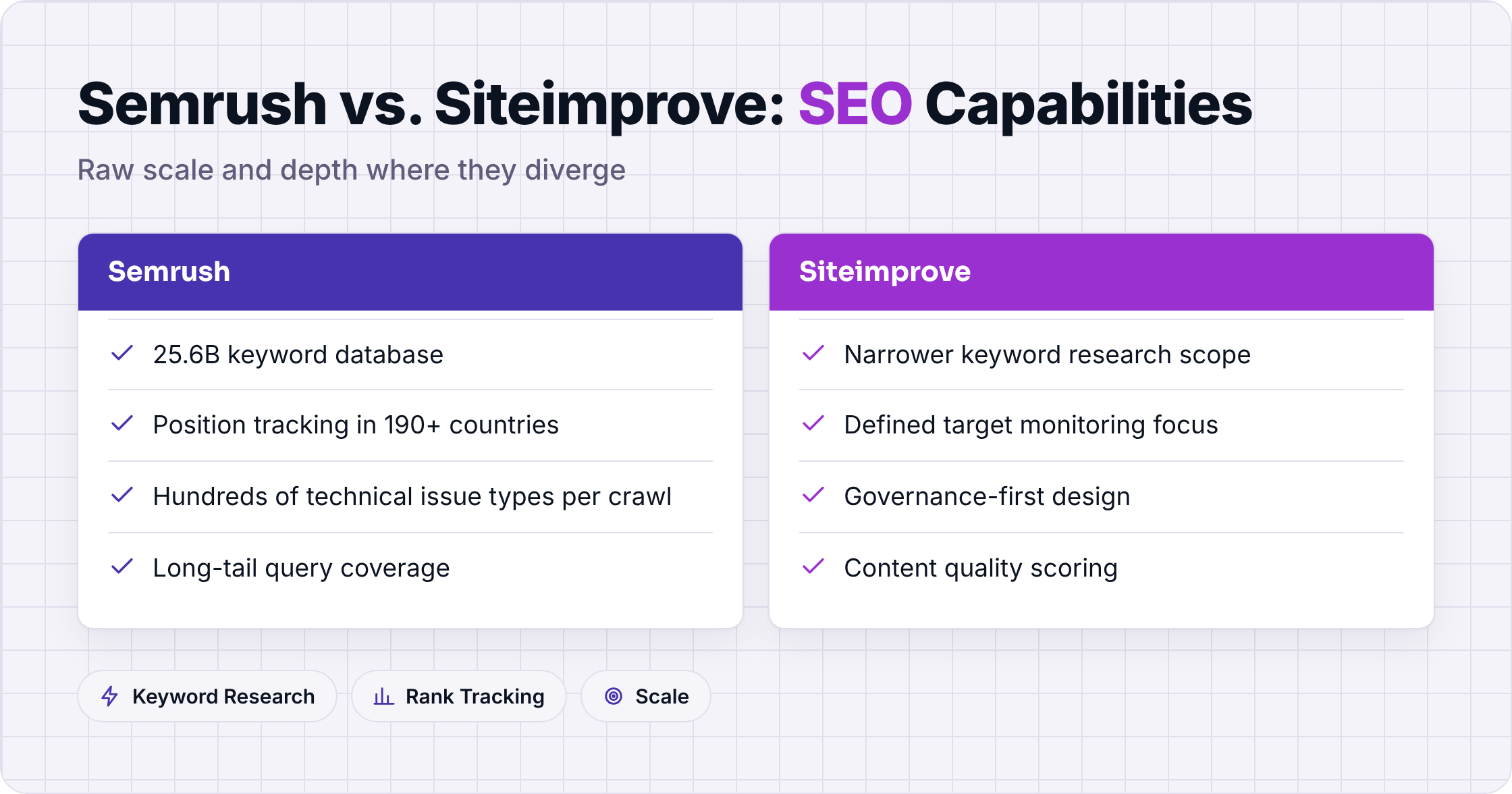
Semrush competes on raw SEO scale: a 25.6 billion keyword database, position tracking across 190+ countries, and a technical audit engine that surfaces hundreds of issue types in a single crawl. Siteimprove competes on governance: content quality scoring, accessibility compliance, and workflow tools built for editorial teams managing large, regulated websites. For pure SEO horsepower, Semrush wins. For organizations where content accuracy and brand consistency matter as much as rankings, Siteimprove holds real ground.
Keyword Research and Rank Tracking
Semrush's keyword database sits at 25.6 billion terms, which means you can pull search volume, intent classification, and competitive difficulty for long-tail queries that smaller databases simply don't index. Siteimprove's keyword research module is functional but narrower in scope, better suited to monitoring a defined set of target terms than to exploratory research across a new market.
Rank tracking tells a similar story. Semrush tracks positions at the city level in 190+ countries, with daily refresh options on higher-tier plans. A Gralio market comparison notes that Semrush is better suited for businesses prioritizing competitive intelligence, while Siteimprove fits organizations focused on governance and compliance. That framing holds up in practice.
Technical SEO Auditing
Semrush's Site Audit crawls up to 100,000 pages per crawl on mid-tier plans, categorizes issues by severity, and maps each finding to a specific fix. The prioritization logic is useful: it weights issues by estimated traffic impact rather than treating a missing alt tag the same as a broken canonical chain.
Siteimprove's technical audit is solid for catching on-page issues and broken links at scale, and its interface is genuinely easier for non-SEO stakeholders to interpret. The trade-off is depth. Semrush surfaces more issue types, including JavaScript rendering problems and Core Web Vitals diagnostics, that Siteimprove's audit doesn't cover with the same granularity. If your site runs heavily on client-side rendering, Semrush is the stronger choice.
Content Quality Management
This is where the comparison flips. Siteimprove was built partly as a content governance tool, and it shows. It flags readability issues, broken content, outdated pages, and policy violations in ways that matter to content managers and compliance teams. Semrush's content tools, including the SEO Writing Assistant and Content Audit module, are oriented toward search optimization rather than editorial governance.
The numbers from Infotech's software review data show that user satisfaction scores differ meaningfully by role: SEO practitioners rate Semrush higher, while digital communications and content teams rate Siteimprove higher. Neither tool is wrong. They are solving different problems, and buying the wrong one usually means paying for features your team never opens.
One limitation worth naming: Semrush's content quality features require you to already know what you want to optimize. They don't proactively surface content that has drifted off-brand or become factually stale. Siteimprove does. If your site has thousands of pages and a small editorial team, that proactive flagging has real operational value that Semrush's SEO-first content tools don't replicate.
Siteimprove vs. Frase: Content Optimization Compared
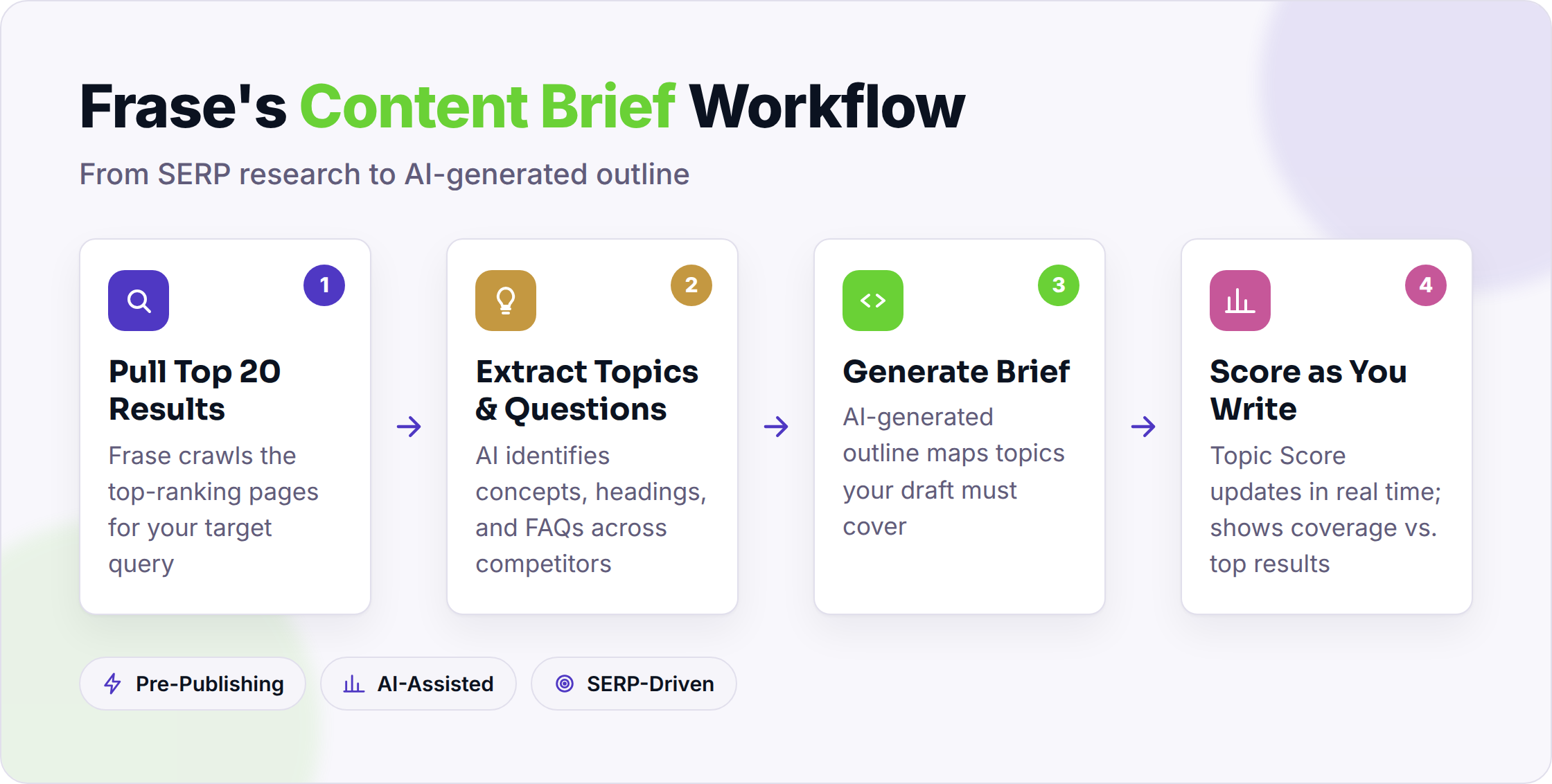
Frase and Siteimprove solve different problems. Siteimprove audits what already exists on your site: broken links, accessibility failures, keyword tracking, and on-page quality signals. Frase starts before a word is written, pulling the top 20 SERP results for a target query and building an AI-generated brief that maps the topics, questions, and headings your draft needs to cover. If your team writes content from scratch for competitive queries, Siteimprove has no equivalent workflow.
AI Content Briefs and Topic Scoring
Frase's Topic Score measures how thoroughly a draft covers the concepts found across ranking pages, weighted by how frequently each topic appears in the top results. That score updates as you write. Siteimprove's content quality checks, documented in St. Joseph's University's internal web guide, focus on readability grades, duplicate content flags, and keyword density on pages that already exist. Useful for governance. Not useful for building a brief.
The practical difference: a content team briefing a writer on "best project management software for agencies" gets a structured outline from Frase in roughly three minutes. Siteimprove has no equivalent starting point for net-new content. If your workflow begins at a blank page, Frase is the more relevant tool. If your workflow begins with an existing 5,000-page CMS estate that needs auditing, Siteimprove is.
Where Frase Falls Short
Frase does not do accessibility auditing, technical SEO crawling, or compliance reporting. Its scope is deliberately narrow: research, brief, draft, optimize. That focus is a strength for content teams, but it means you'll need a separate tool for anything outside that workflow. Frase also lacks the backlink data and rank tracking that Semrush provides, so agencies running full-service SEO campaigns typically use Frase alongside a broader platform rather than instead of one.
Pricing is more accessible than Siteimprove's enterprise model. At $45/month for the Solo plan, Frase is within reach for individual writers and small teams. The trade-off is that the Solo plan limits you to four document searches per month, which is a real constraint if you're briefing content at volume.
Siteimprove vs. Surfer SEO: On-Page Optimization
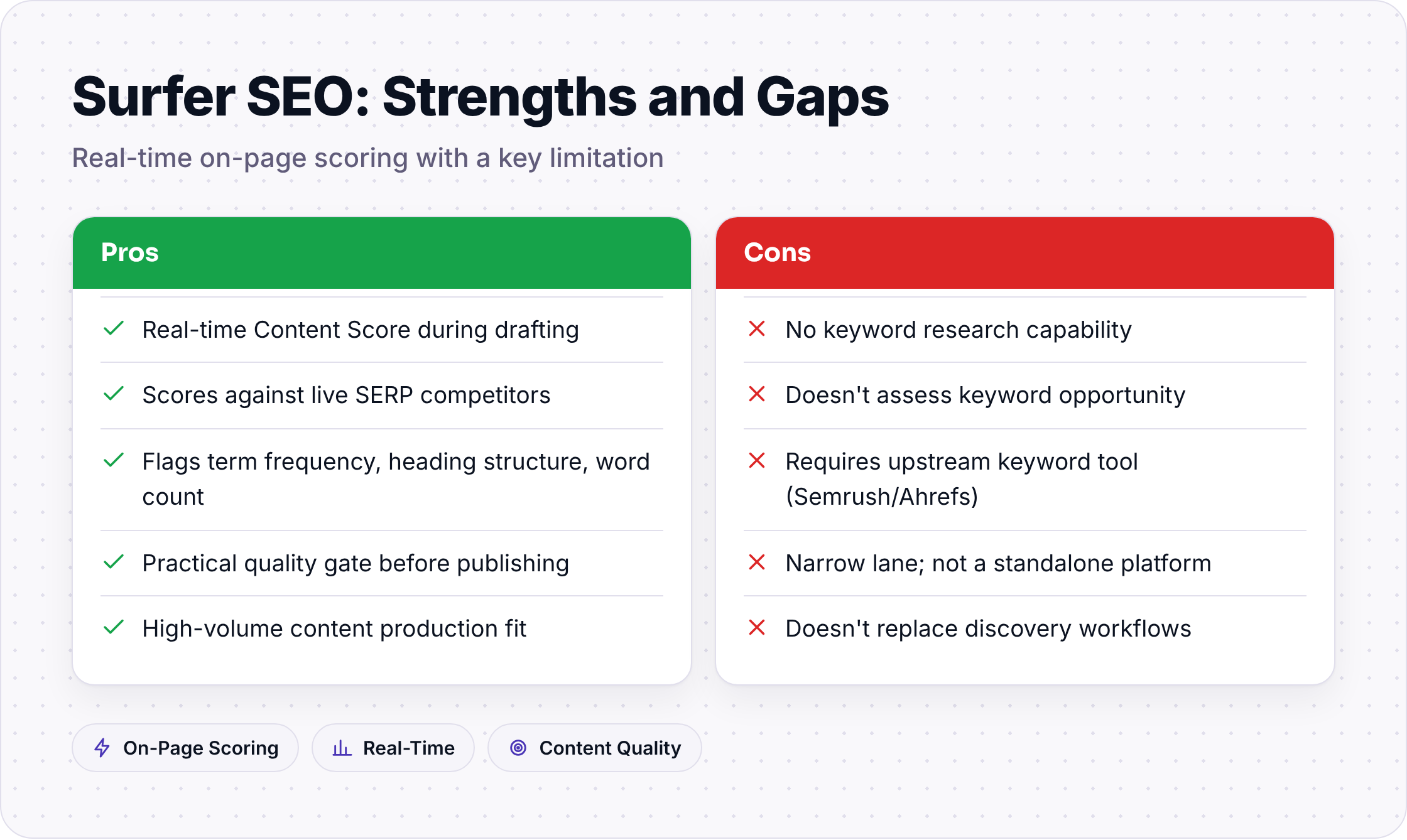
Surfer SEO sits in a narrower lane than either Siteimprove or Semrush. Its core function is real-time on-page scoring: you paste or write content inside Surfer's editor, and it scores your draft against the top-ranking pages for your target keyword, flagging term frequency, heading structure, word count, and NLP entity coverage. Siteimprove's on-page checks don't operate in real time during drafting, and they don't model your content against live SERP competitors.
For teams producing high volumes of SEO-targeted content, Surfer's Content Score is a practical quality gate before publishing. The limitation is that Surfer doesn't tell you whether a keyword is worth targeting in the first place. You still need a keyword research tool upstream. Most teams using Surfer pair it with Semrush or Ahrefs for discovery, then use Surfer to optimize the draft. Siteimprove doesn't fit cleanly into that workflow at any stage.
Siteimprove vs. Deque Axe: Accessibility Testing
If accessibility is your primary concern, Deque Axe is worth a direct comparison. Axe's automated rule engine covers WCAG 2.1 and 2.2 at levels A, AA, and AAA, and it integrates directly into browser developer tools, CI/CD pipelines, and testing frameworks like Cypress and Playwright. That developer-native integration is something Siteimprove's crawler-based approach doesn't match.
Siteimprove's accessibility module is better suited to non-technical stakeholders: content editors, communications teams, and compliance officers who need a dashboard view of accessibility health across a large site without touching code. Axe is better suited to engineering teams that want to catch issues before they reach production. The two tools serve genuinely different audiences, and some organizations run both.
The cost difference is significant. Axe's browser extension is free, and the Axe DevTools Pro plan starts at a fraction of Siteimprove's enterprise contract. For organizations where accessibility testing is an engineering responsibility rather than a governance one, Axe delivers more relevant functionality at a lower price point.
Which Siteimprove Competitor Is Right for Your Team?
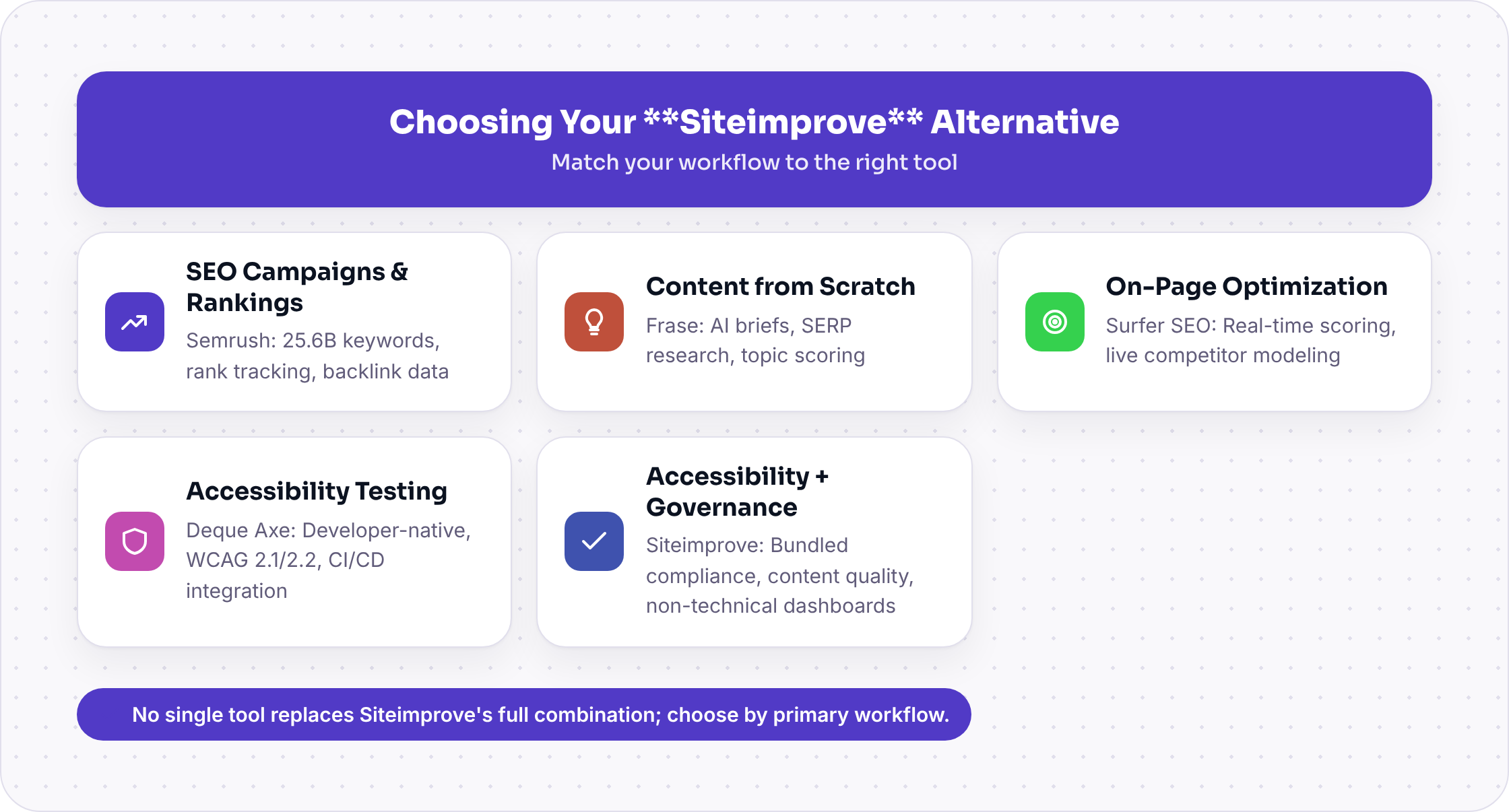
The answer depends on what your team actually does most.
If you run SEO campaigns, track rankings, and need deep keyword and backlink data, Semrush is the stronger choice. Its database and audit depth outclass Siteimprove's SEO layer by a wide margin.
If you produce content from scratch and need to brief writers against live SERP data, Frase fits that workflow directly. Siteimprove has no equivalent pre-publishing research capability.
If you optimize existing pages for search and want real-time scoring during drafting, Surfer SEO fills that gap. It works best alongside a keyword research tool, not as a standalone platform.
If accessibility testing is an engineering function at your organization, Deque Axe integrates into developer workflows in ways Siteimprove's crawler-based model doesn't support.
If you genuinely need accessibility auditing, content governance, and SEO monitoring under one contract, and your organization has the budget for enterprise pricing, Siteimprove's consolidation still has a case. The siteimprove competitors listed here each win on depth in their lane, but none of them covers all three governance pillars in a single platform.
Frequently Asked Questions
What is the closest direct alternative to Siteimprove for enterprise teams?
Semrush is the most direct replacement for teams whose primary use case is SEO. For teams whose primary use case is accessibility compliance, Deque Axe covers WCAG testing with more developer-friendly tooling. No single platform replicates Siteimprove's full combination of accessibility, content governance, and SEO in one contract.
Is Siteimprove worth the cost for mid-market companies?
It depends on how much of the platform your team actually uses. If you need accessibility auditing and content governance together, the bundled pricing can be competitive. If you only need SEO features, you'll likely find better value in a specialist tool at a published monthly rate. Mid-market teams that don't have a compliance mandate often find the enterprise contract structure more friction than it's worth.
How does Siteimprove compare to Semrush on keyword research?
Semrush's keyword database covers 25.6 billion terms with intent classification, competitive difficulty scoring, and city-level rank tracking. Siteimprove's keyword module is narrower, better suited to monitoring a defined list of terms than to exploratory research. For teams building content strategies around keyword opportunity, Semrush is the more capable tool.
Can Frase replace Siteimprove for content teams?
Frase replaces the pre-publishing research and brief-creation workflow that Siteimprove doesn't offer, but it doesn't replace Siteimprove's site-wide auditing, accessibility checks, or governance reporting. If your team's main pain point is briefing and drafting content for competitive queries, Frase addresses that directly. If your main pain point is auditing an existing CMS estate for quality and compliance issues, Frase doesn't help.
Does Siteimprove support agency use cases?
Siteimprove can support agency use cases, but its contract model creates friction. White-label reporting, per-client workspaces, and bulk crawl scheduling are not default features; they require contract-level configuration. Agencies that need to deliver client-facing SEO and content reports monthly typically find specialist platforms with built-in multi-client support more practical.
What do most teams use alongside Siteimprove?
Based on user reviews and community discussions, teams that keep Siteimprove for governance often add Semrush or Ahrefs for keyword research and rank tracking, and sometimes Surfer SEO for on-page content optimization. The pattern suggests that Siteimprove's SEO layer is frequently supplemented rather than relied on as a primary search tool.
If you're weighing these siteimprove competitors and want to see how SEORav fits into your existing SEO and content stack, see how SEORav integrations work before you commit to a new contract. The integrations page covers which platforms SEORav connects with and where it adds the most value alongside tools you may already be running.
Keep reading

How to Measure and Improve Your AI Citation Rate
Learn how to track and improve your AI citation rate across ChatGPT, Perplexity, Claude, and Gemini with a step-by-step citation rate optimization framewor

Which Enterprise CMS Platforms Actually Deliver at Scale
Compare the best enterprise CMS platforms on SEO toolchain fit, analytics depth, and total cost. Contentful, AEM, Sitecore, and WordPress VIP evaluated.

Schema Markup Validators: How to Test and Fix Your Structured Data
Learn how to use a schema markup validator to catch missing properties, type mismatches, and duplicate markup before they cost you rich result eligibility.