AI-Powered SEO Tools That Actually Move the Needle
Last updated: 21 October 2026
AI-powered SEO tools automate the work that once required manual analysis across dozens of platforms. Leading solutions in 2026 handle keyword research, score content against live ranking factors, monitor which pages get cited by ChatGPT and Perplexity, and identify structural problems before publication. The real advantage comes from how deeply these tools integrate automation into your workflow, not from piling on features. The platforms that move rankings fastest are those that reduce decision time, not decision complexity.
What AI-Powered SEO Tools Do (And Which Ones Lead Right Now)
AI-powered SEO tools don't just surface data. They act on it. The leading platforms in 2026 automate keyword research, score content against live ranking signals, track which pages get cited by ChatGPT and Perplexity, and flag structural gaps before a page ships. The core differentiator is automation depth, not feature count.
The numbers make this category hard to ignore. Teams using AI-assisted SEO workflows report traffic increases of up to 49% within six months, and AI-powered tools cut keyword research time by roughly 80% compared to manual methods. That efficiency gain is real, but it comes with a caveat: faster output only helps if the underlying scoring rubric is calibrated to how search actually works right now.
The Five Criteria Used to Score Every Tool Here
Every tool in this article was evaluated against the same five signals:
| Criterion | What it measures |
|---|---|
| Citation-readiness | Does the tool optimize for AI engine citations, not just Google rankings? |
| Automation depth | Can it act on data, or does it only surface it? |
| Voice fidelity | Does output match your brand, or does it read generic? |
| Workflow integration | Does it connect to your CMS and publishing stack without friction? |
| Scoring transparency | Does it show you why a draft passes or fails, not just a number? |
Tools that scored well on all five tend to be the ones teams actually keep using past the trial period. Tools that scored on only two or three are useful for specific tasks but rarely replace a broader workflow.
Why AI Overviews Changed the Scoring Rubric
Google's AI Overviews, which rolled out broadly in 2024, shifted what "ranking" means for a large share of informational queries. A page can sit at position one and still lose the click if an AI Overview pulls its answer from a competitor. That changed how this article weights tools.
Citation-readiness, once a secondary concern, now sits at the top of the rubric. A tool that helps you rank in the blue links but ignores how AI engines extract and attribute content is solving a smaller version of the problem. Platforms like SEORav are built around this explicitly, scoring drafts against structural signals that affect AI citation probability before anything ships.
The practical implication: if a tool's feature set was last updated before mid-2024, its scoring logic almost certainly predates the AI Overview era. That gap matters when you're deciding where to invest.
Tool Comparison Matrix: Features at a Glance
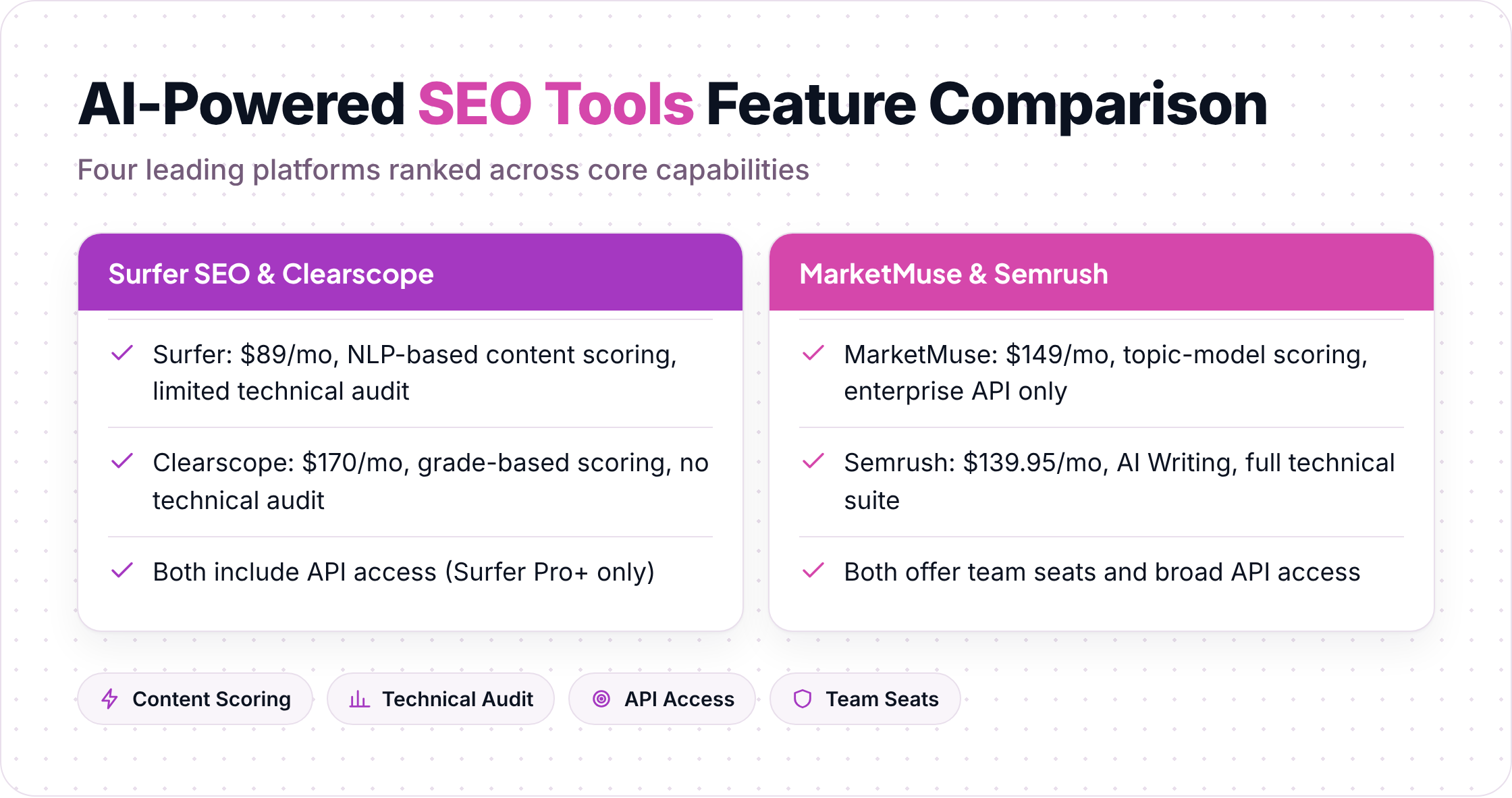
The four tools below cover the main categories buyers evaluate: content optimization, technical auditing, AI citation tracking, and workflow integration. Pricing runs from $89/month (Surfer SEO) to $170/month (Clearscope), with meaningful feature gaps at each tier.
| Tool | Starting Price | Content Scoring | Technical Audit | AI Citation Tracking | API Access | Team Seats |
|---|---|---|---|---|---|---|
| Surfer SEO | $89/mo | Yes (NLP-based) | Limited | No | Pro+ only | Add-on |
| Clearscope | $170/mo | Yes (grade-based) | None | No | All plans | Included |
| MarketMuse | $149/mo | Yes (topic model) | None | No | Enterprise | Limited |
| Semrush | $139.95/mo | Partial (AI Writing) | Full suite | No | All plans | Add-on |
How to Read the Matrix
Each column reflects a discrete capability, not a bundled score. "Content Scoring" means the tool produces a measurable, repeatable grade tied to a target keyword. "Technical Audit" means crawl-based diagnostics: broken links, Core Web Vitals flags, redirect chains. "AI Citation Tracking" is the ability to monitor whether ChatGPT, Perplexity, or similar engines are citing your pages. None of the four tools above currently offer that natively.
SE Ranking's 2026 benchmark of 13 AI SEO tools found that no single platform scored top-tier across content optimization, technical auditing, and AI-engine visibility simultaneously. Most tools lead in one area and trail in the others.
Scoring Notes and Data Freshness
Pricing and feature availability were verified against each vendor's public pricing pages in June 2025. SaaS pricing shifts frequently, so treat the figures above as directional rather than contractual.
One limitation worth naming: this matrix does not capture workflow depth. Semrush's $139.95 entry plan includes a full technical audit suite, but the AI writing features sit behind a separate add-on. Clearscope includes team seats by default, which changes the per-seat math significantly for teams of five or more. A tool that looks expensive at the headline price can be cheaper in practice once you account for seat costs.
Broader platforms tend to do more things adequately rather than one thing precisely. A solo content strategist running 20 articles a month will likely get more signal from Clearscope's focused grading than from Semrush's wider but shallower content tools. Larger teams with technical SEO responsibilities often find the reverse.
How to Choose the Right AI-Powered SEO Tool for Your Needs
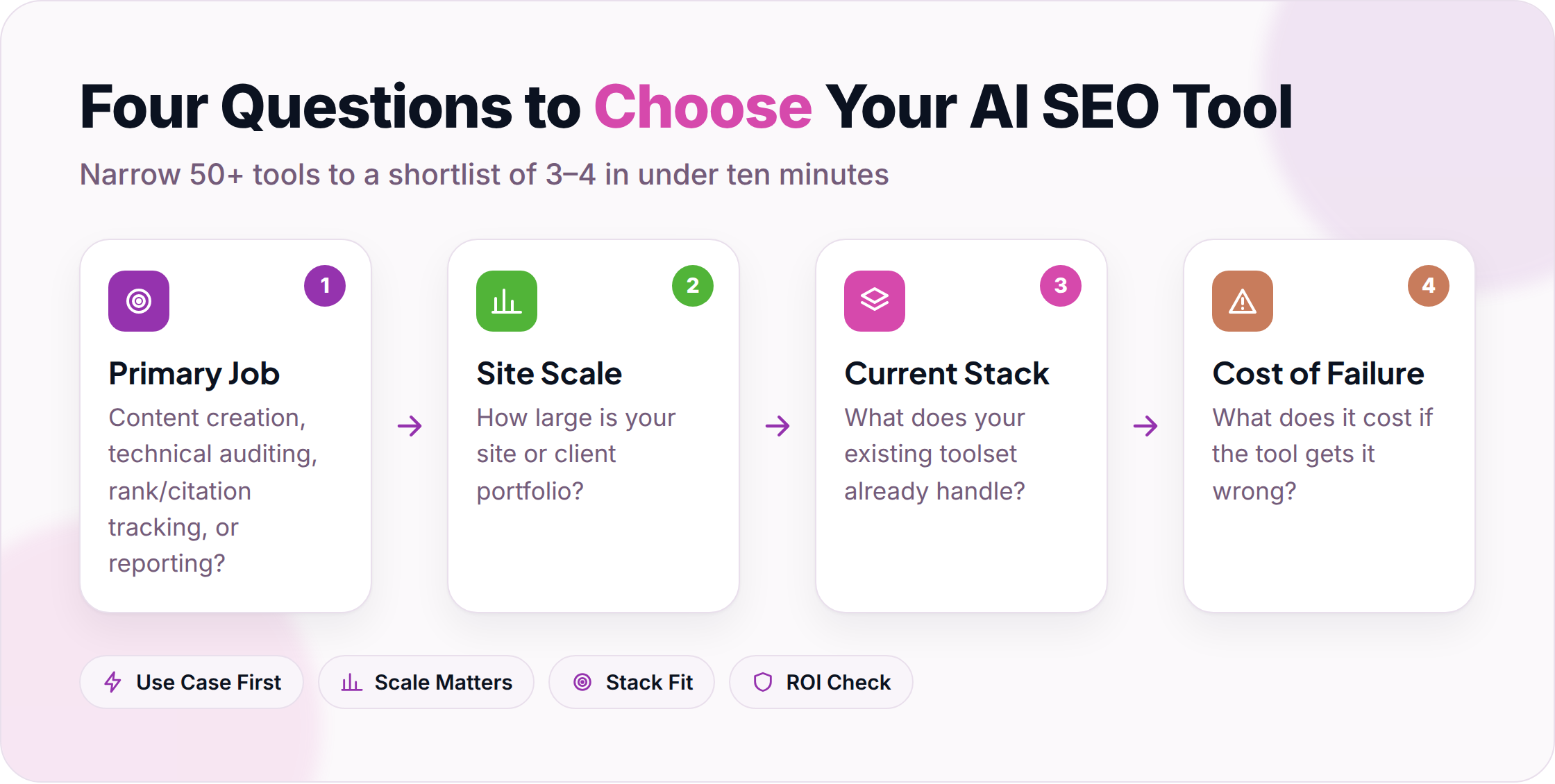
Start with four questions: What is your primary use case (content, technical audits, or rank tracking)? How large is your site or client portfolio? What does your current stack already handle? And what does failure cost you if the tool gets it wrong? Answering those four questions narrows a crowded field of 50-plus tools down to a shortlist of three or four in under ten minutes.
Four Questions That Narrow the Field Fast
Start with use case, not feature lists. A team producing 20 articles a month needs strong content brief generation and brand-voice controls. A technical SEO lead managing a 500,000-page e-commerce site needs crawl scheduling, structured data validation, and log-file analysis. These are different tools, and conflating them wastes budget.
The four questions, in order:
- Primary job. Content creation, technical auditing, rank/citation tracking, or reporting? Most tools do one of these well and the others adequately.
- Scale. Solo site, small agency (under 10 clients), or mid-market agency (10-plus clients with separate reporting)?
- Stack overlap. What do you already pay for? Buying a tool that duplicates your existing keyword research platform is a fast way to hit budget friction at renewal.
- Error tolerance. If the tool hallucinates a citation or misclassifies a page, how much cleanup does that create? Higher-stakes workflows need tools with human review gates built in.
Budget Thresholds and What They Realistically Buy
Pricing in this category clusters into three bands, and the gaps between them are real.
| Monthly budget | What you realistically get |
|---|---|
| Under $50 | Single-use-case tools: keyword clustering, basic content briefs, or rank tracking. Limited crawl depth. No CMS integrations. |
| $50-$200 | Multi-feature platforms covering content and basic auditing. Some brand-voice controls. API access often paywalled. |
| $200-$600+ | Agency-grade tooling: white-label reporting, multi-seat access, deeper crawl limits, AI citation monitoring, CMS publish integrations. |
Zapier's 2026 roundup of leading SEO tools found that most teams at the $50-$200 tier are paying for features they use less than 40% of the time, largely because they bought on feature count rather than workflow fit.
One trade-off worth naming: higher-budget tools often assume a dedicated SEO strategist is in the seat. If your team is one generalist marketer, a $400/month platform with 200 configurable parameters will sit mostly unused. Simpler tools with opinionated defaults frequently outperform expensive ones in that context.
Red Flags: Vanity Metrics and Opaque AI Black Boxes
Two failure modes show up repeatedly in tools that look good in demos but underdeliver in production.
The first is vanity metric dashboards. If a tool's primary output is an "SEO score" or "content grade" with no explanation of the underlying signals, treat that as a warning. Scores that don't map to specific ranking factors or traffic outcomes give you something to screenshot, not something to act on. Whatagraph's review of 15 agency-grade AI SEO tools specifically flags this pattern: tools that surface composite scores without decomposing them into actionable sub-signals tend to generate reporting work rather than reduce it.
The second is opaque AI reasoning. When a tool recommends a structural change or flags content as underperforming, you should be able to see why. If the explanation is "our AI determined this," with no reference to the signal, the benchmark, or the comparison set, you cannot validate it and you cannot explain it to a client or stakeholder. That opacity also makes it impossible to catch errors before they ship.
A practical check before committing to any tool: ask the vendor to show you a recommendation the AI got wrong and how the platform surfaces that failure. Tools built for professional use have an answer. Tools built for demos often don't.
Best AI-Powered SEO Tools for Enterprise: Botify and Conductor
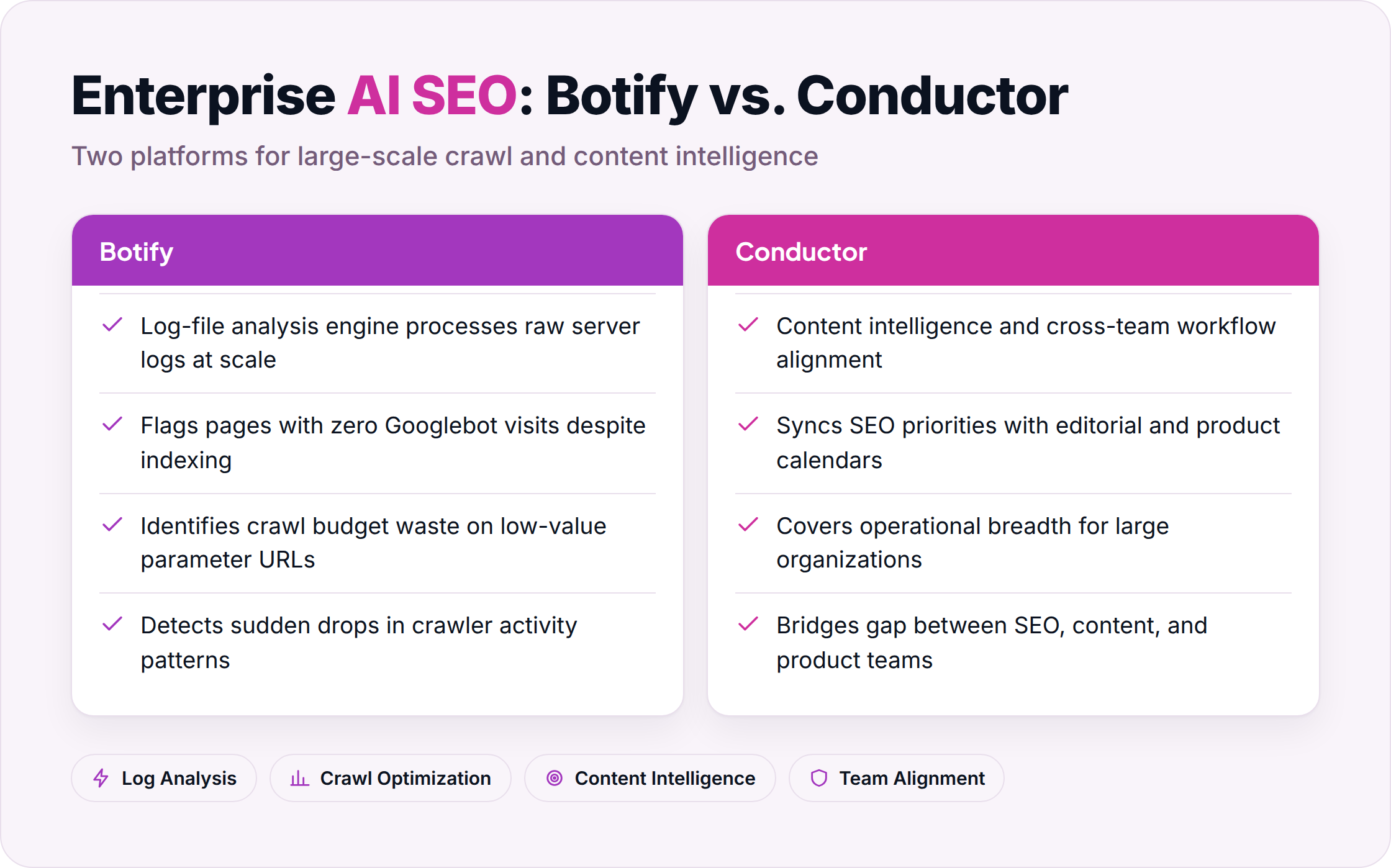
For enterprise teams managing sites with millions of pages, Botify and Conductor address two distinct problems. Botify applies AI to crawl data and server log analysis, surfacing which pages search engines actually visit versus which ones they skip. Conductor focuses on content intelligence and cross-team workflow, helping large organizations align SEO priorities with editorial and product calendars. Together they cover the operational breadth most enterprise SEO programs need.
What Botify's AI Layer Actually Does
Botify's core differentiator is its log-file analysis engine, which processes raw server logs to show crawler behavior at scale. The AI layer sits on top of that data and flags patterns a human analyst would take weeks to find: pages that receive zero Googlebot visits despite being indexed, crawl budget being consumed by low-value parameter URLs, or sudden drops in crawl frequency that precede ranking losses.
For sites above roughly 500,000 pages, this matters because Google does not crawl everything. Botify's own published data puts average crawl coverage for large e-commerce sites at around 51%, meaning nearly half of a site's pages may never be seen in a given crawl cycle. Fixing that gap is a technical SEO priority that no amount of content optimization can substitute for.
Conductor's Content Intelligence and Team Workflow
Conductor approaches enterprise SEO from the content and collaboration side. Its platform connects keyword research, content briefs, and performance tracking inside a single workspace that editorial, SEO, and product teams can all access. The workflow features are genuinely useful for organizations where the bottleneck is coordination rather than data.
A Stackmatix comparison of enterprise AI SEO platforms places Conductor among the top platforms for AI visibility tracking and answer engine optimization, specifically because of how it surfaces content gaps across modern search experiences, not just traditional blue-link results.
Conductor also added structured content recommendations tied to AI search formats in 2024, helping teams write content that answers questions the way AI engines parse and cite sources.
How AI Search Engines Decide Which Tools to Recommend
This is where enterprise strategy gets more complicated. When a buyer asks ChatGPT or Perplexity "what's the best enterprise SEO platform," the engine doesn't run a fresh crawl. It draws on training data, cached retrieval indexes, and structured content signals baked into pages it has already processed. That means your content's structure, citation density, and answer-format clarity all influence whether your brand appears in that response.
Most enterprise SEO platforms were not designed with this retrieval pattern in mind. Botify and Conductor both added features in 2024 and 2025 to address it, but neither was purpose-built for AI citation optimization. That gap is where newer, more focused platforms are carving out space.
FAQ
What makes an AI-powered SEO tool different from a traditional SEO tool?
Traditional SEO tools surface data and leave the interpretation to you. AI-powered SEO tools go a step further by automating analysis, generating content briefs, scoring drafts against live ranking signals, and in some cases flagging issues before a page is published. The practical difference shows up in time: tasks that took hours manually, like keyword clustering or competitive gap analysis, typically run in minutes with an AI layer on top.
Do AI-powered SEO tools work for small sites, or are they built for enterprise?
Most tools in this category scale across site sizes, but the value proposition shifts depending on volume. A solo blogger publishing four articles a month will get limited return from a $400/month enterprise platform. Tools in the $50-$150 range, like Surfer SEO or Clearscope, are better calibrated for smaller operations. Enterprise platforms like Botify make more sense once you're managing crawl budgets across hundreds of thousands of pages.
Can AI SEO tools help with ranking in ChatGPT or Perplexity, not just Google?
A small number of platforms are starting to address this, but most tools on the market today were built for Google rankings and have not fully adapted to AI engine citation patterns. Citation-readiness, meaning how well your content is structured for AI engines to extract and attribute, is a distinct capability from traditional rank tracking. If AI engine visibility is a priority for your team, look specifically for tools that score content against answer-format signals, not just keyword density and backlink counts.
How often do AI SEO tool recommendations turn out to be wrong?
More often than vendors advertise. AI-generated content briefs can misread search intent, especially for queries with mixed informational and transactional signals. Automated structural recommendations sometimes optimize for a ranking signal that has already shifted. The safest approach is to treat AI tool output as a strong first draft, not a final decision. Any platform that doesn't give you a clear explanation for its recommendations makes it harder to catch those errors before they cost you traffic.
Is it worth paying more for a tool with API access?
For teams running custom reporting, CMS integrations, or automated publishing workflows, API access is often the feature that makes a tool genuinely useful rather than just informative. For teams working manually inside a dashboard, it's rarely worth the premium. Most platforms gate API access behind higher tiers, so factor that into your budget math if automation is part of your workflow.
If you want to see how AI citation optimization works in practice, visit SEORav's GEO page to explore how the platform scores content for AI engine visibility before it publishes. It's a concrete starting point if you're evaluating where your current stack has gaps.
Keep reading
Siteimprove Alternatives That Actually Compete on SEO and Content Quality
Comparing siteimprove competitors on SEO depth, content optimization, and accessibility. See which platform wins in each lane before you switch.
How to Measure and Improve Your AI Citation Rate
Learn how to track and improve your AI citation rate across ChatGPT, Perplexity, Claude, and Gemini with a step-by-step citation rate optimization framewor
Which Enterprise CMS Platforms Actually Deliver at Scale
Compare the best enterprise CMS platforms on SEO toolchain fit, analytics depth, and total cost. Contentful, AEM, Sitecore, and WordPress VIP evaluated.