Writing Content That AI Tools Actually Want to Cite
Last updated: 13 October 2026
AI tools for generating content optimized for AI search citations work by extracting answer-first paragraphs directly into responses, bypassing traditional ranking systems. These systems pull specific passages from pages to cite in their outputs, which means your opening paragraph must answer the user's question completely and independently. A well-structured answer paragraph appears in JSON-LD markup and as visible text, making it citable without requiring readers to click through. This shift from ranking to extraction changes how you structure every sentence.
What Gets Your Content Pulled Into AI Responses
AI systems select citations by scanning for passages that deliver a direct, verifiable answer within the first few sentences, are attributed to a named source or author, and use precise language over broad claims. Keyword density and backlink counts play almost no role in that selection.
Classic SEO optimizes for ranking signals: domain authority, anchor text distribution, crawl depth. AI extraction logic works differently. The model looks for the most retrievable passage on a topic, not the most authoritative domain overall. Airops' breakdown of generative engine optimization metrics puts it plainly: GEO and traditional SEO optimize for fundamentally different outputs, one for a ranked list, the other for a quoted sentence.
The numbers reinforce this. Traditional Google rankings predict only 45% of AI visibility, meaning a page that sits comfortably on page one can still be invisible to ChatGPT or Perplexity if its structure does not support extraction.
Three structural traits show up consistently in content that AI systems quote.
- A self-contained opening answer. The first 40 to 60 words answer the question without requiring the reader or the model to read the rest of the page for context.
- Named entities and specific figures. Vague phrasing gets skipped. "Most teams see improvement" gives a model nothing to quote with confidence. "34% of B2B teams reduced churn within 90 days" gives it something citable. Otterly's seven-step GEO framework, which draws on data from a Princeton study on generative engine optimization, identifies statistical specificity as one of the highest-leverage signals for AI citation.
- Logical segmentation. AI models parse content at the passage level, not the page level. A page that buries its core claim in paragraph seven, surrounded by qualifications, will lose to a shorter page that leads with the answer and supports it immediately.
One honest caveat: these traits improve citation probability, not guarantee it. Each AI response typically cites only 3 to 5 sources, and the selection varies by engine, prompt phrasing, and how recently the model indexed your content. Structural clarity gets you into contention. It does not hand you the spot.
Before You Start: What You Need in Place
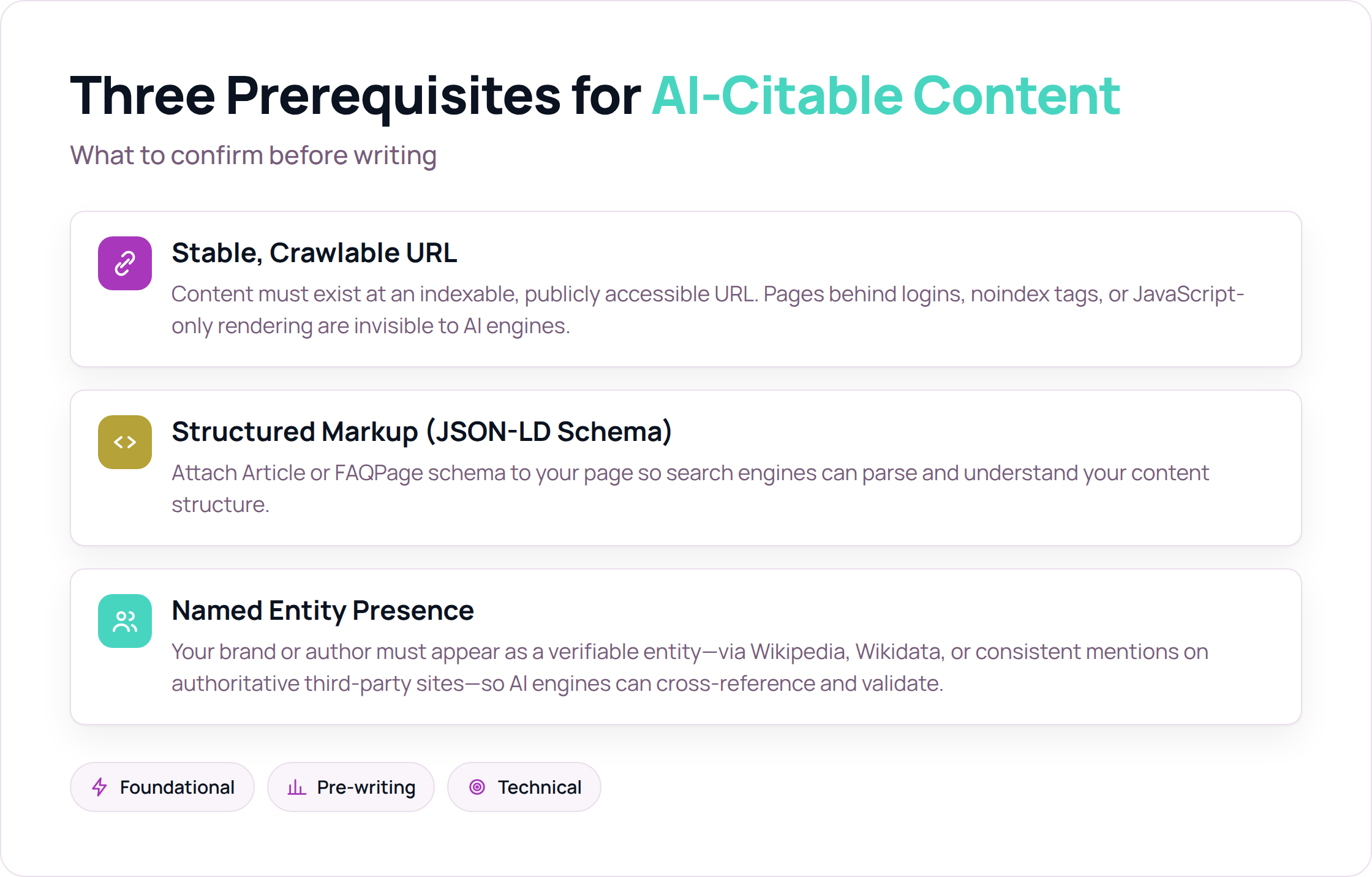
To write content AI tools will cite, you need three things confirmed before you touch a single headline: at least one published, indexable URL, structured markup that search engines can parse, and a named entity presence that AI engines can verify against external sources.
Minimum Content Assets
Your content has to exist at a stable, crawlable URL before any AI engine will consider citing it. Pages behind login walls, noindex tags, or JavaScript-only rendering are effectively invisible. Beyond that, you need JSON-LD schema attached to the page (Article or FAQPage schema covers most cases), and your brand or author needs to appear as a named entity somewhere AI engines can cross-reference, such as a Wikipedia entry, a Wikidata record, or consistent mentions across authoritative third-party sites.
The entity piece is where most teams underestimate the work. A page can be technically perfect and still get skipped if the AI engine cannot confirm who wrote it or whether the source is credible.
One honest trade-off: if your site is new and has fewer than 20 indexed pages, structured markup alone will not move the needle much. AI engines weight citation history and domain authority alongside technical signals. The approach works, but it takes longer for newer domains, and expecting fast results there will lead to frustration.
Tools You Will Use
Across the five steps in this article, you will need:
| Tool | Purpose |
|---|---|
| Google Search Console | Confirm indexing and crawl coverage |
| Google Rich Results Test | Validate JSON-LD schema before and after publish |
| ChatGPT Plus, Perplexity, or Google AI Mode | Test whether AI engines surface your content |
| Schema.dev or similar | Build Article / FAQPage markup without hand-coding |
| Google's Knowledge Panel search | Verify your brand or author appears as a known entity |
None of these require a paid enterprise contract. The crawl verification and schema validation tools are free. The AI engine accounts run between $0 and $20 per month at the consumer tier, which is enough to run citation checks manually.
Step 1: Map the Anatomy of Citable Content for AI Systems
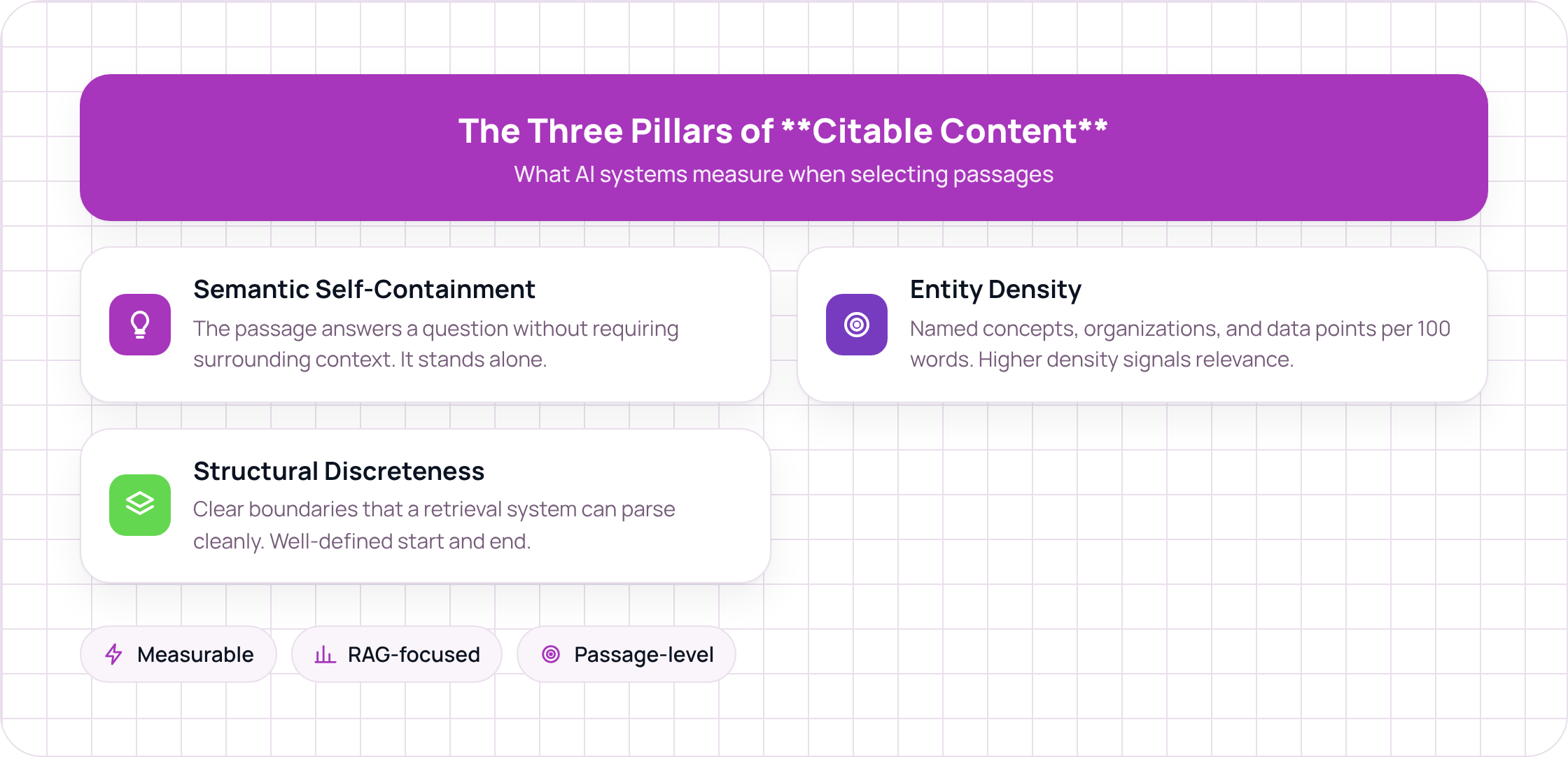
AI systems select passages to cite based on three measurable properties: semantic self-containment (the passage answers a question without requiring surrounding context), entity density (named concepts, organizations, and data points per 100 words), and structural discreteness (clear boundaries that a retrieval system can parse cleanly). Content that scores well on all three gets pulled into generated answers. Content that scores poorly on even one gets skipped, regardless of how authoritative the domain is.
How RAG Decides What to Pull
Retrieval-augmented generation works by chunking source documents into passages, embedding each chunk as a vector, and then ranking chunks by semantic similarity to the query. Passage length matters here in a concrete way: chunks under roughly 80 words often lack enough context to score well against a nuanced query. Chunks over 300 words dilute the signal and reduce retrieval precision. The practical target is 120 to 200 words per discrete passage, each one structured to answer a specific sub-question on its own.
The numbers support this: Google AI Overviews now appear on approximately 48 to 50% of all US Google searches, which means retrieval pipelines are selecting and surfacing content at a scale that makes passage-level optimization consequential.
Entity Density vs. Keyword Density
Keyword density was a Google-era metric. AI citation models score something different: entity density, meaning how many named, verifiable concepts appear per passage and whether those concepts connect to a broader knowledge graph.
A passage that mentions "machine learning," "transformer architecture," "BERT," and "Google DeepMind" in 150 words gives a retrieval model multiple anchor points to confirm relevance and authority. A passage that repeats "AI tools" six times gives it almost nothing to work with. Research published in PMC on AI tool limitations and semantic evaluation notes that AI systems lack true semantic understanding and rely on surface signals, which makes structured entity signals more important, not less. The model cannot read your expertise; it can only detect the markers of it.
The trade-off is real, though. Optimizing hard for entity density can make prose feel like a glossary. If every sentence introduces a new named concept, the passage loses the connective tissue that makes it readable and quotable. The goal is density within a coherent argument, not density as a substitute for one.
Building Knowledge Graph Authority Through Structured Entity Signals
Wikidata is the most direct lever most publishers ignore. When your organization, product, or key authors have verified Wikidata entries with accurate properties (instance of, official website, industry, founding date), AI systems have a structured reference point to confirm that your entity is real and classifiable. Without it, you are asking a retrieval model to infer your authority from prose alone.
Beyond Wikidata, the signals that reinforce knowledge graph authority include consistent NAP data (name, address, phone) across directories, schema markup that explicitly types your organization and its subject matter, and internal link structures that cluster topically related pages under a clear canonical URL. Each of these gives the knowledge graph one more corroborating data point. None of them alone is sufficient; together, they make your entity harder for an AI system to ignore.
Step 2: Write Self-Contained Answer Paragraphs AI Can Extract Cleanly
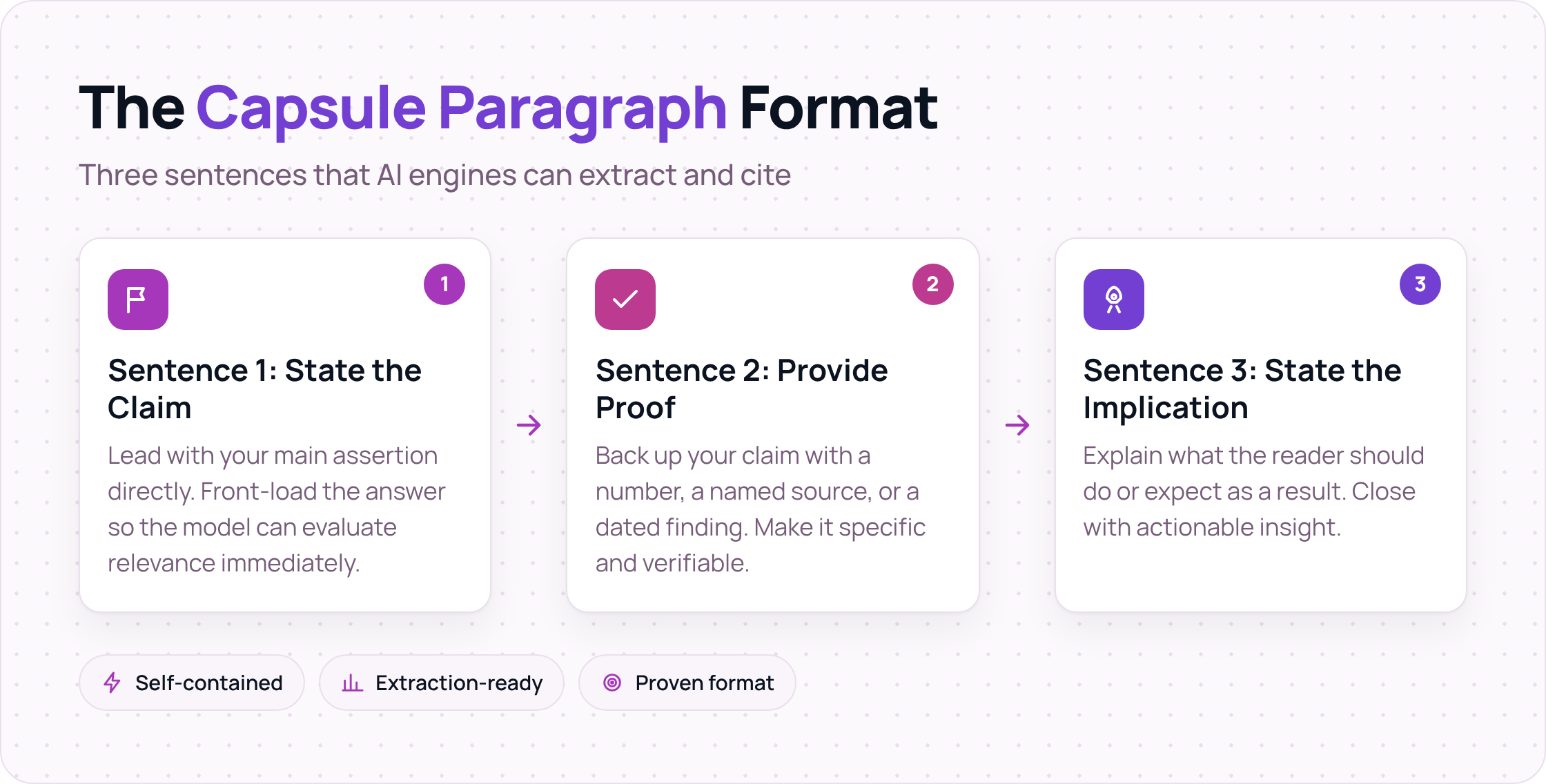
A self-contained answer paragraph delivers one claim, one piece of supporting proof, and one practical implication, in that order, with no reliance on surrounding context. AI engines extract passages verbatim, so each paragraph needs to make sense in isolation. If you dropped your paragraph into a blank document and it still answered the question clearly, the structure is right.
The Capsule Paragraph Format
The core unit is three sentences, sometimes four. Sentence one states the claim directly. Sentence two provides the proof: a number, a named source, a dated finding. Sentence three states what you should do or expect as a result.
That sequence matters because transformer-based models score passages partly on information density per token. A paragraph that buries its claim in the third sentence forces the model to hold more context before it can evaluate relevance. Front-loading the claim removes that ambiguity.
The PRSA's guidance on LLM readability frames this precisely: "LLM readability describes how easily an AI language model can read and extract a passage to use in a response or citation," and the clearest predictor of that ease is whether the passage opens with a declarative, subject-verb-object sentence rather than a dependent clause or a scene-setting phrase.
What Makes a Paragraph Quotable
Quotability has a few concrete markers. The paragraph names its subject explicitly in the first sentence, with no pronouns standing in for a noun introduced two paragraphs earlier. It uses a specific figure or named entity rather than a vague qualifier. And it closes with a consequence that is actionable, not aspirational.
The GEO content strategy framework documented by Discovered Labs identifies entity clarity as one of the strongest signals for AI citation selection. When a passage names a specific tool, standard, or organization rather than referring to "it" or "this approach," retrieval systems can match the passage to a wider range of related queries.
One useful test: read only the first sentence of each paragraph. If that sentence alone answers the section's core question, the paragraph is structured correctly. If the first sentence is a transition, a qualifier, or a rhetorical setup, the paragraph will likely be skipped.
Sentence-Level Patterns That Signal Extractability
At the sentence level, a few patterns consistently improve how transformer models score a passage for extraction.
Active voice with a named subject outperforms passive constructions. "Google's 2024 search quality guidelines require E-E-A-T signals" is extractable. "E-E-A-T signals are required" is not, because the agent is missing.
Short sentences, under 25 words, reduce the risk that a model splits the sentence at a clause boundary and loses the logical connection. Compound sentences joined by "and" or "but" are fine. Sentences with three or more embedded clauses tend to get truncated.
Numeric specificity is a strong extractability signal. A paragraph that says "response rates dropped 34% in Q2 2024" gives a model something concrete to quote. A paragraph that says "response rates dropped significantly" gives it nothing to anchor.
Where This Approach Has Limits
Writing for extraction can work against you if you push it too far. Paragraphs optimized purely for AI retrieval sometimes read as clipped and mechanical to human audiences, which reduces time-on-page and social sharing, two signals that still influence whether AI engines treat your domain as authoritative. The practical balance is to write for a human reader first, then check each paragraph against the capsule format. If the first sentence is not declarative and specific, revise it. If the paragraph still reads naturally after that revision, you are done. If it reads like a data sheet, you have gone too far.
Frequently Asked Questions
Does domain authority still matter for AI citation?
Domain authority influences AI citation, but less directly than it influences traditional search rankings. AI retrieval systems weight passage-level signals, including entity density, structural clarity, and semantic self-containment, more heavily than domain-level metrics. A newer site with well-structured, specific content can outperform a high-authority domain whose pages bury their answers in long, unstructured prose.
How long should a passage be to maximize AI citation probability?
Target 120 to 200 words per discrete passage. Chunks under 80 words often lack enough context to score well against nuanced queries in retrieval-augmented generation pipelines. Chunks over 300 words dilute the relevance signal. Each passage should answer one specific sub-question on its own, without requiring the reader to reference surrounding paragraphs.
What schema markup helps most for AI search citations?
Article and FAQPage schema are the two highest-impact types for most publishers. Article schema signals authorship, publication date, and subject matter to AI indexing systems. FAQPage schema structures question-and-answer pairs in a format that retrieval models can parse and extract with high precision. Both should be implemented as JSON-LD in the page head, validated with Google's Rich Results Test before publishing.
Do AI tools cite content that is behind a paywall?
Generally, no. Content behind login walls, paywalls, or noindex tags is not accessible to AI crawlers and will not be cited. If your goal is AI citation, the content needs to exist at a stable, publicly crawlable URL. Some publishers use a "first paragraph free" model, but even that limits how much of the passage a retrieval system can index and extract.
How do you test whether AI engines are citing your content?
The most direct method is manual: run targeted queries in ChatGPT Plus, Perplexity, and Google AI Mode using the specific questions your content answers, then check whether your URL appears in the cited sources. Do this monthly, since citation patterns shift as models update their indexes. For higher-volume monitoring, tools like Otterly.ai and AirOps offer automated citation tracking across multiple AI engines.
Can using ai tools for generating content optimized for ai search citations hurt your rankings?
Using AI tools to generate content does not automatically hurt rankings, but publishing AI-generated text without editing for entity clarity, factual accuracy, and structural specificity will. Google's guidance focuses on quality signals, not production method. Content produced with AI tools and then edited to meet E-E-A-T standards, with named authors, verifiable claims, and clear passage structure, performs comparably to human-written content in both traditional search and AI citation contexts.
If you want a structured approach to making your content visible in AI-generated answers, see how Seorav can help. The AEO service covers entity setup, schema implementation, and passage-level content audits built around the citation signals covered in this article.
Keep reading
Why ChatGPT Quotes Some Paragraphs and Ignores Others
Learn what makes a paragraph quotable by ChatGPT: self-containment, factual density, and authority signals that determine whether AI cites or skips your co
Ranking in Google's AI Search: The Deterministic Signals That Actually Move the Needle
Learn how do you rank in SGE with the three signals Google's AI uses to cite sources: schema markup, entity salience, and structured factual claims.
Why AI Ignores Your Content (And How to Fix It)
Learn how to avoid AI content that gets ignored by LLMs. Covers RAG retrieval signals, schema, entity salience, and an answer-first structure checklist.