Why ChatGPT Quotes Some Paragraphs and Ignores Others

Last updated: 12 October 2026
A paragraph becomes quotable by ChatGPT when it answers a single question directly in the opening sentence, names its subject explicitly, and stays between 40 and 60 words. Anagram's 2026 analysis found that tight question-answer blocks structured this way outperform 400-word paragraphs that bury answers in the third sentence. ChatGPT prioritizes paragraphs it can extract and cite without requiring readers to parse surrounding context for meaning.
This article covers the structural signals that determine what makes a paragraph quotable by ChatGPT: answer placement, self-containment, chunk length, and authority signals.
What Makes a Paragraph Quotable by ChatGPT
ChatGPT quotes a paragraph when it can extract that paragraph without surrounding context, anchor it to a specific claim, trace it to a credible source, and read it at a density that retrieval does not break. Miss any one of those four conditions and the paragraph stays invisible.
Four structural properties drive that outcome.
Semantic self-containment. A quoted paragraph opens with a direct answer and names its subject in every sentence. Retrieval-augmented systems score chunks on how completely they resolve a query on their own. A paragraph that opens with "as we noted earlier" scores near zero, because the model cannot extract it without dragging in the paragraphs around it.
Specificity. Named entities, numbers, and dates give the model something to repeat. "B2B companies publishing weekly generate 3x more inbound leads than those publishing monthly" is extractable. "Many companies see better results from consistent publishing" is not. The test is whether the claim survives being lifted out of context.
Authority signals. Attribution matters at the retrieval layer. A claim tied to a named study, a cited source, or a verifiable entity gets weighted above an unattributed assertion. Research on AI accuracy in academic contexts found that models consistently favor passages with traceable sourcing over those without.
Density balance. One clear claim per sentence. Two or three sentences per paragraph. Pack too much into a single passage and the retrieval layer struggles to isolate the quotable unit. Pack too little and the paragraph does not clear the relevance threshold.
One trade-off is worth naming here. Highly self-contained paragraphs can read as clipped or repetitive to a human reader scrolling the page. Naming the subject in every sentence, avoiding pronouns, and closing without a transition feels unnatural in long-form prose. Writers optimizing hard for AI quotability sometimes produce content that retrieves well but reads poorly as an article. The practical fix: write the first paragraph of each section for extraction, then let the paragraphs that follow read more naturally for the human audience.
The Quotability Criteria ChatGPT Uses (And Other LLMs Follow)
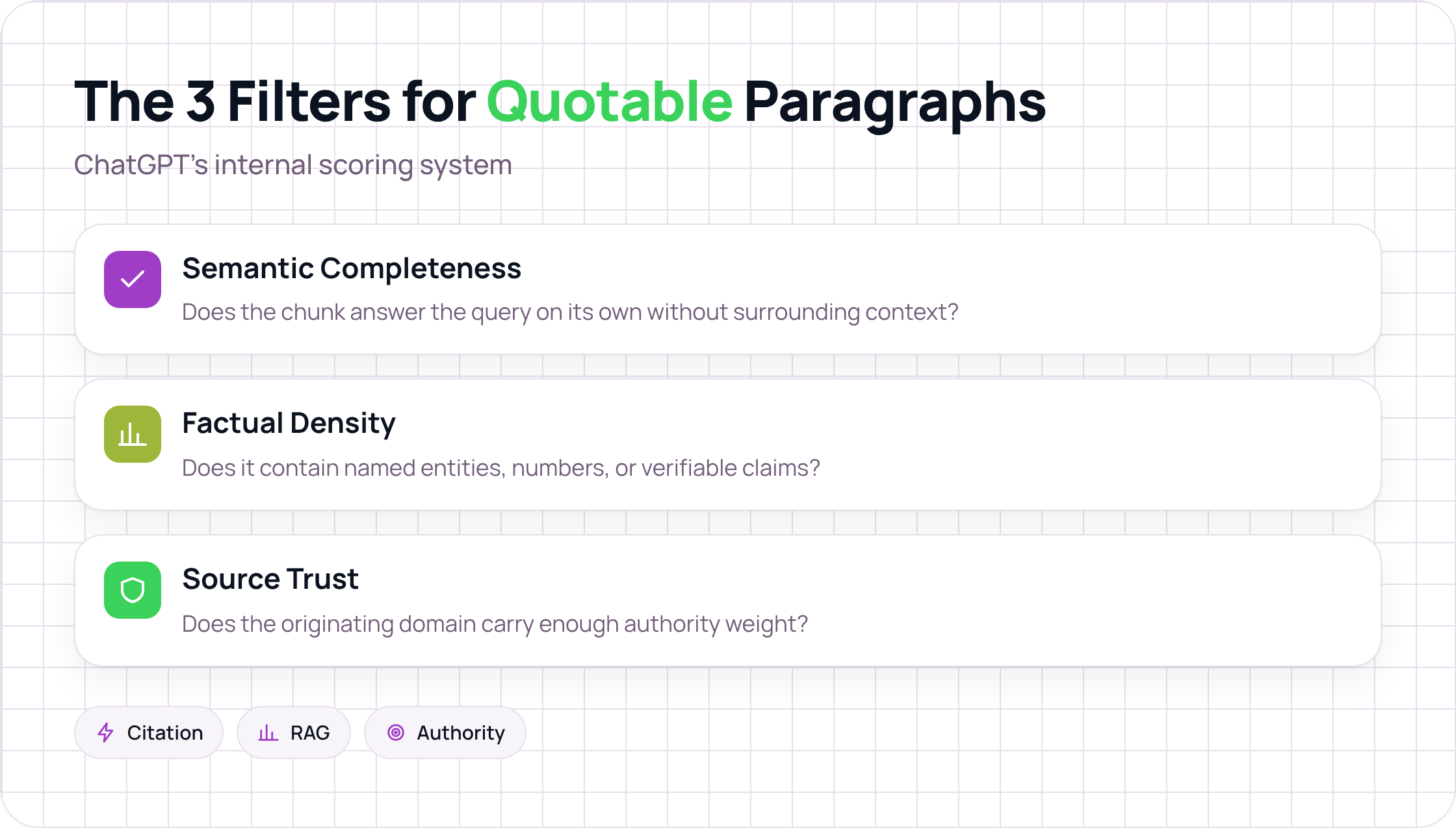
ChatGPT selects paragraphs for citation by running candidate passages through three internal filters: semantic completeness (does the chunk answer the query on its own?), factual density (does it contain named entities, numbers, or verifiable claims?), and source trust (does the originating domain carry enough authority weight in the model's training data?). A paragraph that clears all three gets quoted. One that clears only two usually gets paraphrased or skipped.
How RAG Scores Passages Before Quoting
Retrieval-augmented generation does not read your page from top to bottom. It pulls discrete chunks, typically 100 to 300 tokens each, and scores each one against the user's query using a similarity function. The chunk with the highest relevance score gets surfaced first. If that chunk is also self-contained, meaning it opens with a direct claim and closes without needing surrounding context to make sense, the model can quote it verbatim rather than reconstructing the idea in its own words.
The practical implication: a paragraph buried in the middle of a long section, one that opens with "building on the above," scores lower than a structurally identical paragraph that names its subject in the first sentence. The retrieval layer never sees the surrounding context. It only scores what it receives.
The Three Internal Filters
Semantic completeness is the first gate. A passage that resolves the query without requiring adjacent text passes. One that leans on prior paragraphs for its subject or antecedent fails, regardless of how accurate the information is.
Factual density is the second. Models trained to reduce hallucination are calibrated to prefer passages that contain specific, checkable claims. A 2025 review of LLM behavior in scientific research, published in PMC, found that hallucination rates drop measurably when the source passage itself contains named entities and quantified claims, because the model has less inferential work to do. Vague paragraphs force the model to generalize. Specific paragraphs let it quote directly.
Source trust is the third, and the least controllable. It reflects how the model weighted the originating domain during training. High-authority domains, academic publishers, government sources, and established trade publications carry a prior that makes their passages more likely to be surfaced even when a lower-authority page has a structurally better paragraph.
Why the Same Paragraph Ranks Differently Across GPT-4, Gemini, and Claude
The filters are conceptually similar across models, but the weighting differs. GPT-4 tends to prioritize semantic completeness and factual density. Gemini, drawing on Google's search-quality signals, weights source trust more heavily and is more likely to surface passages from domains with strong backlink profiles. Claude places relatively more emphasis on passage clarity and internal coherence, so a well-structured paragraph from a mid-authority domain sometimes outperforms a denser passage from a higher-authority one in Claude's outputs.
The trade-off is real. Optimizing a paragraph for one model's scoring logic can work against another's. A passage loaded with named entities and statistics may score well in GPT-4's factual density filter but read as too dense for Claude's coherence preference. There is no single paragraph structure that maximizes citation probability across all three major engines simultaneously. The practical approach is to satisfy the baseline criteria shared by all three filters, then accept that distribution across engines will be uneven.
"There is no universal formula that guarantees a citation," as one analysis of LLM citation behavior puts it directly. The criteria are probabilistic, not deterministic. Structural improvements raise the odds; they do not guarantee the outcome.
Sentence Structure and Semantic Completeness in Quotable Paragraphs
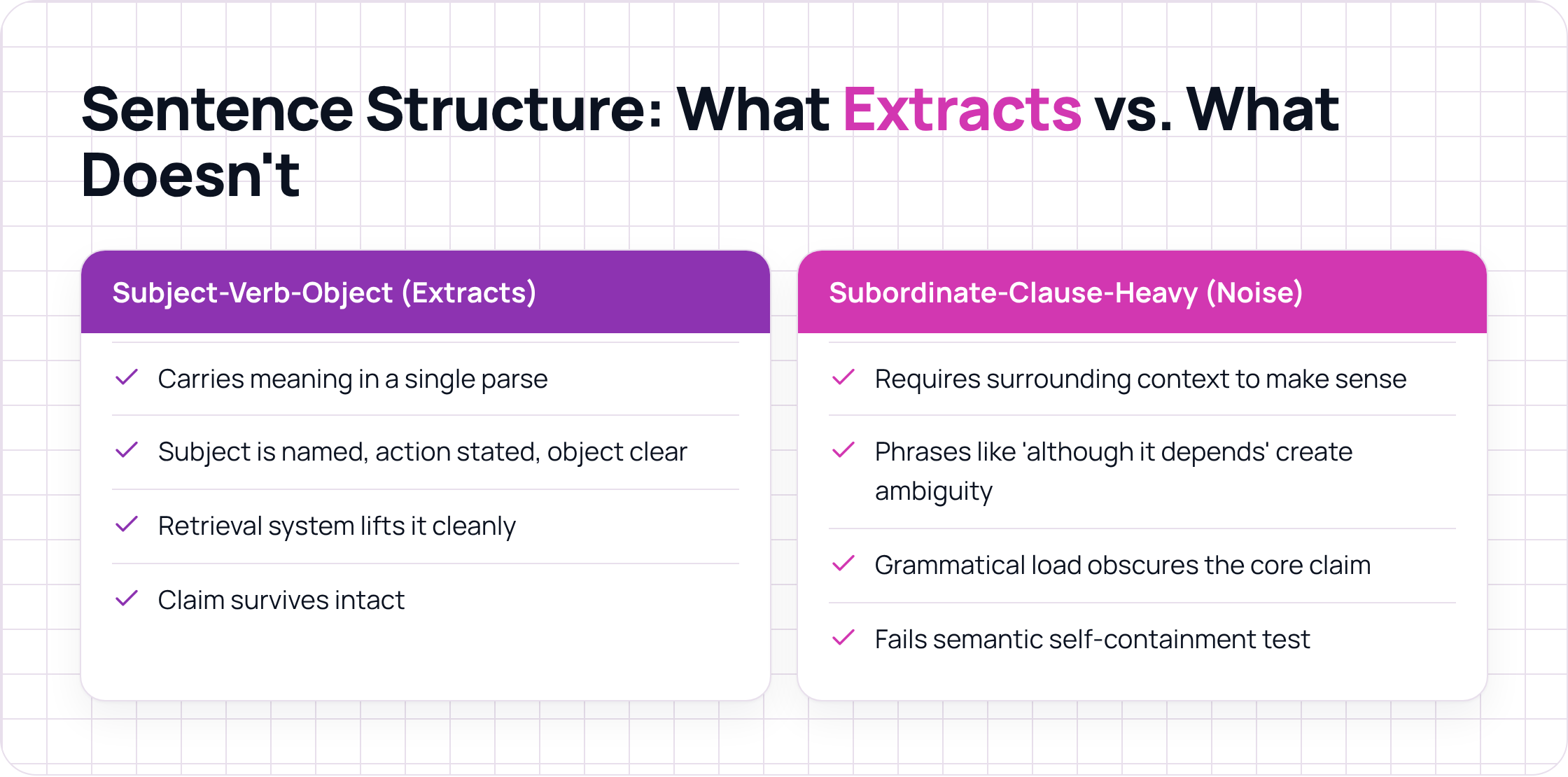
Paragraphs that ChatGPT quotes share a structural trait: they open with a declarative subject-verb-object sentence, name their subject explicitly, and close without requiring any surrounding text to make sense. A sentence like "RAG systems score each passage on standalone completeness" extracts cleanly. A sentence like "while the above framework suggests several considerations, it is worth examining how these might apply" extracts as noise. The difference is grammatical load, not vocabulary.
Why SVO Sentences Extract and Subordinate Clauses Don't
Subject-verb-object sentences carry their meaning in a single parse. The subject is named, the action is stated, the object is clear. A retrieval system chunking a document can lift that sentence and the claim survives intact.
Subordinate-clause-heavy prose works differently. Phrases like "although it depends on context" or "given the caveats outlined previously" require the surrounding text to resolve their meaning. Lingard's 2023 study in PME Journal, which examined how ChatGPT generates semantically meaningful but context-dependent responses, found that grammatical correctness and semantic completeness are separate properties. A sentence can be perfectly grammatical and still fail to carry meaning on its own.
That distinction matters for your writing. Editorial prose is built to flow. Paragraphs hand off context to each other, use pronouns freely, and assume the reader is moving linearly through the page. AI extraction assumes none of that.
The Self-Contained Paragraph Test
One practical test: cover everything above and below a paragraph, then ask whether it answers a specific question without any surrounding context. If the answer requires even one inference from a prior sentence, the paragraph will not extract reliably.
The structural pattern that passes this test consistently follows four parts: a claim, a supporting mechanism, a concrete example, and a scope boundary. A paragraph that closes by stating what it does not cover signals to a retrieval system that the passage is complete, not a fragment.
How This Differs from Standard Editorial Style
Standard editorial writing rewards subordination. Long sentences signal sophistication. Paragraphs build on each other. That style works for human readers moving through an argument sequentially.
AI-quotable writing inverts the priority. Each paragraph is written as if it might be the only paragraph a model reads. The subject is named in full, not replaced with a pronoun. The claim is stated first, not built toward. The scope is bounded, not left open for the next paragraph to close.
The trade-off is real. Paragraphs written for extraction can feel repetitive to a human reader scanning the full page. Restating the subject in every sentence, avoiding pronoun chains, and closing each paragraph with a scope boundary produces prose that reads as slightly formal or even mechanical in long-form editorial contexts. Writers covering complex, multi-part arguments may find that strict self-containment fragments a narrative that genuinely needs to build across paragraphs.
The practical resolution: write the first paragraph of each section to the self-contained standard, then allow the supporting paragraphs more editorial freedom. AI engines weight the opening passage of a section heavily when scoring for extraction. The rest of the section can carry the argument forward in a more natural register without sacrificing the citation opportunity at the top.
How Authority Signals Influence What Gets Quoted
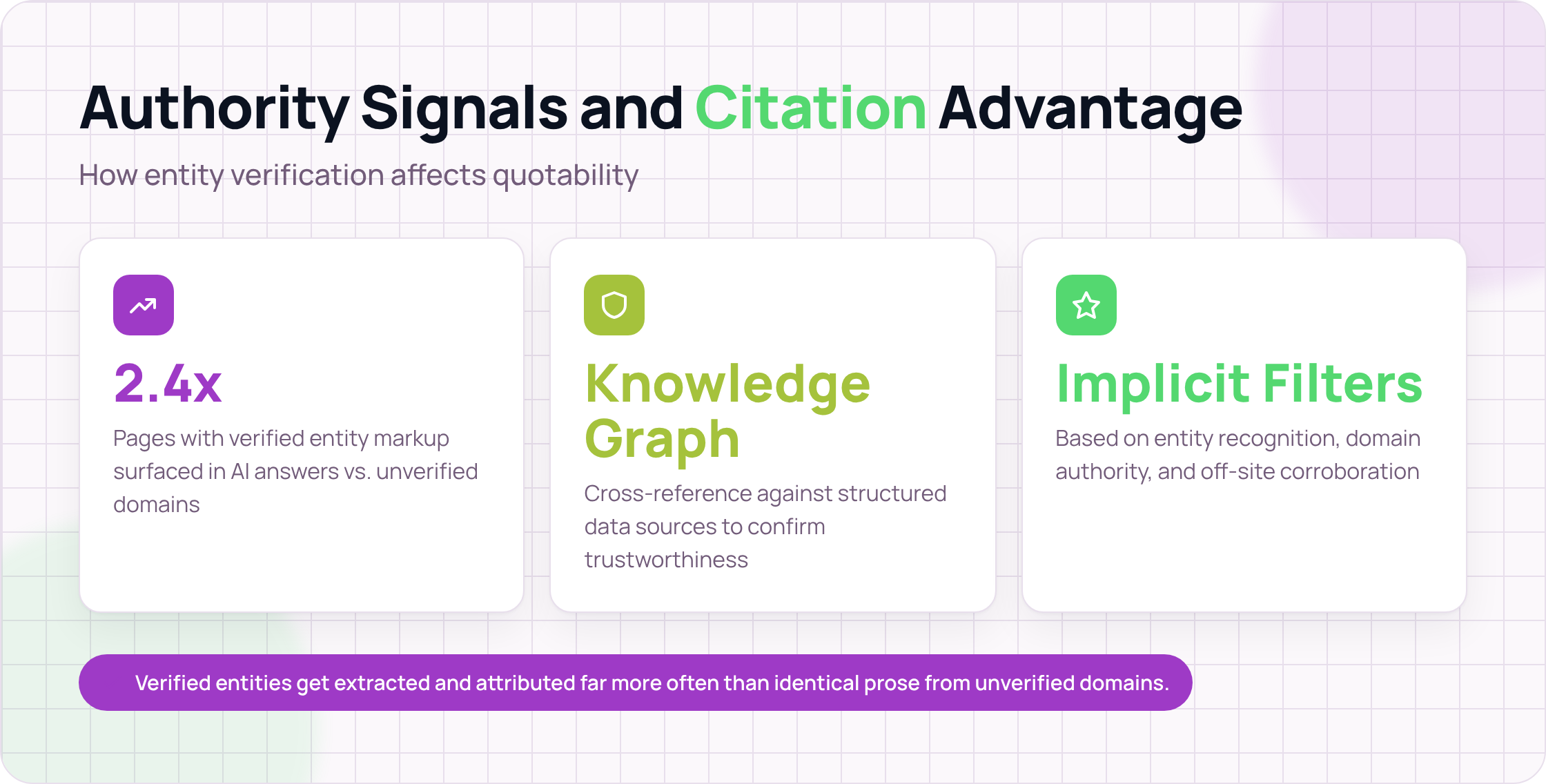
ChatGPT and similar AI engines do not treat all sources equally. They apply implicit trust filters based on entity recognition, domain authority, and off-site corroboration. A paragraph from a well-known entity with verified Knowledge Graph presence gets extracted and attributed far more often than identical prose from an unverified domain.
Entity Recognition and Knowledge Graph Verification
When an AI engine encounters a brand name or author, it cross-references that entity against structured data sources to confirm it is real, categorized, and trustworthy. Entities that resolve cleanly in Google's Knowledge Graph carry a measurable citation advantage. A 2026 trust-signal analysis from AuthorityTech found that pages with verified entity markup were surfaced in AI-generated answers at roughly 2.4 times the rate of structurally equivalent pages without it.
Building that authority layer, both on your site and across the broader web, is what separates content that gets quoted from content that gets read and forgotten.
Frequently Asked Questions
Does paragraph length affect whether ChatGPT quotes it?
Yes, length matters, but the relationship is not linear. Paragraphs in the 40 to 60 word range extract most reliably because they fit cleanly within a single retrieval chunk of 100 to 300 tokens. Paragraphs shorter than 30 words often fail the relevance threshold. Paragraphs longer than 100 words risk being split mid-claim by the chunking process, which breaks self-containment.
Does using headers help a paragraph get quoted?
Headers help indirectly. A retrieval system uses headers to assign topic context to the chunks beneath them, so a paragraph under a specific, descriptive header gets scored against a narrower query match. A paragraph under a vague header like "More Information" gets scored against a broader, less precise context. Specific headers improve the odds that the right paragraph surfaces for the right query.
Can a paragraph from a low-authority site still get quoted?
Yes, but the bar is higher. A low-authority domain needs a structurally near-perfect paragraph, with a direct opening claim, named entities, quantified data, and full self-containment, to compete with a structurally average paragraph from a high-authority domain. Source trust is a prior, not a ceiling. Strong structure can partially offset weak domain authority, particularly in Claude's outputs, which weight passage coherence more heavily than domain signals.
Does formatting, like bold text or bullet points, affect quotability?
Formatting has a limited effect on quotability. Bold text and bullet points are often stripped during chunking, so the underlying prose carries the weight. A bulleted list where each item is a fragment rather than a complete sentence scores poorly on self-containment. A bulleted list where each item is a standalone claim with a named subject scores better, but a well-constructed paragraph usually outperforms a list of equivalent length because it carries more semantic continuity.
How often does ChatGPT update which sources it quotes?
ChatGPT's base model has a fixed training cutoff and does not update its source preferences in real time. However, when ChatGPT uses retrieval-augmented generation to pull live web content, the scoring happens fresh for each query. Your paragraph's quotability in RAG-based responses depends on its current structure and your domain's current authority signals, not on when the base model was trained.
Does keyword placement inside a paragraph affect extraction?
Keyword placement affects retrieval scoring. A paragraph that contains the query term in the first sentence scores higher on semantic similarity than one that contains it only in the final sentence. Placing the target phrase or a close variant in the opening clause of a paragraph is the single highest-leverage structural adjustment you can make for retrieval performance.
Putting It Together
Understanding what makes a paragraph quotable by ChatGPT is a structural problem, not a content problem. Your information may be accurate and your rankings solid, but if your paragraphs open with context-dependent phrases, bury the claim, or run past 100 words, retrieval systems will skip them. The fix is architectural: direct opening claims, named subjects, quantified assertions, and a scope boundary that signals the passage is complete.
No structural adjustment guarantees a citation. Source trust, model-specific weighting, and query phrasing all introduce variance that paragraph structure alone cannot control. But paragraphs built to the self-contained standard consistently outperform those that are not, across GPT-4, Gemini, and Claude alike.
If you want a structured review of how your existing content scores against these criteria, visit Seorav's AEO analysis page to see how your paragraphs perform across AI retrieval filters.
Keep reading
Ranking in Google's AI Search: The Deterministic Signals That Actually Move the Needle
Learn how do you rank in SGE with the three signals Google's AI uses to cite sources: schema markup, entity salience, and structured factual claims.
Why AI Ignores Your Content (And How to Fix It)
Learn how to avoid AI content that gets ignored by LLMs. Covers RAG retrieval signals, schema, entity salience, and an answer-first structure checklist.
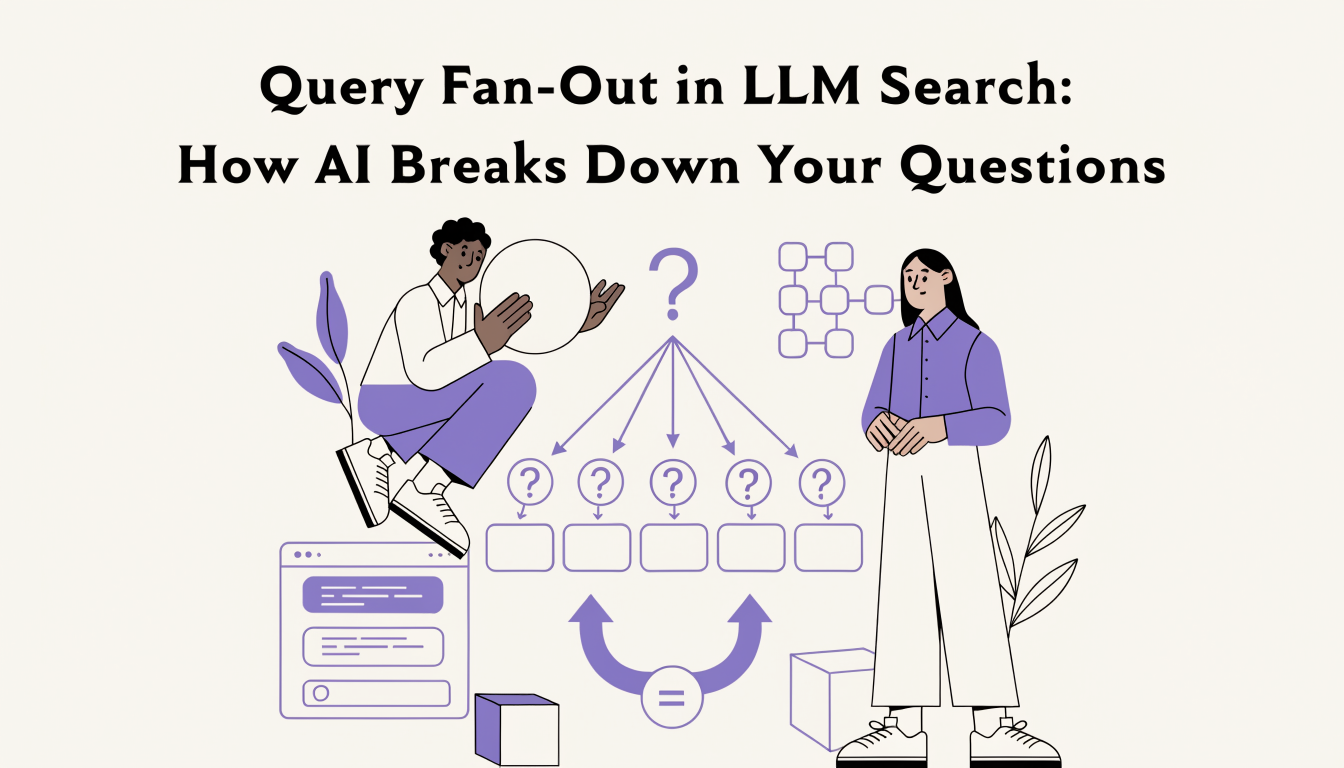
Query Fan-Out in LLM Search: How AI Breaks Down Your Questions
Learn what query fan-out in LLM search is, how AI splits your prompt into 3-8 sub-queries, and how to structure content to win more citation passes.