Ranking in Google's AI Search: The Deterministic Signals That Actually Move the Needle
Last updated: 11 October 2026
Ranking in SGE requires abandoning traditional SERP optimization for extraction-focused content. Google's AI Overviews select sources containing self-contained, directly answerable passages with clear authorship signals and structured data markup. Pages ranking well on standard search results often fail to appear in AI Overviews, and this gap widens monthly. The deterministic signals that drive AI citations differ fundamentally from those powering organic rankings, making your current strategy potentially obsolete.
What "Ranking" Actually Means in SGE
Citation in an AI Overview is determined by reference rate, not click-through rate. Reference rate measures whether the AI engine selected your content as a source worth quoting. A page can sit at position one on a standard SERP and never appear in a single SGE citation block.
The numbers make this concrete. SE Ranking's analysis of 100,000 keywords found that SGE snippets frequently pull from pages that do not hold the top organic position, confirming that traditional ranking signals and citation selection signals are not the same thing.
By February 2026, Omnibound's citation data showed only 17% of AI Overview citations came from pages in the organic top 10, down from 76% in mid-2024. Traditional rank is no longer a reliable proxy for AI visibility.
How Do You Rank in SGE: The Three Deterministic Signals
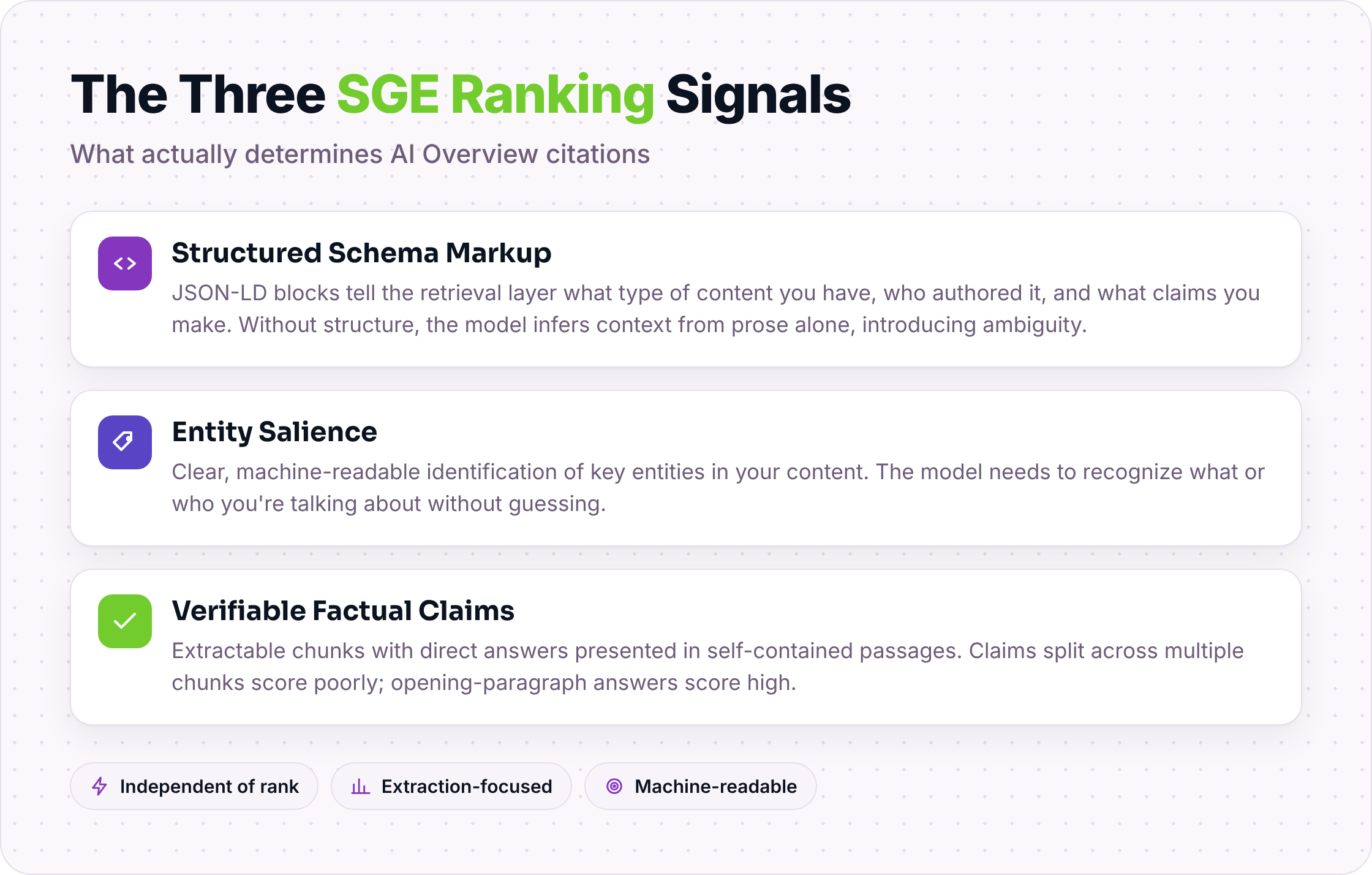
Google's AI search selects content using three signals that are largely independent of traditional ranking factors: structured schema markup, entity salience, and verifiable factual claims presented in extractable chunks. Pages that score well on all three get pulled into AI Overviews. Pages that don't get skipped, regardless of their organic position.
Schema Markup
Schema markup is the most mechanical of the three. JSON-LD blocks tell the retrieval layer what type of content a page contains, who authored it, and what specific claims it makes. Without that structure, the model has to infer context from prose alone, and inference introduces ambiguity that pushes a page down the candidate list.
Jasmine Directory's review of SGE citation patterns found that backlink volume had a weaker correlation with citation selection than structured data presence. That finding holds across multiple studies: schema is a faster lever than link acquisition for AI visibility.
Entity Salience
A page that mentions "insulin resistance" once in a 2,000-word article has low entity salience for that concept. A page that defines it, connects it to related entities (metabolic syndrome, fasting glucose, HOMA-IR), and uses those terms consistently across headings and body copy has high salience.
The retrieval system scores pages partly on how densely and coherently they cover the entities relevant to a query. Covering a topic with varied, precise vocabulary and logical structure tends to produce tighter semantic embeddings that sit closer to a wider range of related queries. Repeating a keyword phrase obsessively does the opposite: it produces noisy embeddings because the surrounding language is thin.
Structured Factual Claims
AI engines are built to extract discrete, verifiable statements. "Studies show benefits" is not extractable. "A 2023 meta-analysis of 14 trials found a 22% reduction in fasting glucose after 12 weeks of resistance training" is. The difference is specificity and attribution.
A meta-analysis of 54 studies on AI citation factors, ranked by evidence strength at Digital Applied, puts named expert authorship, inline citations to primary sources, and specific statistics as the highest-correlation signals for extraction probability. Vague claims attributed to no one in particular score near the bottom, regardless of domain authority.
Why Traditional SEO Tactics No Longer Transfer
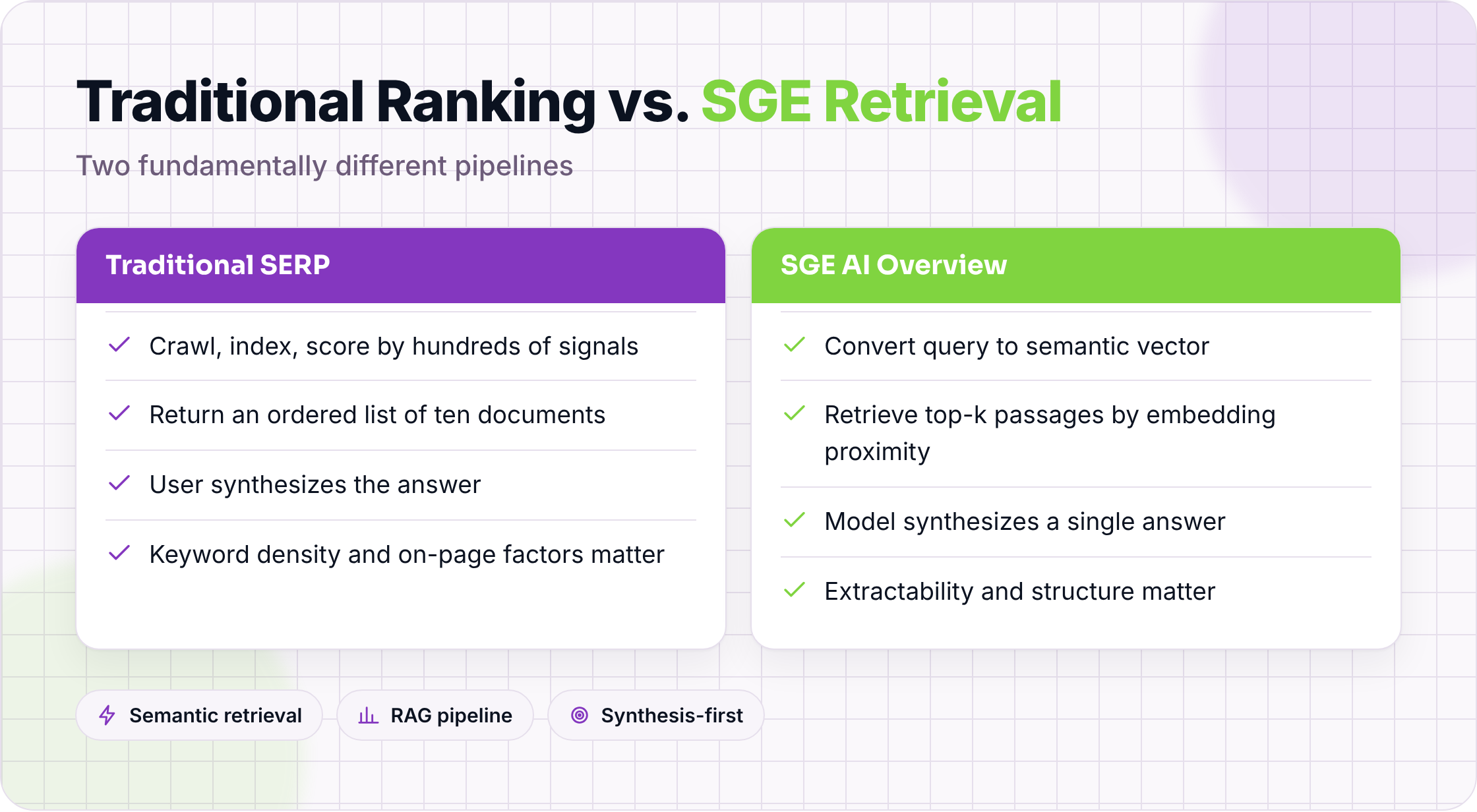
Google's AI-powered search doesn't retrieve ten ranked documents and let the user sort through them. It retrieves dozens of candidate passages, synthesizes a single answer using a retrieval-augmented generation (RAG) pipeline, and cites only the sources whose content mapped closest to the query's embedding vector. Keyword density plays no role in that selection.
From Ten Blue Links to a Synthesized Answer
The traditional ranking pipeline is a relevance sort: crawl, index, score by hundreds of signals, return an ordered list. The user does the synthesis.
SGE inverts that. The model receives a query, converts it to a vector, retrieves the top-k passages whose embeddings sit nearest to that vector in semantic space, and generates a single coherent answer from those passages. The sources cited in the AI snapshot are the ones whose content survived that retrieval step.
Google's internal documentation on the Search Generative Experience, published during the SGE Labs rollout in May 2023, described the system as grounding model outputs in "real-time web retrieval" to reduce hallucination. The practical consequence: a page can rank organically at position four and still be the primary cited source in the AI snapshot, or rank at position one and never appear in the snapshot at all.
The Query Fan-Out Mechanism
One user query rarely stays one query inside SGE. The system runs what researchers call "query fan-out": the original search is decomposed into four to eight sub-queries that probe different facets of the same intent. Each sub-query runs its own retrieval pass, and the results are merged before the model generates the final answer.
A search for "best CRM for a 50-person sales team" might fan out into sub-queries covering pricing tiers, integration compatibility, onboarding complexity, user reviews, and comparison against specific named competitors. A page that answers only the top-level question gets retrieved once. A page that addresses multiple facets gets retrieved across several sub-queries and accumulates more weight in the final synthesis.
Content depth correlates with AI citation rates more reliably than content length does. A 600-word page that directly answers three distinct sub-query intents will outperform a 2,000-word page that restates the same point in different ways.
Why Most Content Gets Ignored
Most pages fail extraction because they bury answers in long paragraphs, use headers that don't match content, and split key claims across multiple chunks. RAG systems score passages independently, so a claim split between two chunks scores poorly on its own. Direct answers in opening paragraphs with clear structure dramatically improve extraction probability.
Readability here doesn't mean Flesch-Kincaid score. It means whether a model can isolate a coherent answer from a passage without needing surrounding context to make sense of it. Long paragraphs that bury the claim in qualifications, headers that don't reflect the content beneath them, and sentences that reference "it" or "this" without a clear antecedent all create extraction failures.
Chunking is the structural version of the same problem. RAG systems split pages into passages before scoring them. If a key claim spans two chunks (the setup in one paragraph, the conclusion in the next), neither chunk scores well on its own. A 900-word article with a named author, one cited statistic, and a direct answer in the first paragraph will outperform a 3,000-word pillar page that buries its conclusions in section four.
How E-E-A-T Translates Into Extraction Probability
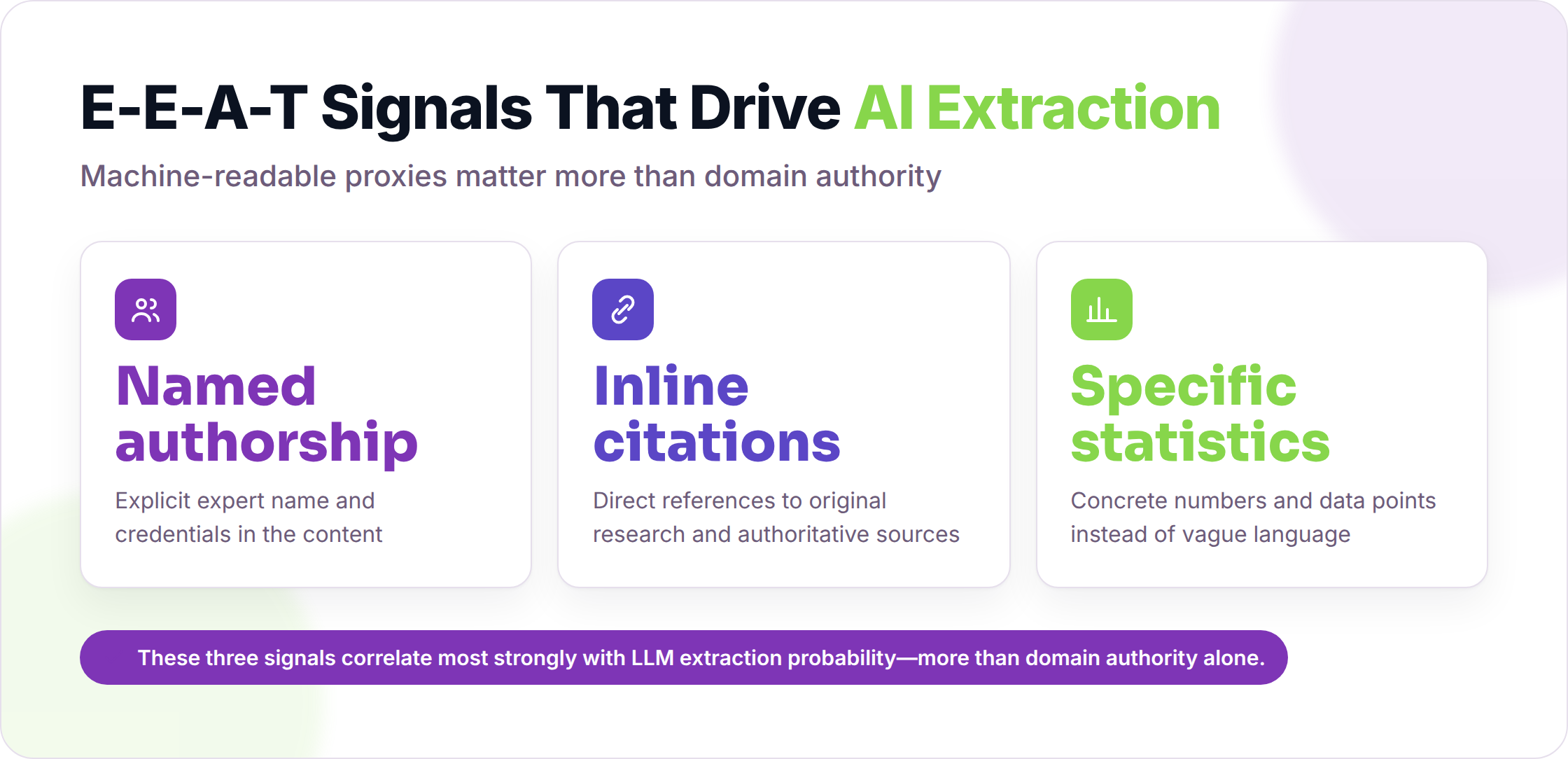
E-E-A-T signals matter to AI extraction, but the model reads machine-readable proxies instead of the signals themselves. Named authorship, inline citations to primary sources, and specific statistics correlate most strongly with LLM extraction probability, making your byline, sources, and numbers more important to AI citation than domain authority alone.
Named expert authorship, inline citations to primary sources, and specific statistics are the three highest-correlation signals for LLM extraction probability, according to the Digital Applied meta-analysis cited above. Practically, this means your byline, your sources, and your numbers matter more to AI citation than your domain authority score.
One honest caveat: SGE is still in active rollout, and citation behavior varies by query category. What holds for informational queries does not always transfer to transactional or navigational ones. Teams working across query types should audit citation performance by category rather than applying one content template across the whole site.
The Traffic Reality Behind These Changes
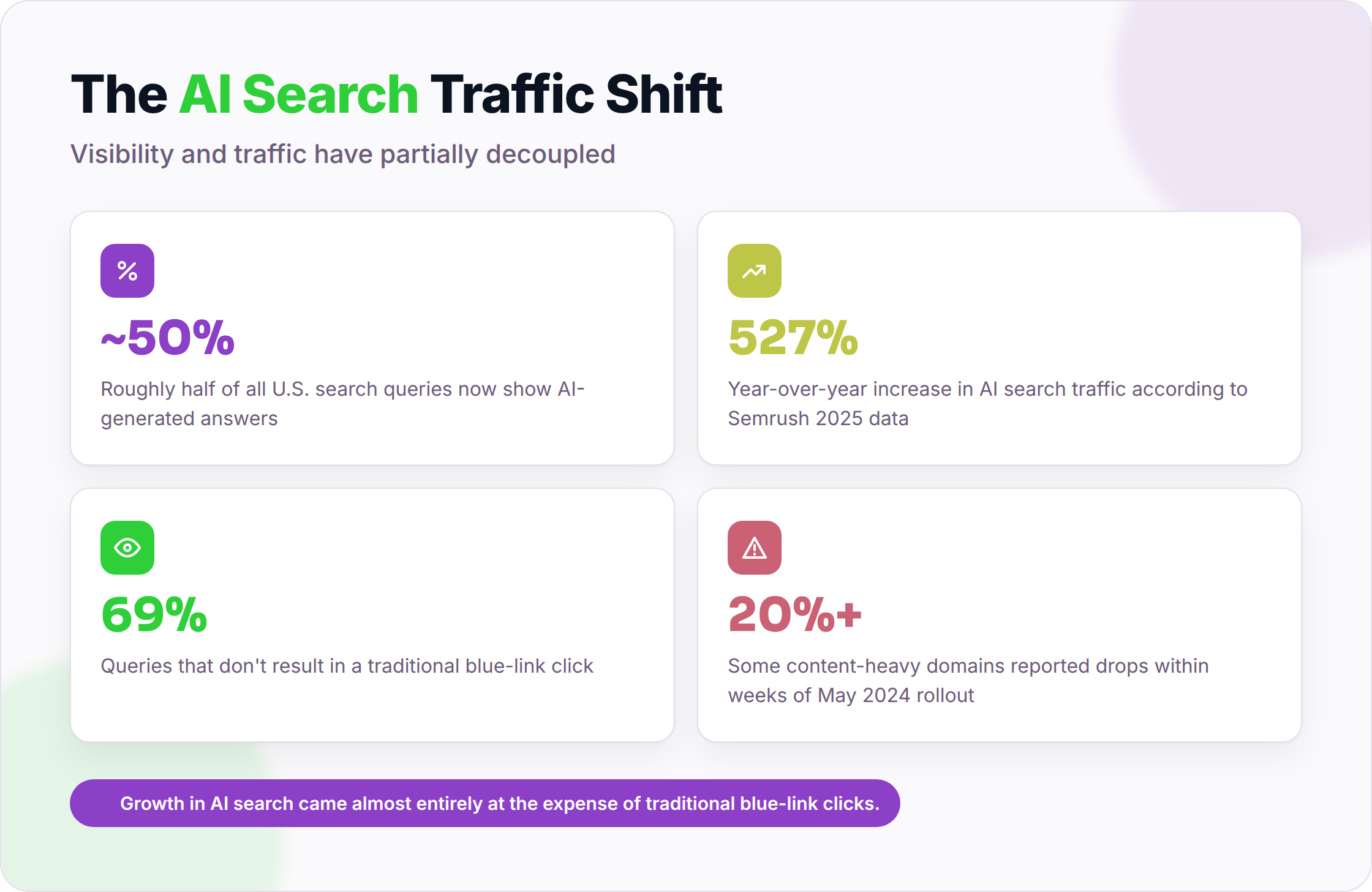
Google's AI Overviews now appear on roughly half of all U.S. search queries. Traffic to publisher sites dropped sharply after the May 2024 rollout, with some content-heavy domains reporting organic losses above 20% within weeks.
AI search traffic grew 527% in a single year, according to Semrush's 2025 benchmark data, and that growth came almost entirely at the expense of traditional blue-link clicks. Zero-click searches now account for 69% of queries, meaning visibility and traffic have partially decoupled. Optimizing for citation frequency is a different discipline from optimizing for rank position.
The trade-off is real. A page optimized for AI citation, with a direct answer-first structure and tight entity markup, can lose some of the long-form narrative depth that drives time-on-page and email signups. For publishers whose revenue depends on display advertising tied to session length, chasing citation placement can actively conflict with monetization. Decide which pages serve which goal rather than applying one template across the whole site.
What an AI Overview Citation Actually Looks Like
Google surfaces a collapsed answer block at the top of the results page, with two to five source cards visible beneath or beside the generated text. Each card shows a domain name, a page title, and a short excerpt. That excerpt is almost always pulled from a passage that directly answers the query in a single, self-contained paragraph. Pages that bury their answer in paragraph six rarely appear.
SGE citations appear in approximately 68% of informational queries, and the sources selected share a consistent structural profile: clear entity recognition, schema markup, and explicit authorship attribution. That figure comes from Jasmine Directory's review of SGE citation patterns linked above.
Frequently Asked Questions
Does traditional Google ranking still matter for SGE?
It matters less than it used to. As of February 2026, only 17% of AI Overview citations come from pages in the organic top 10. You still want strong organic rankings for the traffic that bypasses the AI snapshot, but citation selection follows a separate set of signals centered on structure, authorship, and extractability.
How long does it take to see results after optimizing for SGE?
Most practitioners report seeing citation changes within four to eight weeks of adding schema markup, restructuring content to lead with the answer, and attributing claims to named sources. That timeline varies by crawl frequency and query competition. Niche topics with lower query volume tend to respond faster because there are fewer competing pages in the retrieval pool.
Do backlinks still influence SGE citations?
Backlinks have a weaker correlation with citation selection than structured data presence, according to Jasmine Directory's citation pattern research. They still contribute to overall domain trust, which feeds into E-E-A-T signals the model uses as a proxy for authority. Treat link acquisition as a supporting factor rather than the primary lever for AI visibility.
What schema types matter most for SGE?
Article, FAQPage, HowTo, and Speakable schema types show the strongest correlation with citation selection for informational queries. FAQPage markup is particularly effective because it pre-structures content into discrete question-answer pairs that map directly to how the retrieval layer chunks and scores passages.
Can a short page outrank a long one in SGE?
Yes, and it does regularly. A 600-word page that directly answers three distinct sub-query intents will outperform a 2,000-word page that restates the same point in different ways. Length is not a signal. Semantic coverage of the query's fan-out sub-questions is.
Is SGE the same as Google's AI Overviews?
SGE (Search Generative Experience) was the name used during Google's 2023 Labs rollout. Google rebranded the feature as AI Overviews when it launched broadly in May 2024. The underlying retrieval-augmented generation architecture is the same. Most practitioners use both terms interchangeably, though "AI Overviews" is now the official product name.
If you want a structured way to audit your content against these citation signals, visit SEORav's GEO tool to see how your pages score on answer-first structure, entity salience, and schema completeness before your next content update.
Keep reading
Why AI Ignores Your Content (And How to Fix It)
Learn how to avoid AI content that gets ignored by LLMs. Covers RAG retrieval signals, schema, entity salience, and an answer-first structure checklist.
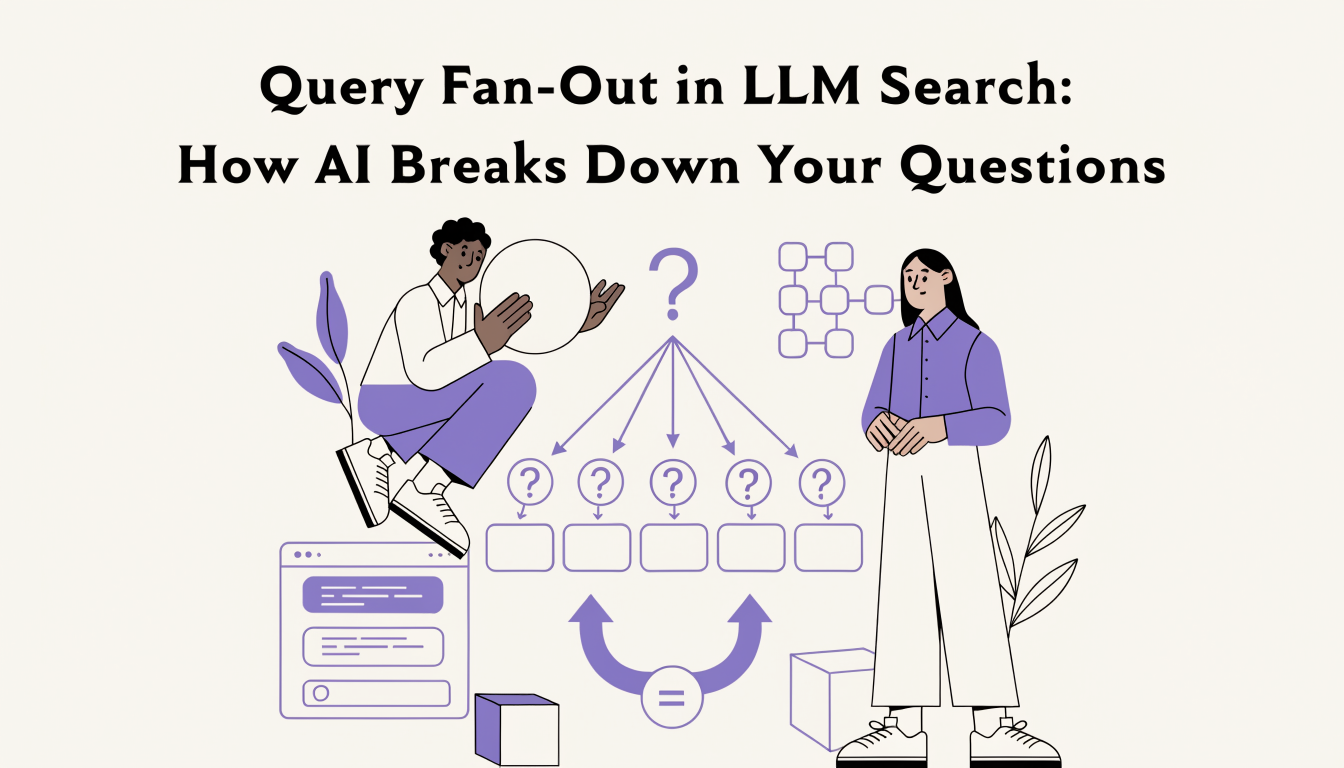
Query Fan-Out in LLM Search: How AI Breaks Down Your Questions
Learn what query fan-out in LLM search is, how AI splits your prompt into 3-8 sub-queries, and how to structure content to win more citation passes.
Reference Rate vs Click-Through Rate: What AI Search Actually Measures
Learn how reference rate vs click-through rate in AI search differ, why CTR can fall while citations rise, and which content formats earn the most AI citat