Why AI Ignores Your Content (And How to Fix It)
Last updated: 10 October 2026
Avoid AI content that gets ignored by LLMs by ensuring your material answers specific questions with verifiable data, cites authoritative sources, and structures information so retrieval systems can extract discrete claims. Most content fails not because search engines can't crawl it, but because language models can't confidently cite it. Your pages need clear topic sentences, named statistics with sources, and logical hierarchies that make individual facts retrievable. Without these signals, even well-ranked content becomes invisible to AI assistants.
This article covers the specific signals LLMs use to evaluate content, how vector placement determines whether your material gets retrieved at all, what query fan-out means for the prompts you're not tracking, and a self-audit checklist you can run today. One honest caveat: fixing these signals improves your odds of citation, but no approach guarantees placement. The engines change their retrieval behavior regularly, and a LinkedIn analysis of recent LLM citation patterns found that even well-structured content can lose ground after a model update.
TL;DR
LLMs filter out thin or repetitive material before it surfaces in an answer. The structural fix with the highest return is leading with a direct, self-contained answer to the exact query. The fastest self-test: paste your opening paragraph into ChatGPT and ask if it answers the query without surrounding context.
- Core problem: LLMs are trained on patterns. Content that mirrors every other article on a topic, with the same generic headings and unsourced assertions, gets deprioritized in favor of material that reads as authoritative.
- Two signal types LLMs trust: specificity (named figures, dates, concrete mechanisms) and verifiability (claims tied to a citable source or original data).
- Highest-ROI structural fix: answer-first openings. Put the direct answer in the first 40 to 60 words, before context, caveats, or background. Models extract the clearest, most self-contained passage available.
- Fastest self-test: copy your H1 into an AI engine and read the first result it returns. If that result is not your page, compare its opening sentence to yours. The gap is your fix.
One trade-off worth naming: answer-first structure improves citation rate, but it can reduce time-on-page for readers who wanted a narrative walkthrough. The numbers favor the citation side. AI-driven answer engines intercept 30 to 40% of informational queries before any click happens, so being cited without a click still beats being skipped entirely. If your business model depends on session depth or ad impressions, the calculus shifts. Optimize for citation first, then layer in depth for the readers who stay.
Why LLMs Skip Your Content in the First Place
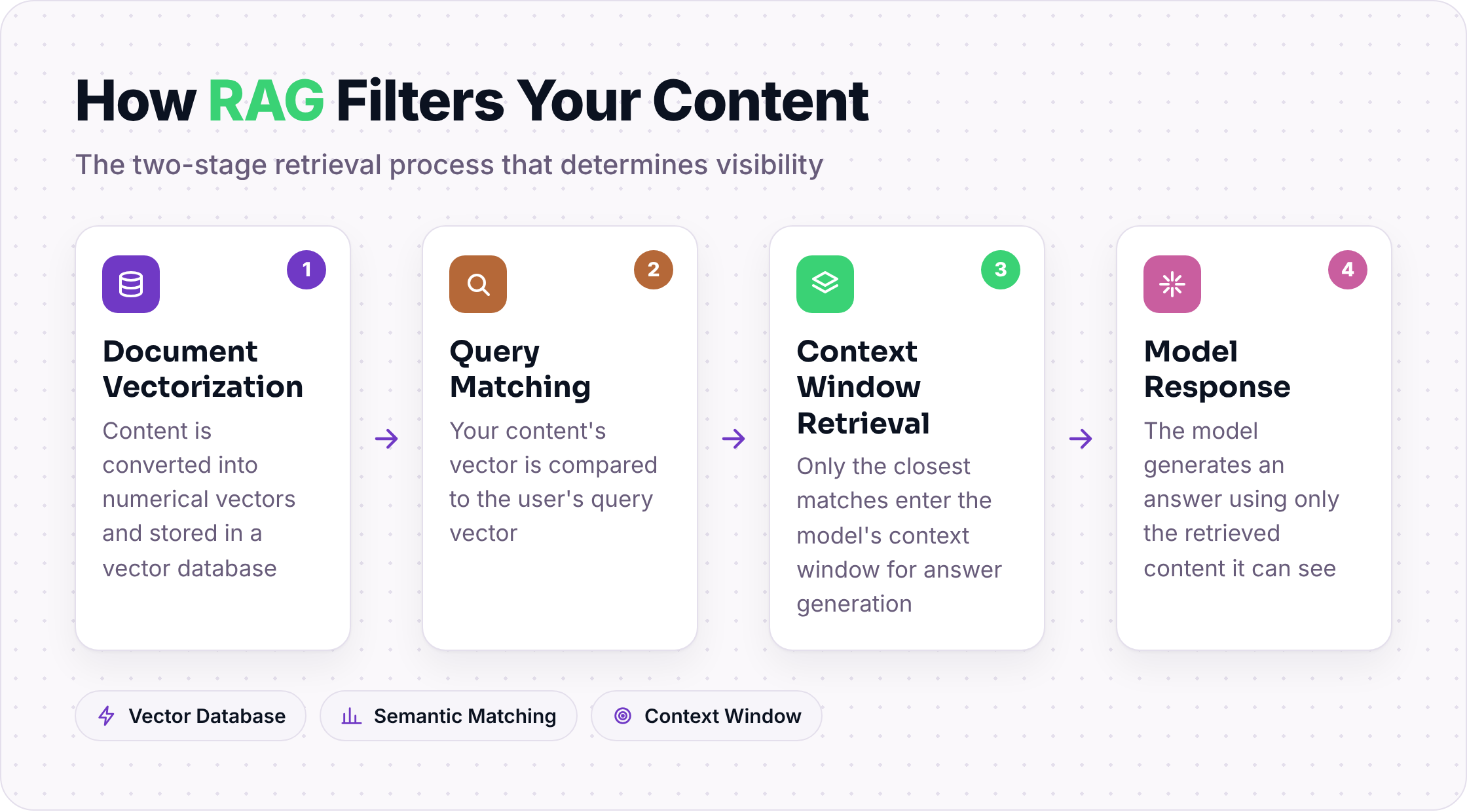
LLMs skip content when it fails two sequential filters: first, whether a crawler has indexed it in a form a vector database can process, and second, whether the embedded representation of that content scores close enough to a user query to enter the context window at all. Most content fails the second filter, not the first.
Retrieval-Augmented Generation and the Context Window
Retrieval-augmented generation (RAG) works by converting documents into numerical vectors, storing them in a vector database, and pulling the closest matches to a query into the model's context window before generating a response. The model only sees what gets retrieved. If your content's vector sits far from the query vector, because your language is too generic, your headings too vague, or your claims too thin, it never enters the window. The model doesn't skip it consciously. It simply never encounters it.
A documented complication here is positional. Research on the "lost in the middle" problem shows that LLMs weight content placed at the start and end of a retrieved context window more heavily than content in the middle. Even retrieved content can be effectively ignored depending on where it lands in the assembled prompt. You can write a structurally sound article and still lose citation share to a shorter, sharper competitor page that front-loads its core claim.
Crawl Coverage vs. Vector Database Placement
These are two separate problems that most teams conflate. Crawl coverage means a bot has visited your URL and parsed the HTML. Vector placement means your content has been chunked, embedded, and stored in a way that makes it retrievable for relevant queries. A page can be fully indexed by Google and still be absent from every major AI engine's retrieval layer, either because the content was never ingested by that engine's pipeline, or because the embedding it produced is too diffuse to match specific queries.
Reflect Digital's analysis of LLM content interpretation makes this distinction concrete: optimizing for LLM retrieval requires structuring content so that individual chunks, not just full pages, carry enough semantic specificity to match narrow queries. A 2,000-word article where the key claim is buried in paragraph nine will produce a weak chunk embedding for that claim, even if the overall page ranks well in traditional search.
The Shared Root Cause Behind Google Traffic Drops and AI Citation Gaps
Google's organic traffic decline in 2025 and the AI citation gap are symptoms of the same underlying problem: content built around keyword density and topical breadth rather than specific, sourced, answer-first claims. Google's own shift toward featured snippets and AI Overviews rewards the same structural qualities that RAG systems favor. Content that hedges every claim, avoids named figures, and mirrors competitor articles at the structural level performs poorly in both environments.
The interception rate is not distributed evenly. It concentrates on queries where one source provides a clear, verifiable, self-contained answer and the rest of the results do not. If your content reads like the consensus, it gets passed over in favor of the source that stated the consensus most precisely.
One honest limitation: highly specialized or emerging topics sometimes lack enough training data for any content to achieve consistent citation, regardless of quality. In those cases, the retrieval gap reflects the model's knowledge cutoff, not a fixable structural flaw in your content.
How to Avoid AI Content That Gets Ignored by LLMs: The Deterministic Signals
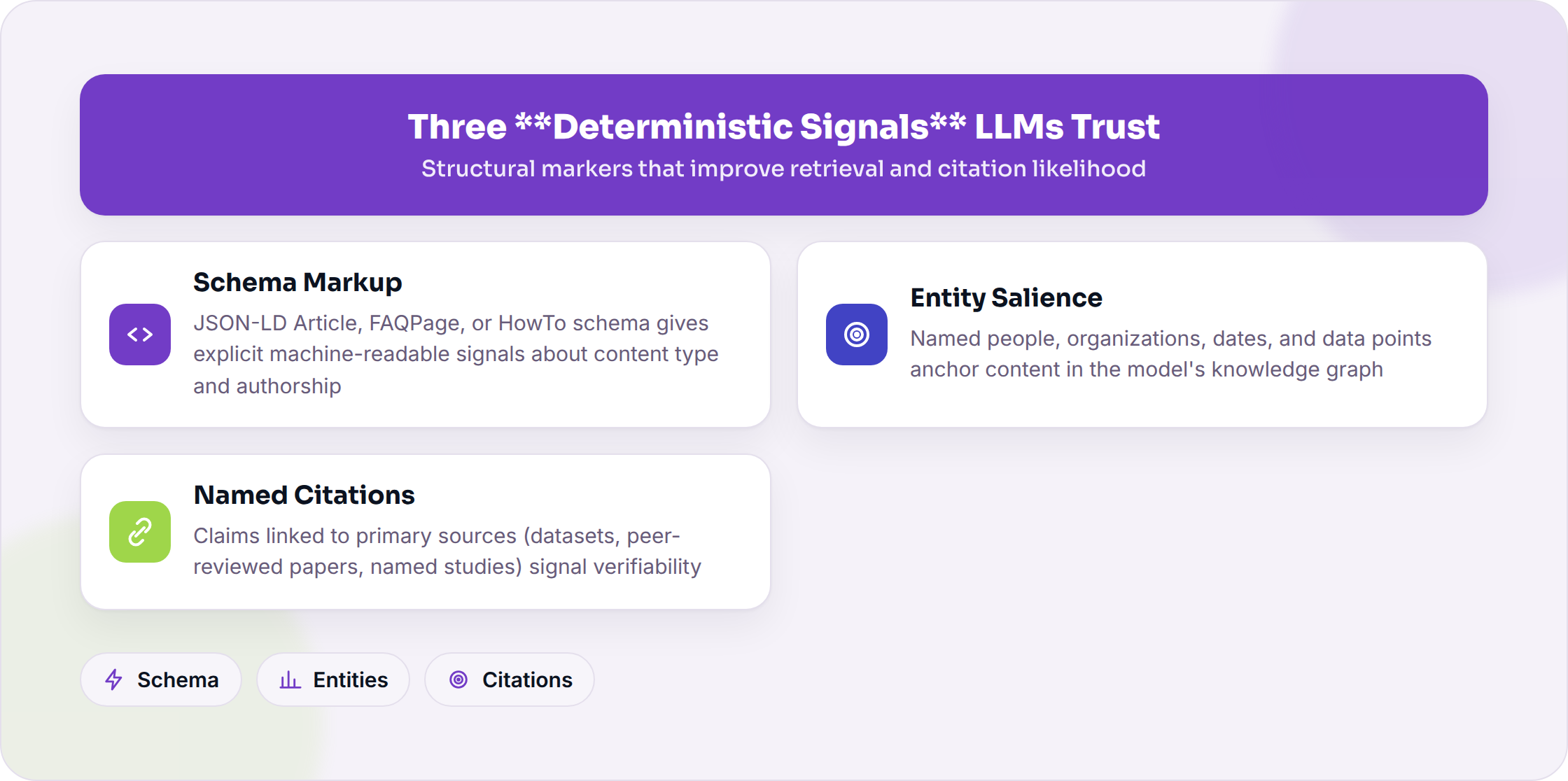
Schema markup, named-source citations, and high entity salience are the three structural signals that most reliably push content into LLM retrieval. A model parsing your page isn't reading it the way a human skims an article. It's resolving entities, checking whether claims connect to verifiable sources, and assigning confidence based on how clearly the content maps to known facts.
Schema, Entity Salience, and Named Citations
JSON-LD schema isn't decoration. When a language model encounters a page, structured data gives it explicit signals about what type of content this is, who authored it, and what organization stands behind it. Article, FAQPage, and HowTo schema types are particularly useful because they map directly to the query formats LLMs use when generating answers.
Entity salience matters for a related reason. LLMs build internal representations of topics as networks of named entities, so a page that clearly names people, organizations, dates, and locations gives the model more to anchor to. Vague prose with no named references scores lower in retrieval confidence, even if the underlying argument is sound. How LLMs understand websites in 2026 documents this parsing behavior in detail: models resolve entities first, then assess claim credibility, then decide whether the passage is worth surfacing.
Named-source citations work as a trust multiplier. Linking to a government dataset, a peer-reviewed study, or a recognized industry report signals that your claims are checkable. That's a different function than a backlink in classic SEO. The citation isn't just for PageRank; it's evidence that your content exists within a verifiable information graph.
How E-E-A-T Maps to LLM Trust Scoring (and Where It Diverges)
Google's E-E-A-T framework (Experience, Expertise, Authoritativeness, Trustworthiness) overlaps with LLM trust scoring in some areas and diverges sharply in others. The overlap: authorship signals, institutional affiliation, and citation to primary sources all carry weight in both systems. A byline linked to a named expert with a verifiable professional history helps both a Google quality rater and a language model assessing source credibility.
The divergence is significant. Classic E-E-A-T rewards signals that are partly social, including review counts, brand mentions across the web, and editorial links from high-authority domains. LLMs weight those signals less directly. What they weight more heavily is internal consistency: does the content contradict itself? Do the claims align with what the model already knows from its training data? A page can have strong backlink authority and still get skipped by an AI engine if its factual claims are ambiguous or its structure is too fragmented to parse cleanly.
Optimizing hard for LLM retrieval can pull your writing toward a more formal, citation-dense style that sometimes reads as dry to human visitors. There's a real tension between content that feels conversational and content that's structurally fit for machine extraction. Most teams need to find a middle register rather than fully optimize for one audience at the expense of the other.
Generative Engine Optimization vs. Classic SEO: What Carries Over
Several classic SEO fundamentals transfer cleanly to generative engine optimization (GEO). Page speed, crawlability, canonical URLs, and clean internal linking still matter because LLMs index content through crawlers that respect the same technical signals. Thin content still fails. Duplicate content still dilutes authority.
What doesn't carry over: keyword density targeting, exact-match anchor text strategies, and meta keyword fields. These were already declining signals in traditional search, and they're essentially irrelevant to LLM retrieval. A model doesn't count how many times you used a phrase. It assesses whether your content answers a query better than the alternatives it has seen.
What's genuinely new in GEO is the emphasis on answer-first structure. Content written for AI citation needs to front-load its core claim in the first 60 to 100 words, in a form that can be extracted and quoted without surrounding context. Guidance on writing content for LLMs specifically recommends auditing what AI systems already recommend in your category before building new pages, so you're filling genuine gaps rather than duplicating what's already being cited.
The practical signal comparison for a page targeting LLM retrieval:
| Signal | Classic SEO Weight | GEO Weight |
|---|---|---|
| JSON-LD schema | Medium | High |
| Named-source citations | Low | High |
| Keyword density | High | Negligible |
| Answer-first opening | Low | High |
| Entity salience | Medium | High |
| Backlink authority | High | Medium |
The Self-Audit Checklist
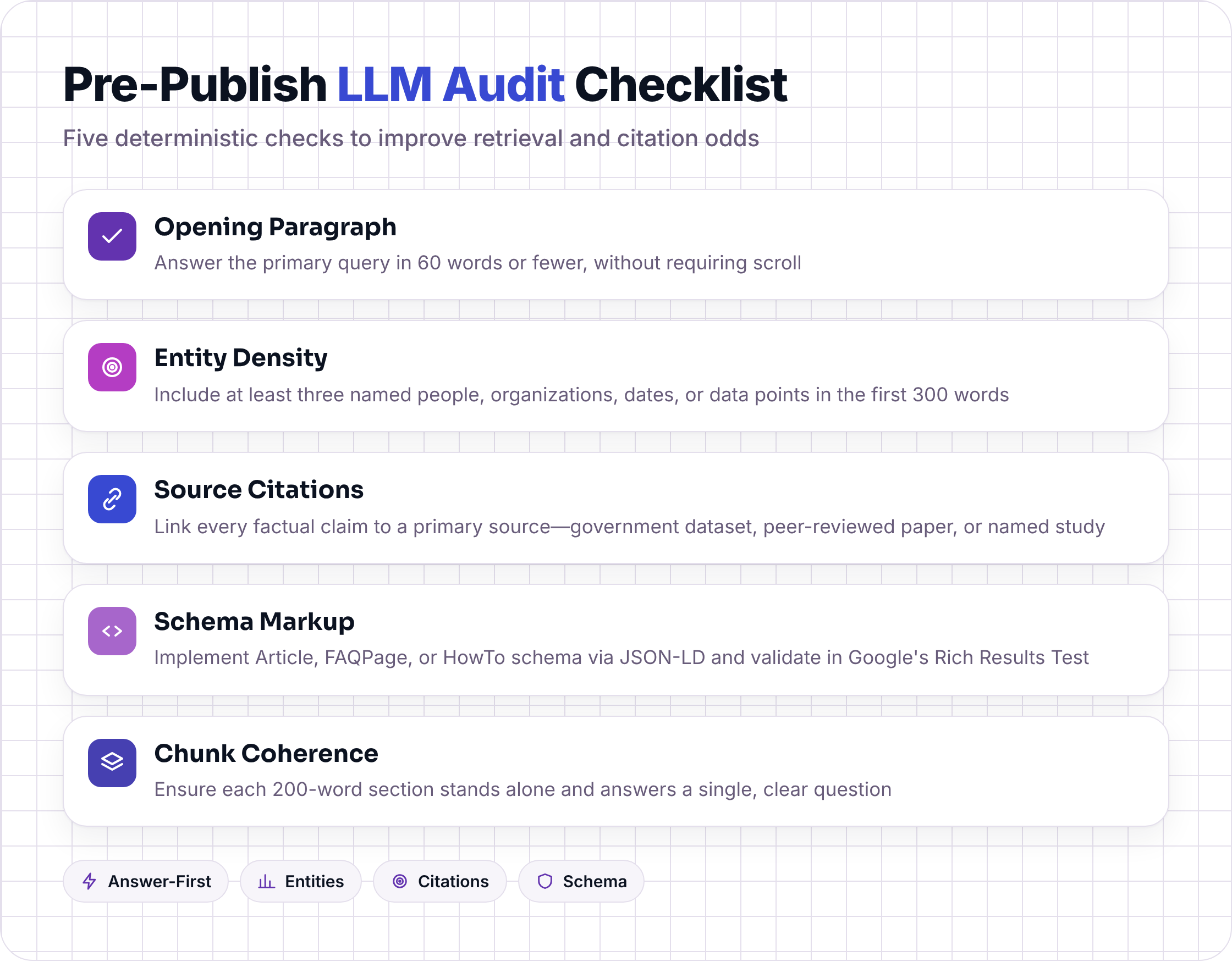
Run through these before publishing or updating any page you want cited in AI-generated answers.
Opening paragraph: Does it answer the primary query in 60 words or fewer, without requiring the reader to scroll? If not, rewrite the first paragraph before touching anything else.
Entity density: Count the named people, organizations, dates, and data points in your first 300 words. If you can't find at least three, the passage is too abstract to anchor in a model's retrieval layer.
Source citations: Every factual claim that isn't common knowledge should link to a primary source. A government dataset, a peer-reviewed paper, or a named study. Not another blog post making the same claim.
Schema markup: Confirm that Article, FAQPage, or HowTo schema is implemented via JSON-LD and validates cleanly in Google's Rich Results Test.
Chunk coherence: Read each 200-word section of your article in isolation. If a section doesn't make sense without the surrounding context, it will produce a weak embedding. Rewrite it to stand alone.
Competitor gap check: Paste your target query into ChatGPT, Perplexity, and Google's AI Overview. Read the first cited source for each. If your content doesn't offer something more specific, more sourced, or more precisely framed than what's already being cited, you're not filling a gap. You're adding noise.
Frequently Asked Questions
Does schema markup directly affect whether an LLM cites my content?
Schema markup doesn't guarantee citation, but it does give language models explicit, machine-readable signals about your content's type, authorship, and subject matter. FAQPage and HowTo schema types are particularly useful because they map to the query formats LLMs use when assembling answers. Think of schema as reducing the model's interpretive work, which lowers the friction between your content and retrieval.
How is GEO different from traditional SEO?
Traditional SEO optimizes for ranking signals that search engine algorithms use to order results, including backlink authority, keyword frequency, and click-through rate. GEO optimizes for retrieval signals that language models use to select content for inclusion in a generated answer, including entity salience, answer-first structure, and named-source citations. Several fundamentals overlap (crawlability, page speed, clean HTML), but keyword density targeting and exact-match anchor text are largely irrelevant in GEO.
Can I tell which AI engines are crawling my site?
Yes, to a degree. Most major AI platforms publish their crawler user-agent strings. Perplexity uses PerplexityBot, OpenAI uses GPTBot, and Anthropic uses ClaudeBot. You can check your server logs or a tool like Cloudflare's bot analytics to see which of these have visited your URLs. Presence in the crawl log doesn't confirm retrieval, but absence from the crawl log is a reliable signal that your content isn't being considered at all.
What's the fastest single fix for a page that isn't being cited?
Rewrite the first paragraph. Put the direct answer to your target query in the first 40 to 60 words, in plain language, with at least one named entity and one specific data point. Models extract the clearest, most self-contained passage available. If your opening paragraph is context-setting or narrative, it's competing poorly against pages that lead with the answer.
Does content length affect LLM citation rates?
Length matters less than chunk quality. A 600-word article with a precise, well-sourced answer to a specific query will outperform a 3,000-word article where the key claim is buried in paragraph twelve. That said, longer content does create more opportunities for individual chunks to match different query variants. The practical approach: write as long as the topic requires, but make sure every 200-word section can stand alone as a coherent, citable unit.
My content ranks well on Google but never appears in AI answers. Why?
Google ranking and LLM retrieval use different signals. A page can rank on page one for a keyword and still be absent from AI-generated answers if its content is too generic to produce a strong vector embedding, if it lacks named-source citations, or if a competitor page answers the same query more precisely in its opening paragraph. The "lost in the middle" research also suggests that even retrieved content can be deprioritized if it lands in the middle of an assembled context window rather than at the start or end.
One More Step
If you want a structured review of where your content stands against current LLM retrieval signals, see how Seorav can help. The AEO audit covers entity salience, schema implementation, answer-first structure, and competitor citation gaps across the major AI engines. It's a faster starting point than running the checklist manually across a large content library.
Keep reading
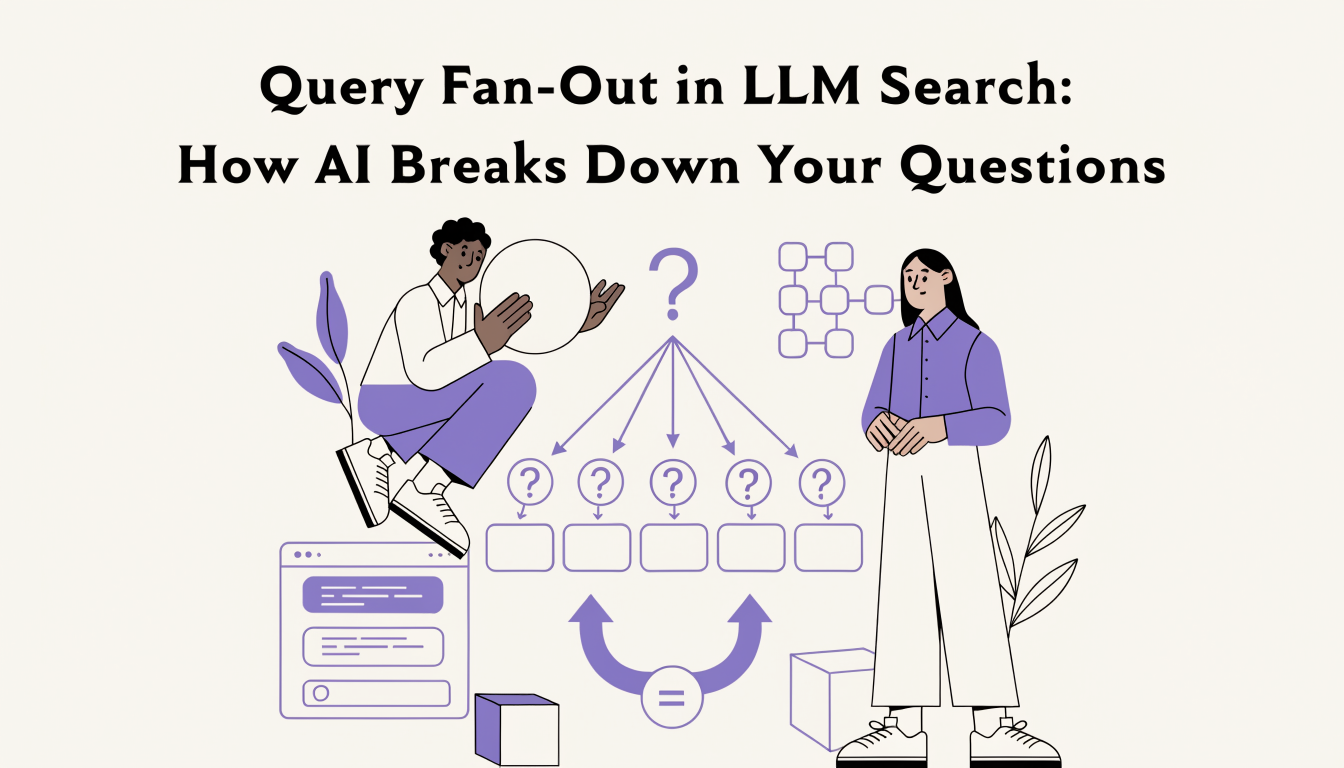
Query Fan-Out in LLM Search: How AI Breaks Down Your Questions
Learn what query fan-out in LLM search is, how AI splits your prompt into 3-8 sub-queries, and how to structure content to win more citation passes.
Reference Rate vs Click-Through Rate: What AI Search Actually Measures
Learn how reference rate vs click-through rate in AI search differ, why CTR can fall while citations rise, and which content formats earn the most AI citat
Writing Answer Paragraphs That AI Systems Will Quote
Learn how to write self-contained answer paragraphs for AI with a four-part structure that improves extraction probability and gets your content quoted by