Writing Answer Paragraphs That AI Systems Will Quote
Last updated: 7 October 2026
Self-contained answer paragraphs for AI work by opening with a direct response, naming the subject in every sentence, and requiring no surrounding context to stand alone. The formula is simple: 40 to 60 words, one core claim, enough mechanism to earn trust, and zero dependencies on prior paragraphs. This structure makes your writing quotable by AI systems and readable by humans who land on your page from search results or links. The real skill lies in balancing specificity with brevity.
RAG systems do not read pages. They read chunks. When a model pulls candidate passages to answer a user query, it scores each chunk on how completely it resolves the question on its own. A paragraph that opens with "as we discussed above" or leans on a prior section for its subject fails that test immediately. The passage gets scored lower, or skipped entirely, because the retrieval layer cannot verify what "above" refers to.
The structural requirement is tighter than most writers expect. Content structured for AI answer engines confirms that AI systems parse content by section, not by page, evaluating each H2 or H3 block independently. A paragraph that reads correctly if you drop it into a blank document is a paragraph a RAG system can safely quote. One that needs a running start cannot be extracted cleanly, so it usually is not.
On the concrete benchmark: paragraph structure measurably shifts extraction probability. Paragraphs where the first sentence states the direct answer and the remaining one to three sentences support it are consistently preferred by AI retrieval systems, with passages over 100 words showing a notable drop in citation frequency. Shorter, closed-loop text wins not because AI engines prefer brevity for its own sake, but because a tighter passage leaves less ambiguity about what claim is being extracted.
One honest caveat: self-containment is necessary but not sufficient. A paragraph can be perfectly atomic and still get ignored if the claim inside it is too vague, or if a competitor's page answers the same question with more specificity. Structure earns the extraction attempt; the quality of the answer determines whether it gets used.
What You Need Before You Write a Single Sentence
To write answer paragraphs that AI systems will quote, you need three things ready before you start: a working draft or clear notes on your topic, a defined scope that limits what the paragraph covers, and a specific target query you are writing to answer. Without all three, the paragraph drifts.
Content Prerequisites
Start with a working draft, not a blank page. The draft does not need to be polished. It needs to be specific enough that you can identify one discrete question it answers. That question becomes your target query, and the target query is what keeps the paragraph from sprawling into a general overview that AI engines cannot cleanly extract.
Scope matters more than most writers expect. A paragraph that tries to answer "how does AI citation work" will lose to a paragraph that answers "what makes a paragraph citable by ChatGPT." Narrower scope produces tighter language, and tighter language is easier for a retrieval system to match to a prompt. The numbers support this: Nu.edu's AI statistics roundup notes that over 60% of adults now use AI tools weekly, which means the volume of prompts AI engines process is large enough that specificity, not breadth, is what gets a passage surfaced.
The trade-off is real. A tightly scoped paragraph answers one query well and may answer adjacent queries poorly. If your article covers a broad topic, you will need multiple answer paragraphs, each scoped to its own query, rather than one paragraph that tries to cover the whole subject. Treating a single dense paragraph as a substitute for a properly structured article is where this approach breaks down.
Tool Requirements
You need two things on the tool side: a plain-text editor and access to at least one AI chat interface for spot-testing.
The plain-text editor matters because rich-text formatting (bold, headers, nested bullets) can obscure whether the paragraph actually reads as a self-contained answer. Strip the formatting and read the paragraph cold. If it still makes sense, it is ready.
The AI chat interface is for verification, not drafting. Paste your paragraph into ChatGPT, Claude, or Perplexity and ask a version of your target query. If the model quotes your paragraph back or paraphrases it closely, the structure is working. If it ignores your paragraph and generates its own answer, the paragraph is missing something: a clear restatement of the question, a direct declarative answer, or a specific supporting detail. Spot-testing takes two minutes and catches structural problems before they ship.
Step 1: Diagnose Whether Your Existing Paragraphs Are Self-Contained
To diagnose whether a paragraph is self-contained, paste it in isolation into an LLM and ask whether it fully answers a specific query without surrounding context. If the model hedges, asks for clarification, or produces a weaker answer than the full article would, the paragraph depends on context it cannot carry alone. Run this test on every paragraph you want AI systems to quote, and log the pass rate before making any edits.
The Cold-Read Test
The mechanics are simple. Take one paragraph, strip everything around it, and paste it into ChatGPT or Claude with a prompt like: "Does this paragraph fully answer the question 'how do I reduce SaaS churn'?" A self-contained paragraph earns a direct yes. A context-dependent one gets a response along the lines of "this seems to be part of a larger explanation."
Run the test on 10 consecutive paragraphs from a page you want cited. Count how many pass. That ratio is your baseline extraction rate. Most content teams find fewer than 3 in 10 paragraphs pass on the first run, which gives you a concrete benchmark to improve against.
Four Failure Signals
Watch for these patterns when you read a paragraph in isolation:
- Pronoun without antecedent. The paragraph opens with "This approach" or "It works because" and the reader has no idea what "this" or "it" refers to.
- Comparative without a referent. Phrases like "unlike the previous method" or "a better alternative" require the reader to have seen what came before.
- Numbered continuation. "Step 3 builds on what we covered in Step 2" is structurally unextractable. The paragraph announces its own dependency.
- Implicit subject. The paragraph discusses a concept, tool, or person named only in a heading two sections back. Stripped of that heading, the subject disappears.
The Thesify analysis of weak academic writing patterns identifies this last failure as one of the most common: writers assume the heading carries meaning into the body text, but AI retrieval systems parse paragraphs as discrete units, not heading-plus-body pairs.
Logging Your Baseline
Before editing anything, create a simple tracking sheet. List each paragraph by its position on the page, record the cold-read test result (pass or fail), and note which failure signal applies. This takes about 20 minutes for a 1,500-word article and gives you a before-and-after comparison once you revise.
Worth acknowledging: some paragraphs are legitimately sequential. A technical walkthrough where Step 4 genuinely cannot be understood without Step 3 should stay sequential. Forcing artificial self-containment on those paragraphs produces awkward, repetitive prose that reads worse for human visitors even if it scores better on the extraction test. Maximize self-contained paragraphs where the content allows it; do not rewrite every sentence as if the rest of the article does not exist.
Step 2: Apply the Four-Part Anatomy of a Paragraph That Gets Extracted
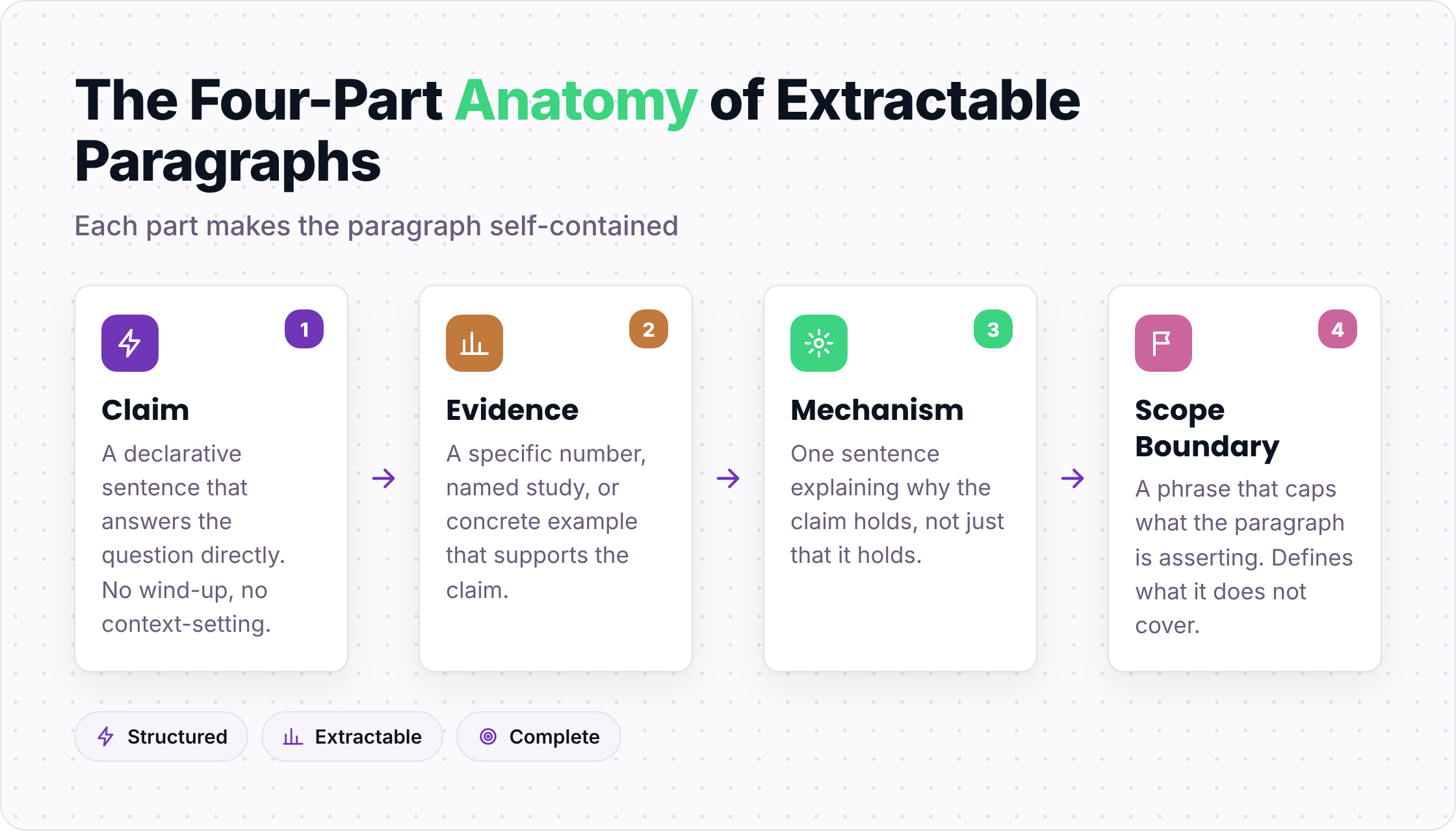
A paragraph gets extracted by an LLM when it opens with a claim that answers the implied question, supports that claim with a specific mechanism or evidence, and closes by stating what the claim does not cover. That four-part structure (claim, evidence, mechanism, scope boundary) makes the paragraph self-contained. An AI engine can lift it verbatim without needing the sentences before or after it to make sense.
The Four-Part Structure
Each extractable paragraph follows the same internal sequence:
- Claim. A declarative sentence that answers the question directly. No wind-up, no context-setting.
- Evidence. A specific number, named study, or concrete example that supports the claim.
- Mechanism. One sentence explaining why the claim holds, not just that it holds.
- Scope boundary. A phrase that caps what the paragraph is asserting.
The numbers back this up: Kime's analysis of AI-optimised content puts the ideal length for an answer-first passage at 40 to 75 words. Below 40 words, the paragraph lacks enough mechanism to be trustworthy. Above 75, the model starts treating it as background prose rather than a discrete answer unit.
Writing a Topic Sentence That Doubles as a Standalone Answer
The topic sentence carries most of the extraction weight. Write it so that a reader who sees only that one sentence gets a complete, usable answer. "Scope boundaries increase citation probability" is a topic sentence. "This section discusses scope" is not.
A useful test: paste just the first sentence into a blank document. If it requires the rest of the paragraph to make sense, rewrite it. The sentence should name its subject explicitly, use an active verb, and include at least one concrete detail.
Scope Boundaries: Why Capping Your Claims Helps
Scope boundaries are the part writers skip, and skipping them is a measurable mistake. When a paragraph overclaims ("this applies to all content types"), an LLM has to either quote it with a caveat or skip it entirely. A tighter claim ("this applies to informational H2 sections, not product pages") gives the model a safe, quotable unit.
The trade-off is real. Narrow scope boundaries make individual paragraphs more citable but can make an article feel fragmented if every paragraph hedges aggressively. The approach works best on definitional and how-to content. On opinion pieces or narrative features, rigid four-part structure can flatten the voice and make the writing feel like a technical manual. Use the anatomy where precision matters; let the structure loosen where argument and flow do the work.
A practical framing: treat the scope boundary as a one-clause addition to the final sentence. "This holds for paragraphs under 80 words targeting informational queries" adds precision without adding length.
Step 3: Use Structural Patterns That Increase Citation Probability
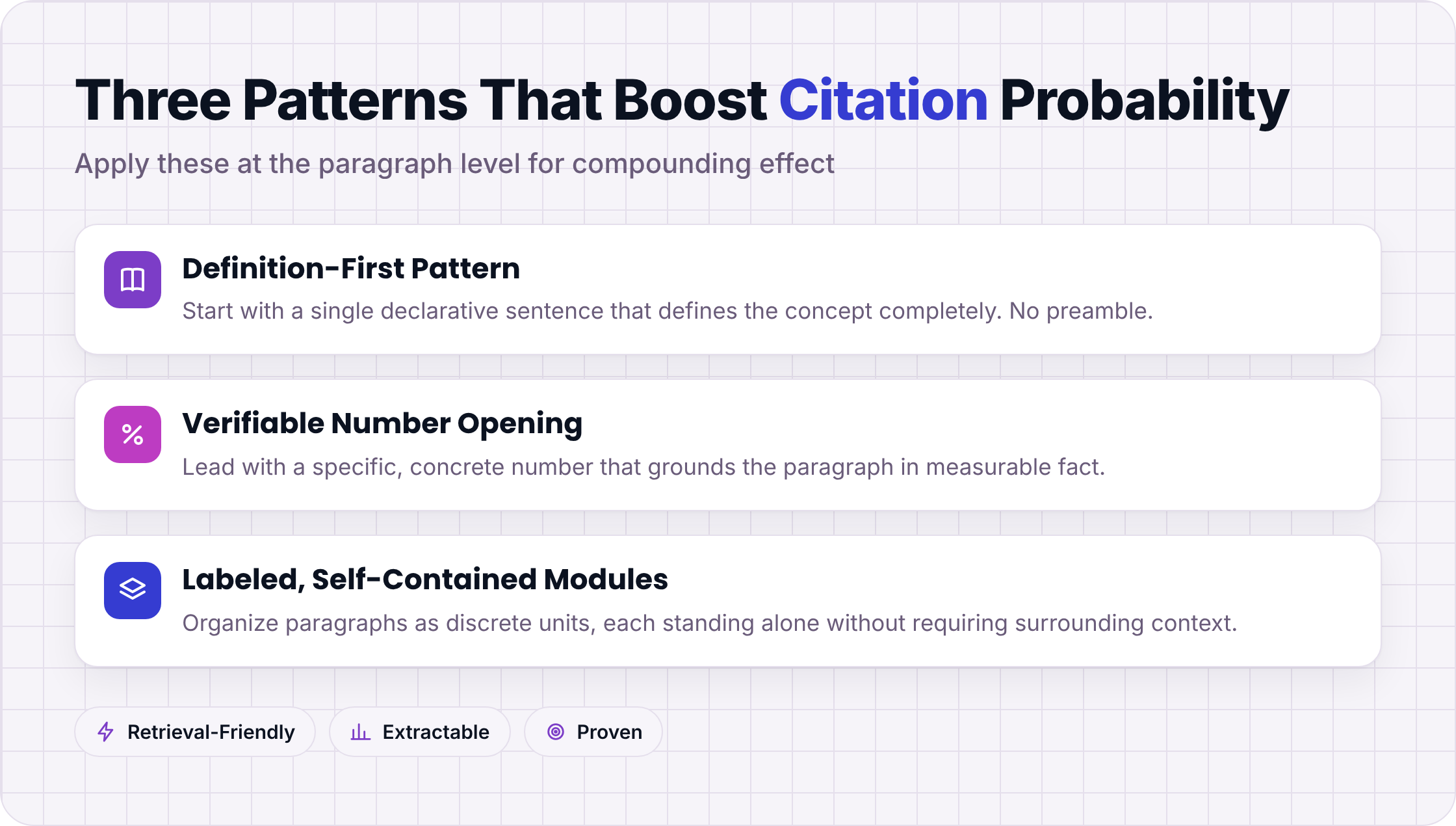
Three structural patterns reliably increase the chance an AI engine lifts your content verbatim: leading with a one-sentence definition, opening with a verifiable number, and organizing paragraphs as labeled, self-contained modules. Each pattern gives a retrieval system a clean extraction target. None requires rewriting your entire content strategy. Apply them at the paragraph level, and the cumulative effect compounds across a page.
The Definition-First Pattern
Start any paragraph that introduces a concept with a single declarative sentence that defines it completely. No preamble, no "in order to understand X." Just the definition.
Example: "A retrieval-augmented generation (RAG) pipeline chunks a source page into passages of roughly 100 to 300 tokens, scores each chunk independently, and returns the highest-scoring passage to the language model." That sentence can be extracted and quoted without any surrounding context. A definition buried in paragraph four, after two sentences of scene-setting, cannot be extracted cleanly because the retrieval system has no way to know where the actual answer begins.
The Number-First Pattern
Open with a verifiable statistic or a precise threshold, then explain what it means. "Paragraphs over 100 words see a measurable drop in AI citation frequency" is extractable. "Long paragraphs perform worse" is not, because "long" is undefined and the claim cannot be verified.
The number-first pattern works because retrieval systems weight specificity. A passage that contains a concrete figure gives the model something to anchor the answer to. A passage that uses relative language ("many," "often," "significantly") gives the model nothing to quote with confidence.
The Labeled-Module Pattern
When you write self-contained answer paragraphs for AI across a long article, treat each H3 section as a discrete module. The heading names the question. The first sentence answers it. The remaining sentences support the answer. The final sentence caps the scope.
This pattern scales. A 2,000-word article structured as 12 labeled modules gives a retrieval system 12 clean extraction targets. The same article written as flowing prose gives it, at best, two or three. The labeled-module approach does carry a cost: it can make long-form content feel like a FAQ rather than an argument. Reserve it for how-to and reference content where the reader is scanning for a specific answer, not reading for narrative.
Step 4: Verify and Iterate Before You Publish
Verification is a two-minute step that most writers skip, and skipping it is how structurally weak paragraphs ship. Before publishing, paste each paragraph you want cited into ChatGPT or Perplexity with a prompt that mirrors your target query. Log whether the model quotes your text, paraphrases it, or ignores it entirely.
Reading the Model's Response
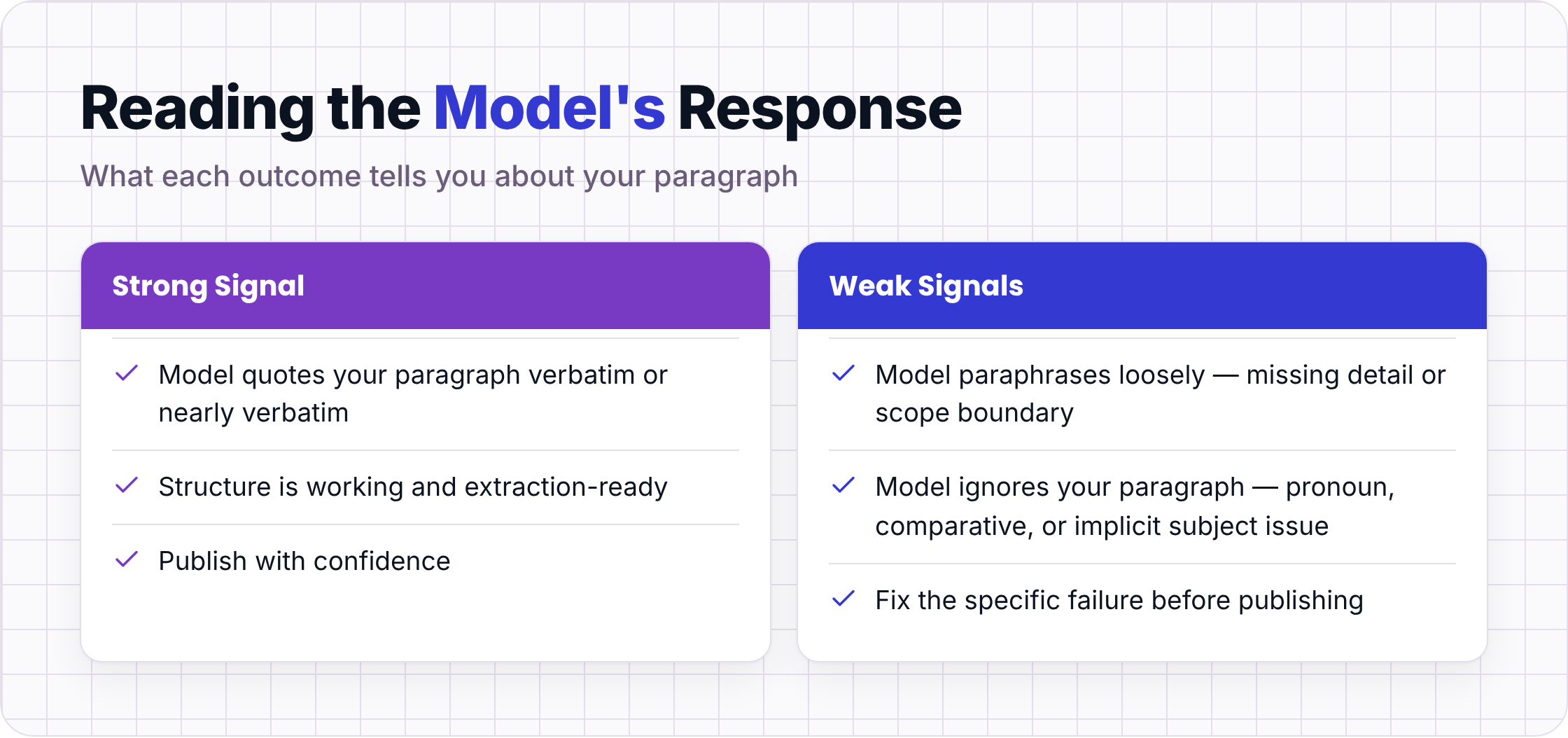
If the model quotes your paragraph verbatim or nearly verbatim, the structure is working. If it paraphrases loosely, the paragraph is close but probably missing a specific detail or a clear scope boundary. If it ignores your paragraph and generates its own answer, one of the four failure signals is present: a pronoun without an antecedent, a comparative without a referent, a numbered continuation, or an implicit subject.
Fix the specific failure, not the whole paragraph. Rewriting a paragraph that fails only because of one vague pronoun wastes time and often introduces new problems.
Setting a Revision Target
A realistic target for a polished article: 6 out of 10 paragraphs should pass the cold-read test before you publish. Below that, the page is unlikely to generate consistent AI citations regardless of how strong the overall content is. Above 8 out of 10, you are probably over-engineering the structure at the expense of readability for human visitors.
The 6-out-of-10 threshold is a practical benchmark, not a guarantee. A page where 7 paragraphs pass the cold-read test but the topic is too niche to attract queries will still see low citation rates. Structure improves extraction probability; it does not create demand for a topic that does not have any.
Frequently Asked Questions
How long should a self-contained answer paragraph be for AI extraction?
The target range is 40 to 75 words. Below 40 words, the paragraph typically lacks enough supporting mechanism for a retrieval system to treat it as a trustworthy answer. Above 75 words, models tend to classify the passage as background prose rather than a discrete answer unit, which reduces how often it gets quoted directly.
Does paragraph structure actually affect whether AI cites my content?
Yes, measurably. Paragraphs where the first sentence states the direct answer and the remaining sentences support it are cited more frequently than paragraphs where the answer is buried mid-block. The effect is strongest on informational queries, where the retrieval system is looking for a single clean passage to surface, rather than on navigational or transactional queries.
Can I apply this structure to every paragraph in an article?
No, and trying to do so creates problems. Sequential technical content, where one step genuinely depends on the previous one, should stay sequential. Forcing self-containment on those paragraphs produces repetitive prose that reads poorly for human visitors. Apply the four-part structure to definitional, how-to, and FAQ content; let narrative and argument sections follow their natural flow.
What is the fastest way to check if a paragraph is self-contained?
Paste the paragraph in isolation into ChatGPT or Claude and ask whether it fully answers a specific query without surrounding context. If the model hedges or asks for clarification, the paragraph depends on context it cannot carry alone. This test takes under two minutes per paragraph and catches the most common structural failures before they reach publication.
Does keyword placement inside a paragraph affect AI citation probability?
Keyword placement has a secondary effect compared to structural clarity, but it is not irrelevant. A paragraph that contains the exact phrasing of a common query in its first sentence is easier for a retrieval system to match to that query. The practical approach: write the topic sentence to answer the query in plain language, and the keyword placement tends to follow naturally without forcing it.
Take the Next Step
If you want to see how self-contained answer paragraph structure applies to your specific content, visit Seorav's AEO service page to see how Seorav can help you audit and restructure your content for AI extraction. The gap between content that gets cited and content that gets ignored is usually structural, and it is fixable.
Keep reading
The FAQ Structure That AI Systems Actually Extract
Learn how to structure FAQs for AI answer extraction with self-contained answers, FAQPage schema, and a repeatable testing process across ChatGPT, Perplexi
How to Verify Your Brand's Authority in Knowledge Graphs
Learn how knowledge graph authority verification works, why AI engines skip unverified brands, and how to build structured entity presence that gets you ci
Why AI Search Misses Sentiment in Your Content
Perceptual sentiment deficit causes ranked pages to lose AI citation slots. Learn how LLMs misread tone and what to fix before your next crawl.