Which Enterprise CMS Will Still Matter in 2030
Last updated: 24 November 2026
Headless CMS platforms built on API-first architecture represent the most future-proof choice for enterprises planning beyond 2025. They separate content management from presentation, enabling deployment across web, mobile, and emerging channels without rebuilding infrastructure. Native headless systems avoid the technical debt of monolithic platforms retrofitted with API layers, which often constrain scalability and create vendor dependencies. The real differentiator lies in whether your CMS was designed for APIs from inception or adapted later.
The Short Answer: Which Enterprise CMS Is Most Future-Proof
API-first, headless platforms are the safest long-term bet for enterprises evaluating CMS infrastructure today. They decouple content from presentation, support multiple front-end channels through a single content layer, and avoid the vendor lock-in that has forced costly rebuilds on monolithic stacks. The platforms most likely to remain relevant through 2030 are those built around this architecture from the ground up, not those that bolted headless support on after the fact.
The numbers frame the scale of the problem: Gartner's 2024 research puts the share of enterprises planning a CMS re-platform within 36 months at 61%. That figure does not reflect dissatisfaction with content management as a category. It reflects how quickly traditional monolithic platforms accumulate integration debt, especially as organizations add mobile apps, digital kiosks, personalization engines, and AI-driven content pipelines that a tightly coupled CMS was never designed to serve.
Headless platforms sidestep most of that debt by design. Content lives in a structured repository and gets delivered via API to whatever front end needs it, whether that is a React web app, a native mobile experience, or a voice interface. The trade-off worth naming: headless architecture shifts more responsibility onto your development team. Marketers lose some of the drag-and-drop simplicity that traditional platforms provide, and organizations without a capable front-end engineering function can find the flexibility harder to use than it looks in a vendor demo.
For most enterprises with a two-to-five year horizon, accepting that trade-off early beats absorbing a forced migration later.
A $2M Lesson from a Healthcare Network's CMS Migration
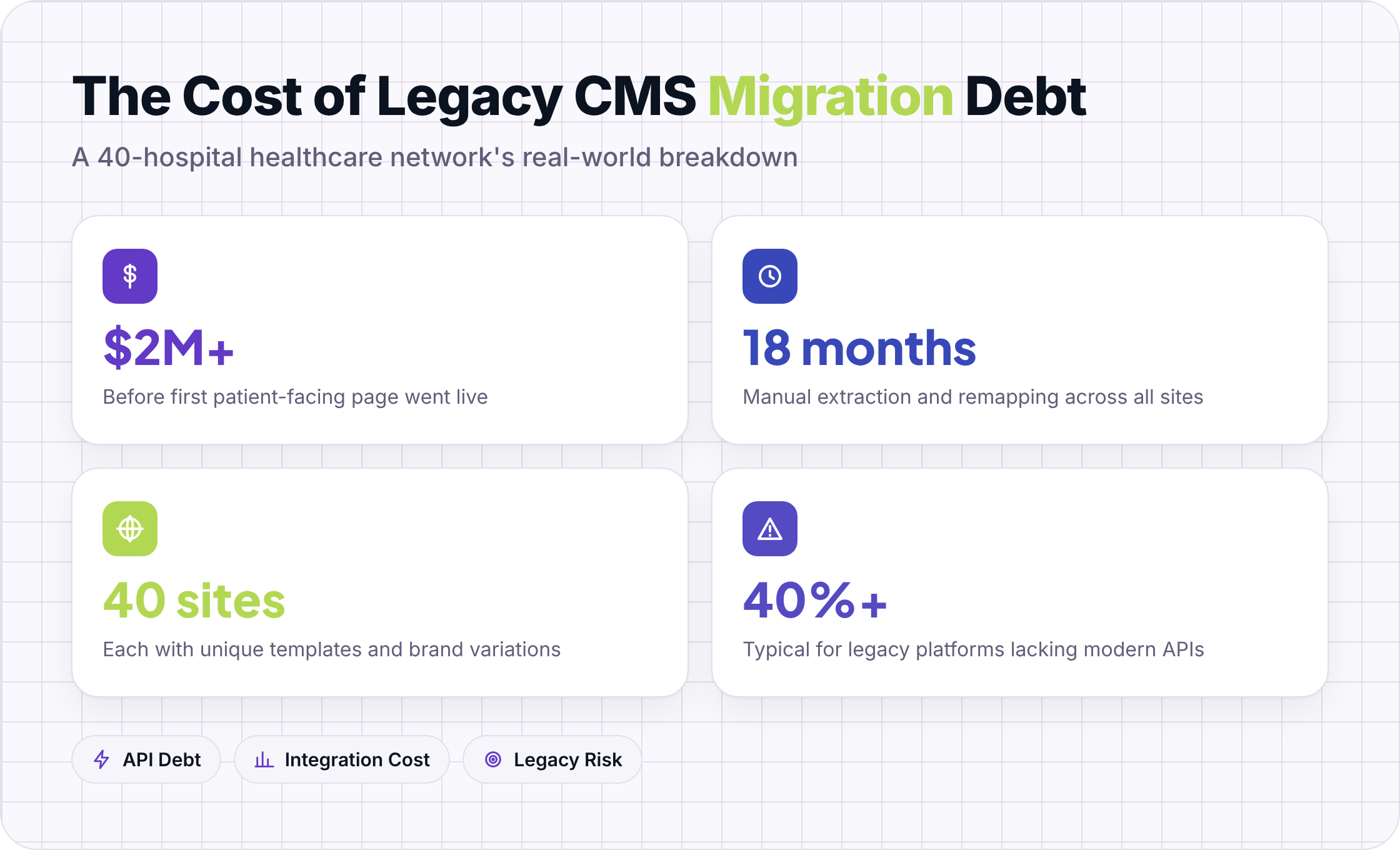
Enterprise CMS migrations in healthcare routinely exceed budget projections by 40% or more when the source platform lacks a modern API layer. A 40-hospital system that spent 18 months migrating off a legacy monolithic CMS discovered this directly: the total project cost cleared $2 million before a single patient-facing page went live on the new platform.
The core problem was not the migration tooling. The legacy system had no REST or GraphQL API, so every content object had to be manually extracted, reformatted, and re-mapped to the new schema. Across 40 hospital sites, that translated to thousands of individual page templates, each carrying its own local variation of brand elements, ADA accessibility markup, and regulatory disclosure language. What the migration exposed was that no single team had a clear picture of how many content variants actually existed. Brand governance had drifted silently for years.
The ADA compliance dimension made this worse. WCAG 2.1 AA conformance requires consistent heading hierarchy, alt-text coverage, and color contrast ratios across every published page. When content lives in a system with no centralized governance layer, individual site teams make local decisions. By the time the migration audit ran, roughly 30% of pages across the hospital network had accessibility gaps that required remediation before the new CMS could go live.
A modern API-first CMS would have prevented the extraction problem, but it would not have automatically fixed the governance problem. Headless architecture separates content from presentation, yet if editorial workflows and brand rules are not enforced at the content model level, the same drift happens on the new platform. Teams that migrate to Contentful or a comparable API-first system without rebuilding their governance structure often recreate the same sprawl within 18 months.
This pattern repeats with notable consistency in financial services and B2B enterprises. A regional bank managing 12 product microsites faces the same structural issue: no API layer means no programmatic audit, no programmatic audit means no visibility into compliance drift, and no visibility means the problem only surfaces during a migration or a regulatory review. The $2 million figure is not an outlier. It reflects what happens when content infrastructure debt compounds quietly over five to eight years and then gets settled all at once.
What Actually Makes an Enterprise CMS Future-Proof
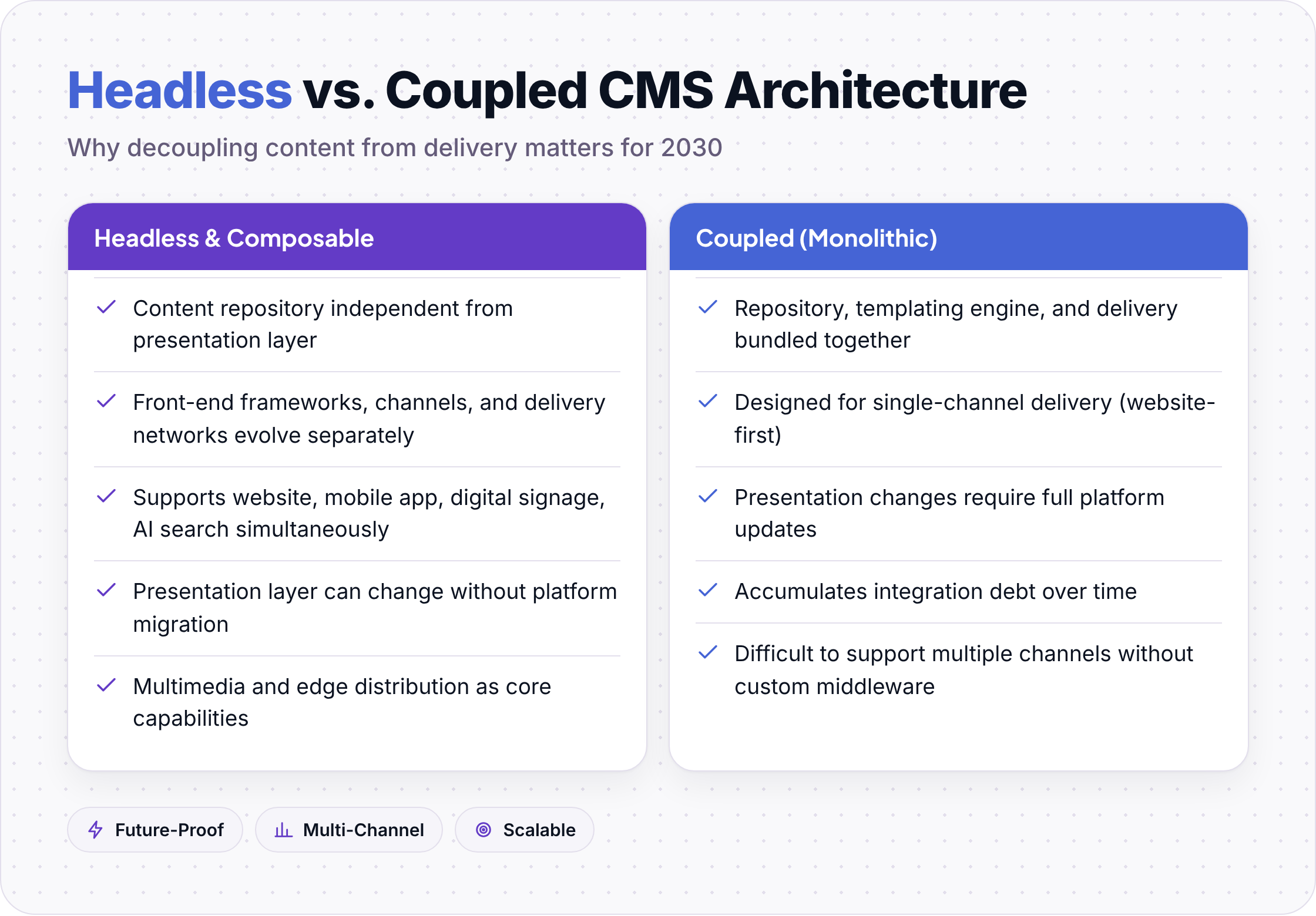
A future-proof enterprise CMS separates content storage from content delivery, runs on infrastructure that can be swapped without a full platform migration, and treats multimedia and edge distribution as core capabilities rather than add-ons. Platforms built on headless or composable architectures outlast coupled systems because the presentation layer can evolve independently. The content repository stays stable while front-end frameworks, channels, and delivery networks change around it.
Architecture Longevity: Why Headless and Composable Designs Win
Coupled CMS platforms bundle the repository, the templating engine, and the delivery layer into one deployable unit. That design made sense when websites were the only channel. By 2025, a single content operation might feed a website, a mobile app, a digital signage network, and an AI-powered search interface simultaneously. A coupled system forces you to rebuild the entire stack every time one of those channels changes.
Composable architecture solves this by treating each capability as a replaceable service. The content API stays constant; the front end, the personalization engine, and the commerce layer can be swapped or upgraded independently. In a 2024 benchmark study published by 40Q Agency on enterprise CMS scalability, teams running composable stacks reported meaningfully shorter integration cycles when adding new digital channels compared to teams on monolithic platforms.
Headless vs. Traditional CMS: The Performance and Flexibility Gap
The performance difference shows up most clearly at scale. A traditional coupled CMS renders pages server-side on each request, which creates a bottleneck when traffic spikes or when content needs to reach multiple regions with low latency. A headless CMS serves raw content via API; the front end handles rendering, usually at the edge.
In real deployments, headless architectures allow teams to cache rendered output at CDN nodes close to the end user, cutting time-to-first-byte significantly on global traffic. Brightspot's structured comparison of leading headless platforms documents this pattern across more than ten enterprise-grade systems, noting that API-first delivery consistently outperforms server-rendered coupled systems on multi-region deployments.
The trade-off is real, though. Headless shifts rendering responsibility to your front-end team. Organizations without strong developer capacity often find that the flexibility gain comes with a steep implementation cost. A traditional coupled CMS, for all its architectural limitations, can get a mid-market marketing team publishing in weeks rather than months. The composable model breaks down when the team maintaining it turns over or when the integration layer between services is under-documented.
Built-in CDN, Edge Hosting, and Multimedia as Baseline Requirements
By 2025, a CMS that requires a separate CDN contract and a third-party video hosting arrangement is already behind. Enterprise buyers now treat edge delivery, image optimization, and video transcoding as table-stakes features, not premium add-ons.
The reasoning is straightforward: Core Web Vitals scores directly affect organic search ranking, and large media assets are the most common cause of poor Largest Contentful Paint times. A CMS with built-in CDN and automatic image resizing removes an entire category of performance debt. Platforms like Contentful, Storyblok, and Hygraph have moved in this direction, as Cosmic's enterprise headless CMS guide details across seven leading platforms.
Edge hosting adds a second layer: logic that used to run in a central data center (personalization rules, A/B test assignments, geo-redirects) can now execute at the network edge, closer to the user. For global organizations publishing across 20 or more markets, that shift from centralized to distributed execution is less a feature and more a structural requirement.
The Mistake Most Enterprises Make When Evaluating CMS Platforms
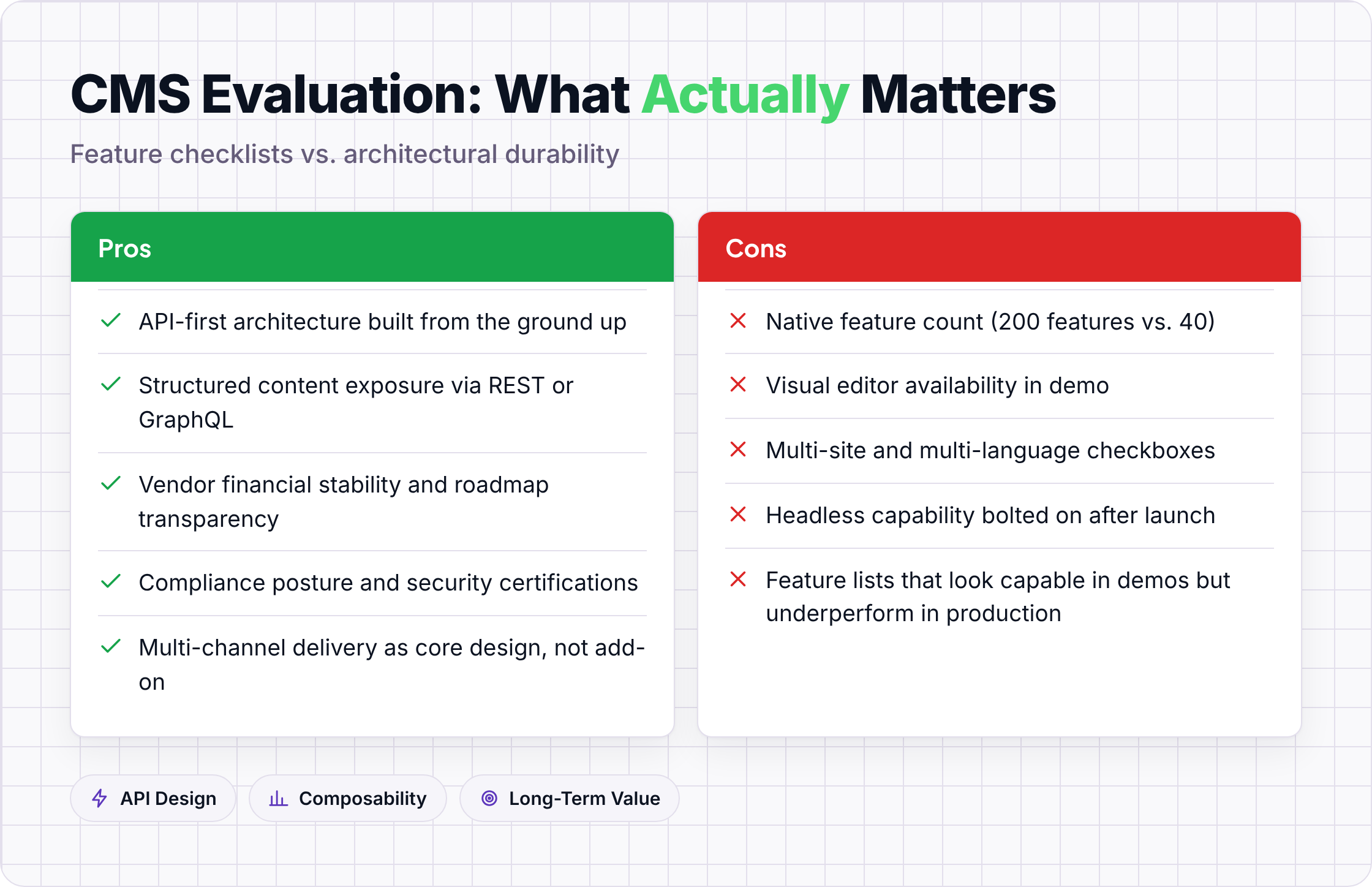
Most enterprises evaluate CMS platforms by comparing feature checklists: does it support multi-site? Does it have a visual editor? Can it handle five languages? Those questions are reasonable, but they consistently lead buyers toward platforms that look capable in a demo and underperform in production. The more consequential questions involve API design depth, vendor financial stability, and compliance posture, none of which appear on a standard RFP scorecard.
Feature Lists vs. Composability Depth
A CMS that ships 200 native features is not automatically more useful than one that ships 40 and connects cleanly to everything else. The distinction is API-first architecture: whether the platform was built from the ground up to expose content through structured APIs, or whether headless capability was bolted on after the fact to keep pace with market expectations.
The difference shows up at integration time. A platform with genuine composability depth lets your commerce layer, personalization engine, and analytics stack pull content without custom middleware. A platform with retrofitted headless support usually requires workarounds that accumulate into maintenance debt. Clear Digital's 2026 enterprise CMS analysis flags this directly: B2B organizations consistently underestimate integration complexity during vendor selection, then absorb the cost in the first 18 months post-launch.
The trade-off is real, though. Genuinely API-first platforms often ship thinner native editorial tooling. If your content team is large and non-technical, a composable architecture that requires three integrated tools to replicate what a monolithic CMS does in one interface may slow publishing velocity rather than improve it. Composability is a structural advantage for engineering teams; it is a workflow burden for teams that lack them.
Vendor Stability and Roadmap Transparency
Sitecore's 2023 restructuring is the clearest recent case study in what happens when enterprises skip vendor due diligence. The company laid off a significant portion of its workforce, consolidated product lines, and shifted its go-to-market model, leaving customers mid-implementation with uncertain roadmap commitments and support continuity questions. Buyers who had signed multi-year contracts on the strength of a product roadmap found that roadmap materially changed within 12 months of signing.
The lesson is not that Sitecore is a poor choice. It is that roadmap transparency and financial health belong in your evaluation criteria alongside feature parity. Ask vendors for audited financials or, at minimum, investor backing details. Request a written roadmap commitment with version timelines. Understand what happens to your contract if the vendor is acquired or restructures. These questions feel uncomfortable in a sales cycle; they feel necessary 18 months later.
Compliance Gaps That Surface After Contract Signing
Security posture and compliance depth are the most consistently underweighted criteria in enterprise CMS evaluations. Most platforms will tell you they are SOC 2 Type II certified and GDPR-compliant. Far fewer will give you a clear answer on data residency controls, role-based access audit logs, or how content delivery infrastructure handles a breach notification requirement under a 72-hour regulatory window.
Ask for a completed security questionnaire before you sign, not after. Request documentation on where content data is stored at rest, which subprocessors handle delivery infrastructure, and whether the platform supports field-level encryption for regulated content types. If a vendor cannot answer those questions during the sales cycle, they will not answer them faster during an incident.
Frequently Asked Questions
What is the most future-proof enterprise CMS architecture?
API-first, headless architecture is the most durable foundation for enterprise content management. It separates the content repository from the presentation layer, so your front-end stack, delivery channels, and personalization tools can evolve without forcing a platform migration. Composable architectures extend this further by making each capability (search, commerce, personalization) independently replaceable.
How do I know if my current CMS will become a liability?
The clearest warning signs are the absence of a native REST or GraphQL API, a rendering engine tightly coupled to the content repository, and a vendor roadmap that has not addressed multi-channel delivery. If your team needs custom middleware to connect your CMS to a third-party tool, that middleware cost compounds with every new integration you add.
Is Contentful still a strong choice for enterprises in 2026?
Contentful remains one of the more mature API-first options, with a well-documented content delivery API, strong ecosystem support, and enterprise-grade role management. The main limitation is cost at scale: pricing tiers can become significant for organizations with large content teams or high API call volumes. Evaluate it against Storyblok and Hygraph if budget predictability matters to your procurement process.
How long does a typical enterprise CMS migration take?
Most enterprise migrations run 12 to 24 months from vendor selection to full production cutover, depending on content volume, integration complexity, and governance debt. Organizations migrating from platforms with no API layer consistently land at the higher end of that range. The 40-hospital healthcare example above cleared $2 million and 18 months before a single page went live, which is not unusual for large regulated environments.
What compliance certifications should an enterprise CMS have?
SOC 2 Type II and ISO 27001 are the baseline. For regulated industries, you should also verify HIPAA readiness (if applicable), data residency controls that match your operating regions, and a documented breach notification process that fits within GDPR's 72-hour window. Ask for the vendor's most recent penetration test summary and their subprocessor list before signing.
Does headless CMS hurt SEO?
Headless architecture does not inherently hurt SEO, but it shifts responsibility for technical SEO to your front-end implementation. Server-side rendering (SSR) or static site generation (SSG) at the framework level (Next.js, Nuxt, Astro) ensures that search crawlers receive fully rendered HTML rather than a JavaScript shell. Organizations that deploy headless without SSR or SSG often see crawl coverage issues within the first few months.
Which enterprise CMS is most future-proof for global organizations?
For organizations publishing across 15 or more markets, the platforms that hold up best are those with native edge delivery, built-in localization workflows, and content models that support locale-specific variants without duplicating the entire content tree. Contentful, Storyblok, and Hygraph all support this pattern. The more important variable is whether your content governance model is designed for multi-market publishing before you choose the platform, not after.
Ready to Audit Your CMS Stack?
If you are evaluating which enterprise CMS is most future-proof for your organization, the integration layer is where most decisions succeed or fail. See how Seorav can help you map your current CMS integrations, identify technical debt, and build a migration roadmap grounded in your actual content architecture.
Keep reading
How to Track Your Content's Visibility in LLM-Powered Search
Learn how llm seo tracking works, which tools to use, and how to measure your content's citation rate across ChatGPT, Perplexity, Gemini, and Claude.
AI Citation Monitoring Tools That Actually Work in 2025
Compare the best AI citation monitoring tools for 2026. Profound, Otterly.AI, Brandwatch, and more, tested across ChatGPT, Perplexity, Claude, and Gemini.
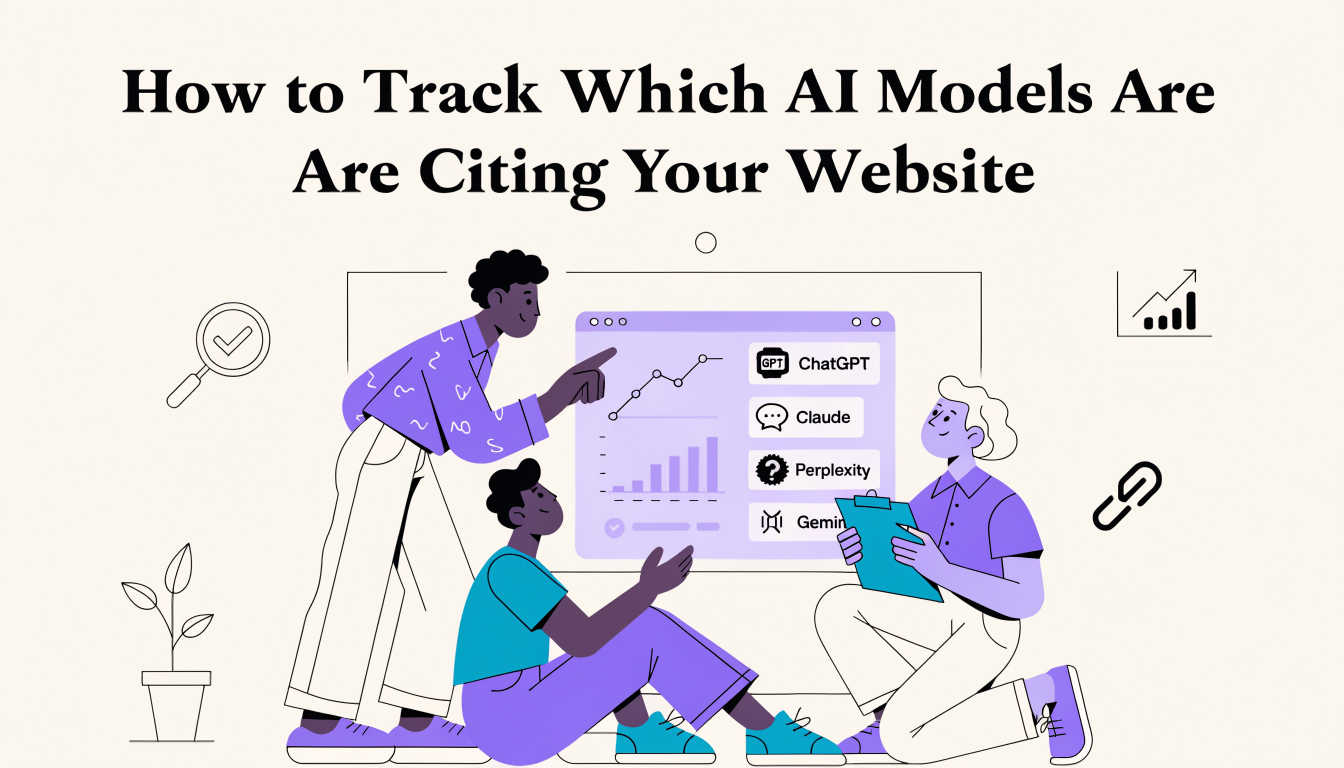
How to Track Which AI Models Are Citing Your Website
Learn how to set up ai search citation analytics across ChatGPT, Perplexity, Claude, and Gemini. Includes tool comparisons, prompt setup, and competitor ga