How to Track Your Content's Visibility in LLM-Powered Search
Last updated: 23 November 2026
LLM SEO tracking monitors whether your content gets cited when users submit queries to AI engines like ChatGPT and Claude. The process involves sending target prompts on a regular schedule, capturing which URLs appear in responses, and recording citation events over time. Unlike traditional keyword rankings that show position numbers, LLM tracking uses binary metrics: your content was cited or it wasn't. This fundamental difference requires new measurement approaches for visibility in AI-powered search.
What LLM SEO Tracking Actually Measures
LLM SEO tracking works by submitting target prompts to AI engines on a recurring schedule, parsing each response, and logging which URLs get cited. Unlike a keyword rank, there is no position number. The metric is binary at the event level: your content was cited, or it was not.
When Google returns a results page, your URL sits at position 3 or position 11, and you can optimize toward moving up. When ChatGPT synthesizes an answer, it does not return a ranked list of your pages. It writes a response and may, or may not, pull a fact from something you published. A page-rank position has no equivalent here.
The tracking problem is real and largely invisible to standard tooling. SEO and LLM tracking measure fundamentally different things: traditional SEO metrics capture stable, quantitative signals like position and click-through rate, while LLM visibility tracking evaluates whether an AI engine included your content in a synthesized answer at all. Google Search Console never captures a ChatGPT citation event. Neither does your analytics platform.
The numbers frame the gap clearly. ChatGPT now processes over a billion queries per week, and Perplexity has crossed 100 million monthly users. A meaningful share of those queries return synthesized answers with no click-through to any source. If your content gets cited, you influence the answer. If it does not, you are absent from the conversation entirely, regardless of where you rank on page one.
One honest caveat: citation tracking is probabilistic. AI engines do not cite sources on every response, and the same prompt can return different citations on different days. Good tracking programs account for this by running each prompt repeatedly over time and looking at citation frequency, not single-event snapshots.
Three Things to Know Before You Start LLM SEO Tracking
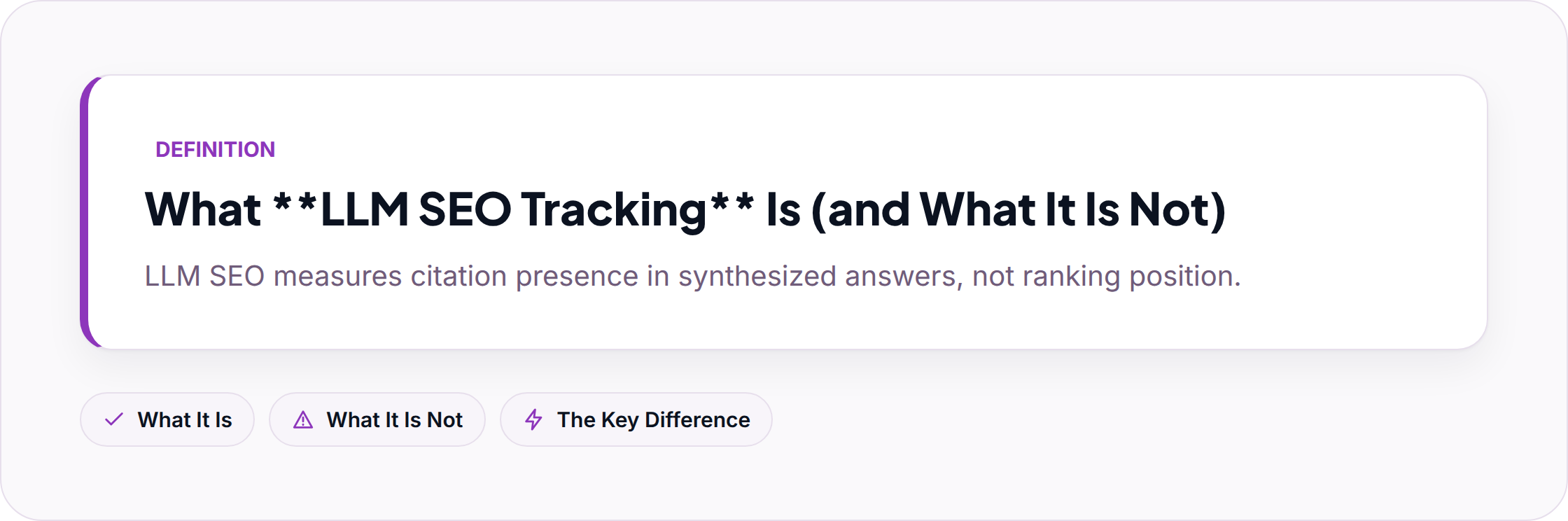
LLM SEO tracking means monitoring whether AI engines cite your content when users ask relevant questions. It does not mean tracking keyword rankings. Most teams have zero baseline data for AI citations because standard analytics tools were never built to capture them. Prioritize LLM tracking when your buyers are already using ChatGPT or Perplexity to research your category.
What LLM SEO tracking is (and what it is not)
LLM SEO is the practice of getting large language models to mention and recommend your content in response to user queries, not to rank a URL in a list of blue links. The mechanism is different: AI engines synthesize answers from sources they find credible and structurally clear, then surface a citation. Your Google position has limited bearing on whether that happens.
The trade-off is real. A page that ranks number one organically may never get cited by ChatGPT if it lacks a direct, quotable answer near the top. Conversely, a page sitting on page two of Google can earn consistent AI citations if it answers a specific question cleanly. Optimizing for both simultaneously is possible, but the signals you watch are not the same.
Why most teams have no baseline data
Search Console tracks impressions and clicks from Google. It does not log a single query that came through ChatGPT, Claude, Perplexity, or Gemini. Most analytics platforms are in the same position: they record the session after the click, not the AI-generated response that preceded it.
The result is a blind spot that compounds over time. ChatGPT now processes over one billion queries per week, and Perplexity has crossed 100 million monthly active users. If your team has not been explicitly polling AI engines with your target prompts and logging the responses, you have no citation history, no trend data, and no way to know whether a content change helped or hurt your AI visibility.
When to prioritize LLM tracking over traditional rank monitoring
This depends on where your buyers are in their research process. AI-generated search responses are rewriting discovery behavior across high-consideration categories, particularly B2B software, financial services, and healthcare. If your sales team is already hearing "I asked ChatGPT and it recommended..." on discovery calls, LLM tracking should move up the priority list immediately.
This breaks down for categories where search intent is still transactional and local. A plumber or a restaurant does not need to audit Claude citations before fixing their Google Business Profile. The calculus shifts when the buyer's research phase is long, the decision is complex, and AI engines are a credible shortcut to a shortlist.
How the LLM Citation Landscape Looks Across Platforms
Each major AI engine pulls from a different content surface. ChatGPT leans on web-crawled sources and Bing-indexed pages. Perplexity actively retrieves live URLs and cites them inline. Gemini draws from Google's index. Claude tends to synthesize from training data, citing less frequently in real time.
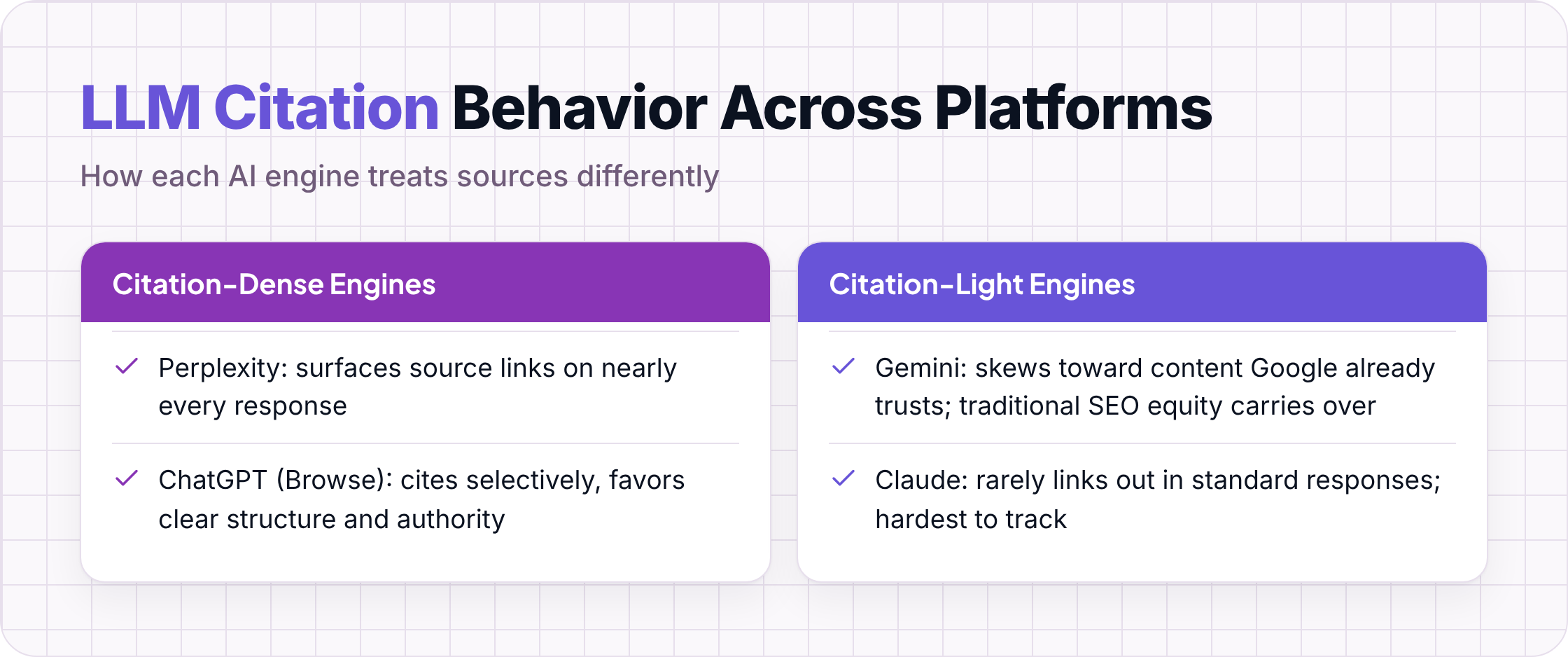
The four platforms do not behave like four versions of the same thing. Perplexity is the most citation-dense: it surfaces source links on nearly every response, making it the easiest engine to track and the most rewarding to optimize for. ChatGPT with Browse enabled cites selectively, usually favoring pages with clear structure and authoritative domain signals. Gemini skews toward content Google already trusts, so traditional SEO equity carries over more directly there than on the other three. Claude, by contrast, rarely links out at all in standard responses, which makes citation tracking on that platform harder to operationalize.
Content format matters as much as content quality. Perplexity and ChatGPT both favor structured, answer-first pages: definitions up top, supporting detail below, schema where possible. LLM SEO optimization research from optimizegeo.ai identifies structured content with clear entity signals as a consistent factor in AI citation selection across platforms. Gemini responds well to long-form editorial content that mirrors what ranks in Google's featured snippets. Claude, when it does cite, tends to pull from dense, well-sourced reference material rather than short-form posts.
One trade-off worth naming: optimizing for one engine's citation pattern can work against another's. A tightly structured FAQ page may perform well on Perplexity but get ignored by Claude, which prefers depth over brevity. Teams with limited content bandwidth have to pick a primary engine to optimize for, then treat the others as secondary coverage rather than equal targets.
How LLM Search Results Differ From Google Rankings
Google returns a ranked list of URLs. LLM-powered search engines like Perplexity and ChatGPT return a synthesized answer, often with two to five inline citations buried inside a paragraph. Your job as a content creator shifts from earning a high position on a results page to earning a mention inside a generated response. Those are different optimization targets, and the measurement tools that work for one do not transfer to the other.
Synthesized Answers vs. Ranked Blue Links
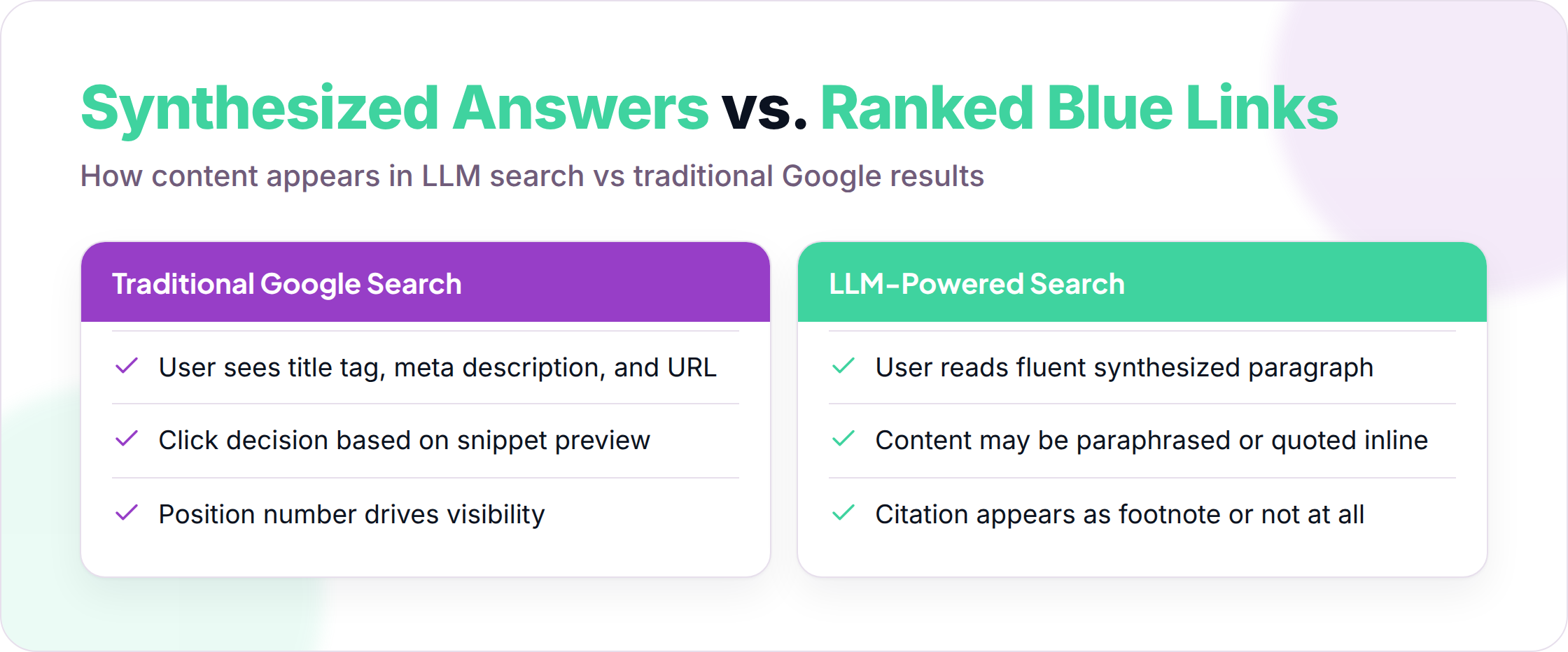
With traditional search, a user sees your title tag, your meta description, and your URL. They decide whether to click. With an LLM response, the user reads a fluent paragraph that may paraphrase your article, quote a sentence from it, or ignore it entirely. Your brand might appear as a citation footnote, or it might not appear at all, even if your article was part of the model's source pool.
The practical shift for content creators: writing for AI citation means structuring content so a model can extract a clean, self-contained answer from it. LLM SEO is the practice of optimizing content to be cited and recommended by large language models, not just indexed by crawlers. That requires answer-first openings, explicit factual claims, and schema markup. Google's ranking algorithm does not penalize any of those choices, but it does not specifically reward them either.
Why CTR and Impressions Data Disappear
Google Search Console gives you impressions, clicks, average position, and click-through rate. Every metric assumes a user saw a link and chose whether to follow it. In an AI-generated response, that chain breaks. The user never sees a ranked list. They read a paragraph. If your article is cited, there may be a small inline link, but most users do not click it.
The numbers reflect this. AI Overviews and zero-click AI responses are measurably compressing organic CTR across high-intent queries, with some category-level data showing double-digit CTR drops on queries where an AI answer now appears above the fold. Impressions stay flat or rise because your URL still gets crawled, but clicks fall because the answer was already delivered.
Search Console has no field for "cited in a Perplexity response." Analytics has no session source labeled "ChatGPT." The visibility exists, but the standard measurement stack cannot see it.
Worked Example: The Same Query, Two Reports
Take the query "best project management software for remote teams." In Google Search Console, you might see 4,200 impressions, 190 clicks, an average position of 6.2, and a CTR of 4.5%. That data tells you where you rank and how often people choose your link over others.
Run the same query through a Perplexity citation report and the output looks different. Perplexity synthesizes an answer that names three or four tools, pulls a sentence from each source, and lists citations at the bottom. Your article might be cited (your URL appears, your brand gets a mention), partially cited (your data is paraphrased without attribution), or absent entirely. The metric that matters is citation frequency across repeated queries over time, not a single position number.
Citation tracking at this level requires active polling: you have to submit the queries you care about, run them repeatedly across engines, and parse the responses. That is not a passive process the way Search Console crawl data is. For teams with a small content footprint or limited tooling, the overhead of building a citation monitoring workflow can outweigh the signal, at least until AI-driven traffic becomes a measurable share of their inbound. The approach works best when you already know which queries your buyers use and can track a focused set of 20 to 50 prompts consistently.
Tools and Methods for Monitoring LLM Visibility
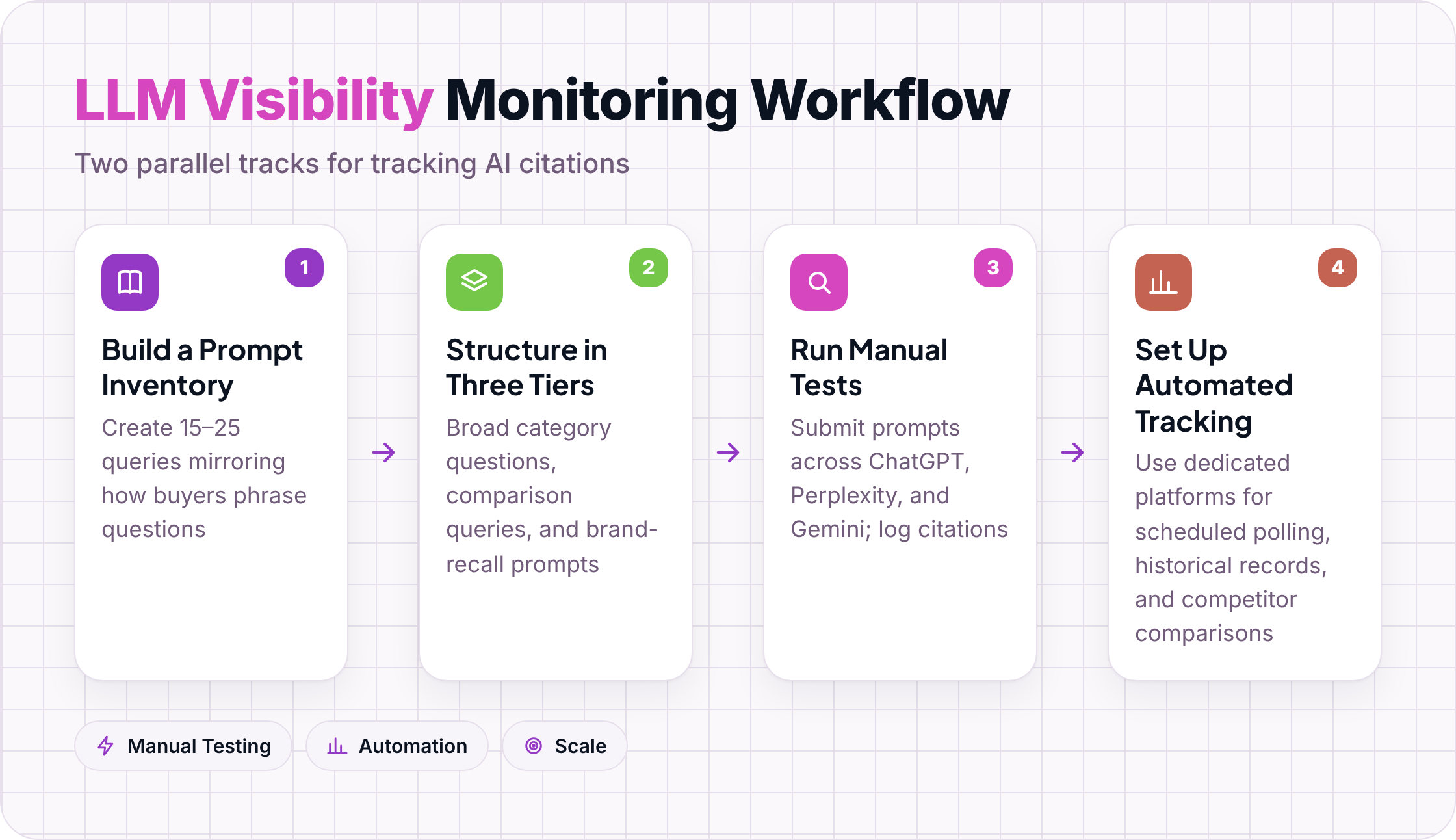
Monitoring your content's visibility in LLM-powered search requires two parallel tracks: manual prompt testing to build intuition quickly, and automated citation tracking to catch trends over time. Manual testing costs nothing but time and works across ChatGPT, Perplexity, and Gemini right now. Dedicated tracking platforms add scheduled polling, historical records, and competitor comparisons that no manual process can replicate at scale.
Manual Prompt Testing: Building a Repeatable Query Set
Start with a prompt inventory of 15 to 25 queries that mirror how your buyers actually phrase questions, not how your internal team talks about your product. Structure each prompt in three tiers:
- Broad category questions ("what tools help with X")
- Comparison queries ("X vs Y for [use case]")
- Specific brand-recall prompts ("what do people say about [your brand]")
Run each prompt across ChatGPT (GPT-4o), Perplexity, and Gemini in the same session, in the same browser profile with no personalization history. Log the full response, the URLs cited, and whether your brand or content appeared. Do this weekly for at least four weeks before drawing any conclusions. Single-session results are too noisy to act on.
A simple spreadsheet works for this stage. Columns for date, engine, prompt, cited URLs, brand mentioned (yes/no), and any notable phrasing your content contributed to the answer. After a month, patterns emerge: which prompts consistently surface your content, which engines ignore you, and which competitor domains appear more often than yours.
Automated Citation Tracking Platforms
Manual testing tells you what is happening now. Automated platforms tell you what changed and when. Several tools have emerged specifically for LLM SEO tracking, each with different strengths.
Platforms like Profound, Goodie AI, and Otterly.ai poll AI engines on a scheduled basis, log citation data over time, and surface trend lines you cannot build manually. They differ in which engines they cover, how frequently they poll, and whether they track competitor citations alongside yours. Pricing as of late 2026 ranges from roughly $99 to $500 per month depending on prompt volume and engine coverage.
The limitation worth knowing: no third-party tool has direct API access to every AI engine's live retrieval layer. Most tools simulate user queries and parse the visible response, the same thing you do manually, just at higher frequency and with structured logging. That means they can miss citations that appear in personalized or logged-in sessions, and they cannot see what a model considered but did not cite.
What to Log and How to Interpret It
Raw citation data is only useful if you track it against content changes. Every time you update a page, add schema markup, or publish a new article targeting a tracked prompt, note the date. Then watch whether citation frequency on related prompts shifts in the following two to four weeks.
Three signals worth tracking consistently:
- Citation rate: how often your content appears across repeated runs of the same prompt, expressed as a percentage (cited in 7 of 10 runs = 70% citation rate)
- Share of voice: your citation count divided by total citations across all sources for a given prompt set, compared against two or three competitors
- Engine distribution: which platforms cite you most, and whether that matches where your buyers actually spend time
A 70% citation rate on a high-intent prompt is a strong signal. A 10% rate on the same prompt after a content update that was supposed to improve clarity is a signal to investigate. The numbers only mean something in context.
Frequently Asked Questions
What is LLM SEO tracking?
LLM SEO tracking is the practice of monitoring whether AI-powered search engines like ChatGPT, Perplexity, Gemini, and Claude cite your content when users ask relevant questions. You submit target prompts to these engines on a recurring schedule, log which URLs appear in the responses, and measure citation frequency over time. Standard analytics tools do not capture this data, so it requires a separate monitoring workflow.
How is LLM SEO tracking different from traditional rank tracking?
Traditional rank tracking measures where your URL appears in a list of search results. LLM SEO tracking measures whether your content is mentioned inside a synthesized paragraph. There is no position number in an AI-generated answer, only presence or absence. The tools, the optimization tactics, and the content signals that drive each outcome are different enough that you need separate processes for each.
Which AI engines should I track first?
Start with Perplexity and ChatGPT. Perplexity cites sources on nearly every response and surfaces inline links, making it the most measurable and the most directly tied to referral traffic. ChatGPT with Browse enabled is the highest-volume engine by query count. Gemini is worth adding if your content already performs well in Google's featured snippets, since the two share significant index overlap. Claude is the hardest to track reliably and the lowest priority for most teams starting out.
How many prompts do I need to track?
A focused set of 20 to 50 prompts is enough to generate actionable data for most content programs. Fewer than 20 and you risk missing the queries where you actually have citation potential. More than 50 and the manual overhead becomes unsustainable without a dedicated tool. Prioritize prompts that map to your highest-value buyer questions, not your broadest category terms.
How long before I see meaningful citation data?
Plan for four to six weeks of consistent tracking before drawing conclusions. Citation behavior varies by day, by engine version, and by how recently a page was crawled. A single week of data is too noisy. After four weeks of weekly polling across your prompt set, you will have enough runs per prompt to calculate a citation rate that reflects a real pattern rather than random variation.
Can I improve my citation rate, or is it outside my control?
You can influence it, though not control it completely. Structuring pages with answer-first openings, explicit factual claims, and schema markup consistently improves citation rates on Perplexity and ChatGPT. Building topical authority across a cluster of related pages helps more than optimizing a single article in isolation. That said, AI engines update their retrieval behavior without notice, and a tactic that works in Q3 may stop working in Q4. Treat citation optimization as an ongoing process, not a one-time fix.
Do AI citations drive actual traffic?
Some, but less than a comparable organic ranking. Most users who read an AI-generated answer do not click through to the cited sources. The value of a citation is partly referral traffic and partly brand influence: your name and framing appear in the answer, shaping how the user thinks about the topic even if they never visit your site. For high-consideration purchases where the buyer researches over weeks, that brand presence in AI answers can matter more than a single click.
If you want to see where your content stands in AI-generated answers right now, visit Seorav's GEO tracking tool to start monitoring your citation visibility across the major LLM platforms.
Keep reading
Which Enterprise CMS Will Still Matter in 2030
Find out which enterprise CMS is most future-proof. Compare headless, composable, and coupled architectures to avoid costly migrations through 2030.
AI Citation Monitoring Tools That Actually Work in 2025
Compare the best AI citation monitoring tools for 2026. Profound, Otterly.AI, Brandwatch, and more, tested across ChatGPT, Perplexity, Claude, and Gemini.
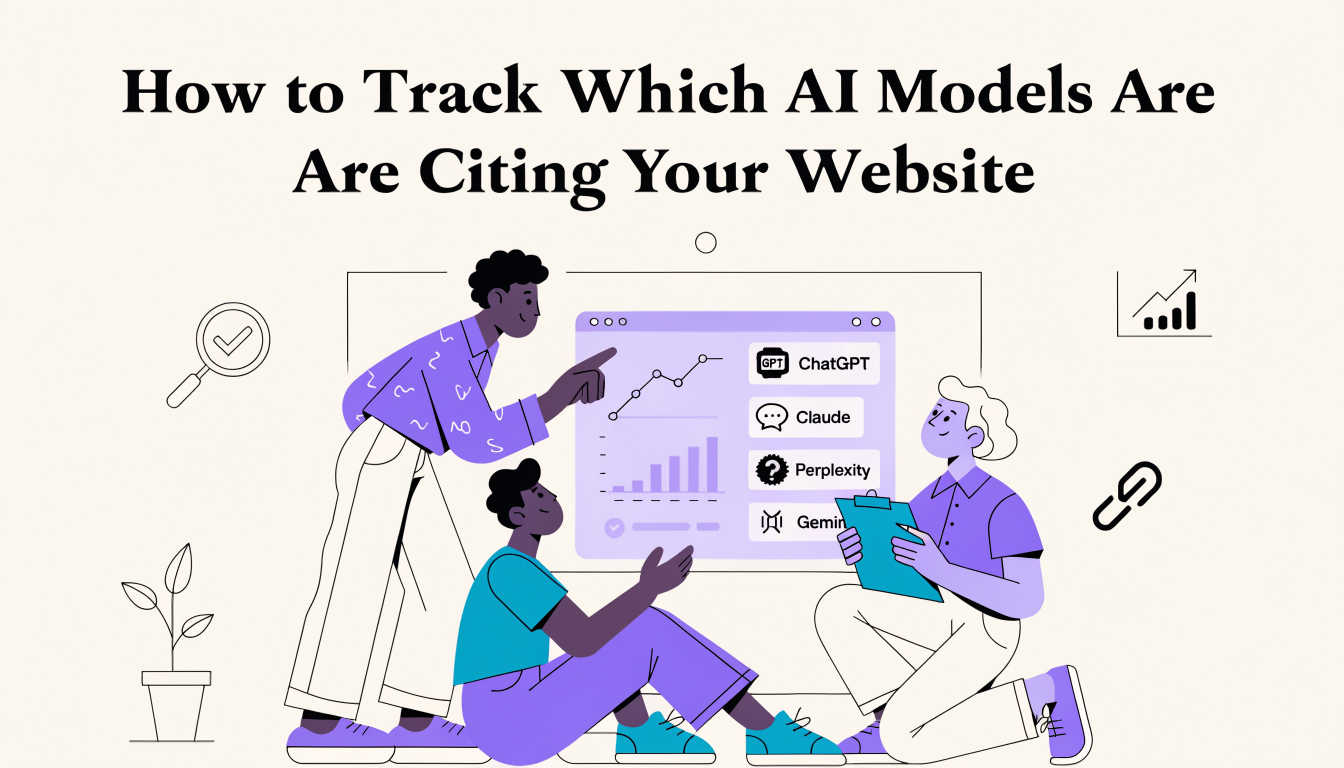
How to Track Which AI Models Are Citing Your Website
Learn how to set up ai search citation analytics across ChatGPT, Perplexity, Claude, and Gemini. Includes tool comparisons, prompt setup, and competitor ga