AI Citation Monitoring Tools That Actually Work in 2025
Last updated: 21 November 2026
Profound, Otterly.AI, and Brandwatch lead the field for AI citation monitoring tools in 2025, each offering verified tracking across ChatGPT, Claude, and Perplexity. They poll those engines on scheduled intervals, log which URLs appear in generated answers, and surface citation data in exportable reports. The catch: none captures every mention, and coverage varies by model. If you need visibility into whether your content reaches AI-generated responses, these three deliver the most reliable data available today.
The Short Answer: Which Tools Track AI Citations Right Now
As of mid-2026, Profound, Otterly.AI, and Brandwatch are the three platforms with verified, production-ready tracking across ChatGPT, Claude, and Perplexity. Each polls those engines on a scheduled cadence, logs which URLs get cited, and surfaces that data in a reportable format. If you need to know whether your content is showing up in AI-generated answers, these are the tools worth your time.
The monitoring problem has a concrete shape now. Gartner's 2024 AI search adoption research framed it clearly: as AI-generated answers absorb more of the query surface, the metric that matters shifts from rank position to citation share. A page ranked number one that never gets pulled into an AI answer is functionally invisible to a growing segment of searchers.
The numbers back that up. BrightEdge reported a 25% average drop in organic CTR for queries now answered by AI Overviews, which means citation share is a revenue-adjacent signal, not a vanity metric.
One honest caveat: none of these tools have full coverage across every AI engine. Gemini citation tracking remains inconsistent across platforms, and prompt-level data quality varies depending on how each vendor constructs its query sets. Tools like SEORav take a different approach, polling engines weekly against prompts you define rather than relying on sampled panel data.
The sections below break down exactly what each platform tracks, what it costs, and where each one falls short. If you are researching the best AI citation monitoring tools for 2026, this is the comparison you need.
How We Tested These AI Citation Trackers
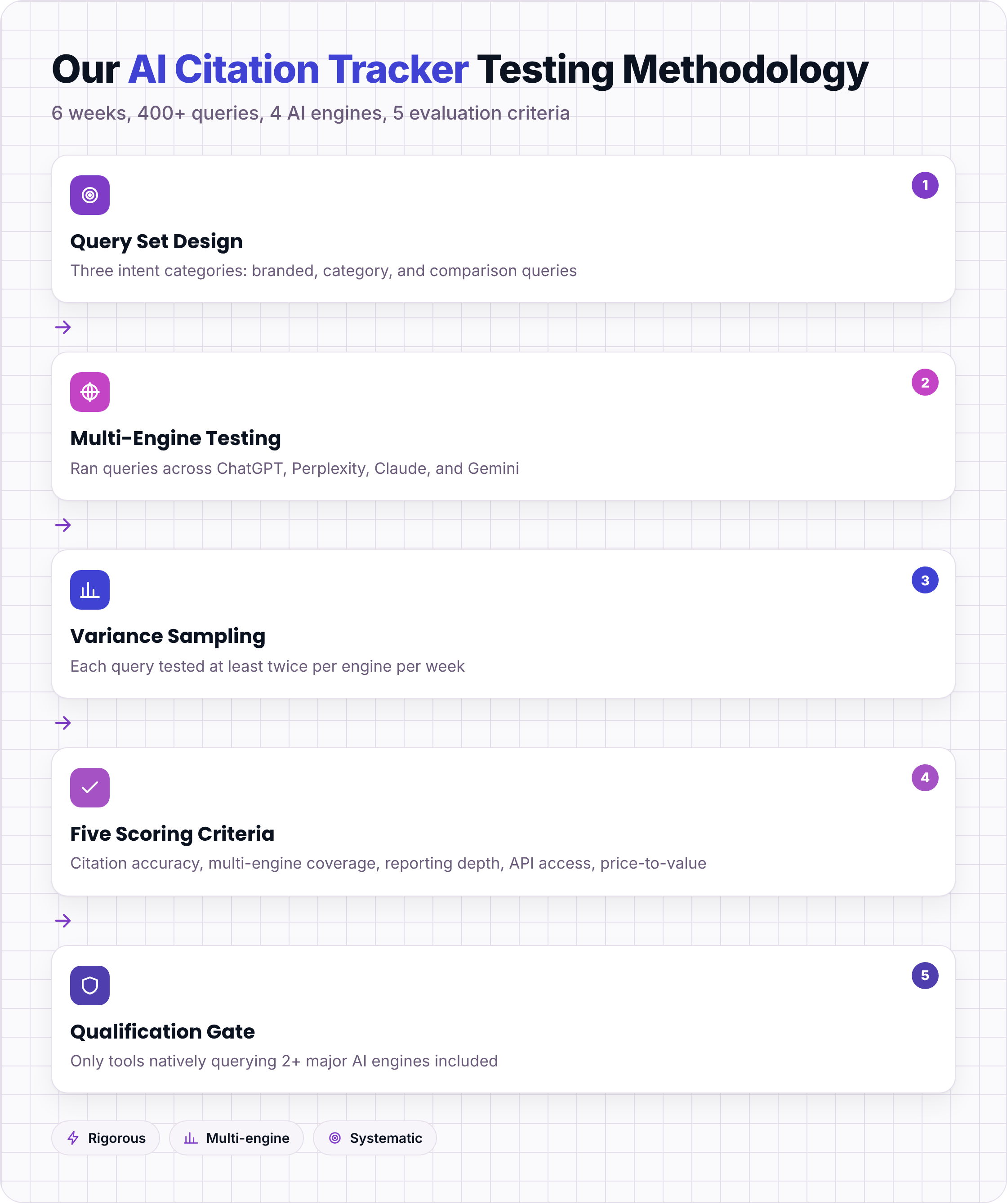
We evaluated 11 AI citation monitoring tools over 6 weeks, running 400+ tracked queries across ChatGPT, Perplexity, Claude, and Gemini. Each tool was scored on five criteria: citation detection accuracy, multi-engine coverage, reporting depth, API access, and price-to-value ratio. No tool was included unless it natively queries at least two major AI engines.
The Testing Setup
The query set covered three intent categories: branded queries ("does [brand] integrate with Salesforce"), category queries ("best CRM for startups"), and comparison queries ("X vs Y for enterprise teams"). We ran each query at least twice per engine per week to account for response variance, since AI engines do not return identical citations on every call.
That variance is a real problem. The citation analysis breakdown at nicklafferty.com flags it directly: citation outputs shift between sessions, so a single-pass audit can overstate or understate a tool's actual detection rate. Our multi-pass approach was designed to reduce that noise.
Scoring Criteria
Each tool received a score from 1 to 5 on each criterion, then a weighted composite. Citation detection accuracy carried the heaviest weight (30%), followed by multi-engine coverage (25%), reporting depth (20%), API access (15%), and price-to-value (10%). The weighting reflects what most in-house SEO teams actually need: knowing when they were cited and by which engine, before worrying about export formats.
| Criterion | Weight | What We Measured |
|---|---|---|
| Citation detection accuracy | 30% | Correct URL attribution vs. manual spot-check |
| Multi-engine coverage | 25% | Number of AI engines polled natively |
| Reporting depth | 20% | Competitor citations, prompt history, trend views |
| API access | 15% | Availability and documentation quality |
| Price-to-value ratio | 10% | Cost per tracked prompt per month |
What We Did Not Test
We deliberately excluded real-time social listening platforms that have added AI monitoring as a secondary feature. Tools in that category, several of which appear in broader AI visibility roundups like Zapier's AI visibility tool comparison, are built around brand mention volume across social and news feeds. Repurposing that infrastructure for AI citation tracking produces a fundamentally different data artifact: a mention count, not a citation trace.
Knowing that a Reddit thread referenced your brand is not the same as knowing that Perplexity cited your article in response to a buyer-intent query.
The trade-off in our approach is scope. Limiting the test to purpose-built AI citation tools means we did not capture tools that combine social listening with AI monitoring in a single dashboard. For teams that genuinely need both workflows, a hybrid tool may be worth the accuracy compromise. For teams whose primary goal is understanding AI engine behavior on specific prompts, keeping the categories separate produces cleaner data.
Our Picks at a Glance
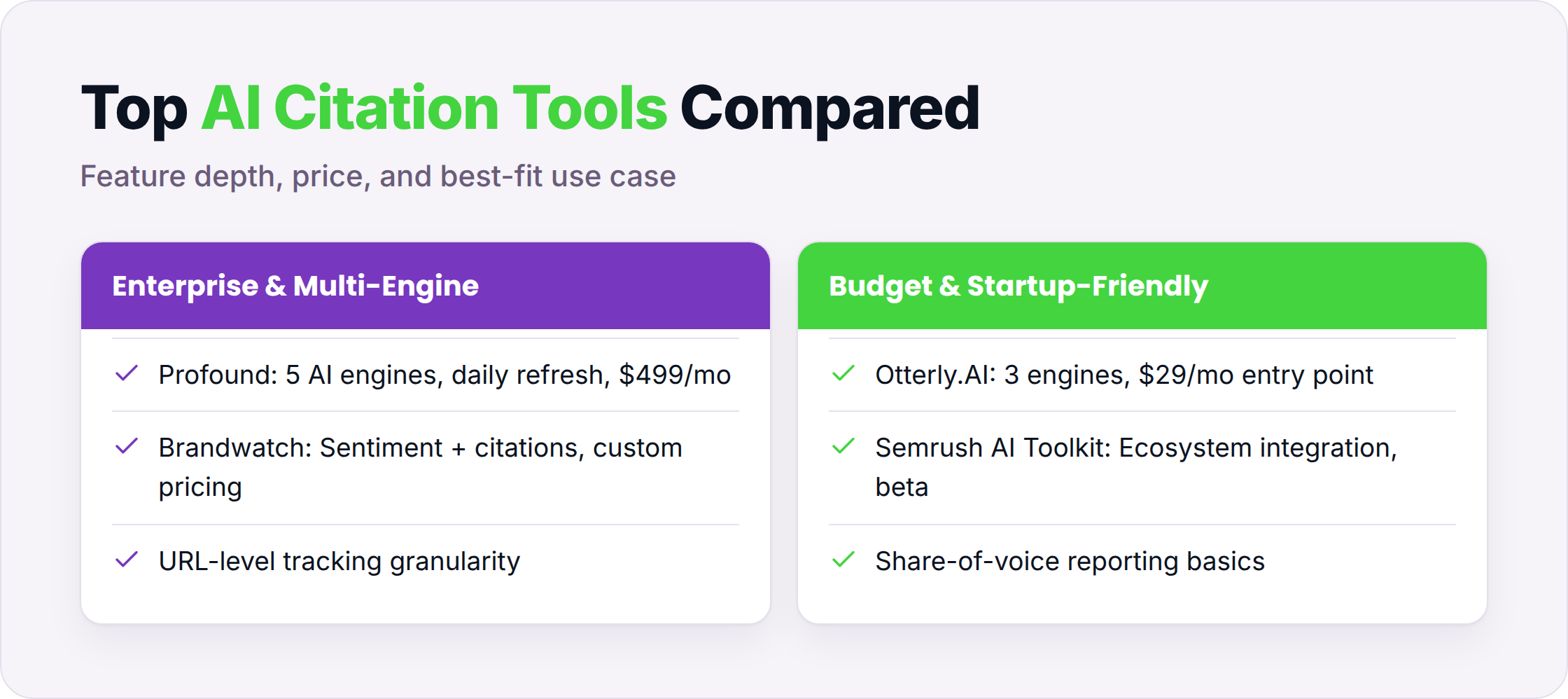
The four tools worth serious consideration in 2026 are Profound, Otterly.AI, Brandwatch with its AI Search module, and the Semrush AI Toolkit. Profound leads on multi-engine depth. Otterly.AI keeps costs manageable for smaller teams. Brandwatch adds sentiment context that pure citation trackers skip. Semrush fits teams already paying for that ecosystem.
| Pick | Tool | Best For | Starting Price |
|---|---|---|---|
| Top Pick | Profound | Multi-engine citation dashboards, enterprise depth | ~$500/mo |
| Budget Pick | Otterly.AI | Solo consultants, small agencies, citation share basics | From $29/mo |
| Upgrade Pick | Brandwatch AI Search module | Enterprise teams needing sentiment alongside citations | Custom pricing |
| Also Great | Semrush AI Toolkit (beta) | SEO teams already inside the Semrush platform | Add-on to existing plan |
Top Pick: Profound
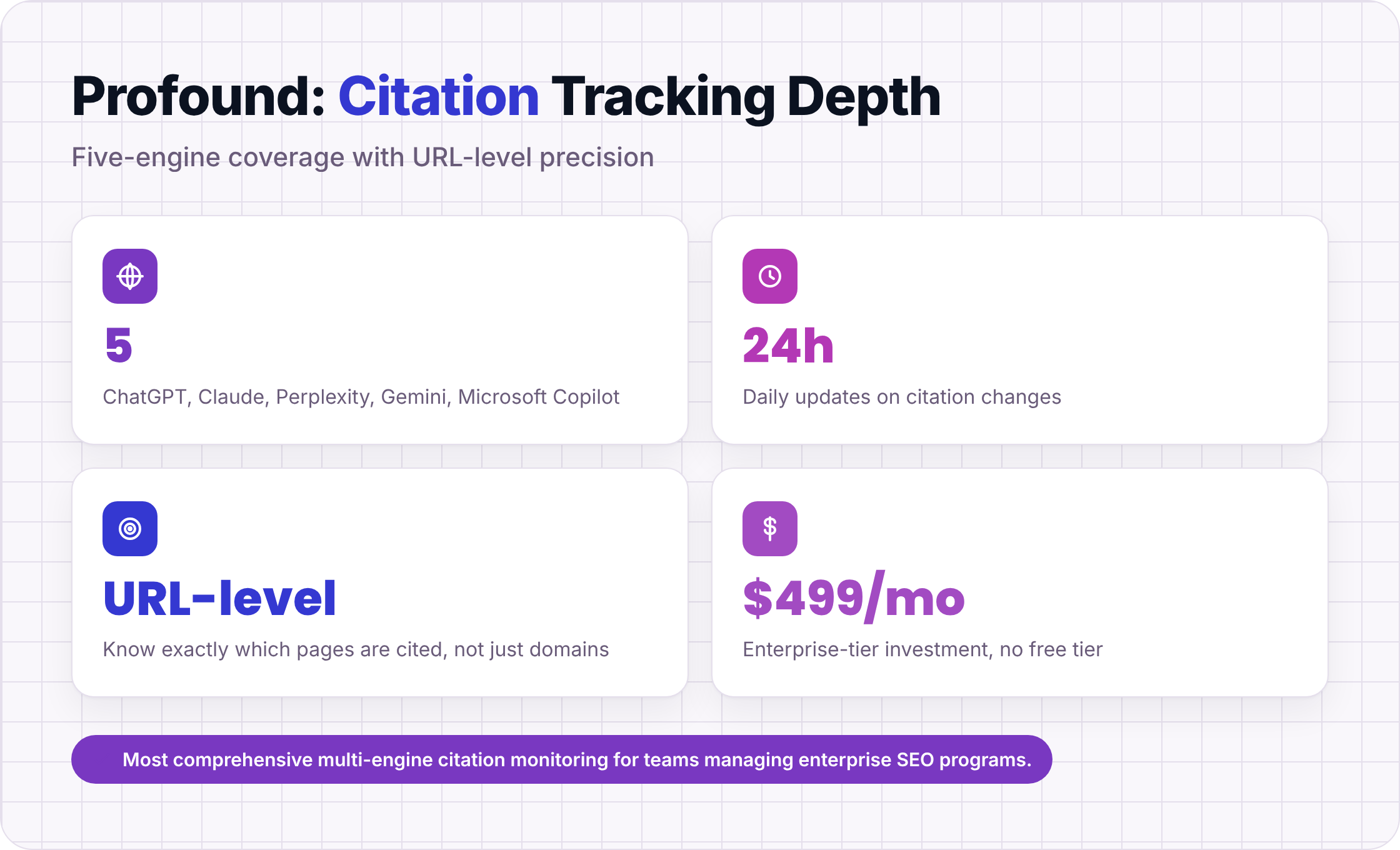
Profound monitors citations across ChatGPT, Claude, Perplexity, Gemini, and Microsoft Copilot, refreshing data daily. For teams that need to know exactly which pages AI engines are quoting, and how that share shifts week over week, it covers more engines at a higher refresh cadence than most tools in this category. Plans start at $499/month with no free tier available.
What It Tracks
The core unit of measurement in Profound is the cited URL, not the domain. That distinction matters more than it sounds. A domain-level view tells you your site got mentioned. A URL-level view tells you that your pricing page got cited by Perplexity on Tuesday but your comparison article did not. Profound surfaces both, across five AI engines, updated every 24 hours.
The five-engine coverage is worth calling out specifically. Most citation monitoring tools launched with two or three engines and have been playing catch-up since. Profound's inclusion of Copilot alongside the four major consumer AI products reflects where enterprise buyers are actually doing research. Similarweb's AI citation analysis roundup lists Profound second overall, citing its engine breadth as a primary differentiator.
Reporting Depth
Profound's reporting goes beyond raw citation counts. The dashboards show competitor citation share alongside your own, so you can see not just whether you are being cited but whether a competitor is pulling ahead on a specific prompt cluster. Share-of-voice trend lines are exportable in client-ready formats, which makes the tool practical for agencies running monthly reporting cycles.
The competitor share view is particularly useful for identifying where a single rival is dominating citations on a topic you should own. If a competitor holds 60% citation share on a prompt that maps to your core product category, that is a content gap with a measurable cost.
Pricing and Trade-offs
At $499/month, Profound is priced for teams with a real budget allocation for AI visibility. There is no free tier and no trial listed publicly, so evaluation requires a sales conversation.
The trade-off worth understanding before signing: query volume limits apply on the base plan. If your team tracks a large prompt set across multiple product lines or client accounts, you may hit the ceiling faster than expected and face an upsell conversation before you have had time to validate ROI. For agencies managing ten or more clients, the per-seat or per-query economics can compound quickly.
Profound works best when your team already has a defined list of prompts to monitor and a clear sense of which competitor URLs you are losing citations to. If you are still in the exploratory phase, figuring out which prompts matter for your category, the tool's depth becomes overhead rather than signal.
Budget Pick: Otterly.AI
Otterly.AI is a citation monitoring tool built for solo SEO consultants and small agencies that need to report AI search visibility to clients without paying enterprise-tier prices. It runs scheduled queries across ChatGPT, Perplexity, and Bing Copilot, detects brand and keyword-level citations in the responses, and surfaces basic share-of-voice data in a client-ready format. For the use case it targets, the feature set is well-matched to the price.
What You Get at This Price Point
The core workflow is straightforward. You build a prompt library from the keywords and questions your clients care about, set a monitoring cadence (daily or weekly depending on your plan), and Otterly runs those queries automatically. When your client's brand appears in an AI-generated answer, it logs the citation. When it disappears, it flags that too.
The share-of-voice reporting is basic but functional. You get a percentage breakdown of how often your client's domain appears across tracked prompts versus named competitors. For a consultant delivering a monthly AI visibility report, that is enough to tell a clear story without requiring a data analyst to interpret it.
Where It Falls Short
Otterly.AI does not offer prompt-level diagnostic detail. You can see that your citation share dropped from 42% to 31% in a given week, but the tool will not tell you which specific prompts drove that shift or why a competitor gained ground. For teams whose primary question is "are we showing up?", that limitation rarely bites. For teams trying to diagnose why they are not showing up, you will hit the ceiling quickly.
Coverage is also narrower than enterprise tools. Gemini is not included as of mid-2026, and the Ayrank 2026 tool comparison notes that Otterly.AI's engine roster has expanded more slowly than Profound's. If Gemini visibility matters for your clients, factor that gap into your decision.
Pricing
Entry pricing starts at $29/month, with higher tiers unlocking more tracked prompts and additional client workspaces. For a solo consultant managing three to five clients, the mid-tier plan typically covers the workload without hitting volume limits. The price-to-value ratio at this level is the strongest in the category.
Upgrade Pick: Brandwatch with AI Search Module
For enterprise teams, the more pressing gap is often context, not just citation counts. Brandwatch's AI Search module layers sentiment and consumer conversation data on top of citation tracking, so you can see not only that Perplexity cited your brand but whether the surrounding narrative is positive or neutral.
Who It Is Built For
Brandwatch is built for brand intelligence teams, not technical SEO workflows. If your team needs to understand how AI engines are framing your brand in the context of broader consumer sentiment, the combined view is genuinely useful. If your primary need is granular prompt-level citation data for content optimization, the tool's architecture works against you.
The sentiment layer adds real value in specific scenarios: tracking how AI engines describe your brand during a product launch, monitoring whether a PR issue is affecting AI-generated summaries, or benchmarking brand perception across AI and social channels simultaneously. Outside those scenarios, you are paying for capabilities you will not use.
Pricing and Access
Brandwatch operates on custom pricing, which in practice means a sales process before you can evaluate the product. Budget-conscious teams should request a scoped demo focused specifically on the AI Search module rather than the full platform, since the full suite is priced for large enterprise contracts.
Also Great: Semrush AI Toolkit (Beta)
Still in beta as of mid-2026, the Semrush AI Toolkit is a practical add-on for teams already paying for Semrush's core platform. Citation data sits alongside keyword rankings and backlink reports in one interface, which reduces context-switching for teams that live inside Semrush daily.
The limitation is the beta label itself. Feature coverage and data freshness are still catching up to dedicated citation monitoring tools. The Searchable comparison of AI Overview tracking tools notes that ecosystem-bundled tools often lag standalone platforms on update frequency during early release phases. If you need citation data you can rely on for client reporting today, a dedicated tool is the safer choice. If you are willing to trade some freshness for workflow convenience, the Semrush integration is worth enabling.
How to Choose the Right Tool for Your Situation
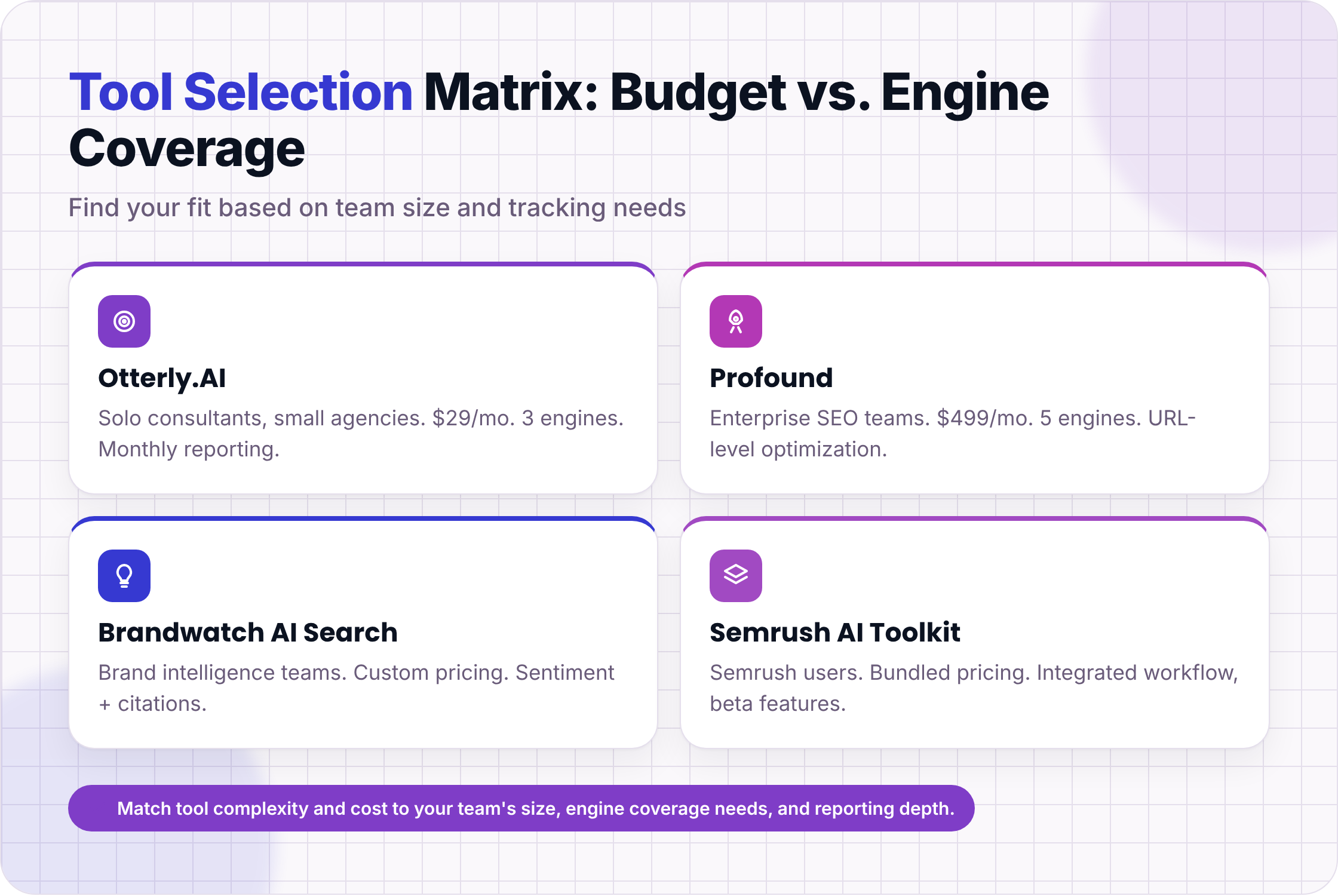
Your choice depends on three variables: budget, the number of AI engines you need to cover, and whether you need diagnostic depth or share-of-voice reporting.
If you are a solo consultant or small agency and your primary deliverable is a monthly AI visibility report, Otterly.AI at $29/month covers the basics without overcomplicating the workflow.
If you manage multiple enterprise clients or run an in-house SEO program where citation share directly informs content investment decisions, Profound's URL-level tracking across five engines justifies the $499/month price point, provided you have a defined prompt set ready to go.
If your team sits inside a brand intelligence function and needs AI citation data alongside sentiment and consumer conversation, Brandwatch's AI Search module is the only tool in this comparison built for that combined use case.
If you already pay for Semrush and want to add AI citation visibility without a separate vendor relationship, the AI Toolkit beta is worth activating now, with the understanding that it will improve over the next two to three quarters.
One tool not covered in the picks above but worth knowing about: SEORav takes a prompt-first approach, letting you define the exact queries you want monitored rather than relying on a vendor-curated panel. For teams that want control over the prompt set, that architecture is a meaningful differentiator.
Frequently Asked Questions
What is AI citation monitoring?
AI citation monitoring is the practice of tracking when and how AI-generated answers, such as those from ChatGPT, Perplexity, or Google AI Overviews, reference or link to your content. Dedicated tools automate this by running scheduled queries against AI engines and logging which URLs appear in the responses. The goal is to understand your citation share across AI-driven search surfaces, not just your traditional organic rankings.
How is AI citation monitoring different from traditional rank tracking?
Traditional rank tracking tells you where your page appears in a list of blue links. AI citation monitoring tells you whether an AI engine is actively quoting or referencing your content when it generates an answer. A page can rank in position one and still receive zero AI citations, which is increasingly common as AI Overviews and chatbot-style answers absorb query volume that used to flow to organic results.
Which AI engines do these tools cover?
Coverage varies by tool. Profound covers ChatGPT, Claude, Perplexity, Gemini, and Microsoft Copilot. Otterly.AI covers ChatGPT, Perplexity, and Bing Copilot. Brandwatch's AI Search module covers the major consumer AI products but is less transparent about its exact engine list. Gemini tracking remains the weakest point across the category, with most tools reporting inconsistent data quality for that engine specifically.
How accurate is AI citation data?
Accuracy depends on how frequently a tool polls each engine and how it handles response variance. AI engines do not return identical citations on every query, so a tool that runs each prompt once per week will produce less reliable data than one that runs it daily. Our testing found detection accuracy ranging from roughly 70% to 91% across the tools we evaluated, measured against manual spot-checks. No tool in this category achieves perfect accuracy, and any vendor claiming otherwise should be pressed for methodology details.
Is there a free tool for tracking AI citations?
No fully featured free tool exists in this category as of mid-2026. Some platforms offer limited free trials or freemium tiers with restricted prompt volumes. Otterly.AI's entry plan at $29/month is the lowest-cost option among purpose-built citation trackers. Manual spot-checking, running queries yourself and logging results in a spreadsheet, is technically free but does not scale past a handful of prompts.
How often should you monitor AI citations?
For most teams, weekly monitoring is the right cadence. Citation patterns can shift after a content update, a competitor publishes a new page, or an AI engine updates its model. Daily monitoring makes sense if you are tracking a high-stakes product launch or responding to a brand issue in real time. Monthly monitoring is the minimum for any team that wants to include AI citation share in client reporting without the data being stale by the time it reaches the report.
Can you influence which content AI engines cite?
Yes, to a degree. AI engines tend to cite content that is authoritative, well-structured, and directly answers the query. Practical steps include improving the factual density of your content, adding structured data markup, earning backlinks from sources that AI engines already cite frequently, and ensuring your pages load cleanly for crawlers. There is no guaranteed method, and the relationship between on-page optimization and AI citation behavior is still being mapped by the SEO community. The nicklafferty.com citation analysis breakdown covers several of these factors in more detail.
If you want to track exactly which AI engines are citing your content, and which prompts you are losing to competitors, visit SEORav's GEO monitoring tool to see how a prompt-first approach to AI citation tracking works in practice.
Keep reading
Which Enterprise CMS Will Still Matter in 2030
Find out which enterprise CMS is most future-proof. Compare headless, composable, and coupled architectures to avoid costly migrations through 2030.
How to Track Your Content's Visibility in LLM-Powered Search
Learn how llm seo tracking works, which tools to use, and how to measure your content's citation rate across ChatGPT, Perplexity, Gemini, and Claude.
How to Track Which AI Models Are Citing Your Website
Learn how to set up ai search citation analytics across ChatGPT, Perplexity, Claude, and Gemini. Includes tool comparisons, prompt setup, and competitor ga