Why E-E-A-T and LLM Optimization Are Reshaping SEO Rankings
Last updated: 4 November 2026
Google's ranking algorithm now prioritizes E-E-A-T and LLM optimization because search results increasingly feed AI-generated answers, which pull from pages demonstrating firsthand expertise and clear authorship. Content that restates existing summaries ranks lower than pages showing original research, verifiable sources, and author credentials. This shift means your SEO strategy must treat content as a primary source rather than an aggregation tool. The measurable payoff comes when AI systems cite your work directly.
What This Means for Your Rankings Right Now
Google's Helpful Content system and LLM-powered results now reward demonstrated expertise over keyword density. Pages that show first-hand knowledge, cite verifiable sources, and carry clear authorship signals get pulled into AI-generated answers. Pages that summarize other summaries get skipped. Treat your content as a primary source, and your citation odds improve measurably.
The numbers make this concrete. BrightEdge's 2024 research found AI Overviews appearing in 84% of queries, and the pages those overviews cite consistently carry strong E-E-A-T signals: named authors, original data, and specific claims tied to real sources. Keyword density barely registers as a selection criterion anymore.
What changed is the underlying mechanism. Google's quality rater guidelines make clear that E-E-A-T is not a single ranking factor you can toggle on, but a cluster of signals the system is designed to reward over time. You cannot patch your way to it with a few schema tags. You build it by publishing content that only you could write, backed by evidence only you have gathered.
One honest caveat: pages with strong E-E-A-T signals still need basic technical hygiene. A well-authored article on a slow, poorly structured page will lose citations to a technically cleaner competitor. The expertise signals and the structural signals work together, not independently.
A Content Team That Did Everything Right and Still Lost Traffic
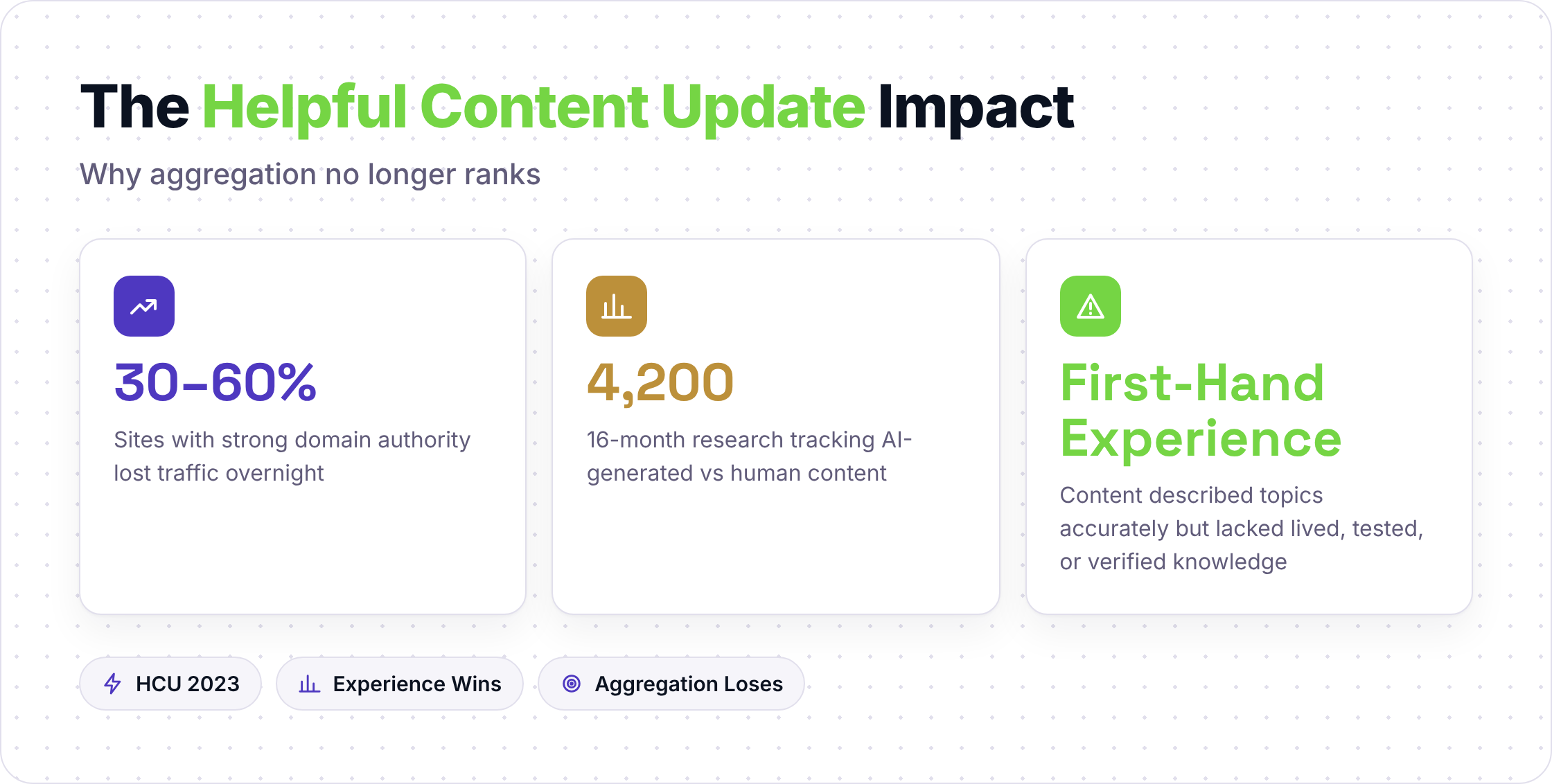
After Google's 2023 Helpful Content Update, many sites with strong domain authority and technically sound content lost 30 to 60% of organic traffic overnight. The cause was not thin word counts or missing keywords. It was the absence of first-hand experience: content that described topics accurately but had never been lived, tested, or verified by the person writing it.
The pattern showed up clearly in the HCU aftermath. Sites that had built authority through aggregation, well-structured summaries, and high-volume publishing found that Google's systems had quietly deprioritized them. A 16-month study of 4,200 articles tracking AI-generated versus human content across Google ranking signals found that pages with demonstrable first-hand experience consistently outperformed technically comparable pages that lacked it.
The traffic loss also revealed something about how LLMs select content to cite. When a language model fans out across candidate sources, it is not just evaluating topical coverage. It is looking for specificity that only comes from direct experience: named outcomes, concrete dates, real failure cases. Generic accuracy does not get quoted. Specific, attributable claims do.
The trade-off is real. Teams with genuine subject-matter experts often produce content that is harder to scale and slower to publish. A practitioner who knows the material deeply may not write at the pace a content calendar demands. That tension does not disappear just because E-E-A-T rewards depth.
What separates pages LLMs quote from pages they ignore tends to be one thing: a claim no one else could have made without doing the work. Not a better summary of existing sources, but a data point, a result, or an observation that traces back to a specific person's direct involvement.
What E-E-A-T and LLM Optimization Actually Mean for Modern SEO
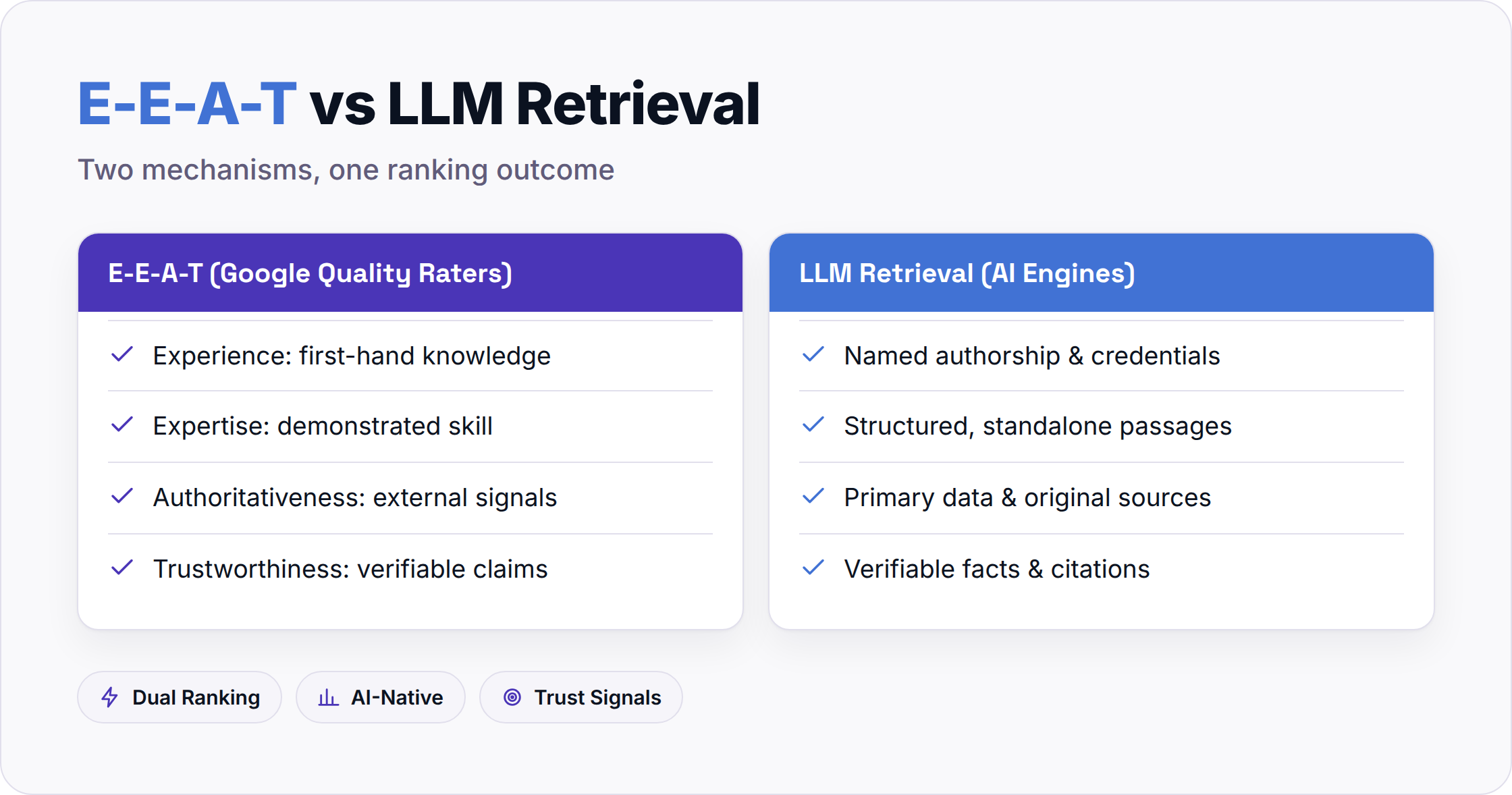
E-E-A-T stands for Experience, Expertise, Authoritativeness, and Trustworthiness. Google's human quality raters use these four dimensions to score content samples, and those scores feed into how ranking systems are calibrated over time. LLM-powered search layers on a separate mechanism: retrieval-augmented generation, where the model pulls candidate passages from indexed sources before composing an answer. Content that satisfies both systems gets ranked and cited. Content that satisfies only one often does neither.
Understanding why E-E-A-T and LLM optimization are the new ranking factors requires separating the two mechanisms and then seeing how they interact.
E-E-A-T: What It Actually Measures
The four signals are not equal in weight, and they are not a direct ranking factor. Google's quality rater guidelines make this explicit: raters assess content against E-E-A-T criteria to produce training signal, not to manually rank individual pages. You cannot "optimize for E-E-A-T" the way you optimize a title tag. You build the underlying conditions, and the ranking system infers the signals from them.
Experience refers to first-hand engagement with the subject. A product review written by someone who used the product for six months reads differently from one assembled from spec sheets. Expertise is domain knowledge, demonstrated through accuracy, depth, and appropriate use of technical language. Authoritativeness is reputational: who links to you, who quotes you, whether your authors are cited elsewhere. Trustworthiness is the floor: accurate claims, clear sourcing, no deceptive design.
E-E-A-T improvements are slow and hard to attribute. A site that adds author bios, earns three editorial backlinks, and fixes factual errors in twenty articles will not see a measurable ranking shift in the next two weeks. This approach also breaks down for new domains with no link equity and no named authors, where even high-quality content struggles to accumulate the reputational signals raters look for.
How LLM Search Selects Its Sources
Retrieval-augmented generation works in two stages. First, the model issues a retrieval query against an index to pull candidate passages. Then it generates an answer by synthesizing those passages, citing the sources it drew from. AI search engines interpret content through semantic meaning rather than keyword density, which means a page stuffed with the exact query phrase can lose a citation to a page that answers the underlying concept more completely.
The practical implication: your content needs to be structured so that individual passages can be extracted and quoted without losing meaning. Answer-first openings, clear claim-to-evidence chains, and named citations all raise the probability that a retrieval system selects your passage over a competitor's.
Query Fan-Out and Why It Changes What You Write
A single user question rarely maps to a single retrieval query. When someone asks "what is the best CRM for a 50-person sales team," an LLM-powered engine typically fans that out into several sub-queries: what features matter at that team size, how leading CRM platforms compare on those features, what pricing looks like at that scale, and what real users report about implementation time. Each sub-query pulls from potentially different sources.
If your content answers only the top-level question, you surface for one sub-query and get ignored for the rest. The pages that get cited across multiple sub-queries are the ones that cover the topic with enough depth to satisfy the full fan-out. In practice, that means including concrete comparisons, specific numbers, and the secondary questions a buyer would naturally ask after the first one.
One real limitation: writing to cover query fan-out can push article length past what a general reader wants to consume. A 2,800-word page that answers eight sub-questions may rank well and get cited by AI engines while generating lower average time-on-page than a tighter 900-word piece. Both metrics matter, and optimizing for one can hurt the other.
The Shift From Traditional Ranking Factors to AI-Native Signals
Most SEOs are still optimizing for signals that large language models largely bypass. Backlink volume, keyword frequency, and Core Web Vitals scores matter for Google's classic ranking pipeline, but when an LLM selects a passage to cite, it parses named authorship, verifiable credentials, structured markup, and primary data first. The optimization targets have shifted, and the two approaches conflict in ways that are not obvious until you watch a well-ranked page get ignored by every AI engine.
What Classic SEO Still Measures (and Why That Creates a Gap)
The standard playbook: build links, hit keyword density targets, compress images, and score above 90 on PageSpeed Insights. Those signals feed Google's traditional ranking algorithm well. They do almost nothing to influence whether ChatGPT, Perplexity, or Google's Search Generative Experience pulls your content into a cited response.
Generative engines evaluate content differently from traditional crawlers: they extract passages, score them for internal coherence, and cross-reference the source's credibility signals before surfacing a citation. A page with 400 backlinks and no named author loses to a page with 40 backlinks, a byline tied to a verifiable LinkedIn profile, and a data table with a cited methodology.
The Signals AI Crawlers Actually Parse First
Three signals consistently determine AI citation probability: named authors with verifiable credentials, primary or proprietary data, and structured markup (JSON-LD schema in particular).
Named authorship is the most underrated. An author page that links to published work, a professional profile, or institutional affiliation gives an LLM a trust anchor it can cross-reference. Anonymous content, even technically excellent content, gets treated as lower-confidence by default.
Primary data carries more citation weight because LLMs are trained to prefer sources that generate information rather than aggregate it. A survey of 500 customers, a proprietary benchmark, or an original case study with specific numbers outperforms a summary of someone else's findings. The pattern Strategyc's E-E-A-T optimization research makes explicit: structuring content so AI systems can extract discrete, attributable claims is the core task, not keyword placement.
JSON-LD schema tells AI crawlers what a page is, who wrote it, when it was published, and what organization stands behind it. Without it, the crawler infers. Inference introduces uncertainty, and uncertain sources get deprioritized.
Where Classic On-Page SEO and AI Optimization Conflict
The clearest conflict is between keyword density and answer-first structure. Classic on-page SEO often rewards building toward a conclusion: introduce the topic, cover the context, then answer. AI engines reward the opposite. A passage that opens with a direct, self-contained answer to the implied question gets extracted and cited. A passage that buries the answer in paragraph four does not, regardless of how well the page ranks organically.
A second conflict sits in content length strategy. Long-form content built to capture keyword variants and internal links can dilute the passage-level authority signals that AI engines score. A 4,000-word guide optimized for 30 keyword variations may score well in traditional search while producing no single passage strong enough to survive chunk extraction.
Optimizing aggressively for AI citation can reduce the keyword surface area that feeds organic traffic from traditional search. Teams running both strategies simultaneously often find they need separate content formats, not a single piece trying to serve both goals. This breaks down especially for transactional pages, where classic conversion-focused copy and AI-citation-ready structured content are nearly incompatible at the same URL.
A Framework for Building Content That Both Google and LLMs Trust
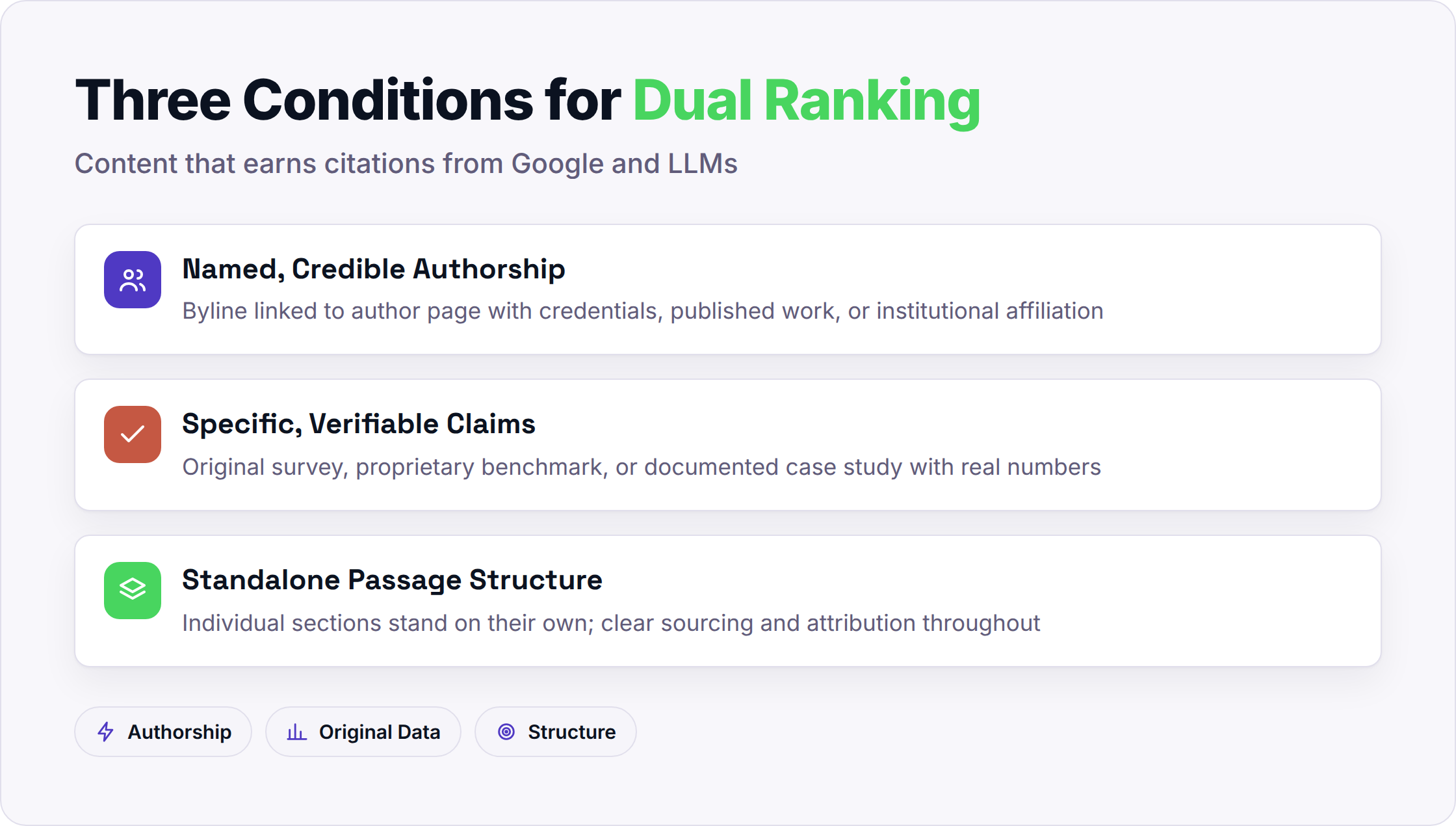
Content earns citations from both Google and LLM-powered engines when it satisfies three conditions at once: it comes from a named, credible source; it makes specific, verifiable claims; and it is structured so individual passages stand on their own.
Start with authorship. Every piece of content should carry a byline linked to an author page that includes credentials, published work, or institutional affiliation. This is not cosmetic. It gives both Google's quality raters and AI retrieval systems a trust anchor they can verify independently.
Add primary data wherever possible. Even a small original survey, a proprietary benchmark, or a documented case study with real numbers gives your content something no aggregator can replicate. LLMs are trained to prefer sources that originate information, and a single original data point can anchor an entire article's citation probability.
Structure for extraction. Open each major section with a direct answer to the question that section addresses. Follow with evidence, then context. This mirrors how retrieval systems chunk and score passages. A section that buries its main claim in the third paragraph will be passed over in favor of a competitor whose first sentence answers the question cleanly.
Apply JSON-LD schema to every page: Article or BlogPosting type, author entity, datePublished, dateModified, and publisher. These fields reduce inference and increase the confidence score AI crawlers assign to your source.
Finally, audit for specificity. Replace phrases like "many studies show" with the actual study, year, and finding. Replace "significant growth" with the percentage. Replace "experts agree" with the name of the expert and where they said it. Specificity is the single most reliable proxy for first-hand knowledge, and both Google's raters and LLM retrieval systems treat it as such.
The honest limitation: this framework takes months to produce measurable results, and it requires genuine subject-matter access that many content teams do not have. Outsourcing to generalist writers who then add a named byline does not satisfy the experience dimension. The signals have to be real, because the systems checking them are increasingly good at detecting when they are not.
Frequently Asked Questions
Does E-E-A-T apply to every type of website?
E-E-A-T applies to all websites, but the weight of each dimension shifts by topic. Google applies the strictest scrutiny to YMYL (Your Money or Your Life) content, covering health, finance, legal, and safety topics. For a recipe blog, trustworthiness and experience matter most. For a medical information site, expertise and authoritativeness carry far more weight, and the bar for named credentials is significantly higher.
Can a small site with no backlinks still rank well under E-E-A-T?
Yes, but the path is narrower. A small site with a named expert author, original research, and accurate sourcing can outperform larger aggregator sites on specific queries, particularly long-tail questions where depth matters more than domain authority. The constraint is that authoritativeness, the "A" in E-E-A-T, depends partly on external signals like backlinks and mentions, which take time to accumulate regardless of content quality.
How do I know if my content is being cited by AI engines?
Direct citation tracking is still limited. Perplexity and some AI search tools show source links, so you can monitor branded mentions and referral traffic from those platforms in your analytics. Google Search Console does not yet break out AI Overview citations separately from organic clicks, though referral patterns from AI-driven queries are starting to appear as a distinct traffic segment in some third-party tools.
Is keyword optimization still worth doing in 2026?
Keyword research still matters for understanding what questions your audience is asking, but keyword density as a ranking lever has weakened considerably. The more useful frame is intent coverage: does your content fully address the question behind the keyword, including the follow-up questions a reader would naturally have? Pages that cover intent thoroughly tend to rank for keyword variants without targeting them explicitly.
How long does it take to see results from E-E-A-T improvements?
Most practitioners report a lag of three to six months before E-E-A-T-focused changes produce measurable ranking or citation improvements. Authorship signals and backlink growth are slow by nature. Technical fixes like adding JSON-LD schema can show faster results in AI citation rates, sometimes within weeks, but the reputational signals that underpin authoritativeness build on a longer timeline. Plan accordingly.
What is the difference between E-E-A-T and LLM optimization?
E-E-A-T is a framework Google's quality raters use to evaluate content quality, and it feeds into how Google's ranking systems are trained over time. LLM optimization refers to structuring content so that AI-powered retrieval systems, including Google's AI Overviews, ChatGPT, and Perplexity, select your passages when composing answers. The two overlap significantly: both reward named authorship, specific claims, and verifiable sourcing. The main difference is structural. LLM optimization also requires answer-first formatting and passage-level coherence that traditional SEO does not prioritize.
If you want a clearer picture of where your content stands against these signals, visit Seorav's AEO service page to see how their team approaches answer engine optimization for sites navigating both Google's E-E-A-T requirements and LLM citation selection. The audit process starts with the signals that matter most for your specific content type and traffic goals.
Keep reading
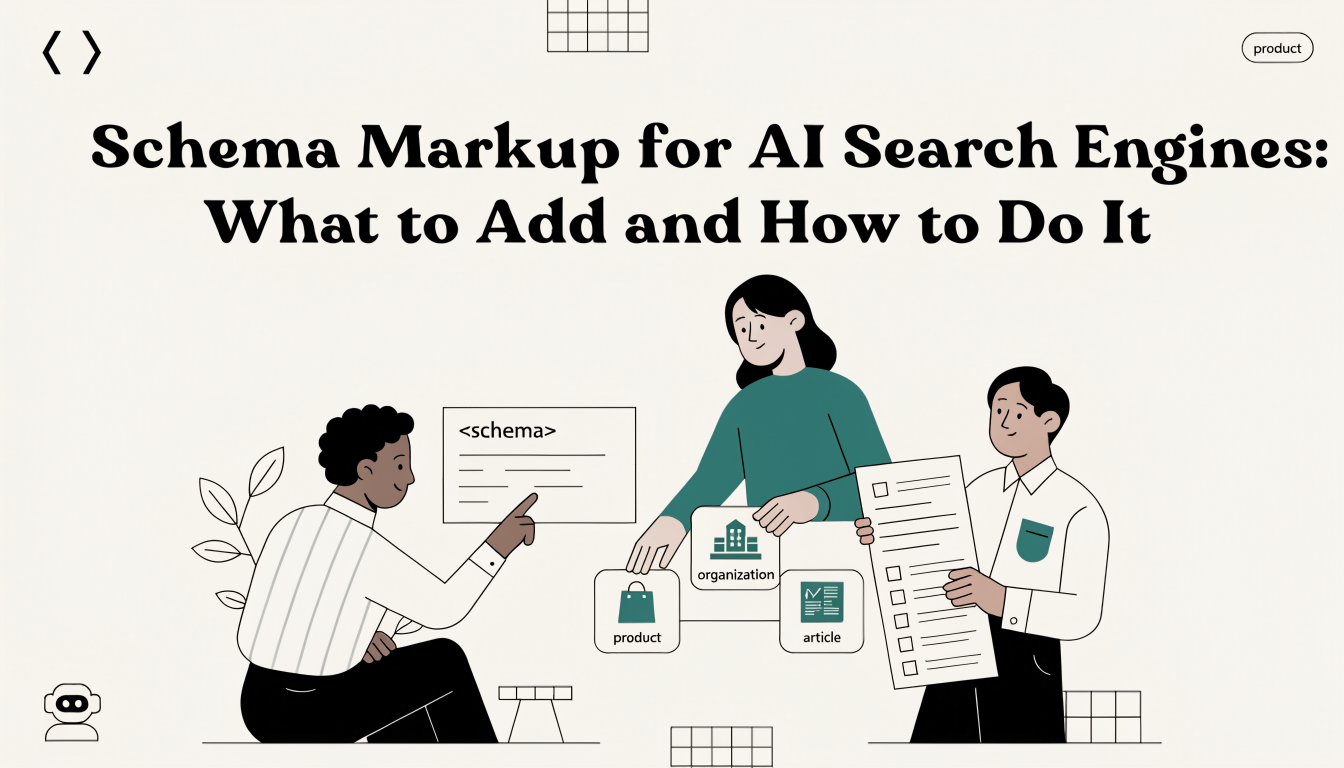
Schema Markup for AI Search Engines: What to Add and How to Do It
Learn how to use schema markup for AI engines with JSON-LD examples for Article, HowTo, and FAQPage types. Includes validation tools and scaling tips.
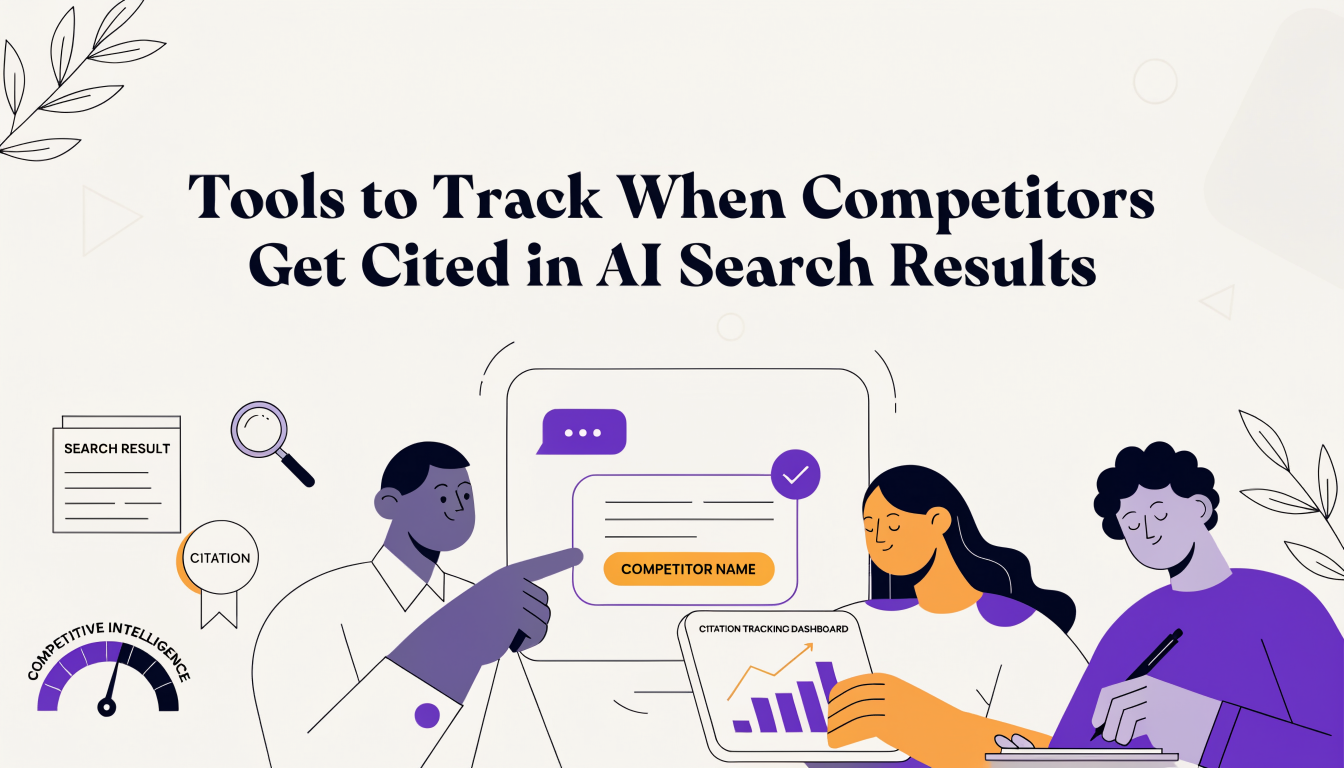
Tools to Track When Competitors Get Cited in AI Search Results
What solutions track competitor citations in AI-generated search responses? Compare 7 tools including Profound, Semrush, and Otterly across engine coverage

Scaling Content Production While Keeping Your Brand Voice Intact
Learn how to scale content without losing brand voice using voice docs, brief templates, and risk-calibrated review. Practical framework with real numbers.