Scaling Content Production While Keeping Your Brand Voice Intact

Last updated: 1 November 2026
Scaling content production while keeping your brand voice intact depends on three operational foundations you can build before hiring additional writers. First, create a voice guide with concrete examples that new contributors can apply independently. Second, design a review process that flags actual brand risk rather than counting words. Third, use templates that lock down format and tone without restricting the ideas themselves. Once these systems are in place, you can safely increase output without diluting what makes your brand recognizable.
The revenue case is concrete. Marq's 2021 brand consistency research found that consistent brand presentation increases revenue by up to 23%. That figure covers visual and verbal identity together, so voice is only part of the equation, but it signals the order of magnitude at stake when consistency slips.
The practitioner community has converged on documentation as the foundation. "AI can help you scale that voice... but it cannot decide who you are," writes Julia Koh in her analysis of AI and brand voice at scale. The point holds whether you are using AI or a team of freelancers: the decisions about voice have to be made once, written down clearly, and handed to every contributor before the first draft starts.
One honest caveat: documentation alone does not guarantee consistency. It reduces drift. Enforcement, through review and feedback loops, is what closes the gap.
The Brand Voice Problem at Scale
Scaling content output and maintaining a consistent brand voice pull against each other by design. The more contributors, formats, and publishing cadences you add, the more surface area exists for the voice to fragment.
Teams that scale without a shared voice infrastructure don't lose their brand identity all at once. They lose it in small, compounding increments: a slightly different tone in one blog post, a different sentence rhythm in another, until the body of work no longer sounds like it came from the same organization.
Why Volume and Consistency Pull in Opposite Directions
Every piece of content is a decision about language. Word choice, sentence length, what to explain and what to assume, how formal to be with a technical audience. When one writer makes those decisions, the output is coherent. When eight writers make those decisions independently across 80 pieces a month, you get eight different interpretations of the same brand.
The numbers make this concrete. Consistent brand presentation across channels can increase revenue by up to 33%, per Omnibound's brand consistency research. The inverse is also true: inconsistency erodes the signal that makes a brand recognizable in the first place.
The Three Failure Modes
Dilution happens first. The core voice exists in the founding team's heads but never gets written down. New contributors approximate it. Each approximation drifts slightly from the original, and the cumulative effect is a voice that has been averaged into something generic.
Drift is slower and harder to catch. A single writer's style gradually shifts over months, often toward whatever they have been reading or editing most. Without periodic audits, no one notices until the archive looks like it was produced by two different companies.
Contributor fragmentation is the structural version of the same problem. Freelancers, agencies, and internal writers each bring their own defaults. Without a shared reference document, they default to their own voice, not yours.
Scaling content 3-5x is a process problem dressed up as a capacity problem, as Contentoo's scaling guide frames it. Most teams treat it as a hiring problem and are surprised when the output still feels inconsistent.
What Actually Happens at 80 Pieces a Month
Consider a 10-person content team shipping 80 pieces a month across a blog, a newsletter, social, and a resource library. No shared voice document. Editors review for accuracy and grammar, not tone. Writers are briefed on topics, not on how the brand sounds when it explains something complex, or how it handles disagreement with a common industry assumption.
Six months in, the blog reads differently from the newsletter. The resource library sounds like a different company entirely. Readers who follow multiple channels notice the inconsistency even if they can't name it. The brand feels less authoritative, not because the content is wrong, but because it doesn't cohere.
Building guardrails, including style guidelines, quality systems, and review workflows, is what lets teams publish more without weakening integrity, a point Martech's content scaling analysis makes directly.
One trade-off worth acknowledging: voice documentation takes real time to build and maintain. For very small teams shipping fewer than 10 pieces a month, the overhead may not be justified. This approach also breaks down when the voice document itself is wrong, meaning it was written to describe an aspirational brand rather than the actual one. A style guide that doesn't reflect how your best writers actually write will be ignored, or worse, followed in ways that make the output sound stiff and artificial. The document has to be descriptive before it can be prescriptive.
How to Scale Content Without Losing Brand Voice: The Framework
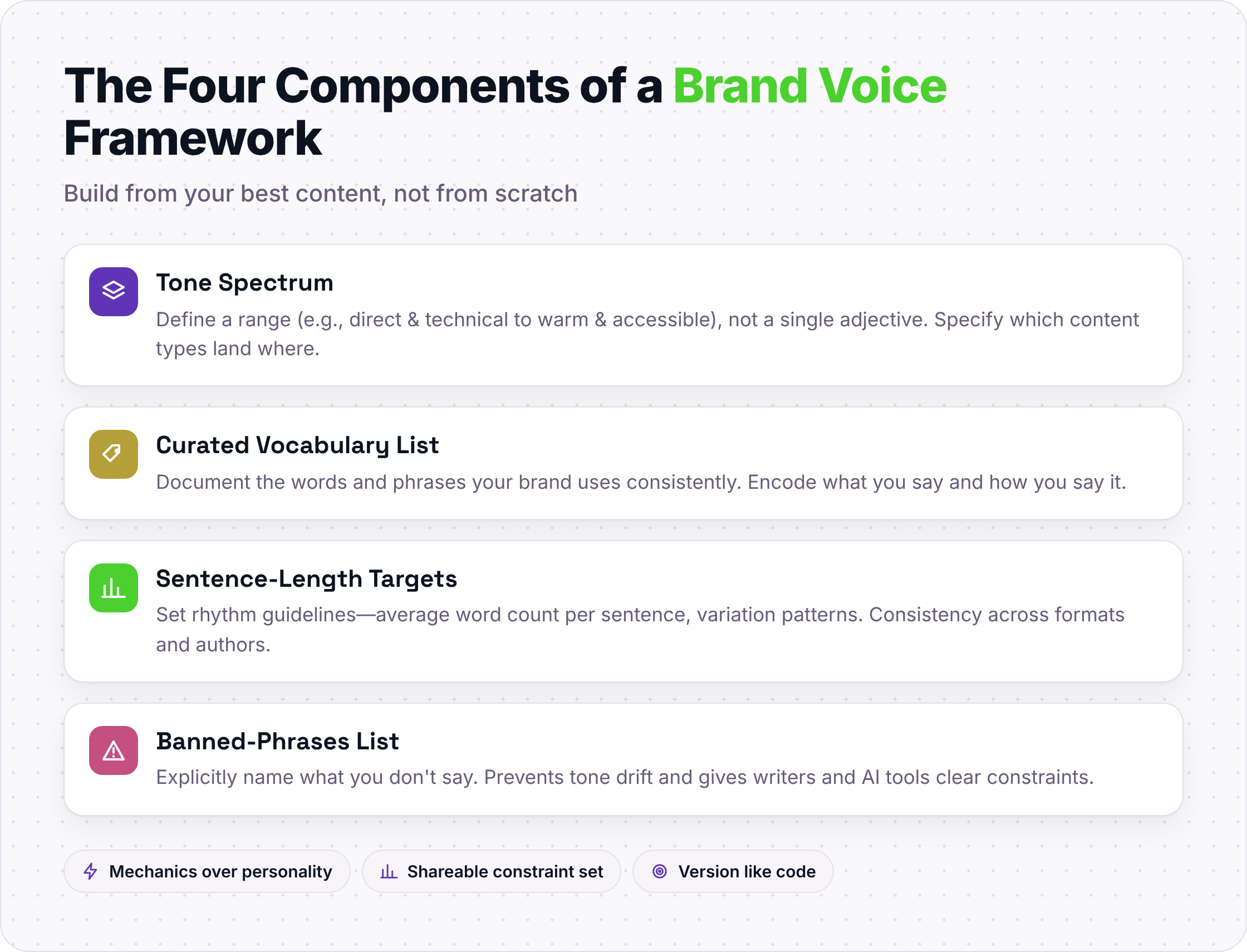
A scalable brand voice framework needs four concrete components: a tone spectrum (not a single adjective), a curated vocabulary list, sentence-length targets, and a banned-phrases list. Build it from your existing top-performing content rather than inventing it from scratch. This document gives writers and AI tools a shared constraint set that holds across formats, authors, and volume. Review it quarterly and version it like code.
The Four Components of a Usable Voice Document
Most voice documents fail because they describe personality instead of behavior. "We're conversational and authoritative" tells a writer nothing. A usable document gives them mechanics.
Tone spectrum. Define two ends of a range, not a fixed point. Your brand might sit between "direct and technical" on one end and "warm and accessible" on the other, with guidance on which content types land where. A product changelog lives at the direct end; a customer story lives closer to accessible.
Vocabulary list. Two columns: preferred terms and their alternatives. If you say "revenue" not "sales," write that down. If you say "team" not "staff," write that down too. Fifty to eighty word pairs is a practical target for most B2B brands.
Sentence-length targets. Set a range by content type. Long-form articles might average 16 to 20 words per sentence; social posts cap at 12. These numbers are measurable, so they're enforceable in an AI prompt or a style linter.
Banned phrases. The Bigeye Agency's brand voice framework guide notes that defining what a brand explicitly avoids is as clarifying as defining what it prefers. Build this list from real examples: pull phrases your editors have deleted in the last six months and codify the pattern.
Extract Voice From What Already Works
Writing voice rules from scratch is the wrong starting point. Pull your five to ten highest-performing articles or pages, the ones with the best engagement, shares, or conversion rates, and read them analytically.
Look for: average sentence length, paragraph depth, how often the writing uses first person, whether it leads with data or narrative, and what category of words it avoids (jargon, hedges, superlatives). Those patterns are your voice, observed rather than invented.
This maps to the same extraction logic enterprise brand teams use to maintain authentic voice at scale: start with what your audience already responded to, then formalize it into a replicable constraint set.
One real trade-off here: extracting voice from top performers can encode the biases of a particular era or author. If your best content from two years ago was written by one person who has since left, you risk building a framework around a voice that no longer has a living owner. Audit the source material before you codify it, and make sure more than one person recognizes the patterns as genuinely representative.
Versioning Your Voice Doc
Treat your voice document like a software dependency: it needs version numbers, a changelog, and a scheduled review cycle.
A quarterly review is the right cadence for most teams. Each review should answer three questions: Has your audience shifted in how they communicate? Have AI search engines started surfacing different content formats for your core topics? Have you added product lines or entered markets that the current vocabulary list doesn't cover?
The AI search alignment question matters more now than it did 18 months ago. AI engines parse for structural clarity and consistent terminology. If your voice doc allows too much synonym variation, the same concept appears under five different labels across your content, and citation engines have a harder time attributing authority to a single source.
Version your document with a simple header: v1.0 (launch), v1.1 (Q2 2024 review), v2.0 (rebrand or major audience shift). Keep the old versions. When a piece of content underperforms, you want to know which version of the voice rules governed it.
Template Systems That Preserve Authenticity
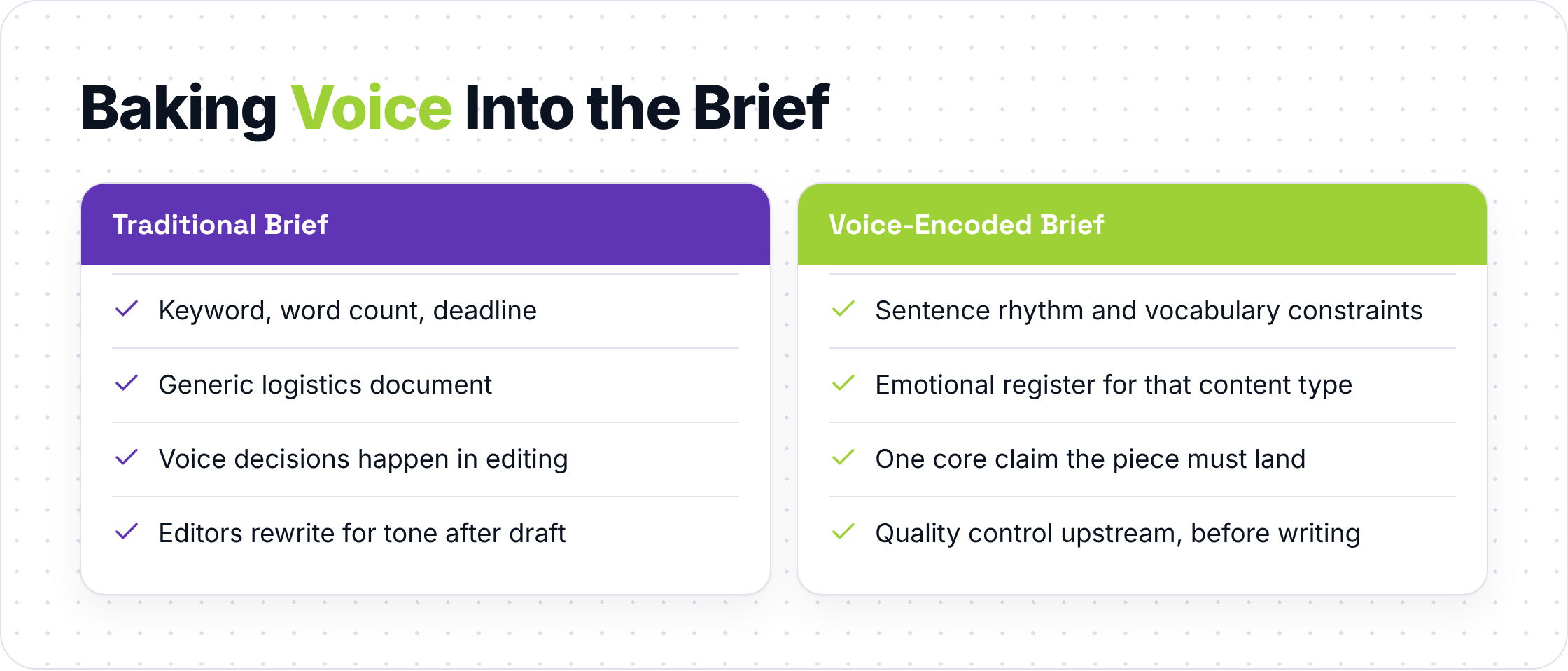
Template systems preserve brand voice at scale by encoding voice decisions into the brief itself, before any writer or AI model touches the draft. A well-built brief specifies sentence rhythm, permitted vocabulary, the emotional register for that content type, and the one claim the piece must land. That front-loading shifts quality control upstream, so your editors spend time on ideas rather than rewriting generic prose back into something that sounds like the company.
Bake Voice Cues Into the Brief, Not the Edit
Most teams treat the brief as a logistics document: keyword, word count, deadline. That works fine when you have three writers who already know the brand. At ten writers or ten AI-assisted drafts per week, the brief becomes the only reliable place to transmit voice.
A modular brief template for a thought leadership piece looks different from one for a product-led post. The thought leadership version might specify: "open with a concrete observation from the industry, not a definition; use first-person plural sparingly; avoid hedging the central argument." The product-led version specifies: "lead with the problem the feature solves, name the specific user role affected, keep feature names exact." Those are not style guide excerpts pasted in. They are task-specific instructions written for that content type.
The numbers support this approach. Thestarrconspiracy's analysis of AI content and brand voice found that teams who embed voice constraints at the brief stage produce first drafts that require significantly fewer revision cycles than teams who apply voice guidance only at the editing stage.
Structural Scaffolding Without Flattening Tone
Scaffolding is not the same as a rigid template. A scaffold defines the skeleton: where the argument opens, where evidence lands, where the call to action sits. Tone fills the gaps between those bones.
For SEO-driven content, the scaffold is tighter. The answer to the primary query appears in the first paragraph. Supporting claims follow in a predictable order. That structure is not a constraint on voice; it's a constraint on sequence. Your brand can sound like itself inside a tight structure just as easily as inside a loose one. The mistake most teams make is conflating format with voice and loosening both when they should only be loosening one.
For thought leadership or narrative content, the scaffold can be lighter: an opening observation, a complication, a resolution, a concrete takeaway. Within that, sentence rhythm, vocabulary, and point of view are entirely yours to control.
The Review Process: Calibrate to Risk, Not Word Count
Not every piece of content carries the same brand risk. A 200-word social caption and a 3,000-word pillar page are not equivalent review tasks, but most teams treat them as if they are, either reviewing everything lightly or reviewing everything heavily.
A risk-calibrated review process assigns review depth based on two variables: audience reach and content type. High-reach, high-stakes content (pillar pages, press releases, executive bylines) gets a full voice review against the style guide. Mid-tier content (standard blog posts, newsletters) gets a lighter pass focused on flagged phrases and tone spectrum placement. Low-stakes content (internal updates, routine social posts) gets a checklist review or no voice review at all.
This is the approach Martech's content scaling analysis recommends for teams trying to maintain quality without creating review bottlenecks that slow publishing velocity.
The limitation: risk calibration requires someone to make the initial categorization call, and that person needs enough brand fluency to do it accurately. If your most brand-fluent editor is also your bottleneck, the system doesn't solve the problem. Build the categorization criteria into the brief so writers self-classify before the piece reaches an editor.
AI Tools and Brand Voice: What They Can and Can't Do
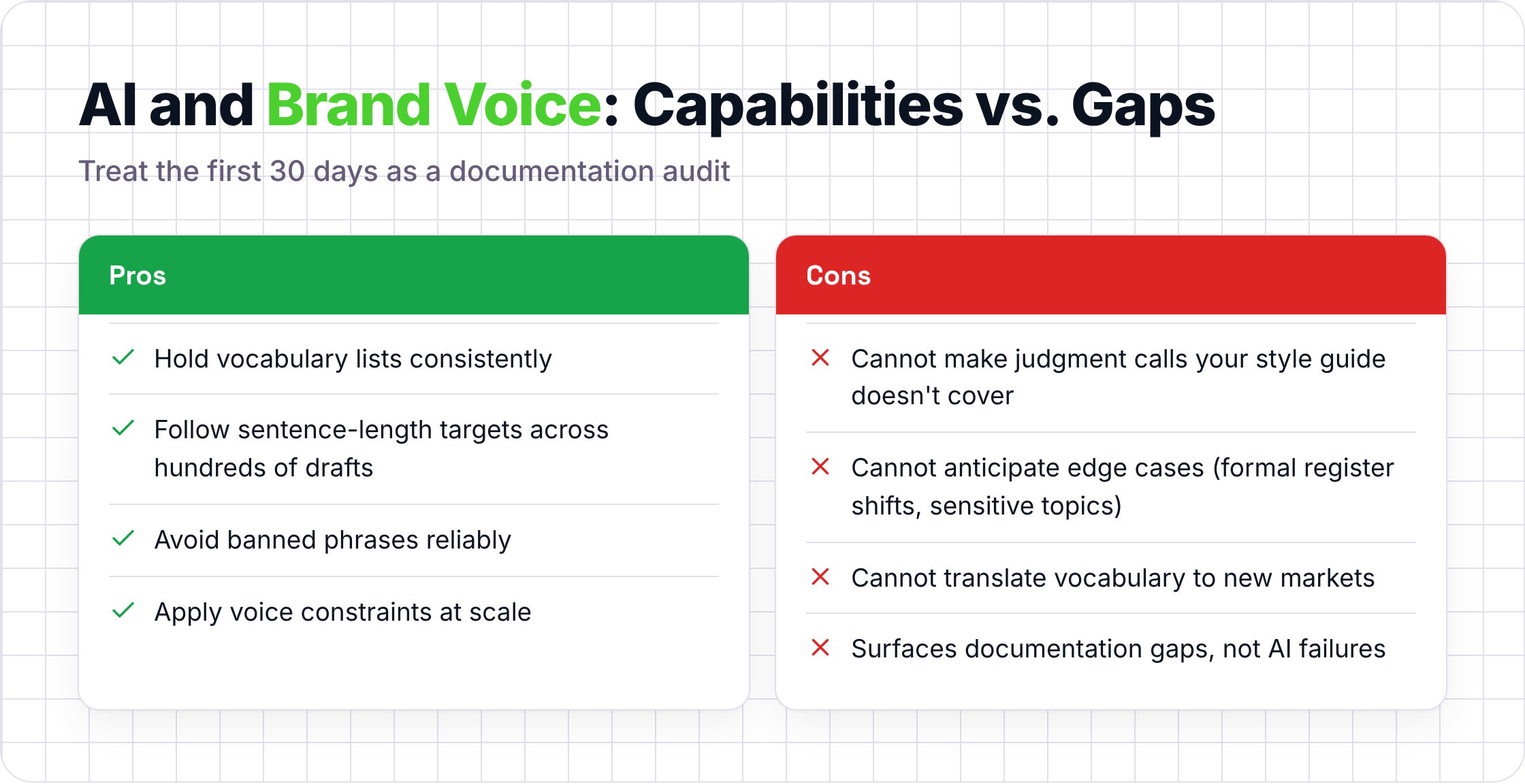
AI writing tools can apply your voice constraints at scale if you give them the right inputs. They can hold vocabulary lists, follow sentence-length targets, and avoid banned phrases consistently across hundreds of drafts. What they cannot do is make the judgment calls your voice document doesn't cover.
Every AI-generated draft will surface edge cases your style guide didn't anticipate. A product announcement that requires a more formal register than your usual blog tone. A sensitive topic where your default directness reads as dismissive. A new market where your standard vocabulary doesn't translate. Those gaps are not AI failures; they are documentation gaps. The AI is showing you where your voice guide is incomplete.
The practical implication: treat your first 30 days of AI-assisted content production as a documentation audit. Every time an editor rewrites an AI draft for voice reasons, log the rewrite. After 30 days, you have a list of undocumented voice rules. Add them to the guide.
Julia Koh's analysis makes the same point from a different angle: AI tools are amplifiers, not authors. They amplify whatever voice infrastructure you give them. A weak voice document produces weak AI output. A specific, behaviorally-grounded voice document produces output that requires far less human correction.
Frequently Asked Questions
How do you maintain brand voice when using multiple freelancers?
Give every freelancer the same onboarding package before they write a single word: the voice document, three annotated examples of content that hits the target, and three examples of content that misses it. The annotated examples do more work than the document alone because they show the rules in action. Pair that with a first-draft review on their initial piece, with written feedback tied to specific voice guide sections, and most freelancers calibrate within two to three assignments.
How long does it take to build a brand voice document?
A functional first version takes 8 to 12 hours of focused work if you start from existing content rather than blank-page principles. That breaks down roughly as: 2 to 3 hours pulling and analyzing top-performing content, 3 to 4 hours drafting the four components (tone spectrum, vocabulary list, sentence targets, banned phrases), and 2 to 3 hours getting sign-off from the people whose instincts the document is meant to encode. A more comprehensive guide with annotated examples and content-type-specific scaffolds can take 20 to 30 hours, but you don't need that version to start.
Can you scale content 3x without losing quality?
Yes, but the ceiling depends on your infrastructure before you scale, not after. Teams that triple output without first building a voice document, brief templates, and a risk-calibrated review process almost always see quality drop within 60 to 90 days. Teams that build the infrastructure first and then scale tend to hold quality because the system absorbs the volume rather than individual editors absorbing it. The honest limit: at very high volume (100-plus pieces a month), even good infrastructure requires dedicated quality oversight. Someone has to own the voice document and have authority to enforce it.
What's the difference between brand voice and brand tone?
Voice is stable; tone shifts by context. Your brand voice is the underlying personality and set of language preferences that stay consistent across everything you publish. Tone is how that voice adjusts for a specific audience, format, or emotional register. A brand with a direct, data-forward voice might use a warmer tone in a customer success story and a more formal tone in a technical white paper, but the underlying vocabulary preferences and sentence patterns stay the same. The practical implication: your voice document should define voice as a fixed set of rules and tone as a set of contextual adjustments, not treat them as the same variable.
How do you audit existing content for brand voice consistency?
Pull a random sample of 20 to 30 pieces published in the last 12 months, across formats and authors. Read them against your voice document and score each one on three dimensions: vocabulary alignment (are the preferred terms being used?), sentence rhythm (does the average length match the target range?), and structural pattern (does the piece follow the expected scaffold for its content type?). Pieces that score low on all three are outliers. Pieces that score low on one dimension consistently point to a gap in the voice document or a gap in how it was communicated to contributors. Run this audit every six months, not just when something feels off.
How do you handle brand voice when entering a new market or language?
Localization is where voice frameworks most often break down, because direct translation of vocabulary preferences rarely works across languages or regional markets. The right approach is to translate the intent of each voice rule rather than the rule itself. If your English voice document says "avoid passive voice," the equivalent rule in German or Japanese may look completely different because passive constructions carry different connotations in those languages. Work with a native-speaking editor who understands both the target market and your brand, and treat the localized voice document as a separate artifact with its own version history.
Putting It Together
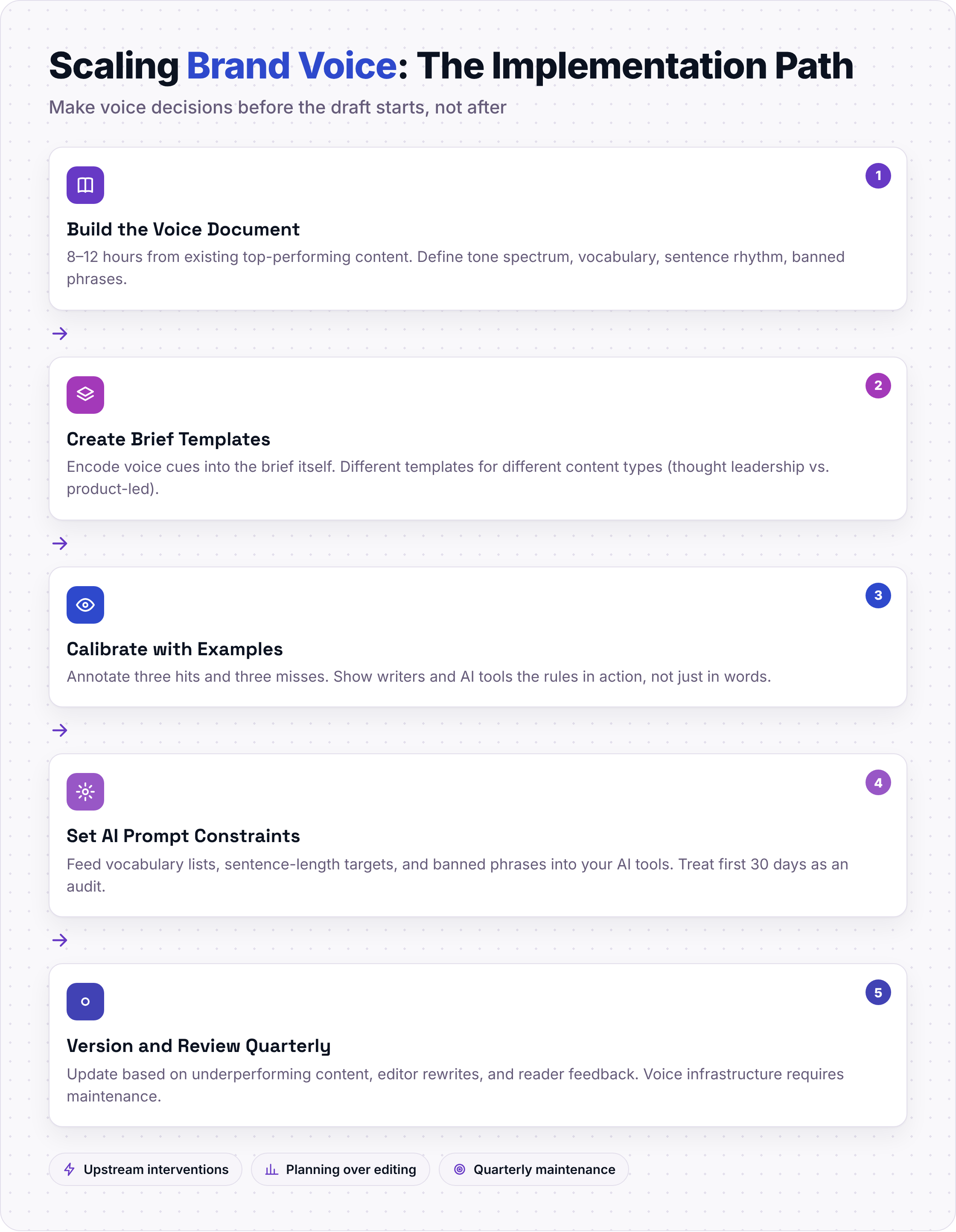
The teams that figure out how to scale content without losing brand voice share one structural habit: they make voice decisions before the draft starts, not after. The voice document, the brief template, the review calibration, the AI prompt constraints, all of these are upstream interventions. They shift the cost of quality from editing to planning, and planning costs less per piece at scale.
The failure mode to avoid is treating this as a one-time project. Voice infrastructure requires maintenance. Your audience shifts. Your product evolves. Your best writers leave and new ones arrive. A voice document written in 2024 and never revisited will be partially wrong by 2026. Version it, review it quarterly, and update it when the evidence (underperforming content, editor rewrites, reader feedback) tells you something has drifted.
Start with the voice document. Build the brief templates second. Calibrate your review process third. Then scale.
If you want a structured approach to making your content more discoverable as you scale, visit Seorav to learn more about how answer engine optimization fits into a high-volume content strategy.
Keep reading
How Perplexity AI Decides Which Sources to Cite
Learn how Perplexity AI ranks content through its RAG pipeline, covering freshness, domain authority, semantic matching, and citation graph signals.

How to Get Your Website Into ChatGPT Search Results
Learn how to appear in ChatGPT search results: Bing indexing, robots.txt setup, schema markup, and answer-first content that earns citations.

How to Get Your Products Into AI Chatbot Shopping Suggestions
Discover tools that help improve visibility in AI chatbot shopping suggestions, from Otterly.AI to Profound, plus schema fixes and citation strategies that