Tools to Track When Competitors Get Cited in AI Search Results
Last updated: 2 November 2026
Several tools now track competitor citations in AI-generated search responses, including Semrush's Brand Monitoring, Brandwatch, and specialized platforms like Originality.AI and Citation Labs. These solutions monitor when your competitors appear in ChatGPT, Perplexity, and other generative AI outputs, alerting you to visibility gaps your team might miss. The challenge lies in choosing between broad brand monitoring suites and AI-specific trackers, each with different pricing models and citation detection accuracy rates.
Three categories of tools cover this problem today. Dedicated AI visibility platforms built specifically to track citations across LLMs offer the most depth. Integrated SEO suites that have added AI monitoring modules offer familiarity. Manual methods using direct API queries or spreadsheet logging cost nothing but scale poorly beyond a handful of tracked prompts.
The market is still catching up. Fewer than 15% of SEO teams were tracking AI citations as of early 2024, per BrightEdge's State of Search report, which means most of the tooling reviewed here launched or matured in the 18 months since that number was published. Expect rough edges: coverage gaps, inconsistent attribution, and pricing that changes quarterly.
Every tool in this article was scored against five criteria:
| Criterion | What it measures |
|---|---|
| Coverage breadth | How many AI engines are polled (ChatGPT, Perplexity, Claude, Gemini) |
| Citation attribution accuracy | Whether the tool correctly identifies which URL an engine cited, not just a domain |
| Alert speed | How quickly you're notified when a competitor gains or loses a citation |
| Competitor tracking depth | Whether you can monitor specific rival domains, not just your own |
| Pricing transparency | Whether costs are published without a sales call |
No tool scores perfectly across all five. The platforms with the widest engine coverage tend to be the least transparent on pricing, and the most affordable options typically poll fewer engines or update less frequently. The sections below work through each tool against this rubric so you can match the right fit to your actual monitoring needs.
AI Citation Tracker Comparison Matrix
No single tool tracks competitor citations across ChatGPT, Perplexity, Claude, and Gemini with equal depth. The matrix below scores seven options across five criteria: engine coverage, competitor tracking, prompt customization, citation frequency, and export or API access for teams that need the data downstream.
Scores run 1 to 5. A 5 means the tool handles that criterion well enough that you wouldn't need a workaround. A 1 means you're largely on your own.
| Tool | Engine Coverage | Competitor Tracking | Prompt Customization | Citation Frequency | Export / API |
|---|---|---|---|---|---|
| Profound | 5 | 5 | 5 | Daily | 5 |
| Semrush AI Toolkit | 4 | 4 | 3 | Weekly | 4 |
| Ahrefs Brand Radar | 3 | 3 | 2 | Weekly | 3 |
| Otterly.ai | 4 | 4 | 4 | Daily | 3 |
| Brandwatch | 3 | 4 | 2 | Daily | 5 |
| SE Ranking AI Overview Tracker | 3 | 3 | 3 | Daily | 3 |
| Manual prompt auditing | 4 | 5 | 5 | On demand | 1 |
A few things stand out in those scores.
Profound scores highest overall because it was built specifically for AI visibility, not retrofitted from a traditional SEO or social listening base. It polls multiple engines, lets you configure competitor domains directly, and surfaces which URLs those engines cite alongside yours. The trade-off: pricing sits at the enterprise tier, which puts it out of reach for most small teams running lean content operations.
Semrush AI Toolkit and Ahrefs Brand Radar both earn solid marks, but their prompt customization is limited compared to purpose-built tools. You can track branded queries reasonably well. Tracking the unbranded, intent-driven prompts your buyers actually type, like "best project management tool for remote teams," requires more manual configuration than either platform makes easy. Qvery's comparison of eight AI citation tracking tools found that most platforms prioritize two or three engines and treat the others as secondary, which is consistent with what Ahrefs and Semrush show in practice.
Otterly.ai punches above its price point on prompt customization and daily polling. The gap shows up in export options: the API is limited compared to Profound or Brandwatch, so teams that need to pipe citation data into a BI dashboard or a custom report will hit friction.
Brandwatch earns a 5 on export and API access because it was built for enterprise data workflows. The limitation is that its AI citation tracking is a feature layered onto a broader social listening platform, not a core product. Coverage of Claude and Gemini in particular is thinner than its ChatGPT and Perplexity tracking.
Manual prompt auditing scores a 4 on engine coverage because a human can query any engine, and a 5 on competitor tracking because you can look at exactly what you want. The obvious problem: it doesn't scale. Running 30 prompts across four engines weekly, logging every cited URL, and comparing that to last week's results takes hours. Otterly's framework for tracking AI search engine citations recommends manual auditing as a baseline calibration step, not a sustainable ongoing process. Use it to validate what your paid tool is telling you, not to replace it.
SE Ranking's AI Overview Tracker is worth including for teams already inside the SE Ranking ecosystem. It covers Google's AI Overviews well and has improved its non-Google engine tracking through 2024 and into 2025. For pure competitor citation monitoring across all four major engines, it still trails the purpose-built options.
One honest limitation of this entire category: none of these tools give you real-time citation data. Even daily polling means you're seeing a 24-hour-old snapshot of what AI engines cited. For fast-moving news cycles or product launches where competitor coverage shifts quickly, that lag matters. These tools are best suited to tracking structural patterns over weeks and months, not reacting to individual citation events the day they happen.
How to Choose the Right AI Citation Tracker for Your Situation
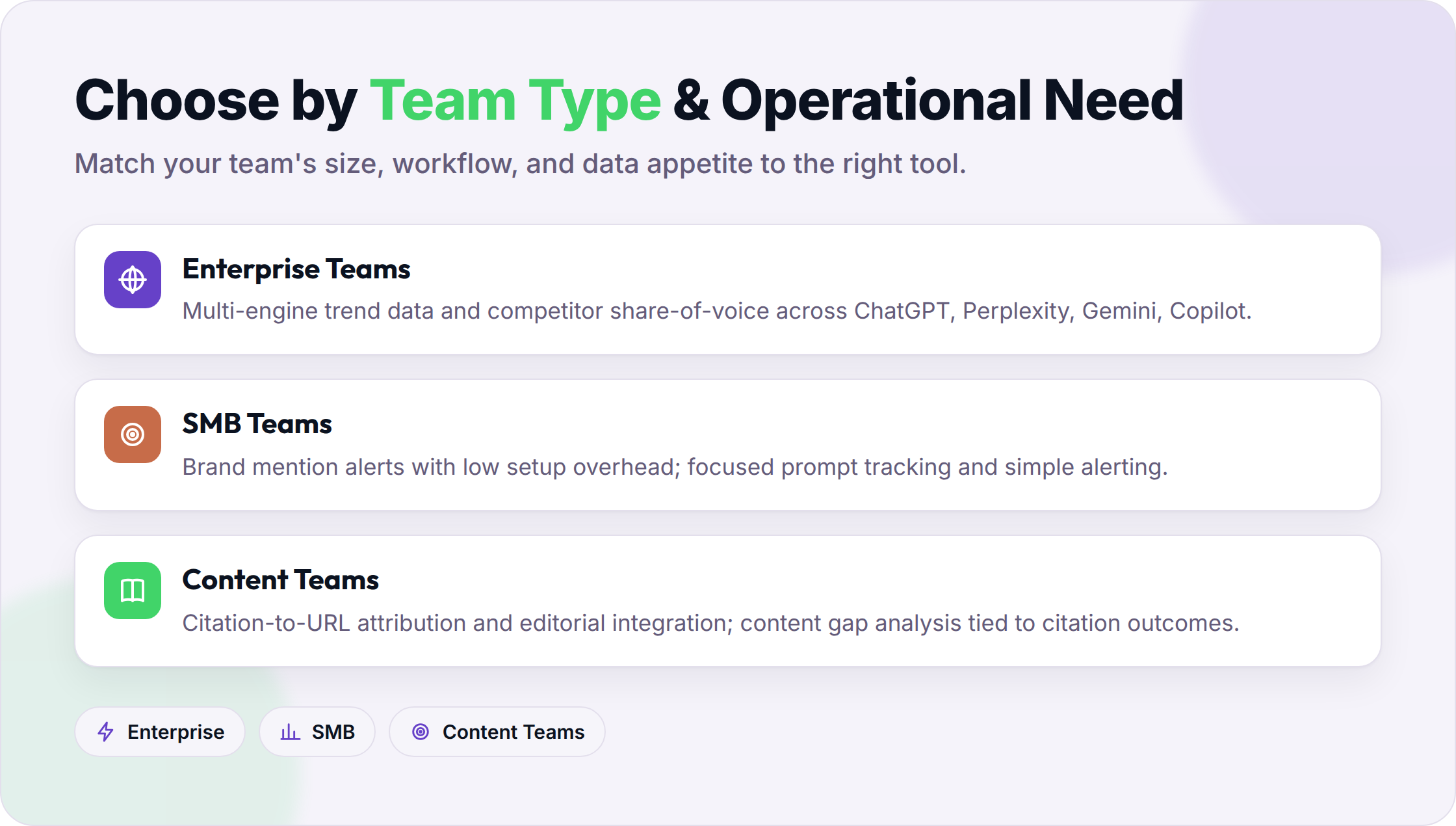
The right tool depends on three variables: how many engines you need to monitor, how much operational overhead your team can absorb, and whether citation data needs to feed directly into a publishing workflow or just sit in a dashboard.
| Team Type | Primary Need | Key Feature to Prioritize |
|---|---|---|
| Enterprise | Multi-engine trend data, competitor share-of-voice | Daily polling across ChatGPT, Perplexity, Gemini, Copilot |
| SMB | Brand mention alerts, low setup overhead | Focused prompt tracking, simple alerting |
| Content team | Citation-to-URL attribution, editorial integration | Content gap analysis tied to citation outcomes |
Enterprise Teams Needing Multi-Engine Coverage
If your brand operates across markets and your buyers use a mix of ChatGPT, Perplexity, Gemini, and Bing Copilot, you need a tool that polls all four on a consistent schedule and stores the full response history. One-shot snapshots are not useful at this scale. You need trend lines: which engine cited you last week versus this week, which competitor gained ground on a specific prompt cluster, and which URLs are getting pulled into answers versus ignored.
Airops' breakdown of AI citation tracking tools identifies multi-engine coverage and prompt-level attribution as the two features that separate enterprise-grade tools from basic mention monitors. Both matter because an engine like Perplexity may cite a completely different set of sources than ChatGPT for the same query, and a tool that only covers one engine will miss that divergence entirely.
The trade-off is cost and setup time. Tools with genuine multi-engine polling, competitor tracking, and weekly trend data typically sit at the higher end of the market. For a team running 50 or more tracked prompts across four engines, that overhead is justified. For a five-person startup, it usually isn't.
SMBs That Need Brand Mention Alerts Without a Six-Figure Contract
Smaller teams have a narrower need: know when AI engines start citing a competitor in a space you own, and know when your brand drops out of answers it used to appear in. You don't need a full share-of-voice dashboard. You need a weekly alert that tells you something changed.
Start with a short prompt list, around 10 to 20 queries your buyers actually type, and track those consistently rather than trying to cover every possible variation. Useomnia's guide to AI citation tracking makes the point that prompt selection matters more than prompt volume: a focused list of high-intent queries gives you more actionable signal than 200 loosely related ones.
This approach breaks down when a brand operates in multiple verticals or sells to buyers with very different search behaviors. In that case, 10 prompts won't capture enough surface area, and the SMB-tier tooling starts to feel like a keyhole view of a much larger problem.
Content Teams That Want Citation Data in Their Editorial Workflow
For content teams, the relevant question isn't just "are we getting cited?" It's "which of our published articles are getting cited, and what do the articles that beat us look like structurally?" That requires a tool that connects citation outcomes back to specific URLs and surfaces the gap between what you published and what got picked.
Slatehq's 2026 review of AI citation tracking tools notes that the most effective setups pair citation monitoring with content gap analysis, so editorial teams can see not just where they're losing citations but what type of content is winning them. That pairing turns citation data from a reporting metric into an editorial input.
One limitation to flag: citation data has a lag. An article published today may not appear in AI engine responses for several weeks, depending on how frequently the engine updates its retrieval index. Content teams that expect immediate feedback on a new publish will be disappointed. The signal is most useful for auditing existing content and prioritizing rewrites, not for validating new articles in real time.
Best for Enterprise: Profound
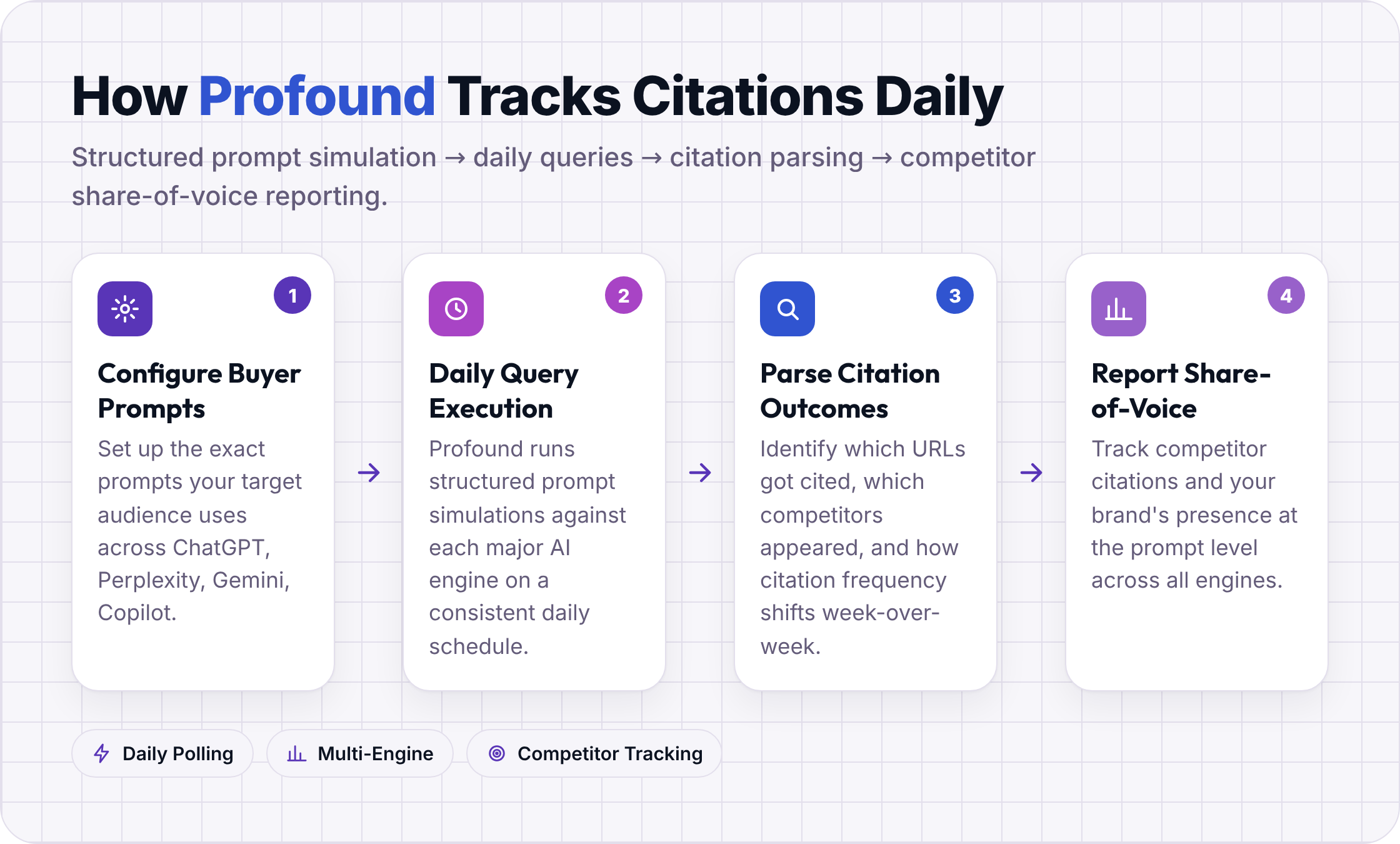
Profound is a purpose-built AI citation tracking platform designed for large marketing and SEO teams. It monitors brand mentions and URL citations across ChatGPT, Perplexity, Gemini, and Microsoft Copilot on a daily refresh cadence, logs which sources each engine surfaces, and reports competitor share-of-voice at the prompt level. For enterprise teams whose core job is knowing whether AI engines are citing them at scale, Profound is the clearest purpose-fit option available in 2026.
What Profound Tracks
The platform runs structured prompt simulations against each major AI engine and records citation outcomes over time. You configure the prompts your buyers actually use, and Profound queries those prompts daily, parsing every response to identify which URLs got cited, which competitors appeared, and how citation frequency shifts week over week. That daily cadence matters: ChatGPT and Google overlap on only 12% of citations, so a tool that only checks one engine misses most of the picture.
What Profound Costs and Where It Falls Short
Profound does not publish pricing publicly. You'll need a sales conversation to get a number, which is a friction point for teams that want to evaluate cost before committing time to a demo. Based on publicly available user reports and third-party reviews, the platform sits firmly in the enterprise tier, with annual contracts that put it out of reach for most teams under 20 people.
The other limitation: Profound's strength is citation tracking, not content recommendations. It tells you who is getting cited and how often. It doesn't tell you why a competitor's article is winning citations or what you'd need to change to displace it. You'll need a separate content analysis layer to close that gap.
When Profound Makes Sense
Profound fits teams that are already past the "should we track this?" question and need a reliable, scalable system for ongoing competitor citation monitoring across all major AI engines. If you're running a content program at a company where AI search visibility is a board-level metric, Profound is built for that context. If you're still figuring out which prompts matter to your buyers, start with a lighter tool and graduate to Profound once your prompt library is stable.
Frequently Asked Questions
Can free tools track competitor citations in AI-generated search responses?
Free tools can get you partway there, but not all the way. You can manually query ChatGPT, Perplexity, or Gemini and log which URLs appear in responses, but doing that consistently across dozens of prompts and multiple engines takes significant time. No free platform currently automates competitor citation tracking across all four major AI engines with daily polling and alert functionality.
How often do AI engines change which sources they cite?
Citation patterns shift more often than most teams expect. A source that appears consistently for a given query one week may drop out the following week as the engine updates its retrieval index or as new content enters the pool. Daily polling catches these shifts; weekly polling can miss short-term fluctuations that still carry strategic signal.
Does tracking AI citations require access to the engines' APIs?
Most dedicated tracking tools use their own query infrastructure rather than requiring you to set up API access directly. You configure the prompts and competitor domains inside the platform, and the tool handles the querying. Manual methods do benefit from API access, particularly for ChatGPT and Perplexity, because API queries are more consistent and easier to log than browser-based sessions.
What's the difference between AI citation tracking and traditional brand monitoring?
Traditional brand monitoring scans the web for mentions of your brand name across news sites, forums, and social media. AI citation tracking specifically watches what large language models include in their generated responses when answering queries, which is a different data source entirely. A competitor could be cited in thousands of AI-generated answers without those citations ever appearing as indexable web content that traditional monitoring tools would catch.
How many prompts should you track to get useful competitor citation data?
Start with 15 to 30 prompts that map directly to your buyers' actual search behavior, covering both branded and unbranded queries in your category. Tracking fewer than 10 prompts gives you too narrow a view to spot patterns. Tracking more than 100 prompts without a clear taxonomy makes the data hard to act on. Refine the list quarterly as you learn which prompt clusters produce the most citation movement.
Do AI citation tracking tools work for local or regional businesses?
Most platforms are optimized for national or global brand tracking and handle local queries less reliably. If your buyers are searching with location-specific intent, like "best accountant in Austin," you'll want to verify that your chosen tool actually polls those localized queries rather than stripping the geographic modifier. Some platforms let you configure location context; many don't.
If you want a clearer picture of where your brand stands in AI-generated search responses, and where your competitors are gaining ground, visit Seorav's GEO service page to see how structured generative engine optimization can turn citation data into a content strategy you can actually act on.
Keep reading

Scaling Content Production While Keeping Your Brand Voice Intact
Learn how to scale content without losing brand voice using voice docs, brief templates, and risk-calibrated review. Practical framework with real numbers.
How Perplexity AI Decides Which Sources to Cite
Learn how Perplexity AI ranks content through its RAG pipeline, covering freshness, domain authority, semantic matching, and citation graph signals.

How to Get Your Website Into ChatGPT Search Results
Learn how to appear in ChatGPT search results: Bing indexing, robots.txt setup, schema markup, and answer-first content that earns citations.