Query Fan-Out in LLM Search: How AI Breaks Down Your Questions
Last updated: 9 October 2026
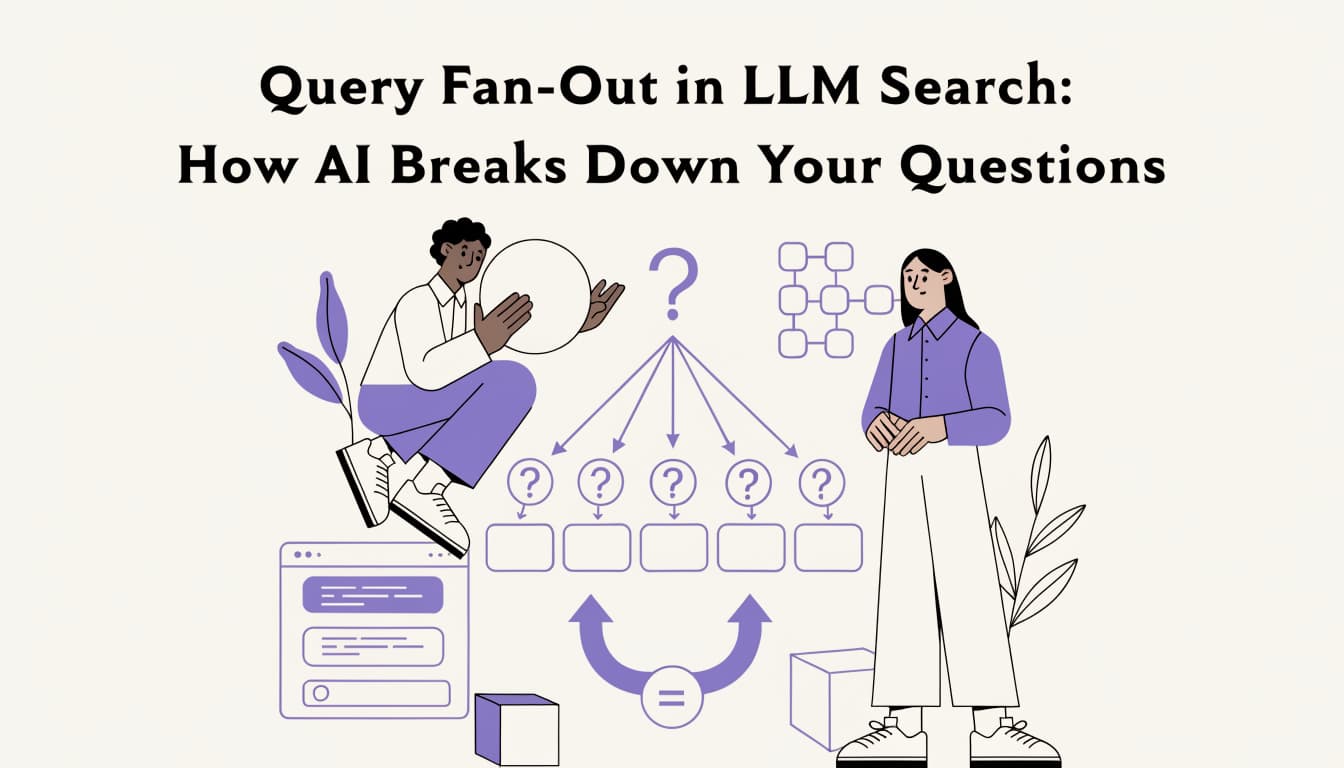
Query fan-out in LLM search is when an AI system automatically breaks a single user question into multiple parallel sub-queries, retrieves results for each independently, then combines them into one coherent response. This process happens before the final answer generates, completely invisible to the person who submitted the original prompt. The technique improves answer quality by exploring different angles of a question simultaneously rather than following a single retrieval path.
In retrieval-augmented generation pipelines, this decomposition is not incidental. Conductor's technical breakdown of answer-engine retrieval documents that a single complex prompt can produce anywhere from 3 to 10 distinct sub-queries, each routed to separate retrieval calls before synthesis begins. The exact fan-out rate scales with prompt complexity: a narrow factual question may fan out to just 2 sub-queries, while a comparative or multi-part question can push well past 8.
One honest caveat: fan-out counts vary significantly across model architectures and pipeline configurations. A number that holds for one RAG implementation may not transfer to another, so treat published ranges as directional rather than fixed benchmarks.
What stays consistent across implementations is the structural logic. The AI treats your original question as a parent node, generates child queries that each address a distinct facet, and then merges the retrieved evidence. Understanding that layer is where content visibility decisions actually get made.
Four Things to Know About Query Fan-Out
Query fan-out is the process by which an AI search engine decomposes a single user prompt into multiple parallel sub-queries, retrieves content against each one separately, then synthesizes the results into one response. Most systems generate between 3 and 8 sub-queries per prompt.
It happens before the answer is written. Fan-out runs inside the retrieval-augmented generation (RAG) pipeline, at the decomposition stage, before a single word of the response is drafted. If your content is not structured to answer a specific sub-query facet, it will not surface in that retrieval pass.
The sub-queries are thematic, not random. Ipullrank's analysis of query expansion and fan-out shows that AI systems identify distinct themes within a prompt and generate targeted sub-queries around each one. A question about "best project management tools for remote teams" might fan out into cost, integrations, async collaboration features, and onboarding time as separate retrieval threads.
The scale is measurable. A study classifying 1,323 fan-out queries generated from 540 parent queries across ChatGPT, Gemini, and Perplexity found consistent decomposition patterns across all three platforms, per this SSRN working paper on fan-out query classification. The behavior is not platform-specific.
The trade-off is real. Fan-out improves answer completeness, but it also means a single piece of content rarely wins the full response. Your article might get cited for one sub-query and ignored for three others. Optimizing for fan-out means writing content that covers distinct facets clearly, not just ranking for the parent keyword. That requires more structural discipline than traditional SEO, and for smaller content teams, it is a genuine resource constraint.
How LLMs Decompose Complex Questions Into Sub-Queries
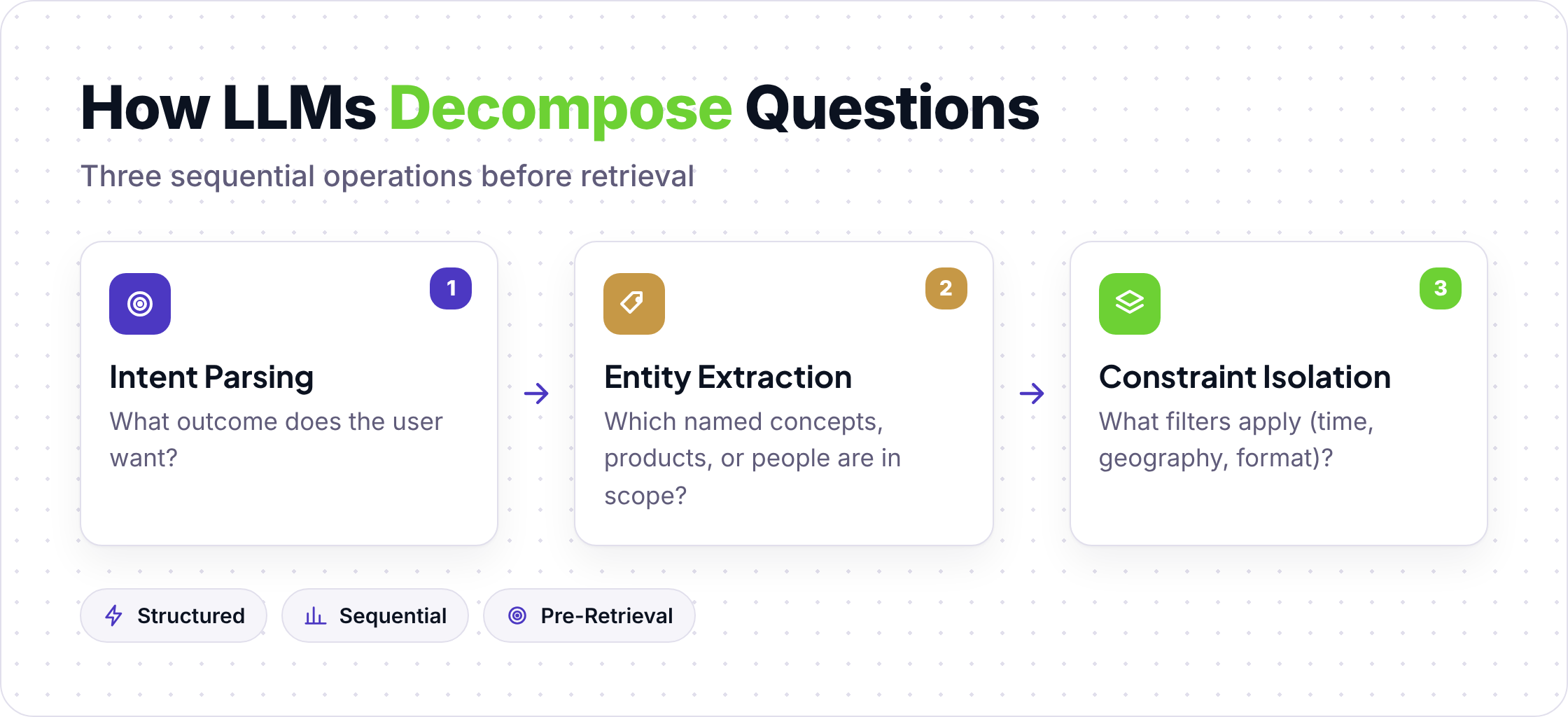
When an LLM receives a complex question, it rarely retrieves against the raw input string. Instead, the model runs three operations in sequence: intent parsing (what outcome does the user want?), entity extraction (which named concepts, products, or people are in scope?), and constraint isolation (what filters apply, such as time range, geography, or format?). Each output becomes a discrete sub-query, routed independently through the retrieval layer before any answer is drafted.
Intent, Entities, and Constraints: The Three-Part Split
Take the question "What are the best project management tools for remote engineering teams under 50 people in 2026?" A single retrieval call against that full string would return noisy, unfocused results. So the model splits it: one sub-query targets tool comparisons, a second targets remote-team workflows, a third targets company-size benchmarks, and a fourth targets recency signals tied to 2026 releases. The decomposition is systematic, not random.
Ekamoira's original research on query fan-out puts the typical fan-out range at 3 to 8 sub-queries per prompt, with the upper end appearing on questions that combine comparative intent with multiple named entities and at least one hard constraint.
How RAG Assigns Each Sub-Query to a Separate Vector Search
In a retrieval-augmented generation pipeline, each sub-query gets embedded independently and matched against the vector store in a parallel lookup. The retrieval layer returns a separate ranked chunk list for each sub-query, and the generation layer synthesizes those lists into one coherent response. The practical consequence: a single user question can trigger 5 or 6 distinct vector searches, each pulling different documents, before the model writes its first sentence.
This maps to the same architectural pattern Omnius describes in their breakdown of query fan-out: the system takes each sub-query, runs appropriate retrieval, then aggregates. The aggregation step is where content either gets included or dropped. If your page answers only one of the five sub-queries, it may surface in one retrieval call but get outweighed by a competitor page that answers three.
Why Fan-Out Depth Tracks Complexity, Not Length
A short question can generate deep fan-out. "Is Rust better than Go?" looks like a five-word query, but it contains two named entities, an implicit comparison intent, and an open constraint set (better for what? at what scale?). The model fills in those gaps by generating sub-queries that cover performance benchmarks, ecosystem maturity, hiring market data, and use-case fit. A long question with a single clear intent, such as "What is the capital of France?", generates no fan-out at all.
Deeper decomposition improves answer completeness but increases retrieval latency and raises the risk of sub-query drift, where one generated sub-query diverges far enough from the original intent that it pulls irrelevant content into the synthesis step. This breaks down most visibly on ambiguous queries where the model must guess at constraints the user never stated. When the guessed constraint is wrong, the fan-out produces a confident-sounding answer built partly on the wrong retrieval set. No decomposition mechanism fully solves for that.
Why LLMs Fire Fan-Out and When It Changes Citation Patterns
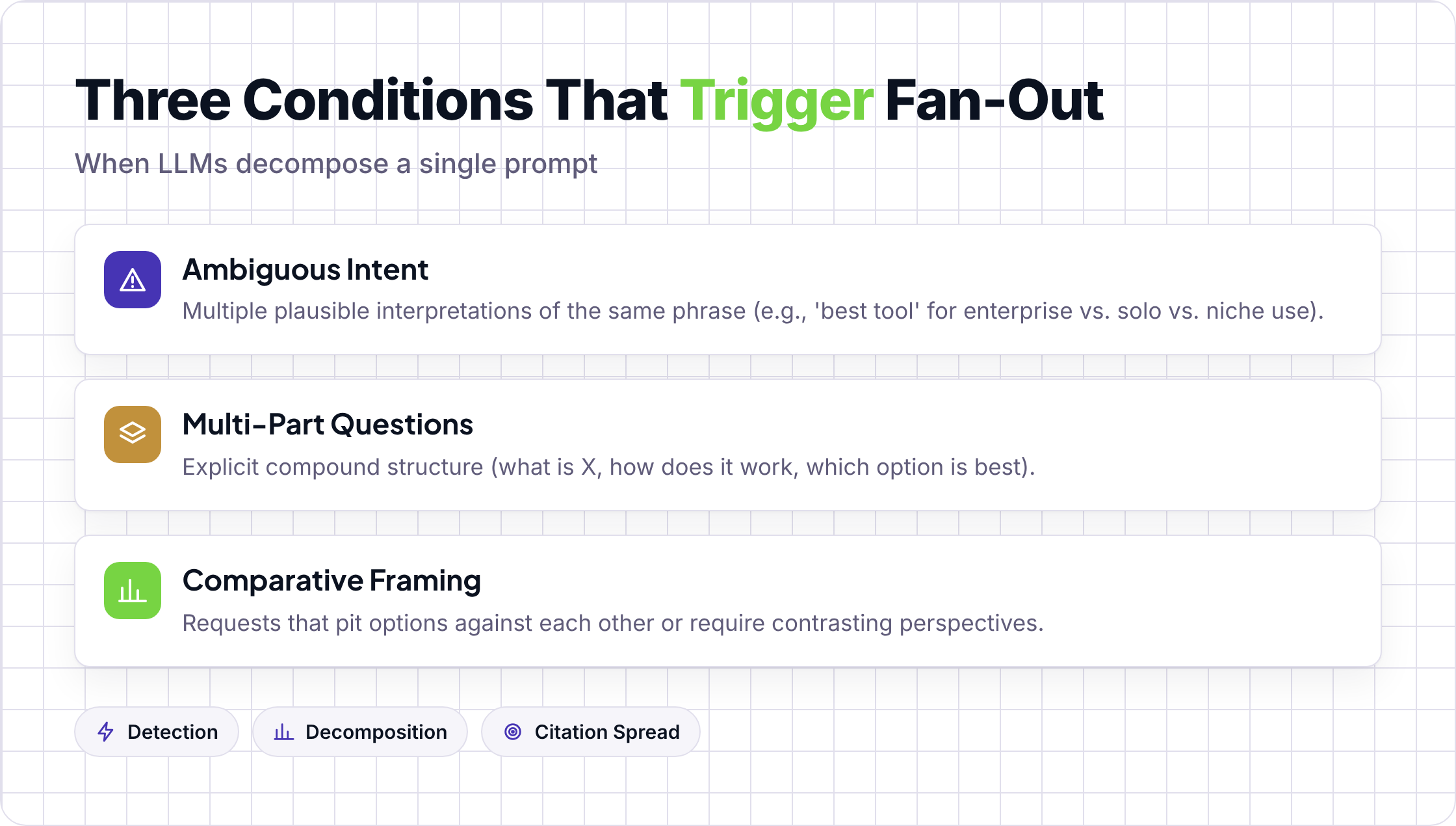
LLMs trigger query fan-out when a single prompt contains more than one answerable facet. The engine detects ambiguous intent, multi-part structure, or comparative framing, then decomposes the prompt into parallel sub-queries before retrieving a single source. That decomposition shifts which pages get cited: instead of one authoritative URL dominating the answer, citation spreads across a cluster of topically distinct pages, each covering one branch of the original question.
The Three Conditions That Pull the Trigger
Ambiguous intent is the most common trigger. A prompt like "best project management tool" could mean enterprise software, a free solo option, or a specific use case like construction scheduling. The model fires sub-queries for each plausible interpretation rather than guessing.
Multi-part questions are the clearest case. "What is RAG, how does it work, and which vector databases support it?" contains three distinct retrieval tasks. Fan-out typically produces between 3 and 8 sub-queries per prompt, meaning a three-part question almost always generates at least three separate retrieval passes before synthesis begins.
Comparative queries ("X vs. Y") reliably trigger fan-out because the model needs independent evidence for each option before it can construct a balanced comparison. A single page that covers both sides rarely satisfies all sub-queries on its own.
How Fan-Out Redistributes Citations
Before fan-out, traditional search rewarded depth on a single topic: one comprehensive page could rank for a broad keyword and capture most of the traffic. Fan-out breaks that dynamic. The Similarweb AI search citation analysis puts it directly: query fan-out determines which sources AI pulls from, and the sources that win are those that match individual sub-query facets, not the ones that try to answer everything at once.
In practice, a three-part comparative prompt might cite a technical explainer from one domain, a pricing breakdown from another, and a user-experience review from a third. No single page wins the whole answer. Citation distributes across a topical cluster, and any page that does not map cleanly to at least one sub-query facet gets skipped entirely, regardless of its overall authority.
Reference Rate vs. Click-Through Rate
Being cited and being clicked are not the same metric, and conflating them leads to bad optimization decisions.
Reference rate measures how often an AI engine includes your URL in a synthesized answer. Click-through rate measures how often a reader follows that citation to your page. In AI-generated answers, reference rate can be high while click-through stays low, because the engine has already extracted and presented the relevant passage. The reader got the answer without leaving the interface.
A page optimized to be cited (short, structured, answer-first) may actually reduce clicks compared to a page that withholds enough detail to make the reader want more. There is no clean solution here. Teams that track only one metric will misread their AI search performance. A page with a 12% reference rate and a 1.2% click-through rate is performing very differently from a page with the same reference rate and a 6% click-through, and the gap usually traces back to how much of the answer the AI engine surfaced inline.
This also breaks down when the cited page is behind a paywall or requires a login. Fan-out will still retrieve and cite gated content if the model has indexed it, but the click-through conversion is near zero. Reference rate looks healthy; actual traffic does not materialize.
Fan-Out in Action: Real Examples Across Three Domains
A single conversational question can generate between 3 and 8 sub-queries before you see one word of response. The examples below show what that decomposition looks like in practice, and what content gaps it exposes.
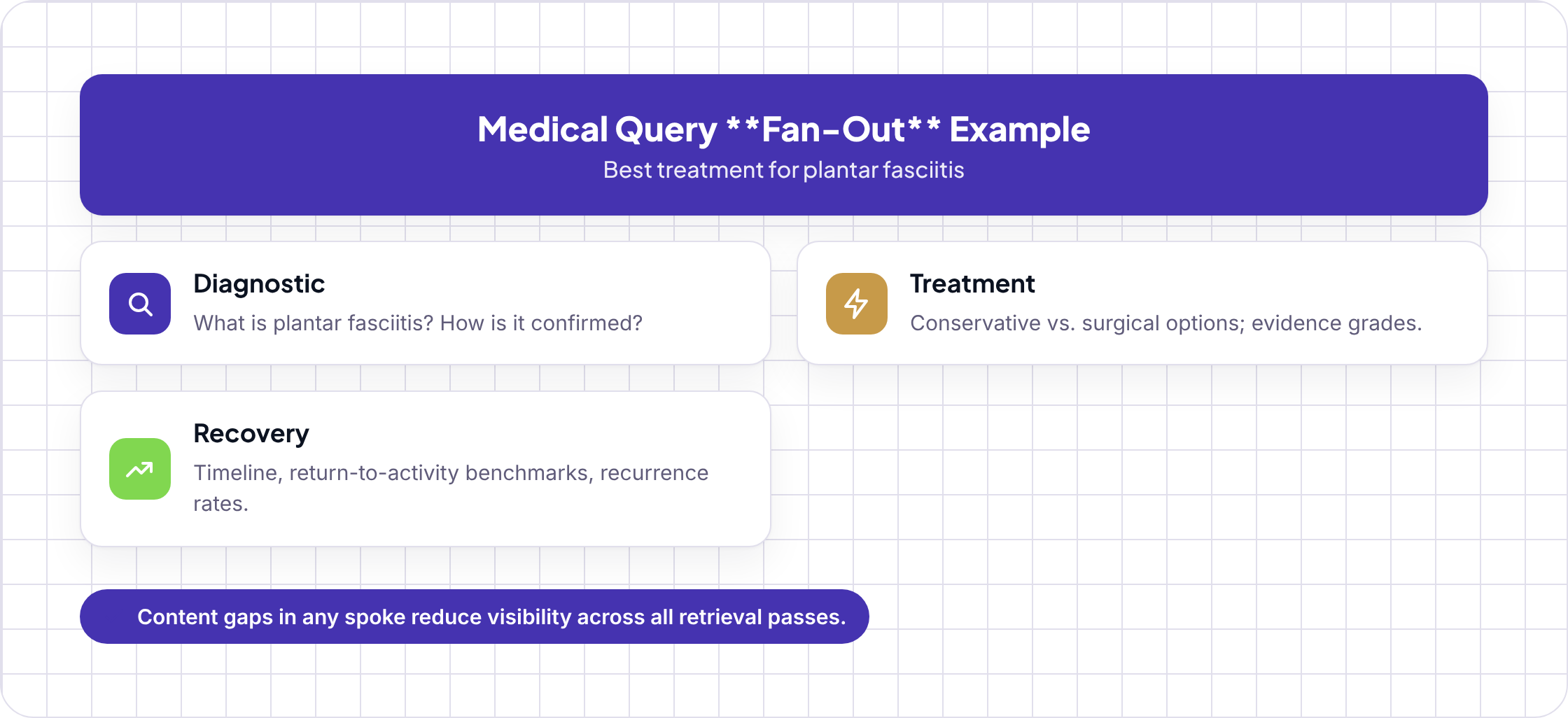
Medical: "best treatment for plantar fasciitis"
You type this expecting one answer. The retrieval layer sees three distinct information needs: a diagnostic sub-query (what is plantar fasciitis, how is it confirmed), a treatment sub-query (conservative vs. surgical options, evidence grades), and a recovery sub-query (timeline, return-to-activity benchmarks, recurrence rates).
Most health content covers the treatment layer reasonably well. The diagnostic and recovery layers are where gaps appear. If your page never defines the condition or never addresses the 6-to-18-month recovery window that clinical guidelines cite, the AI engine pulls those facets from a competitor page. Your page gets cited for one sub-query and skipped for two others, even if your treatment section is the strongest on the web.
Software: "best CI/CD tool for a small DevOps team"
This prompt fans out into at least four threads: tool comparisons (Jenkins vs. GitHub Actions vs. CircleCI), pricing tiers for teams under 10 engineers, integration depth with common stacks (Docker, Kubernetes, Terraform), and setup complexity or time-to-first-pipeline benchmarks. A page that covers only the feature comparison misses the pricing and setup sub-queries entirely.
The content gap here is common. Most vendor comparison pages lead with features and bury pricing. Fan-out means the AI engine will pull pricing data from a separate source, and that source gets the citation credit for the pricing sub-query, regardless of which page ranks first in traditional search.
Finance: "should I use a Roth IRA or traditional IRA"
This looks like a binary choice, but the model decomposes it into income eligibility thresholds, tax treatment at contribution vs. withdrawal, required minimum distribution rules, and early withdrawal penalties. Each facet is a separate retrieval pass.
A page that answers only "Roth is better if you expect higher taxes in retirement" satisfies one sub-query. The pages that get cited across the full answer are the ones that address each facet in a clearly labeled section, so the retrieval layer can match the right chunk to the right sub-query. Broad conclusions without supporting detail tend to lose citation coverage on multi-facet financial queries.
What Query Fan-Out Means for Your Content Strategy
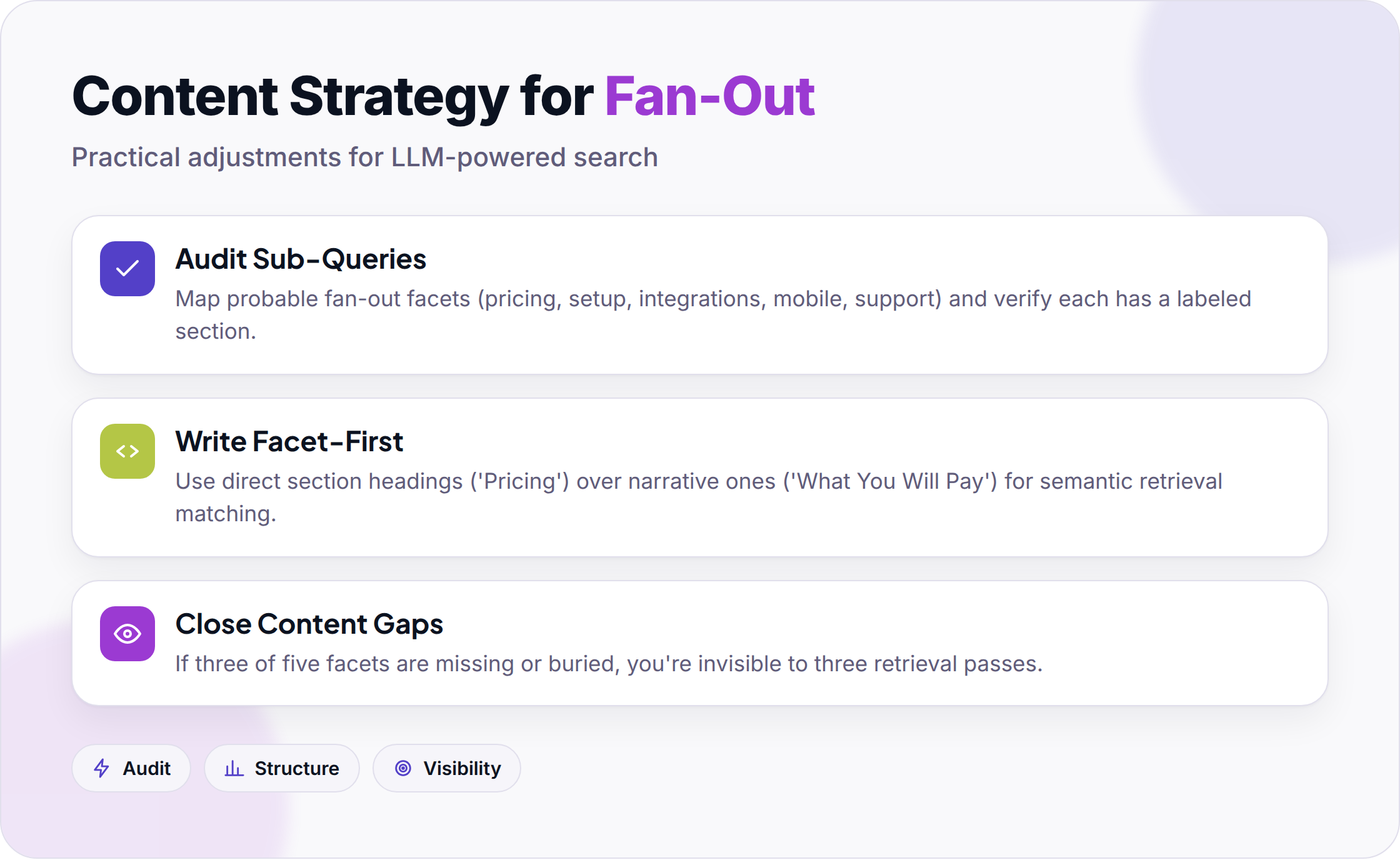
Understanding what is query fan-out in LLM search changes how you should think about content structure. The goal shifts from "rank for this keyword" to "answer each facet that this keyword fans out into."
A few practical adjustments follow from that shift.
Audit your existing pages against the sub-queries they are likely to trigger. For a page targeting "best CRM for small business," map out the probable fan-out: pricing, ease of setup, integration with email tools, mobile access, and support quality. Check whether your page has a clearly labeled section for each. If three of those five facets are missing or buried, you are invisible to three of the five retrieval passes.
Write facet-first, not topic-first. A section heading like "Pricing" is more retrievable than "What You Will Pay." The retrieval layer matches chunks to sub-queries by semantic similarity, and a heading that names the facet directly reduces ambiguity in that matching step.
Shorter, denser sections outperform long narrative blocks for citation purposes. A 150-word section that answers one sub-query cleanly is more likely to surface in that retrieval pass than a 600-word section that addresses the same sub-query while also covering three others. The model pulls the most relevant chunk, and a tightly scoped chunk wins that match more reliably.
One limitation worth naming: none of this guarantees citation. Fan-out retrieval is probabilistic, and the model's sub-query generation is not fully predictable from the outside. You can structure content to improve your odds, but you cannot engineer a guaranteed outcome. Teams that treat fan-out optimization as a precision tool will be disappointed; teams that treat it as a structural discipline will see incremental gains over time.
Frequently Asked Questions
What is query fan-out in LLM search?
Query fan-out is the process by which an LLM-powered search system breaks a single user prompt into multiple parallel sub-queries, runs a separate retrieval pass for each one, then combines the results into one synthesized answer. It happens inside the retrieval-augmented generation pipeline, before any response text is generated. The number of sub-queries typically ranges from 3 to 8, depending on how many distinct facets the original prompt contains.
How many sub-queries does fan-out typically generate?
Most implementations generate between 3 and 8 sub-queries per prompt, based on published research across ChatGPT, Gemini, and Perplexity. Simple factual questions may produce only 2, while complex comparative or multi-part prompts can exceed 8. These numbers vary by model architecture and pipeline configuration, so treat them as a directional range rather than a fixed rule.
Does fan-out affect which pages get cited in AI answers?
Yes, directly. Because each sub-query triggers a separate retrieval pass, citation spreads across multiple pages rather than concentrating on one. A page that answers only one facet of a multi-part prompt may get cited for that facet and skipped for the others. Pages that cover multiple distinct facets in clearly labeled sections tend to appear across more retrieval passes and accumulate more citation coverage.
Is query fan-out the same as query expansion?
They are related but not identical. Query expansion typically refers to adding synonyms or related terms to a single query to broaden retrieval coverage. Query fan-out refers to splitting one query into multiple structurally distinct sub-queries, each targeting a different facet of the original intent. Fan-out produces parallel retrieval threads; expansion widens a single thread. Some pipelines use both techniques at different stages.
Can you optimize content specifically for fan-out?
You can structure content to improve your odds, though you cannot guarantee a specific outcome. The most reliable adjustments are: auditing pages against the sub-queries they are likely to trigger, writing clearly labeled sections for each distinct facet, and keeping individual sections short and focused so the retrieval layer can match the right chunk to the right sub-query. Broad narrative sections that blend multiple facets together tend to perform worse in fan-out retrieval than tightly scoped, facet-specific sections.
Does fan-out behave differently across ChatGPT, Gemini, and Perplexity?
The SSRN working paper that classified 1,323 fan-out queries from 540 parent queries found consistent decomposition patterns across all three platforms. The structural logic (intent parsing, entity extraction, constraint isolation) appears stable across implementations, even though the exact sub-query wording and count can differ. Platform-specific tuning affects the edges, but the core behavior is not unique to any one system.
If you want to see how your content maps against the sub-queries AI engines are likely to generate for your target topics, visit Seorav's GEO analysis tool to get a structured breakdown of your visibility across fan-out retrieval passes.
Keep reading

Reference Rate vs Click-Through Rate: What AI Search Actually Measures
Learn how reference rate vs click-through rate in AI search differ, why CTR can fall while citations rise, and which content formats earn the most AI citat
Writing Answer Paragraphs That AI Systems Will Quote
Learn how to write self-contained answer paragraphs for AI with a four-part structure that improves extraction probability and gets your content quoted by

The FAQ Structure That AI Systems Actually Extract
Learn how to structure FAQs for AI answer extraction with self-contained answers, FAQPage schema, and a repeatable testing process across ChatGPT, Perplexi