Why AI Search Misses Sentiment in Your Content
Last updated: 4 October 2026
A perceptual sentiment deficit occurs when AI search systems extract factual claims and structural signals from your content but fail to recognize emotional tone, confidence markers, or contextual nuance underneath. This gap matters because retrieval models weight authoritative voice and tonal clarity as ranking signals, meaning pages that read emotionally flat get cited less often than those with distinct, readable sentiment. Understanding how AI interprets tone is essential for visibility.
What Perceptual Sentiment Deficit Does to Your Rankings
When AI engines parse your content, they extract factual claims and structural signals but routinely miss the emotional register underneath. That gap, a perceptual sentiment deficit, reduces the likelihood your page gets cited because AI retrieval models favor content that reads as authoritative and confident, not tonally flat.
The mechanism is straightforward. Sentiment analysis in NLP systems, as documented in a 2025 systematic review across 42 citing studies, operates on surface-level lexical patterns. When your content's emotional cues are ambiguous or suppressed, the model assigns lower confidence to its interpretive match, and lower confidence correlates with lower citation frequency.
This article covers detection first, then impact, then fixes. That order is deliberate. Trying to fix a sentiment deficit before you can measure it produces changes that feel meaningful but move nothing.
One honest caveat: sentiment deficit is one suppression factor among several. Schema gaps, citation diversity, and answer-first structure all matter too. This section focuses on sentiment specifically because it is the least visible and, for most content teams, the least instrumented.
TL;DR
AI search engines extract factual claims and structured answers well, but they routinely miss the emotional register of your content. That gap means a page can rank and still never get cited, because the model reads your words without reading your tone.
What's happening: Large language models parse syntax and semantics, not sentiment. They identify what you said, not how confidently or critically you said it.
The failure mode: A cautious, hedged review and an enthusiastic endorsement look structurally identical to most retrieval pipelines, so the model treats them as equivalent sources.
The visibility consequence: Content with strong, clear sentiment signals gets passed over in favor of neutral, encyclopedic text, even when your piece is more authoritative. The Stanford HAI 2026 AI Index notes that public trust in AI outputs is rising globally, which raises the stakes: more readers are acting on AI-cited content without checking the original source.
One fix: Add an explicit stance sentence near the top of each article. Something like "This approach works well for X but fails under Y conditions" gives the model a parseable sentiment anchor, not just a topic cluster.
The trade-off worth acknowledging: explicit stance sentences can feel forced in certain content types, particularly reference documentation or neutral comparison guides. If your brand voice is deliberately impartial, injecting sentiment may undercut credibility with human readers even as it improves AI citation rates. Balance is required.
What Perceptual Sentiment Deficit Is and Why It Matters for AI Ranking
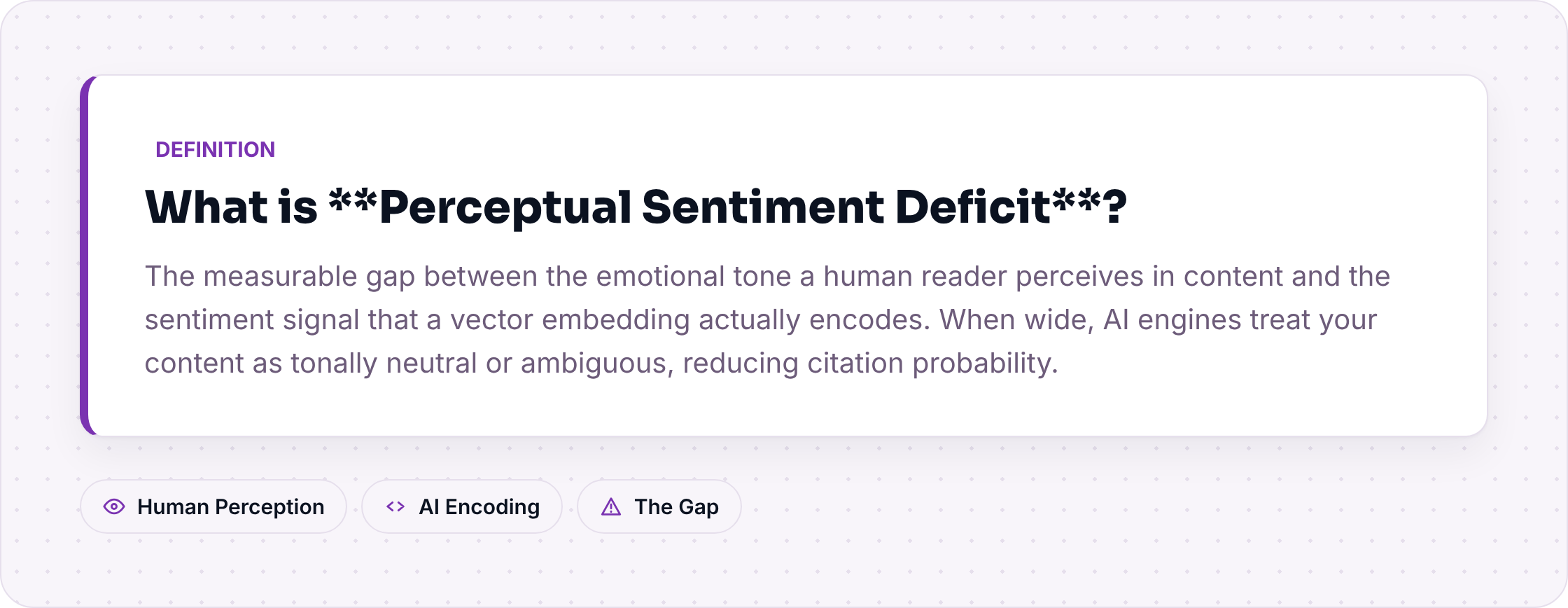
Perceptual sentiment deficit is the gap between the emotional tone a human reader perceives in a piece of content and the sentiment signal that a vector embedding actually encodes. When that gap is wide, generative AI engines treat your content as tonally neutral or ambiguous, which reduces the probability it gets cited in a synthesized answer. For content that relies on hedged, ironic, or nuanced language, this gap is almost always wider than the author expects.
The mechanics are worth understanding precisely. Transformer models convert text into high-dimensional vectors, and the attention weights that shape those vectors are trained primarily on co-occurrence patterns, not on the pragmatic meaning a reader infers from context. A sentence like "the product works, if you can tolerate the setup time" reads as mildly negative to a human. To an embedding model, "works" and "tolerate" pull in opposite directions and the vector lands close to neutral. The hedged qualifier gets flattened. AuthorityTech's 2026 analysis of AI brand sentiment describes this exact dynamic: the gap between how a brand describes itself and how AI describes it is the metric that reveals the problem.
Irony compounds the issue further. Sarcasm depends on a reader recognizing the mismatch between literal meaning and intended meaning. Attention mechanisms do not reliably detect that mismatch, especially in short passages without surrounding context. The result is that ironic criticism can register as mild praise, and cautious endorsements can register as criticism.
Google SGE and comparable generative engines add another layer. These systems apply a confidence filter when selecting passages to synthesize: content with ambiguous or inconsistent sentiment scores is deprioritized in favor of content that reads as clearly positive, clearly negative, or clearly neutral. Ambiguity signals low reliability to the ranking layer, even when the ambiguity is intentional and editorially appropriate.
The trade-off is real, though. Flattening your prose to produce clean sentiment signals can strip out the nuance that makes expert content credible to human readers. A technical review that hedges appropriately ("performs well under moderate load, degrades noticeably above 10,000 concurrent requests") is more accurate and more trustworthy than one that rounds to a clean verdict. The fix is not to eliminate hedging but to structure it so the primary sentiment signal is unambiguous before the qualifier appears, giving the embedding model a clear anchor.
How LLMs Fail to Detect Nuanced Sentiment in Text
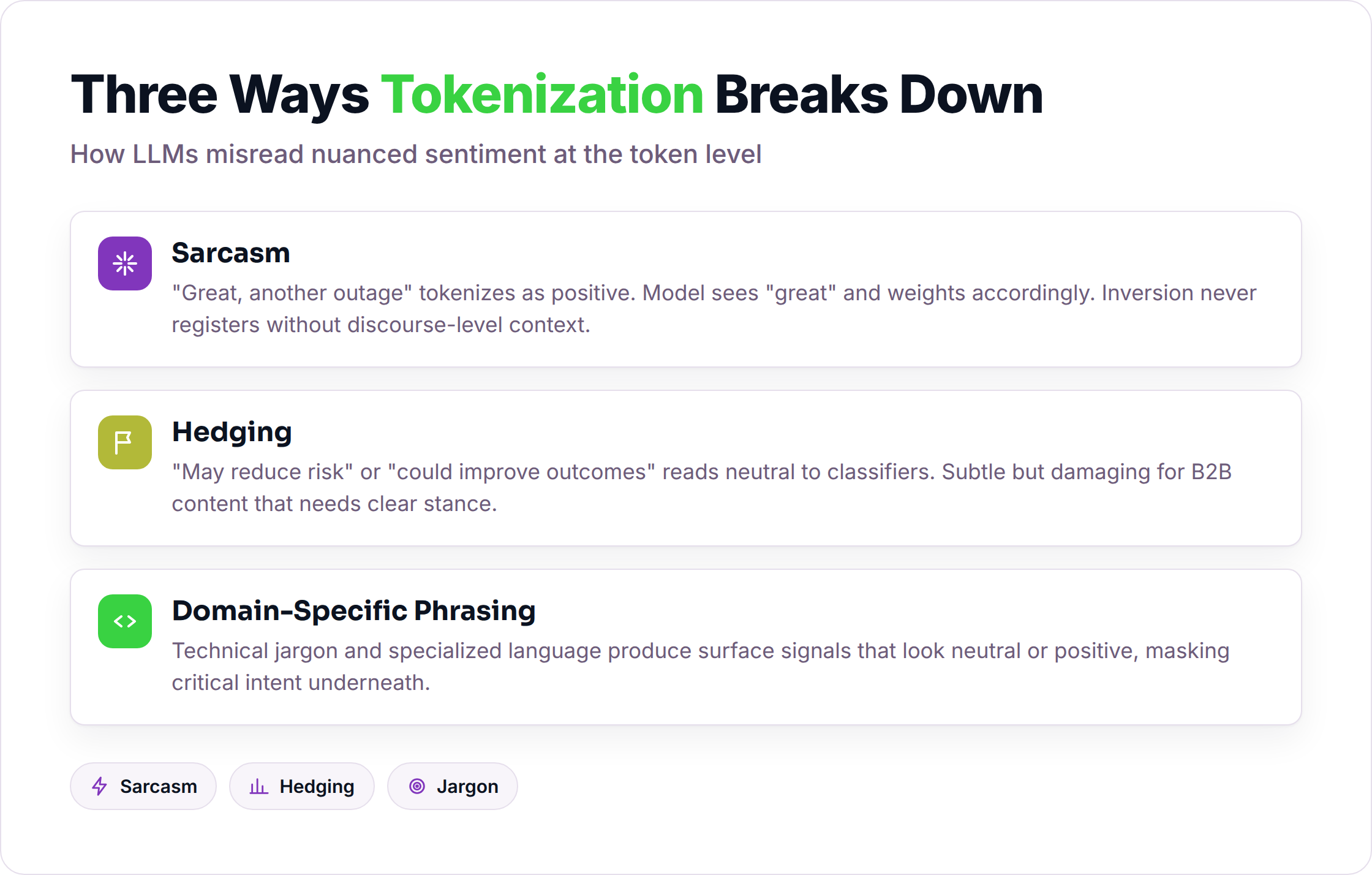
LLMs misread nuanced sentiment because their token-level processing flattens tone before meaning is fully resolved. Sarcasm, hedged language, and domain-specific phrasing each produce surface signals that look neutral or positive to a classifier, even when the underlying intent is critical or uncertain. The result is that retrieval systems built on those misreadings pull the wrong content, rank it confidently, and compound the error across every downstream query.
Three Cases Where Tokenization Breaks Down
Sarcasm is the clearest failure mode. A phrase like "great, another outage" tokenizes into individually positive and neutral tokens. The model sees "great" and weights the sequence accordingly. Without discourse-level context, the inversion never registers.
Hedging is subtler and arguably more damaging for B2B content. Phrases like "may reduce risk" or "could improve outcomes" carry deliberate epistemic caution. A sentiment classifier trained on review-style corpora reads them as weak positives. A reader, or a buyer, reads them as qualified claims that require scrutiny.
Domain-specific tone is the third case. Legal, medical, and financial writing uses language that reads as negative in general corpora but is neutral or even favorable in context. "Liability is limited" is reassuring in a contract; a general-purpose model may score it negatively.
A 2024 comprehensive investigation into LLM sentiment analysis capabilities, published in the ACL Anthology findings, found that even leading models show measurable degradation on aspect-level and nuanced sentiment tasks compared to standard polarity classification, with performance gaps widening on domain-shifted text.
Query Fan-Out Multiplies the Error
Modern AI search engines don't run one query. They decompose a user's prompt into several sub-queries, retrieve results for each, then synthesize. If the sentiment of your source content is misread at step one, that misclassification propagates into every sub-query that inherits the initial retrieval context.
A page flagged as expressing uncertainty about a product category may be deprioritized across all sub-queries touching that category, even when the uncertainty was intentional and the content was authoritative. The fan-out mechanism turns a single tokenization error into a structural exclusion.
Polarity Scores vs. Semantic Confidence
This is where the gap between how sentiment is measured and how LLMs actually rank content becomes concrete. Sentiment polarity scores (positive, negative, neutral) are a classification output. Semantic confidence, the internal signal LLMs use when deciding which passage to surface or cite, operates differently. It reflects how well a passage resolves the query's intent, not how emotionally valenced the text is.
Research evaluating seven leading LLMs on sentiment tasks, documented in this arXiv analysis of multilingual and code-mixed datasets, shows that models frequently assign high confidence to passages with clear polarity while underweighting passages with accurate but tonally ambiguous content. A hedged expert opinion scores lower on retrieval confidence than a definitive but less accurate claim.
The trade-off here is real. Calibrated, nuanced writing, the kind that acknowledges uncertainty and qualifies claims, is epistemically stronger but retrieval-weaker. Content that states things flatly tends to get cited more often, even when the flat statement is an oversimplification. This breaks down most visibly in technical and scientific content, where precision requires hedging and hedging penalizes retrieval rank.
The Impact on Content Visibility in AI Search Results
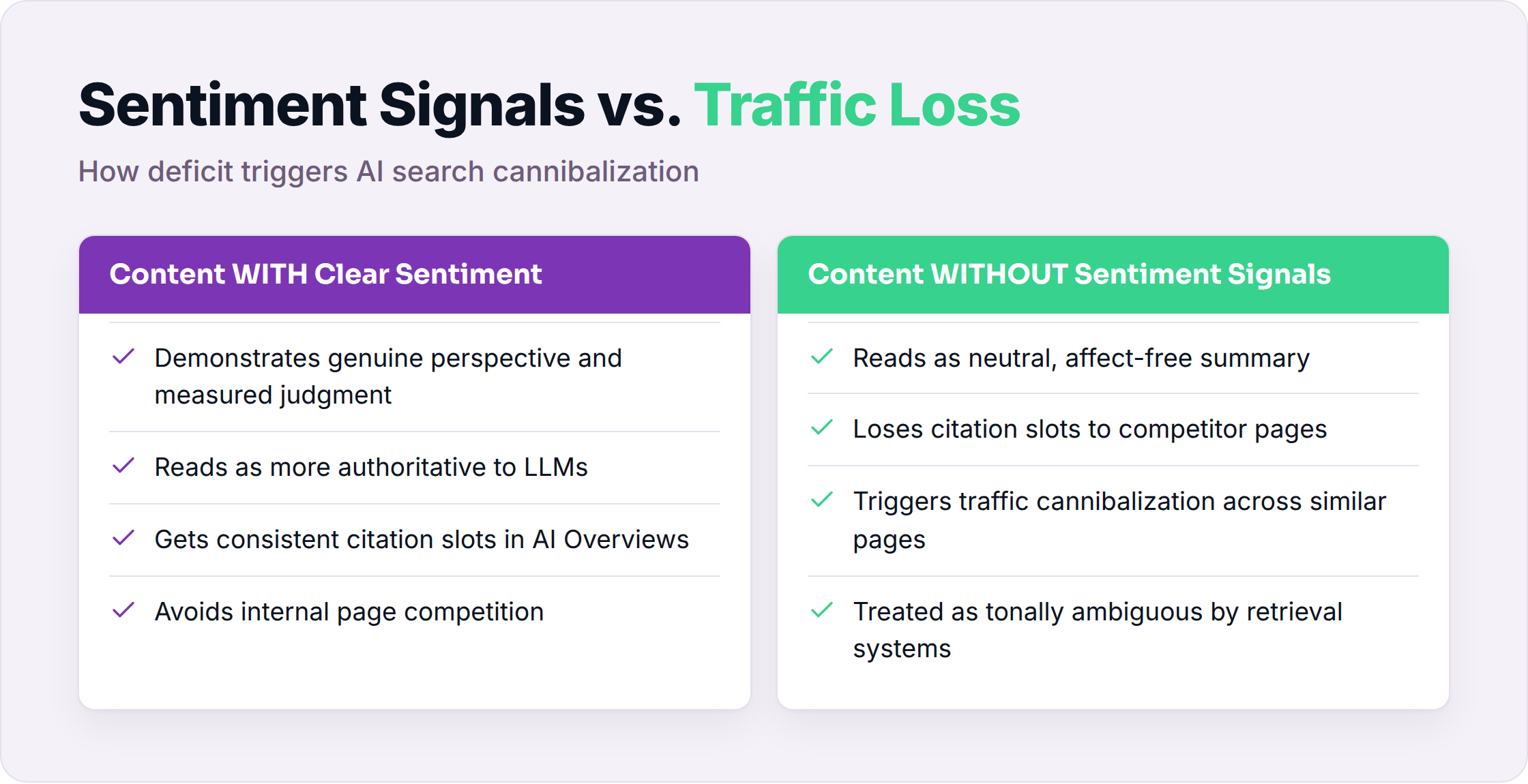
Content that lacks sentiment signals gets systematically deprioritized by AI search engines, not because the information is wrong, but because LLMs treat emotional credibility markers as part of topical authority scoring. Pages that read as neutral, affect-free summaries often lose citation slots to pages that demonstrate genuine perspective, measured concern, or first-hand judgment. The result is measurable traffic loss, not a ranking footnote.
How Sentiment Deficit Triggers Traffic Cannibalization
When two pages on your site cover similar ground but neither carries distinct sentiment signals, AI engines struggle to differentiate them. They may cite one inconsistently, split citation weight between them, or skip both in favor of a competitor page that reads as more authoritative. This is a specific form of AI search traffic cannibalization: your own pages compete for the same citation slot and both lose.
The numbers are stark. Organic CTR on AI Overview queries dropped from 1.76% to 0.61% between June 2024 and September 2025, a 65% collapse. Pages that were already thin on sentiment signals absorbed the worst of that drop, because AI Overviews preferentially surface content that signals confidence, nuance, and experiential grounding.
E-E-A-T and Emotional Credibility Markers
Google's E-E-A-T framework has always included "Experience" as a signal, but the practical implication for AI search is newer: LLMs weight content that demonstrates a point of view. A page that hedges every claim into mush, or presents information without any authorial stance, scores lower on the experience dimension than a page that acknowledges trade-offs, names specific outcomes, or expresses calibrated judgment.
This maps to a broader credibility problem. Consumer trust in AI search dropped from 82% to 54% in a single year, per Fractl's survey of 1,008 consumers and 150 marketers. Part of that erosion comes from AI engines surfacing content that feels generic. Emotional credibility markers, things like measured skepticism, named stakes, or concrete first-person observation, are what separate citable content from filler.
What You're Actually Losing
Citation share is the metric that matters here, not just keyword rankings. A page can hold a top-three organic position and still receive zero citations in AI Overviews if its sentiment profile reads as ambiguous. That means you're paying for the ranking but not collecting the traffic. For content teams running on tight budgets, that is a meaningful efficiency loss.
The perceptual sentiment deficit problem is also asymmetric. Fixing it on high-traffic pages produces outsized returns because those pages already have authority signals; adding clear sentiment anchors tips them into citation eligibility. Fixing it on low-traffic pages first is a common mistake: the authority floor is too low for sentiment alone to move the needle.
How to Fix Perceptual Sentiment Deficit in Your Content
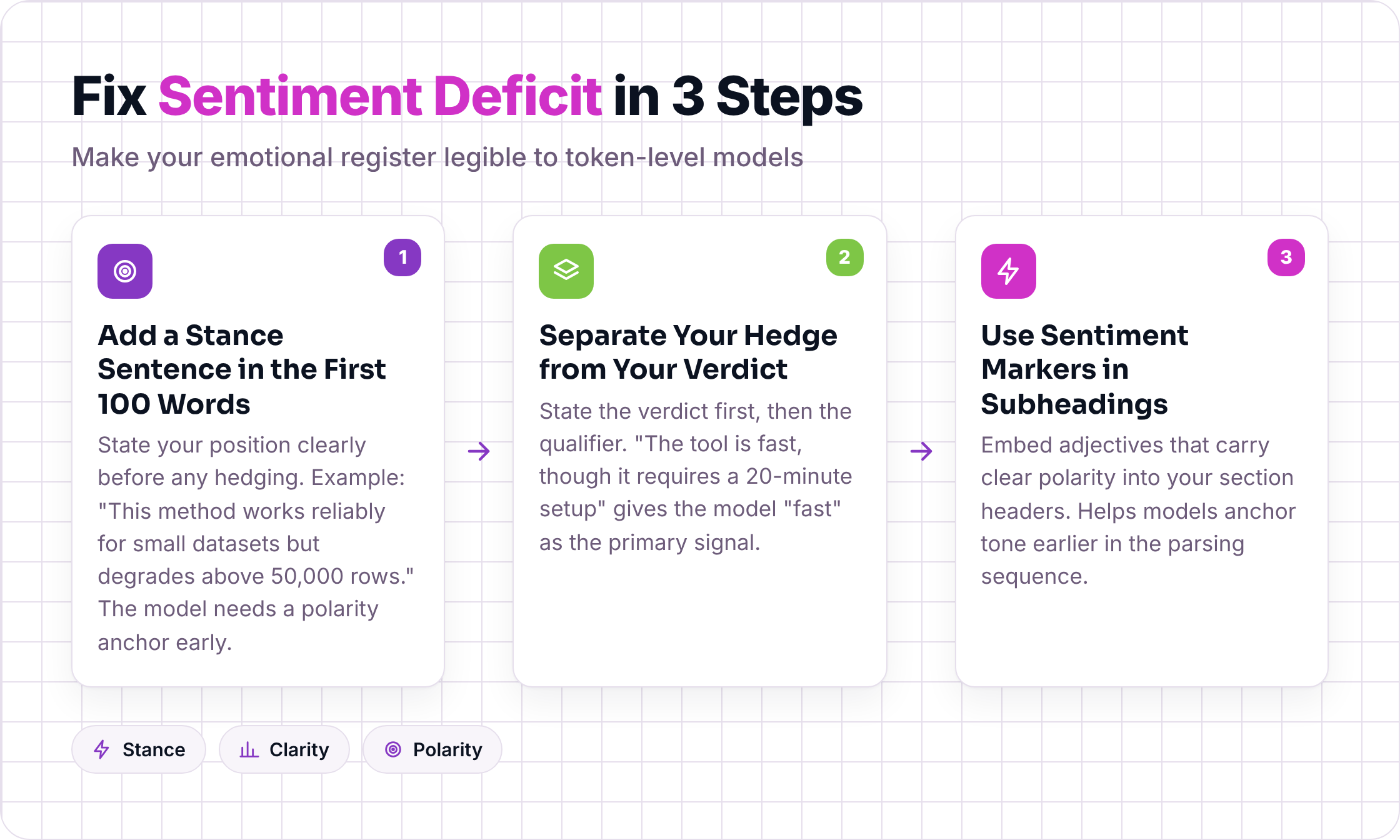
The goal is not to make your content more emotional. The goal is to make your content's emotional register legible to a model that reads at the token level. Those are different problems with different solutions.
Add a Stance Sentence in the First 100 Words
Place one sentence near the top of each article that states your position clearly, before any hedging. "This method works reliably for small datasets but degrades above 50,000 rows" is a stance sentence. "There are pros and cons to this approach" is not. The model needs a polarity anchor early; everything after that can be nuanced.
Separate Your Hedge from Your Verdict
If you need to qualify a claim, state the verdict first, then the qualifier. "The tool is fast, though it requires a 20-minute setup" gives the model "fast" as the primary signal. "Despite requiring a 20-minute setup, the tool is fast" buries the positive signal after a negative opener and risks a neutral or negative vector.
Use Sentiment-Explicit Language at Section Boundaries
The first and last sentences of each section carry disproportionate weight in retrieval. If those sentences are tonally flat, the section reads as neutral regardless of what's in the middle. Ending a section with "This is a meaningful limitation for teams working at scale" is more retrievable than "This is one factor to consider."
Audit for Irony and Sarcasm
If your content uses irony, flag it for revision or add a literal restatement nearby. "Naturally, the documentation is perfect" followed by nothing is a retrieval liability. "Naturally, the documentation is perfect, though in practice most users will need to supplement it with community guides" gives the model a literal signal to work with.
One Structural Limit to Keep in Mind
These fixes improve AI citation rates, but they can reduce the texture that makes content feel authoritative to expert human readers. A technical audience that expects hedged, precise language may find stance-forward writing reductive. You will need to calibrate by content type: stance sentences work well in how-to and opinion content, less well in reference documentation or academic-style analysis.
Frequently Asked Questions
What exactly is perceptual sentiment deficit?
Perceptual sentiment deficit is the measurable gap between the emotional tone a human reader perceives in a piece of content and the sentiment signal that an AI embedding model actually encodes. When that gap is large, AI search engines treat your content as tonally ambiguous, which reduces how often it gets cited in synthesized answers.
Does sentiment affect Google rankings directly?
Google has not confirmed sentiment as a direct ranking factor, but it influences E-E-A-T scoring indirectly. Content that demonstrates a clear authorial stance, named trade-offs, and calibrated judgment scores higher on the "Experience" dimension, which feeds into how AI Overviews select passages to surface.
Can fixing sentiment deficit hurt my content's credibility with human readers?
Yes, and this is a real trade-off. Flattening nuanced language to produce clean sentiment signals can make expert content feel oversimplified to a technical audience. The practical fix is to lead with a clear verdict and follow with your qualifications, rather than burying the verdict inside hedged prose.
How do I know if my content has a sentiment deficit?
Run your top-traffic pages through a sentiment analysis tool and compare the polarity scores against pages that are currently getting cited in AI Overviews for your target queries. If your pages score closer to neutral while cited competitors score clearly positive or negative, you have a measurable deficit. Tools like MonkeyLearn, Amazon Comprehend, or even the open-source VADER library can give you a baseline reading quickly.
Does this apply to all content types equally?
No. How-to articles, product reviews, and opinion pieces are most affected because readers and models both expect a clear stance. Reference documentation and neutral comparison guides are less affected because their expected register is already flat. Applying sentiment fixes uniformly across all content types is a mistake; prioritize pages where a clear authorial voice is contextually appropriate.
How long does it take to see results after fixing sentiment signals?
Recrawl timelines vary, but most sites see AI Overview citation changes within four to eight weeks of updating high-authority pages. Lower-authority pages may take longer or may not move at all if the authority floor is too low for sentiment alone to tip the balance. Focus your first round of fixes on pages that already rank in positions one through five organically.
Fix Your Sentiment Signals Before the Next Crawl
If your pages are ranking but not getting cited, a perceptual sentiment deficit is one of the first places to look. See how Seorav can help you identify and close that gap across your content, before the next AI Overview update redistributes citation share to competitors who got there first.
Keep reading

Placing Your Content in Vector Space for AI Discovery
Learn how Neural Vector Placement works, why cosine similarity scores determine AI retrieval, and how to optimize your content chunks for SGE and RAG pipel
Finding and Fixing the Semantic Gaps Costing You AI Citations
A semantic gap deficit stops AI engines from citing your content. Learn how to identify missing concept clusters and fix them before a competitor does.

How to Get Your Content Cited Across Multiple AI Models
Learn how decentralized footprint expansion gets your content cited across ChatGPT, Claude, Gemini, and Perplexity with structured, multi-model content str