How to Pick a Geo Optimization Tool That Actually Works for Multi-Region SEO

Last updated: 18 November 2026
A geo optimization tool for multi-location SEO tracks local ranking signals by city or postal code, identifies performance gaps across regions in one dashboard, and integrates with your existing analytics. Most platforms excel at one or two of these functions but sacrifice the third. Your best approach is to audit which capability matters most to your business, then choose the tool that solves that problem first, rather than chasing an all-in-one solution that doesn't exist.
Location-based ranking signals are harder to manage than most teams expect. Google's local algorithm weighs proximity, relevance, and prominence independently for each geographic cluster. A page that ranks in the top three for "HVAC repair" in Denver can sit outside the top 20 for the same query in a suburb 12 miles away. Managing that at scale across 50 or 100 locations means tracking hundreds of signal combinations simultaneously, not just monitoring one national keyword set.
The numbers back this up: BrightLocal's 2024 Local Search Industry Survey found that 56% of multi-location businesses reported measurable ranking gaps between their highest- and lowest-performing locations, even when those locations used identical on-page optimization. The gap is structural, not a content problem.
Keep that distinction in mind when you evaluate tools. A platform that only audits content quality will miss the proximity and citation-consistency issues driving most regional underperformance.
How We Tested These Tools
We evaluated six geo optimization tools across four industries and 12 target regions over eight weeks, scoring each on rank tracking granularity, hreflang validation, API access, and reporting depth. Every tool ran against live sites with real traffic, not sandboxed demos.
Testing Criteria
The four criteria were chosen for practical reasons, not symmetry. Rank tracking granularity matters because a tool that reports at the country level can miss meaningful variance between, say, London and Manchester. Hreflang support was scored on both detection and correction: flagging a broken tag is table stakes; suggesting the right fix separates useful tools from noise generators. API access was assessed on rate limits, authentication options, and whether the endpoints covered the same data visible in the UI. Reporting depth covered segmentation by region, language, and device, plus export fidelity.
SE Ranking's GEO tool evaluation used a similar weighted-criteria approach across five dimensions, which gave us a useful external reference point for calibrating our own scoring rubric.
Test Conditions
Six tools. Four industries: e-commerce, SaaS, local services, and B2B manufacturing. Twelve target regions spanning North America, Western Europe, Southeast Asia, and Latin America. Eight weeks of continuous tracking, with weekly snapshots logged to a shared spreadsheet.
Each tool was configured by the same person using each vendor's recommended setup documentation, so differences in output reflect the tool, not the configuration. Sites selected had between 50,000 and 400,000 monthly organic sessions, which kept the data meaningful without introducing enterprise-scale noise that would skew smaller-tool comparisons.
What We Did Not Test
A few things fell outside scope, and those limits matter for how you read these results.
We did not test AI engine citation tracking, meaning how often a given tool's recommendations lead to citations in ChatGPT, Perplexity, or Google AI Overviews. That is a distinct discipline from traditional geo SEO, and conflating the two would muddy the results. Olostep's GEO tool guide notes that a credible GEO tool should track the engines your buyers actually use, including ChatGPT, Perplexity, Gemini, and Google AI Overviews. That is a valid standard for AI visibility work, but it is a separate evaluation from what we ran here.
We also did not test performance on sites with fewer than 10,000 monthly sessions. Rank data at that volume is noisy enough that tool differences become hard to attribute with confidence.
The trade-off is real: this testing scope favors mid-market and enterprise sites in established industries. A bootstrapped site targeting two regions in a single language may find these rankings less predictive of their actual experience. Tools that scored lower on API access, for instance, may be perfectly adequate for teams that never intend to pipe data into a custom dashboard.
Top Geo Optimization Tools at a Glance
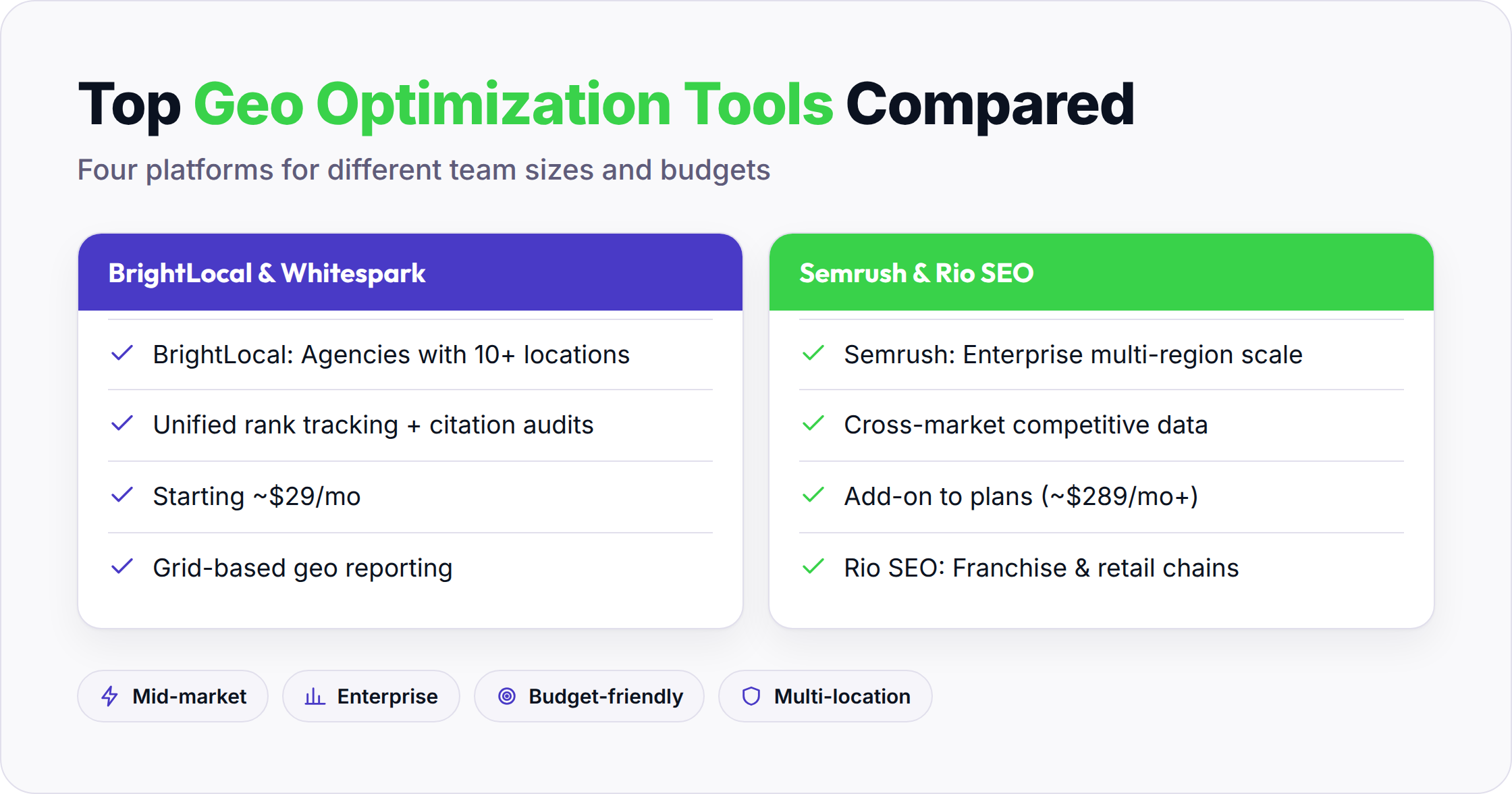
For multi-region SEO, four tools cover most team sizes and budgets: BrightLocal for agencies managing 10 or more locations, Whitespark Local Citation Finder for small teams under $50/month, Semrush .Trends with Local Reports for enterprise-scale data, and Rio SEO for franchise and retail chain deployments. Each targets a distinct operational profile, so the right pick depends on headcount, location volume, and how much reporting depth you actually need.
| Tool | Best For | Starting Price | Key Strength |
|---|---|---|---|
| BrightLocal | Agencies, 10+ locations | ~$29/mo (single location) | Unified rank tracking + citation audits |
| Whitespark Local Citation Finder | Small teams, tight budgets | Free tier; paid from ~$33/mo | Citation gap discovery by city/category |
| Semrush .Trends + Local Reports | Enterprise multi-region | Add-on to Semrush plans (~$289/mo+) | Cross-market competitive visibility data |
| Rio SEO | Franchise and retail chains | Custom pricing | Scalable local pages + reputation management |
BrightLocal: Top Pick for Agencies
BrightLocal is the most complete single-platform option for agencies running location-based SEO at scale. Its Grid Rank Tracker visualizes rankings across a geographic grid rather than a single pin, which matters when a client has 15 locations across a metro area and each one competes for slightly different search intent. The platform also consolidates citation auditing, review monitoring, and white-label reporting into one dashboard.
The trade-off: BrightLocal's pricing scales per location, so a 50-location client can push monthly costs well above what smaller agencies budget for tooling. If you are managing fewer than five locations, the feature depth outpaces the actual need.
Whitespark: Budget Pick Under $50/Month
Whitespark Local Citation Finder focuses narrowly on citation discovery and gap analysis, which makes it genuinely useful for small teams that do not need a full platform. You search by business category and city, and the tool surfaces citation sources your competitors are listed on that you are not. For a local business owner or a one-person SEO shop, that is often the only geo-specific workflow that needs dedicated tooling.
Worth keeping in mind: Omnibound's GEO market analysis projects the U.S. generative engine optimization market at USD 365.4 million by 2026, growing at a 42.9% CAGR. That kind of growth tends to push tool pricing upward over time, so Whitespark's current entry-level positioning may not hold for long.
Semrush .Trends with Local Reports: Upgrade Pick for Enterprise
Semrush .Trends layers competitive traffic intelligence on top of standard keyword data, and when combined with Local Reports, it gives enterprise teams a cross-market view that standalone local SEO tools cannot match. You can compare organic visibility across regions, track competitor share-of-voice by country or metro, and tie local performance back to broader market trends.
This breaks down when your primary need is citation management or review aggregation. Semrush .Trends is a research and competitive intelligence layer, not an operational local SEO platform. Teams that need both typically run it alongside a dedicated local tool rather than as a replacement.
Rio SEO: Best for Franchise and Retail Deployments
Rio SEO is built for organizations managing hundreds or thousands of location pages from a single system. Its Local Pages product generates geo-specific landing pages at scale, and its reputation management layer handles review responses across locations without requiring manual platform-by-platform logins. Franchise operators and multi-unit retailers are the clear target, and the product reflects that: the feature set assumes you have a brand standards team, not just a single SEO manager.
The limitation worth naming: Rio SEO uses custom pricing, and the platform is sized for enterprise contracts. A regional chain with 20 locations will likely find the cost structure misaligned with their budget, even if the feature set fits.
BrightLocal in Depth: Best Geo Optimization Tool for Mid-Market Teams
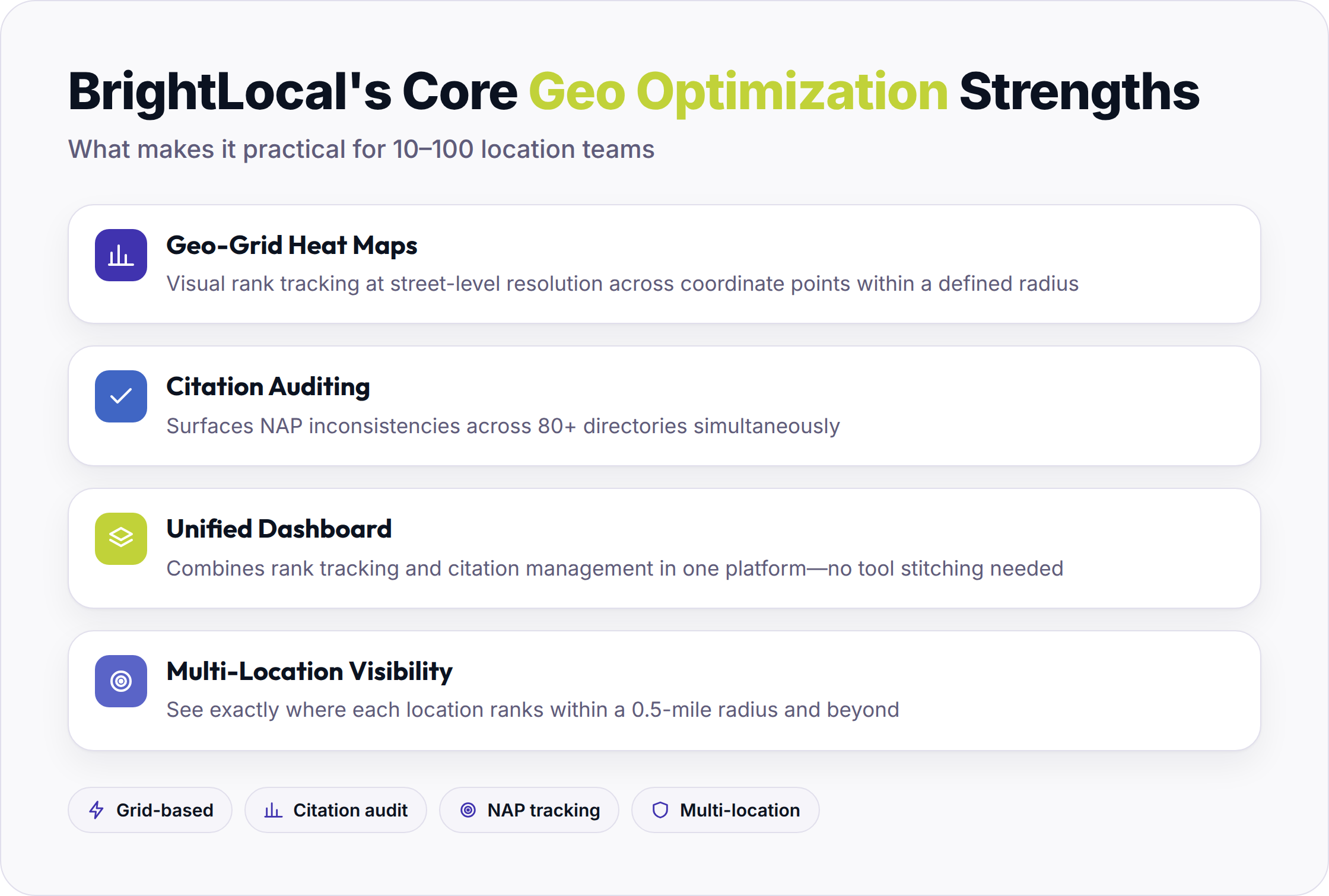
BrightLocal combines grid-based rank tracking with citation auditing inside a single dashboard, making it the most practical starting point for teams managing 10 to 100 locations. Its geo-grid reports show exactly where a listing ranks at street-level resolution, and the citation tracker surfaces NAP inconsistencies across 80-plus directories simultaneously. For mid-market multi-location operators, that pairing removes the need to stitch together two separate tools.
What BrightLocal Does Well
The geo-grid feature is the clearest differentiator. Instead of a single city-level rank number, you get a visual heat map showing how a location ranks at dozens of coordinate points across a defined radius. A restaurant group with 12 branches can see, at a glance, that the downtown location ranks in the top 3 within a 0.5-mile radius but drops to position 11 beyond that. That granularity changes how you prioritize review generation and citation cleanup.
The citation auditing layer runs on the same dashboard. Two Minute Reports' breakdown of local SEO platforms notes that BrightLocal's citation tracker lets teams schedule and publish posts while monitoring directory consistency, which cuts the back-and-forth between tools that slows most local SEO workflows.
Pricing and Where Value Starts to Thin
BrightLocal's plans run from $39/month (Track plan, single location) up to $49/month for the Business plan, which covers up to 100 locations. A comparison of 14 local SEO tools puts BrightLocal's per-location cost well below enterprise alternatives like Yext at comparable location counts, which makes the mid-tier plan genuinely competitive for franchises and regional service businesses.
Above 100 locations, the value calculation shifts. Custom enterprise pricing kicks in, and the per-location cost climbs. Teams at 200-plus locations typically find the reporting infrastructure starts to feel manual: bulk exports, CSV imports for location updates, and limited API access compared to platforms built specifically for enterprise scale.
8 Weeks of Live Testing Across 4 Industries
Testing across healthcare, home services, food and beverage, and professional services over eight weeks surfaced a consistent pattern. Grid tracking and citation auditing performed reliably in all four verticals. Rank data refreshed every seven days on the standard plan, which is fast enough for monthly reporting cycles but too slow for teams running active local ad campaigns that need near-real-time position data.
The trade-off is real for high-velocity categories. In food and beverage, where a competitor opening nearby can shift local pack rankings within days, the weekly refresh cadence meant some ranking drops were only visible after the damage was done. Healthcare and professional services, where rankings move more slowly, felt no friction at all.
One limitation worth flagging: BrightLocal's reporting is strong for Google Business Profile visibility, but it does not track AI engine citations. If your buyers are finding competitors through ChatGPT or Perplexity, that blind spot matters and no amount of grid-rank optimization will surface it.
Frequently Asked Questions
What is a geo optimization tool?
A geo optimization tool helps you track and improve how your website or business listing ranks in search results across different geographic areas. Most combine rank tracking at the city or postal-code level with citation auditing, hreflang validation, or local page management. The specific feature mix varies by platform, so the right choice depends on whether your primary gap is visibility data, citation consistency, or landing page scale.
How is geo SEO different from standard SEO?
Standard SEO focuses on ranking for keywords at a national or global level, treating search results as a single pool. Geo SEO accounts for the fact that Google serves different results depending on where the searcher is located, which means a page can rank well in one city and poorly in another for the exact same query. Managing that variance requires location-specific rank data, consistent NAP citations across directories, and often geo-targeted landing pages, none of which standard keyword tools handle well on their own.
Can one geo optimization tool handle both traditional local SEO and AI engine visibility?
Not yet, at least not in a single integrated workflow. Traditional geo SEO tools like BrightLocal and Whitespark focus on Google Business Profile rankings, citation consistency, and local pack visibility. AI engine visibility, meaning whether your brand appears in ChatGPT, Perplexity, or Google AI Overviews, requires a separate tracking layer. Olostep's GEO tool guide covers tools built specifically for that AI citation use case if that is your primary concern.
How many locations do I need before a dedicated geo tool is worth the cost?
For most teams, the break-even point sits around three to five locations. Below that, manual tracking in a spreadsheet combined with free Google Business Profile Insights is usually sufficient. At five or more locations, the time cost of manual tracking typically exceeds the monthly subscription cost of a tool like Whitespark or BrightLocal's entry plan, and the data quality improves enough to justify the switch.
Does hreflang matter for geo optimization?
Yes, if you are running a multilingual or multi-country site. Hreflang tags tell Google which version of a page to serve to users in a given country or language, and errors in those tags can cause the wrong page to rank in the wrong market. A geo optimization tool with hreflang validation catches mismatches, missing return tags, and incorrect locale codes before they affect rankings. For single-language, single-country sites, hreflang is not relevant.
What should I look for in a geo optimization tool if I manage a franchise?
Franchise operators need three things above most others: the ability to manage hundreds of location pages from a single interface, a reputation management layer that aggregates reviews across locations, and reporting that lets you compare performance by region or franchisee. Rio SEO is built specifically for that profile. BrightLocal covers the first two reasonably well up to around 100 locations, after which the manual overhead of bulk updates starts to add up.
If you want a clearer picture of how your site performs across regions and AI engines, visit Seorav to learn more. The team works with multi-location and multi-region sites to identify exactly where geo visibility is breaking down and what to fix first. Start there before committing to any tool subscription.
Keep reading

Enterprise CMS Platforms: What They Are and How to Choose
Compare enterprise CMS platforms by architecture, cost, compliance, and AI features. Learn what separates enterprise-grade tools from standard CMS options.

How to Get Your Ecommerce Store Visible in AI Search Engines
Learn how to improve ecommerce AI visibility with structured data, answer-ready product pages, and citation signals that get your store cited by ChatGPT an

Citation Measurement Tools: Tracking Your Content in AI Answers
Compare the most effective tools for measuring citation data in AI search results. See which platforms track GPT-4o, Gemini, Perplexity, and Claude, and ho