Enterprise CMS Platforms: What They Are and How to Choose
Last updated: 19 November 2026
An enterprise CMS platform manages content across multiple sites, brands, and markets while enforcing role-based access controls and approval workflows. Unlike smaller systems, enterprise platforms integrate with existing marketing automation, commerce, and analytics tools that large organizations already use. They support simultaneous work by editors, developers, and marketers across different regions, often handling hundreds of content pieces daily. The right platform reduces publishing bottlenecks and keeps distributed teams aligned on brand standards.
What an Enterprise CMS Platform Actually Is
An enterprise CMS platform is a content management system built for large organizations that need multi-site publishing, granular permissions, workflow approvals, and integrations with existing marketing and commerce stacks. It serves editorial teams, developers, and digital experience owners simultaneously, typically across dozens of markets or brands.
That scope separates it from SMB tools like WordPress.com or open-source installs managed by a single developer. An enterprise platform ships with audit logs, SSO, SLA guarantees, and vendor support contracts. The open-source alternative gives you flexibility; the enterprise platform gives you accountability and a defined upgrade path. Enterprise licenses run from roughly $30,000 to well over $300,000 annually, and that cost only makes sense once content operations reach a certain complexity.
The numbers confirm how fast that complexity is growing. The global headless CMS market was valued at $1.8 billion in 2025 and is projected to reach $6.2 billion by 2033, a signal that structured, API-first content delivery is becoming the default architecture for organizations that publish at scale.
Four Things to Know Before You Evaluate Options
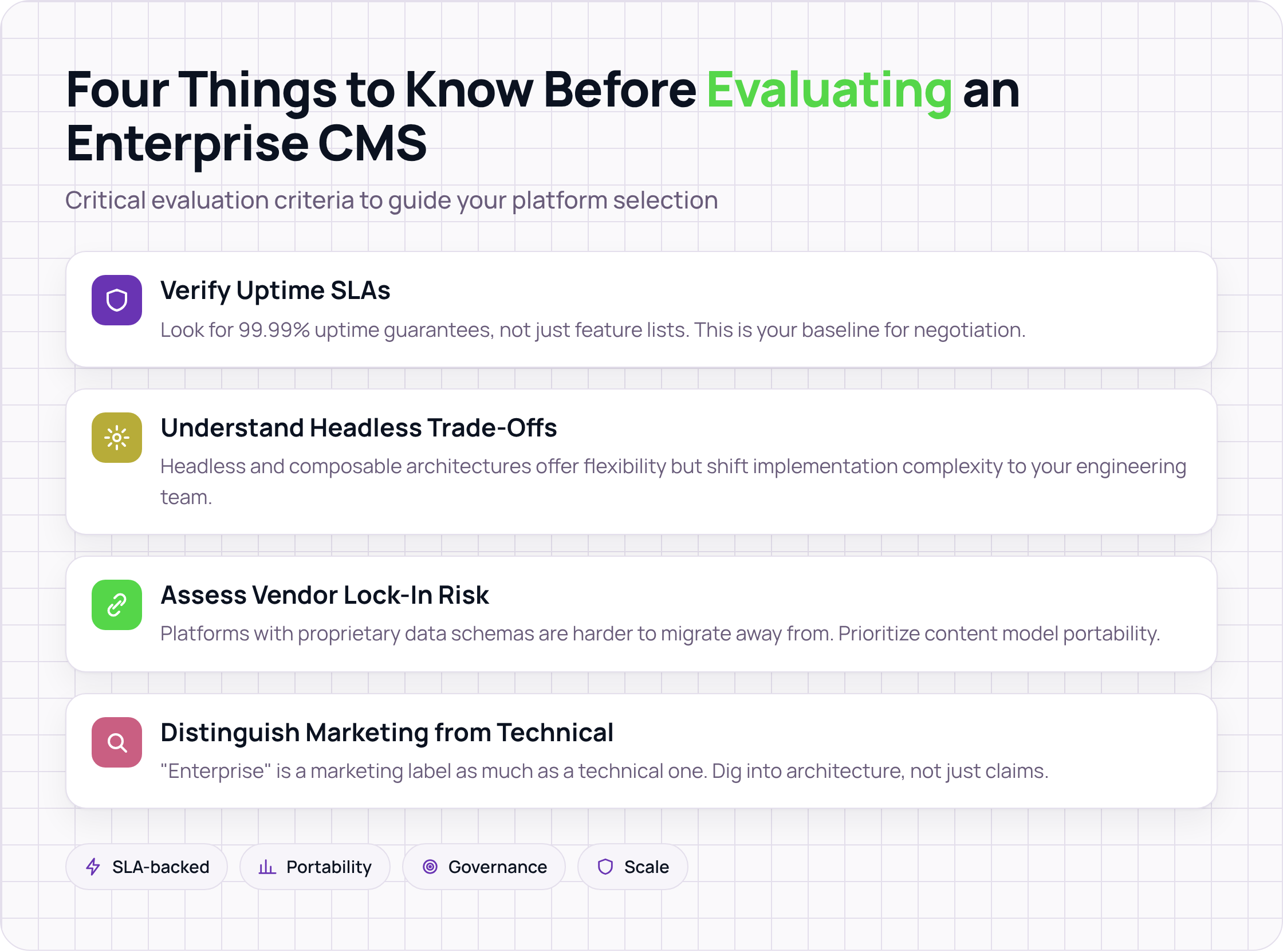
Enterprise CMS platforms are content infrastructure built for scale: multi-site publishing, granular permissions, API-first architecture, and compliance controls that consumer-grade tools skip entirely. The headless CMS market alone is projected to reach $20.93 billion by 2033, per content.one's 2026 platform review.
- "Enterprise" is a marketing label as much as a technical one. Verify uptime SLAs (99.99% is the floor worth negotiating), not just feature lists.
- Headless and composable architectures give you flexibility, but they shift implementation complexity onto your engineering team. That trade-off is often underestimated during procurement.
- Vendor lock-in risk varies significantly by content model portability. Platforms with proprietary data schemas are harder to migrate away from than those built on open standards.
- Total cost of ownership routinely runs 2-4x the license fee once you factor in integrations, training, and ongoing maintenance.
What Defines an Enterprise CMS Platform
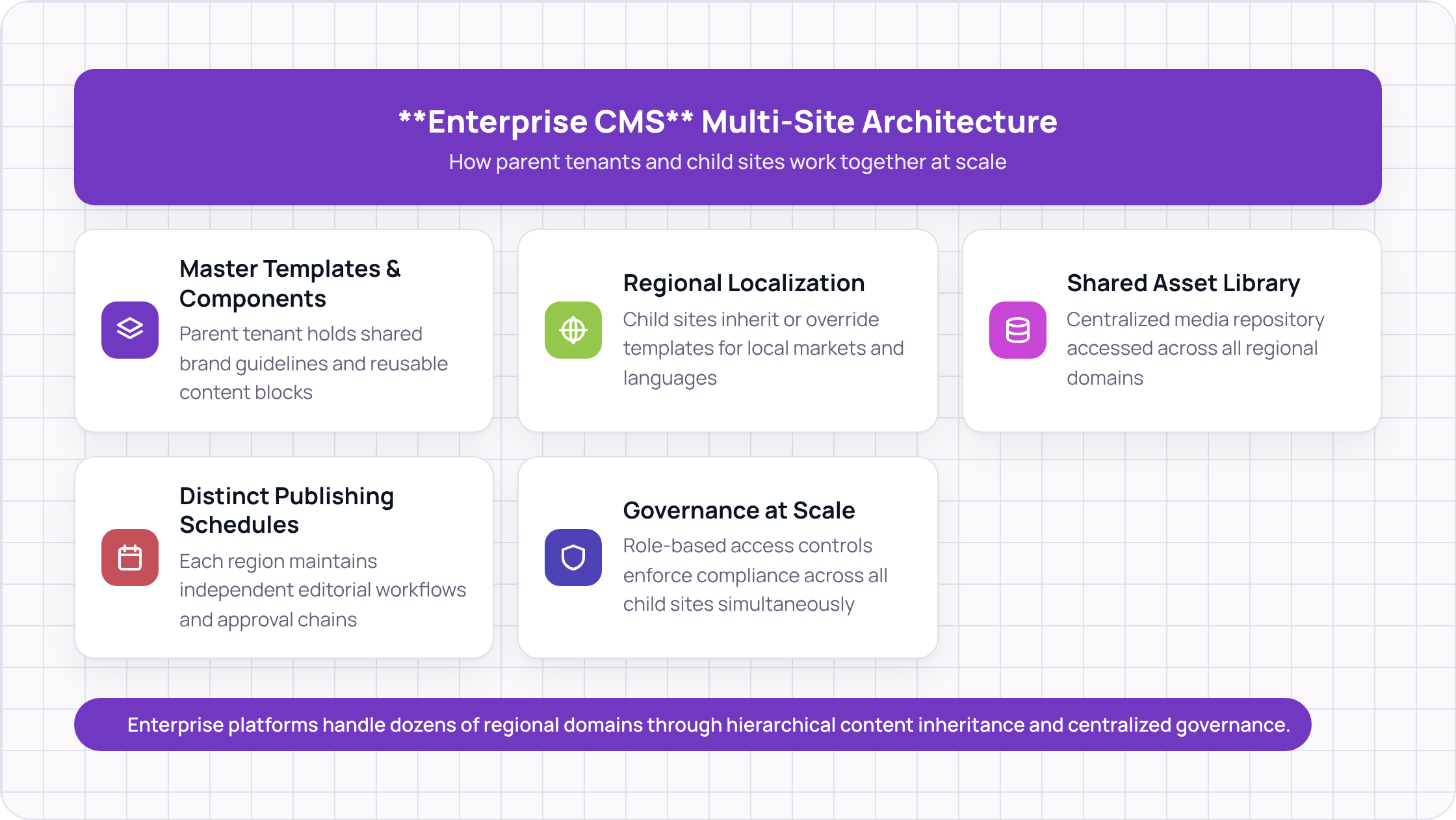
An enterprise CMS platform handles publishing at organizational scale: multiple brands, multiple regions, complex editorial hierarchies, and delivery across more than one channel or front end. The core distinction from a standard CMS is structural, not cosmetic. These platforms are licensed to support governance, not just publishing, and the architecture reflects that from the ground up.
Multi-Site and Multi-Brand Architecture
Large organizations rarely run a single site. A global manufacturer might operate 40 regional domains, each with localized content, separate brand guidelines, and distinct publishing schedules, all drawing from a shared asset library. Enterprise CMS platforms handle this through content hierarchies: a parent tenant holds master templates and shared components, while child sites inherit or override them at the local level.
Contentful's breakdown of enterprise CMS requirements identifies multi-site governance as one of the primary structural differences between enterprise-grade and mid-market platforms. The practical implication: content teams can push a global brand update to every regional site simultaneously, without manually touching each one.
There is a real cost to this, though. Hierarchical content models add setup complexity. Teams that underestimate taxonomy planning often end up with inheritance rules that conflict, forcing manual overrides at the local level anyway. Multi-site architecture pays off when the governance model is defined before implementation, not after.
Role-Based Access Control and Editorial Workflow Depth
A 500-person content operation cannot run on a binary "editor/admin" permission model. Enterprise CMS platforms support granular role-based access control (RBAC): a regional editor might publish to their market's blog but have read-only access to global product pages. A legal reviewer might approve specific content types without touching anything else.
Workflow depth matters as much as permissions. Mature platforms support multi-stage approval chains, conditional routing (send to legal only if the content mentions pricing), and audit logs that record every state change. For regulated industries like financial services and healthcare, documented approval trails are a compliance requirement, not a preference.
Headless and Hybrid Delivery Modes
A headless CMS decouples the content repository from the presentation layer. Content is stored as structured data and delivered via API to whatever front end consumes it: a React app, a mobile app, a digital kiosk, or a voice interface. The benefit is front-end flexibility. The cost is that non-technical editors lose the visual, in-context editing experience they are used to.
Hybrid delivery addresses that gap. Platforms like those covered in Cosmic's 2026 enterprise headless CMS comparison increasingly offer both modes: a headless API layer for developer-built front ends and a visual editor for content teams who need to see layout context while writing.
The honest limitation: headless works best when your engineering team has the capacity to build and maintain the front end. Organizations without a dedicated front-end team often find that the flexibility headless promises becomes a bottleneck in practice. Hybrid or traditional coupled delivery is the more pragmatic choice in those cases, even if it trades some architectural flexibility.
Key Features Enterprise Teams Actually Use
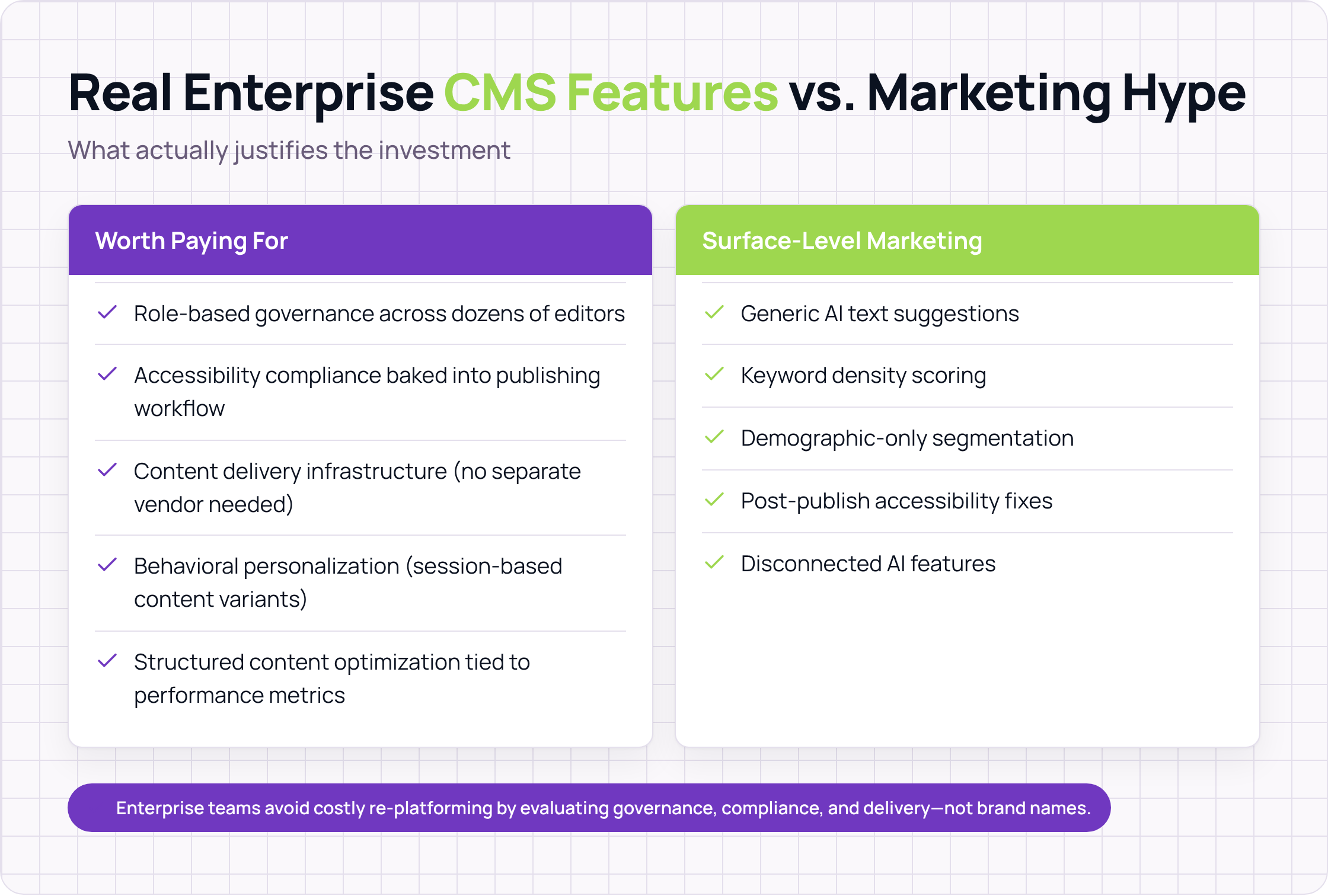
Enterprise CMS platforms earn their price tag through a specific set of capabilities: role-based governance that holds across dozens of editors, accessibility compliance baked into the publishing workflow rather than bolted on afterward, and content delivery infrastructure that does not require a separate vendor contract. Teams that evaluate platforms on these axes tend to avoid the expensive re-platforming cycles that hit organizations who bought on brand name alone.
Built-in AI: Separating Real Functionality from Marketing Copy
Most enterprise CMS vendors now advertise AI features. Very few are doing anything beyond surface-level text suggestions or keyword density scoring.
The features worth paying for are behavioral personalization (serving different content variants based on session signals, not just demographic segments) and structured content optimization that ties directly to your publishing workflow. Sitecore XM Cloud's built-in Customer Data Platform, for instance, feeds live behavioral and transactional signals into content decisioning rather than relying on batch exports. That is a meaningful architectural difference from a CMS that labels a spell-checker "AI-powered."
Deep AI personalization requires clean, structured data to function. Organizations with fragmented CRM records or inconsistent content tagging will see little return from these features until the underlying data hygiene is addressed. The AI amplifies what is already there; it does not fix what is not.
When evaluating a vendor's AI claims, ask for a demo against your actual content model, not a staged sandbox. If they cannot show it working on headless or multi-locale content, the feature is probably not production-ready.
ADA Compliance and Multi-Site Brand Governance
For regulated industries, accessibility and governance are not optional checklist items. The Web Content Accessibility Guidelines (WCAG) 2.1 Level AA is the current baseline for ADA compliance in the U.S., and a 2024 comparison of leading enterprise platforms shows significant variation in how platforms handle automated accessibility audits during the authoring process, not just at the output stage.
A platform that flags an accessibility violation at publish time is useful. One that surfaces it during content creation, before the editor has moved on, is operationally better. Look for platforms that integrate WCAG checks into the editorial workflow rather than running them as a post-publish scan.
Brand governance across multiple sites follows a similar logic. Enterprise teams running 10 or more regional or product sites need component-level locking, shared design token libraries, and permission structures that let local editors customize within defined boundaries without overriding global brand rules. Platforms that handle this through a single content repository with inheritance rules are generally easier to govern than those that replicate configuration across separate site instances.
CDN and Edge Hosting: What's Bundled and What Isn't
This is where vendor marketing and actual infrastructure diverge most sharply.
Several platforms bundle CDN and edge delivery as part of their managed offering. WordPress VIP includes Fastly-backed edge caching as part of its enterprise tier. Adobe Experience Manager can be paired with Adobe's CDN layer, though the configuration overhead is non-trivial. Contentful delivers assets through a global CDN by default, but compute-at-the-edge for personalization requires additional configuration or a third-party edge provider.
A 2026 headless CMS comparison notes that many enterprise teams underestimate the total cost of content delivery when evaluating platforms that separate CMS licensing from infrastructure costs. A platform priced at $50,000 per year with no bundled CDN can quickly reach $80,000 or more once edge delivery, image optimization, and DDoS mitigation are added from separate vendors.
Bundled CDN is not always better, though. Large enterprises with existing Akamai or Cloudflare contracts may get better performance and pricing by keeping infrastructure separate and integrating via API. In those cases, a headless CMS with clean delivery APIs is often the more practical choice than a platform that bundles a CDN you will not use.
Scalability, Security, and Compliance Considerations
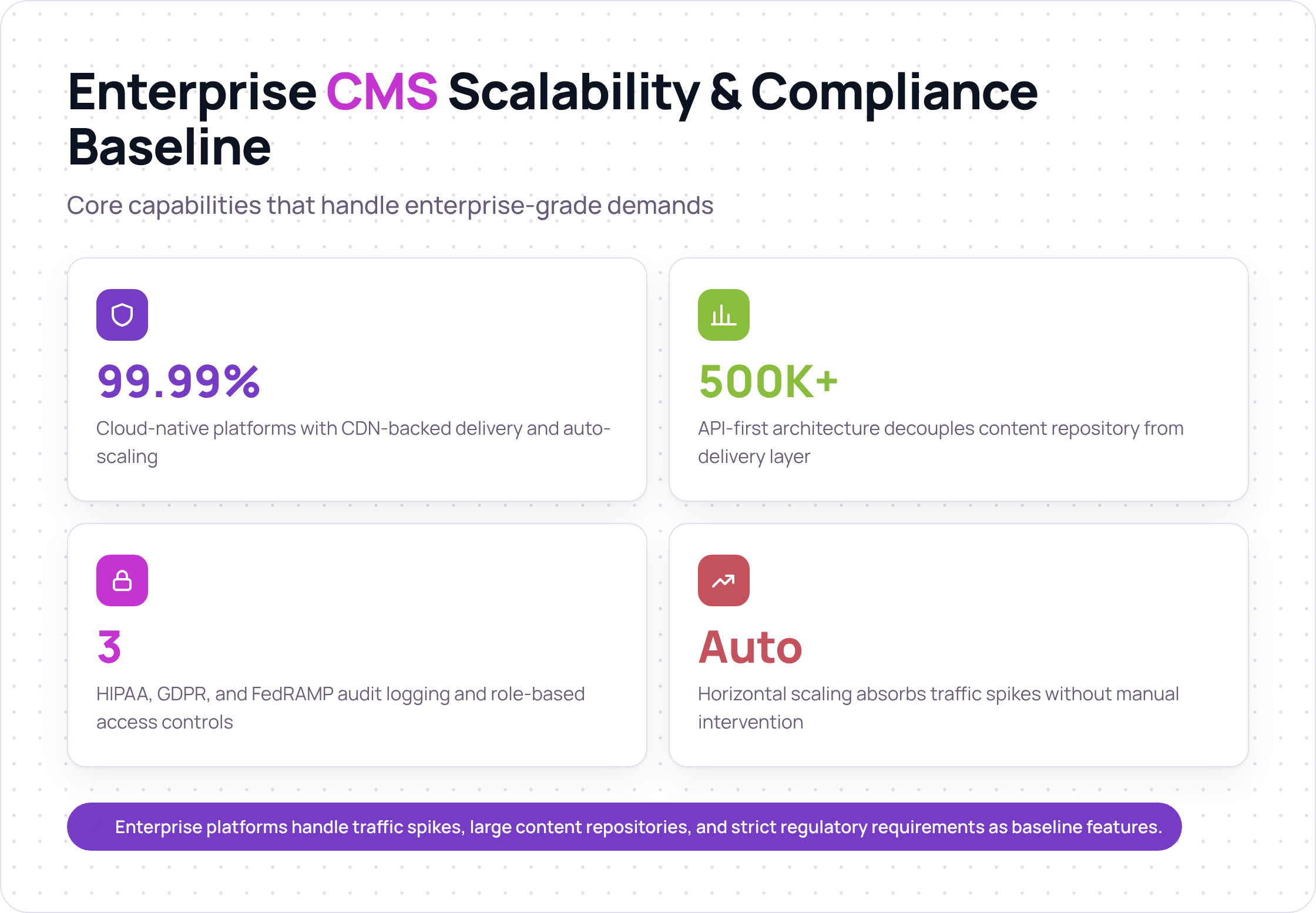
Enterprise CMS platforms are built to handle traffic spikes, large content repositories, and strict regulatory requirements that would break a standard CMS. Most offer auto-scaling infrastructure, role-based access controls, and audit logging as baseline features. For organizations in healthcare or financial services, the compliance layer covering HIPAA, GDPR, and FedRAMP is often the deciding factor between shortlisted platforms.
Handling Traffic Spikes and Content Volume Growth
Cloud-native enterprise CMS platforms typically rely on CDN-backed delivery and horizontal auto-scaling to absorb sudden load. A retail site pushing a flash sale to 500,000 concurrent users needs the same content layer that handles a quiet Tuesday morning. Platforms like Contentful and Adobe Experience Manager use API-first architectures that decouple the content repository from the delivery layer, which means you can scale the front end independently without touching the authoring environment.
The trade-off is real. Headless and composable architectures distribute scaling responsibility across multiple services. If your CDN scales but your personalization service or search index does not, the bottleneck shifts rather than disappears. Scaling an enterprise CMS platform is not a single dial you turn up; it is a set of interdependent services that each need capacity planning.
Frequently Asked Questions
What is an enterprise CMS platform?
An enterprise CMS platform is a content management system designed for large organizations that need to publish across multiple sites, brands, or regions while maintaining governance, compliance, and editorial workflow controls. Unlike standard CMS tools, enterprise platforms include features like granular role-based access, SSO, audit logging, and SLA-backed vendor support. They are typically licensed annually, with costs starting around $30,000 and scaling well past $300,000 depending on usage and feature tier.
How is an enterprise CMS different from a regular CMS?
The core difference is governance and scale. A regular CMS lets you publish content; an enterprise CMS lets you control who publishes what, where, and under what approval conditions, across dozens of sites simultaneously. Enterprise platforms also carry contractual obligations like uptime SLAs, dedicated support, and compliance certifications that open-source or SMB tools do not offer.
What does headless mean in the context of an enterprise CMS?
Headless means the content repository is separated from the presentation layer. Your content is stored as structured data and delivered via API to any front end, whether that is a website, a mobile app, or a digital kiosk. The advantage is flexibility across channels; the trade-off is that your engineering team takes on responsibility for building and maintaining the front end rather than relying on built-in templates.
How much does an enterprise CMS platform cost?
License fees typically range from $30,000 to over $300,000 per year depending on the platform, the number of sites, and the feature tier. Total cost of ownership, however, routinely runs 2-4x the license fee once you account for implementation, integrations, training, and ongoing maintenance. Platforms that do not bundle CDN or edge delivery can add another $20,000 to $50,000 or more in infrastructure costs annually.
What compliance certifications should an enterprise CMS have?
The certifications that matter depend on your industry. Healthcare organizations should look for HIPAA-eligible infrastructure. Companies operating in the EU need GDPR-compliant data handling and data residency options. U.S. federal agencies or their vendors typically require FedRAMP authorization. SOC 2 Type II is a reasonable baseline to require of any enterprise vendor regardless of industry, as it documents controls around security, availability, and confidentiality.
Is WordPress a viable enterprise CMS platform?
WordPress in its open-source form is not typically considered enterprise-grade because it lacks native multi-site governance, granular RBAC, and SLA-backed support. WordPress VIP, the managed enterprise offering, addresses most of those gaps: it includes Fastly-backed edge caching, dedicated support, and security hardening. Several large media organizations and brands run on WordPress VIP at scale, though it is better suited to content-heavy publishing than to complex commerce or highly personalized digital experiences.
What is the difference between headless and composable CMS?
Headless refers specifically to the separation of content storage from content presentation. Composable refers to a broader architectural philosophy where the entire digital experience stack, including CMS, commerce, search, and personalization, is assembled from best-of-breed services rather than a single monolithic platform. A headless CMS is often a component within a composable architecture, but not every headless CMS is designed with composability in mind. Platforms built around open APIs and standardized content schemas are generally easier to compose than those with proprietary data models.
If you are evaluating how an enterprise CMS platform fits into your broader marketing and content stack, see how Seorav can help with the integration layer that connects your CMS to the rest of your tools. The integrations page covers the specific connectors and workflows Seorav supports, so you can assess fit before committing to a conversation.
Keep reading
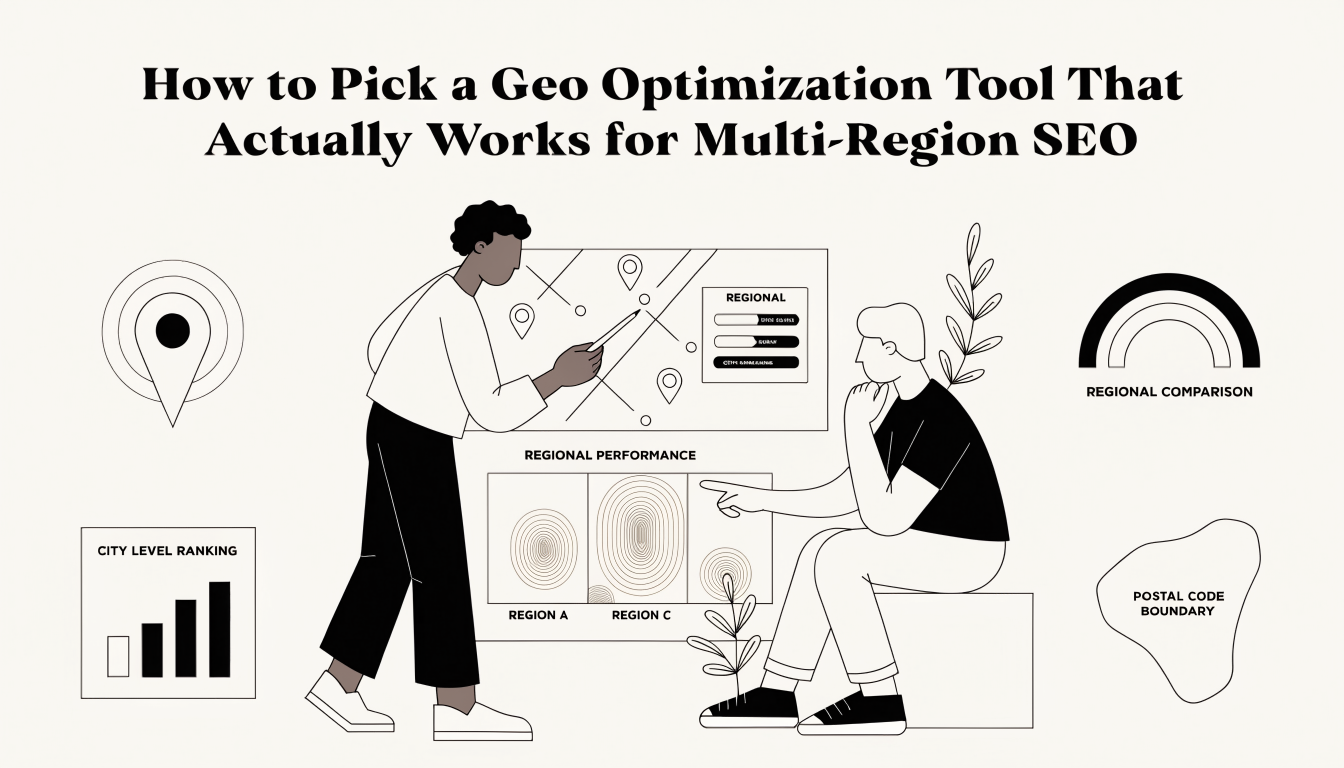
How to Pick a Geo Optimization Tool That Actually Works for Multi-Region SEO
Compare the top geo optimization tools for multi-location SEO. See which platforms track rankings at city level, fix citation gaps, and scale across 100+ l
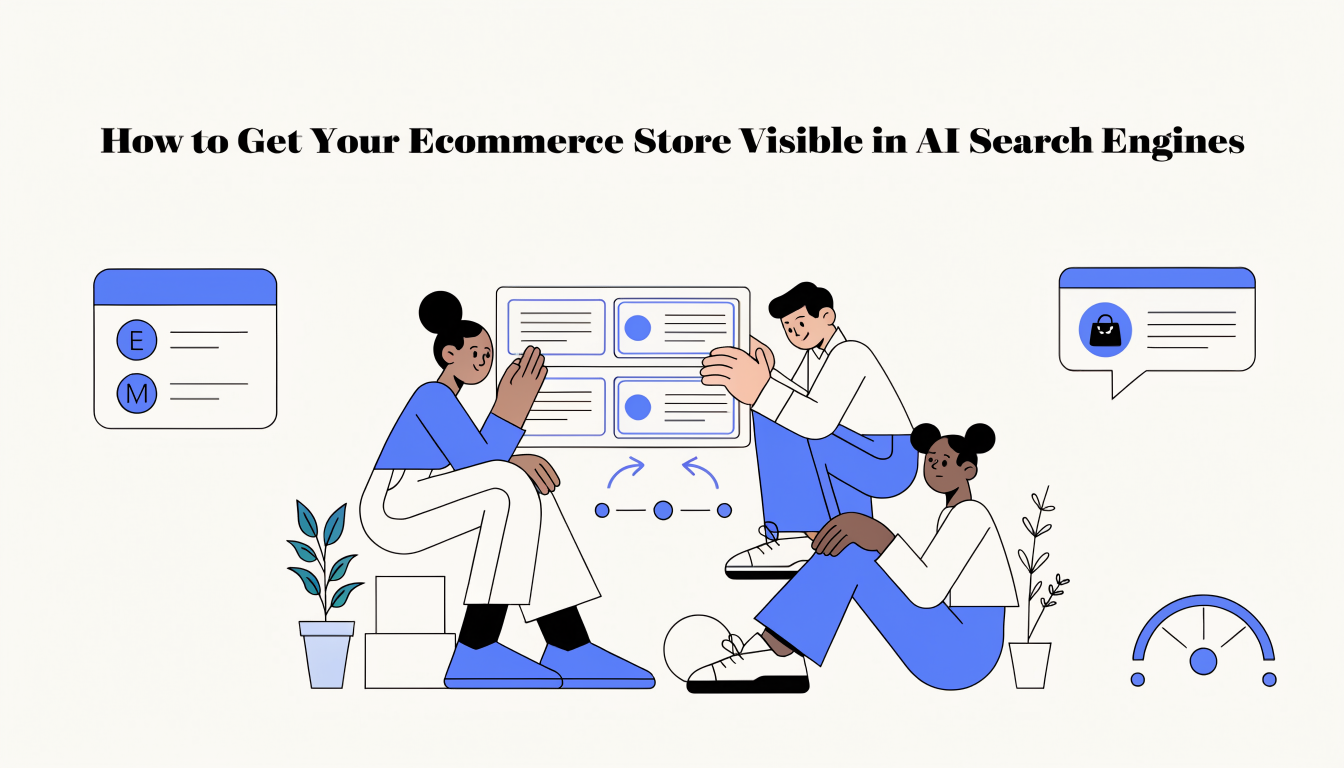
How to Get Your Ecommerce Store Visible in AI Search Engines
Learn how to improve ecommerce AI visibility with structured data, answer-ready product pages, and citation signals that get your store cited by ChatGPT an
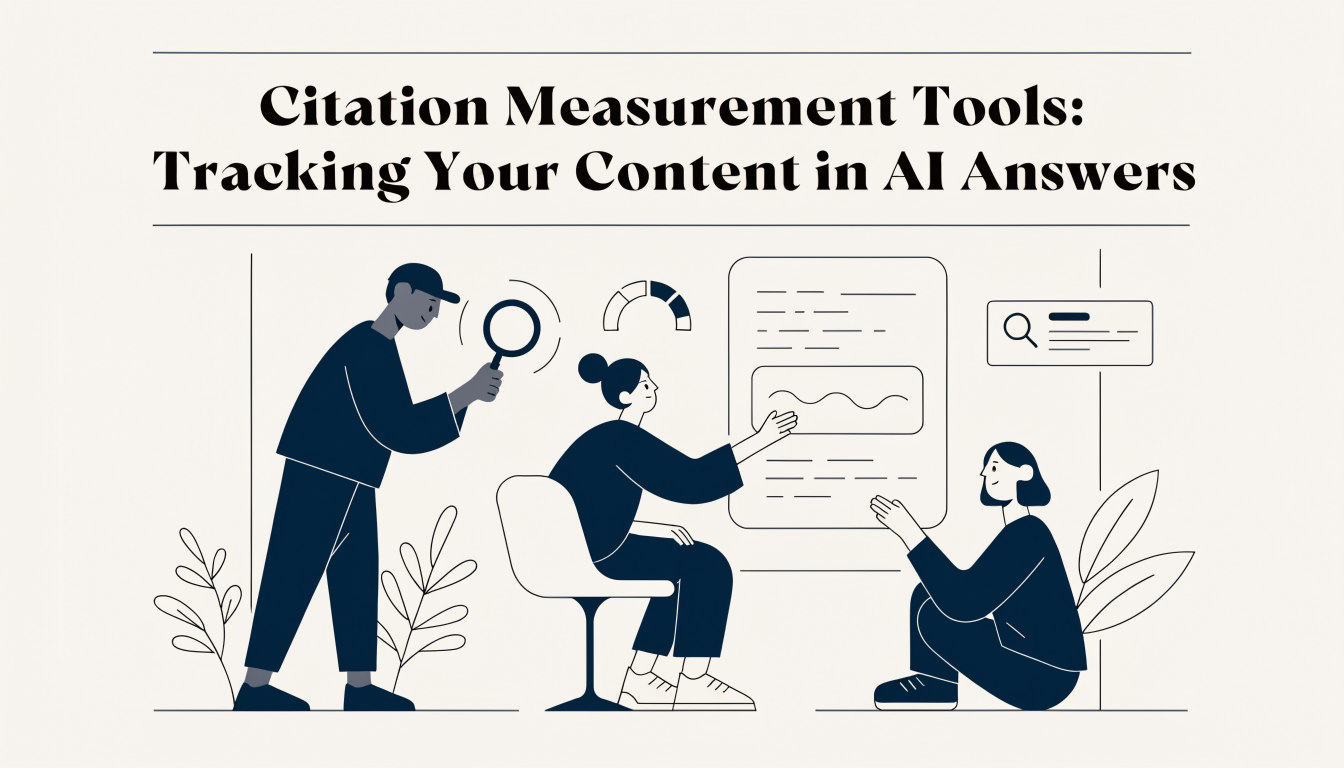
Citation Measurement Tools: Tracking Your Content in AI Answers
Compare the most effective tools for measuring citation data in AI search results. See which platforms track GPT-4o, Gemini, Perplexity, and Claude, and ho