How to Track Which AI Models Are Citing Your Website
Last updated: 20 November 2026
AI search citation analytics requires specialized monitoring tools because ChatGPT, Claude, Perplexity, and Gemini don't expose citation data through standard analytics platforms. These tools poll the AI engines directly, parse their responses, and identify exactly which URLs each model cited and how often. You can track citation frequency, which models reference your content most, and whether citations drive measurable traffic. The data reveals which pages resonate with AI systems and which competitors' content gets recommended instead of yours.
The stakes are measurable. Brightedge's 2024 research found that 65% of AI-generated answers include at least one cited source, which means ai search citation analytics has moved from a niche experiment to a real traffic and brand variable.
One honest caveat upfront: no tool has direct API access to every model's internal citation logic. What monitoring platforms do is systematic query-and-parse, reliable enough to spot trends but not a perfect real-time feed. Keep that in mind as you read.
Quick Takeaways
Citation analytics for AI engines measures which URLs ChatGPT, Perplexity, Claude, and Gemini surface when answering prompts in your category. Standard Search Console and analytics platforms do not capture this data. Dedicated tracking tools poll AI engines on scheduled queries, log every cited URL, and surface gaps where competitors appear instead of you.
- What it measures. AI citation tracking records which of your pages get referenced in AI-generated answers, across which engines, and for which query types. This is separate from organic ranking data entirely.
- Which tools exist. Purpose-built GEO monitoring platforms query AI engines on a set schedule and parse responses for cited domains. The right fit depends on how many engines you need to cover and how frequently you need fresh data.
- What content gets cited. A 2026 meta-analysis of 54 studies found that cited content runs 25.7% fresher than non-cited content, and brand mentions outperform backlinks as a citation signal by a factor of three.
- How to act on the data. Gaps in your citation coverage map directly to content you haven't written or pages that lack the structural signals AI engines reward. Fix the gap, re-run the prompt, verify the result.
The trade-off worth acknowledging: AI engine responses are non-deterministic. The same prompt can return different cited sources on consecutive days, so a single-week snapshot is rarely enough to draw firm conclusions. Tracking citation frequency over four to eight weeks gives you a pattern rather than a data point.
What AI Search Citation Analytics Actually Measures
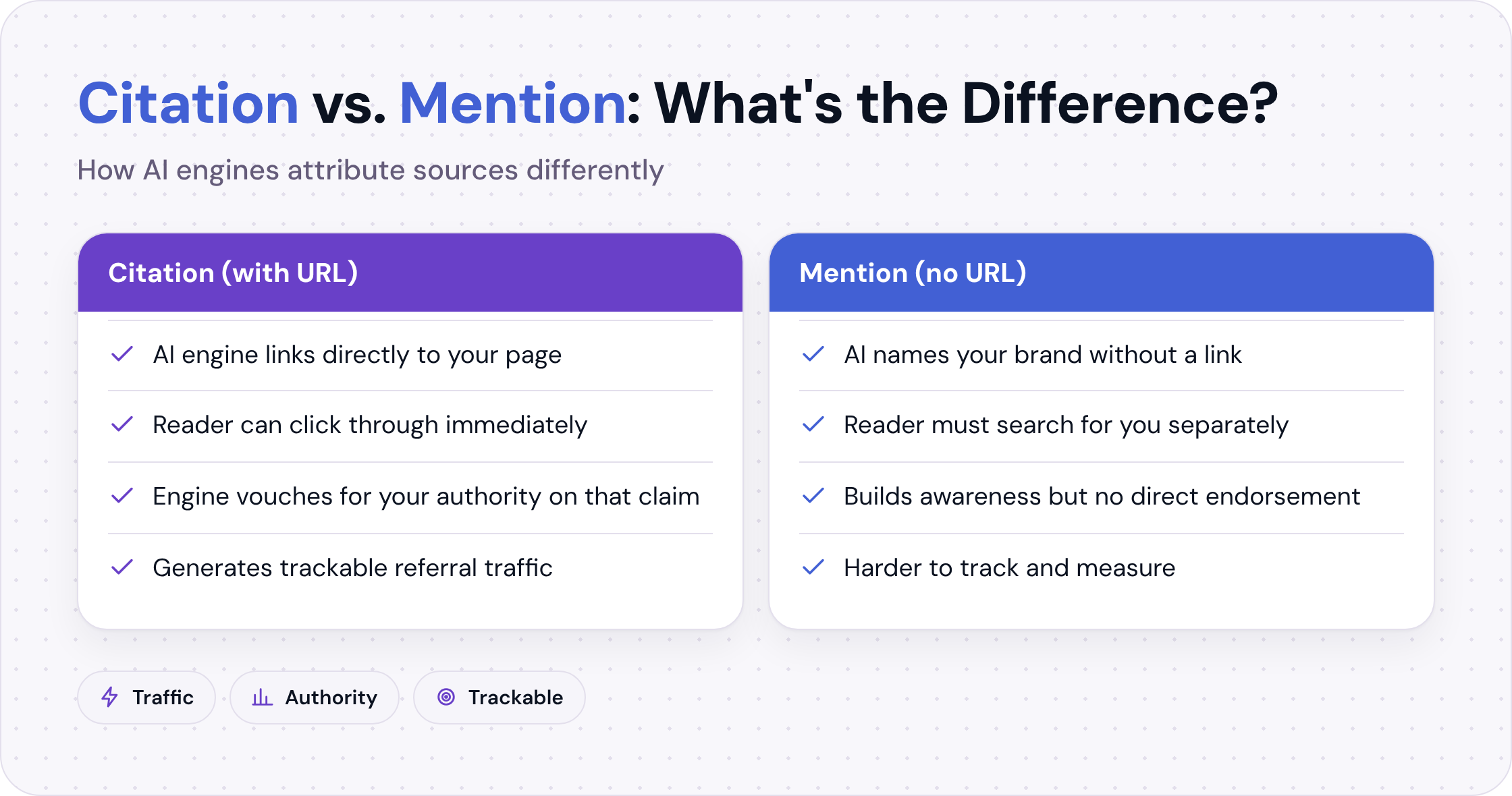
AI search citation analytics tracks three distinct signals: whether an AI engine links to your URL directly (a citation), whether it names your brand without a link (a mention), and what share of total citations across multiple engines your content captures on a given topic. These signals behave differently in practice, and conflating them produces a misleading picture of how visible your brand actually is in AI-generated responses.
Citation Rate vs. Mention Rate
A brand mention without a URL still carries weight, but it carries different weight. When ChatGPT names your company in a response without linking to a source, a reader may search for you directly. When it cites your URL, the engine is effectively vouching for your page as the authoritative source on that specific claim.
The numbers make this concrete: Lumengeo's 2026 AI search analysis found that AI search referral traffic converts at 14.2%, compared to 2.8% for traditional Google traffic. That gap exists largely because a cited URL arrives with implied endorsement attached. A mention without a link gets none of that transfer.
How Citation Share Works Across Engines
Citation share is calculated by dividing your citations on a given prompt by the total citations returned across all engines you track, then aggregating that ratio across your full prompt set. The practical challenge is that ChatGPT, Perplexity, Claude, and Gemini do not cite the same sources at the same rate.
Tinuiti's analysis of AI citation patterns found that AI citations peaked at 11% of responses on certain query types, with significant variation by engine and topic category. If you only track one engine, you may be optimizing for a citation pattern that does not generalize. A page that Perplexity cites consistently may get ignored by Gemini entirely, for reasons that have more to do with entity structure than content quality.
Why Sentiment Changes the Value of a Citation
A citation is not automatically positive. An AI engine can cite your page as an example of a flawed approach, an outdated statistic, or a contested claim. In those cases, the citation drives traffic but damages brand perception.
This is where most citation tracking tools fall short. Most measure presence, not framing. A comparison of 1,422 AI citations found that topic-relevant titles appeared in 85.9% of AI-cited results, which tells you something about what gets cited, but nothing about how it gets framed once cited.
Sentiment classification at scale is noisy. Automated tools often misread hedged language or technical qualifications as neutral when the surrounding context is actually critical. For high-stakes brand queries, manual review of the full AI response, not just the citation flag, remains the more reliable method. Automated tracking is useful for volume and trend detection; it breaks down when the nuance of framing matters more than the raw citation count.
How Different AI Models Select and Display Sources
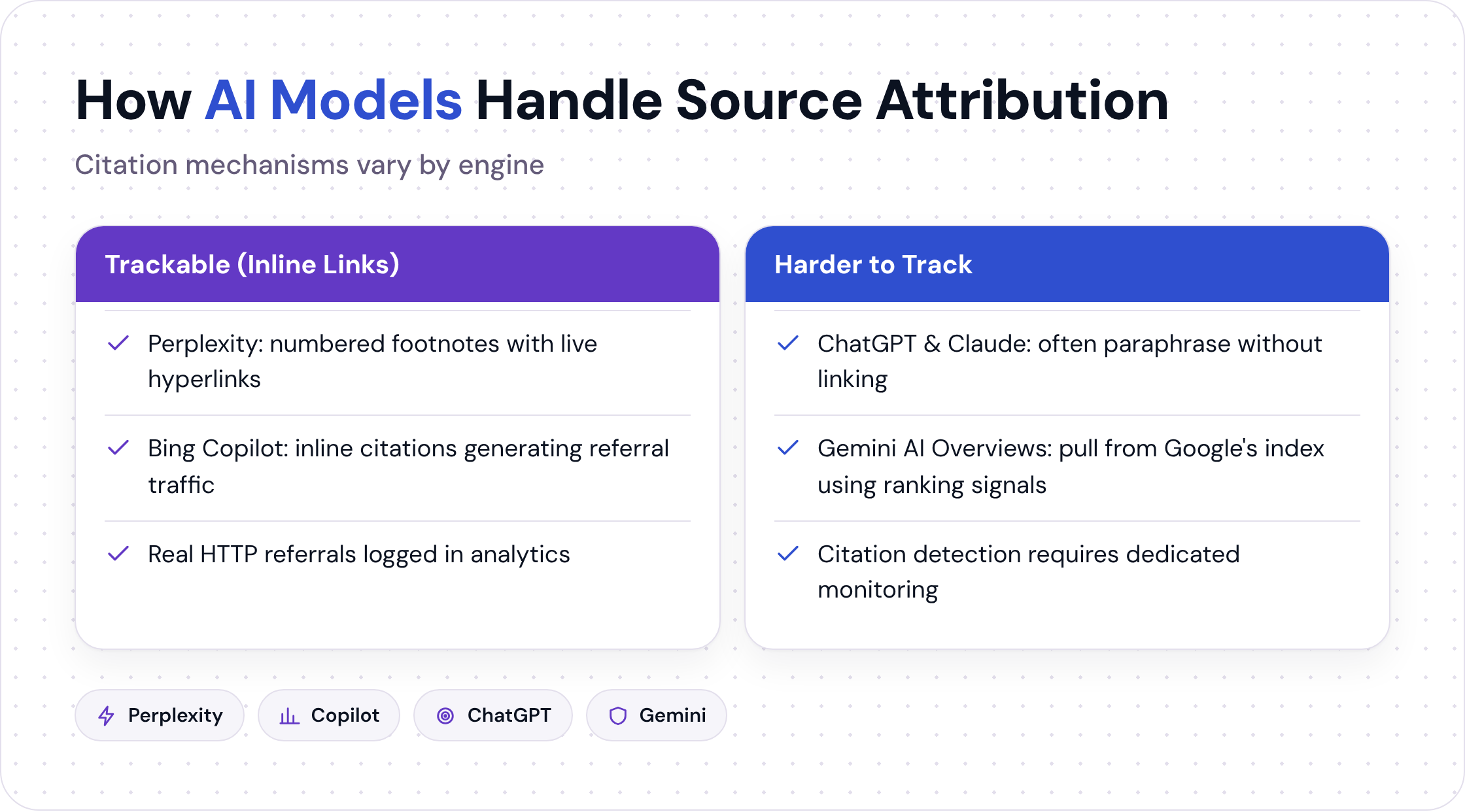
Each major AI model handles source attribution through a different mechanism. Perplexity and Bing Copilot attach inline footnote numbers that generate real HTTP referral traffic. ChatGPT and Claude often paraphrase without linking, making citation detection harder. Gemini's AI Overviews pull from Google's own index using ranking signals that differ from how standalone assistants evaluate authority. Knowing which model does what changes how you instrument your tracking.
Perplexity and Bing Copilot: The Trackable Ones
These two are the most straightforward to monitor. Both render numbered footnotes next to claims, and each footnote is a live hyperlink. When a user clicks through, your server logs record a referral from perplexity.ai or bing.com. That referral signal is real and measurable in any analytics setup without special tooling.
Yext's analysis of 17.2 million distinct AI citations across Q4 2025 found that citation behavior follows predictable, model-specific patterns, with Perplexity consistently producing the highest ratio of clickable, attributed citations relative to total responses. If you are seeing referral traffic from Perplexity, you are already being cited. If you are not, you are not.
ChatGPT Browse and Claude: Attribution Is Conditional
ChatGPT with browsing enabled will surface a URL when it retrieves a page live via Bing during the session. Without browsing, it draws on training data and typically paraphrases without attribution. Claude follows a similar pattern: it cites sources when it has retrieved them in context, but defaults to unattributed synthesis when working from its base knowledge.
The practical consequence is that a large share of citations from these two models never appear in your referral logs at all. Josh Blyskal's research on how answer engines search and attribute content confirms that ChatGPT, Claude, and similar models frequently surface information without linking back to the originating page, making referral-based tracking an incomplete signal on its own.
Referral logs catch the clickable citations but miss every instance where a model quotes your content without a link. A site can be heavily cited by ChatGPT in paraphrased form and see zero referral traffic from it. Tracking only referrals will systematically undercount your actual AI visibility.
Gemini's AI Overviews: A Different Selection Logic
Gemini's AI Overviews operate inside Google Search, so the source-selection logic is tied to Google's existing index and ranking infrastructure rather than a separate retrieval layer. Pages that rank well organically have a higher baseline probability of appearing in an AI Overview, but ranking alone does not guarantee inclusion.
Google applies an additional editorial filter that favors pages with clear entity definitions, structured data, and content that directly answers the query in the first few paragraphs. A page that ranks third but lacks schema markup may lose an AI Overview citation to a page ranking eighth that has it. The selection criteria and the ranking criteria are related but not identical.
| Model | Citation Format | Referral Traffic Generated | Primary Retrieval Source |
|---|---|---|---|
| Perplexity | Inline numbered footnotes | Yes, consistently | Live web index |
| Bing Copilot | Inline numbered footnotes | Yes, consistently | Bing index |
| ChatGPT (Browse on) | Linked URLs in response | Sometimes | Bing (live retrieval) |
| ChatGPT (Browse off) | Paraphrase, no link | Rarely | Training data |
| Claude | Paraphrase or linked, context-dependent | Rarely | Context window / retrieval |
| Gemini AI Overviews | Linked source cards | Yes, when clicked | Google index |
Setting Up Citation Monitoring: A Step-by-Step Walkthrough
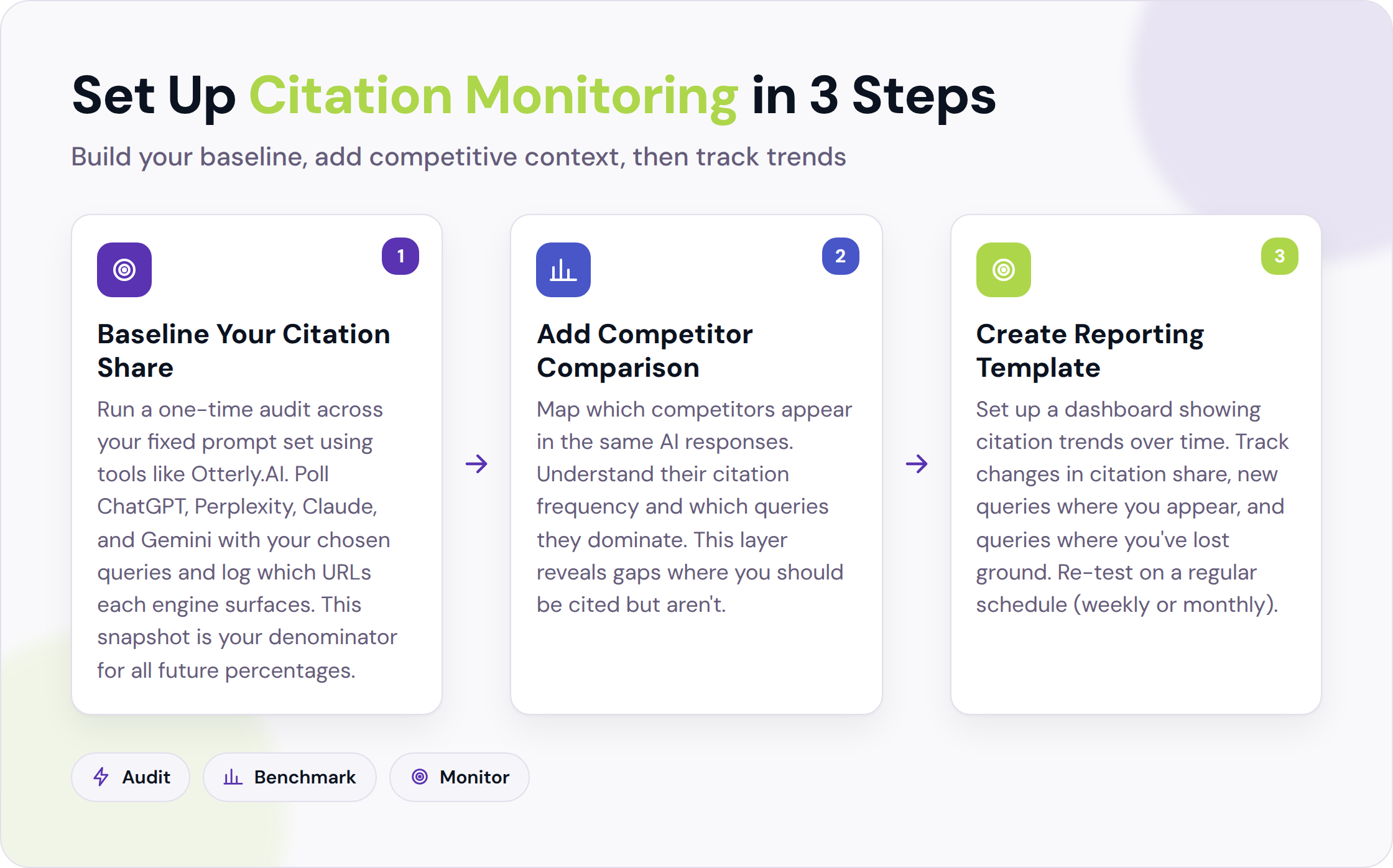
To track which AI models cite your website, you need three things working together: a baseline citation share measurement, a competitor comparison layer, and a reporting template that shows trends over time. Set these up in order. Skipping the baseline means you have no reference point when citation share shifts, and you won't know whether a change reflects your content improving or a competitor's content getting better.
Step 1: Baseline Your Current Citation Share
Before you configure anything else, run a one-time audit across your fixed prompt set to record where you stand today. Tools like Otterly.AI and similar platforms poll ChatGPT, Perplexity, Claude, and Gemini with your chosen queries and log which URLs each engine surfaces. That first snapshot is your denominator for every percentage you report later.
A 2025 comparison of AI citation tracking tools found that most platforms differ significantly on engine coverage, with some tracking only two of the four major models. Check coverage before you commit to a tool, because a baseline built on two engines will look very different from one built on four.
Run your baseline over at least two consecutive weeks before drawing conclusions. AI engine responses vary by day, and a single-week snapshot can misrepresent your actual citation rate by 15 to 20 percentage points in either direction.
Step 2: Build Your Prompt Set
Your prompt set is the list of queries you send to each AI engine on a recurring schedule. The quality of your prompt set determines the quality of your data. A prompt set that is too narrow will miss citation opportunities in adjacent topics; one that is too broad will dilute your signal with queries that have no realistic conversion value.
A practical starting point: map your top 20 organic keywords, convert each into a natural-language question a user might type into Perplexity or ChatGPT, and add five to ten competitor-brand queries to see where rivals are getting cited instead of you. That gives you 25 to 30 prompts, which is enough to establish a meaningful baseline without overwhelming your tool's query budget.
Revisit your prompt set every 60 days. AI engine behavior shifts as models update, and a prompt that returned consistent citations in Q1 may behave differently by Q3.
Step 3: Layer in Competitor Tracking
Once your baseline is set, add your top three to five competitors to the same prompt set. The goal is to calculate a competitive citation share: your citations divided by the total citations your category generates across all tracked engines.
This comparison is where ai search citation analytics becomes actionable. If a competitor appears in 40% of responses on a query where you appear in 8%, you have a specific content gap to close, not a vague "improve your SEO" directive. Look at what page they are getting cited for, examine its structure, and identify what your equivalent page is missing.
Step 4: Set Up a Reporting Cadence
Weekly snapshots are useful for catching sudden drops. Monthly rollups are better for identifying trends. The most useful reporting format combines both: a weekly alert if your citation share drops more than 10 percentage points on any single prompt, and a monthly summary that shows directional movement across your full prompt set.
Most monitoring platforms export to CSV or connect to Google Sheets via API. Build your trend chart in whatever tool your team already uses. The format matters less than the consistency of the cadence.
What Content Gets Cited Most Often
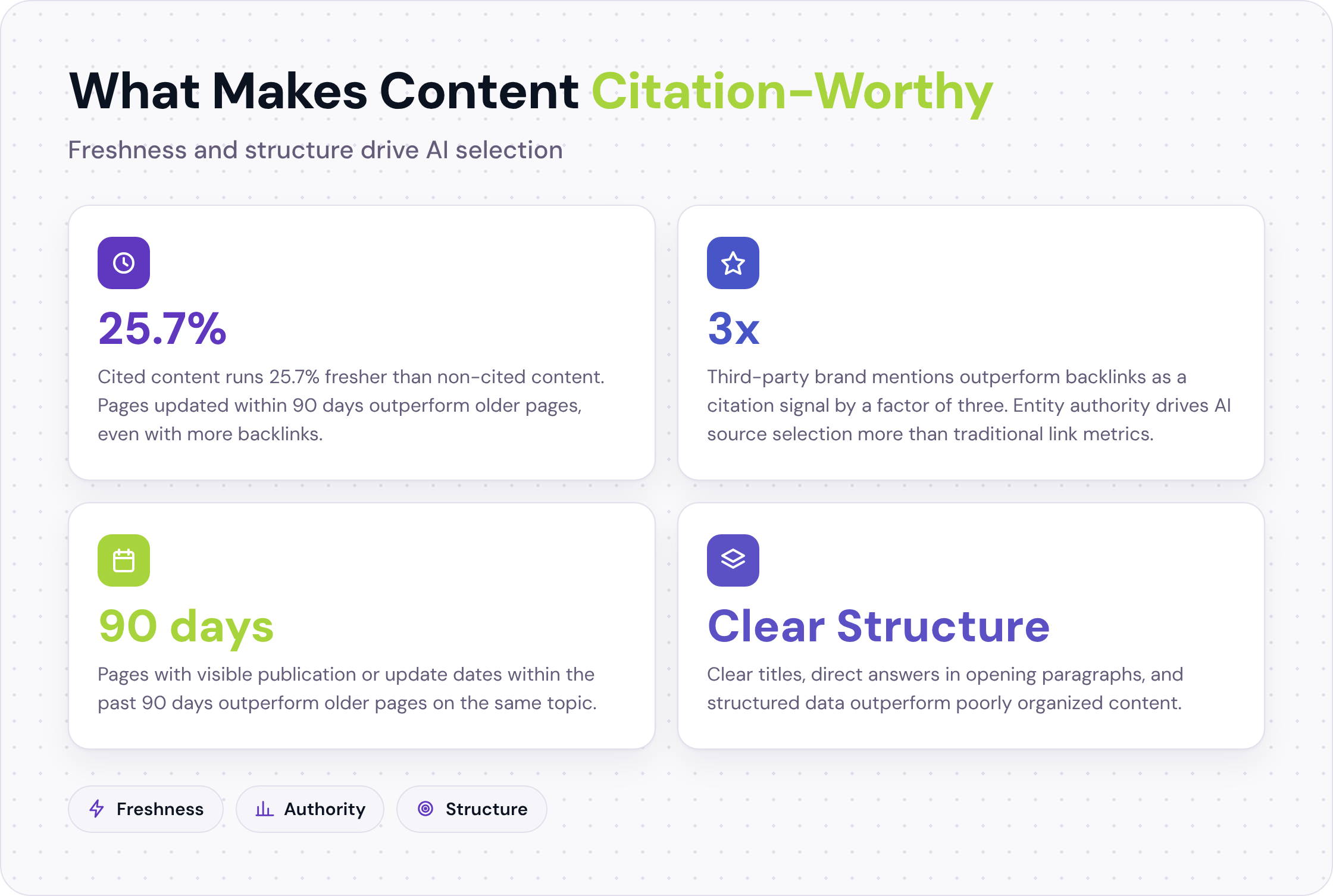
Freshness and structural clarity are the strongest predictors of AI citation. Pages updated within the past 90 days, with clear titles, direct answers in opening paragraphs, and structured data outperform older or poorly organized content. Brand mentions from third-party sources outperform backlinks as a citation signal by a factor of three, indicating that entity authority drives AI source selection more than traditional link metrics.
Freshness is the strongest single predictor. The 2026 meta-analysis of 54 studies found cited content runs 25.7% fresher than non-cited content on average. Pages with a visible publication or update date within the past 90 days outperform older pages on the same topic, even when the older page has more backlinks.
Structural clarity is the second major factor. The Rankability data on 1,422 AI citations found that topic-relevant titles appeared in 85.9% of cited results. Pages that answer the query directly in the first two paragraphs, use clear subheadings, and include structured data (particularly FAQ and HowTo schema) show up in AI-generated answers at a higher rate than pages that bury the answer or rely on narrative flow alone.
Brand mentions from third-party sources outperform backlinks as a citation signal by a factor of three, according to the same 2026 meta-analysis. This means a brand that appears frequently in industry publications, forums, and review sites, even without a direct link, builds the entity authority that AI engines use to evaluate source credibility.
The counter-case is worth stating plainly: none of these signals guarantee citation. AI engines are probabilistic systems. A page can check every structural box and still get passed over in favor of a competitor's page that happens to match the model's training distribution more closely. Optimization improves your odds; it does not produce deterministic outcomes.
What to Do When a Competitor Keeps Getting Cited Instead of You
When a competitor appears in AI responses instead of you, diagnose the gap systematically. Retrieve the full AI response to understand what type of content is being cited, examine the competitor's page structure and freshness signals, check their brand-mention coverage in third-party sources, and then rewrite your equivalent page to match those attributes. Re-test after two to four weeks, as AI engines update their retrieval behavior on a slower cycle than search engines.
First, retrieve the full AI response for the prompt where your competitor appears. Do not just note that they were cited. Read the surrounding context. Is the engine citing them for a specific statistic, a definition, a how-to process, or a product comparison? The type of citation tells you what content type you need to produce.
Second, examine the cited page directly. Check its publication date, its title tag, its use of structured data, and whether it includes a direct answer to the query in the opening paragraph. Compare those attributes to your equivalent page. The gap between the two pages is your content brief.
Third, check whether your competitor has stronger brand-mention coverage in third-party sources on that topic. If they are cited in 15 industry publications and you are cited in two, the citation gap in AI responses may reflect entity authority rather than on-page content quality. In that case, the fix is a PR and content distribution effort, not a page rewrite.
Fourth, after making changes, re-run the prompt set and wait two to four weeks before evaluating results. AI engines do not re-index instantly, and some models update their retrieval behavior on a slower cycle than search engines update their rankings.
Frequently Asked Questions
Does Google Search Console show AI citation data?
No. Google Search Console reports clicks, impressions, and rankings from Google's organic index. It does not capture citations from ChatGPT, Claude, or Perplexity, and it does not distinguish between a standard organic click and a click from a Gemini AI Overview. For full AI citation visibility, you need a dedicated monitoring tool alongside Search Console, not instead of it.
How often do AI engines update which sources they cite?
It varies by model. Perplexity and Bing Copilot retrieve pages live at query time, so their citation behavior can shift within hours of a page being updated or indexed. ChatGPT without browsing draws on training data that updates on a slower cycle, measured in months rather than days. Gemini's AI Overviews reflect Google's index, which crawls at a frequency tied to your site's crawl budget and page authority. Practically, you should expect citation patterns to shift meaningfully over a four-to-eight-week window rather than overnight.
Can you get cited by ChatGPT if your site is new?
Yes, but the path is indirect. ChatGPT with browsing enabled retrieves pages via Bing, so a new page that gets indexed by Bing and earns a few credible inbound links can appear in ChatGPT responses relatively quickly. Without browsing, ChatGPT relies on training data, which means new sites have no realistic path to citation until the next training cycle. Focus your early efforts on Perplexity and Bing Copilot, where live retrieval gives newer pages a fair shot.
What is a realistic citation share benchmark for a mid-size brand?
There is no universal benchmark, because citation share varies heavily by industry, query type, and how many competitors are active in your topic area. As a rough reference point, Tinuiti's analysis found that AI citations appeared in roughly 11% of responses on competitive query types. A mid-size brand appearing in 5 to 15% of AI responses on its core topic set is performing within a normal range. Anything below 3% on queries where you rank in the organic top five suggests a structural gap worth investigating.
Do AI citations directly drive traffic?
Perplexity and Bing Copilot citations drive measurable referral traffic because their footnotes are live hyperlinks. ChatGPT and Claude citations often do not, because those models frequently paraphrase without linking. Lumengeo's 2026 data puts AI search referral conversion at 14.2%, which is high relative to organic search, but that figure applies primarily to the engines that generate clickable citations. For models that cite without linking, the value is brand awareness and downstream branded search, not direct referral traffic.
Is AI citation tracking worth the cost for small sites?
For a site with fewer than 10,000 monthly organic visitors, the ROI on a dedicated citation monitoring tool is harder to justify. The more practical starting point is manual: run your 10 most important queries through Perplexity and ChatGPT once a week, note which URLs appear, and log the results in a spreadsheet. That process takes about 30 minutes per week and gives you directional data without a platform subscription. Scale to a paid tool when your prompt set grows beyond 30 queries or when you need competitor tracking at volume.
If you want a clearer picture of where your site stands in AI-generated answers, visit Seorav's GEO tracking page to see how the monitoring process works and what citation data looks like in practice.
Keep reading
Enterprise CMS Platforms: What They Are and How to Choose
Compare enterprise CMS platforms by architecture, cost, compliance, and AI features. Learn what separates enterprise-grade tools from standard CMS options.
How to Pick a Geo Optimization Tool That Actually Works for Multi-Region SEO
Compare the top geo optimization tools for multi-location SEO. See which platforms track rankings at city level, fix citation gaps, and scale across 100+ l
How to Get Your Ecommerce Store Visible in AI Search Engines
Learn how to improve ecommerce AI visibility with structured data, answer-ready product pages, and citation signals that get your store cited by ChatGPT an