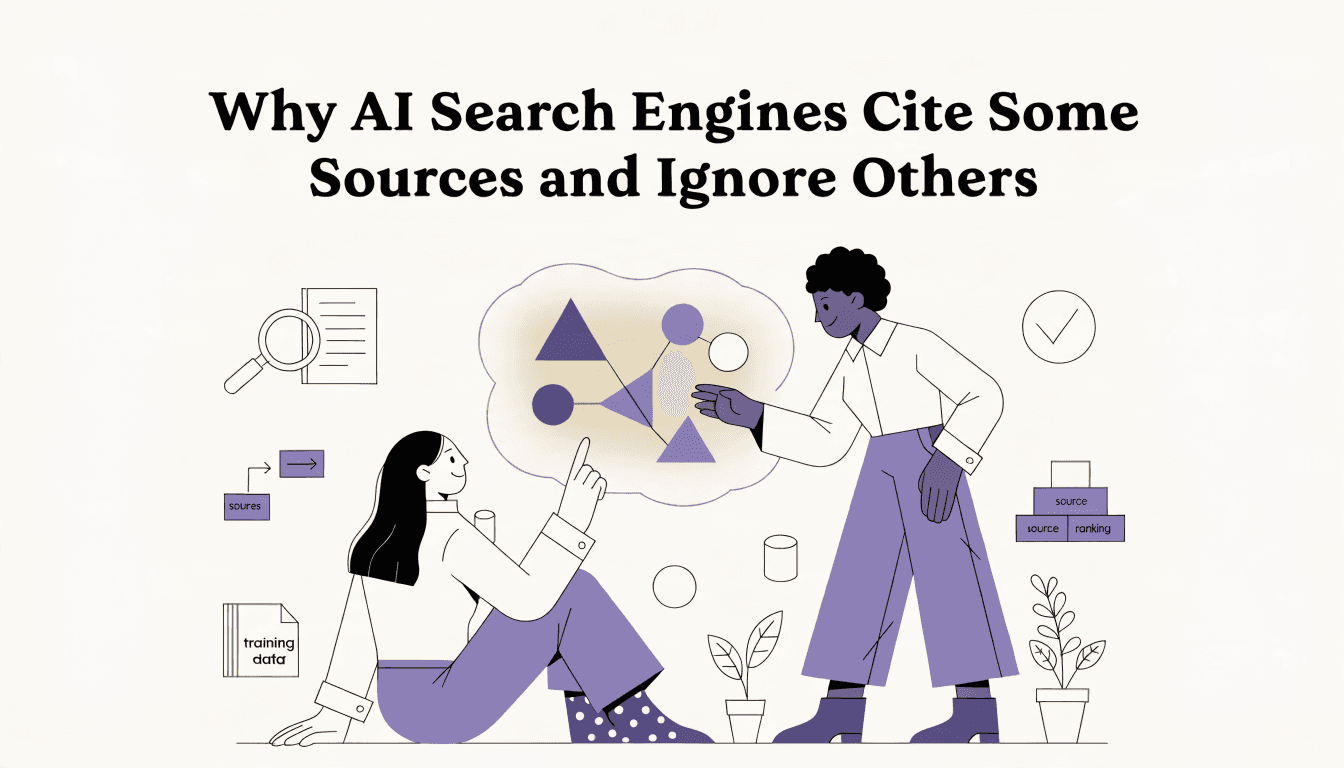
Why AI Search Engines Cite Some Sources and Ignore Others
Last updated: 1 August 2026
AI search engines select sources to cite based on three core mechanisms: whether content appeared in their training data, live retrieval signals like freshness and relevance scores, and structural trust markers such as author credentials and citation patterns. Traditional Google rankings offer little advantage here because ranking algorithms and citation selection use different criteria. Sources that dominate organic search often remain invisible to AI systems, which means earning citations requires rethinking how you structure and present information.
Word count: 81
Idea in Brief
AI search engines select sources through a combination of training data inclusion, live retrieval signals, and structural trust cues. Brands with strong Google rankings are frequently invisible to these systems because the selection criteria are fundamentally different. Earning citations requires deliberate content architecture, not just good traditional SEO.
The Problem
Most brands have optimized for a ranking model that AI engines largely ignore. A page can sit in Google's top three results and still never appear in a ChatGPT or Perplexity response. The gap exists because AI engines are not re-running a search ranking algorithm. They are selecting sources that look authoritative, verifiable, and structurally trustworthy to a language model. A 252,000-trial study by Machine Relations on AI citation architecture found consistent patterns in how source selection is structured across major engines, and traditional domain authority was only one of several factors in play.
Why It Matters
AI-generated answers are increasingly the first response a user sees, and sometimes the only one. When a source gets cited, it earns both the referral traffic and an implicit trust signal that no paid placement can replicate. When it gets ignored, it effectively does not exist for that query, regardless of how well the underlying page ranks elsewhere.
The Solution
There is a repeatable path to earning citations: produce content with original, attributable claims, structure it so AI engines can parse and extract answers cleanly, then track which prompts cite you and which cite competitors instead. No framework guarantees citation, though. AI engines update their retrieval behavior as models are retrained, so measurement has to be ongoing, not a one-time audit. The sections below lay out the mechanics of each step.
The Brand That Vanished When ChatGPT Arrived

When AI Overviews and ChatGPT-style answers absorb a query, the click often never happens. A SaaS company can hold its Google rankings, watch its organic positions stay flat, and still lose a significant share of top-of-funnel traffic because the answer engine cited a competitor instead. The traffic disappears before the user ever sees a search result page.
A concrete version of this played out across several mid-market SaaS companies after Google's AI Overviews rolled out broadly in 2024. The pattern was consistent: a 22% drop in top-of-funnel sessions, with Google Search Console still showing stable impressions and average positions. GA4 told a similar story of apparent health. Clicks were down, but the dashboard offered no obvious culprit. No ranking drops. No penalty signals. No crawl errors.
What GA4 could not show was where those users went instead. They got an answer inline and stopped. The brand was structurally invisible to the AI layer, even though it remained visible to the traditional index.
The numbers behind this are worth sitting with. AI engines cite sources in 89.3% of responses, but name a specific brand in only 18% of those answers. That gap is where traffic goes quiet.
One trade-off worth naming: not every traffic drop in this period was caused by AI citation displacement. Some of it was seasonal. Some was attributable to content decay or shifting keyword intent. Attributing a 22% decline entirely to AI Overviews without ruling out those factors is a mistake. Most current analytics setups were not built to distinguish between "user saw the answer in an AI Overview and stopped" and "user never searched for this at all." Until that instrumentation exists, the diagnosis requires inference, not certainty.
How AI Answer Engines Actually Choose What to Cite

Understanding how AI search engines select sources to cite starts with one key distinction: live retrieval versus trained associations. AI answer engines filter candidates through four measurable signals: domain authority, content recency, topical specificity, and structured markup. A page that satisfies all four is far more likely to be surfaced than one that ranks well on Google but fails on structure or specificity.
Retrieval-Augmented Generation vs. Training Data
Most citations you see today come from retrieval-augmented generation (RAG), not from what the model memorized during training. In a RAG pipeline, the engine queries an external index at response time, pulls candidate passages, and selects the ones that best answer the prompt. Perplexity runs this on every query. ChatGPT does it when browsing is enabled, pulling from Bing's index. Gemini blends both approaches depending on the query type.
The practical implication: your page needs to be crawlable and indexed by the retrieval layer the engine uses, not just by Google. A page that Google ranks on page one but Bing has not indexed will not appear in a ChatGPT browsing-enabled response, regardless of its domain rating.
Training data still matters for engines running without live retrieval, but that path is increasingly narrow. The content baked into GPT-4's training corpus closed off in early 2023. For anything time-sensitive, RAG is the active mechanism.
The Four Signals That Predict Citation
The signal stack that llmreach.ai mapped across major platforms consistently points to the same four factors.
Authority. Domain-level trust signals still feed into retrieval ranking. A page on a site with a strong backlink profile gets retrieved more often, all else equal.
Recency. Engines weight freshness, especially for queries with implicit time sensitivity. Pages with a visible publish or update date within the last 12 months outperform undated content on the same topic.
Specificity. Vague overviews rarely get cited. Engines prefer passages that answer a narrow question with a concrete claim. A page that states "conversion rates for SaaS trials average 2-5% across the industry" is more extractable than one that says "conversion rates vary."
Structured markup. JSON-LD schema, clear heading hierarchies, and short answer-first paragraphs all make it easier for a retrieval model to identify and extract the relevant passage. Clairon's analysis of citable content puts the optimal extractable passage length at 40 to 60 words: long enough to carry context, short enough to lift cleanly.
Where Backlinks Still Matter, and Where They Stop
Backlinks influence ChatGPT citations indirectly. Because ChatGPT's browsing layer uses Bing, and Bing's ranking algorithm weights inbound links, a stronger backlink profile improves the probability that your page surfaces in the retrieval pool at all. A 2026 AI citation ranking factors data study found that pages with 50 or more referring domains appear in AI citations at roughly twice the rate of pages with fewer than 10.
This relationship breaks down past a certain threshold, though. Once a page clears a baseline of authority, additional backlinks produce diminishing returns on citation frequency. What starts to matter more is whether the content is structurally extractable. A DR-90 page written as a long-form narrative with no clear answer passages will lose citations to a DR-40 page that opens each section with a direct, specific claim.
The trade-off is real: optimizing purely for AI extractability (short paragraphs, answer-first structure, heavy schema) can reduce the depth and narrative flow that earns backlinks in the first place. The practical balance is to write for human readers at the section level, but treat every opening paragraph as a standalone answer that an engine could lift without the surrounding context.
The Misconceptions That Keep Brands Out of AI Answers
Most brands assume that ranking on page one of Google means they are visible to AI engines. That assumption is wrong, and it costs them citations. AI engines select sources based on earned authority, entity clarity, and structural trust signals, none of which are guaranteed by organic search position. A page can sit at rank one and still be invisible to every major LLM retrieval layer.
Ranking and Citation-Worthiness Are Not the Same Thing
Google's ranking algorithm rewards relevance signals: backlinks, click-through rate, on-page optimization, freshness. LLM retrieval layers weight different things. AuthorityTech's analysis of AI citation behavior puts it plainly: SEO rankings do not predict AI citation. A page optimized for a featured snippet, with keyword density tuned and headers structured for Google, may still fail the threshold tests an LLM applies when deciding whether a source is trustworthy enough to quote.
The practical gap is real. Brands that have spent years building topical authority for search often find their content skipped entirely in AI-generated answers, while a single well-sourced article from a niche trade publication gets cited repeatedly.
Why Thin "Optimized" Content Gets Passed Over
Content built to rank, short-form, keyword-dense, structured around search intent without genuine depth, tends to fail LLM source selection for a straightforward reason: it does not contain the kind of verifiable, specific claims that an AI engine can extract and attribute with confidence.
LLMs are looking for passages they can lift and cite. Thin content gives them nothing to lift. A 600-word article that covers a topic at surface level, even if it ranks well organically, offers no quotable density. The engine moves to the next source.
Depth alone is not sufficient either. A 3,000-word article with no external citations, no named data, and no clear entity signals can still be skipped. Depth and verifiability have to work together. Substance without structure does not reliably earn citations.
The Overlooked Role of Digital PR and Off-Site Mentions
This is where most brands leave the most ground uncovered. Semrush's research on AI brand misinformation identifies the sources AI systems draw on for brand-related answers: third-party review sites, forums, news articles, and industry directories. Your own website is one input among many, and often not the primary one.
AI engines treat mentions on domains they already trust as credibility proxies. If your brand appears consistently across respected trade publications, analyst reports, and editorial coverage, the retrieval layer reads that pattern as a signal of legitimate authority. If your footprint is confined to your own domain, the engine has less external evidence to work with.
Digital PR, press coverage, and strategic placements in industry directories are not supplementary to AI visibility. For many brands, they are the primary mechanism by which AI engines form an opinion about whether a source is worth citing at all. A brand with strong organic rankings but thin off-site presence is structurally disadvantaged in AI search, regardless of how well its pages are optimized.
A Framework for Becoming a Source AI Engines Trust

To become a source AI engines cite, you need three things working together: content structured so retrieval systems can extract a clean answer, an off-site footprint that signals credibility to the model before it even reads your page, and a measurement system that tells you which prompts are citing you and which are citing someone else instead.
Step 1: Build Content Around Extractable Claims
Every section of your content should open with a direct, specific claim that stands on its own. Think of it as writing two articles at once: one for the human reader who will read the full piece, and one for the retrieval model that will lift a single passage and attribute it.
Concrete claims beat vague ones every time. "Email open rates for B2B SaaS average 21.5% according to Mailchimp's 2025 benchmark report" is extractable. "Email open rates vary by industry" is not. The difference is not length. It is specificity and attributability.
Add JSON-LD schema where it applies, particularly FAQ schema for question-and-answer sections and Article schema with a clear dateModified field. Keep your heading hierarchy clean: one H1, logical H2s, H3s only when you genuinely need a sub-level. Retrieval models use heading structure to understand what a passage is about before they read it.
Step 2: Build an Off-Site Presence AI Engines Can Read
Your on-site content is only part of the picture. AI engines form a prior about your brand's credibility from what they find across the web before they ever retrieve your page. That prior is built from mentions in editorial coverage, analyst reports, trade directories, and forums.
A practical starting point: audit where your brand currently appears off-site. Search for your brand name in Perplexity and note which third-party sources it cites when answering brand-related questions. Those are the domains the engine already trusts. Getting mentioned on those domains, through contributed articles, press coverage, or directory listings, directly improves your citation probability.
One realistic limitation: this takes time. A digital PR campaign that earns 10 placements in respected trade publications over six months will move the needle, but you will not see citation gains in week two. The brands that win in AI search are the ones that started building off-site credibility before they needed it.
Step 3: Measure Citation Share, Not Just Rankings
Traditional rank tracking tells you where you appear in a list. It does not tell you whether an AI engine cited you when a user asked a question your content is supposed to answer.
Set up a prompt monitoring system. Write out the 20 to 30 questions your target audience is most likely to ask an AI engine, then run those prompts weekly across ChatGPT, Perplexity, and Gemini. Log which sources get cited for each prompt. Over time, you will see patterns: which content earns citations, which competitors are being cited instead of you, and which prompts you are simply absent from.
This is the instrumentation gap most brands have not closed yet. Without it, you are optimizing blind.
Frequently Asked Questions
Does Google ranking affect whether AI engines cite you?
Indirectly, yes, but the relationship is weaker than most brands expect. Google ranking signals and AI citation signals overlap in some areas (domain authority, content quality) but diverge significantly in others. A page can rank in Google's top three and still be absent from every major AI-generated answer if it lacks structured markup, specific attributable claims, or off-site credibility signals. Treat AI citation optimization as a parallel discipline, not a byproduct of SEO.
How do I know if an AI engine is citing my competitors instead of me?
Run the questions your audience is most likely to ask into ChatGPT, Perplexity, and Gemini, then record which sources each engine cites. Do this weekly for at least four weeks to get a stable baseline. You will quickly see which competitors appear consistently and which content formats they use. That competitive citation map is more actionable than any rank tracking report for understanding your AI visibility gap.
Does publishing more content help with AI citations?
Volume alone does not move the needle. A single well-structured article with specific, attributable claims and clean schema will earn more citations than ten thin pieces optimized for keyword density. If you are going to publish more, focus each piece on a narrow question and open every major section with a direct answer. Breadth without depth gives retrieval models nothing to extract.
How long does it take to start appearing in AI-generated answers?
There is no fixed timeline, and anyone who gives you one is guessing. For on-site structural changes (schema, heading hierarchy, answer-first paragraphs), you may see citation gains within four to eight weeks as engines re-crawl and re-index your content. For off-site credibility building through digital PR, expect three to six months before the pattern of mentions is dense enough to shift how AI engines perceive your brand's authority. Both tracks need to run simultaneously.
Do AI engines cite the same sources every time?
No. Citation behavior varies by prompt phrasing, model version, and whether the engine is using live retrieval or its training corpus. The same question asked two different ways can produce different cited sources. This is one reason prompt monitoring needs to be ongoing rather than a one-time snapshot. Retrieval behavior also shifts when models are updated, so a source that earns consistent citations today may need to re-earn that position after a model retrain.
Is there a way to directly submit my site to AI engines for citation consideration?
Not in the way you submit a sitemap to Google Search Console. The closest equivalent is ensuring your site is indexed by Bing (since ChatGPT's browsing layer uses Bing's index) and that your content is accessible to common crawlers. Perplexity and other engines run their own crawlers. Blocking those crawlers in your robots.txt file will exclude you from live retrieval entirely. Beyond crawlability, there is no direct submission path. Citation is earned through content quality and off-site credibility, not through registration.
If you want to know exactly how AI search engines select sources to cite in your category, and where your brand stands relative to competitors, visit Seorav to see how they can help you close the gap.
Keep reading
Ranking in Google's AI Search: The Deterministic Signals That Actually Move the Needle
Learn how do you rank in SGE with the three signals Google's AI uses to cite sources: schema markup, entity salience, and structured factual claims.
Why AI Ignores Your Content (And How to Fix It)
Learn how to avoid AI content that gets ignored by LLMs. Covers RAG retrieval signals, schema, entity salience, and an answer-first structure checklist.
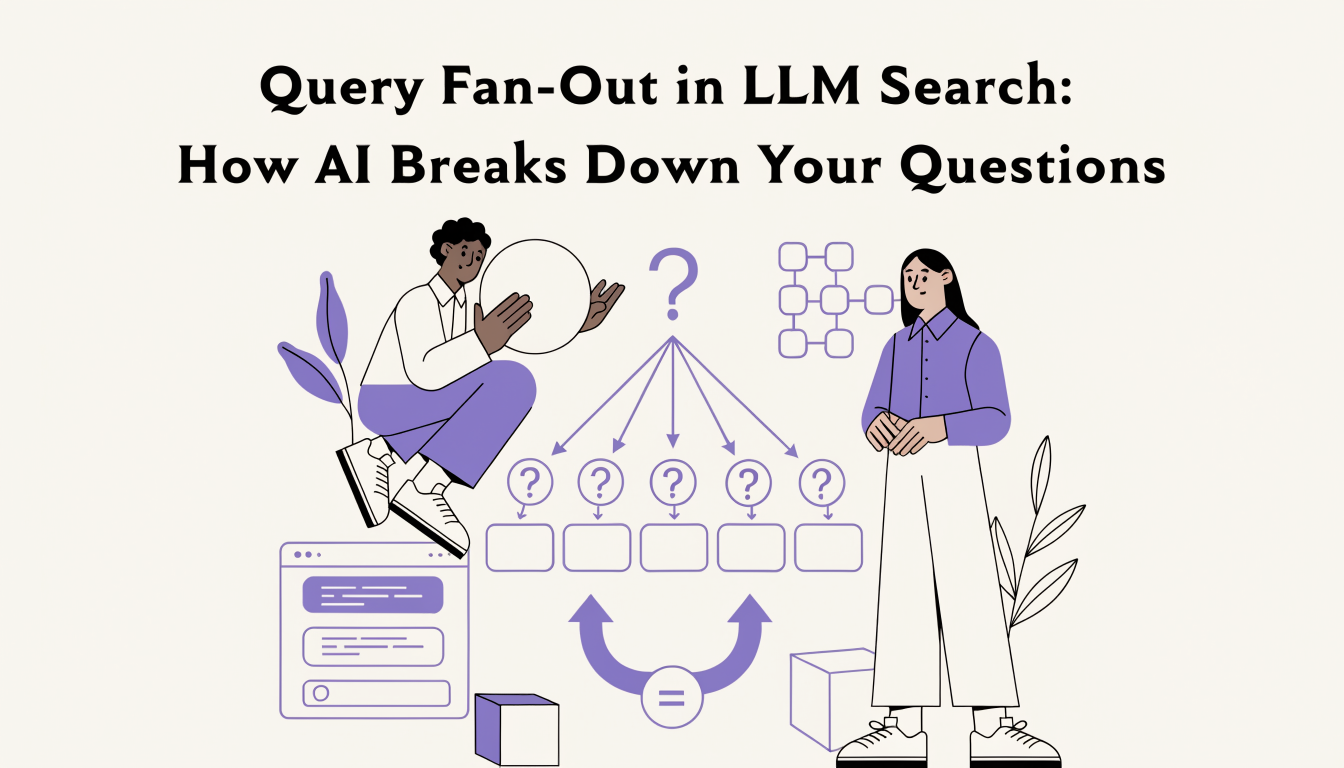
Query Fan-Out in LLM Search: How AI Breaks Down Your Questions
Learn what query fan-out in LLM search is, how AI splits your prompt into 3-8 sub-queries, and how to structure content to win more citation passes.