Which LLM Citation Tracking Platform Actually Works for Your Brand
Last updated: 21 September 2026
No single LLM citation tracking platform covers all four major AI engines (ChatGPT, Perplexity, Claude, and Gemini) with equal depth as of mid-2026. Profound, Otterly.AI, Semrush AI Toolkit, and BrandMentions with its AI filter come closest, but each has blind spots. Profound excels at ChatGPT and Claude tracking, Perplexity dominates its own engine, and Semrush captures broader web mentions. Your choice depends on which AI platforms your audience actually uses.
The Short Answer: Best Tools for Monitoring LLM Citations Right Now
No single llm citation tracking platform reliably covers all four major AI engines (ChatGPT, Perplexity, Claude, and Gemini) with equal depth. As of mid-2026, the tools closest to full coverage are Profound, Otterly.AI, the Semrush AI Toolkit, and BrandMentions with its AI filter. Each covers a different slice of the problem, and none covers all of it.
The gap in coverage is real. Semrush's LLM monitoring tool comparison found that most platforms prioritize two or three engines and treat the others as secondary. If your buyers use the engine a tool deprioritizes, you are flying blind on that channel.
To rank every tool in this article, five criteria were applied consistently:
| Criterion | What it measures |
|---|---|
| Model coverage | Which AI engines are actively polled (not just claimed) |
| Alert latency | How quickly you're notified when a citation appears or drops |
| Competitor tracking | Whether you can monitor which competitors get cited on your tracked prompts |
| Historical data depth | How far back citation records go, and whether trends are visible |
| Pricing transparency | Whether plans and limits are published without a sales call |
One honest caveat: alert latency is the hardest spec to verify independently. Most vendors quote polling frequency, not actual notification delay, and those two numbers are rarely the same. Where latency claims could not be confirmed, that is noted in the tool breakdowns below.
LLM Citation Tracking Platforms at a Glance
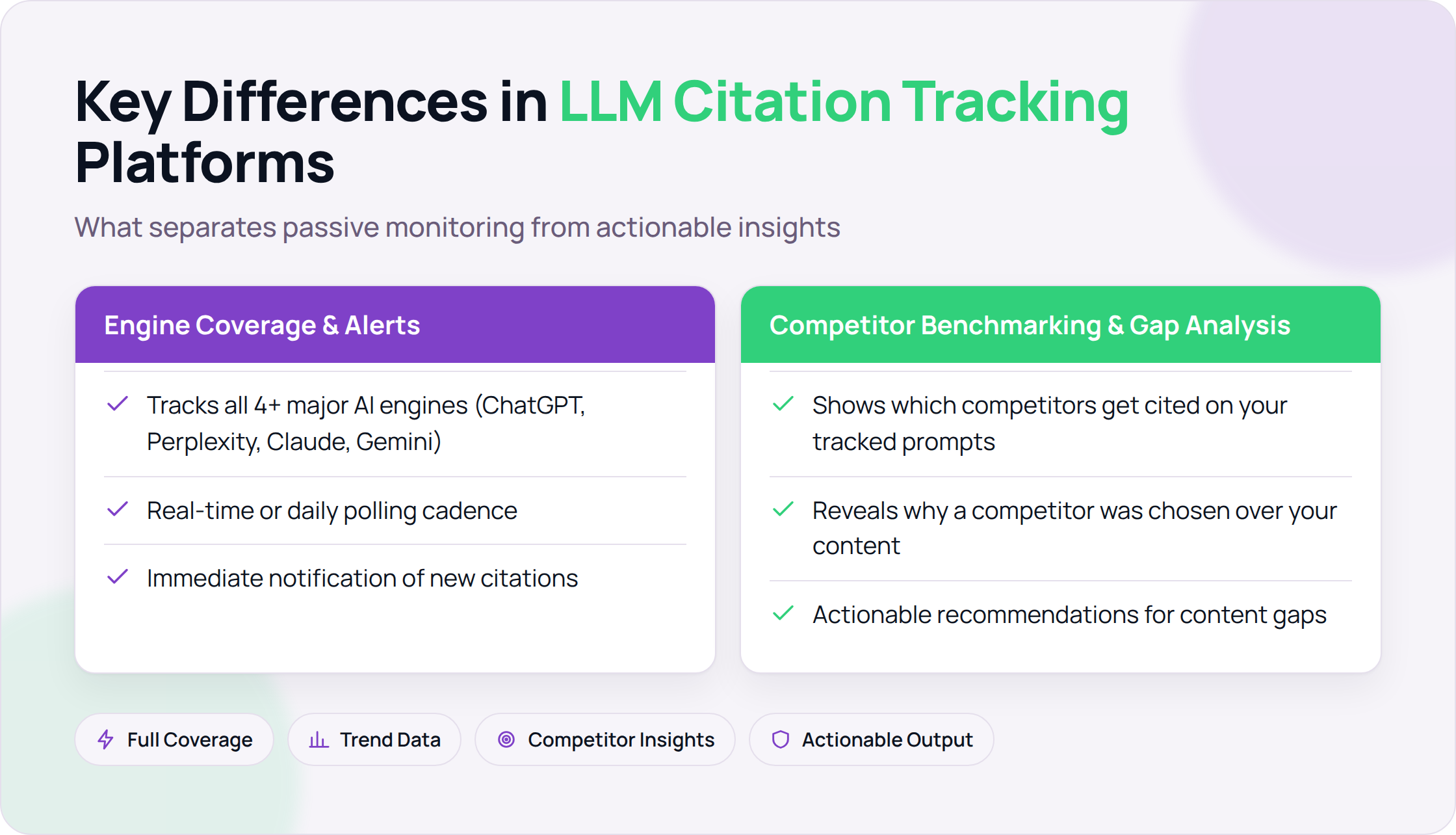
The major platforms share a common core: they send test prompts to AI engines, parse which URLs get cited, and store that data over time. Where they differ is in engine coverage, prompt volume limits, competitor benchmarking depth, and how they surface gaps between your content and what gets cited.
How to Read This Matrix
Each column in the comparison below maps to a concrete buying decision. Engine coverage tells you whether a platform tracks all four major engines or just one or two. Prompt volume caps determine how many queries you can monitor per week before hitting a paywall tier. Competitor benchmarking shows you who else gets cited on your tracked prompts, not just whether you appear. Gap analysis is the column that separates passive monitoring from actionable output: does the tool tell you why a competitor got cited and what your content would need to change?
A 2026 evaluation of 13 platforms found that URL-level tracking, domain classification, and localized tracking by country varied significantly across tools, with most platforms strong on one or two dimensions but weak on the rest.
| Platform dimension | What it means for buyers |
|---|---|
| Engine coverage | Fewer engines = blind spots in your citation data |
| Prompt volume | Low caps force you to prioritize; high caps let you track long-tail queries |
| Competitor benchmarking | Without it, you see your rank but not the gap |
| Gap analysis | The difference between a dashboard and a to-do list |
| Localized tracking | Matters if your buyers are in multiple regions |
| Publish cadence | Weekly polling catches trends; daily polling catches fast-moving topics |
Scoring Notes
A few caveats before you use this matrix to make a decision.
Several platforms provided their own benchmark figures during vendor review. Self-reported numbers on prompt accuracy and citation match rates are hard to verify independently. Where data came directly from a vendor's marketing materials rather than a third-party audit, treat those figures as directional, not definitive.
One number worth keeping in mind: a synthesis of twelve months of LLM citation research found that 44.2% of citations come from the first 30% of a page. Most tracking platforms log citation presence at the URL level and miss structural detail about where on a page the cited content lives. That resolution gap is real, and few tools address it yet.
There is also a breadth-versus-depth trade-off worth naming. Platforms with broader engine coverage tend to run fewer prompts per engine per week to stay within API cost limits. If you track 200 prompts across four engines weekly, you are likely getting shallower polling cadence than a tool that covers two engines at twice the frequency. Neither approach is wrong, but the choice depends on whether breadth or depth matters more for your category.
One limitation that applies across the board: citation tracking tells you what AI engines are citing today. It does not reliably predict what they will cite after a model update or a training data refresh. Teams that treat citation data as a fixed signal rather than a moving one tend to over-invest in optimizing for a snapshot that shifts within a quarter.
How to Choose the Right Platform for Your Situation
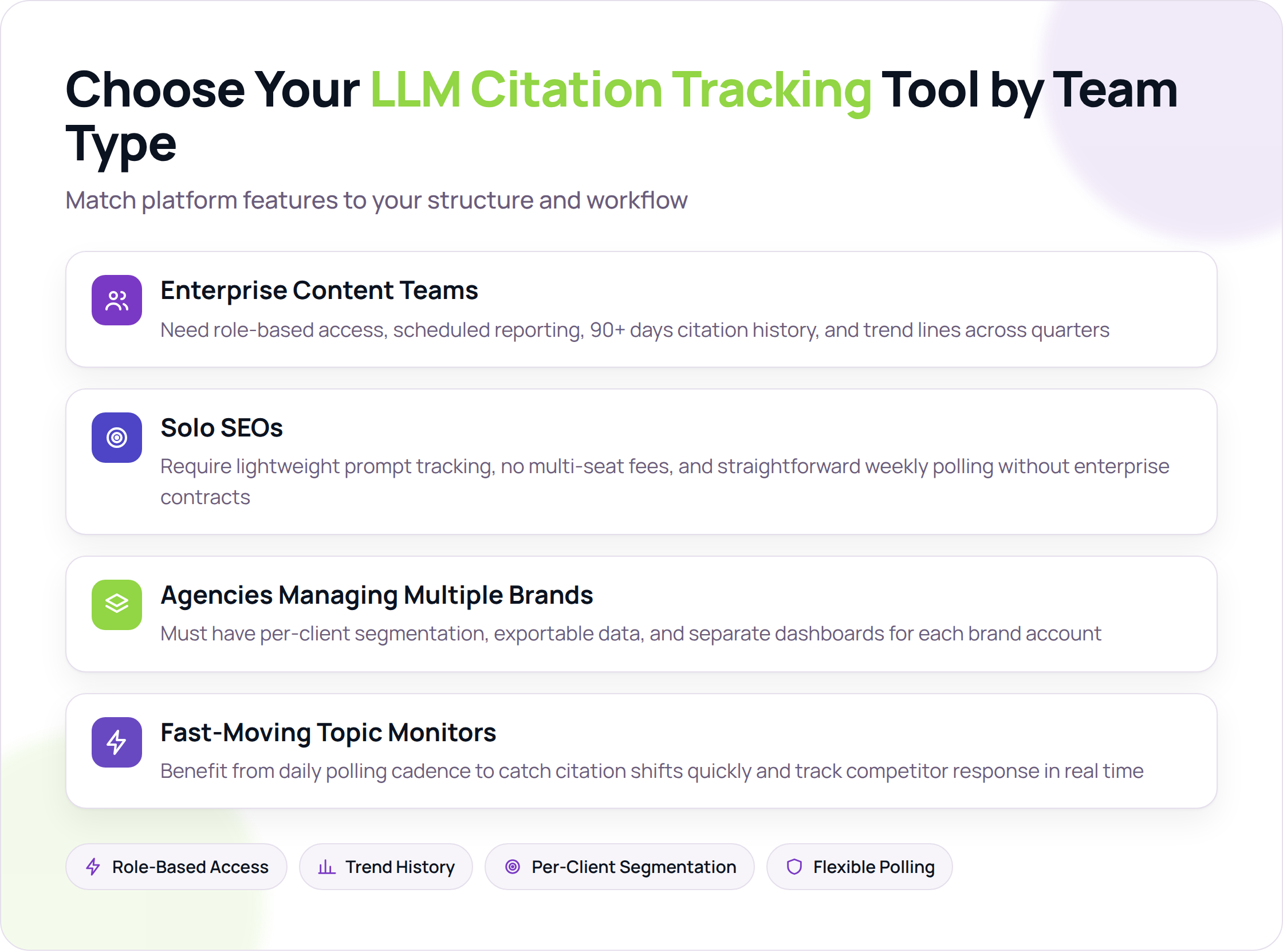
The right llm citation tracking platform depends on three variables: how many brands you manage, whether you need trend data or immediate alerts, and how many AI models the platform actually queries. Enterprise content teams need multi-seat reporting and historical baselines. Solo SEOs need lightweight prompt tracking without a six-figure contract. Agencies managing multiple brands need per-client segmentation and exportable data.
Match the Tool to Your Team Structure
Enterprise content teams should prioritize platforms that support role-based access, scheduled reporting, and citation history going back at least 90 days. A single snapshot of which AI engine cited you last Tuesday tells you almost nothing. Trend lines across quarters tell you whether a content investment is working.
Solo SEOs have a different problem. Most enterprise-grade platforms charge for seats and brand slots you do not need. The better move is a tool that lets you track 10 to 20 high-intent prompts across two or three AI engines, with weekly digests rather than real-time dashboards. The Slatehq overview of AI citation tools notes that the most useful platforms for smaller operators separate brand citations from competitor citations clearly, rather than burying both in a single feed.
Agencies face a different constraint entirely: client reporting. You need per-brand segmentation, white-label exports, and the ability to show a client which prompts their competitors are winning. A platform that only shows aggregate citation counts across all your clients is operationally useless at billing time.
When Historical Data Beats Real-Time Alerts
Real-time alerts matter most for brand reputation monitoring, catching a sudden drop in citations after a site migration or a major content change. For strategic decisions, historical citation data is more valuable.
If you are trying to prove that a content program shifted AI citation share over six months, you need stored query logs, not push notifications. The Airops guide to LLM brand citation tracking makes this distinction explicit: measuring AI visibility over time requires consistent prompt sets run on a fixed cadence, not ad hoc queries.
The trade-off is that historical data requires the platform to have been running your prompts before you needed the data. If you sign up today and want six-month trends, you are out of luck unless the platform maintains a shared citation index. Most do not. Ask about this before you commit.
Red Flags to Watch For
The most common one: a platform that queries only ChatGPT and describes this as "full AI coverage." ChatGPT, Perplexity, Claude, and Gemini each have different retrieval behaviors and different source preferences. A brand that gets cited consistently in Perplexity may be invisible in Gemini. Sorn.ai's analysis of LLM visibility tools identifies multi-model monitoring as a baseline requirement, not a premium feature, specifically because citation patterns diverge significantly across engines.
Two other red flags worth checking before you sign a contract:
- Prompt transparency. Can you see the exact prompt the platform sends to each AI engine? If not, you cannot verify the results or replicate them independently.
- Citation attribution. Does the platform distinguish between a direct URL citation and a brand name mention with no link? These are not the same signal, and conflating them inflates your apparent visibility.
No platform gets all of this perfectly right. The category is still maturing, and every tool involves some trade-off between coverage breadth, data freshness, and price.
Best LLM Citation Tracking Platform for Enterprise Teams: Profound
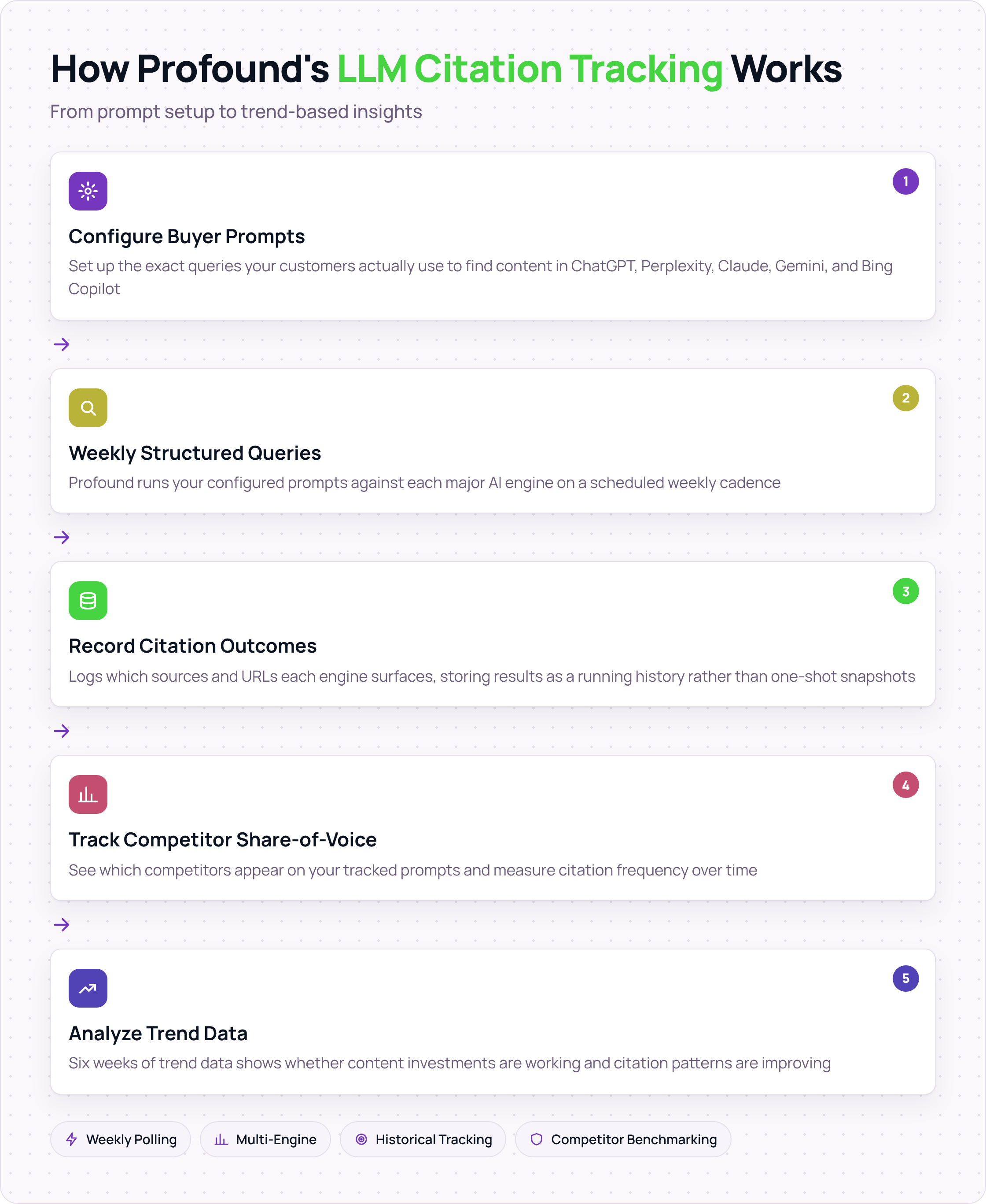
Profound is the most purpose-built option available in 2026 for large marketing and SEO teams. It monitors brand mentions and URL citations across ChatGPT, Perplexity, Claude, Gemini, and Bing Copilot on a scheduled cadence, logs which sources each engine surfaces, and reports competitor share-of-voice at scale. For enterprise teams whose core job is knowing whether AI engines are citing them, Profound is the clearest purpose-fit option currently available.
What Profound Actually Tracks
The platform runs structured prompt simulations against each major AI engine and records citation outcomes over time. You configure the prompts your buyers actually use, Profound queries each engine on a weekly schedule, and the results get stored as a running history rather than a one-shot snapshot. A single week of data tells you almost nothing, but six weeks of trend data shows you whether a content update moved the needle.
The five-engine coverage (ChatGPT, Perplexity, Claude, Gemini, and Bing Copilot) is the broadest of any dedicated citation tracker currently available. A practical evaluation of LLM tracking tools published by Nick Lafferty notes that Profound's prompt simulation approach gives teams a more structured framework for scaling citation programs than manual monitoring or general-purpose SEO tools.
Competitor Citation Analysis and Share-of-Voice Reporting
Profound's share-of-voice reporting is where it pulls ahead for enterprise use cases. You configure named competitors, and the platform surfaces how often each one gets cited across your tracked prompts, which URLs they are winning with, and where you are losing ground. If a competitor's blog post gets cited in 60% of responses to a purchase-intent prompt you care about, you have a concrete content gap to close.
The reporting layer is built for teams, not individual analysts. Multiple users, exportable data, and prompt libraries that can scale to hundreds of tracked queries are all part of the enterprise tier.
Pricing Reality Check
The trade-off is cost. Profound's enterprise pricing starts well above what most small or mid-size teams budget for SEO tooling. Entry-level tiers for competing tools start around $69/month, while Rzlt's 2026 tool comparison notes that Profound's positioning is explicitly aimed at larger organizations with dedicated AI visibility programs. Smaller teams get priced out before they can access the full prompt simulation and historical reporting features that make the platform worth using.
If your team runs fewer than 50 tracked prompts per week and does not need multi-seat access, Profound is likely more platform than you need. The tools below are better fits for those situations.
Frequently Asked Questions
What is an LLM citation tracking platform?
An LLM citation tracking platform sends structured prompts to AI engines like ChatGPT, Perplexity, Claude, and Gemini, then records which URLs or brand names appear in the responses. The data gets stored over time so you can see whether your content is being cited, how often, and how that changes after you publish or update pages. Most platforms also let you track competitor citations on the same prompts.
How often do these platforms poll AI engines?
Polling cadence varies by platform and pricing tier. Most tools run prompts on a weekly schedule at entry-level plans, with daily polling available on higher tiers. Weekly cadence is sufficient for strategic content decisions; daily polling is more useful if you are monitoring a fast-moving topic or recovering from a site migration that may have dropped your citations.
Can one platform track all four major AI engines?
A few platforms claim full coverage, but depth varies. Profound covers five engines (including Bing Copilot), while most other tools prioritize two or three and treat the rest as secondary. Before you commit to any platform, ask specifically which engines are actively polled on your plan tier, not just which ones appear in the marketing copy.
Do I need real-time alerts or historical data?
It depends on your use case. Real-time alerts are useful for catching sudden citation drops after a site change or a competitor content push. Historical data is more valuable for proving that a content program is working over time. If you can only have one, historical trend data tends to drive better strategic decisions, but you need the platform to have been running your prompts before you needed the data.
How do I know if a platform's citation data is accurate?
Ask the vendor whether you can see the exact prompts sent to each engine and whether the platform distinguishes between direct URL citations and brand name mentions without a link. Platforms that conflate these two signals will overstate your visibility. Independent audits of citation accuracy are rare in this category, so prompt transparency is the closest proxy for data reliability you can realistically verify.
Is LLM citation tracking the same as traditional SEO rank tracking?
No. Traditional rank tracking measures where your page appears in a list of search results. LLM citation tracking measures whether an AI engine references your content when generating a response, which is a different retrieval mechanism entirely. A page can rank on page one of Google and never get cited by Perplexity, or vice versa. The two data streams are complementary, not interchangeable.
What should I do if my brand is not getting cited?
Start by identifying which prompts your buyers are likely using and whether your content directly answers those queries. Research on LLM citation patterns suggests that 44.2% of citations come from the first 30% of a page, so front-loading your key claims matters. From there, look at which competitor URLs are getting cited on your tracked prompts and audit what those pages do differently in terms of structure, specificity, and source credibility.
If you want a clearer picture of how your brand is performing across AI engines, visit Seorav's GEO service page to see how they approach LLM citation tracking and generative engine optimization for brands at different stages. The page covers methodology, what to expect from an audit, and how to get started.
Keep reading
Siteimprove for SEO: What It Does (and What It Doesn't)
A clear-eyed look at Siteimprove SEO features, pricing, and gaps versus AI-native platforms. Find out if it fits your team's workflow in 2026.
How AI Overviews Are Reshaping Organic Traffic (And What SEOs Must Do)
AI Overviews now trigger on 30%+ of Google queries. See how zero-click search AI impact on organic traffic is measured, and what SEOs can do about it.
How to Monitor Your Brand Across AI Search Engines
Learn how to track brand mentions in AI search engines like ChatGPT, Perplexity, and Gemini. Tested tools, real data, and honest trade-offs for SMB teams.