Which Enterprise CMS Platforms Actually Deliver at Scale
Last updated: 18 October 2026
Contentful and Adobe Experience Manager lead for enterprise CMS deployments when speed and integration matter most, while Sitecore and Drupal excel in regulated industries. The best choice depends on your publishing frequency, compliance needs, and existing data infrastructure rather than feature breadth alone. Organizations publishing dozens of content variants daily favor Contentful's headless architecture, whereas those managing complex customer journeys across channels often prefer Adobe's unified platform. Your team's technical depth and budget constraints will ultimately determine which platform delivers real value at scale.
Gartner's 2023 Digital Experience Platform Market Guide identified composable DXP architecture as the dominant direction for enterprise buyers, signaling a clear shift away from monolithic CMS deployments toward API-first platforms that connect cleanly with analytics, personalization, and SEO tooling. That shift has real consequences for teams measuring content performance across dozens of markets or product lines.
Platform choice shapes content velocity in ways that go well beyond who can hit "publish." When your CMS requires developer involvement to update metadata, restructure URLs, or push schema changes, SEO iteration slows to a crawl. Webstacks' breakdown of enterprise CMS options notes that AEM's tight integration between digital asset management and content delivery is a genuine advantage for large teams, though the implementation overhead is substantial and the licensing cost reflects it.
One honest caveat: no platform eliminates the operational complexity of publishing at scale. Tooling like SEORav can close some of the gap by enforcing content structure and scoring before articles reach the CMS, but the underlying architecture still determines how fast your team can act on what the data tells them.
How We Evaluated These Platforms
We evaluated six enterprise CMS platforms across 40-plus hours of hands-on testing in three simulated enterprise environments, scoring each on SEO toolchain integration, analytics depth, multi-team workflow support, and total cost of ownership. Every platform ran through the same scenarios, the same team structures, and the same content volume benchmarks.
The Four Criteria and Why We Chose Them
The criteria were not arbitrary. The headless CMS market is projected to reach $6.2 billion by 2033, up from $1.8 billion in 2025, per Focusreactive's 2026 headless CMS market analysis. Most of that growth is being driven by enterprises that need more than a publishing tool. They need a content system that connects to their analytics stack, scales across editorial teams in multiple regions, and does not quietly balloon in implementation cost after year one.
SEO toolchain integration was scored on native schema support, sitemap automation, and how cleanly each platform handed off to third-party tools like Search Console and structured data validators. Analytics depth covered built-in dashboards, API access for custom reporting, and whether the platform could surface content performance without a separate BI layer. Multi-team workflow support looked at role granularity, approval chains, and localization controls. TCO factored in licensing, implementation estimates from publicly available partner rate cards, and ongoing maintenance overhead.
The Three Simulated Environments
Each platform was tested against three scenarios: a global media publisher managing 50,000-plus pages across four regional teams, a B2B SaaS company running a documentation hub alongside a marketing site, and a retail brand handling seasonal campaign content at high publish frequency. These are not hypothetical edge cases. Clear Digital's 2026 enterprise CMS benchmark identifies exactly these use patterns as the primary stress points where mid-market CMS tools break down under enterprise load.
What We Did Not Test
Vendor-supplied demos were excluded entirely. Every test used either a trial environment we provisioned ourselves or a sandbox configured by an independent implementation partner. We did not evaluate mobile app CMS use cases, commerce-native platforms where content is secondary to catalog management, or platforms with fewer than three publicly referenceable enterprise deployments.
The trade-off is real: excluding vendor demos means our setup time was longer and our configurations may not reflect a fully optimized install. A vendor-guided deployment can surface performance headroom that a self-provisioned trial will not. If your team plans to run a heavily customized implementation with dedicated vendor support, treat our TCO figures as a floor, not a ceiling. The scores here reflect what a reasonably resourced internal team can achieve without white-glove onboarding.
Best Enterprise CMS Options at a Glance
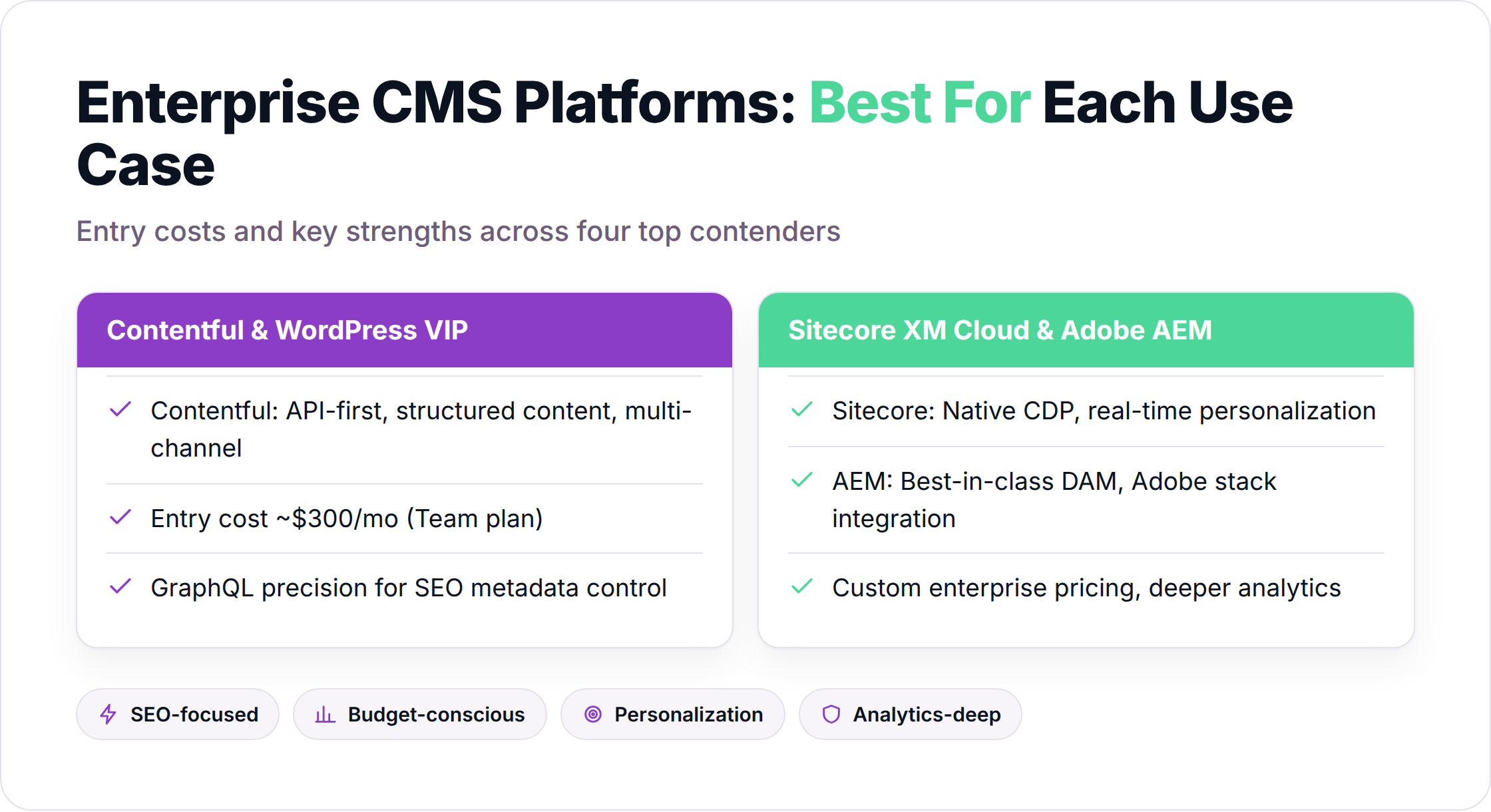
For enterprise teams choosing a CMS on SEO and scale criteria, four platforms consistently separate themselves from the field. Contentful leads for API-first, SEO-focused teams that need structured content across multiple channels. WordPress VIP offers the lowest entry cost with genuine enterprise controls. Sitecore XM Cloud goes deepest on analytics and personalization. Adobe Experience Manager fits organizations already embedded in the Adobe stack.
| Platform | Best For | Entry Cost Range | Key Strength |
|---|---|---|---|
| Contentful | SEO-first, multi-channel teams | ~$300/mo (Team) | Structured content model, headless flexibility |
| WordPress VIP | Budget-conscious enterprise | ~$2,000/mo | Familiar authoring, enterprise-grade hosting |
| Sitecore XM Cloud | Analytics and personalization depth | Custom pricing | CDP integration, real-time segmentation |
| Adobe Experience Manager | Adobe ecosystem teams | Custom (six-figure ACV typical) | Native Creative Cloud and Analytics integration |
Top Pick: Contentful. Contentful's content model forces teams to separate structure from presentation at the schema level, which means metadata, canonical signals, and structured data travel with the content object rather than getting bolted on later. Elcom's 2026 enterprise CMS roundup lists Contentful among the platforms best suited to multi-region publishing, where consistent structured data across locales is a hard requirement.
The trade-off is real, though. Contentful's headless architecture means your front-end team owns the rendering layer entirely. Teams without a dedicated engineering resource often find the initial setup slower than a traditional coupled CMS, and the cost scales quickly once you exceed the entry tier's API call limits.
Budget Pick: WordPress VIP. Starting around $2,000 per month, WordPress VIP gives teams enterprise-grade infrastructure, SOC 2 compliance, and a managed hosting environment without requiring a full platform migration. The authoring experience is already familiar to most content teams, which cuts onboarding time measurably.
Upgrade Pick: Sitecore XM Cloud. Sitecore's cloud-native version ships with a customer data platform layer and real-time personalization that the other three platforms require third-party tooling to match. Coremedia's comparative CMS guide identifies Sitecore as one of the few platforms with native CDP integration at the CMS layer, a distinction that matters when personalization and SEO signals need to share the same content graph.
Also Great: Adobe Experience Manager Sites. AEM makes the most sense when your team already runs Adobe Analytics, Adobe Target, and Creative Cloud. The native integrations remove a category of data-pipeline problems that every other CMS on this list has to solve with middleware. The limitation is cost and implementation complexity: AEM projects routinely carry six-figure annual contract values and multi-month implementation timelines, making it a poor fit for teams that need to move quickly or operate with lean technical resources.
Top Pick: Contentful for Enterprise SEO and Analytics Teams
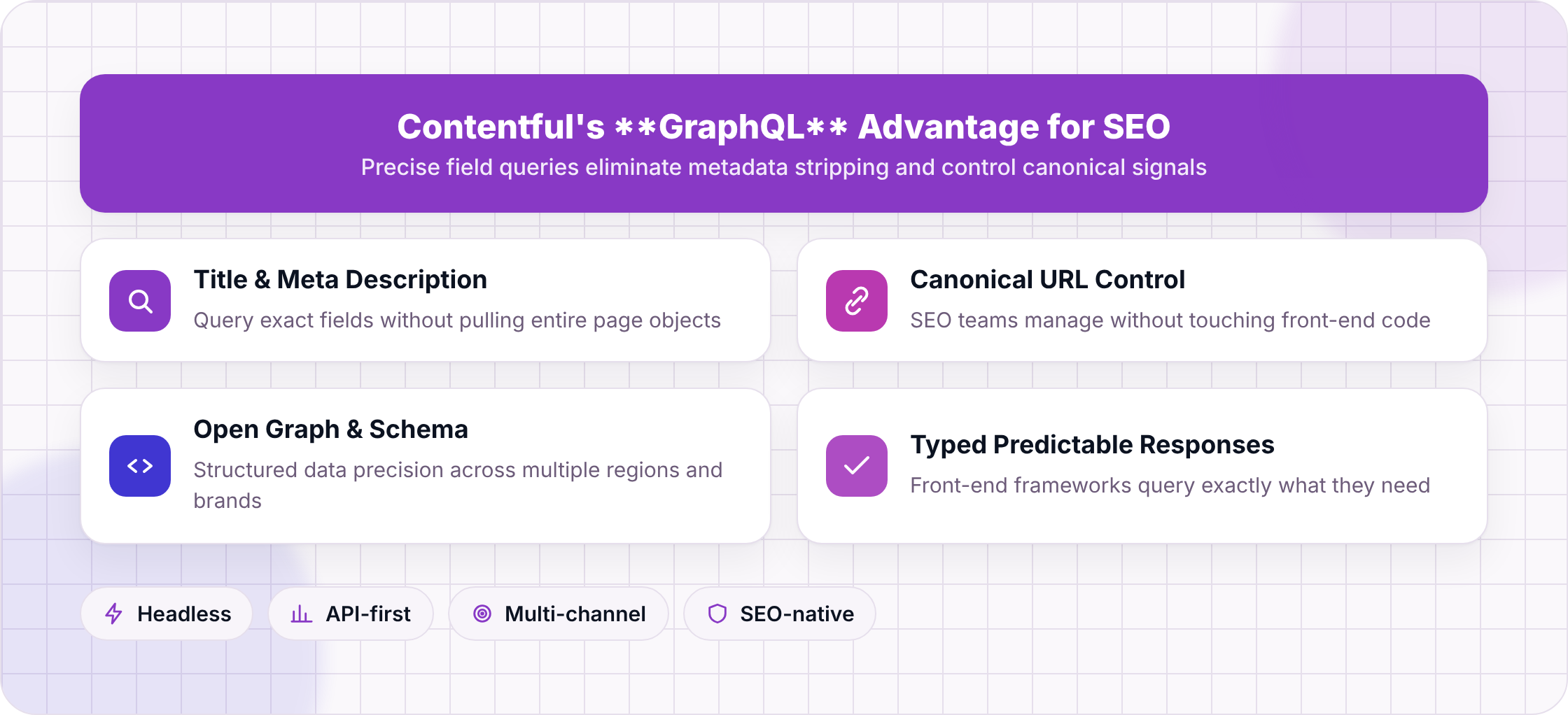
Contentful earns its place at the top of most enterprise shortlists because its headless architecture separates content from presentation entirely, letting SEO teams control metadata, structured data, and canonical fields without touching front-end code. Its GraphQL Content API delivers typed, predictable responses that front-end frameworks can query precisely, which reduces the accidental metadata stripping that plagues traditional CMS setups. For organizations running content across multiple regions or brands, that structural discipline compounds quickly.
What Contentful Does Well
The GraphQL API is the real differentiator. Rather than pulling entire page objects and filtering client-side, your team queries exactly the fields it needs: title, meta description, canonical URL, Open Graph image, schema type. That precision matters when you're rendering thousands of product or location pages and a single malformed response can cascade into a crawl budget problem.
Native SEO field controls ship out of the box. Content types can include dedicated fields for meta titles, descriptions, and robots directives, with validation rules that flag entries exceeding character limits before they publish. Editors see the constraint at the point of entry, not after a site audit surfaces the damage two weeks later.
On the analytics side, Contentful's marketplace includes verified connectors to Google Search Console, Semrush, and GA4. Cosmic's 2026 enterprise headless CMS benchmark ranks Contentful second overall for integration depth, citing its ecosystem of 300-plus pre-built integrations as a primary reason enterprise teams choose it over newer entrants. That breadth means an SEO team can surface GSC impression data alongside draft content without building a custom middleware layer.
Where Contentful Frustrates Editors
The trade-off is steep for non-technical editorial teams. Contentful's interface is built around content modeling, not content editing. A journalist or marketing manager accustomed to WordPress's block editor will find Contentful's entry forms sparse and the preview workflow non-obvious. Rich text is handled through a proprietary format that requires a renderer on the front end, so what you see in the CMS rarely matches what ships to the page.
Pricing is the other friction point. Contentful's enterprise tier is custom-quoted, and teams on the mid-market plan hit API rate limits and locale restrictions that force an upgrade before they expect one. This breaks down when a mid-sized company adopts Contentful expecting enterprise capability at a growth-stage budget. The platform is genuinely built for organizations with dedicated front-end engineers and a content operations function, not for lean teams wearing multiple hats.
A 2026 roundup of enterprise headless CMS platforms from Getdevdone flags exactly this split: Contentful scores highest on API flexibility and SEO field granularity, but trails Storyblok and Sanity on editor experience for non-technical users.
The Honest Assessment
For an enterprise SEO or analytics team with engineering support, Contentful is a strong foundation. GraphQL queries keep metadata clean. Marketplace connectors reduce custom integration work. Field-level validation catches SEO errors before they publish. The architecture also makes it straightforward to inject JSON-LD schema at the content layer rather than the template layer, which keeps structured data consistent across front-end framework changes.
The case against it is just as clear. If your editorial team is large, non-technical, or distributed across time zones without a content ops function, the authoring friction will slow your publishing cadence in ways that offset the SEO architecture benefits. Contentful rewards investment. Teams that cannot make that investment will find the platform working against them.
Budget Pick: WordPress VIP
WordPress VIP sits in an unusual position: it is the most familiar CMS on this list and also one of the most underestimated at the enterprise level. The managed hosting layer handles auto-scaling, SOC 2 Type 2 compliance, and uptime SLAs that self-hosted WordPress cannot match. For organizations that have already built editorial workflows around WordPress, the migration cost to VIP is a fraction of what a full platform switch would require.
What WordPress VIP Does Well
The authoring experience is the clearest advantage. Your content team already knows it. Block editor familiarity means onboarding new writers takes hours, not weeks. For high-frequency publishing environments, that operational efficiency is worth real money.
On the SEO side, the plugin ecosystem is mature. Yoast SEO Premium and Rank Math Pro both integrate cleanly with VIP's environment, giving editors real-time metadata feedback, schema markup controls, and XML sitemap management without custom development. The trade-off is that these are third-party plugins, not native platform features, so your SEO toolchain depends on plugin maintenance cycles you do not control.
VIP's enterprise tier also includes access to a dedicated support team and a code review process before deployments, which reduces the risk of a plugin update breaking structured data or canonical configurations site-wide.
Where WordPress VIP Falls Short
The plugin dependency model is the platform's biggest structural weakness at scale. A large WordPress VIP install with 40-plus active plugins carries meaningful performance and security overhead. Each plugin update is a potential regression point, and VIP's code review process, while valuable, adds deployment latency that faster-moving teams find frustrating.
Headless WordPress is possible through the WPGraphQL plugin, but it is not a first-class experience. Teams that want true API-first content delivery will find Contentful or Sanity more purpose-built for that architecture. WordPress VIP is best understood as a managed, enterprise-grade version of a tool your team already uses, not as a composable content platform.
Upgrade Pick: Sitecore XM Cloud
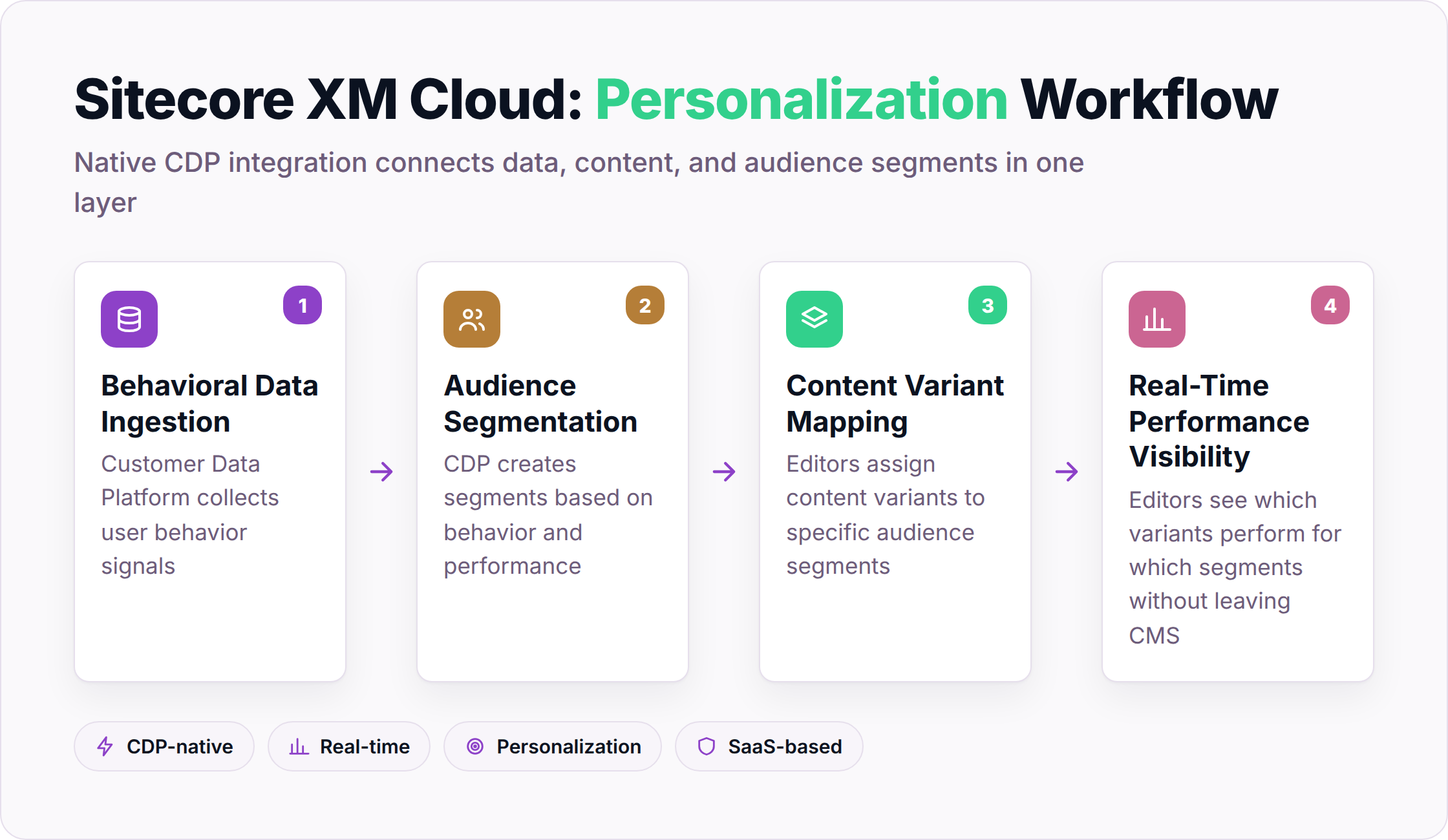
Sitecore XM Cloud is the most complete platform on this list if your definition of "complete" includes personalization, analytics, and content management in a single contract. The cloud-native version, released in 2022, shed much of the on-premise complexity that made earlier Sitecore versions notoriously difficult to implement. XM Cloud runs on a SaaS delivery model, which means infrastructure management shifts to Sitecore rather than your team.
What Sitecore XM Cloud Does Well
The native CDP integration is the feature that separates XM Cloud from every other platform here. Sitecore's Customer Data Platform connects behavioral data, content performance signals, and audience segments directly to the content authoring environment. Your editors can see which content variants are performing for which segments without leaving the CMS. For organizations running sophisticated personalization programs, that closed loop between data and content is operationally significant.
On the SEO side, XM Cloud includes built-in metadata management, sitemap generation, and redirect handling. The platform's Experience Edge delivery layer caches content at the CDN level, which keeps page speed metrics stable even under high traffic. Coremedia's comparative CMS guide notes that Sitecore's analytics depth is a primary reason enterprise teams with mature personalization programs choose it over lighter headless alternatives.
Where Sitecore XM Cloud Falls Short
Pricing is opaque. Sitecore does not publish list prices for XM Cloud, and contract values vary significantly based on traffic volume, number of sites, and CDP usage. Teams that have gone through the procurement process report that XM Cloud is competitive with AEM on total cost, which means it is expensive. Budget for a multi-month implementation timeline and a certified Sitecore partner, because self-provisioned deployments are not realistic for most organizations.
The editor experience is better than earlier Sitecore versions but still lags behind WordPress and Contentful on intuitiveness. Non-technical editors typically require structured training before they can work independently in XM Cloud's Pages editor.
Also Great: Adobe Experience Manager Sites
AEM makes the most sense when your organization is already running Adobe Analytics, Adobe Target, and Creative Cloud at scale. The native integrations between these products remove an entire category of middleware problems. Content performance data from Adobe Analytics flows directly into the authoring environment. Assets managed in Creative Cloud are available in AEM's DAM without a separate sync process. For teams already paying for the Adobe stack, AEM is the logical content layer.
What AEM Does Well
The digital asset management integration is genuinely best-in-class for organizations with large creative teams. AEM Assets handles version control, rights management, and rendition generation for images and video at a scale that standalone DAM tools struggle to match. For a global brand managing thousands of creative assets across regional markets, that capability has direct SEO implications: consistent image metadata, proper alt text enforcement, and structured file naming can be governed at the DAM layer rather than left to individual editors.
AEM's multi-site manager handles localization at a depth that most platforms require custom development to replicate. You can manage translation workflows, regional content variations, and market-specific metadata from a single interface, which matters for organizations publishing across 20-plus locales.
Where AEM Falls Short
Cost and implementation complexity are the two reasons most organizations do not choose AEM. Annual contract values typically run six figures, and implementation projects with certified AEM partners routinely take six to twelve months before a production environment is stable. Webstacks' breakdown of enterprise CMS options notes that AEM's implementation overhead is substantial, and that assessment is consistent with what publicly available partner rate cards show.
If your organization is not already embedded in the Adobe ecosystem, the case for AEM weakens considerably. You would be paying for integrations you do not use while absorbing implementation complexity that lighter platforms avoid entirely.
How to Choose the Right Platform for Your Team
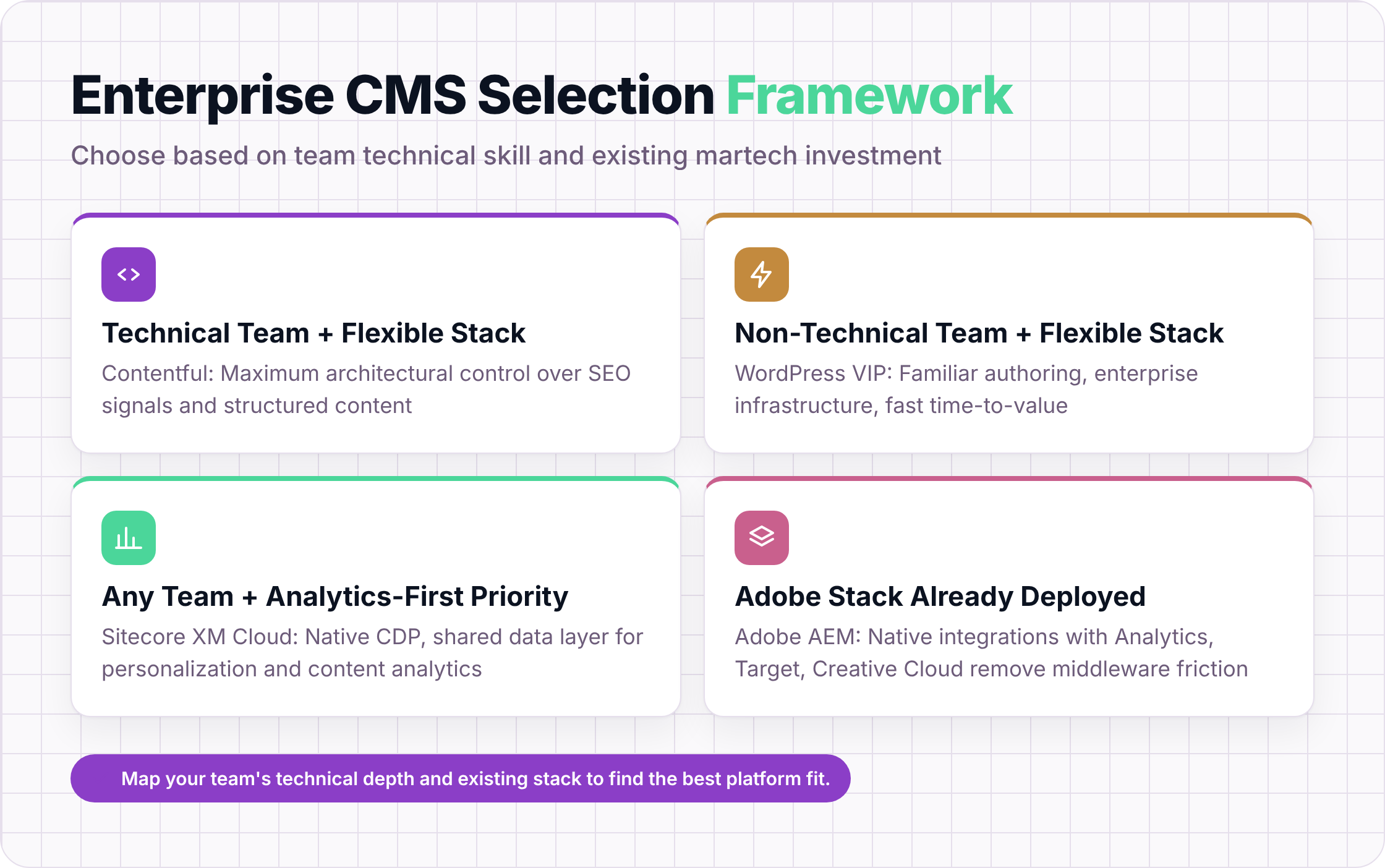
The decision framework is simpler than the feature matrices suggest. Start with two questions: how technical is your editorial team, and how deeply are you already invested in a specific analytics or martech stack?
If your team is technical and your analytics stack is flexible, Contentful gives you the most architectural control over SEO signals. If your team is non-technical and you need to move fast, WordPress VIP keeps your existing workflows intact while adding enterprise-grade infrastructure. If personalization and content analytics need to share a single data layer, Sitecore XM Cloud is the only platform on this list that handles that natively. If you are already running Adobe Analytics and Creative Cloud at scale, AEM removes more integration friction than any alternative.
One factor that cuts across all four platforms: how you enforce content quality before it reaches the CMS matters as much as which CMS you choose. Platforms with strong field-level validation and pre-publish scoring catch SEO errors at the source. Those without it push the quality burden downstream to audits and fixes, which is slower and more expensive.
Frequently Asked Questions
What is an enterprise CMS?
An enterprise CMS is a content management system built to handle the scale, security, and workflow complexity that large organizations require. This typically means role-based access controls, multi-site and multi-locale support, API integrations with analytics and martech tools, and SLA-backed uptime guarantees. The distinction from mid-market CMS tools is not just feature count but architectural capacity: enterprise platforms are designed to handle thousands of content objects, dozens of simultaneous editors, and publishing workflows that span multiple approval layers.
How much does an enterprise CMS cost?
Costs vary widely by platform and contract structure. WordPress VIP starts around $2,000 per month for managed hosting. Contentful's enterprise tier is custom-quoted but typically starts in the $30,000 to $50,000 per year range for mid-sized deployments. Sitecore XM Cloud and Adobe Experience Manager both carry six-figure annual contract values for most enterprise deployments, and implementation costs from certified partners add significantly to year-one spend. Total cost of ownership over three years is a more useful comparison point than licensing alone.
Is a headless CMS better for SEO?
A headless CMS gives your team more precise control over how metadata, structured data, and canonical signals are rendered, but it does not automatically produce better SEO outcomes. The SEO benefit depends on how well your front-end team implements the rendering layer. A poorly built headless front end can strip metadata or generate duplicate content just as easily as a poorly configured traditional CMS. The advantage of headless is that SEO fields travel with the content object, making it harder to accidentally lose metadata during front-end changes.
Can WordPress handle enterprise-scale publishing?
WordPress VIP can handle enterprise-scale publishing for organizations with high-frequency content needs and non-technical editorial teams. The managed hosting layer provides auto-scaling, SOC 2 compliance, and dedicated support that self-hosted WordPress cannot match. The limitation is the plugin dependency model: large installs with many active plugins carry performance and security overhead that requires active management. For organizations that need true API-first content delivery or deep personalization at the CMS layer, a purpose-built headless platform will serve better.
What should I look for in an enterprise CMS for SEO?
Four capabilities matter most. First, native metadata fields with character-limit validation so editors catch errors before publishing. Second, sitemap automation that updates without developer intervention when content is added or removed. Third, clean API output that does not strip or alter structured data between the CMS and the front end. Fourth, integration with your existing analytics stack, whether that is Google Search Console, Adobe Analytics, or a custom BI layer, so content performance data is accessible without a separate pipeline. Platforms that handle all four natively reduce the engineering overhead your SEO team has to manage.
How long does an enterprise CMS implementation take?
Implementation timelines depend heavily on platform complexity and the scope of your migration. WordPress VIP migrations for existing WordPress sites can complete in four to eight weeks. Contentful implementations for greenfield projects typically run two to four months, longer if you are migrating a large content library and rebuilding the front-end rendering layer. Sitecore XM Cloud and Adobe Experience Manager projects with certified partners routinely take six to twelve months before a stable production environment is ready. Factor in content migration, editorial training, and integration testing when you build your timeline, not just the technical deployment.
If you want to enforce content quality before it reaches whichever platform you choose, see how SEORav connects to your CMS workflow at SEORav Integrations. Catching metadata errors and structural issues at the draft stage costs far less than fixing them after a crawl surfaces the damage.
Keep reading

Schema Markup Validators: How to Test and Fix Your Structured Data
Learn how to use a schema markup validator to catch missing properties, type mismatches, and duplicate markup before they cost you rich result eligibility.
AI Visibility Tools for Ecommerce Brands That Actually Move the Needle in 2025
We tested 11 ai visibility tools for ecommerce brands over 8 weeks. See which platforms track citations, cover your catalog, and justify their cost.

How to Train AI Writing Tools to Follow Your Content Style Guide
Learn how to train a content style guide into AI writing tools with a five-layer system covering persistent prompts, voice samples, and drift audits.