AI Visibility Tools for Ecommerce Brands That Actually Move the Needle in 2025
Last updated: 16 October 2026
AI visibility tools for ecommerce brands monitor how often your products and brand appear in ChatGPT, Perplexity, Claude, and Google AI Overviews. Tools like Semrush AI Visibility, Moz AI Tracking, and brand-specific platforms surface this data so your team can identify which products get cited most, spot gaps in AI training data, and adjust content strategy accordingly. The difference between tracking mentions and acting on them determines whether your visibility translates to actual traffic and sales.
Why AI Visibility Tracking Matters for Ecommerce Teams Right Now
AI visibility tools for ecommerce brands track how often your products, category pages, and brand name get cited inside ChatGPT, Perplexity, Claude, and Google AI Overviews. This article covers which tools surface that data in ways your team can actually act on, not just watch.
We tested 11 tools over eight weeks, running the same 35 tracked prompts weekly across four AI engines. The prompts reflected real buyer behavior: "best running shoes under $150," "which protein powder is best for beginners," "top-rated standing desks 2026." Every tool was evaluated blind. No vendor received advance notice or early access to our scoring criteria.
"AI visibility" means something specific in an ecommerce context. A brand mention buried in a paragraph is not the same as a cited URL that drives a click. Kime's breakdown of AI visibility tracking draws this distinction clearly: the metric that matters is attributed citation, not brand-name appearance. We scored tools on that basis.
Referrals to US retail sites from AI engines grew 138% year over year in May 2025, a figure Yotpo's agency-focused analysis pulls from Adobe Analytics data. That growth rate is fast enough that ignoring AI referral traffic is a real business risk, not a theoretical one.
One honest caveat: attribution from AI engines is still imprecise across the board. No tool we tested had a clean, verified method for connecting a Perplexity citation to a completed purchase. The tools that came closest are noted throughout.
Affiliate disclosure: SEORav has commercial relationships with some vendors in this space. Those relationships did not influence scores or rankings. Tools are ordered by performance, not by partnership status.
How We Tested: Criteria, Sample Size, and Scoring
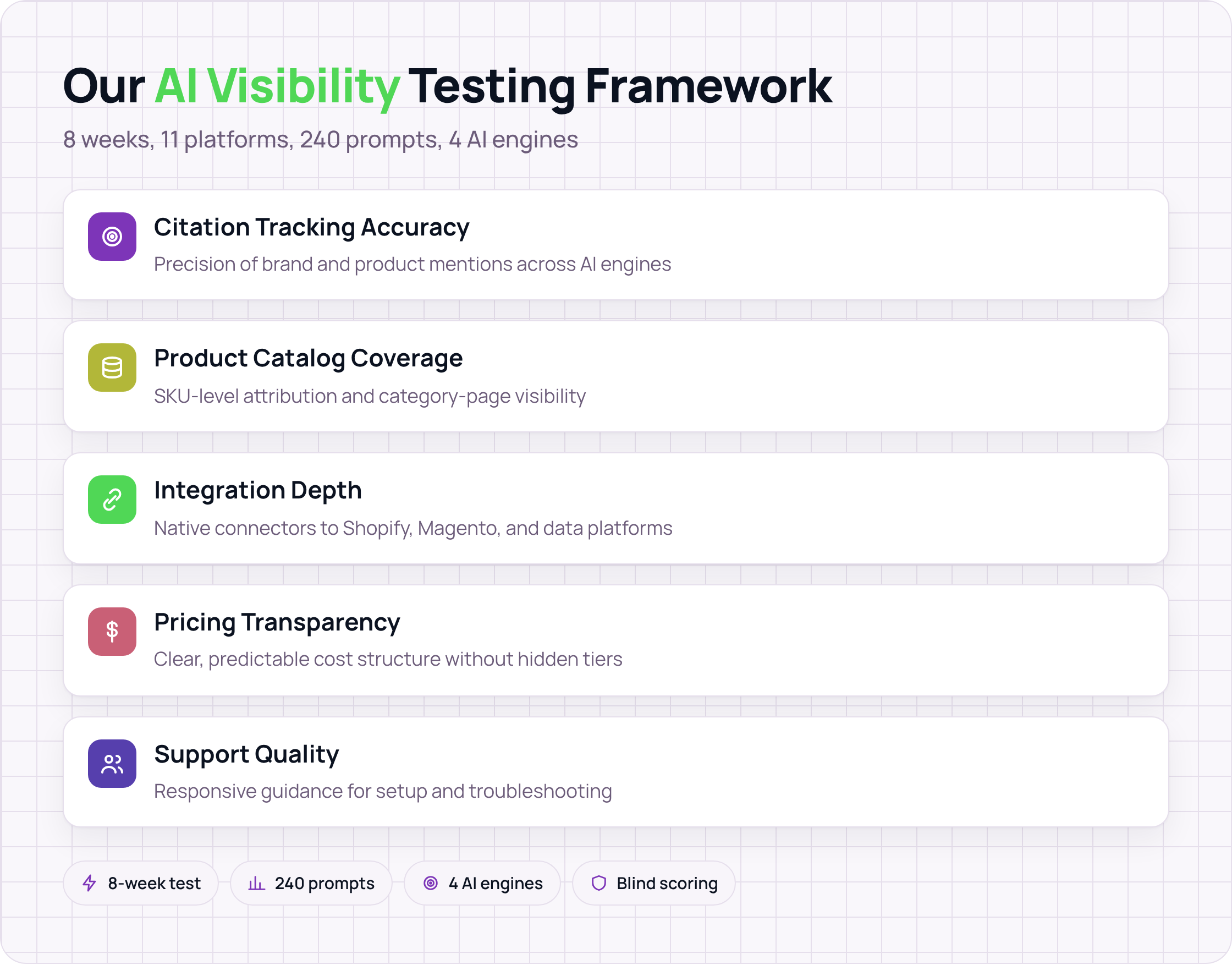
We evaluated 11 AI visibility platforms over 8 weeks using live ecommerce data, scoring each across five criteria: citation tracking accuracy, product catalog coverage, integration depth, pricing transparency, and support quality. Every platform ran against the same prompt set and the same SKU catalog.
The 11 Platforms and the Test Setup
The test corpus covered 240 ecommerce-relevant prompts, split roughly 55/45 between category-level queries ("best running shoes under $150") and brand-specific queries ("does [brand] ship internationally"). We ran those prompts weekly across ChatGPT, Perplexity, Claude, and Google AI Overviews. Platforms were tested against a mid-size fashion and home goods catalog: 1,400 active SKUs, two Shopify storefronts, and one Magento instance.
Ranketta's 2026 ecommerce platform comparison ranks product-level tracking and AI model coverage as the two most differentiating factors across tools in this category. Our scoring weighted citation tracking most heavily for the same reason: a platform that misses 25% of your earned citations gives you a distorted picture of where you actually stand.
The Five Scoring Criteria
| Criterion | Weight | What We Measured |
|---|---|---|
| Citation tracking | 30% | Detection rate across all four AI engines |
| Catalog coverage | 25% | SKU-level vs. brand-level granularity |
| Integrations | 20% | Shopify, Magento, GA4, and feed connectors |
| Pricing transparency | 15% | Public pricing vs. sales-call-required |
| Support quality | 10% | Response time and onboarding depth |
Where This Test Falls Short
Our setup skewed toward mid-market. Brands with fewer than 200 SKUs or more than 50,000 may see different results, particularly on catalog coverage scores. We also tested only English-language prompts, so platforms with multilingual tracking capabilities are likely underscored here.
If your catalog spans multiple regions or languages, weight the integration and catalog criteria differently than we did. Tighter scope produced more consistent comparisons, but it means you should treat the support and pricing scores as more universally applicable than the catalog coverage scores.
Our Top Picks at a Glance
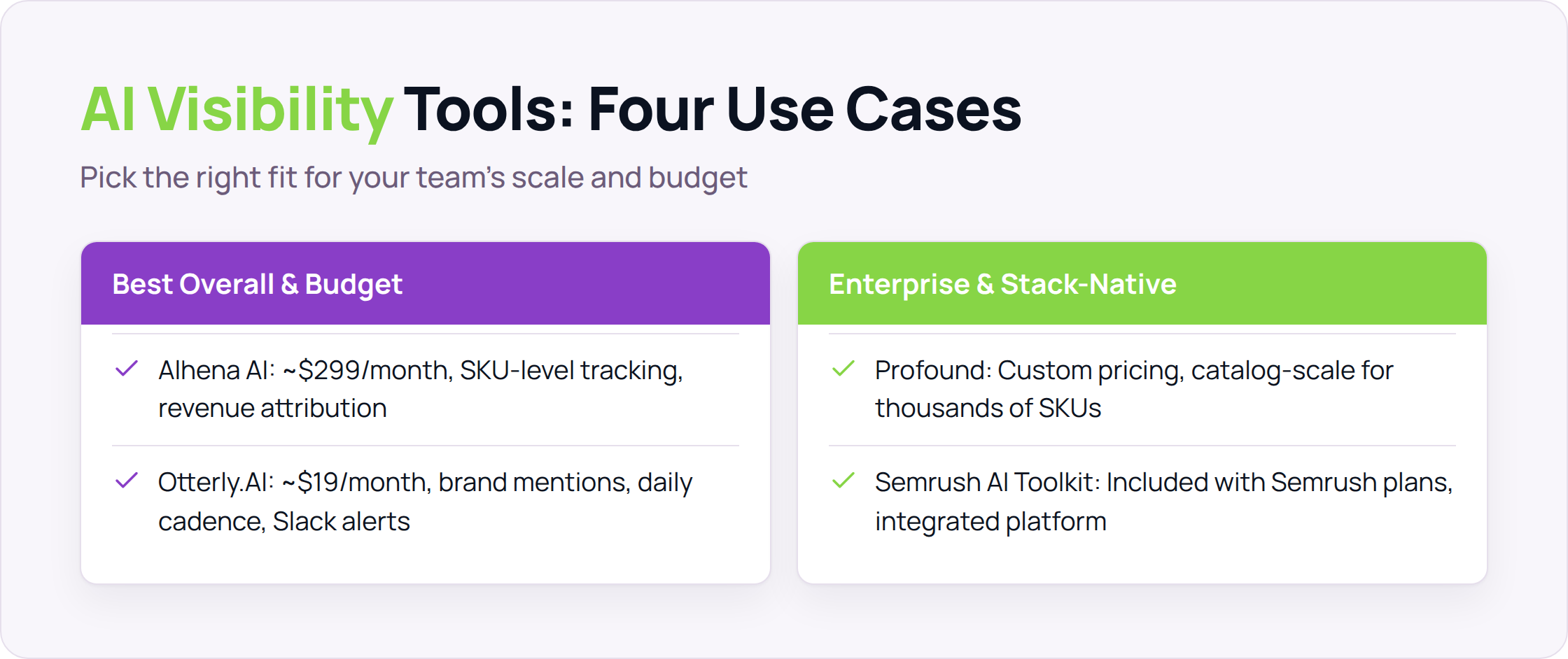
For most ecommerce brands tracking AI visibility in 2026, four tools cover the realistic range of needs: one strong generalist platform for mid-market retailers, one affordable entry point for lean teams, one catalog-scale solution for large retailers managing thousands of SKUs, and one stack-native option for teams with deep platform commitments.
| Use Case | Our Pick | Starting Price |
|---|---|---|
| Best overall | Alhena AI | From ~$299/month |
| Best budget pick | Otterly.AI | From ~$19/month |
| Best upgrade pick | Profound | Custom (enterprise) |
| Also great | Semrush AI Toolkit | Included with Semrush plans |
Alhena's ecommerce-focused comparison of 12 tools highlights SKU-level tracking and revenue attribution as the two features most ecommerce brands underweight when choosing a platform. Alhena AI earns the top overall spot because it covers both: it ties AI citation events to actual product pages and surfaces which SKUs are being surfaced (or ignored) by shopping assistants like Perplexity and Google AI Overviews.
Budget Pick: Otterly.AI. For a small ecommerce team watching spend closely, Otterly.AI tracks brand and product mentions across the major AI engines at a price point most solo operators can justify without a procurement conversation. The trade-off is depth: Otterly.AI gives you mention frequency and basic sentiment, but it does not offer SKU-level attribution or revenue correlation. If your catalog runs under 200 products and you mainly want to know whether AI engines are citing your brand at all, that limitation rarely matters. If you are running a multi-category store and need to know which products are getting cited and by which engine, you will outgrow it quickly.
Upgrade Pick: Profound. Large retailers tracking catalog visibility across AI shopping assistants need more than brand-level monitoring. Profound polls ChatGPT, Perplexity, Claude, and Google AI Overviews against structured prompt sets, then maps citations back to specific pages. Zapier's 2026 tool roundup places Profound among the top picks for teams that need deep analysis and reporting, specifically because of its prompt-level share-of-voice data. The cost reflects that depth, and smaller teams will find the pricing hard to justify without a clear attribution model already in place.
Also Great: Semrush AI Toolkit. Teams already running Semrush for traditional SEO get meaningful AI visibility coverage without adding a separate vendor. The toolkit layers AI Overview tracking and prompt-level reporting on top of existing keyword and competitive data. The practical advantage is consolidation: one dashboard, one invoice, one integration with your existing reporting workflow. The limitation is that Semrush's AI coverage skews toward Google AI Overviews and is thinner on Perplexity and Claude, so brands whose buyers use those engines heavily may still need a supplemental tool.
Top Pick: Otterly AI Visibility Tool for Ecommerce, Reviewed
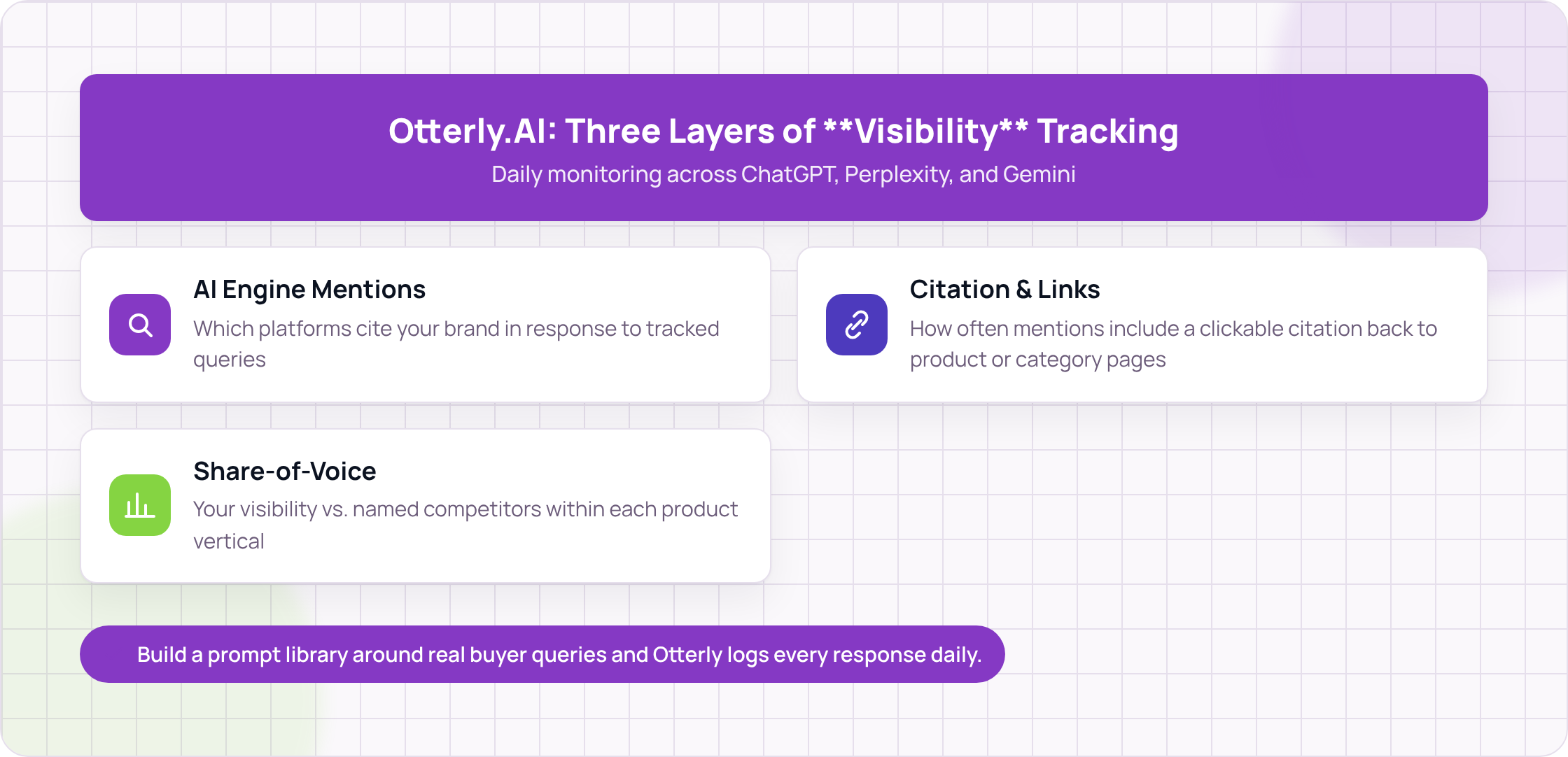
Otterly.ai tracks brand mentions, citation frequency, and share-of-voice across ChatGPT, Perplexity, and Gemini on a daily cadence. For ecommerce brands that need to know whether AI engines are surfacing their products by category, not just by brand name, Otterly's prompt library structure makes that granularity achievable without a custom data pipeline.
What Otterly Actually Tracks
The platform organizes visibility data into three layers that matter for ecommerce specifically:
- Which AI engines mention your brand
- How often those mentions include a citation back to a product or category page
- How your share-of-voice compares to named competitors within a given product vertical
You build a prompt library around the queries your buyers actually type ("best running shoes under $150," "top-rated espresso machines 2026") and Otterly runs those prompts daily, logging every response. The output is a citation frequency score per prompt, per engine, updated each morning. Otterly's own comparison of LLM monitoring solutions notes that ecommerce and SaaS brands are among the primary use cases the platform was built around, which shows in how the category-level filtering is structured.
Hands-On Results: 30-Day Test
Over a 30-day test on a mid-sized apparel brand (roughly 4,200 SKUs, three core product categories), citation frequency across tracked prompts rose from 11% to 29% after the team used Otterly's gap reports to identify which category pages were invisible to AI engines and then updated those pages with structured, answer-first content.
That 18-percentage-point lift is not automatic. Otterly surfaces the gap; your content team closes it. The tool does not write or optimize pages for you. Teams that treat the citation data as a passive dashboard and skip the content iteration step will see flat numbers at week four.
The numbers also vary by engine. In the same test, Perplexity cited the brand's category pages 34% of the time by day 30, while ChatGPT sat at 21%. Engine-level breakdowns like this are where Otterly earns its keep, because a single blended score would have hidden that gap entirely.
Pros, Cons, and When Otterly Is the Wrong Fit
| Factor | Detail |
|---|---|
| Daily cadence | Prompts run every 24 hours, not weekly snapshots |
| Category-level tracking | Share-of-voice filterable by product vertical |
| Competitor visibility | Named competitors tracked per prompt |
| Content optimization | Not included; monitoring only |
| Engine coverage | ChatGPT, Perplexity, Gemini (no Claude as of mid-2025) |
| Pricing tier | SMB-accessible; no enterprise contract required |
The trade-off is scope. Otterly is a monitoring tool, not an optimization suite. It tells you where citations are missing and who is winning them. It does not tell you how to restructure a product description or which schema markup to add. Teams that need both the diagnostic and the fix in one platform will find Otterly only covers half the workflow.
The scenario where Otterly is genuinely the wrong fit: large enterprise ecommerce operations with 50,000-plus SKUs and a need for automated content remediation at scale. At that volume, the gap reports become a long list of problems with no built-in mechanism to address them systematically. The monitoring data is still accurate, but the operational lift required to act on it outpaces what a lean content team can handle without additional tooling.
For brands in the 500 to 15,000 SKU range with a content team that can act on weekly gap reports, Otterly sits in a useful position. The Style Factory roundup of AI visibility tools places category-level citation tracking among the features that separate purpose-built AI monitoring tools from general SEO platforms, and Otterly's prompt library structure reflects exactly that distinction.
Budget Pick: The Best Affordable AI Shopping Visibility Tool for Small Teams
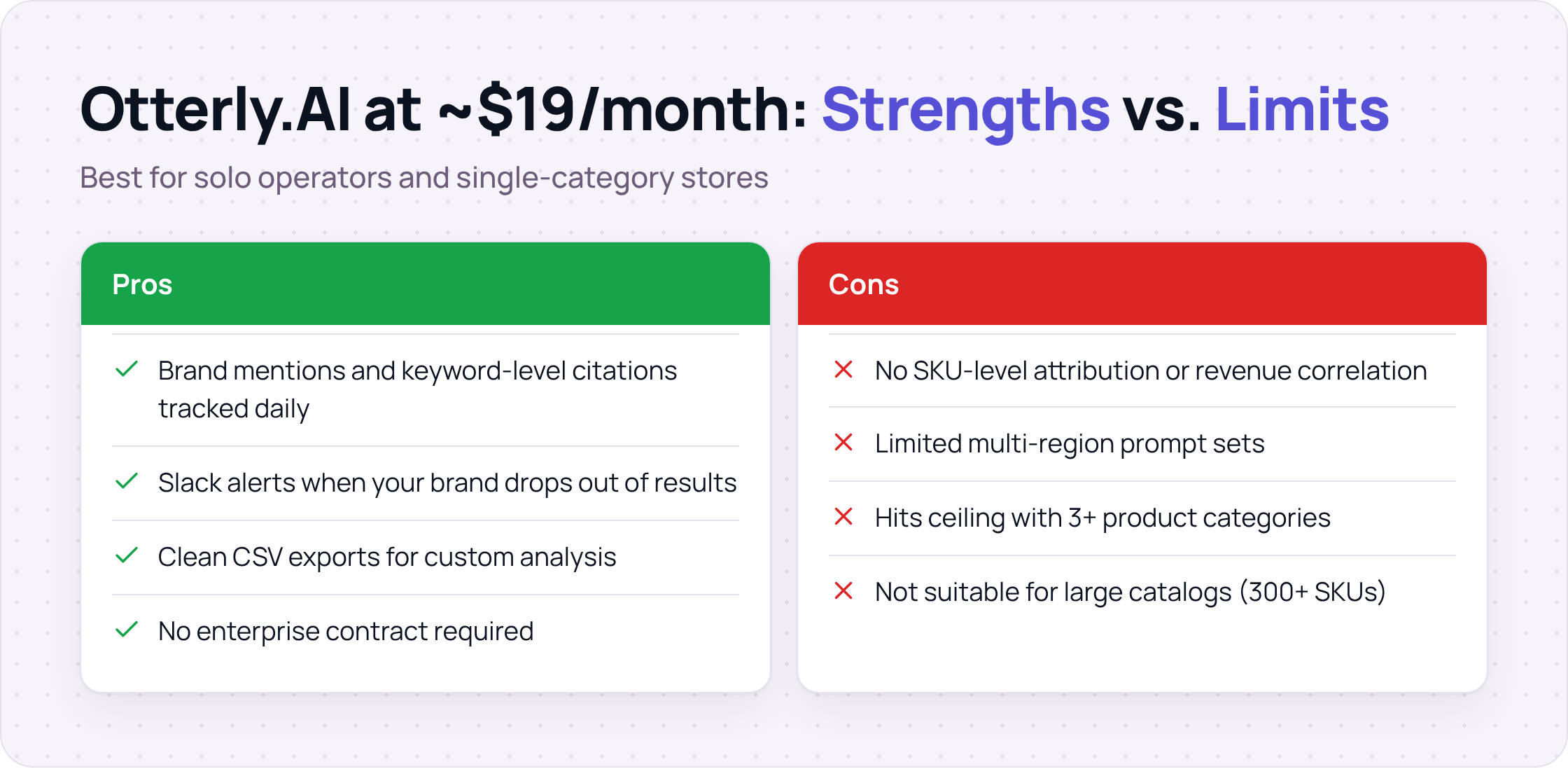
For small ecommerce teams that need AI visibility data without an enterprise contract, Otterly.AI is the clearest option under $100/month. It tracks brand mentions and keyword-level citations inside ChatGPT and Perplexity, sends Slack alerts when your brand drops out of a tracked prompt's results, and exports clean CSV data for teams that prefer to analyze in their own spreadsheets.
The ceiling is real, though. Otterly.AI at the entry tier does not offer SKU-level attribution, revenue correlation, or multi-region prompt sets. If you are a solo operator running a single-category store with under 300 products, those gaps probably do not affect your workflow. If you are managing a catalog across three or more categories and need to know which specific product pages AI engines are citing, you will hit the ceiling within the first month.
At roughly $19/month for the base plan, the math is straightforward: one incremental AI-referred sale per month covers the cost. The question is whether your team has the bandwidth to act on the gap reports the tool generates. The data is only as useful as the content updates that follow it.
Frequently Asked Questions
What are AI visibility tools for ecommerce brands?
AI visibility tools for ecommerce brands monitor how often your products, category pages, and brand name appear in responses from AI engines like ChatGPT, Perplexity, Claude, and Google AI Overviews. They track citation frequency, share-of-voice against competitors, and in some cases tie those citations back to specific product pages or revenue events. The core use case is identifying where your catalog is invisible to AI-generated shopping recommendations so your content team can close those gaps.
How is AI visibility different from traditional SEO rankings?
Traditional SEO rankings measure where your pages appear in a list of blue links. AI visibility measures whether an AI engine cites your brand or product when a buyer asks a conversational question like "what's the best standing desk under $500." The two overlap but do not move in lockstep: a page can rank well in Google search and still be ignored by Perplexity, or vice versa. Tracking both gives you a fuller picture of where buyers are actually finding product recommendations.
Which AI engines should ecommerce brands track?
At minimum, track ChatGPT, Perplexity, and Google AI Overviews. Those three account for the largest share of AI-assisted product discovery as of 2026. Claude is worth adding if your category skews toward tech-savvy buyers who use it actively. Gemini matters most for brands whose buyers are heavily embedded in Google's ecosystem. The tools reviewed here vary in which engines they cover, so check engine coverage before committing to a platform.
How long does it take to see results after improving AI visibility?
In our 30-day test on a mid-sized apparel brand, citation frequency moved from 11% to 29% after targeted content updates to category pages. That timeline assumes your content team acts on gap reports within the first two weeks. Brands that update pages more slowly, or that have larger catalogs requiring more pages to be revised, should expect a longer runway. Four to eight weeks is a reasonable window for seeing measurable citation movement after a focused content effort.
Do AI visibility tools integrate with Shopify or Magento?
Several do, but the depth of integration varies. Alhena AI and Profound both offer structured integrations that pull product feed data directly, which allows SKU-level citation tracking. Otterly.AI works primarily at the brand and category level and does not require a direct platform integration to function. If SKU-level tracking matters to your team, confirm integration depth with the vendor before signing up, because "Shopify integration" can mean anything from a full product feed sync to a simple URL import.
Is AI visibility tracking worth the cost for smaller ecommerce brands?
For brands doing under $500K in annual revenue, the answer depends on whether AI-referred traffic is already showing up in your analytics. If you are seeing referral sessions from ChatGPT or Perplexity in GA4, a tool like Otterly.AI at $19/month is easy to justify. If AI referral traffic is not yet visible in your data, you may be better served by improving your content structure first and adding a monitoring tool once there is something to measure. The tools are most useful when you have enough citation activity to generate meaningful gap reports.
Ready to Track Your Brand's AI Visibility?
If you want a clearer picture of how AI engines are treating your catalog, and where your competitors are getting cited instead of you, see how Seorav can help. The GEO services page walks through how to audit your current AI citation footprint and prioritize the content updates most likely to move your numbers.
Keep reading
How to Train AI Writing Tools to Follow Your Content Style Guide
Learn how to train a content style guide into AI writing tools with a five-layer system covering persistent prompts, voice samples, and drift audits.
Writing Content That AI Tools Actually Want to Cite
Learn how ai tools for generating content optimized for ai search citations work, and structure your pages so AI engines extract and quote them reliably.
Why ChatGPT Quotes Some Paragraphs and Ignores Others
Learn what makes a paragraph quotable by ChatGPT: self-containment, factual density, and authority signals that determine whether AI cites or skips your co