When to Refresh Your Content for AI Search Engines
Last updated: 28 October 2026
Most pages benefit from quarterly content updates for AI search, though high-stakes topics like pricing, AI tools, and regulatory guidance warrant monthly reviews. Research tracking AI citation patterns found that over 70% of pages cited by AI engines had been updated within 12 months, with more than 50% refreshed within six months. The frequency that works depends on how quickly your topic changes and how often AI systems encounter your content.
"Update frequency" is not a single dial you set once. The right cadence depends on topic volatility, how often AI engines are surfacing your category, and whether your page is already getting cited or sitting invisible. This article covers four things: how to think about refresh cycles by content type, which signals tell you a page needs attention now, how to prioritize when you have more pages than time, and how to measure whether an update actually moved the needle.
Key Takeaways
Content refresh decisions for AI search follow four principles: monitor citation signals weekly, prioritize pages with factual decay over thin traffic, schedule high-priority updates every 8 to 12 weeks, and track AI citation rate as a distinct metric from organic click-through. Recency is now a ranking input, not a bonus.
- Cadence: High-priority pages covering statistics, comparisons, and how-to guides need a refresh cycle of 8 to 12 weeks with updated data points and revised publication dates. Lower-stakes evergreen content can run on a 6-month cycle without meaningful citation loss.
- Signals: Watch for factual decay first: outdated statistics, superseded product versions, or broken citations. These are the triggers AI engines penalize fastest.
- Prioritization: About 49% of US adults now use AI chatbots for information retrieval, per a February 2026 Pew survey reported by Reporter Outreach. Pages that answer the queries those users type deserve the first refresh slot.
- Measurement: Track AI citation rate separately from organic traffic. The two metrics diverge, and optimizing only for clicks will cause you to miss citation losses entirely.
One trade-off worth naming upfront: aggressive refresh cycles work well for data-heavy content but can introduce instability on pages where AI engines have already built a citation pattern around a specific passage. Rewriting too heavily resets that signal. Targeted updates, not full rewrites, are usually the safer move.
Why Update Frequency Matters for AI Search Visibility
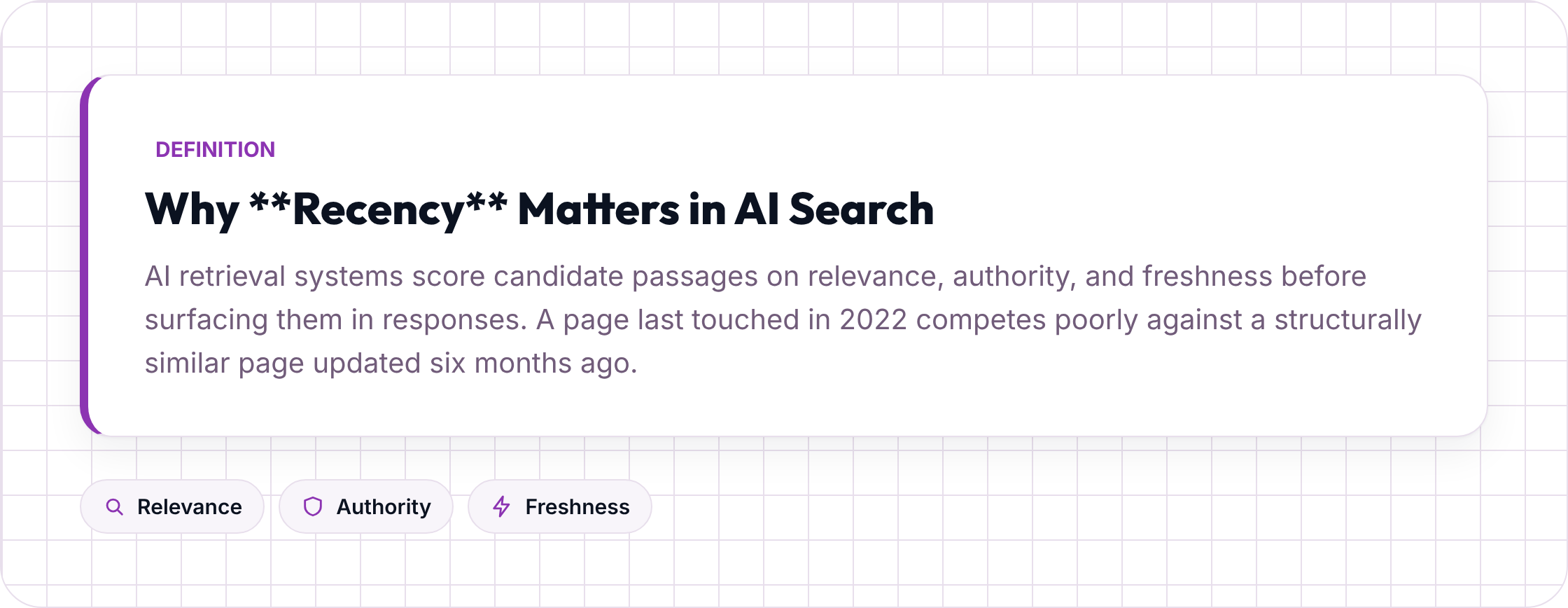
AI search engines prioritize recently updated content because their retrieval systems are built to surface accurate, current information. When Perplexity, ChatGPT, or Gemini pull sources into a response, recency is one of the signals that filters which pages make the cut. Pages that go stale, with outdated statistics or superseded claims, lose citation eligibility faster than most content teams expect.
How LLMs Like Perplexity and ChatGPT Weight Recency in Source Selection
These models do not read your page the way a human editor does. They retrieve chunks of text through a retrieval-augmented generation (RAG) pipeline, and that pipeline scores candidate passages on relevance, authority, and freshness before any text gets surfaced in a response. A page last touched in 2022 competes poorly against a structurally similar page updated six months ago, even if the older page has more backlinks.
The numbers are pointed here. Pages not updated at least once per quarter are three times more likely to lose their AI citations entirely, based on research Quattr published in 2026. That is a steep penalty for what is often a fixable problem.
The Crawl-to-Citation Pipeline: From Googlebot to RAG Retrieval
The path from a published page to an AI citation runs through several gates. Googlebot (or another crawler) indexes the updated content, that index feeds into the training data or live retrieval layer the AI engine uses, and the RAG system then scores your passage against competing sources at query time.
Each gate introduces lag. A content update published today may take days to be re-crawled, longer to propagate into a retrieval index, and even longer to displace a previously cached passage inside a model's context window. Citation frequency, the rate at which AI systems reference your content in responses to relevant queries, is the downstream metric that reflects whether you have cleared all three gates successfully.
One Trade-Off Worth Knowing: Freshness vs. Topical Authority Depth
Aggressive update cycles can fragment the depth that makes a page authoritative in the first place. A piece that gets rewritten every eight weeks to chase freshness signals may never accumulate the dense, specific coverage that AI engines reward when a query requires a comprehensive answer. Thin updates, swapping a date or one statistic, do not help much either. Models are increasingly good at detecting cosmetic refreshes versus substantive revisions.
Update cadence should match query type. Discovered Labs' analysis of crawl patterns found that "best" comparison keywords require meaningful updates roughly every 400 days, while rate-based or pricing content averages closer to 496 days before staleness becomes a citation liability. For genuinely time-sensitive categories, pricing, platform features, and regulatory topics, a review every six to nine months is a practical floor, not a ceiling.
The practical approach: treat evergreen depth as the foundation and schedule targeted updates to the sections most likely to go stale, specifically statistics, product references, and dated examples. That preserves authority while keeping the freshness signal alive.
How Often to Update Content for AI Search: Cadence by Content Type
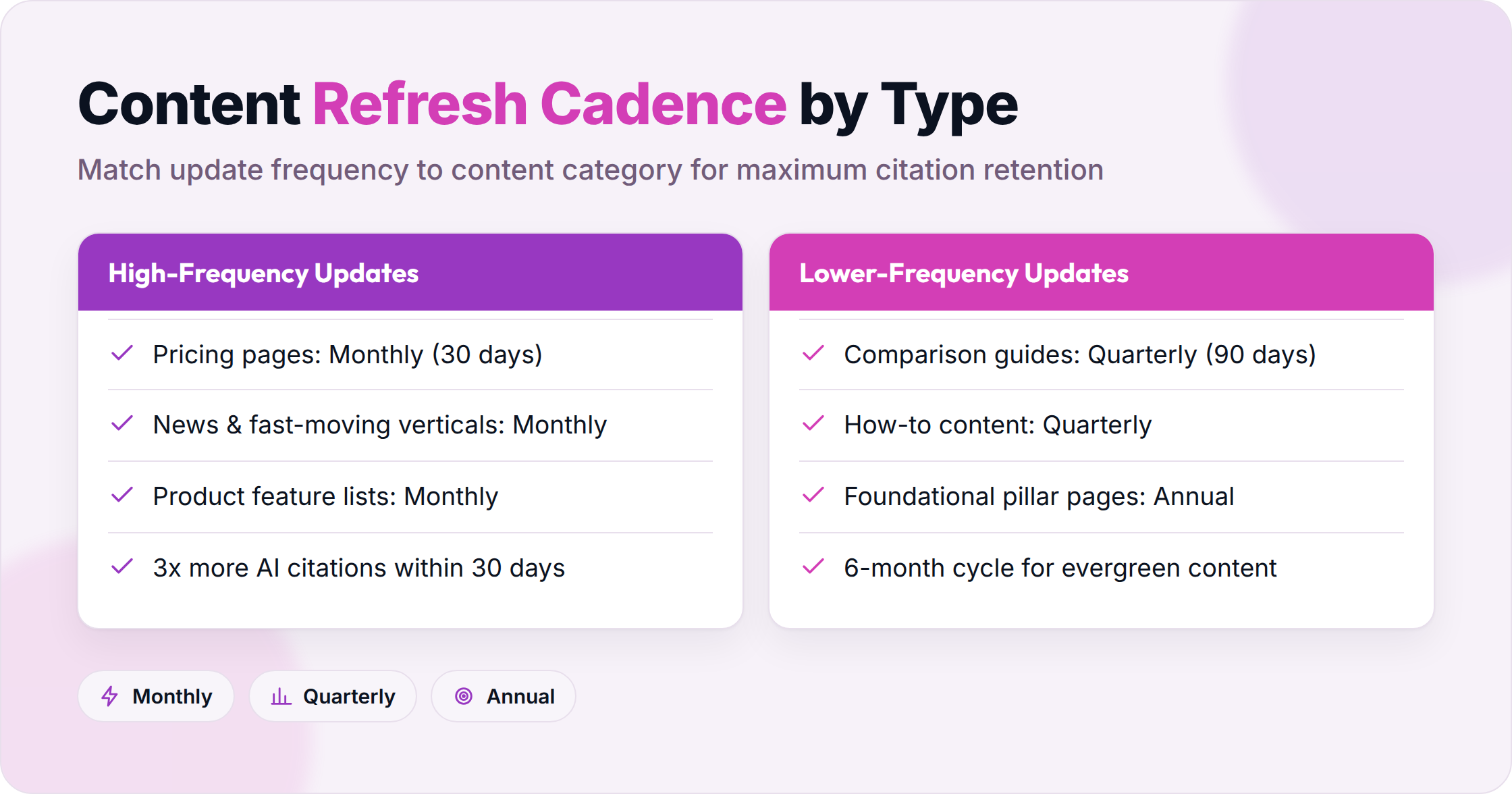
The right refresh cadence depends on content type, not a single universal rule. Product and pricing pages need monthly attention. Comparison guides and how-to content hold up for a quarter before citations start slipping. Foundational pillar pages can run on an annual deep rewrite, provided the core structure and brand voice stay consistent throughout. Matching cadence to content type is where most teams recover lost citation share.
Monthly Cadence: News, Pricing Pages, and Fast-Moving Verticals
Pages updated within 30 days receive 3x more AI citations than pages older than 90 days, which creates a practical 13-week shelf life for anything time-sensitive. Pricing pages, product feature lists, and news-adjacent content fall squarely into this bucket. A pricing page that still shows last year's tiers is not just outdated, it actively signals neglect to the retrieval layer.
For fast-moving verticals like cybersecurity, fintech regulation, or AI tooling, monthly is the floor. The goal each pass is narrow: update figures, replace deprecated references, and confirm that any claims still hold. A full rewrite every month is unnecessary and expensive.
Quarterly Cadence: Evergreen How-To Content and Comparison Pages
How-to guides and comparison pages sit in a more forgiving window. The defensible cadence for evergreen guides and pillar content is 60 to 90 days for high-priority commercial pages, with six months as an outer limit for lower-traffic evergreen material.
Quarterly reviews work well here because the underlying information shifts slowly, but the competitive landscape around it does not. A comparison page that was accurate in January may be missing a new competitor by April. Each quarterly pass should check three things: statistics that may have been superseded, tool or product references that have changed, and any date-specific claims that now read as stale.
The trade-off is real, though. Quarterly refreshes require editorial bandwidth that smaller teams often do not have. If you have to choose, prioritize pages that already rank in AI citation pools over pages that have never been cited. Refreshing a page with zero citation history rarely produces the same return as maintaining one that already gets pulled.
Annual Deep Rewrites: Foundational Pillar Pages and Brand Voice Consistency
Pillar pages covering broad, stable topics, think "what is X" or "complete guide to Y," do not need quarterly rewrites. What they do need is a structured annual pass that goes deeper than a statistics update. This means revisiting the argument structure, checking that the page still reflects how your brand writes and positions itself, and confirming that internal links point to current content rather than deprecated pages.
The numbers from Ziptie's content refresh strategy analysis support this: product pages monthly, blog posts quarterly, and all content at minimum annually. The annual threshold is a floor, not a target. If a pillar page is actively cited by AI engines, treat it like a quarterly asset until citation rates plateau.
Brand voice consistency matters more on pillar pages than anywhere else. These are the pages AI engines are most likely to extract extended passages from. If the voice drifts between the original author and whoever ran the last refresh, the page reads as inconsistent, and inconsistency is a quiet citation killer.
Signals That Trigger AI Engine Re-Indexing
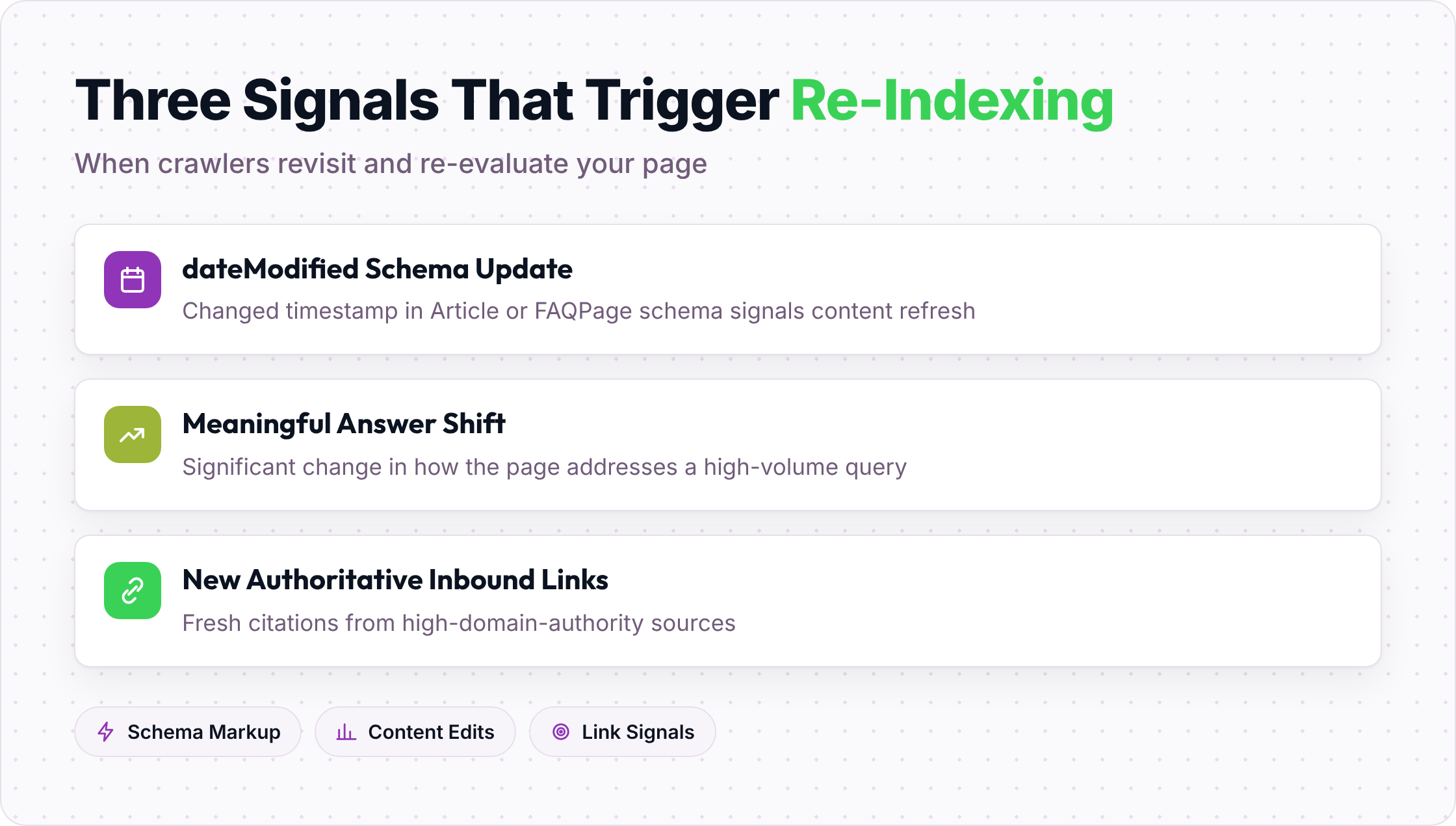
Three signals most reliably prompt AI engines to re-evaluate a page: a changed dateModified timestamp in structured data, a meaningful shift in the page's answer to a high-volume query, and new inbound links from authoritative domains. When any of these change, crawlers tend to revisit faster. The practical implication is that small, targeted edits tied to schema updates often do more for AI citation frequency than full rewrites.
Structured Data Changes That Prompt Faster Recrawl
Schema markup is one of the clearest signals a page can send to a crawler. When you update dateModified in your Article or FAQPage schema, you are telling the retrieval pipeline that the content has changed since the last visit. That timestamp, combined with a genuine content edit, is what separates a meaningful refresh from a cosmetic one.
Quarterly schema audits are a practical baseline: check that statistics, external links, and markup stay accurate and current. The trade-off is that updating schema without updating the underlying content can backfire. AI engines that retrieve a page and find stale facts behind a fresh timestamp will deprioritize it in future citation pools. The signal has to be honest.
What Query Fan-Out Means for Which Pages Get Pulled Into LLM Answers
Query fan-out is the process by which an LLM expands a single user prompt into multiple sub-queries before assembling an answer. A question like "how often should I refresh content for AI search" might fan out into sub-queries about crawl frequency, schema freshness, and citation signals. Each sub-query pulls from a different retrieval pool.
This matters for page structure. A page that answers only the top-level question may get skipped in favor of one that addresses two or three of the sub-queries explicitly. Gartner predicted in early 2024 that traditional search engine volume would drop 25% by 2026 as AI chatbots absorbed query share. Pages structured to satisfy multiple related sub-queries, not just the headline question, are better positioned to survive that shift.
How to Prioritize When You Have More Pages Than Time
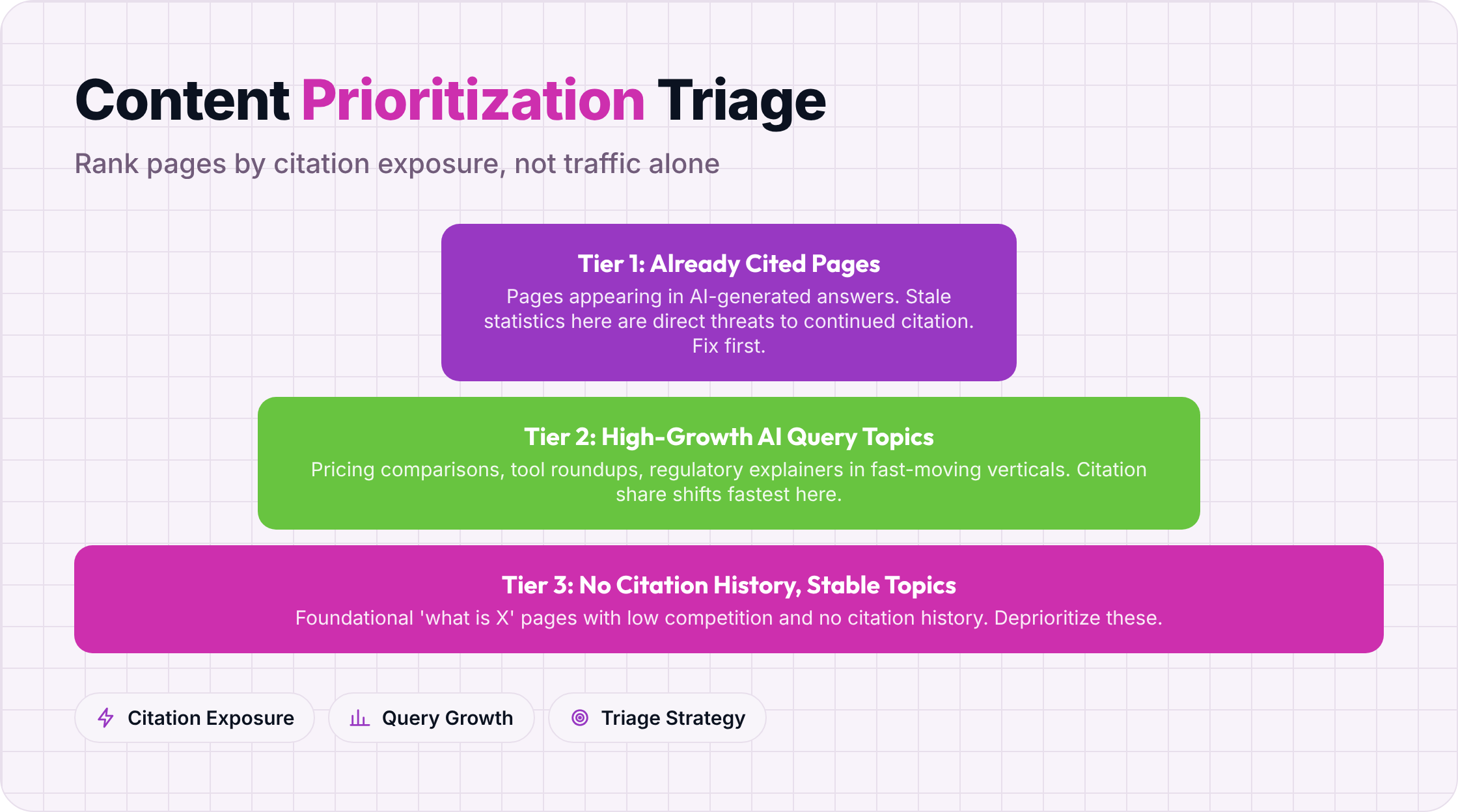
Most content teams cannot refresh everything on an ideal schedule. The practical answer is triage: rank pages by citation exposure, not by traffic alone.
Start with pages that already appear in AI-generated answers. A page getting cited has proven retrieval eligibility, and a stale statistic on that page is a direct threat to continued citation. Fix those first.
Next, look at pages covering topics where AI chatbot query volume is growing. Pricing comparisons, tool roundups, and regulatory explainers in fast-moving verticals are the categories where citation share shifts fastest. A page that was not cited six months ago may be in active competition now.
Finally, deprioritize pages with no citation history and stable, low-competition topics. Spending bandwidth on a foundational "what is X" page that has never been cited, when a pricing comparison page is losing citation share, is the wrong order of operations.
How to Measure Whether a Content Update Actually Worked
Organic traffic is a lagging and incomplete signal for AI search performance. A page can lose AI citation share while holding steady in traditional rankings, because the two systems pull from overlapping but distinct signals.
The metric to track directly is AI citation rate: how often your page appears as a source in AI-generated responses to relevant queries. Tools like Profound, Otterly, or AirOps can monitor this at scale. Set a baseline before any update, then measure again at 30 and 60 days post-refresh.
Secondary signals worth watching: changes in branded query volume (users who saw your page cited may search for you by name), shifts in referral traffic from AI-adjacent platforms, and changes in the specific passages AI engines quote from your page. If the quoted passage shifts to a section you recently updated, the retrieval layer noticed.
One honest limitation: attribution is imperfect. AI engines do not always surface citations visibly, and some citation activity happens in zero-click responses where no referral traffic follows. You are measuring a proxy, not the thing itself. That is a real constraint, and any team claiming perfect AI citation measurement is overstating what the current tooling can do.
Frequently Asked Questions
How often should I update blog posts for AI search?
Most blog posts benefit from a quarterly review, roughly every 60 to 90 days for posts covering competitive or data-heavy topics. Posts on stable, low-competition subjects can run on a six-month cycle without significant citation loss. The trigger for an earlier refresh is factual decay: a statistic that has been superseded, a tool reference that is now outdated, or a claim that a newer source contradicts.
Does changing the publish date without editing content help AI rankings?
No. AI retrieval systems are increasingly good at detecting cosmetic updates. Changing a publish date or dateModified timestamp without making substantive edits to the content itself can actually backfire, because a crawler that revisits the page and finds unchanged facts behind a fresh timestamp learns to discount your freshness signals. The timestamp needs to reflect a real change.
What counts as a "meaningful" content update for AI engines?
A meaningful update adds, corrects, or replaces information that changes the factual substance of the page. Updating a statistic with a newer figure, adding a section that addresses a related sub-query, replacing a deprecated product reference, or correcting a claim that has since been contradicted all qualify. Fixing typos, adjusting formatting, or swapping synonyms do not. The test is whether a reader who saw the old version would learn something new from the updated one.
Should I prioritize pages with high traffic or high AI citation potential?
Prioritize pages with existing AI citation activity first, regardless of traffic volume. A page already being cited by AI engines has proven retrieval eligibility, and protecting that citation is higher-value than refreshing a high-traffic page that has never appeared in an AI-generated answer. After covering cited pages, move to pages covering topics where AI query volume is growing fastest in your category.
How do I know if my content is being cited by AI engines?
Tools like Profound, Otterly, and AirOps track AI citation frequency by running queries relevant to your content and checking whether your page appears as a source. You can also run manual spot-checks in Perplexity or ChatGPT by searching for queries your page targets and reviewing the cited sources. Neither method is perfectly comprehensive, but together they give you a workable signal. Set a baseline before any refresh so you have something to measure against.
Does content length affect how often I need to update?
Longer, more comprehensive pages tend to hold citation eligibility longer because they cover more sub-queries and are harder for a single competitor to displace entirely. A 3,000-word pillar page covering a topic from multiple angles has more retrieval surface area than a 600-word post. That said, length without accuracy is a liability. A long page with one stale statistic in a prominent position can lose citation on that sub-query even if the rest of the page is current.
If you want a clearer picture of where your content stands in AI search right now, visit Seorav's GEO service page to see how they approach citation tracking and content refresh strategy for generative engine optimization. Getting the cadence right is easier when you can see which pages are already in the retrieval pool and which ones have drifted out.
Keep reading
How AI Search Is Changing the Business of News Publishing
AI search is cutting news publisher traffic by 35% or more. See how citation-without-click works, which content survives, and what the licensing deals actu
How to Measure Your Brand's LLM Citation Share Across AI Search Engines
Learn how to measure LLM citation share across ChatGPT, Perplexity, and Gemini with a step-by-step tracking system, prompt library, and scoring method.
Structuring Content So AI Systems Actually Retrieve and Cite It
Learn how to structure content for RAG retrieval using semantic chunking, HowTo schema, and answer-first headings that AI systems actually cite.