How AI Search Is Changing the Business of News Publishing
Last updated: 27 October 2026
AI search engines answer questions directly in results, citing news sources but sending no traffic. Publishers lose referral visits even when their reporting appears in AI responses. This citation without clicks undermines the advertising and subscription revenue models that sustained newsrooms for decades. The shift forces publishers to choose between optimizing for AI visibility, building direct audience relationships, or both, each with different resource demands and uncertain payoffs.
The numbers are stark. NiemanLab's reporting on search-to-publisher referrals shows traffic from Google to news sites dropped sharply over the past year, with Chartbeat's annual publisher playbook confirming the trend across hundreds of outlets. AI summaries have lowered click-through rates by roughly 35%, and traditional search volume is projected to fall another 25% within the next year, per state library research tracking the behavioral shift.
News content gets hit harder than product reviews or how-to guides because breaking news and explainers are exactly the format AI engines synthesize most efficiently. A recipe or a software tutorial still benefits from the user visiting the full page. A summary of a court ruling does not.
One honest caveat: not every publisher is losing at the same rate. Outlets with strong direct traffic, email lists, or paywalled depth are more insulated. The pain concentrates on ad-supported sites that built their model around search volume.
How AI Search Affects News Publishers: The Traffic Collapse in Detail
News publishers began losing meaningful Google referral traffic in 2024 not because their rankings fell, but because AI engines started answering queries directly. Outlets tracking referral data noticed the pattern first in breaking news coverage, where AI summaries absorbed reader intent before a click ever happened.
The Atlantic and similar editorial outlets flagged the shift through a specific anomaly: impressions held steady or even rose, but click-through rates compressed to near zero on certain query types. The story was not a ranking collapse. The rankings looked fine. The problem was that being cited by an AI engine and receiving a visit from a reader had quietly become two separate outcomes.
Query fan-out makes this worse for news than for almost any other content category. When an LLM processes a breaking news query, it pulls fragments from dozens of sources simultaneously, synthesizes them, and returns a single answer. No single outlet gets the referral. Evergreen content has a slightly different exposure: a well-structured explainer on Federal Reserve policy can earn repeated citations over months. Breaking news gets consumed once, in aggregate, and the traffic never materializes. New data from Mediacopilot shows some publishers have lost over 90% of clicks from search since 2024, with news-heavy properties hit hardest.
The citation-without-click problem is the structural break that took publishers longest to name. A newsroom could watch its content appear in an AI Overview or a ChatGPT response, confirm the citation was accurate, and still record zero sessions from that surface. Media leaders now project a 43% drop in traffic over the next three years, a figure circulating among senior publishing executives as the working assumption for budget planning.
Publishers who have restructured content toward evergreen depth and clear factual claims do report more stable citation rates from AI engines. However, that stability does not automatically translate to revenue. A citation in Perplexity or Claude does not carry a display ad impression with it. The business model built on pageview volume has no direct equivalent in the AI referral layer, and no one has solved that conversion gap yet. Opting out of crawler access is one lever, but Nieman Lab's reporting on the opt-out debate makes the cost explicit: block the AI bots and you also disappear from traditional search results. For most newsrooms, that trade is not viable.
Where News Readers Are Going Instead
AI answer engines are absorbing the middle of the news funnel. Readers who once clicked through to a publisher's article to get a quick fact, a definition, or a brief summary now receive that answer directly inside ChatGPT, Perplexity, or Google's AI Overviews. What reaches publisher sites is a narrower slice: readers with deeper intent, or readers who already know the brand. The referral layer in between is thinning fast.
The Reuters Institute's annual Trends and Predictions survey found that publishers expect to lose over 40% of their search-referred traffic as AI Overviews and AI Mode reshape how readers interact with search results. For many mid-size news operations, that figure is already a baseline, not a worst-case projection.
How AI Answer Engines Absorb the Middle Funnel
The traditional funnel had a predictable shape. A reader searched for something, Google surfaced a headline, the reader clicked, the publisher got a session. AI answer engines collapse step three. The reader gets a synthesized response, the publisher's reporting may have fed that response, and no click happens.
This hits specific content types hardest. Explainers, definition pieces, and "what is X" articles built around a single answerable question are the most vulnerable. Retrieval-augmented generation (RAG) systems extract the core answer from those pages and surface it inline. The article itself never loads.
Formats that survive RAG retrieval tend to share a few traits: original data the model cannot synthesize from elsewhere, named sources with direct quotes, or analysis that requires reading the full piece to be useful. A 600-word explainer on how interest rates work gets summarized away. A 1,200-word piece with an exclusive interview and proprietary survey data is harder to replace with a generated paragraph.
Index Exchange research from 2026 points to high-quality news as a resilient category within this shift, precisely because original reporting carries signals that AI engines cannot replicate from aggregated training data alone. "Resilient" does not mean "unaffected," though. Even publishers with strong original reporting are seeing referral volume compress, because AI engines cite the fact and not always the full article.
Why Google SGE and LLM Citation Logic Diverge
Most SEOs treating Google's AI Overviews and LLM citation behavior as the same optimization problem are working from a flawed assumption. SGE (Search Generative Experience) still operates within Google's index and ranking infrastructure. It tends to pull from pages that already rank in the top positions for a query, so traditional authority signals, backlinks, E-E-A-T, and structured data still carry weight.
LLM citation logic in tools like Perplexity or ChatGPT Search works differently. These systems retrieve from a broader corpus and weight for extractability: can the model pull a clean, self-contained answer from this page? A page that ranks first on Google because of its domain authority may score poorly in LLM retrieval if the key claim is buried in paragraph seven, wrapped in hedging language, or split across multiple sections without a clear topic sentence.
SparkToro's traffic analysis found that AI tools currently send less than 1% of all outbound traffic, even as more than 20% of Americans now use an AI tool ten or more times per month. The gap between usage and referral is the structural problem. High engagement with AI engines does not translate into publisher sessions at anything close to the rate that Google search historically did.
The practical implication: optimizing for SGE and optimizing for LLM citation require different structural choices. SGE rewards authority and topical depth. LLM retrieval rewards answer-first structure, named attribution, and claims specific enough to be quoted verbatim. You can do both, but only if your content team understands they are solving two distinct problems, not one.
Citation vs. Click-Through: The New Economics of AI-Driven News
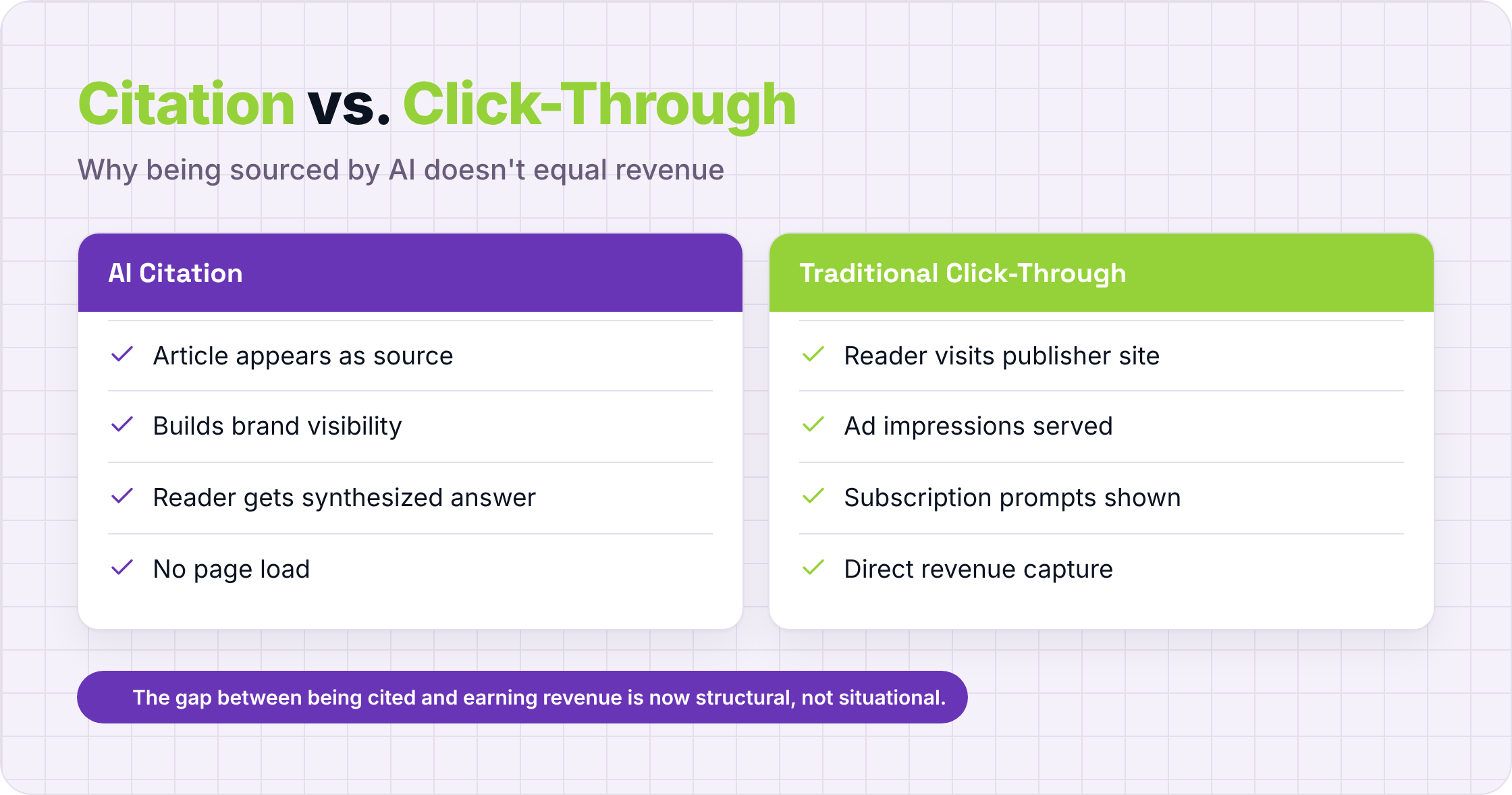
Being cited by an AI engine and earning revenue from that citation are two separate events, and publishers are learning the hard way that the gap between them is wide. When Perplexity or ChatGPT surfaces a news article as a source, the reader typically gets the synthesized answer and moves on. No page load, no ad impression, no subscription prompt. The citation builds brand visibility; it does not replace the CPM.
Pew Research found that Google users were measurably less likely to click through to source links when an AI summary appeared on the results page, compared to pages without one. Extrapolate that behavior to AI-native search engines where the summary is the entire interface, and the click deficit becomes structural, not situational.
This is what pushed major publishers toward licensing. The AP and News Corp both signed content agreements with AI companies, and the terms matter. These deals are not traffic-sharing arrangements. They are wholesale content licenses: the AI company pays for the right to train on or retrieve from a publisher's archive, and the publisher receives a flat or tiered fee rather than per-impression revenue. The AP's agreement with OpenAI, announced in 2023, covers access to its text archive and real-time wire content. News Corp's deal with OpenAI, signed in 2024, reportedly spans the Wall Street Journal, the Times, and the Sun. Neither agreement has published per-article rates, but the structure is closer to a syndication contract than an ad network.
Licensing fees are predictable, but they are also fixed. A publisher that signs a flat annual deal and then triples its output gets no additional compensation. Smaller outlets with strong local expertise but limited archive depth are unlikely to attract licensing interest at all, which means the economics of AI citation may consolidate further toward large legacy brands.
On the optimization side, E-E-A-T (Experience, Expertise, Authoritativeness, Trustworthiness) and LLM retrieval signals overlap more than they diverge, but not completely. Both reward named authors with verifiable credentials, primary sourcing, and factual precision. A 2025 study documented in an arXiv preprint found that AI search engines cite incorrect news sources 60% of the time, with accuracy varying sharply by engine. That figure suggests LLMs are not simply inheriting Google's authority rankings wholesale. They are running their own retrieval logic, and that logic can misfire in ways that E-E-A-T compliance alone does not prevent.
Where the two frameworks diverge most visibly is structure. Google's E-E-A-T evaluation is largely document-level: it asks whether a page, as a whole, signals expertise. LLM retrieval is passage-level: it asks whether a specific paragraph contains a clean, extractable answer. A publisher can have excellent E-E-A-T signals and still get bypassed at the passage level if the writing buries the lede, hedges every claim, or structures answers as narratives rather than direct statements.
FAQ
Does AI search actually reduce traffic to news sites?
Yes, and the data is consistent across multiple sources. Mediacopilot's 2024 analysis found some news-heavy publishers lost over 90% of clicks from search, while Pew Research confirmed that the presence of an AI summary on a Google results page measurably reduces click-through rates compared to pages without one.
Which types of news content are most at risk from AI search?
Short explainers, definition pieces, and articles built around a single answerable question face the highest exposure. Retrieval-augmented generation systems extract the core answer from those pages and surface it inline, so the article itself never loads. Original reporting with exclusive data, named sources, and direct quotes is harder for AI engines to replace with a generated paragraph.
Can news publishers get paid when AI engines cite their content?
A few large publishers have negotiated licensing deals, including the AP and News Corp, both of which signed agreements with OpenAI. These are flat or tiered fees for archive and retrieval access, not per-citation payments. Most publishers, especially smaller regional outlets, have no licensing arrangement in place and receive no direct compensation when their reporting feeds an AI-generated answer.
Should publishers block AI crawlers?
Blocking AI crawlers removes your content from AI retrieval, but it also risks reducing your visibility in traditional search results, since some AI crawler infrastructure overlaps with standard indexing. Nieman Lab's 2026 reporting on the opt-out debate lays out this trade-off clearly. For most ad-supported newsrooms, disappearing from both surfaces simultaneously is not a workable option.
What content formats hold up best in AI search?
Formats that require reading the full piece to extract value tend to survive better. That includes long-form investigations with proprietary data, interviews with named sources and direct quotes, and analysis pieces where the conclusion depends on the argument built across the full article. A 600-word summary of a policy change is far more vulnerable than a 2,000-word piece with original survey data and on-record sources.
How is LLM citation different from Google ranking?
Google ranking is document-level: it evaluates the page as a whole using signals like backlinks, domain authority, and E-E-A-T. LLM citation is passage-level: the model looks for a specific paragraph that contains a clean, self-contained, extractable answer. A page can rank first on Google and still get bypassed by an LLM if the key claim is buried deep in the article or written in a way that resists direct quotation.
If you want to understand exactly how your publication is positioned for AI search visibility, visit Seorav's GEO service page to see how generative engine optimization applies to your specific content and traffic situation.
Keep reading
How to Measure Your Brand's LLM Citation Share Across AI Search Engines
Learn how to measure LLM citation share across ChatGPT, Perplexity, and Gemini with a step-by-step tracking system, prompt library, and scoring method.
Structuring Content So AI Systems Actually Retrieve and Cite It
Learn how to structure content for RAG retrieval using semantic chunking, HowTo schema, and answer-first headings that AI systems actually cite.
How to Track Your Brand Mentions Across AI Search Engines
Learn how to track brand mentions in AI search across ChatGPT, Perplexity, Claude, and Gemini. Manual methods, tool comparisons, and gap-closing tactics in