Structuring Content So AI Systems Actually Retrieve and Cite It
Last updated: 25 October 2026
Structure content for RAG retrieval by setting explicit chunk boundaries around semantic units, embedding metadata that systems can parse without guessing, and using headers that clarify scope and topic. Most RAG pipelines fail not because they lack data but because pages lack these signals, causing retrievers to skip relevant sections or pull fragments too small to cite. Getting these three elements right transforms your content from invisible to reliably retrievable.
The numbers behind that claim are concrete. Retrieval accuracy drops roughly 40% when documents lack clear semantic boundaries, according to Stanford NLP research on how chunking quality affects embedding-based retrieval. The mechanism is simple: a retrieval model scores candidate chunks against a query, and a chunk that blends two topics scores weakly on both. Databricks' RAG workflow guide documents the same pattern at the data-ingestion stage, noting that poorly delimited text consistently degrades downstream retrieval precision.
One honest caveat: restructuring alone does not guarantee citation. AI engines also weigh domain authority, recency, and how closely your content matches query intent. Structure is a prerequisite, not a shortcut.
Work through each step here and you will finish with a repeatable editing checklist: chunk boundaries mapped to heading hierarchy, metadata fields populated for retrieval context, and answer-first openings that let systems like ChatGPT or Perplexity extract a citable passage without reading the full page. SEORav's content scoring layer checks several of these signals before an article ships, but the structural logic applies regardless of what tooling you use.
Before You Start: What You Need
To restructure content for AI retrieval, you need three things in place: at least one published or draft page you can edit, a working grasp of HTML heading hierarchy and schema markup, and access to a crawl tool that can audit your current structure. Without all three, the changes you make are guesswork.
Content Assets
Start with a real page, not a hypothetical one. It can be a published post, a product page, or a detailed draft sitting in your CMS. AI retrieval systems index and rank existing content, not intentions, so you need something concrete to restructure.
A page that has already accumulated some crawl history is preferable because you can measure before and after. The trade-off worth naming: heavily trafficked pages carry risk. Restructuring headings and adding schema on a page that drives significant organic traffic can temporarily disrupt rankings while search crawlers re-process the changes. If that concerns you, start with a secondary page, validate the approach, then roll it out to higher-stakes URLs.
Technical Baseline
You need a functional understanding of HTML heading hierarchy (H1 through H3 at minimum) and how JSON-LD schema blocks are structured. You do not need to be a developer. You do need to know that an H2 signals a major sub-topic to a crawler, and that a poorly nested heading structure actively confuses both search engines and the retrieval layer that AI systems use to parse documents.
The retriever and generator modules in a RAG pipeline depend on clean document structure to identify which passages are relevant to a query, as a 2025 Springer survey of retrieval-augmented generation details. Schema markup is the other half of this baseline. FAQPage, Article, and HowTo are the three schema types most directly relevant to AI citation optimization. If you have never written a JSON-LD block before, spend 30 minutes with Google's Rich Results documentation before continuing.
Crawl and Audit Access
You need a tool that can crawl your site and surface heading structure, missing schema, and internal link gaps. Screaming Frog's free tier handles up to 500 URLs and exports heading data by page, which is enough to audit most small sites. Ahrefs Site Audit covers the same ground with additional context on page authority and link equity.
What does not work is auditing by hand. A 50-page site has enough structural variation that manual review will miss patterns a crawler catches in minutes. One practical note: crawl tools show you what exists, not what AI engines have already indexed or cited. Treat the crawl audit as your structural baseline, not your citation report.
Step 1: Understand Why RAG Systems Care About Content Structure
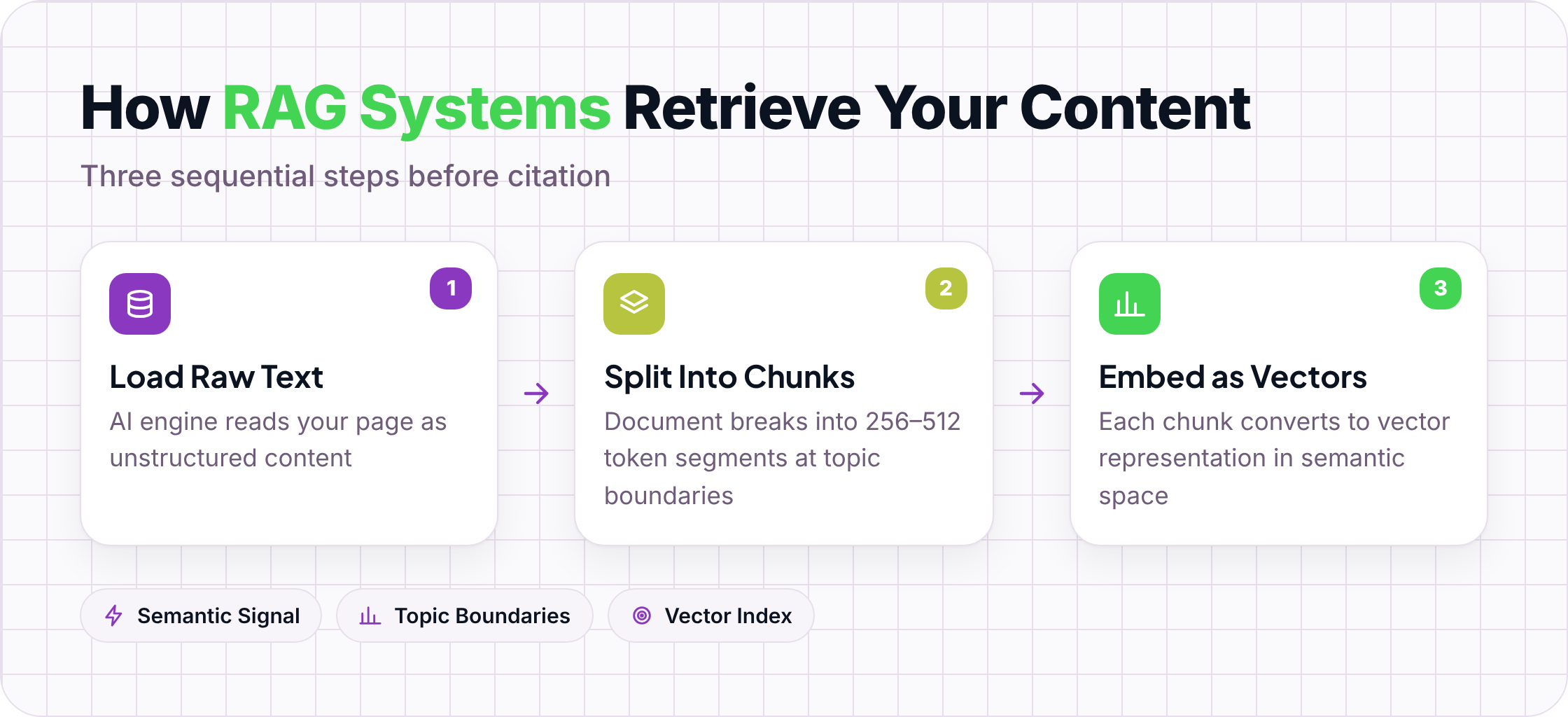
RAG systems retrieve content by splitting documents into small chunks, embedding each chunk as a vector, and pulling the chunks whose embeddings sit closest to the query vector. A page that mixes five topics in one section dilutes every chunk's semantic signal, making it less likely to surface for any single query. Structure is not a formatting preference. It is the mechanism by which your content gets retrieved at all.
How Chunking Works Before Your Content Reaches the Model
Before an AI engine can cite your page, it has to process it. The LaunchDarkly RAG pipeline walkthrough breaks this into three sequential steps: load the raw text, split it into chunks, then embed each chunk into a vector index. Most pipelines use fixed-size chunking (commonly 256 to 512 tokens) or paragraph-boundary chunking. Either way, the chunk is the unit of retrieval, not the page.
This has a direct consequence for writers. A 1,200-word section that covers product pricing, onboarding steps, and competitive positioning in one unbroken block will get sliced arbitrarily. The resulting chunks each carry fragments of three different topics, and none of them will score well on cosine similarity for any specific query.
The Density Problem: Mixed Topics, Weak Signals
Cosine similarity measures the angle between two vectors. A chunk about "enterprise SaaS pricing tiers" will score high against a query about pricing and low against a query about onboarding. That is the system working correctly. The problem appears when a single chunk contains both topics: the embedding lands somewhere between the two, scoring moderately on each and winning neither.
A 2025 survey on RAG architectures published on arXiv notes that retrieval quality depends directly on how well the retrieved passage aligns with the query's semantic intent, not just keyword overlap. A dense, multi-topic section produces an embedding that aligns weakly with almost everything.
The practical fix is one idea per section, with a heading that names that idea explicitly. Headings are often preserved as chunk metadata, which gives the retriever a second signal beyond the embedding itself.
How Google SGE and LLM Search Select Passages, Not Pages
Google's Search Generative Experience and tools like Perplexity do not rank your page and then read it. They run what researchers call query fan-out: the original query gets decomposed into several sub-queries, each retrieving its own set of candidate passages. The winning passages get stitched into a synthesized answer.
The implication is significant. A page that ranks first in traditional search can still contribute zero passages to an AI-generated answer if its sections are too broad to match any specific sub-query cleanly. A page ranked fifth that has tight, single-topic sections can contribute three separate passages to the same answer.
The trade-off is real. Writing one idea per section can make long-form content feel fragmented if the ideas are genuinely interdependent. A technical tutorial where step 3 only makes sense after step 2 should not be split into isolated chunks just to satisfy a retrieval pipeline. In those cases, explicit cross-references within the prose ("this builds on the authentication setup from the previous section") help the model reconstruct context even when chunks arrive separately. Forcing artificial separation on content with genuine logical dependencies will hurt the reader without meaningfully improving retrieval.
Step 2: Apply Semantic Chunking to Your Page Structure
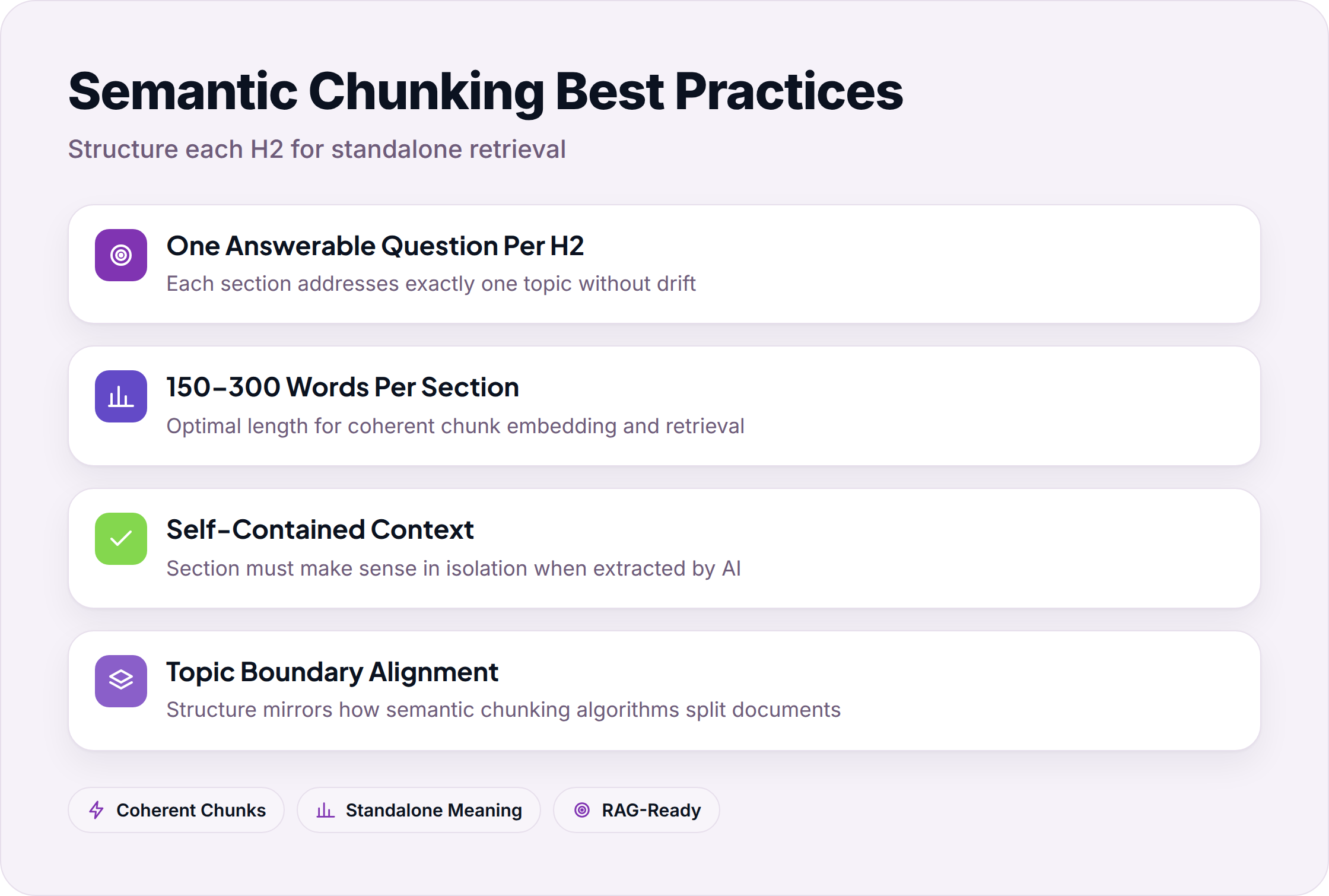
Semantic chunking means organizing your page so each H2 section addresses exactly one answerable question, contains roughly 150 to 300 words, and can be extracted by a retrieval system without losing its meaning. When an LLM pulls a chunk from your page, it gets that block in isolation. If the block depends on surrounding context to make sense, the retrieved passage becomes incoherent and gets passed over in favor of a self-contained competitor source.
Map Each H2 to a Single Answerable Question
The practical test: write the question your H2 answers at the top of a blank document, then write only content that answers it. If you find yourself drifting into a second question, that is a new section.
This mirrors how RAG systems actually split documents. Semantic chunking splits at topic boundaries using embedding similarity, meaning a section that blends two concepts will get cut at an arbitrary point, likely mid-argument. The chunk that surfaces in a query response will be incomplete.
A useful benchmark: each discrete concept block should sit between 150 and 300 words. Below 150, there is rarely enough semantic signal for the embedding to score well against a real query. Above 300, the chunk starts covering multiple sub-topics and dilutes its own relevance score.
Specificity Over Padding
Vague filler text actively hurts retrieval performance. A sentence like "there are many factors to consider" contributes near-zero semantic signal and pulls the chunk's embedding away from the specific query terms you want to match.
The numbers support cutting aggressively. Agenta's chunking strategy benchmarks show that semantic chunking consistently outperforms fixed-size splitting on retrieval precision, largely because it keeps topically coherent content together rather than padding chunks to hit an arbitrary token count.
Name the mechanism. Name the number. Name the version. "Cosine similarity scores above 0.85 typically clear the retrieval threshold in most production RAG pipelines" is citable. "High similarity scores help your content get found" is not.
Where This Approach Breaks Down
Strict one-idea-per-section structure can fragment content that genuinely requires sequential reasoning. A tutorial where Step 3 only makes sense after Step 2 will suffer if each step gets retrieved independently. In those cases, include a brief self-contained summary at the top of each step so the chunk can stand alone even when the surrounding steps are absent. The structure still holds. It just requires a small amount of deliberate redundancy built in at the section level.
Step 3: Add Metadata and Structured Data That AI Parsers Read First
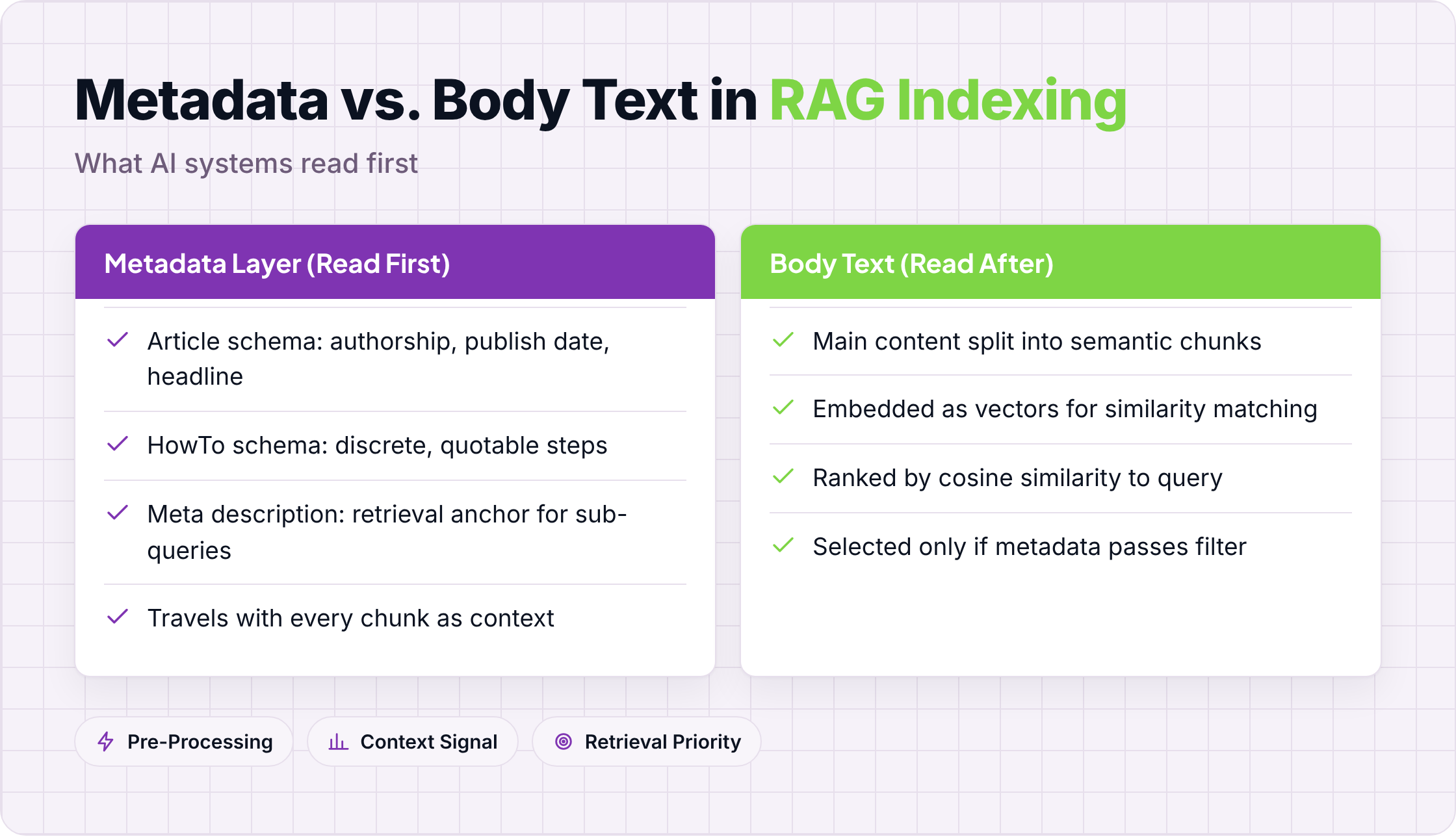
Structured data and metadata are the first layer AI retrieval systems read, often before they process a single word of body text. Article schema communicates authorship, publish date, and headline. HowTo schema breaks procedural content into discrete, quotable steps. A meta description written to match a specific sub-query acts as a retrieval anchor. Together, these signals raise the probability that an LLM selects your content over a competitor's when constructing an answer.
Article and HowTo Schema: What RAG Crawlers Extract Before Body Text
When a RAG pipeline indexes a page, it parses document metadata before chunking the body. The Galileo AI data processing framework identifies metadata enrichment as a distinct pre-processing stage, separate from chunking, because metadata fields like datePublished, author, and headline travel with every chunk as context the retriever can filter on.
For editorial content, implement Article schema with at minimum these fields populated: headline, author, datePublished, dateModified, and description. For procedural content like tutorials or guides, HowTo schema is more precise. Each HowToStep element becomes a discrete, quotable unit that retrieval systems can extract independently. A step written as "Install the dependency by running npm install rag-client in your project root" is far more retrievable than "install the required packages."
FAQPage Schema: Turning Questions Into Citable Passages
FAQPage schema is one of the highest-leverage structured data types for AI citation because it maps directly to the question-answer format that LLMs use when constructing responses. Each Question and acceptedAnswer pair in your schema becomes a self-contained retrieval unit.
Write each answer as if it will be read in isolation, because it will be. Keep answers between 40 and 60 words. Shorter than 40 words and the semantic signal is thin. Longer than 60 and you risk the answer spanning multiple sub-topics, which dilutes the embedding. Validate your schema implementation with Google's Rich Results Test before publishing. Malformed JSON-LD is invisible to both search crawlers and RAG indexers.
Meta Descriptions as Retrieval Anchors
Most teams treat meta descriptions as an afterthought. For AI retrieval, they function as a compressed summary that some pipelines use to pre-filter pages before chunking the body. A meta description that matches the phrasing of a likely sub-query increases the probability your page enters the candidate set at all.
Write your meta description to answer one specific question in 150 characters or fewer. "Learn how to structure content for RAG retrieval using semantic chunking, HowTo schema, and answer-first headings" is a retrieval anchor. "We help businesses grow with great content" is not.
Step 4: Write Answer-First Openings for Every Section
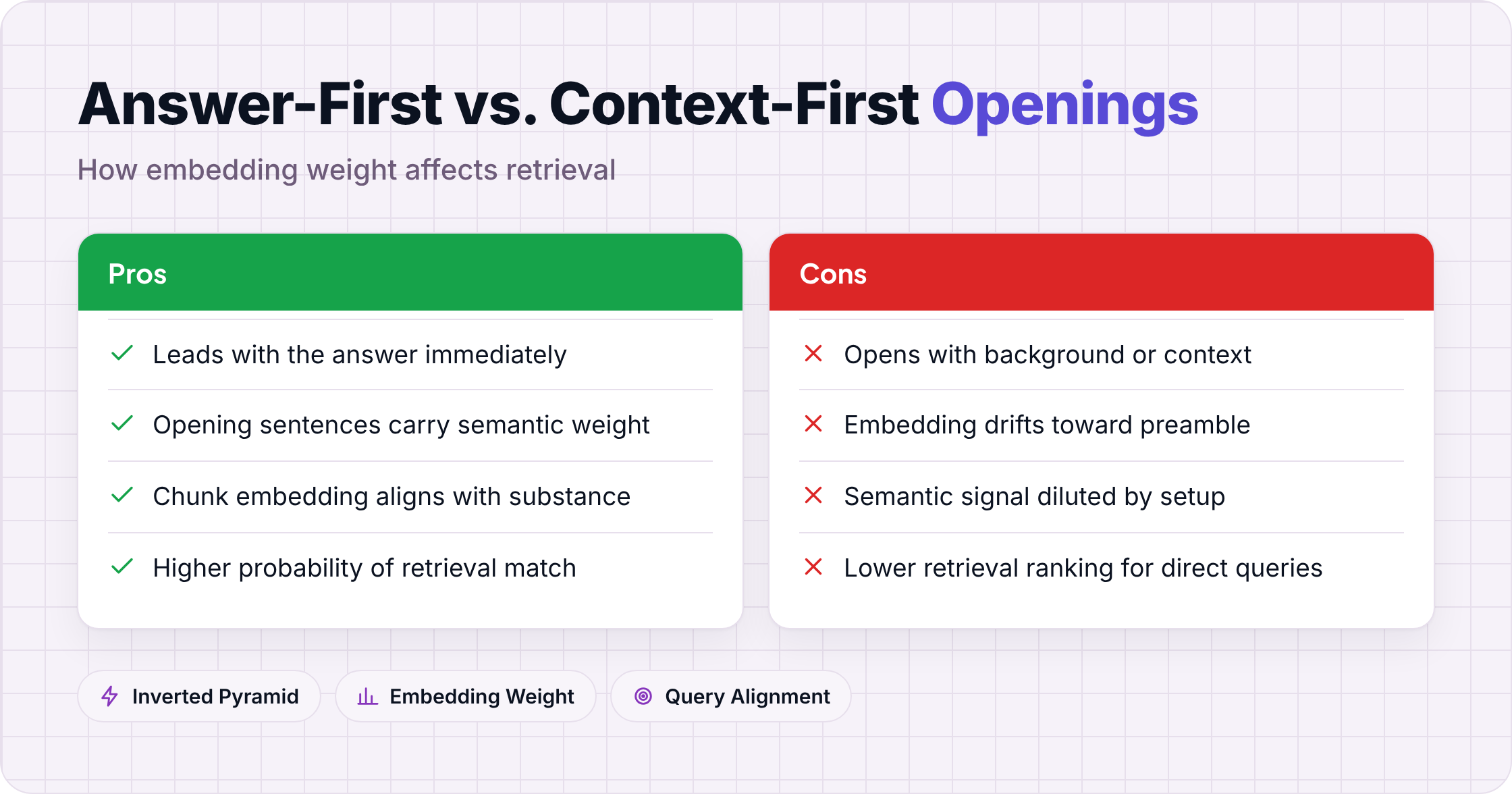
AI systems extract passages, not pages. The first two sentences of each section carry disproportionate weight because many chunking pipelines weight the opening of a chunk more heavily when computing its embedding. If your section opens with context-setting prose before getting to the actual answer, the chunk's embedding drifts toward the preamble rather than the substance.
The Inverted Pyramid Applied to Chunks
Journalism has used the inverted pyramid for over a century: lead with the most important information, then add supporting detail. RAG retrieval rewards exactly the same structure at the chunk level.
Compare these two section openings:
Opening A: "Before we discuss the specific techniques involved, it's helpful to understand the broader context of how retrieval systems work and why they were developed."
Opening B: "Retrieval systems score chunks by cosine similarity between the chunk embedding and the query embedding. A chunk that opens with the answer scores higher than one that opens with background."
Opening B will score higher on almost any query about retrieval systems. Opening A will score well on almost none. The difference is not style. It is the semantic content of the first 30 tokens.
Applying This to Headers
Your H2 and H3 text is often stored as chunk metadata and used as a retrieval signal independent of the body text. A header like "More Information" contributes nothing. A header like "How cosine similarity scores determine chunk retrieval order" contributes a dense semantic signal that helps the retriever match your section to the right query.
Write headers as compressed answers or precise topic labels. Avoid headers that are clever but vague. "The Secret to Better Rankings" tells a retrieval system nothing. "How heading specificity affects RAG chunk scoring" tells it exactly what the section covers.
Step 5: Build Internal Linking That Reinforces Topical Clusters
Internal links serve two functions in a RAG context. First, they signal to crawlers that related pages form a topical cluster, which raises the authority of every page in the cluster. Second, some RAG pipelines follow internal links during indexing, meaning a well-linked cluster increases the probability that all relevant pages get indexed together.
Cluster Architecture for AI Retrieval
A topical cluster has one pillar page covering a broad topic and several supporting pages covering specific sub-topics. Each supporting page links back to the pillar, and the pillar links out to each supporting page. This structure is not new. What has changed is that AI retrieval systems use link topology as one signal among many when deciding which pages to include in a candidate set.
The practical implication: if you have three pages covering related aspects of RAG content structure, link them explicitly. A retrieval system that indexes one page and follows its internal links will find the other two. A retrieval system that indexes one isolated page will not.
Anchor Text Precision
Use descriptive anchor text that names the destination page's topic. "Click here" and "learn more" are invisible to retrieval systems. "How to write HowTo schema for RAG pipelines" as anchor text tells both the crawler and the retrieval system exactly what the linked page covers.
One limitation worth acknowledging: internal linking helps with indexation but does not directly improve the cosine similarity score of individual chunks. It raises the probability that your pages enter the candidate set. What happens after that depends on chunk quality, which is why the structural work in Steps 1 through 4 matters more than link architecture alone.
Frequently Asked Questions
What chunk size works best for RAG retrieval?
Most production RAG pipelines perform well with chunks between 256 and 512 tokens, but the right size depends on your content type. Procedural content with discrete steps often works better at the lower end of that range, around 200 to 300 tokens, because each step is a self-contained unit. Conceptual content that requires more context to be meaningful can tolerate 400 to 512 tokens without significant embedding dilution.
Does heading hierarchy actually affect whether AI systems cite my content?
Yes, in two ways. First, headings are frequently preserved as chunk metadata, giving the retriever a second signal beyond the embedding itself. Second, a clear H1, H2, H3 hierarchy helps chunking algorithms identify topic boundaries, which means your chunks are more likely to align with actual topic shifts rather than arbitrary token counts. A flat or inconsistently nested heading structure produces chunks that span multiple topics and score weakly on most queries.
How is structuring content for RAG retrieval different from traditional SEO?
Traditional SEO optimizes for a ranking algorithm that scores whole pages against queries. RAG retrieval optimizes for a similarity function that scores individual chunks against sub-queries. The practical difference is granularity. In traditional SEO, a strong page can rank even if some sections are weak. In RAG retrieval, each section competes independently. A weak section does not drag down a strong one, but it also does not benefit from it.
Should I add schema markup if my site already ranks well organically?
Organic ranking and AI citation are increasingly separate outcomes. A page can rank on page one and contribute zero passages to AI-generated answers if its structured data is absent or malformed. Adding Article, HowTo, or FAQPage schema to already-ranking pages is low-risk and raises the probability that those pages enter the candidate set for AI retrieval. The implementation cost is typically under two hours per page for someone comfortable with JSON-LD.
Can I restructure existing content without hurting my current rankings?
You can, with some care. Changing body text and adding schema carries minimal ranking risk. Changing H1 or H2 text on pages with significant organic traffic can cause temporary ranking fluctuations while crawlers re-process the changes. The safest approach is to restructure one page at a time, monitor rankings for two to three weeks, and roll out changes to higher-traffic pages only after confirming the approach is stable on lower-traffic ones.
How often should I update content to stay retrievable by AI systems?
Recency is one of the signals AI retrieval systems use alongside semantic similarity and domain authority. Pages with a dateModified value more than 12 months old are at a disadvantage for queries where freshness matters. A practical cadence is to review and update high-priority pages every six months, updating statistics, examples, and schema fields like dateModified each time. Pages covering stable technical concepts can tolerate longer update cycles without significant retrieval penalty.
If you want to see how these structural checks apply in practice, visit SEORav's integrations page to explore how the platform audits chunk boundaries, schema completeness, and heading specificity before content goes live. The audit runs against the same signals covered in this guide.
Keep reading
How to Track Your Brand Mentions Across AI Search Engines
Learn how to track brand mentions in AI search across ChatGPT, Perplexity, Claude, and Gemini. Manual methods, tool comparisons, and gap-closing tactics in
Writing Content That LLMs Actually Want to Cite
Learn how to write distinctive content LLMs will cite: original data, expert attribution, structured formatting, and freshness signals that clear the retri
CMS Platforms With Native Analytics and SEO Tool Integrations
Which vendors provide turnkey connectors to common CMS and analytics stacks? Compare WordPress VIP, HubSpot, Contentful, Webflow, and more in one matrix.