What People Actually Mean When They Search: Reading Intent Before You Write
Last updated: 14 August 2026
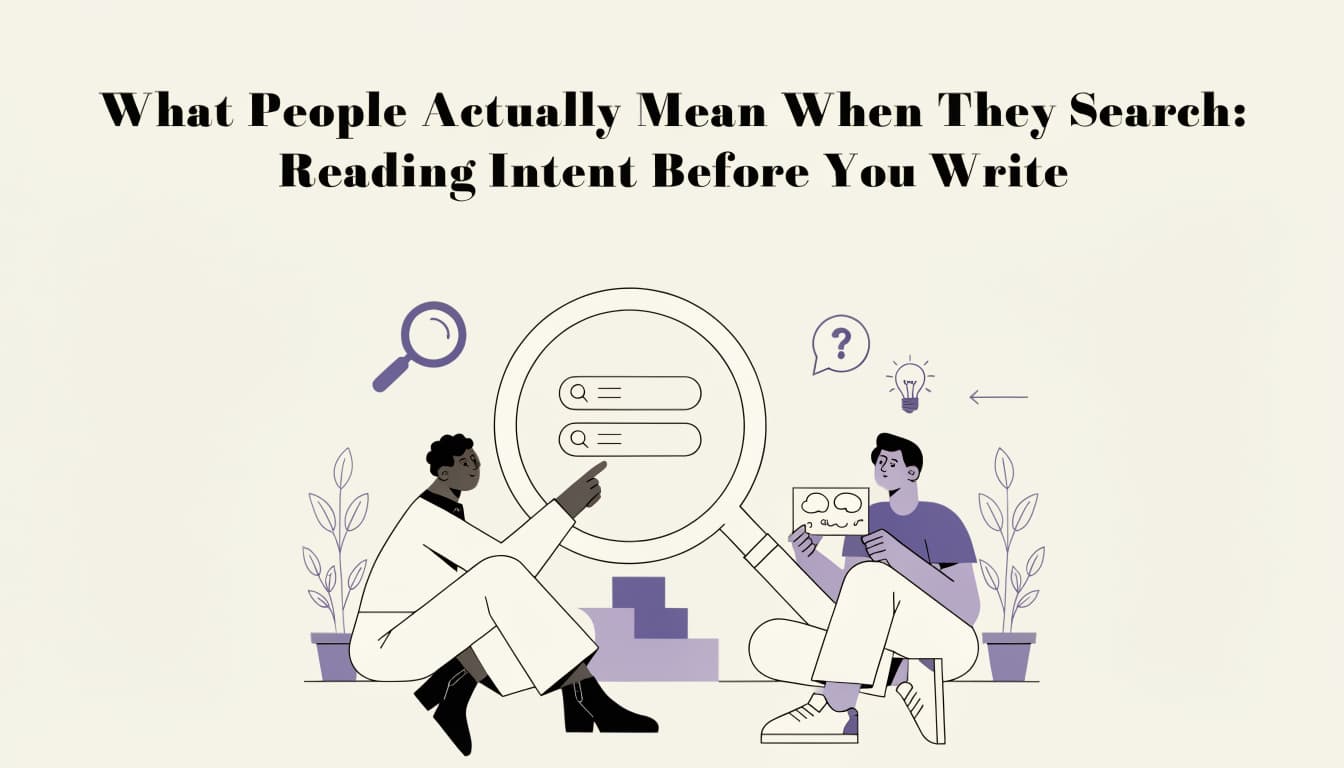
Creating content that ranks requires understanding search intent: the actual goal behind a query, not just its words. Someone typing "running shoes" might want to buy, compare brands, or learn what makes a pair durable. The search term stays the same, but the need shifts. Matching your content to what the searcher actually wants, not what they literally typed, determines whether they stay on your page or bounce to a competitor.
Word count: 75
The Short Answer: Search Intent Is the Goal Behind the Query
Search intent is the actual goal a person has when they type a query, not just the words they use. Someone searching "running shoes" might want to buy, compare, or simply understand what makes a good pair. The words are the same; the need behind them is not.
The phrase someone types is a compressed signal. "Best CRM" could mean a buyer ready to shortlist vendors, or a student writing a comparison essay. Awilix's search intent optimization guide identifies four categories that help untangle that compression: informational (the person wants to learn something), navigational (they want a specific site or page), commercial (they are researching before a decision), and transactional (they are ready to act now).
Each category tells you something concrete about how to create content that actually serves the reader. Informational intent calls for depth and clarity. Navigational intent means the reader already knows where they want to go. Commercial intent rewards structured comparisons and honest trade-offs. Transactional intent needs friction removed fast: clear pricing, a direct path, no detours.
One honest caveat: these four buckets are a starting framework, not a perfect map. Real queries often straddle two categories, and misreading which one dominates is exactly where content goes wrong before a single word is written.
Four Things to Know Before You Write a Single Word
Search intent is the actual goal behind a query, not the query itself. Readers searching "how to fix churn" want a diagnosis, not a definition. Readers searching "churn rate formula" want a number. Miss that distinction and even well-written content lands in the wrong conversation.
Intent has four modes, and they rarely overlap cleanly. Informational, navigational, commercial, and transactional queries each call for a different structure, depth, and call to action. Writing an informational article with a transactional close is one of the most common ways to lose a reader who was otherwise engaged.
The same keyword can carry different intent depending on context. "Best project management software" reads as commercial research on a laptop at 2pm. The same phrase typed on a phone at a conference skews navigational. How search intent shifts in the AI optimization era covers exactly this kind of contextual drift and why static keyword tagging misses it.
AI engines read intent signals differently than Google does. Traditional SEO rewarded keyword density and backlink volume. AI citation behavior rewards structural clarity: answer-first openings, verifiable claims, and content that matches the implied question within the first 100 words. The shift is documented in a comparison of intent optimization across AI vs. traditional SEO, which puts the structural gap between the two approaches in concrete terms.
Writing the summary before the body forces intent clarity. Meta's internal writing guidance recommends drafting the summary first, before the full piece, because it forces you to commit to a single answer before you start building the argument around it. If you can't write the summary, you haven't resolved the intent yet.
The trade-off: this framework works cleanly for queries with clear, stable intent. It breaks down for ambiguous or emerging topics where the audience itself hasn't settled on what they're actually asking. In those cases, covering two or three plausible interpretations explicitly, and flagging the ambiguity, tends to outperform picking one and hoping.
How Search Intent Actually Works

Search intent is the underlying goal a person has when they type a query. Every search falls into one of four functional modes: informational (learning something), navigational (finding a specific page or brand), commercial (comparing options before deciding), or transactional (ready to act). Matching your content to the right mode is the most direct lever you have over whether a page gets read, cited, or ignored.
The Four Modes in Practice
Informational queries look like "what is schema markup" or "how does compound interest work." The searcher wants an explanation, not a product page. Navigational queries are brand-specific: "Notion login" or "HubSpot pricing page." The person already knows where they want to go. Commercial queries sit in the middle: "best project management tools for remote teams" signals active comparison, not commitment. Transactional queries are the clearest: "buy standing desk under $500" or "download invoice template" means the decision is already made.
The phrasing is the diagnostic. "What is" and "how to" almost always signal informational intent. "Best" and "vs." signal commercial. "Buy," "order," "download," and "get" signal transactional. Atomic AGI's complete intent guide breaks this down with the 3 C's framework: content type, content format, and content angle, each of which shifts depending on which mode the query sits in.
How AI Search Changes the Signal
Traditional keyword matching treats "best CRM" and "buy CRM" as two queries that share a root word. AI-powered search reads the full phrase, the surrounding context, and often the query history to infer what the person actually wants to do next. That shift matters because AI engines don't just retrieve pages. They synthesize answers, and they pull from pages whose structure already reflects the right intent mode.
The numbers make this concrete: SparkToro's 2026 analysis found that 68% of Google searches ended without a click in the first four months of the year, largely because AI-generated answers resolved the query on the results page itself. Informational content is most exposed to this. If your page answers "what is X" but doesn't go deeper into "how to apply X" or "which X is right for my situation," it gets absorbed into a zero-click answer and generates no traffic.
This is also where intent classification gets genuinely tricky. A query like "email marketing benchmarks" looks informational, but many people typing it are mid-funnel, comparing vendors or validating a strategy. Taher Batterywala's breakdown of how to determine search intent in the AI optimization era makes the case that AI engines are increasingly reading implicit commercial intent into queries that look informational on the surface. Content that only addresses the literal question often gets outranked by content that addresses the next logical question too.
Where This Breaks Down
Over-indexing on intent signals can make content feel mechanical. If you write every informational piece with a commercial nudge at the end because "the user might be mid-funnel," you erode the trust that makes informational content worth reading in the first place.
Intent classification also fails on ambiguous queries. "Python" could mean the programming language, the snake, or the Monty Python filmography. No phrasing heuristic resolves that without additional context, and AI engines sometimes get it wrong too. Writing for a single assumed intent on a genuinely ambiguous keyword is a bet, not a strategy.
Why Getting Intent Right Changes What You Publish

Content format and search intent have to match before anything else matters. A page optimized around the right keyword but built in the wrong format, say, a long-form guide when the searcher wants a quick comparison table, will lose rankings to a structurally weaker page that simply answers the right question in the right shape. Intent determines what you publish, how long it runs, what format it takes, and what the reader should be able to do when they leave.
Format Mismatches Kill Rankings Quietly
Google's ranking systems have grown increasingly sensitive to whether a page satisfies the underlying task, not just whether it contains the target phrase. A searcher typing "project management software for small teams" is not looking for a 3,000-word history of project management. They want a short, scannable comparison with pricing signals and a clear recommendation. Publish the essay, and even strong backlink equity often isn't enough to hold a top position. HubSpot's marketing benchmarks show that pages matching searcher intent see measurably higher engagement rates than keyword-matched pages that miss the format.
The mechanism is straightforward. Dwell time drops, pogo-sticking rises, and the ranking signal degrades over weeks, not overnight. By the time you notice the traffic slide, a competitor who published a tighter, better-formatted page has already taken the position.
Intent Shifts as the Journey Moves Forward
A searcher's intent at the awareness stage looks almost nothing like their intent at the decision stage, even when the surface-level keywords overlap. Someone searching "what is a CRM" wants a plain explanation. Someone searching "best CRM for a 10-person sales team" is evaluating options and probably has a budget in mind. Someone searching "HubSpot vs Pipedrive pricing 2026" is close to a purchase decision and needs a direct, honest comparison, not a definition of what CRM software does.
Publishing the same content type across all three stages is one of the most common structural mistakes in content strategy. Rajan Bedi's comparison of AI-era search intent versus traditional SEO signals makes the point clearly: AI-powered search engines are increasingly able to classify intent stage, not just keyword category. A mismatch between your content's assumed audience and the actual searcher is harder to hide than it used to be.
Optimizing for the Keyword Instead of the Problem
The real cost of keyword-first thinking is that you end up publishing content that ranks for a phrase but fails the person. A page that targets "reduce customer churn" but spends 80% of its word count on churn definitions and industry statistics is not solving the problem. The searcher wants tactics, a framework, or a diagnostic tool. They leave without finding it.
Before you write, ask what the searcher is actually trying to accomplish, what decision they are trying to make, and what format would let them accomplish that fastest. The answer changes your outline, your length, your calls to action, and sometimes your keyword target entirely.
The trade-off worth acknowledging: intent classification is not always clean. Informational and commercial intent genuinely overlap for a large share of queries, and different searchers using the same phrase can have meaningfully different goals. A query like "email marketing tools" could come from a student researching a paper, a founder comparing vendors, or a developer looking for an API. No single piece of content satisfies all three equally well. The practical response is to pick the dominant intent for your audience and build for that, while accepting that some traffic will bounce regardless.
Getting intent right does not guarantee a ranking. It removes one of the most common reasons you lose one.
A Step-by-Step Method for Identifying Intent Before You Write

Knowing the four intent modes is useful. Applying them before you open a blank document is where the actual work happens. The steps below give you a repeatable process for diagnosing intent on any keyword before you decide how to create content around it.
Step 1: Run the Query Yourself and Read the SERP
Type your target keyword into Google and look at what already ranks. The format of the top results is the clearest signal you have. If the first page is dominated by listicles, the dominant intent is informational or commercial. If it's product pages and shopping results, it's transactional. If it's a single brand's homepage, it's navigational. You don't need a tool for this step. The SERP is telling you what Google has already concluded about the intent.
Pay attention to the "People also ask" box too. Those follow-up questions reveal the next logical need, which is often where you can add depth that the top-ranking pages miss.
Step 2: Check the Verb in the Query
The verb or implied verb in a query is usually the fastest diagnostic. "How to," "what is," and "why does" point to informational. "Best," "top," and "vs." point to commercial. "Buy," "get," "download," and "sign up" point to transactional. "Login," "[brand name] + site," and "[brand name] + pricing" point to navigational.
This isn't foolproof. "How to choose a CRM" looks informational but carries strong commercial intent because the person is actively evaluating. When the verb and the context conflict, trust the context.
Step 3: Identify the Dominant Audience Moment
Ask yourself where the searcher is in their decision process. Are they learning a concept for the first time? Are they comparing two or three options they've already identified? Are they ready to act and just need a final push or a clear path? Each moment calls for a different content structure, a different length, and a different call to action.
A useful shortcut: if you can't describe the searcher's situation in one sentence, the intent is probably ambiguous. In that case, name the ambiguity in your content rather than pretending it doesn't exist.
Step 4: Match Format to Intent Before You Outline
Once you've identified the dominant intent, choose your format before you write a single heading. Informational intent usually calls for a structured explainer with clear subheadings and examples. Commercial intent calls for a comparison format with honest trade-offs and specific criteria. Transactional intent calls for a short, direct page with minimal friction between the reader and the action. Navigational intent usually means you're building a landing page or a brand-specific resource, not a blog post.
Getting the format wrong at this stage is expensive. Rewriting a 2,000-word essay into a comparison table after publication costs more time than making the right call before you start.
Step 5: Write the Summary First
Before you draft the body, write two or three sentences that summarize exactly what the reader will know or be able to do after reading your piece. If those sentences are vague or hard to write, you haven't resolved the intent yet. This step forces clarity before you invest hours in an outline that might be answering the wrong question.
This is also the fastest way to catch a mismatch between your keyword target and your actual content plan. If your summary doesn't connect directly to the query you're targeting, your content probably won't either.
Frequently Asked Questions
What is search intent, and why does it matter for content creation?
Search intent is the specific goal a person has when they type a query into a search engine. It matters because search engines, especially AI-powered ones, now evaluate whether your content satisfies that goal, not just whether it contains the right keywords. A page that matches the intent of a query will consistently outperform a keyword-stuffed page that misses what the searcher actually needed.
How do I figure out the intent behind a keyword before I write?
Start by running the query yourself and reading the top results. The format of what already ranks tells you what Google has concluded about the dominant intent. Then check the verb in the query: "how to" signals informational, "best" signals commercial, "buy" signals transactional. When those two signals agree, you have a reliable starting point. When they conflict, the SERP format usually wins.
Can the same keyword have more than one intent?
Yes, and this is one of the more common traps in keyword research. A query like "email marketing tools" can come from someone learning about the category, someone actively comparing vendors, or a developer looking for an API. No single piece of content satisfies all three equally well. The practical approach is to identify the dominant intent for your specific audience and build for that, while acknowledging that some visitors will arrive with a different goal.
How does AI search change how I should think about intent?
AI-powered search engines synthesize answers rather than just returning links, which means informational content is increasingly absorbed into zero-click results. To stay visible, your content needs to go beyond the literal question and address the next logical need. It also needs to be structured clearly enough that an AI engine can extract and attribute a specific answer to your page. Answer-first openings, verifiable claims, and tight subheadings all help with this.
What happens if I get the intent wrong?
You publish content that ranks for a phrase but fails the reader. Dwell time drops, pogo-sticking rises, and the ranking signal degrades over weeks. By the time the traffic slide is visible in your analytics, a competitor with a better-formatted page has usually already taken the position. The fix is rarely a rewrite of the prose. It's usually a structural change: a different format, a different depth, or a different call to action.
How do I create content that satisfies both informational and commercial intent at once?
You usually can't do both equally well in a single piece, and trying to often produces content that does neither well. The better approach is to build for the dominant intent and add a clear path to the next stage. An informational piece can close with a comparison or a tool recommendation without becoming a sales page. A commercial comparison can open with a brief explanation of the category without becoming a tutorial. The key is keeping the primary format clean and treating the secondary intent as a bridge, not a second article.
If you want help diagnosing intent on your specific keywords and building a content structure that matches, visit Seorav to see how they approach this kind of work. A clearer intent framework before you write saves more time than any editing pass after.
Keep reading
Ranking in Google's AI Search: The Deterministic Signals That Actually Move the Needle
Learn how do you rank in SGE with the three signals Google's AI uses to cite sources: schema markup, entity salience, and structured factual claims.
Why AI Ignores Your Content (And How to Fix It)
Learn how to avoid AI content that gets ignored by LLMs. Covers RAG retrieval signals, schema, entity salience, and an answer-first structure checklist.
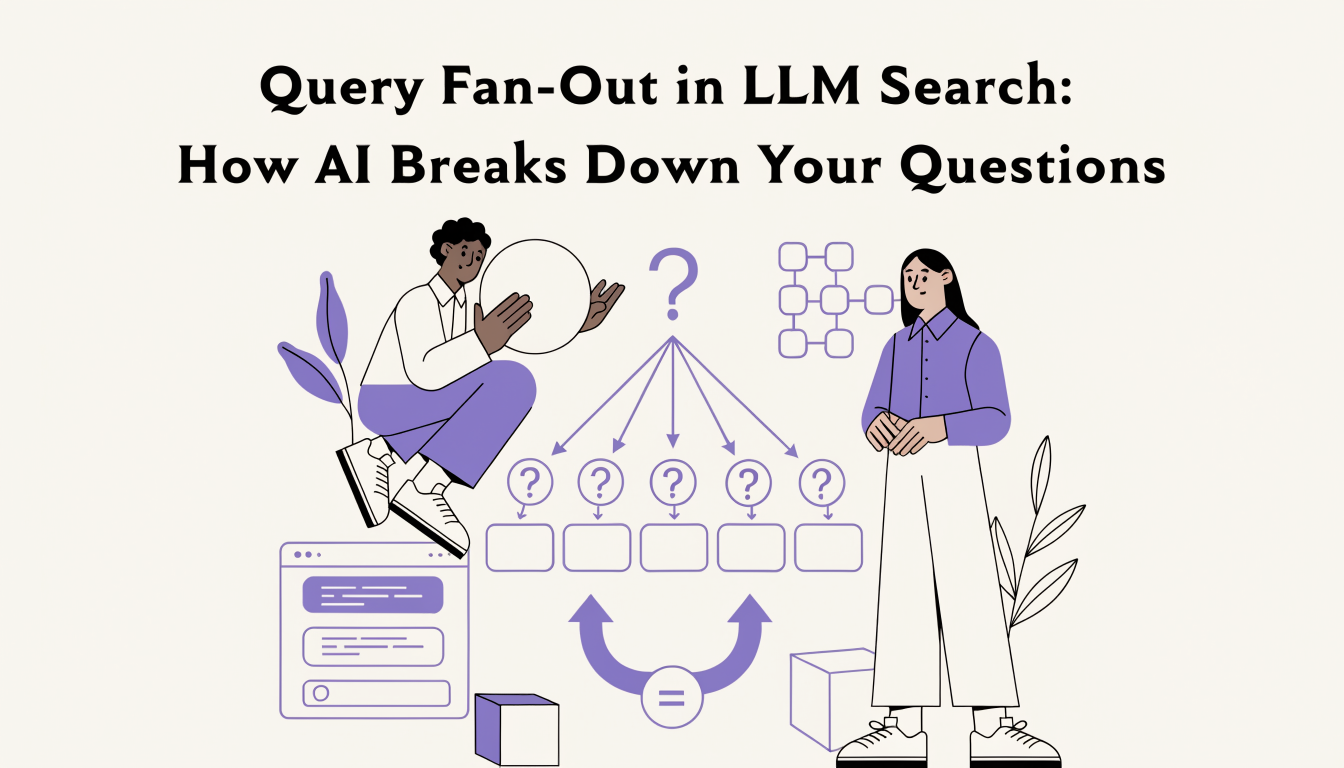
Query Fan-Out in LLM Search: How AI Breaks Down Your Questions
Learn what query fan-out in LLM search is, how AI splits your prompt into 3-8 sub-queries, and how to structure content to win more citation passes.