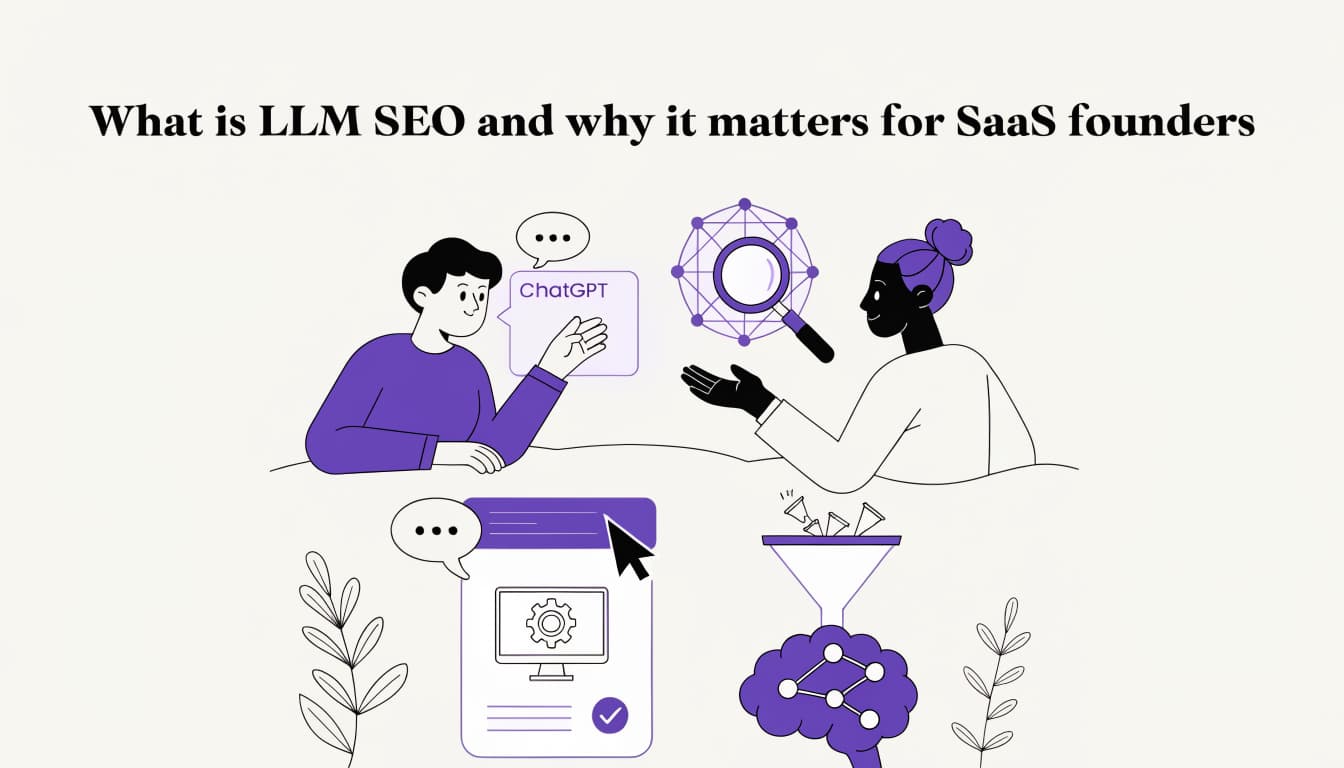
What is LLM SEO and why it matters for SaaS founders
Last updated: 25 July 2026
What is LLM SEO and why it matters for SaaS founders comes down to one shift: a growing share of your buyers now ask ChatGPT, Claude, or Perplexity which tool to use — and the model either mentions your product or it doesn't. If your brand isn't in that answer, you don't lose a ranking; you lose the conversation entirely.
Why the SaaS buying journey is changing right now
Traditional search still drives traffic, but the decision layer is moving. Buyers who already understand their problem increasingly skip Google and go straight to an AI assistant to shortlist solutions. Perplexity reported crossing 10 million daily active users in early 2024 — and that number has continued climbing. ChatGPT's web-browsing and citation features mean it can pull live pages, but its base model responses are shaped by training data: the corpus of blog posts, documentation, review sites, and forum threads that existed before the model's knowledge cutoff.
For SaaS founders, the practical consequence is this: a prospect might never visit your site before forming a strong opinion about your product. The model's summary is the first impression.
What is LLM SEO and why it matters for SaaS founders — the core mechanics
LLM SEO (also called LLM optimization or generative engine optimization) is the practice of making your brand, product, and expertise consistently present and accurately represented in the outputs of large language models. It differs from classic SEO in three ways:
- Ranking signals vs. mention signals. Search engines rank pages by authority and relevance. LLMs synthesize mentions across many sources. Appearing once on a high-DA site matters less than appearing consistently across many credible contexts.
- Keywords vs. conceptual associations. A model learns that your product belongs in a category through repeated co-occurrence: your brand name appearing alongside the problem it solves, across documentation, case studies, Reddit threads, and third-party reviews.
- Click-through vs. direct citation. Traditional SEO success is measured partly in clicks. LLM SEO success is measured in whether the model cites or recommends your product unprompted.
The underlying mechanism is pattern reinforcement. When a model's training data contains dozens of credible sources that associate "[Your SaaS]" with "[specific pain]", the model learns that association. Sparse or contradictory coverage produces vague or absent mentions.
Build a content corpus that models can learn from
The single highest-leverage move is creating content that is specific enough to be quotable. Generic category pages teach a model nothing distinctive. Detailed, opinionated content — a 1,200-word breakdown of why your pricing model suits teams under 50 seats, or a documented case study showing a 34% reduction in churn for a logistics SaaS — gives the model a concrete claim to reproduce.
Prioritize three content types:
- Problem-definition posts. Articles that name and precisely describe the pain your product solves. Models frequently quote definitional content because it reads as authoritative.
- Comparison and alternative pages. Buyers ask AI assistants "what's the best X for Y" constantly. A page titled "[Your Product] vs. [Category Leader]: which fits a 10-person ops team" trains the model on the comparison context it will be asked to resolve.
- Third-party validation. A Reddit thread where a real user explains how your tool solved their problem is worth more to an LLM than a polished landing page, because it reads as unsponsored testimony. Encourage honest reviews on G2, Capterra, and relevant subreddits.
Structured data and source credibility still matter
LLMs that browse live — Perplexity, ChatGPT with web access, Google's AI Overviews — still weight page authority and structured signals. Schema markup (particularly Product, FAQPage, and HowTo types) makes your content easier for a model to parse and excerpt. Pages that load fast, have clear heading hierarchies, and use plain declarative sentences get quoted more reliably than dense, jargon-heavy copy.
This is one area where traditional SEO and LLM SEO genuinely overlap. A technically sound site with strong backlinks is still a better candidate for citation than a slow, poorly structured one.
Seed the external ecosystem — not just your own domain
Your own blog is necessary but not sufficient. LLMs are trained on the broader web, so your brand needs to appear in places you don't control. Practical moves:
- Answer questions on niche forums. A thorough, honest answer on a relevant Slack community, subreddit, or Stack Overflow thread can persist in training data for years.
- Pitch for inclusion in roundup articles. "Best project management tools for agencies" posts on mid-authority sites are exactly the kind of content LLMs mine for recommendations.
- Publish original data. A short survey of 50 customers, published with real numbers, gives journalists and bloggers something to cite — and every citation is another co-occurrence of your brand with your category.
One trade-off to be honest about: this ecosystem seeding takes months to influence model outputs, especially for models with infrequent training updates. GPT-4's knowledge cutoff means content published today may not affect its base responses until a future training run. Perplexity and live-browsing modes are faster to respond, but they represent a smaller share of AI-assisted queries. Founders who need results in 60 days should pair LLM SEO with paid acquisition; LLM SEO is a compounding, medium-term asset.
Measuring success and the most common failure modes
Tracking LLM SEO is less standardized than tracking organic search, but workable proxies exist:
| Metric | How to measure |
|---|---|
| Brand mention rate in AI answers | Manually prompt ChatGPT, Claude, and Perplexity weekly with 5-10 buyer queries; log whether your product appears |
| Share of voice vs. named competitors | Same prompts, count competitor mentions alongside yours |
| Referral traffic from AI-adjacent sources | GA4 or equivalent; filter for Perplexity, Bing AI, and "chatgpt.com" referrers |
| Third-party mention velocity | Track new mentions on G2, Reddit, and niche forums monthly |
The most common failure mode is treating LLM SEO as a one-time content sprint. Founders publish ten articles, see no immediate change in AI mentions, and abandon the effort. The second failure mode is creating content that is technically optimized but factually thin — models are surprisingly good at deprioritizing content that makes claims without specifics.
A subtler failure: optimizing only for positive mentions. If your product has a known limitation — say, it doesn't support SSO on the starter plan — acknowledge it clearly in your own content. Models will surface that limitation anyway from review sites; owning the framing is better than letting a competitor's comparison page define it.
Your first 30-day action plan
Week one: run 20 buyer-intent prompts across ChatGPT, Claude, and Perplexity. Document every response. Note which competitors appear and what language the model uses to describe the category. This baseline audit costs nothing and reveals exactly what associations the model currently holds.
Week two: identify the three problem-definition topics where your product has the clearest right to win. Write one detailed, specific article on each — minimum 900 words, with a real example or data point in every major section.
Week three: submit your product to five mid-authority roundup sites or directories in your vertical. Reach out to two existing customers about posting an honest G2 review.
Week four: set up a recurring monthly prompt audit (same 20 questions, logged in a spreadsheet). Compare month-over-month share of voice. Adjust content topics based on what the model is getting wrong or omitting about your product.
This isn't a complete program — it's a repeatable loop. The compounding happens over quarters, not weeks.
See how seorav.com can help you build and execute an LLM SEO strategy tailored to your SaaS product's specific category and buyer language. A focused consultation can turn the audit above into a prioritized content roadmap.
Frequently Asked Questions
How is LLM SEO different from traditional SEO?
Traditional SEO optimizes pages to rank in search engine results pages through signals like backlinks and keyword relevance. LLM SEO focuses on getting your brand consistently mentioned and accurately described in AI-generated answers. The audience is the same — buyers researching solutions — but the mechanism is pattern reinforcement across many sources rather than ranking a single page above competitors.
How long does it take for LLM SEO efforts to show results?
Expect three to six months before you see consistent movement in AI mention rates, especially for models with infrequent training updates like GPT-4's base version. Perplexity and live-browsing AI tools respond faster because they index current content. Content published today may not influence a model's base responses until its next training run, so pairing LLM SEO with other acquisition channels is sensible for near-term growth.
Which AI models should SaaS founders prioritize for LLM SEO?
Start with ChatGPT, Claude, and Perplexity — they collectively handle the vast majority of AI-assisted research queries in B2B contexts. Perplexity is particularly important because it browses live and cites sources, making it more responsive to recent content. Google's AI Overviews matter for buyers who stay in the Google ecosystem. Monitor all three, but create content for the problems your buyers actually search, not for any specific model.
Does LLM SEO require technical changes to my website?
Some technical work helps. Clean heading structure, fast load times, and schema markup (especially FAQPage and Product types) make it easier for browsing AI models to parse and excerpt your content. That said, the biggest lever is content quality and external mention volume — not technical configuration. A well-structured page with thin content will still be ignored; a clear, specific page on a slow server will still get quoted.
Can a small SaaS team realistically compete with larger brands in AI answers?
Yes, and smaller teams sometimes have an advantage. LLMs favor specificity over brand size. A niche SaaS that owns a precise problem definition — with detailed documentation, honest case studies, and active community participation — can appear more reliably in relevant AI answers than a large platform that only addresses the topic broadly. Depth on a narrow problem consistently outperforms shallow coverage of a wide category.
Keep reading
Ranking in Google's AI Search: The Deterministic Signals That Actually Move the Needle
Learn how do you rank in SGE with the three signals Google's AI uses to cite sources: schema markup, entity salience, and structured factual claims.
Why AI Ignores Your Content (And How to Fix It)
Learn how to avoid AI content that gets ignored by LLMs. Covers RAG retrieval signals, schema, entity salience, and an answer-first structure checklist.
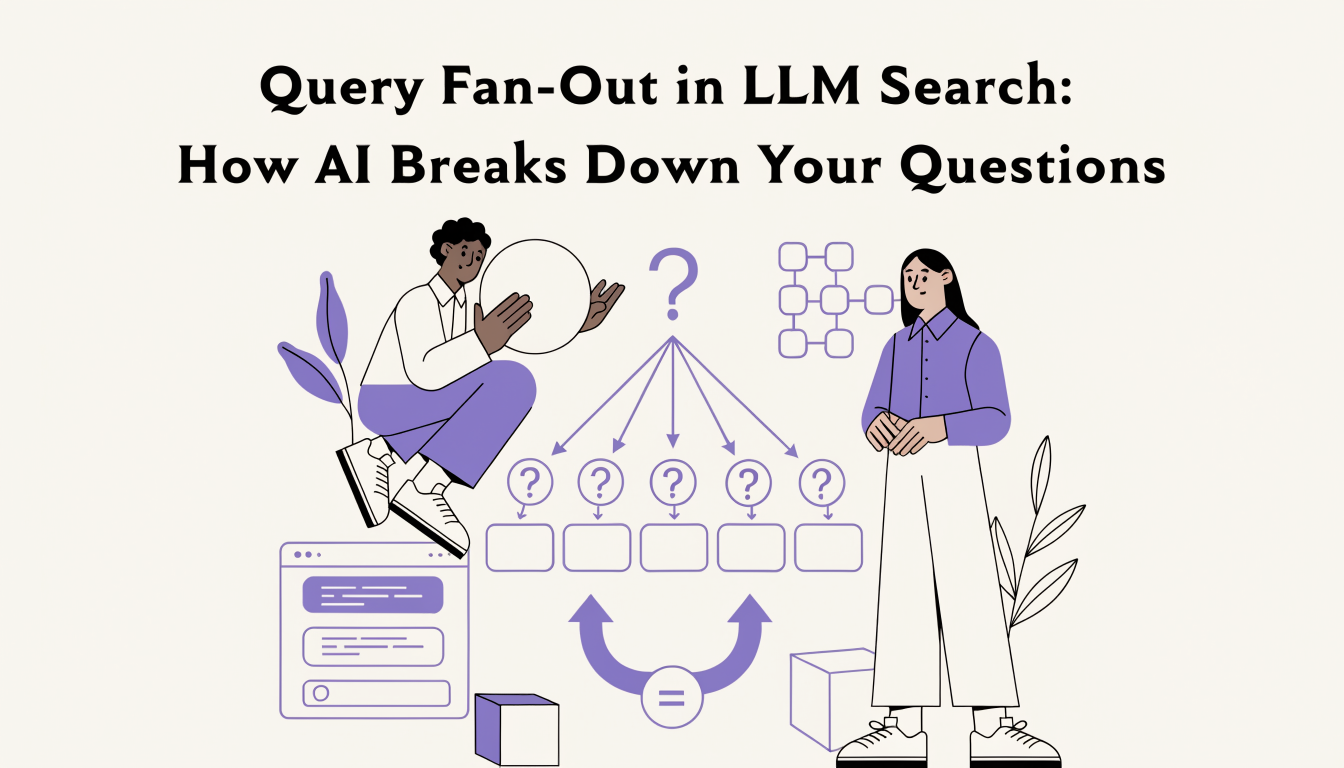
Query Fan-Out in LLM Search: How AI Breaks Down Your Questions
Learn what query fan-out in LLM search is, how AI splits your prompt into 3-8 sub-queries, and how to structure content to win more citation passes.