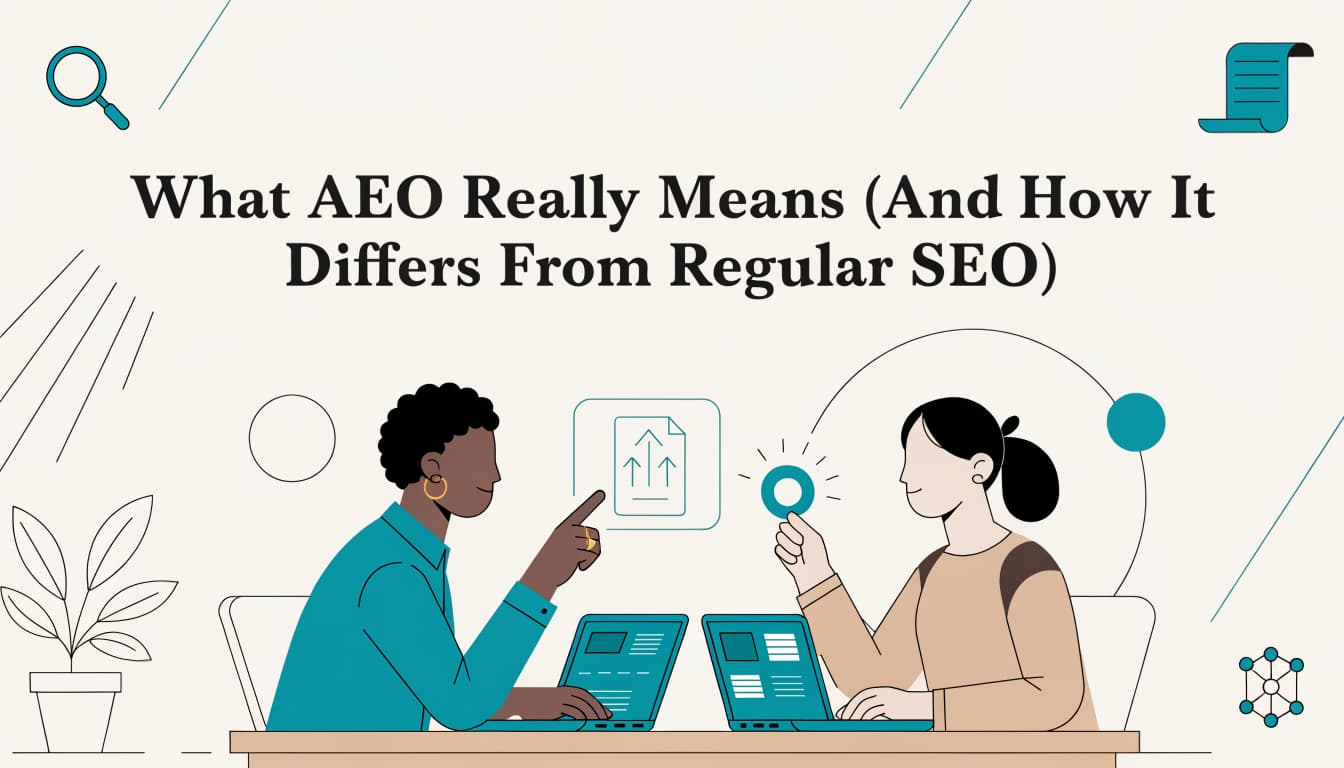
What AEO Really Means (And How It Differs From Regular SEO)
Last updated: 28 August 2026
AEO stands for answer engine optimization, the practice of structuring content so AI systems can extract, summarize, and directly cite it when answering user questions. Unlike traditional SEO, which aims for page rankings, AEO targets being quoted by AI assistants as a primary source. This shift matters because search behavior is moving toward conversational queries answered by language models rather than blue links. The difference lies in how you format claims, cite sources, and present information.
Word count: 77
AEO in Plain Terms: The 40-Word Answer
Answer engine optimization (AEO) is the practice of structuring content so AI-driven systems can extract, summarize, and cite it when answering a user's question directly. The goal is to be the source an AI engine quotes, not just a page that ranks.
The term has been around long enough to collect competing definitions, but the core a e o meaning is stable. Machine Relations' 2026 research on AEO frames it precisely: structuring content so AI systems can find it, extract it, trust it, and cite it inside a generated response. Each step is a separate failure point. A page can be findable but not extractable. Extractable but not trusted. Trusted but never cited.
One stat anchors why this matters now: Contently's 2026 reporting puts AI engine usage growth at a pace where optimizing purely for Google clicks leaves a measurable share of query traffic unaddressed. AEO is not a replacement for SEO. Pages still need to rank to be crawled and indexed by AI systems in the first place. The two disciplines overlap more than the framing wars suggest.
What AEO adds is a layer of intent: write for the machine that will summarize your content, not just the algorithm that will rank it.
Quick Takeaways
AEO (Answer Engine Optimization) is the practice of structuring content so AI-powered platforms select and cite it when generating answers. Unlike traditional SEO, which targets search ranking positions, AEO targets citation slots inside AI-generated responses on tools like ChatGPT, Perplexity, and Gemini.
- What it is: AEO means writing content that AI engines can extract, quote, and attribute, not just index. CXL's comprehensive AEO guide frames it plainly: the goal is getting your content into the answer itself.
- How it differs from SEO: SEO optimizes for click-through from a results page. AEO optimizes for direct citation inside a generated response, where no click may ever happen.
- Why 2026 matters: Omnibound reports that AI-powered answer engines now handle a measurable share of queries that previously flowed through traditional search, with adoption accelerating sharply through late 2024 and into 2025.
- First action step: Audit your highest-traffic pages for answer-first structure. If the core definition or claim is not in the first two sentences, AI engines will skip past it.
One trade-off worth naming: AEO-optimized content tends to front-load conclusions, which can reduce time-on-page metrics and occasionally feels abrupt for readers who prefer narrative buildup. If your audience skews toward long-form research consumption, a strict answer-first format may not fit every page.
AEO Meaning: The Core Definition

Answer Engine Optimization (AEO) is the practice of structuring content so that AI-driven systems, including ChatGPT, Perplexity, and Microsoft Copilot, can extract, summarize, and cite direct answers from it. Where traditional SEO earns a ranked position in a list of blue links, AEO earns a citation inside a generated response. The goal is to be the source an AI engine quotes, not simply a result a user might click.
How Answer Engines Differ From Traditional Search Engines
A traditional search engine indexes pages and ranks them. The user still has to choose which result to open. An answer engine skips that step: it reads multiple sources, synthesizes a response, and surfaces one or two citations inline. The user often never visits any page at all.
This changes what "visibility" means in practice. Content Science's breakdown of AEO frames it clearly: the optimization target shifts from a crawlable page structure to extractable, citable content blocks. Headings, concise definitions, and structured Q&A formatting all make it easier for an AI engine to pull a clean answer from your page rather than a competitor's.
What 'Being Cited' Means Versus 'Ranking on Page One'
Ranking on page one puts you in a pool. Being cited means the engine chose your content as the answer.
The distinction has measurable consequences. In a 2025 analysis, Riseatseven's AEO and AI search statistics found that AI-generated answers frequently cite sources that do not appear in the top organic positions for the same query. Ranking well helps, but it does not guarantee citation. The content itself, specifically its clarity, structure, and directness, carries more weight in the citation decision than domain authority alone.
The trade-off is real. A cited source in an AI answer may receive fewer direct clicks than a page ranking in position two or three on a traditional results page, because the user already got their answer. For brands that depend on session volume and on-site conversions, AEO visibility does not automatically translate to traffic. It builds recognition and authority in the model's training data and response patterns, but that is a longer feedback loop than a click.
AEO vs. GEO: Where the Definitions Overlap and Split
AEO and Generative Engine Optimization (GEO) are often used interchangeably, and the overlap is genuine. Both focus on making content legible to AI systems rather than just to crawlers. Both prioritize structured, answer-first writing.
The split is mostly one of scope and framing. AEO tends to focus on the content layer: how a specific page is written, formatted, and marked up so an answer engine can extract a clean response. GEO, a term that gained traction through academic work at Princeton and Georgia Tech in mid-2024, broadens the frame to include how generative models represent a brand across many queries over time, including queries where no single page is the obvious source. Think of AEO as optimizing the asset; GEO as managing the overall presence inside generative systems.
For most content teams, the practical starting point is the same regardless of which label you use: write content that answers a specific question completely, in the first 100 words, with enough structural clarity that a language model can quote it without paraphrasing.
How AEO Differs From Traditional SEO

AEO and traditional SEO optimize for different endpoints. SEO earns a ranked position in a results list by signaling relevance to a search engine crawler. AEO earns a citation inside an AI-generated answer by signaling trustworthiness and extractability to a language model. The unit of optimization shifts from a full page competing for a keyword to a single passage that can stand alone as a direct response.
Ranking Signals vs. Citation Signals: The Mechanical Split
Search engines score pages on backlink authority, crawl depth, Core Web Vitals, and keyword placement. AI answer engines work differently. They parse content for semantic completeness: does this passage answer the question fully, without requiring the reader to click elsewhere?
Similarweb's AEO breakdown frames this precisely: where SEO targets a full page for a keyword, AEO targets individual content passages for extraction. A page can rank on page one of Google and still never get cited by ChatGPT or Perplexity, because ranking signals and citation signals are not the same signals.
Keyword Density vs. Semantic Completeness
Traditional SEO rewards keyword presence and co-occurrence. You place the target phrase in the title, H1, first paragraph, and a handful of times in the body. That still matters for crawlers.
AI models parse differently. They look for complete conceptual coverage: definitions, context, conditions, and counter-cases. A passage that uses the exact keyword twice but answers the question fully will outperform a passage that uses it eight times but leaves gaps. Keyword-stuffed content tends to disappear from AI citations even when it holds a top-three ranking.
When AEO and SEO Goals Align, and When They Conflict
The two approaches share a foundation. High-quality, well-structured content with clear headings and authoritative sourcing performs better in both systems. Schema markup helps both Google's featured snippets and AI extraction. Fast-loading pages matter for crawlers and for the downstream training pipelines that pull from cached versions.
The conflict surfaces in content depth. SEO often rewards long-form, comprehensive pages that cover a topic from multiple angles across 2,000-plus words. AEO rewards concise, self-contained passages that answer one question cleanly in under 60 words. A single page can serve both goals, but only if it is structured deliberately: a direct-answer opening paragraph, followed by the deeper supporting content SEO favors.
Optimizing too aggressively for AI extraction can produce content that feels thin or transactional to a human reader who clicks through from a ranked result. Pages built entirely around short answer blocks sometimes underperform on time-on-page and conversion metrics, because there is little left to read once the answer is delivered. Teams running both strategies in parallel need to decide, at the page level, which goal takes priority.
Why AI Answer Engines Are Changing Search (With Numbers)

AI answer engines are reshaping how users find information: instead of scanning a list of links, they receive a single synthesized response. ChatGPT crossed 300 million weekly active users by early 2025, and Perplexity reported over 15 million daily queries in late 2024. For content teams, this means a growing share of potential readers never reaches a search results page at all, let alone clicks through to a ranked article.
The adoption curve is steep enough that traditional click-through metrics are starting to misrepresent actual content performance. Evergreen Media's AEO research documents a consistent pattern: pages that rank in positions 4 through 10 on Google are seeing organic traffic decline even when their rankings hold, because AI Overviews and generative answers absorb the query before a click happens. Rank stayed the same. Visits dropped.
Which content gets cited? The pattern is fairly consistent across engines. Structured, answer-first content from authoritative domains performs best: medical and legal reference sites, established trade publications, and pages with clear schema markup. Long-form editorial content without a direct answer in the first 100 words tends to get skipped, regardless of domain authority.
One real trade-off: a page optimized for AI citation, with short paragraphs, direct answers, and structured headers, often sacrifices the narrative depth that earns backlinks and social shares. Content built purely for answer extraction can underperform on traditional SEO signals, particularly for competitive head terms where Google still serves a standard results page. Teams running hybrid strategies have to make deliberate choices about which pages serve which purpose, rather than assuming one format fits every query type.
For content teams still measuring success primarily through keyword rankings and session volume, the numbers above signal a structural problem. Writer's breakdown of GEO and AEO optimization frames it directly: optimizing for AI answers requires a different content architecture than optimizing for ranked links, and treating them as the same task leaves performance on the table.
Frequently Asked Questions
What does AEO stand for?
AEO stands for Answer Engine Optimization. It refers to the practice of structuring content so that AI-powered platforms, such as ChatGPT, Perplexity, and Google's AI Overviews, can extract and cite it when generating a direct answer to a user's query. The a e o meaning is distinct from SEO in that the target is a citation slot inside a generated response, not a ranked position in a link list.
How is AEO different from SEO?
SEO optimizes a full page to rank in a search engine's results list, relying on signals like backlinks, keyword placement, and Core Web Vitals. AEO optimizes individual content passages to be extracted and cited by AI answer engines, where the deciding factor is semantic completeness rather than domain authority. A page can hold a top-three Google ranking and still never appear in an AI-generated answer if the content is not structured for extraction.
Do I need to choose between AEO and SEO?
No. The two approaches share a foundation: clear structure, authoritative sourcing, and well-organized headings help both. The tension appears at the page level, where SEO often favors long-form depth and AEO favors concise, self-contained answer blocks. Most teams resolve this by opening each page with a direct 60-word answer, then following it with the longer supporting content that traditional SEO rewards.
Which AI platforms does AEO apply to?
AEO applies to any platform that generates synthesized answers from external sources, including ChatGPT (with Browse or search enabled), Perplexity, Microsoft Copilot, Google's AI Overviews, and Claude when used with web access. Each platform weights citation signals slightly differently, but the core requirements are consistent: answer-first structure, clear headings, factual accuracy, and schema markup where applicable.
Does AEO affect click-through rates?
Yes, and not always favorably. When your content is cited in an AI-generated answer, the user may get what they need without ever visiting your page. Studies from 2025 show that AI citation can build brand recognition and authority inside generative models over time, but it does not reliably drive session volume the way a page-two-to-page-one ranking jump does. If your business model depends on on-site conversions, AEO visibility needs to be tracked separately from traffic metrics.
How do I start optimizing for AEO?
Start by auditing your highest-traffic pages for answer-first structure. If the core definition or claim is not in the first two sentences, rewrite the opening. Add FAQ sections with direct answers under clear heading tags, use schema markup (FAQ and HowTo schemas in particular), and keep individual answer passages under 60 words. From there, check whether your pages are being cited in Perplexity or ChatGPT for your target queries, and treat citation rate as a separate KPI from organic rank.
Ready to Optimize for AI Citation?
If you want your content to show up where your audience is actually searching in 2026, AEO belongs in your content strategy alongside traditional SEO. Visit Seorav to learn more about building a content architecture that earns citations in AI-generated answers, not just rankings on a results page.
Keep reading
Why ChatGPT Quotes Some Paragraphs and Ignores Others
Learn what makes a paragraph quotable by ChatGPT: self-containment, factual density, and authority signals that determine whether AI cites or skips your co
Ranking in Google's AI Search: The Deterministic Signals That Actually Move the Needle
Learn how do you rank in SGE with the three signals Google's AI uses to cite sources: schema markup, entity salience, and structured factual claims.
Why AI Ignores Your Content (And How to Fix It)
Learn how to avoid AI content that gets ignored by LLMs. Covers RAG retrieval signals, schema, entity salience, and an answer-first structure checklist.