Tracking Citation Frequency and Sentiment Across AI Models
Last updated: 14 November 2026
Tools like Profound, Otterly.AI, and AI Rank Tracker monitor citation frequency and sentiment by tracking how often your brand appears in LLM-generated responses and analyzing whether the surrounding language is positive, neutral, or negative. A 2024 Bain survey found 80 percent of consumers used AI search at least once weekly, shifting citation visibility from a vanity metric into a measurable driver of reach and revenue. Understanding where and how your brand surfaces in AI answers has become essential for competitive positioning.
Which Tools Track Citation Frequency and Sentiment in AI-Generated Responses Right Now
Tools like Profound, Otterly.AI, and AI Rank Tracker let you monitor how often your brand appears in LLM-generated answers and whether the surrounding language is positive, neutral, or negative. A 2024 Bain survey found 80% of consumers used AI search at least once a week, which moves citation visibility from a vanity metric into something you can tie directly to reach and revenue.
Every tool reviewed here is evaluated against five criteria: citation volume tracking, sentiment scoring, multi-model coverage, reporting cadence, and price-to-feature ratio. Those five signals map to the two decisions most teams actually face: how visible am I, and is that visibility helping or hurting me?
Citation frequency and sentiment are distinct signals, and conflating them leads to bad content decisions. Your brand can appear in 90% of relevant AI responses and still lose deals if the surrounding language consistently frames it as "expensive" or "complex for small teams." Frequency tells you whether the model knows you exist. Sentiment tells you what story it's telling about you. Optimizing for one while ignoring the other is like tracking impressions without tracking conversion rate.
The best AI citation tracking tools in 2026 separate these two layers explicitly, polling multiple models and scoring the tone of each mention independently. Not every platform does both well. Some offer strong volume tracking across ChatGPT, Perplexity, and Gemini but return only a binary positive/negative sentiment flag rather than a scored range. Others provide granular sentiment analysis but cover only one or two models, which limits how much you can trust the data as a cross-platform signal.
One honest caveat: sentiment scoring in this category is still maturing. Most tools derive it from keyword proximity and phrase classification rather than true contextual understanding, so nuanced framing like "reliable but slow to implement" can score as neutral when a human reader would flag it as a soft negative. Keep that limitation in mind when setting thresholds for action.
Tool Comparison Matrix: Citation and Sentiment Tracking at a Glance
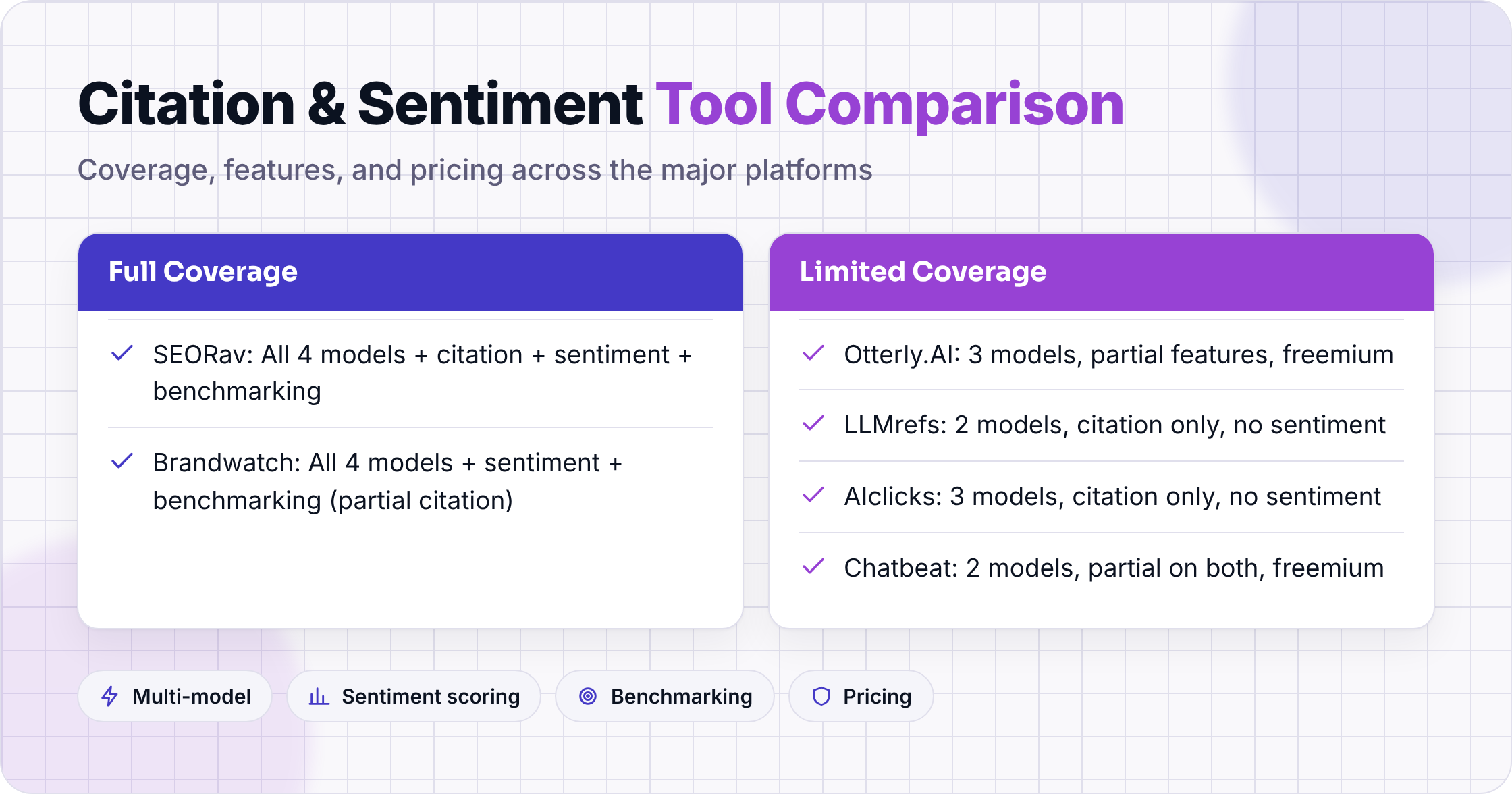
No single tool in 2026 covers all four major AI engines (ChatGPT, Perplexity, Claude, Gemini) with both citation frequency tracking and sentiment scoring in one dashboard. Most tools do one well and approximate the other. The matrix below maps the current field honestly.
| Tool | Models covered | Citation frequency | Sentiment scoring | Competitor benchmarking | Starting price |
|---|---|---|---|---|---|
| SEORav | ChatGPT, Perplexity, Claude, Gemini | Yes | Yes | Yes | Paid |
| Otterly.AI | ChatGPT, Perplexity, Claude | Partial | Partial | Partial | Freemium |
| LLMrefs | ChatGPT, Perplexity | Yes | No | Partial | Freemium |
| AIclicks | ChatGPT, Perplexity, Gemini | Yes | No | Yes | Paid |
| Chatbeat | ChatGPT, Perplexity | Partial | Partial | No | Freemium |
| Brandwatch | ChatGPT, Perplexity, Claude, Gemini | Partial | Yes | Yes | Enterprise |
| Mangools | ChatGPT, Perplexity | Partial | No | No | Paid |
How to Read This Matrix
"Partial" citation frequency means the tool logs whether your domain appeared in a response, but does not break down citation rate by prompt intent, query volume, or model version. You get a presence signal, not a rate. "Partial" sentiment scoring means the tool flags positive or negative framing at the response level but does not isolate sentiment by entity (your brand versus a competitor mentioned in the same paragraph) or by model.
The numbers back up how significant this gap is. Digimetrics' 2026 citation tracking analysis found that most platforms still treat a citation as a binary event, present or absent, rather than measuring frequency across repeated prompt runs or tracking how sentiment shifts between model updates.
Gemini coverage is the most common gap. Of the tools listed, only three poll Gemini at all, and none do so with the same query cadence they apply to ChatGPT or Perplexity. That matters because the Stanford 2026 AI Index Report documents continued divergence in how different models source and attribute information, meaning a citation pattern on ChatGPT does not reliably predict your standing on Gemini.
The trade-off worth naming: tools with broader model coverage tend to poll less frequently, sometimes weekly rather than daily, because API costs compound fast across four engines. If your category moves quickly (a product launch, a PR event, a competitor rebrand), weekly polling can leave you reading stale data. Conversely, tools that poll daily often cap coverage at two models. No current option does both at enterprise query volume without a significant price step up.
Ayrank's 2026 comparison of citation tracking tools notes that sentiment analysis remains the weakest column across the category, with most tools relying on keyword-level classifiers rather than contextual scoring. A response that calls your product "reliable but slow" may register as positive (the word "reliable" scores well) even though the framing is a net negative for conversion. Teams using partial sentiment scores for strategic decisions should validate a sample of flagged responses manually before acting on the aggregate.
How to Choose the Right Citation Tracking Tool for Your Situation
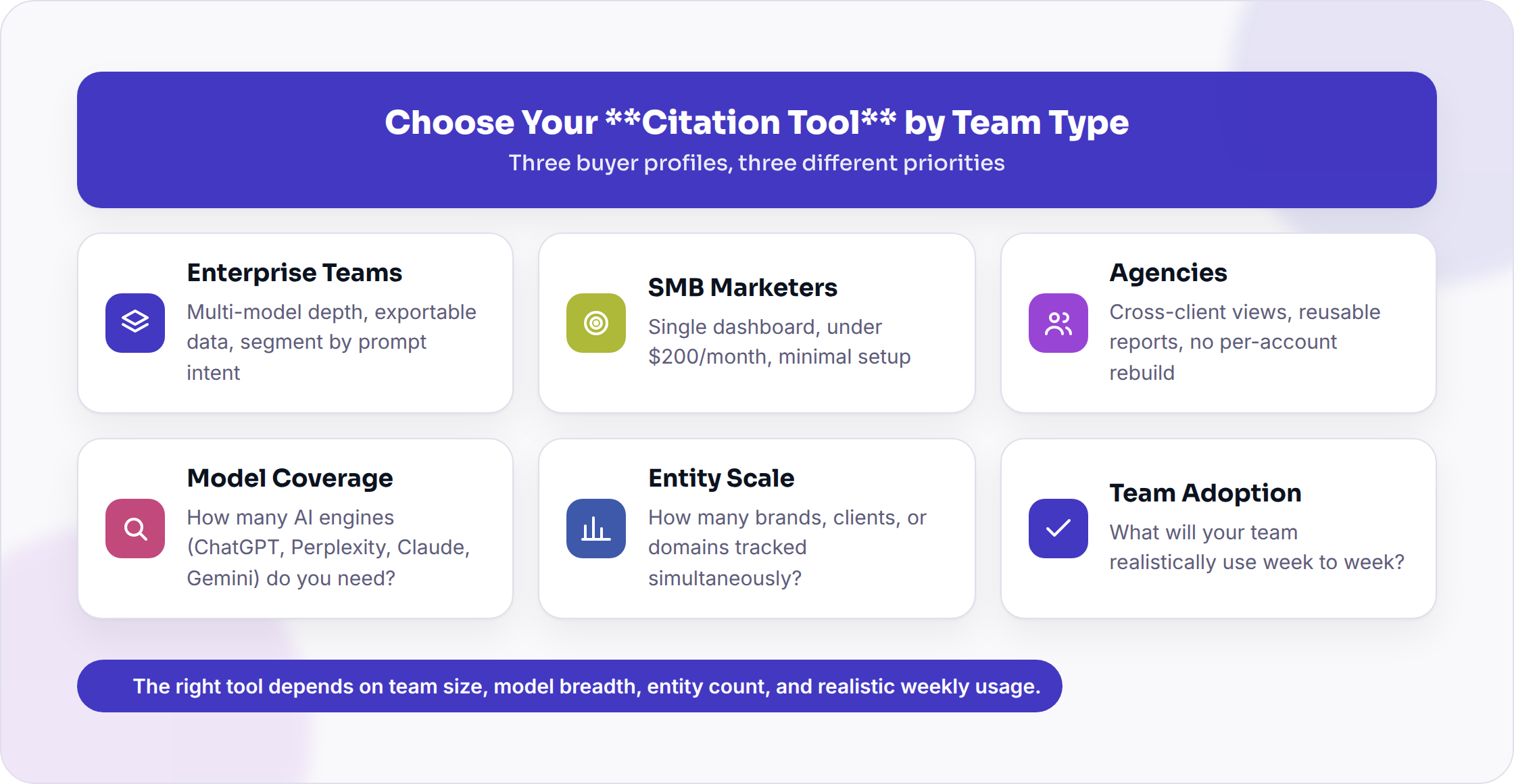
The right tool depends on three variables: how many AI models you need to monitor, how many entities (brands, clients, or domains) you're tracking simultaneously, and what your team will realistically use week to week. Enterprise teams need multi-model depth and exportable data. SMB marketers need a single dashboard under $200/month. Agencies need cross-client views without rebuilding reports from scratch for every account.
Decision Path 1: Enterprise Content Teams
If your team publishes at scale across multiple product lines and already has a dedicated analytics budget, the priority is breadth of model coverage and raw data access. You need a tool that polls ChatGPT, Perplexity, Claude, and Gemini on a defined cadence, stores full response logs, and lets you segment citation data by prompt intent, not just by URL.
Pilotdeck's 2025 comparison of AI visibility tools identifies multi-model polling frequency and citation-level sentiment tagging as the two features enterprise buyers most commonly request. The trade-off: tools built for this level of depth tend to require onboarding time and often surface more data than smaller teams can act on. If your analytics function is not already resourced to interpret citation trends, a feature-heavy platform will collect dust.
Decision Path 2: SMB Marketers
For a solo marketer or a two-person content team, the ceiling is practical: you need something that works inside a $200/month budget and does not require a data analyst to interpret. Look for tools that surface citation gaps plainly, ideally showing you which competitor got cited on a prompt you should own, and why.
Similarweb's 2026 roundup of AI citation analysis tools lists four platforms with meaningfully different pricing tiers, and the gap between entry-level and mid-market plans often reflects polling frequency more than feature count. If weekly polling is sufficient for your content cadence, you can stay at the lower tier without losing much signal.
One honest limitation: sub-$200 tools typically monitor two or three AI models, not all four. If your audience skews toward Perplexity users specifically, confirm that model is included before committing.
Decision Path 3: SEO Agencies
Agencies face a structural problem that neither enterprise tools nor SMB tools solve cleanly: you're tracking citation patterns across clients in completely different industries, each with their own competitor sets and prompt libraries. A tool that works for a SaaS client's prompts will not automatically configure itself for a healthcare client's.
Prioritize workspace or account separation, the ability to configure distinct prompt sets per client, and reporting exports that do not require manual reformatting before a client call. Sentiment tracking matters here too, since a citation that frames a client's brand negatively is a different problem than a missed citation entirely. Flat citation-count reports will not catch that distinction.
Best for Enterprise: Profound for Large-Scale LLM Citation Monitoring
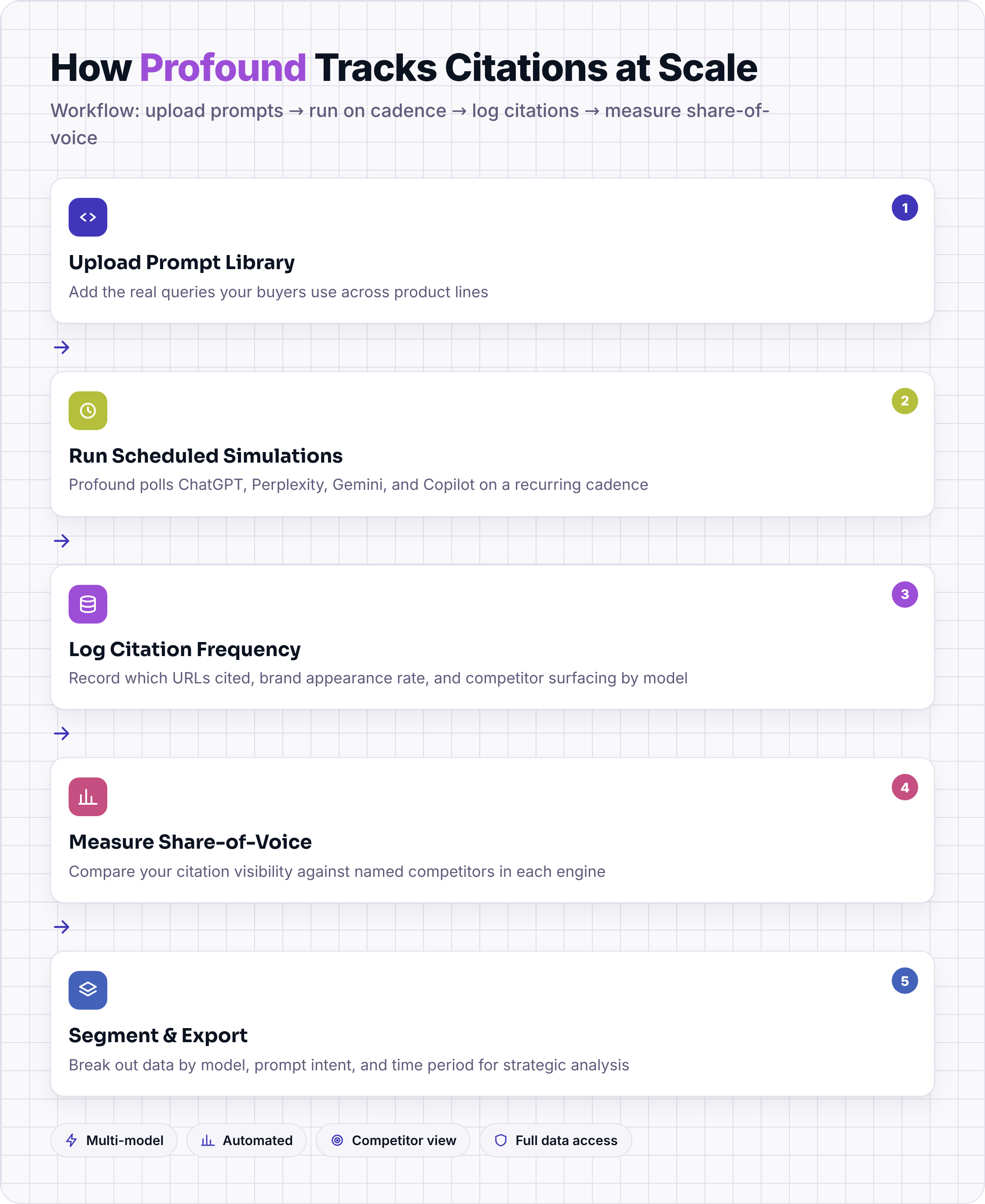
Profound is built for organizations that need systematic, multi-model citation tracking at scale. It monitors brand mentions and URL citations across ChatGPT, Perplexity, Gemini, and Microsoft Copilot by running scheduled prompt simulations against each engine, logging citation frequency by model, and measuring share-of-voice against named competitors. For enterprise marketing and SEO teams running hundreds of tracked prompts, it is the most purpose-built platform available in 2026.
What Profound Tracks
The core of Profound's offering is its prompt library system. You upload the queries your buyers actually use, and Profound runs those prompts on a recurring cadence across each AI engine, recording which URLs get cited, how often your brand appears in generated answers, and which competitors are being surfaced instead. Citation frequency is broken out by model, so your team can see that Perplexity cites your content 40% more often than ChatGPT does and adjust content strategy accordingly.
A 2025 LLM tracking tools guide by Nick Lafferty identifies Profound as one of the few platforms that combines prompt-level citation logging with competitive share-of-voice reporting in a single interface, rather than requiring teams to stitch together data from separate tools.
Sentiment Analysis Depth and Known Gaps
Profound goes beyond binary citation tracking. It scores brand framing, distinguishing between a factual citation (your URL appears as a source) and a positive or negative brand mention within generated prose. The NLP model flags whether the surrounding context is neutral, favorable, or critical, which matters when an AI engine cites your brand while also describing a product limitation.
The trade-off is that Profound's sentiment classification struggles with nuanced or hedged language. When an AI engine says something like "Brand X is generally well-regarded, though some users report onboarding friction," the model sometimes scores that as neutral rather than mixed. Teams tracking brand reputation through sensitive product categories or competitive comparisons should manually review flagged responses rather than relying on automated sentiment scores alone. Factor in analyst review time when scoping the workflow.
Pricing and Integration Reality
Profound connects to Slack, Looker, Tableau, and other BI tools via API, which makes it practical for teams that already route marketing data into a central dashboard. API access ships with the enterprise plan, not behind a separate tier.
The minimum contract size puts Profound in range only for teams with a dedicated AI visibility budget. Most practitioners place the entry point above $1,000 per month. If you're an SMB or a solo practitioner, the tools in the matrix above will serve you better at a fraction of the cost.
Frequently Asked Questions
What tools track citation frequency and sentiment in AI-generated responses?
The tools most commonly used for this in 2026 are Profound, SEORav, Otterly.AI, Brandwatch, and AIclicks. Each covers a different combination of AI models and sentiment depth, so the right choice depends on how many engines you need to monitor and whether you need entity-level sentiment scoring or just a positive/negative flag at the response level.
How accurate is sentiment scoring in AI citation tracking tools?
Accuracy varies significantly across platforms, and the category as a whole is still catching up to the complexity of LLM-generated language. Most tools use keyword-proximity classifiers rather than contextual NLP, which means hedged or mixed phrasing (for example, "strong product but steep learning curve") often scores as neutral when a human reader would read it as a qualified negative. Manual spot-checking on a sample of flagged responses is a reasonable safeguard until the underlying models improve.
Can I track citations across ChatGPT, Perplexity, Claude, and Gemini in one tool?
A small number of tools cover all four engines, but none do so with equal polling depth across all of them. Gemini coverage is the most common gap. SEORav and Brandwatch both list all four models, but polling cadence and query volume often differ by engine. Before committing to any platform, ask the vendor specifically how often they poll each model and whether the cadence is the same across all four.
How is citation frequency different from share of voice in AI responses?
Citation frequency measures how often your brand or URL appears across a defined set of prompts in a given time window. Share of voice adds a competitive layer: it expresses your citation count as a percentage of all citations in your category, including competitors. Frequency tells you your absolute visibility. Share of voice tells you your relative standing. Both numbers are useful, but share of voice is harder to game and more meaningful for strategic decisions.
Do these tools work for tracking AI citations for multiple clients or brands?
Some do, some do not. Agency-focused platforms and enterprise tiers typically offer workspace or account separation so you can configure distinct prompt libraries, competitor sets, and reporting views per client. SMB-tier tools usually assume a single brand and do not support multi-client views cleanly. If you're running an agency, confirm multi-account support and whether prompt libraries are isolated per client before signing up.
How often should I check my AI citation data?
For most teams, weekly reviews are sufficient unless your category is moving fast (a product launch, a competitor rebrand, or a significant PR event). Daily polling is available on some platforms but adds cost and rarely changes the strategic picture week over week. A practical cadence is weekly monitoring with a manual deep-dive any time a significant external event could shift how AI models describe your category.
If you want to see how citation frequency and sentiment scoring work across all four major AI engines in a single view, visit SEORav's GEO tracking tool to explore what the platform tracks and how it reports on both signals together.
Keep reading
How to Track Which AI Models Are Citing Your Website
Learn how to set up ai search citation analytics across ChatGPT, Perplexity, Claude, and Gemini. Includes tool comparisons, prompt setup, and competitor ga
Enterprise CMS Platforms: What They Are and How to Choose
Compare enterprise CMS platforms by architecture, cost, compliance, and AI features. Learn what separates enterprise-grade tools from standard CMS options.
How to Pick a Geo Optimization Tool That Actually Works for Multi-Region SEO
Compare the top geo optimization tools for multi-location SEO. See which platforms track rankings at city level, fix citation gaps, and scale across 100+ l