How Perplexity AI Decides Which Sources to Cite
Last updated: 31 October 2026
Perplexity AI ranks content through a multi-stage retrieval pipeline that scores individual passages rather than entire pages, then cites only sources that survive every filtering stage. Unlike Google's document-level ranking, Perplexity extracts and evaluates specific text segments for relevance, factuality, and source credibility. Most pages fail at intermediate stages of this funnel. Knowing where your content drops out reveals exactly what changes improve your odds of being cited.
Domain authority accounts for roughly 15% of Perplexity's ranking weight, per Searchatlas's breakdown of Perplexity ranking factors. That figure is useful because it shows authority is necessary but not sufficient. A high-DA page with weak semantic alignment still loses to a mid-authority page that answers the query directly and completely.
One honest caveat before going further: Perplexity does not publish its ranking weights. The ordering here reflects observed patterns from structured testing and third-party analysis, not an official specification. Where the evidence is thin, this article says so.
What Perplexity Looks For: Four Core Signals
Perplexity evaluates sources using four core signals: recency, domain trust, semantic precision, and citation graph strength. These signals determine which pages enter the candidate pool and how they rank during re-ranking, before content quality is assessed by the language model.
Recency. On fast-moving queries, a page updated two weeks ago will routinely outrank a more thorough piece from 18 months back. Perplexity's retrieval layer filters by freshness before it scores relevance, so stale content drops out early regardless of depth.
Domain trust. Established domains with consistent authorship signals, clear editorial standards, and a track record of accurate coverage get cited more often. Seoprofy's breakdown of Perplexity ranking factors puts domain-level E-E-A-T among the top signals Perplexity's re-ranking layer evaluates before passing candidates to the language model.
Semantic precision. Mentioning a keyword and answering the query are different things. Perplexity's RAG pipeline extracts passages, not pages, so a section that directly resolves the query phrase scores higher than a 3,000-word article that buries the answer in paragraph nine.
Citation graph. Pages cited by authoritative sources carry extra weight. Otterly's Perplexity SEO analysis documents this pattern: inbound citation signals from credible domains function as a secondary trust layer on top of on-page quality.
One trade-off worth naming: optimizing hard for recency can work against depth. A page refreshed weekly to stay current may never accumulate the inbound citations that give the citation graph signal its value. The right balance depends on whether your target queries are evergreen or time-sensitive.
How Perplexity AI Ranks Content: The Retrieval-Then-Rerank Pipeline
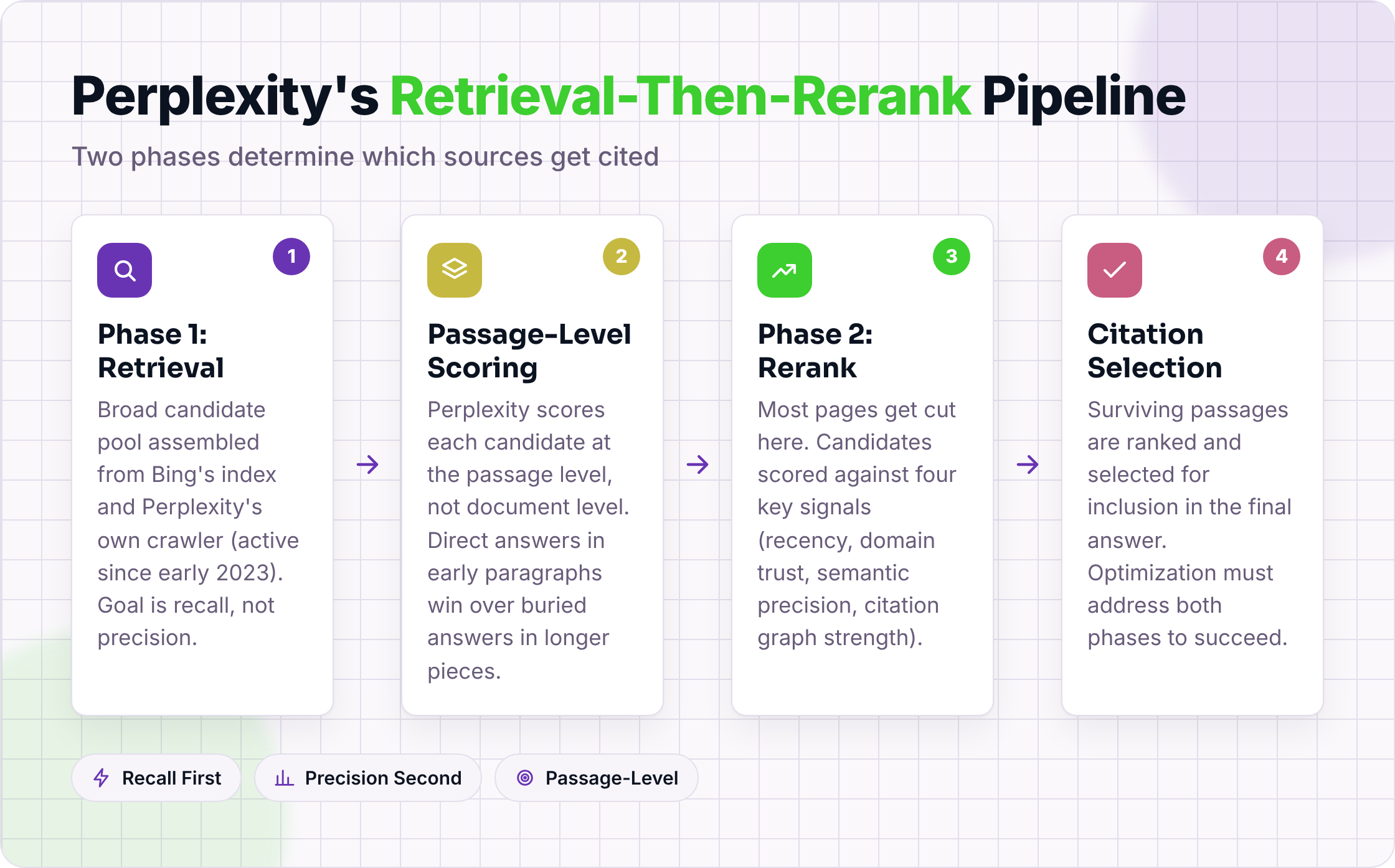
Perplexity uses a two-phase retrieval-augmented generation pipeline that first assembles a broad candidate set, then scores passages against four key signals. Understanding which phase filters content at each stage is essential for effective optimization, since a page optimized only for retrieval may still fail at re-ranking.
Phase 1: Retrieval
Perplexity assembles a broad candidate set, drawing on Bing's index for coverage and its own crawler (active since at least early 2023) for fresher or more specialized content. This phase is relatively permissive. The goal is recall, not precision. A page does not need to be perfect to make the candidate pool.
Phase 2: Rerank
This is where most pages get cut. Perplexity scores each candidate at the passage level, not the document level. A 3,000-word article that buries its direct answer in paragraph fourteen will lose to a 600-word page that leads with a clean, extractable response. Stackmatix's Perplexity SEO guide confirms that content freshness and structural clarity are weighted heavily at this stage, particularly for queries with a time-sensitive component.
The Three Scoring Dimensions
Query-answer alignment is the dominant signal. Perplexity's model scores how precisely a passage answers the specific query, not just how topically related the page is. A page about "project management software" will not score well on a query asking "which project management tools support Gantt charts for teams under 10 people" unless it addresses that specificity directly.
Source credibility factors in domain authority, citation patterns across the web, and whether the entity behind the content is recognizable in Perplexity's knowledge base. Established publishers, government domains, and peer-reviewed sources carry a structural advantage here.
Content freshness is weighted differently depending on query type. For evergreen how-to content, a well-structured page from 2022 can still rank. For queries about current events, product releases, or pricing, Perplexity strongly favors pages updated within the last 90 days.
How This Differs from Google
Google optimizes for a ranked list of pages a user might visit. Perplexity optimizes for a single synthesized answer it will deliver directly, with citations attached as evidence.
Google rewards topical authority, backlink profiles, and click-through signals accumulated over months. Perplexity rewards passage-level extractability and answer precision, often within days of a page going live. A page optimized purely for Perplexity's passage-extraction model (short, direct, answer-first) can underperform in Google's rankings, where depth, internal linking, and dwell time still carry weight.
The practical fix is structural: lead with a direct answer, then expand with supporting depth. The same page can satisfy both retrieval models without sacrificing either.
Freshness, Domain Authority, and Semantic Matching
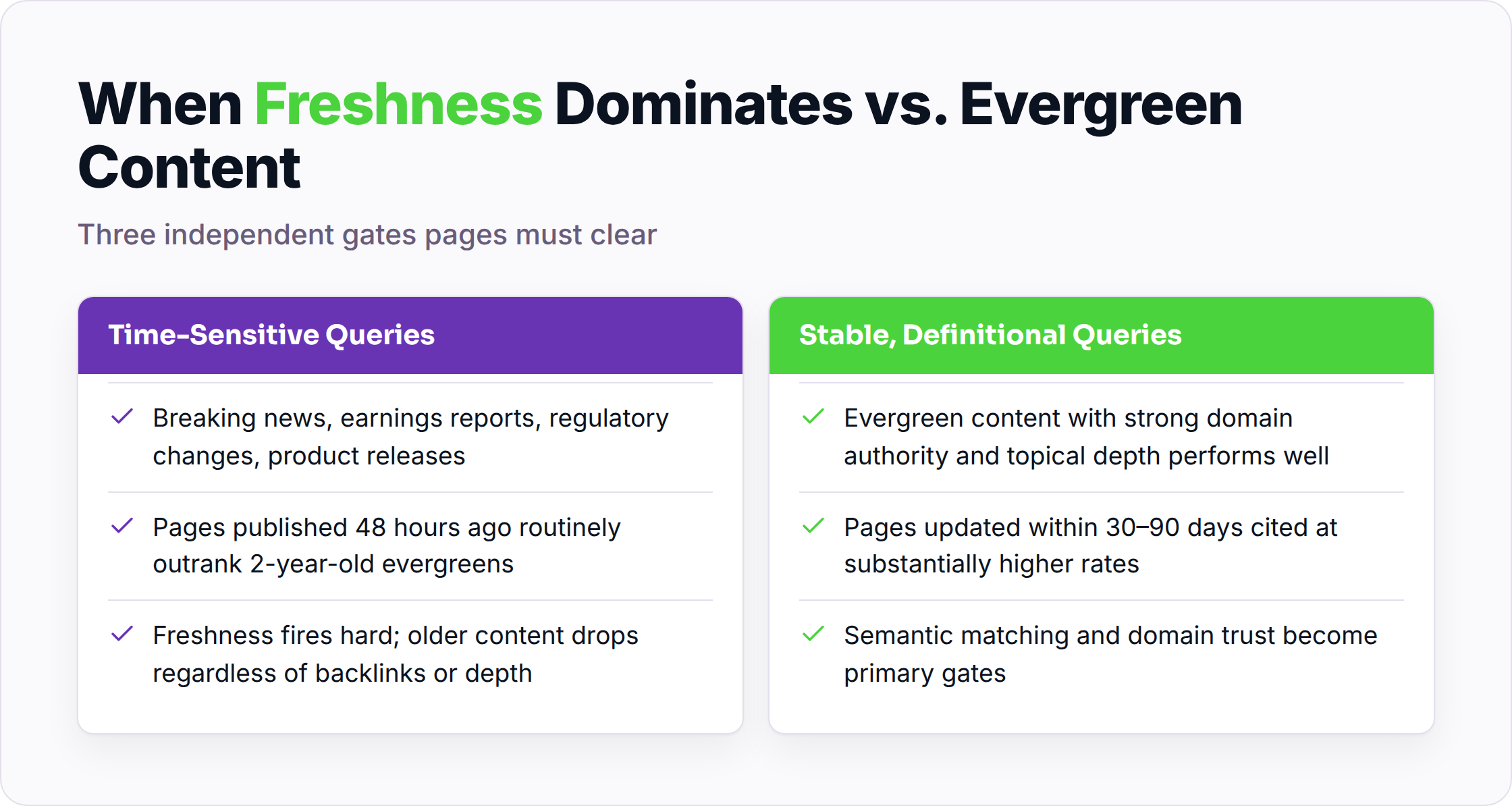
Freshness, domain authority, and semantic matching are three independent gates that pages must clear at the retrieval and re-ranking stages. A page failing any one signal rarely survives to citation, regardless of how well it performs on the others.
When Recency Dominates
Freshness is not a universal ranking factor. It fires hard on specific query types: breaking news, earnings reports, regulatory changes, and product releases. For those queries, a page published 48 hours ago routinely outranks a two-year-old evergreen, even if the older page has more backlinks and richer content.
Content updated within the last 30 to 90 days is cited at substantially higher rates across ChatGPT, Perplexity, and Google AI Overviews than older pages, per Demandlocal's analysis of AI citation patterns. For stable, definitional queries ("what is a RAG pipeline"), recency matters far less. Teams that chase freshness on evergreen topics often produce thin updates that dilute the original page's authority without meaningfully improving citation rates.
Domain Authority as a Trust Floor
Low-DA pages rarely appear in Perplexity citations, even when the content is structurally sound and semantically precise. Domain authority functions as a gate, not a ranking boost. It accounts for approximately 15% of Perplexity's ranking system, per Searchatlas's breakdown of Perplexity's weighting factors, with consistent publication quality and inbound link patterns from already-trusted sources driving that score.
This creates a compounding problem for newer publishers. A well-structured article on a low-authority domain may clear the retrieval stage but drop out at re-ranking because the trust signal is too weak. Building domain authority takes months, and there is no shortcut that works at scale. If you are trying to get cited on a new domain, prioritize earning coverage from high-authority sources before investing heavily in content volume.
How Semantic Matching Activates
Once a page clears the freshness and authority gates, semantic matching determines whether it actually gets pulled into the answer.
Entity density. Pages that name the specific entities a query references (people, products, standards, dates, organizations) score higher in retrieval than pages that describe the same topic in general terms. A page about "AI citation ranking" that explicitly names Perplexity, its RAG pipeline, and specific signal categories will outperform a page that discusses "how AI engines choose sources" in the abstract.
Direct answer placement. Perplexity's retrieval system extracts passages, not full pages. The answer to the implied question needs to appear in the first 100 to 150 words of the section, not buried in paragraph four. Answer-first structuring is a retrieval optimization, not a stylistic preference.
Structured data. Schema markup (Article, FAQPage, HowTo) gives Perplexity's crawler explicit signals about what a passage is and what question it answers. Pages without schema are not penalized outright, but pages with accurate schema have a measurable advantage in passage extraction, particularly for FAQ-type queries where Perplexity is assembling a multi-part answer from several sources.
One limitation worth naming: semantic matching breaks down when Perplexity's index has strong coverage from high-authority competitors on the same topic. Even a perfectly structured page with dense entities and clean schema will lose to a DA-80 domain that covers the same ground adequately. In those cases, the path to citation runs through differentiation: a unique data point, a named study, or a specific mechanism no competitor has documented.
How to Optimize Your Content to Get Cited
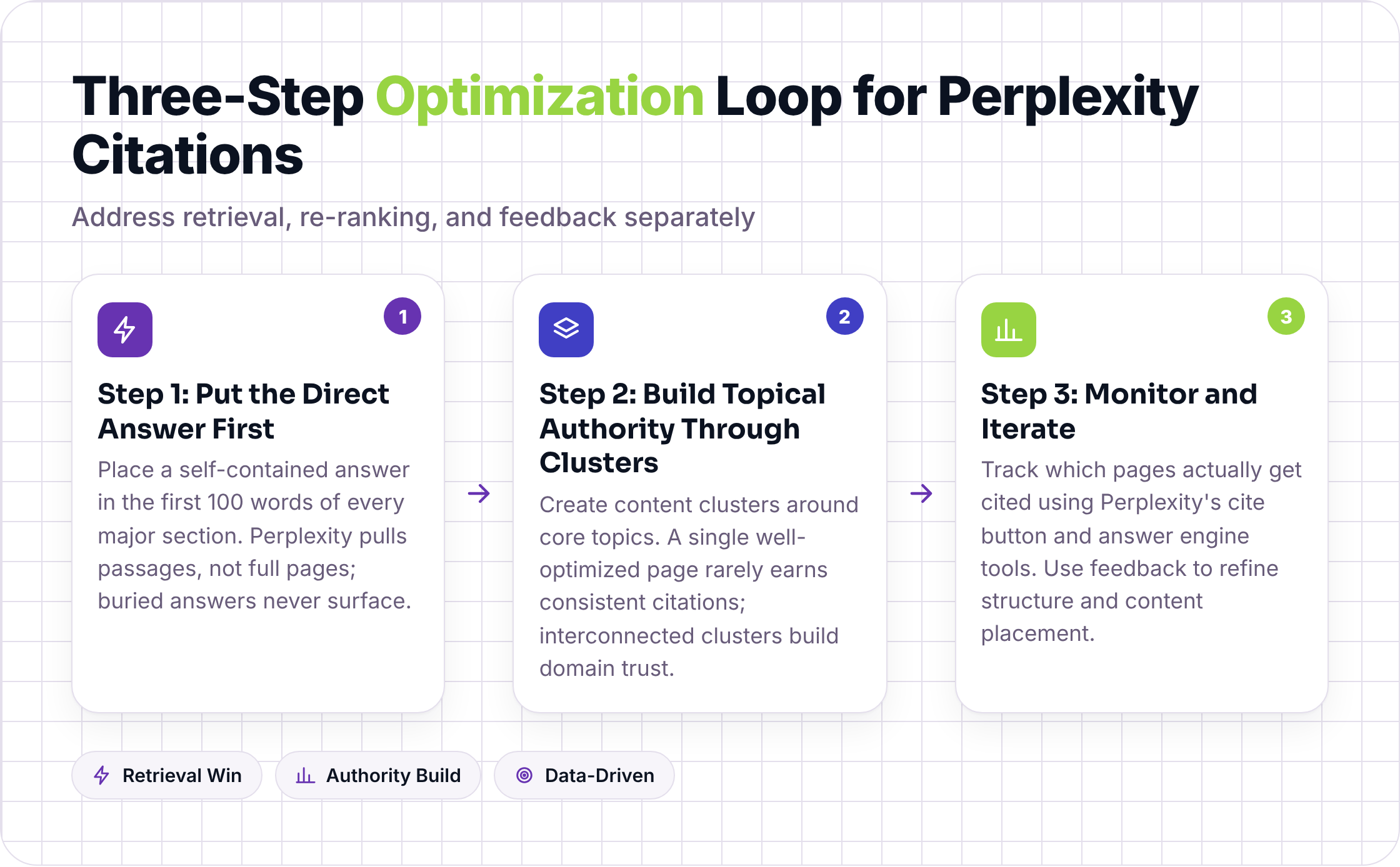
Optimize for Perplexity by placing direct answers first, building topical authority through content clusters, and monitoring which pages actually get cited. These three steps address retrieval, re-ranking, and feedback separately, creating a complete optimization loop that improves citation rates over time.
Step 1: Put the Direct Answer First
Perplexity's retrieval layer pulls passages, not full pages. If your answer is buried in paragraph six, the engine may never surface it. Place a direct, self-contained answer in the first 100 words of every major section.
A useful test: paste just the first paragraph of your section into a blank document. If it answers the query on its own, you are in good shape. If it only sets context, move the actual answer up and push the context below it.
Step 2: Build Topical Authority Through Clusters
A single well-optimized page rarely earns consistent citations on its own. Perplexity's credibility signals favor domains that cover a topic thoroughly across multiple pages, not domains that have one strong article surrounded by unrelated content.
Build a cluster of interlinked pages on one subject. A central pillar page covering the broad topic, supported by narrower pages on specific subtopics, gives Perplexity's crawler a coherent signal that your domain has genuine depth on the subject. This also accelerates the inbound citation patterns that feed the citation graph signal.
Step 3: Monitor What Gets Cited and Iterate
You cannot optimize what you do not measure. Set up a process to check which of your pages Perplexity actually cites on target queries. Run the queries manually, note which sources appear, and compare their structure to yours.
If a competitor's page is consistently cited over yours, look at three things: where their direct answer appears, what entities they name that you do not, and whether they have schema markup you are missing. Those three gaps account for the majority of cases where a structurally sound page still loses at re-ranking.
Frequently Asked Questions
Does Perplexity use Google's index to find sources?
Perplexity draws primarily from Bing's index, not Google's, supplemented by its own crawler. Its crawler has been active since at least early 2023 and indexes content independently of both major search engines. Being indexed by Bing is a practical prerequisite for appearing in Perplexity's candidate pool.
How often does Perplexity update its index?
Perplexity does not publish a specific crawl frequency, but its freshness weighting suggests it indexes new content within days for high-authority domains. For lower-authority domains, the lag can be longer. Submitting your sitemap to Bing Webmaster Tools is the most reliable way to accelerate indexing.
Does social media presence affect Perplexity citations?
There is no confirmed direct signal from social media engagement in Perplexity's ranking system. Social sharing can drive inbound links from authoritative sources, which feeds the citation graph signal indirectly. The effect is real but indirect, and it is not a reliable lever on its own.
Can a new website get cited by Perplexity?
Yes, but the bar is higher. New domains lack the domain authority and citation graph signals that established publishers carry by default. The fastest path for a new domain is earning a mention or link from a high-authority source in your niche, then publishing tightly structured, entity-dense content that directly answers specific queries. Volume alone does not compensate for low trust signals.
Does Perplexity cite paywalled content?
Perplexity can index and cite paywalled content if its crawler can access the page. Some publishers use metered access or crawler-specific exceptions that allow indexing without full public access. If your content is fully paywalled with no crawler access, it will not appear in Perplexity's candidate pool regardless of its quality.
How does schema markup affect Perplexity citations?
Schema markup (Article, FAQPage, HowTo) gives Perplexity's crawler structured signals about what a passage answers and how it is organized. Pages with accurate schema have a measurable advantage in passage extraction, particularly on FAQ-type queries. Schema does not guarantee a citation, but it reduces the ambiguity the model has to resolve on its own.
Getting Your Content in Front of Perplexity
Perplexity's citation logic rewards pages that answer precisely, come from trusted domains, and stay current on time-sensitive topics. Structural clarity and entity density matter more than word count, and domain authority functions as a gate you have to clear before any of the other signals even apply.
If you want a clearer picture of how your current content performs against these signals, visit Seorav's AEO service page to see how they approach answer engine optimization for exactly this kind of retrieval environment.
Keep reading

How to Get Your Website Into ChatGPT Search Results
Learn how to appear in ChatGPT search results: Bing indexing, robots.txt setup, schema markup, and answer-first content that earns citations.

How to Get Your Products Into AI Chatbot Shopping Suggestions
Discover tools that help improve visibility in AI chatbot shopping suggestions, from Otterly.AI to Profound, plus schema fixes and citation strategies that
When to Refresh Your Content for AI Search Engines
Learn how often to update content for AI search, with cadence by content type, signals that trigger re-indexing, and metrics that show whether your refresh