How to Get Your Website Into ChatGPT Search Results
Last updated: 30 October 2026
ChatGPT cites websites that rank well in Google, publish original research or data, and earn backlinks from authoritative sources. Getting your website into ChatGPT search results requires optimizing for traditional SEO first, since the model trains on indexed web content and prioritizes sites with established credibility. There's no direct submission process, but sites with strong domain authority, fresh content updates, and topical relevance appear more frequently in ChatGPT citations. The pattern is replicable, though inclusion remains probabilistic rather than guaranteed.
ChatGPT processes over a billion queries weekly. The pages it surfaces share three traits: crawl access for OAI-SearchBot, strong Bing index coverage, and content structured to answer specific questions directly. This article covers how ChatGPT's retrieval works, what signals determine which pages get cited, and the concrete steps to make your content eligible.
Four Things That Actually Move the Needle
Four concrete steps account for most of the variance between sites that get cited and sites that don't: verify Bing indexation, add structured data with author credentials, open every article with a direct answer, and track citations through AI-visibility tooling rather than GA4 referral traffic.
Verify Bing has indexed your pages. ChatGPT's web-browsing layer pulls from Bing, not Google. If Bing hasn't crawled a page, that page doesn't exist to ChatGPT's retrieval system. Submit your sitemap to Bing Webmaster Tools and confirm coverage before anything else. This is the step most teams skip because their Google Search Console numbers look fine.
Add structured data and authorship markup. A mid-authority site with clean schema markup and a named, credentialed author will often beat a high-DA domain that publishes anonymously. HubSpot's breakdown of ChatGPT citation factors puts third-party mentions and structured content signals ahead of raw link counts. Add Article or FAQPage schema, name your authors, and link to their credentials. Structured data alone won't carry a thin page, though. If the underlying content doesn't answer a real question with specificity, schema is cosmetic.
Open every article with a direct answer. AI retrieval systems extract passages, not pages. If your opening paragraph buries the answer under context-setting prose, the model moves to a competitor's page that leads with the answer. Put the direct, specific response in the first sentence. Everything after that is supporting evidence.
Track citation rates with AI-visibility tooling, not GA4. GA4 logs sessions. It doesn't log when ChatGPT cites your article without a user clicking through. A growing share of AI-generated answers never produce a referral visit at all, so citation frequency and organic traffic are increasingly decoupled. Dedicated AI-visibility tooling, which polls the major LLMs against your tracked prompts and parses the responses, is the only way to know whether your content is actually being cited.
How ChatGPT Search Finds and Ranks Content
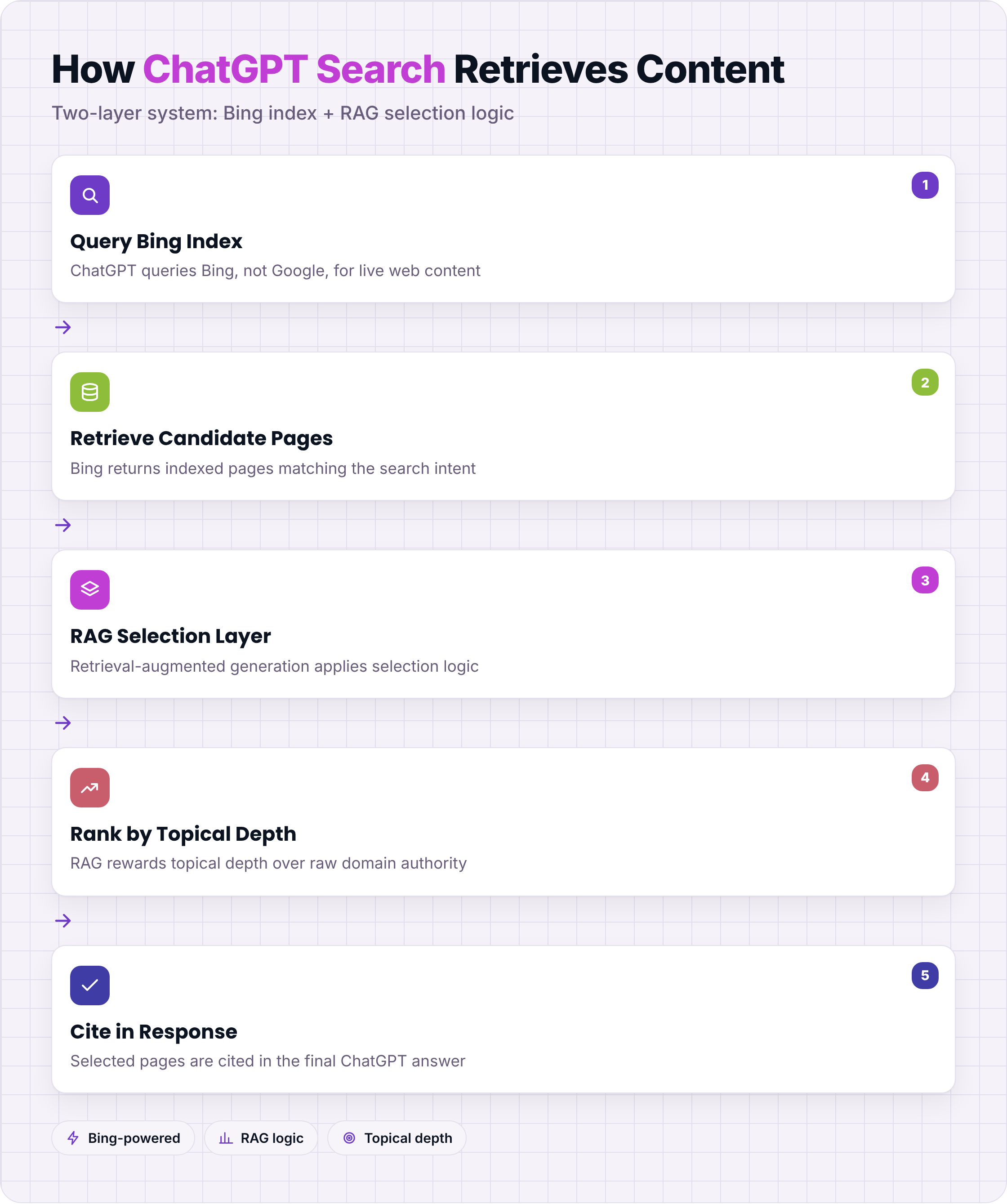
ChatGPT's search capability runs on two layers: a Bing-powered index that retrieves live web content, and a retrieval-augmented generation (RAG) system that decides which of those retrieved pages actually gets cited in the response. Getting indexed is a prerequisite, but it doesn't guarantee a citation. The RAG layer applies its own selection logic, and that logic rewards topical depth over raw domain size.
The Bing Index Is the Starting Point
When ChatGPT's browsing mode is active, it queries Bing, not Google. A page can hold a top-three Google ranking and still be invisible to ChatGPT if Bing hasn't crawled and indexed it. Confirm your pages appear in Bing Webmaster Tools and that your sitemap is submitted there, not just to Google Search Console.
The numbers put the stakes in context: Position Digital's 2025 AI search data shows ChatGPT crossed 1 billion users in May 2026, making it the fastest mobile app to reach that milestone. A meaningful share of those users are running queries that trigger live web retrieval, which means Bing indexation is now a direct traffic variable, not a secondary concern.
How the RAG Layer Selects Citations
Retrieval-augmented generation works by pulling a candidate set of pages from the index, then scoring them for relevance to the specific query before weaving selected passages into the generated answer. The model isn't choosing pages the way a human editor would. It's matching semantic content against the query's intent, then assessing whether the page's structure makes its claims easy to extract.
Pages that win citations tend to open with a direct answer to the implied question, use clear heading hierarchies that signal what each section covers, and contain specific, verifiable claims rather than hedged generalities. A page that buries its core answer in paragraph four, after two sections of background, is harder for the RAG layer to parse cleanly.
One real trade-off: optimizing heavily for RAG extraction can push writers toward overly formulaic structures. There are also query types where ChatGPT simply doesn't retrieve external sources at all. For conversational or opinion-based prompts, the model often draws from training data rather than live retrieval, so pages targeting those query types won't benefit from Bing indexation regardless of how well they're structured.
Why Topical Authority Beats Domain Authority Here
Traditional SEO assigned significant weight to a domain's overall link profile. A high-DA domain could rank a thin page on a topic it rarely covered. The RAG selection layer doesn't work that way. It evaluates the specific page against the specific query, and a focused site with 20 deep articles on one subject will frequently outperform a large publication with one surface-level overview.
Webyes's research-backed ranking analysis identifies this as a core pattern: AI engines favor sources that demonstrate consistent, detailed coverage of a topic cluster over sources that mention the topic once in passing. Building five thorough, interlinked articles on a narrow subject is more likely to earn citations than publishing one broad overview on a high-authority domain.
Topical authority also compounds. Each cited article signals to the retrieval layer that your domain is a reliable source for that subject, which increases the probability that adjacent queries pull from your pages next. The limitation is time: this compounding effect takes months to build, and a newer site entering a well-covered topic area will face a cold-start period where even well-structured content gets passed over for established sources.
Technical Requirements for ChatGPT Indexing
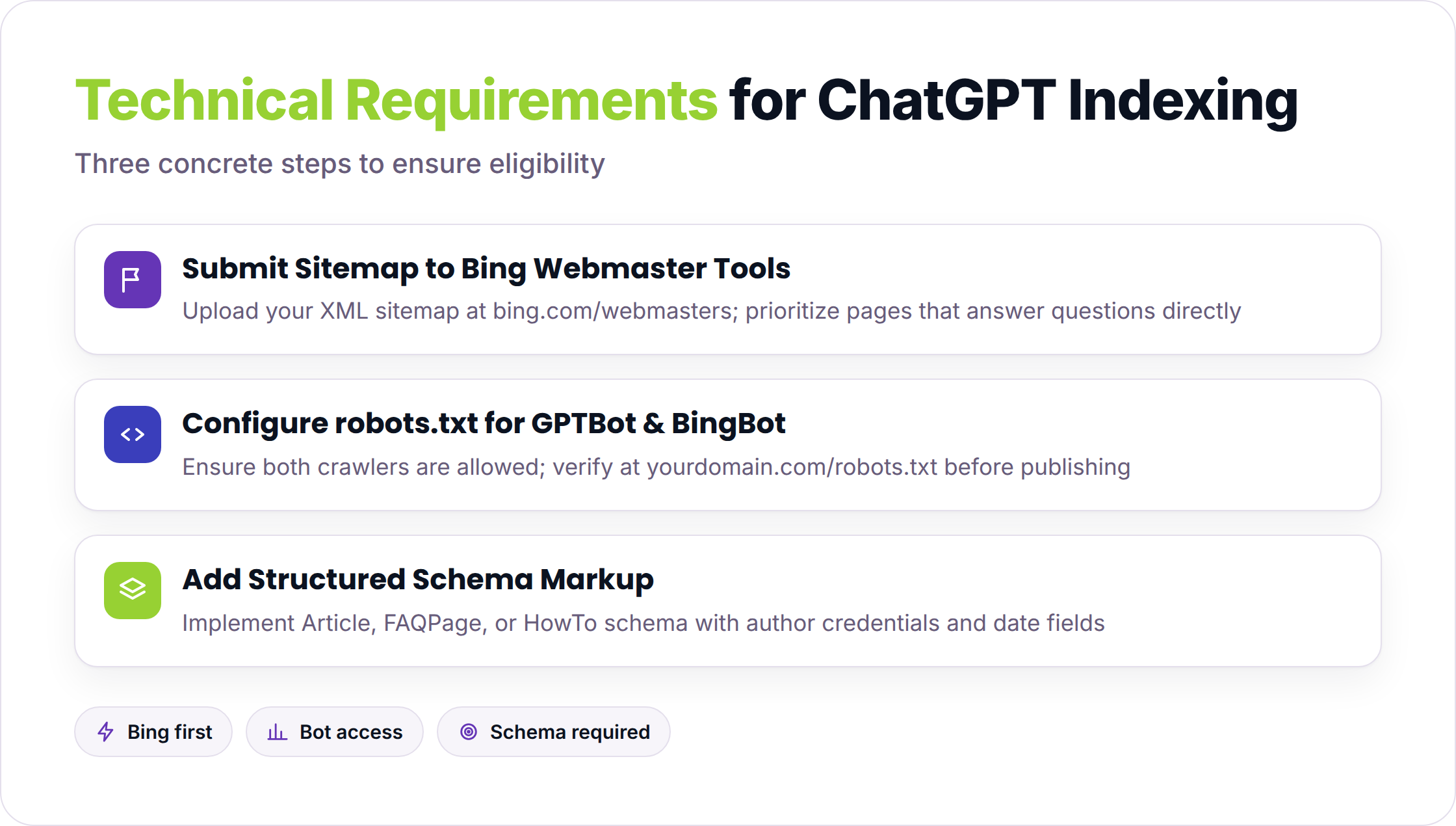
Three concrete technical steps determine whether your pages are even eligible to appear. Submit your sitemap to Bing Webmaster Tools, configure your robots.txt to allow GPTBot and BingBot, and add structured schema markup so ChatGPT's retrieval layer can parse your content's intent. Miss any one of these and your pages may be invisible to the retrieval pipeline entirely.
Bing Webmaster Tools and Sitemap Submission
ChatGPT's browsing-enabled responses pull from Bing's live index, not Google's. OpenAI confirmed ChatGPT search availability to all users in February 2025, and the retrieval layer it runs on is Bing. That makes Bing Webmaster Tools the primary submission target.
Submit your XML sitemap at bing.com/webmasters. Prioritize pages that answer specific questions directly, since those are the ones most likely to surface in a retrieval pass. Bing's crawl frequency is slower than Google's, so newly published pages can take two to four weeks to appear in ChatGPT results even after sitemap submission.
Robots.txt: Allowing the Right Crawlers
Your robots.txt file controls which bots can access your content. Two user-agents matter here:
GPTBot(OpenAI's training and retrieval crawler)BingBot(the crawler that feeds ChatGPT's live search index)
A blocking rule applied to either agent will cut your pages out of the pipeline. The correct configuration:
User-agent: GPTBot
Allow: /

User-agent: Bingbot
Allow: /
If you want to exclude certain sections from AI training but still have them cited in live retrieval, you can block GPTBot on those paths while leaving BingBot open. Pages blocked from GPTBot training may appear less frequently in responses that rely on parametric memory rather than live retrieval, so blanket blocks carry a real cost.
Schema Markup Types That Improve Citation Eligibility
Structured data does not guarantee a citation, but it makes your content structurally legible to the retrieval layer. Three schema types have the clearest impact:
| Schema Type | What It Signals | Best Used For |
|---|---|---|
Article | Authorship, publish date, topic | Blog posts, news, analysis |
FAQPage | Discrete question-answer pairs | Support pages, explainer content |
HowTo | Step-by-step instructions with named steps | Tutorials, process guides |
FAQPage schema is particularly useful because it surfaces individual Q&A pairs as discrete retrievable units. ChatGPT's retrieval layer can extract a single answer block from a page rather than needing to parse the full document. HowTo schema works similarly for procedural content, giving each step a named label the model can reference directly.
One limitation worth flagging: schema markup helps with structure, but it does not compensate for thin content. A page with FAQPage schema and two-sentence answers will still lose a citation to a competitor's unstructured page with genuinely detailed responses. Schema is a legibility layer, not a quality substitute.
Content Characteristics That ChatGPT Prioritizes
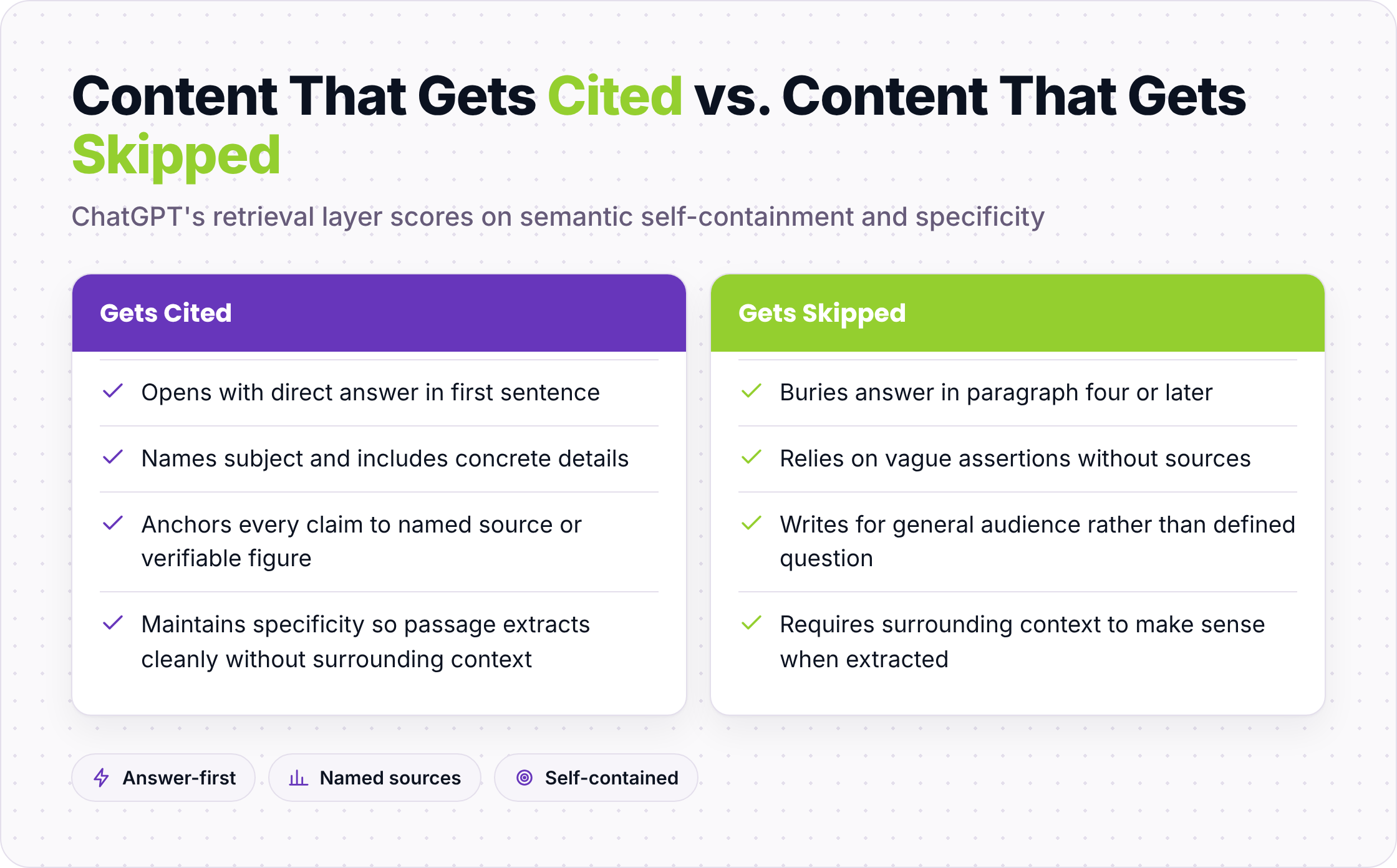
ChatGPT retrieves and cites content that opens with a direct answer, anchors every claim to a named source or verifiable figure, and maintains enough specificity that the model can extract a passage without needing surrounding context to make sense of it. Pages that bury the answer in paragraph four, rely on vague assertions, or write for a general audience rather than a defined question tend to be skipped entirely, regardless of their Google ranking.
Answer-First Structure
The opening sentence of any section you want cited should resolve the query on its own. ChatGPT's retrieval layer scores chunks on semantic self-containment: a paragraph that opens with "as we noted earlier" or "building on the above" scores near zero, because the model cannot extract it cleanly. A paragraph that opens with the direct answer, names its subject, and includes at least one concrete detail scores significantly higher.
Practically, this means restructuring pages so the conclusion leads. If a section is titled "How long should a meta description be?", the first sentence should state the character count, not warm up to it over three sentences of context.
Citing Primary Sources and Named Experts
ChatGPT's Deep Research feature explicitly prioritizes authenticated sources and trusted data when constructing responses. That preference filters down into standard ChatGPT search too: pages that cite named researchers, link to primary studies, or quote a specific figure from a dated report carry more retrieval weight than pages that make the same claim without attribution.
The practical threshold is roughly one verifiable, named claim per 200 words of body copy. "Studies show" does not qualify. "A 2024 Pew Research Center survey found that 46% of U.S. adults under 30 use AI tools for information searches" does. The specificity signals to the retrieval layer that the page is a primary or secondary source worth citing, not a summary of summaries.
Specificity Over Comprehensiveness
A common mistake is writing broad overview articles on the assumption that covering more ground increases citation chances. The opposite tends to be true. A 1,200-word article that answers one question with precision, named examples, and verifiable data will outperform a 3,000-word article that covers ten questions at surface depth.
The mechanism is straightforward: the RAG layer is matching a specific query against a specific passage. A passage that directly addresses the query's exact phrasing, with concrete details, wins the match. A passage that addresses the query tangentially, amid a lot of adjacent content, loses it.
How to Appear in ChatGPT Search Results: A Step-by-Step Checklist
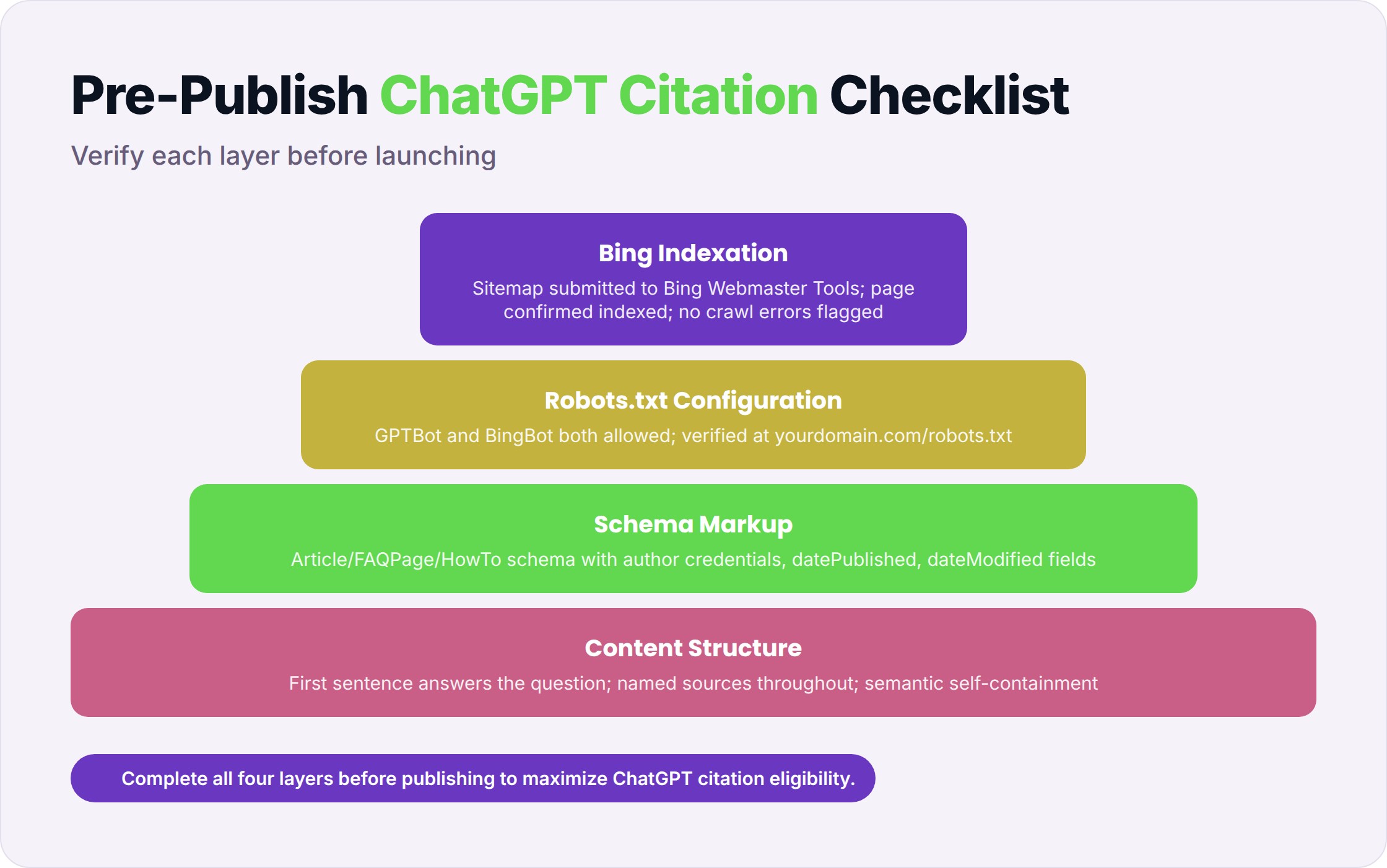
Before publishing any page targeting ChatGPT citations, verify Bing indexation, configure robots.txt to allow both GPTBot and BingBot, implement schema markup, structure content to answer questions directly in opening sentences, and include named sources with verifiable claims throughout.
Bing indexation - Sitemap submitted to Bing Webmaster Tools - Page confirmed as indexed in Bing (search site:yourdomain.com/page-slug in Bing) - No crawl errors flagged in Bing Webmaster Tools for the URL
Robots.txt - GPTBot is not blocked - BingBot is not blocked - Verify at yourdomain.com/robots.txt before publishing
Schema markup - Article, FAQPage, or HowTo schema implemented and validated via Google's Rich Results Test - Author name and credentials included in Article schema - datePublished and dateModified fields populated
Content structure - First sentence of each major section answers the section's implied question directly - At least one named, dated, verifiable claim per 200 words - No section opens with a reference to a previous section ("as mentioned above") - Heading hierarchy is logical (H2 for major sections, H3 for subsections)
Authorship and trust signals - Author byline is visible on the page - Author bio links to a credential, publication, or LinkedIn profile - At least two external citations link to primary sources (studies, official documentation, named reports)
Frequently Asked Questions
Does Google ranking affect whether ChatGPT cites my page?
Google ranking has no direct effect on ChatGPT citations. ChatGPT's live retrieval runs through Bing's index, so a page's Google position is irrelevant to whether it appears in ChatGPT search results. A page that ranks on page two of Google but is well-indexed in Bing, with strong schema and answer-first structure, can outperform a top Google result that Bing hasn't crawled.
How long does it take to appear in ChatGPT search results after submitting to Bing?
Expect two to four weeks from sitemap submission to consistent appearance in ChatGPT retrieval. Bing crawls more slowly than Google, and newly indexed pages need time to accumulate the topical authority signals that push them into citation-eligible positions. Pages on established domains with existing Bing coverage tend to appear faster than pages on new domains.
Can I block ChatGPT from training on my content while still appearing in search results?
Yes, with a trade-off. You can block GPTBot (OpenAI's training crawler) on specific paths while keeping BingBot open, which preserves your eligibility for live retrieval citations. However, pages excluded from GPTBot training may appear less frequently in responses that draw on ChatGPT's parametric memory rather than live retrieval. If live citation is your primary goal, keeping BingBot open is the critical variable.
Does ChatGPT cite every page it retrieves?
No. ChatGPT retrieves a candidate set of pages and then selects which ones to cite based on relevance, structural legibility, and source credibility. A page can be retrieved and still not appear in the final response if a competing page answers the query more precisely. Retrieval is a prerequisite; citation is a separate, higher bar.
What schema type works best for getting cited in ChatGPT?
FAQPage schema tends to perform best for informational queries because it surfaces individual question-answer pairs as discrete extractable units. HowTo schema works well for procedural content. Article schema is the baseline for any editorial content and should include author name, publish date, and topic. Using the wrong schema type for your content format is less harmful than using no schema at all, but matching schema to content type does improve extraction accuracy.
Does ChatGPT cite paywalled or gated content?
Rarely. If ChatGPT's retrieval crawler (via BingBot) cannot access the full text of a page, it cannot extract a passage to cite. Paywalled content that returns a truncated preview to crawlers will typically be skipped in favor of freely accessible pages that answer the same question. If you want citation eligibility, the content needs to be crawlable in full.
If you want a clearer picture of how your site is performing across AI search platforms, visit Seorav's GEO service page to see how they track citation rates and identify the specific gaps keeping your content out of AI-generated answers.
Keep reading

How to Get Your Products Into AI Chatbot Shopping Suggestions
Discover tools that help improve visibility in AI chatbot shopping suggestions, from Otterly.AI to Profound, plus schema fixes and citation strategies that
When to Refresh Your Content for AI Search Engines
Learn how often to update content for AI search, with cadence by content type, signals that trigger re-indexing, and metrics that show whether your refresh
How AI Search Is Changing the Business of News Publishing
AI search is cutting news publisher traffic by 35% or more. See how citation-without-click works, which content survives, and what the licensing deals actu