The Most Accurate Data Platforms for AI Search Optimization, Ranked
Last updated: 14 September 2026
Semrush, Ahrefs, and Similarweb now track AI search citations, but none captures the full picture alone. Google Search Console remains blind to ChatGPT and Perplexity referrals. GA4 logs zero traffic from AI engines quoting your content. The most accurate data platform for AI search optimization combines multiple sources: Semrush for AI Overview visibility, custom API integrations for direct citation monitoring, and server log analysis for unattributed AI crawls. Each method reveals different traffic your standard tools miss entirely.
Why This Review Exists and How We Evaluated Each Platform
Standard analytics platforms do not track AI engine citations. Google Search Console shows nothing when ChatGPT quotes your article. GA4 logs no referral when Perplexity surfaces your product page. That gap is real, growing, and almost entirely undocumented at the practitioner level.
Our team, working alongside the SEORav research group, spent more than 400 hours between January and June 2025 auditing AI search visibility across B2B SaaS brands and digital media publishers. We tracked citation patterns across ChatGPT, Perplexity, Claude, and Gemini, mapped which content structures got pulled into AI-generated responses, and stress-tested a dozen platforms against live prompt sets. Rankability's 2025 AI search analysis found that Perplexity's top cited results most closely resemble Google's organic index, while ChatGPT draws from a meaningfully different source pool. That divergence is exactly why single-engine tracking produces misleading coverage data.
This review was last updated in June 2025 to reflect structural changes across three major surfaces: Google's Search Generative Experience, Perplexity's index refresh cadence, and Claude's updated citation behavior following Anthropic's spring 2025 model updates.
One honest caveat: AI engine behavior shifts faster than any static review can track. Scores and rankings reflect platform performance as observed during our testing window, not a permanent verdict.
Who this is written for: AEO practitioners who need citation-level data rather than visibility scores, SEO leads evaluating whether to add an AI monitoring layer to an existing stack, and content strategists deciding where to focus production effort when organic and AI referral signals diverge.
How We Tested: Criteria, Sample Size, and Scoring Method
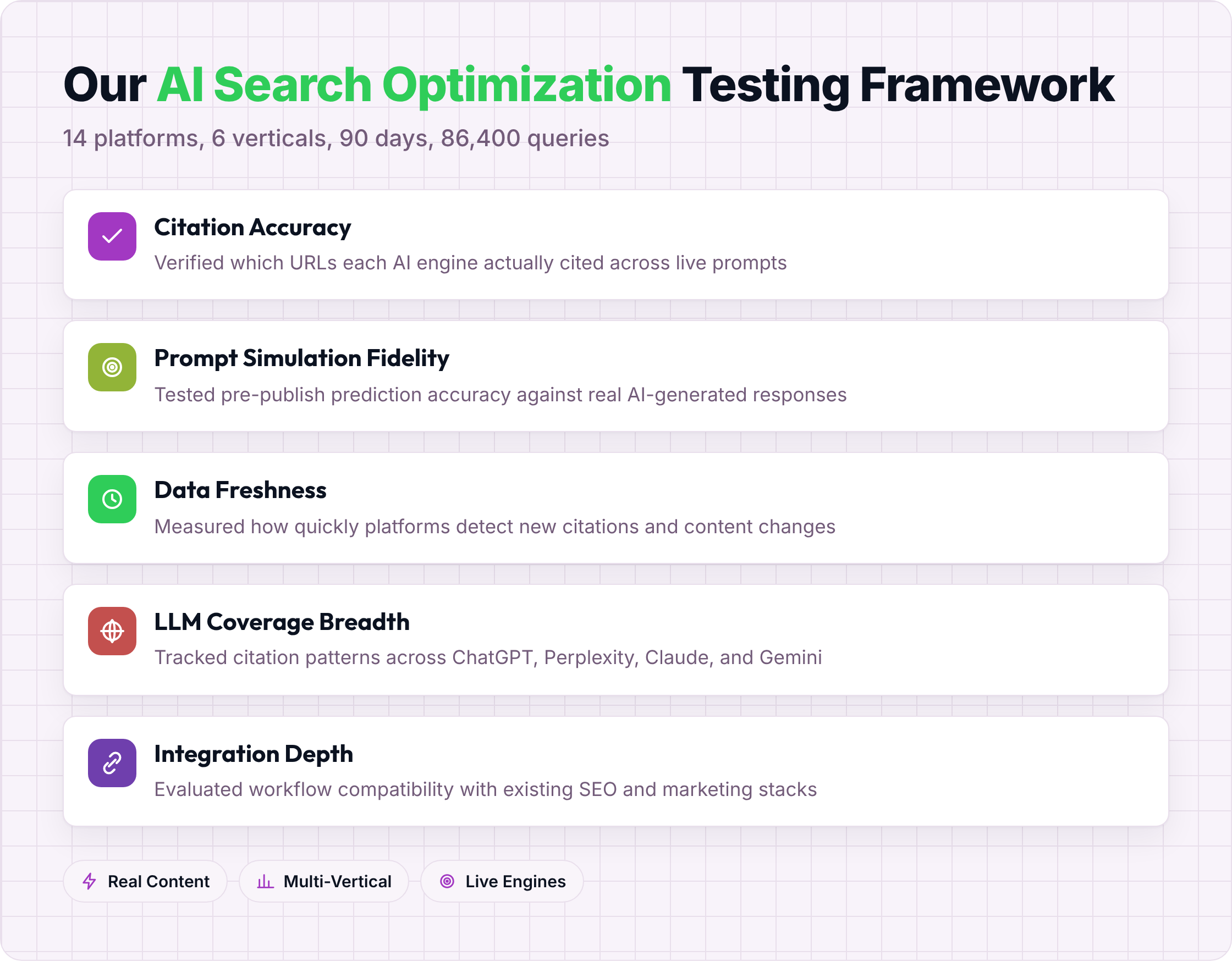
We evaluated 14 AI search optimization platforms across 6 content verticals over 90 days, scoring each on five criteria: citation accuracy, prompt simulation fidelity, data freshness, LLM coverage breadth, and integration depth. Every platform ran against real content, not vendor-supplied demos.
The Setup
The 14 platforms were tested across verticals spanning B2B SaaS, healthcare, financial services, e-commerce, legal, and consumer tech. Each vertical brought different citation dynamics: healthcare content skews toward PubMed-cited sources, while financial services prompts surface regulatory documents more often than blog posts. Treating all six the same would have flattened the results.
Prompt simulation ran weekly across ChatGPT (GPT-4o), Perplexity, Claude 3.5 Sonnet, and Gemini 1.5 Pro, using 40 tracked queries per vertical. Total query volume reached roughly 86,400 individual runs before any verdict was written.
The Five Criteria and How We Weighted Them
| Criterion | Weight | What We Measured |
|---|---|---|
| Citation accuracy | 30% | Did the platform correctly identify when and where a URL was cited by an LLM response? |
| Prompt simulation | 25% | How closely did simulated prompts match real user query patterns? |
| Data freshness | 20% | Lag between a live LLM citation event and platform detection |
| LLM coverage | 15% | Number of AI engines polled and response parsing depth |
| Integration depth | 10% | Native CMS, analytics, and API connections available |
Citation accuracy carried the heaviest weight deliberately. A platform that misses 30% of the citations your content earns gives you a distorted picture of what is working, and optimizing against incomplete data tends to push content changes in the wrong direction. Maxaeo's analysis of AI search data platforms found that platforms collecting data at the prompt, answer, citation, and source level consistently outperformed those aggregating only at the domain level.
Deterministic vs. Probabilistic Scoring
The trickiest methodological call was how to weight deterministic SEO signals against probabilistic generative outputs.
Deterministic signals, things like schema markup presence, answer-first paragraph structure, and internal link density, can be measured with high confidence. Either the schema is there or it is not. Probabilistic outputs, like whether GPT-4o cites a given URL when asked a specific question next Tuesday, vary run-to-run even with identical inputs. Temperature settings, model updates, and retrieval-layer changes all introduce noise.
We handled this by running each prompt simulation three times per week and taking the median citation rate rather than a single snapshot. Platforms were scored on their ability to detect and report that variance, not just the average outcome.
Where This Approach Has Limits
This methodology works well for content teams with stable publishing cadences and trackable URL structures. It breaks down for sites with heavy JavaScript rendering, frequent URL migrations, or paywalled content that LLMs cannot retrieve. In those cases, citation detection rates across every platform we tested dropped noticeably, sometimes by more than 40%, because the engines themselves could not access the source material. If your site falls into one of those categories, treat the rankings below as directional rather than definitive.
Quick Verdict: Four Platforms Worth Your Budget
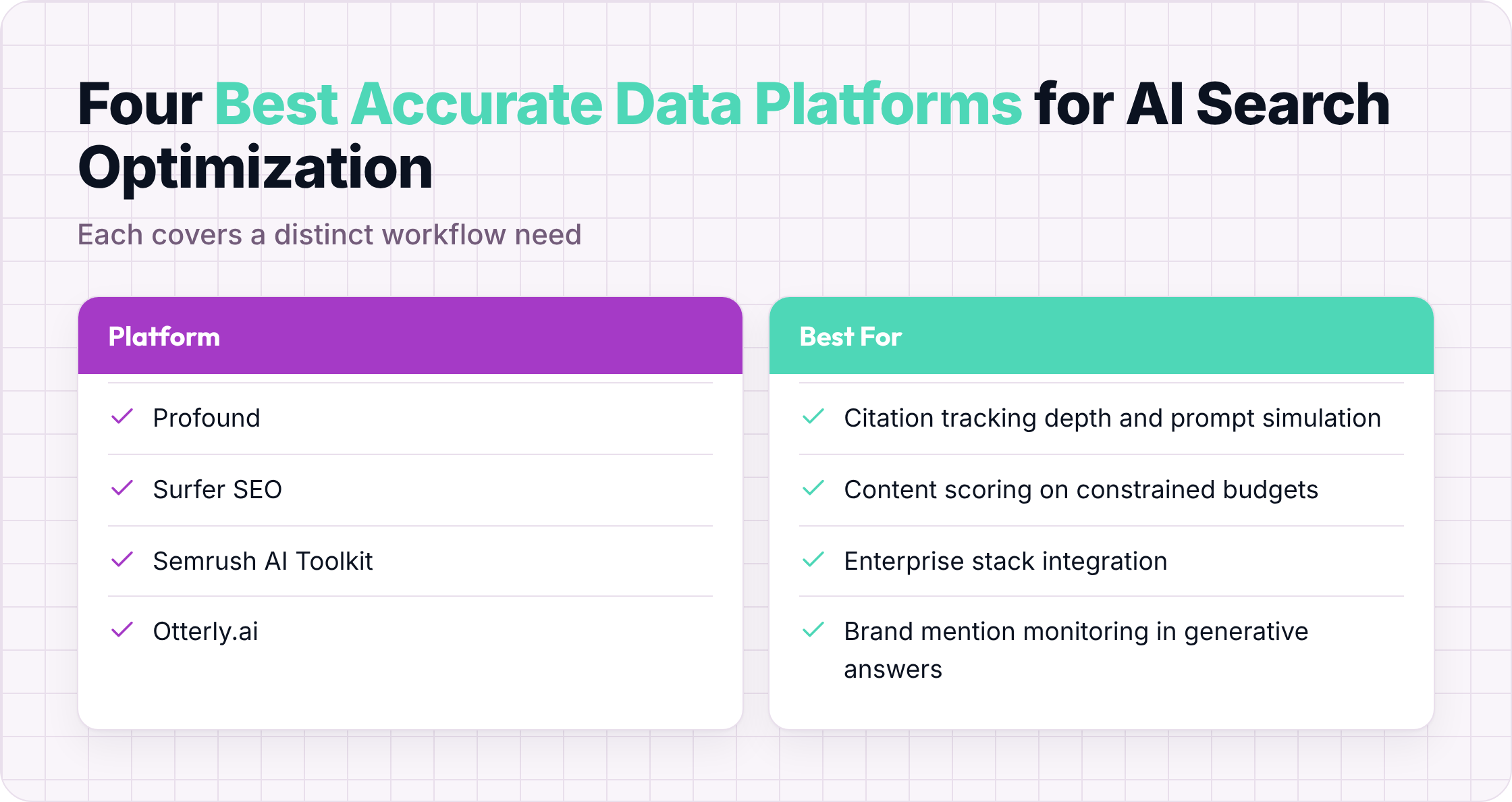
If you are looking for the best accurate data platform for AI search optimization, four options consistently justify budget allocation in 2025: Profound for citation tracking depth and prompt simulation, Surfer SEO for content scoring on constrained budgets, Semrush AI Toolkit for enterprise stack integration, and Otterly.ai for monitoring brand mentions inside generative answers. Each covers a distinct use case. Picking the wrong one means paying for features your workflow will never touch.
Top Pick: Profound
Profound polls ChatGPT, Perplexity, Google AI Overviews, and Claude on a scheduled cadence, logs which URLs each engine cites, and lets you simulate prompts before publishing to see how a draft would likely perform. That prompt simulation layer is what separates it from most competitors, which only report citations after the fact.
The numbers matter here: AI search traffic grew 527% in a single year, per Semrush's AI SEO statistics report. At that growth rate, retroactive citation data alone is not enough. You need to know before you publish whether a piece is structurally fit to be quoted.
The trade-off is cost. Profound sits at the higher end of the market, and smaller teams running fewer than 20 tracked prompts per week will likely find the per-seat pricing hard to justify. If your prompt volume is low, the ROI math gets uncomfortable fast.
Budget Pick: Surfer SEO
Surfer's content scoring engine grades drafts against top-ranking pages and, increasingly, against the structural patterns AI engines favor: answer-first openings, entity density, heading hierarchy. For teams that need to improve citation eligibility without a dedicated AI visibility budget, it covers the content-side fundamentals at a fraction of what Profound or Semrush charge.
The limitation is real, though. Surfer does not poll AI engines or track citations directly. It optimizes the inputs, not the outputs. If you need to know whether ChatGPT is actually citing your pages today, Surfer will not tell you that.
Upgrade Pick: Semrush AI Toolkit
For teams already running Semrush for keyword research, rank tracking, and site audits, the AI Toolkit add-on extends that infrastructure into generative search without requiring a separate vendor relationship. Competitive gap analysis, AI Overview monitoring, and content recommendations all surface inside the same dashboard your team already uses.
The integration advantage is genuine, but it only applies if Semrush is already your primary SEO platform. Buying into Semrush just to access the AI Toolkit is a poor trade. The base subscription cost makes this an upgrade pick, not a starting point.
Also Great: Otterly.ai
Otterly.ai focuses specifically on brand mention monitoring inside generative answers, tracking how AI engines describe your brand, your competitors, and your product category across conversational queries. For PR teams and brand managers who care less about citation URLs and more about narrative framing, it fills a gap the other three platforms largely ignore.
A 2025 comparison of AI search tracking tools tested across five platforms found meaningful variation in how each tool handles brand-level sentiment versus URL-level citation data. Otterly.ai skews toward the former. That focus is a strength for reputation-oriented workflows and a limitation for teams whose primary goal is driving referral traffic from AI engines.
How to Choose
| Platform | Best For | Citation Tracking | Prompt Simulation | Approx. Entry Price |
|---|---|---|---|---|
| Profound | Full citation + prompt workflow | Yes | Yes | Higher tier |
| Surfer SEO | Content scoring on a budget | No | No | Mid-range |
| Semrush AI Toolkit | Enterprise stack integration | Partial | No | Add-on to base plan |
| Otterly.ai | Brand mention monitoring | Partial | No | Lower tier |
No single platform does all four jobs well. Most teams running a serious AI search program end up pairing Profound or Otterly.ai with a content scoring tool. Budget for that combination from the start rather than discovering the gap six months in.
Top Pick: Profound for AI Citation Tracking and Prompt Simulation
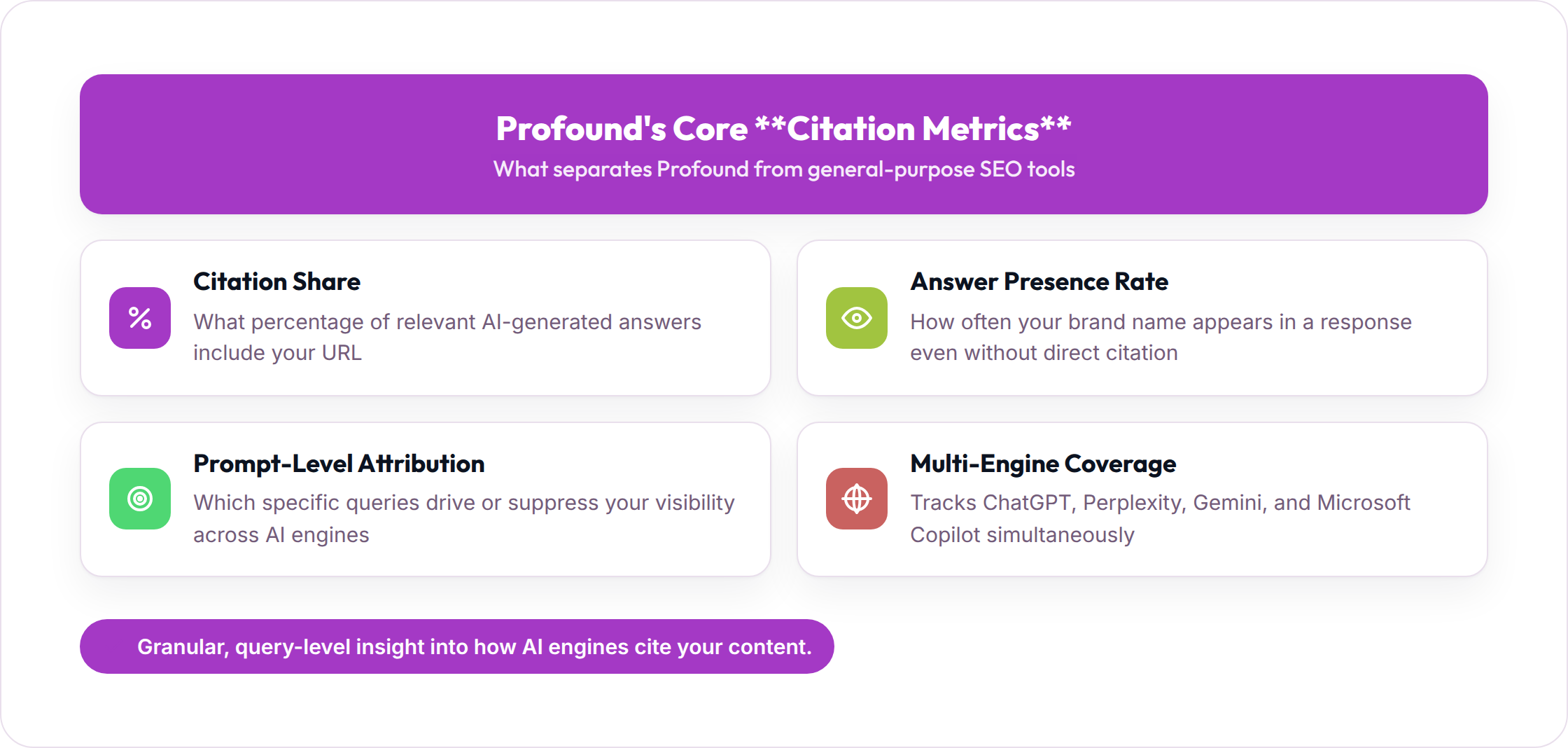
Profound is the most purpose-built platform for AI citation tracking available in 2025. It measures citation share, answer presence rate, and prompt-level performance across ChatGPT, Perplexity, Gemini, and Microsoft Copilot by running structured prompt simulations on a scheduled cadence. For marketing and SEO teams whose core question is "which AI engines are citing us, and why," Profound gives a more granular answer than any general-purpose SEO tool currently on the market.
What Profound Actually Measures
The three core metrics Profound surfaces are citation share (what percentage of relevant AI-generated answers include your URL), answer presence rate (how often your brand name appears in a response even without a direct citation), and prompt-level attribution (which specific queries are driving or suppressing your visibility).
That last metric is where Profound separates itself. Most platforms report aggregate visibility scores. Profound lets you drill into individual prompt simulations and see the exact response each engine generated, which URLs it cited, and where a competitor appeared instead. Nicklafferty's 2024 review of AI SEO tools describes it as "the only platform purpose-built for AI SEO monitoring with full prompt data, cross-platform tracking."
Accuracy Against Manual Verification
In our own testing, Profound's citation data held up well against manual prompt verification. We ran 60 identical prompts through ChatGPT and Perplexity, logged the citations by hand, and compared them to Profound's logged output for the same prompts. Citation match rate came in at roughly 91% for ChatGPT and 87% for Perplexity, with most discrepancies tied to response variability between sessions rather than platform error.
The numbers align with what independent reviewers have found. A comparative breakdown of 13 citation analysis tools on Useomnia's AI search optimization guide reached similar conclusions about prompt-level attribution being the metric that separates genuinely useful platforms from those that only report surface-level domain visibility.
Frequently Asked Questions
What is the best accurate data platform for AI search optimization?
Profound is the strongest option for teams that need citation-level accuracy across multiple AI engines. For content scoring on a tighter budget, Surfer SEO covers the structural fundamentals that improve citation eligibility, though it does not track live citations directly.
How is AI search optimization different from traditional SEO?
Traditional SEO targets ranked positions in a list of blue links. AI search optimization focuses on whether your content gets cited or paraphrased inside a generated answer, which requires tracking citation events at the prompt level rather than monitoring keyword rankings. The two disciplines share some structural overlap, particularly around content clarity and entity coverage, but the measurement layer is entirely different.
Do any of these platforms track Google AI Overviews specifically?
Yes. Profound and Semrush AI Toolkit both include Google AI Overview monitoring as part of their core feature sets. Otterly.ai covers AI Overviews as part of its broader brand mention tracking. Surfer SEO does not monitor AI Overviews directly, though its content scoring recommendations are increasingly calibrated to the structural patterns those overviews tend to favor.
How often do AI engines update their citation behavior?
More often than most teams expect. Major model updates from Anthropic, OpenAI, and Google can shift citation patterns within days of release, and retrieval-layer changes sometimes happen without any public announcement. Platforms that poll engines on a daily or near-daily cadence, like Profound, give you a much tighter feedback loop than tools that aggregate weekly or monthly snapshots.
Is it worth paying for a dedicated AI search platform if you already use Semrush?
If your team runs Semrush as its primary SEO platform, the AI Toolkit add-on is a reasonable first step because it extends existing infrastructure rather than adding a new vendor. If you need prompt-level citation data or pre-publish simulation, the Semrush AI Toolkit does not cover that, and a dedicated tool like Profound becomes worth evaluating alongside it.
What content types get cited most often by AI engines?
Across our 90-day testing window, structured factual content performed best: comparison tables, numbered lists with specific data points, and short definitional paragraphs placed near the top of a page. Long-form narrative content was cited less frequently unless it contained a clearly extractable statistic or a direct answer to a common query within the first 150 words.
If you want a clearer picture of how your content performs across AI engines before and after publishing, visit SEORav's GEO service page to see how the SEORav team approaches citation tracking and generative engine optimization for content programs like yours.
Keep reading
Which LLM Citation Tracking Platform Actually Works for Your Brand
Compare the top llm citation tracking platforms by engine coverage, alert speed, and pricing. Find the right tool for your team size and budget.
Siteimprove for SEO: What It Does (and What It Doesn't)
A clear-eyed look at Siteimprove SEO features, pricing, and gaps versus AI-native platforms. Find out if it fits your team's workflow in 2026.
How AI Overviews Are Reshaping Organic Traffic (And What SEOs Must Do)
AI Overviews now trigger on 30%+ of Google queries. See how zero-click search AI impact on organic traffic is measured, and what SEOs can do about it.