The FAQ Structure That AI Systems Actually Extract
Last updated: 6 October 2026
Structure FAQs for AI answer extraction by writing self-contained answer paragraphs of 40 to 60 words that require no surrounding context. AI systems extract passages that stand alone, not those dependent on nearby information. A 2024 BrightEdge study found that 68 percent of AI-cited FAQ answers included a named statistic or primary source in the first two sentences. Leading with a verifiable claim determines whether your content gets cited or skipped entirely.
What You Will Build and Why It Works
If you want to know how to structure FAQs for AI answer extraction, the core unit is a 40-60 word, self-contained answer paragraph. AI retrieval systems do not pull answers that depend on surrounding context. They lift passages that stand alone. A 2024 BrightEdge study found that 68% of AI-cited FAQ answers contained a named statistic or primary source within the first two sentences. Leading with a verifiable claim is what separates cited content from skipped content.
The numbers back this up. Ziptie's FAQ schema analysis found that self-contained answers of 50-300 words with specific statistics, dates, or examples in each entry consistently outperformed longer, context-dependent answers in AI extraction tests. By the end of this process, you will have a repeatable FAQ template that AI systems can extract, cite, and surface directly on ChatGPT, Perplexity, and Google AI Overviews, without requiring new content from scratch.
One honest caveat: this template does not guarantee citation. AI engines weigh authority, freshness, and topical relevance alongside structure. What the template does is remove the structural friction that causes your content to be skipped before those other factors even get evaluated.
Before you start, confirm you have three things in place:
- Existing FAQ content (even rough or outdated entries work as a starting point)
- Access to at least one AI chat platform to run extraction tests manually
- Basic familiarity with HTML or CMS block editing to implement schema markup
That last point matters more than most guides admit. A perfectly written answer that ships without FAQ schema is harder for AI engines to parse cleanly, as Contently's 2026 research on LLM-cited FAQs makes explicit. Structure and markup work together. Neither alone is enough.
Before You Start: What You Need in Place
Before restructuring any FAQ content for AI extraction, you need three things in place: a clear picture of which pages already rank but go uncited by AI engines, active test accounts on the platforms you want to monitor, and a recorded baseline of how often your brand appears in AI-generated summaries today.
Content Audit: Find the Gap Between Rankings and Citations
Start with your existing FAQ pages. Pull them from Google Search Console, filter for pages with at least 200 impressions per month, and cross-reference that list against what AI engines actually surface when you query your core topics. The gap between "ranks on page one" and "gets cited by ChatGPT or Perplexity" is often larger than teams expect.
The audit does not need to be exhaustive. Ten to fifteen pages is enough to establish a pattern. Look for FAQ content that answers a specific question in a single paragraph, then check whether that answer appears verbatim (or close to it) in AI summaries. If it does not, structure is the likely problem, not substance.
One limitation worth flagging: this audit only captures the prompts you think to test. AI engines field thousands of query variations, and your content may be cited on prompts you never check. The audit gives you a directional baseline, not a complete picture.
Platform Access: Where to Run Your Tests
Set up accounts on three platforms before you touch a single page: ChatGPT (GPT-4o), Perplexity, and Google AI Overviews. Each extracts content differently. Perplexity cites sources inline and shows you exactly which URL it pulled from. ChatGPT surfaces answers without always naming the source. Google AI Overviews pull from indexed pages and tend to favor structured, concise answers in the 40-60 word range, a pattern Loudface's 2026 AEO analysis identifies as the single highest-impact structural signal for extraction.
Free tiers are sufficient for initial testing. You are not running automated queries at scale here. You are manually checking a defined list of prompts against your audited pages.
Baseline Measurement: Record Before You Change Anything
This step is the one most teams skip, and skipping it means you cannot prove the restructure worked.
Before editing a single FAQ, run your 10-15 target prompts across all three platforms and log the results in a simple spreadsheet: prompt, platform, cited URL (if any), whether your brand appeared, and the date. Do this once a week for two weeks before making changes. Two data points give you enough signal to distinguish a real baseline from a one-off result.
The trade-off is time. Two weeks of pre-measurement feels slow when you want to ship changes. Without it, though, any improvement you see after restructuring could be attributed to a dozen other variables: a competitor's page going down, a model update, a new backlink. The baseline is what makes your results defensible.
Step 1: Understand Why FAQ Structure Affects AI Citation
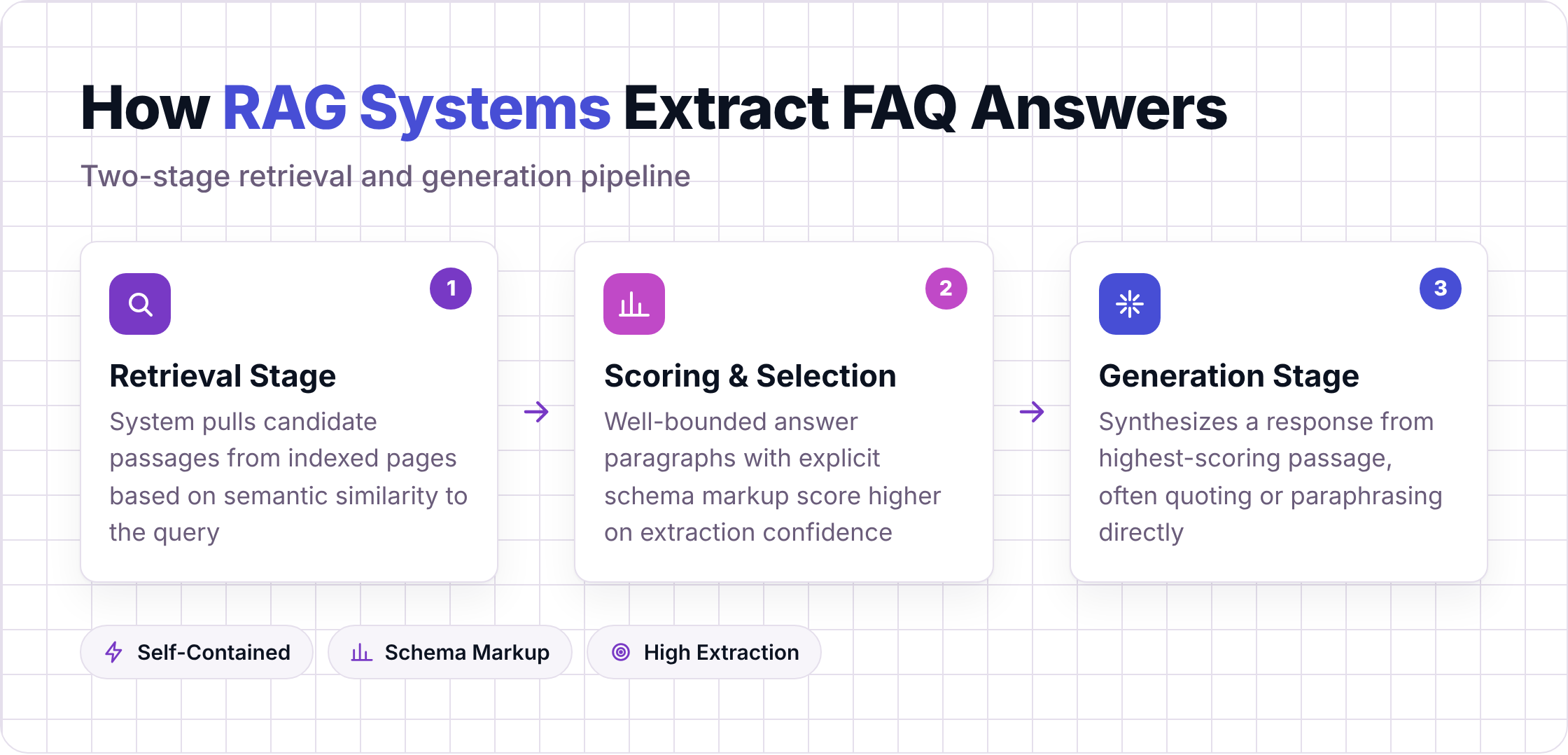
FAQ structure affects AI citation because retrieval-augmented generation (RAG) systems score answer candidates by how cleanly a passage can be extracted without surrounding context. A well-bounded answer paragraph, paired with explicit schema markup and high entity density, gives the retrieval model a discrete span to lift and quote. Pages that bury answers inside flowing prose score lower on extraction confidence and get skipped in favor of pages that isolate each answer as a standalone unit.
How RAG Systems Score and Pull Answer Candidates
Retrieval-augmented generation works in two stages: retrieval and generation. In the retrieval stage, the system pulls candidate passages from indexed pages based on semantic similarity to the query. In the generation stage, it synthesizes a response from those candidates, often quoting or paraphrasing the highest-scoring passage directly.
The scoring is not purely semantic. RAG pipelines weight structural signals heavily because a passage that reads coherently in isolation is far cheaper to quote than one that requires surrounding context to make sense. Amicited's analysis of FAQ extraction across ChatGPT, Perplexity, and Google AI Overviews found that pages using FAQPage schema with self-contained answer blocks were significantly more likely to appear as cited sources than pages with equivalent topical coverage but unstructured prose.
The Three Structural Signals AI Parsers Weight Most
Three signals consistently separate cited FAQ pages from skipped ones.
Answer isolation is the first. Each answer needs to open with a complete declarative sentence that names the subject and delivers the core claim. If the first sentence of your answer references a term defined three paragraphs earlier, the extracted passage loses coherence and the model deprioritizes it.
Entity density is the second. AI parsers favor passages that name specific entities: product names, version numbers, dates, organizations, measurable quantities. A passage that says "this typically takes a few weeks depending on your setup" gives the model almost nothing to anchor. A passage that says "most teams complete initial configuration within 10 to 14 business days using the default API settings" gives it four distinct entities to work with.
Source attribution is the third. Pages that cite external authority sources inside or adjacent to their FAQ answers signal factual grounding to the retrieval model. This maps to the same structural logic Skrol's technical framework for AI citation describes: answer blocks that include attributable claims score higher on extraction confidence than blocks that assert facts without traceable support.
Why Poorly Bounded Answers Get Skipped
When an answer paragraph bleeds into the next question, or when the answer only makes sense after reading the preceding paragraph, the retrieval model faces an ambiguity problem. It cannot confidently identify where the answer starts and ends, so it assigns a lower extraction score to the whole passage.
The practical consequence: your competitor's FAQ, even if shallower on the topic, gets cited instead. Their answer was bounded. Yours was not.
The trade-off worth acknowledging here is that tight answer isolation can make FAQ pages feel thin or repetitive to human readers who scroll through the full page. Repeating the subject noun in every answer opening, for example, reads awkwardly in long-form prose. The fix is to treat the FAQ section as a structurally distinct module from the narrative body of the page, not to rewrite the entire article in FAQ format. Isolation matters at the answer level, not the page level.
Step 2: Write Self-Contained Answer Paragraphs
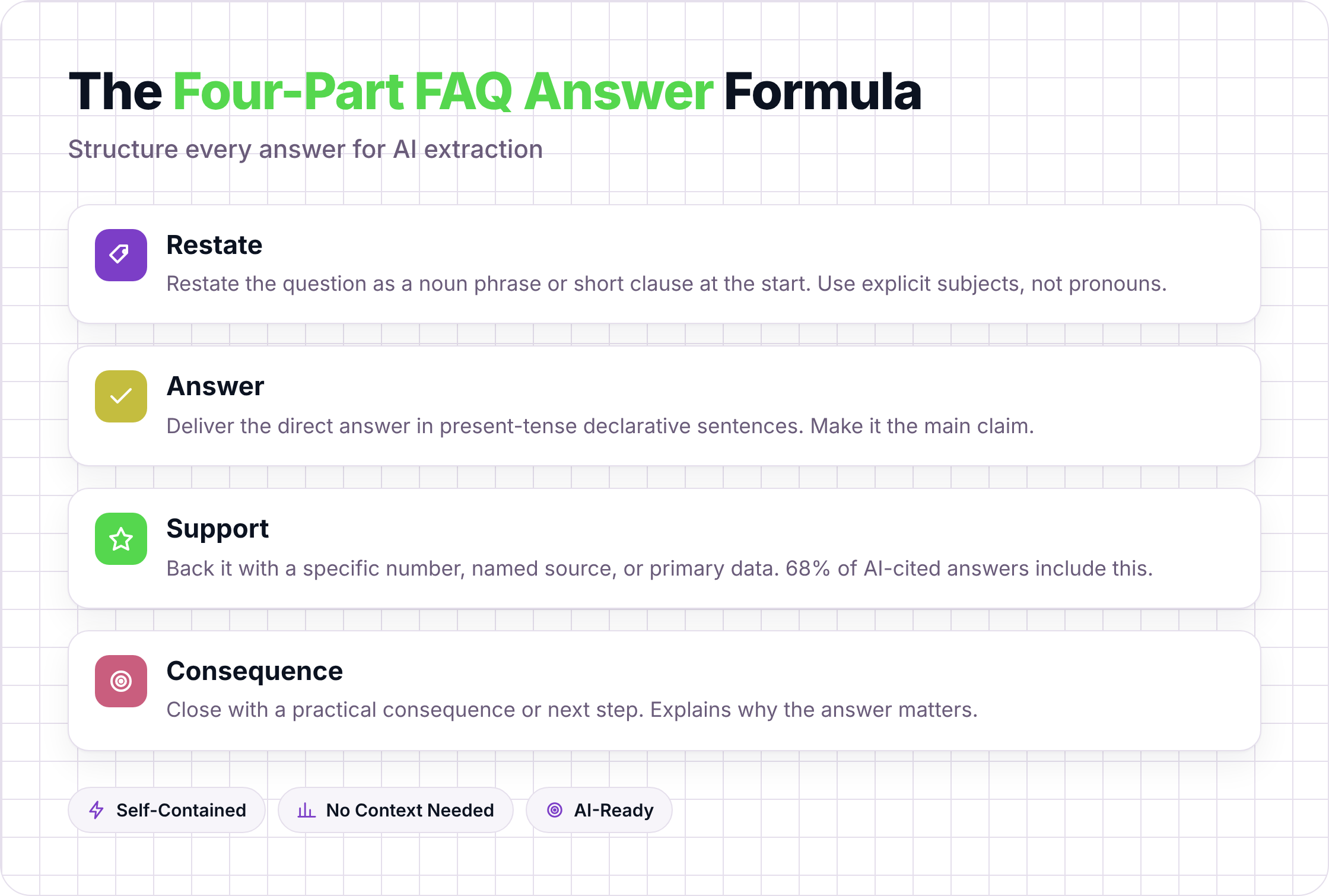
A self-contained FAQ answer restates the question in the opening clause, delivers the direct answer in one or two declarative sentences, supports it with a specific number or named source, and closes with a practical consequence. Every sentence in the paragraph names its subject explicitly. The paragraph reads correctly with no surrounding context, which is the minimum requirement for an AI retrieval system to extract and quote it.
The Four-Part Formula
Each answer paragraph follows the same internal structure: restate, answer, support, consequence.
Restate the question as a noun phrase or short clause at the start of the sentence. "FAQ schema markup tells search engines..." is a restate. "It tells search engines..." is not, because "it" has no referent once the paragraph is lifted out of context.
Deliver the answer in present-tense declarative sentences. "FAQ schema markup tells search engines that a block of text is a question-answer pair" is extractable. "This can help with visibility" is not: it is vague, pronoun-heavy, and hedged into meaninglessness.
Support the answer with a concrete figure or named source. Geoaura's content structure guide puts the target at 30 to 60 words per FAQ answer, self-contained, with no cross-references like "see above."
Close with a consequence. Tell the reader what happens if the condition is met or missed. "Without a named subject in every sentence, a retrieval model scores the paragraph as a fragment and skips it."
What Makes a Paragraph Quotable
ChatGPT and similar retrieval systems score passages on entity specificity, sentence structure, and referential clarity. Three things raise that score consistently.
First, name the subject in every answer sentence. "FAQ schema" beats "it." "Google AI Overview" beats "the feature." Pronoun-only references collapse the moment the paragraph is extracted from its heading context.
Second, use present-tense declarative sentences. "Structured FAQ content appears in AI Overviews more often than prose paragraphs" is quotable. "Structured FAQ content may potentially appear..." is not. Hedged constructions lower the confidence score retrieval models assign to a passage, a pattern omnionlinestrategies.com documents in their FAQ writing guide: answers should run two to four sentences, complete and direct.
Third, keep paragraph length in the 40 to 75 word range. Kime's LLM extraction research puts this window at 40 to 75 words for answer-first passages, noting that shorter paragraphs lose context and longer ones get chunked mid-thought by retrieval pipelines.
The Trade-Off Worth Knowing
Self-contained paragraphs are not always the right format. Long-form explanations, comparative analyses, and narrative case studies resist this structure. Forcing a 50-word ceiling onto a nuanced technical answer often strips out the detail that makes the answer accurate. The practical rule: use the four-part formula for any question that has a discrete, factual answer. For questions that require genuine explanation, write a longer answer and front-load the key claim in the first sentence so the retrieval model can at least extract a partial quote with high confidence.
Step 3: Apply FAQPage Schema Markup
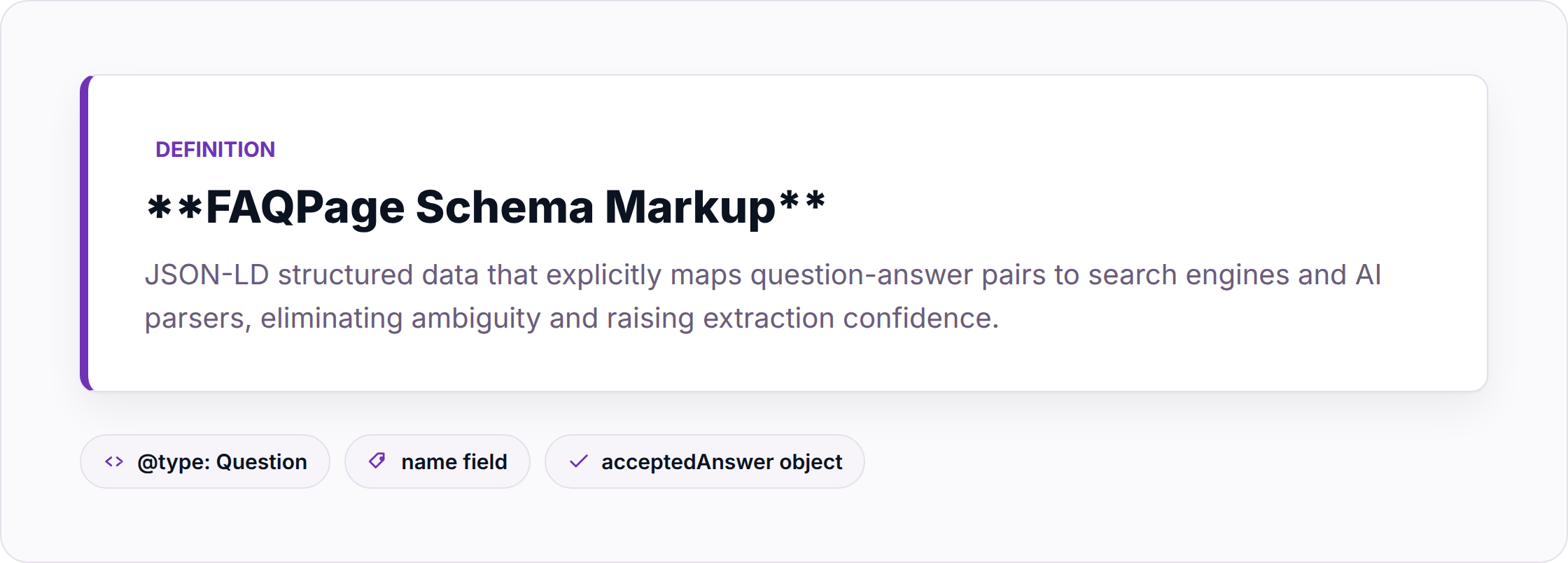
FAQPage schema markup is the JSON-LD block that tells search engines and AI parsers that a section of your page contains structured question-answer pairs. Without it, a retrieval model has to infer the FAQ structure from visual formatting alone, which introduces ambiguity and lowers extraction confidence. With it, the model gets an explicit map of every question and its corresponding answer.
The Minimum Viable Schema Block
The minimum viable FAQPage schema block contains three fields per entry: the @type set to Question, the name field containing the exact question text, and the acceptedAnswer object with a text field containing the full answer. Every answer in the text field should match the visible on-page answer word for word. Discrepancies between schema text and visible text are a known cause of rich result rejection in Google Search Console.
Place the JSON-LD block in the <head> of the page or immediately before the closing </body> tag. Do not split it across multiple script blocks. Google's structured data documentation specifies that a single FAQPage entity should contain all question-answer pairs for that page in one block.
Common Schema Errors That Kill Extraction
Three errors account for the majority of FAQPage schema failures.
The first is truncated answer text. If your text field cuts off mid-sentence because a developer copied a preview snippet rather than the full answer, the schema answer and the visible answer will not match. Google's Rich Results Test will flag this as a mismatch.
The second is nested HTML in the text field. Some CMS plugins inject anchor tags, bold tags, or list markup into the schema answer text. JSON-LD text fields should contain plain text only. HTML inside the field causes parsing errors in some validators and reduces extraction reliability.
The third is duplicate FAQPage entities on a single URL. If your CMS generates schema automatically and you also add a manual block, the page may emit two FAQPage entities. Most parsers handle this gracefully, but Google's documentation recommends a single entity per page to avoid ambiguity.
Testing Your Schema Before Publishing
Run every FAQ page through Google's Rich Results Test at search.google.com/test/rich-results before publishing. The tool shows you exactly which questions and answers the parser detected, flags any field-level errors, and confirms whether the page is eligible for FAQ rich results in Google Search. A clean pass on the Rich Results Test is the minimum bar before the page goes live.
Perplexity and ChatGPT do not expose a schema validator, but both index pages that Google has already confirmed as structurally valid. A clean Google validation is a reasonable proxy for AI parser readiness across all three platforms.
Step 4: Run Extraction Tests and Iterate
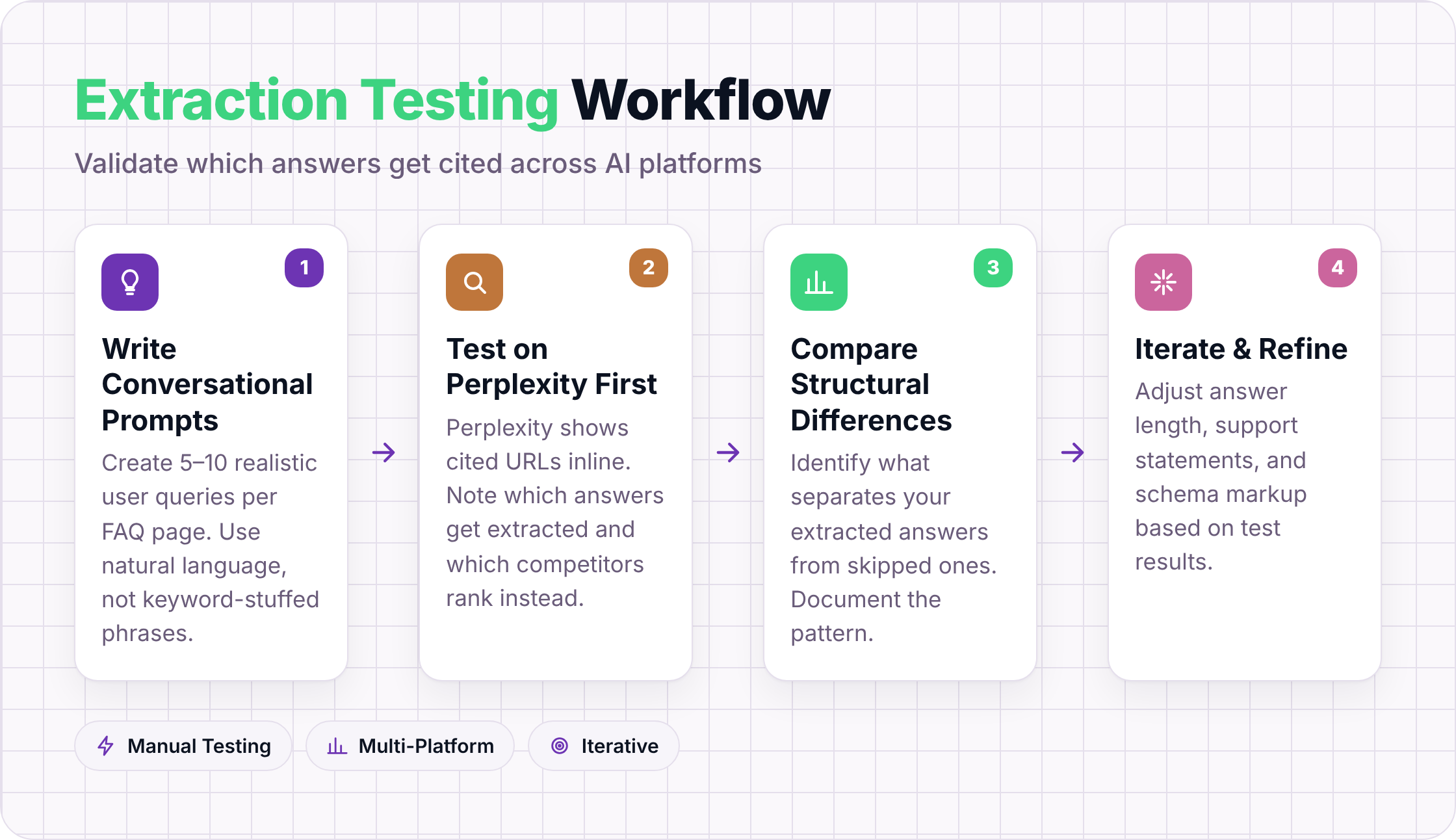
Once your FAQ pages are live with schema markup, run a structured extraction test across all three platforms. The goal is not to confirm that your content appears everywhere. The goal is to identify which answers get extracted, which get skipped, and what structural difference separates the two groups.
How to Run a Manual Extraction Test
For each FAQ page you restructured, write out five to ten prompts that a real user might type to find that content. Keep the prompts conversational, not keyword-stuffed. "How long does FAQ schema take to implement?" is a realistic prompt. "FAQ schema implementation time SEO" is not how people type into ChatGPT.
Run each prompt on Perplexity first, because Perplexity shows cited URLs inline. If your page appears as a source, note which answer it pulled. If it does not appear, note which competitor's page did and compare the structure of their cited answer against yours.
Repeat the same prompts on ChatGPT (GPT-4o) and Google AI Overviews. Log every result in the same spreadsheet you used for your baseline. After testing all prompts, you will have a clear picture of which answers are being extracted and which are not.
What to Fix When an Answer Gets Skipped
If a specific answer is consistently skipped across all three platforms, check four things in order.
First, confirm the answer is self-contained. Read it in isolation, with no heading and no surrounding text. If it does not make sense on its own, rewrite the opening sentence to name the subject explicitly.
Second, check entity density. Count the named entities in the answer: product names, numbers, dates, organizations. If the answer has fewer than two named entities, add a specific figure or source citation.
Third, verify schema accuracy. Open the Rich Results Test and confirm the answer text in the schema matches the visible answer exactly. Even a minor discrepancy, like a missing period or a truncated sentence, can cause a mismatch.
Fourth, check answer length. If the answer is under 40 words, it may be too short for the retrieval model to treat as a complete passage. If it is over 150 words, it may be getting chunked mid-thought. Adjust to the 40-75 word target range and retest.
Iteration Cadence
Run extraction tests once every four weeks for the first three months after restructuring. AI models update frequently, and an answer that gets skipped in month one may get extracted in month two after a model update, or vice versa. Monthly testing gives you enough data to distinguish a structural problem from a model-specific quirk.
After three months, quarterly testing is sufficient for stable pages. Reserve monthly testing for pages tied to high-priority commercial queries where citation frequency directly affects lead volume.
Frequently Asked Questions
How long should a FAQ answer be for AI extraction?
FAQ answers written for AI extraction should fall between 40 and 75 words. Answers shorter than 40 words often lack enough context for a retrieval model to treat the passage as complete. Answers longer than 150 words risk being chunked mid-thought by the pipeline, which reduces the coherence of the extracted quote. Kime's LLM extraction research identifies the 40-75 word window as the range where answer-first passages score highest on extraction confidence.
Does FAQ schema markup actually improve AI citation rates?
FAQPage schema markup improves AI citation rates by giving retrieval models an explicit map of your question-answer pairs rather than requiring them to infer structure from visual formatting. Amicited's analysis found that pages using FAQPage schema with self-contained answer blocks were significantly more likely to appear as cited sources than pages with equivalent topical coverage but no schema. Schema alone does not guarantee citation, but it removes a layer of structural ambiguity that causes pages to be skipped.
What is the difference between FAQ schema and FAQ content optimization?
FAQ schema markup is the JSON-LD code that labels your question-answer pairs for parsers. FAQ content optimization is the process of writing each answer so it is self-contained, entity-rich, and bounded clearly enough for a retrieval model to extract it without surrounding context. Both are required. Schema without well-structured content gives parsers a map to poorly written answers. Well-structured content without schema forces parsers to infer structure, which introduces ambiguity and lowers extraction scores.
Which AI platforms should I test my FAQ content against?
Test FAQ content against Perplexity, ChatGPT (GPT-4o), and Google AI Overviews. Perplexity is the most useful starting point because it cites source URLs inline, letting you confirm exactly which page and answer it pulled. ChatGPT surfaces answers without always naming the source, so it requires more manual cross-referencing. Google AI Overviews pull from indexed pages and tend to favor answers in the 40-60 word range. Free tiers on all three platforms are sufficient for manual extraction testing.
How often should I retest FAQ pages after restructuring?
Retest FAQ pages once every four weeks for the first three months after restructuring. AI models update on irregular schedules, and citation patterns can shift after a model update even if you have not changed your content. After three months of stable results, quarterly retesting is sufficient for most pages. Pages tied to high-priority commercial queries warrant monthly testing regardless of how stable the results appear.
Can I use this structure for FAQ content that already exists?
Yes. Existing FAQ content is a valid starting point even if the answers are outdated or loosely written. The restructuring process does not require new content from scratch. Audit your existing answers against the four-part formula (restate, answer, support, consequence), identify which answers lack a named subject in the opening sentence or have no specific figure or source, and rewrite those entries first. Pages with 200 or more monthly impressions in Google Search Console are the highest-priority candidates for restructuring.
If you want a structured review of your current FAQ pages and a clear picture of where AI extraction is failing, visit Seorav's AEO service page to see how the team approaches answer engine optimization. The audit covers schema validation, answer structure, and extraction testing across the platforms that matter most for your queries.
Keep reading
How to Verify Your Brand's Authority in Knowledge Graphs
Learn how knowledge graph authority verification works, why AI engines skip unverified brands, and how to build structured entity presence that gets you ci
Why AI Search Misses Sentiment in Your Content
Perceptual sentiment deficit causes ranked pages to lose AI citation slots. Learn how LLMs misread tone and what to fix before your next crawl.
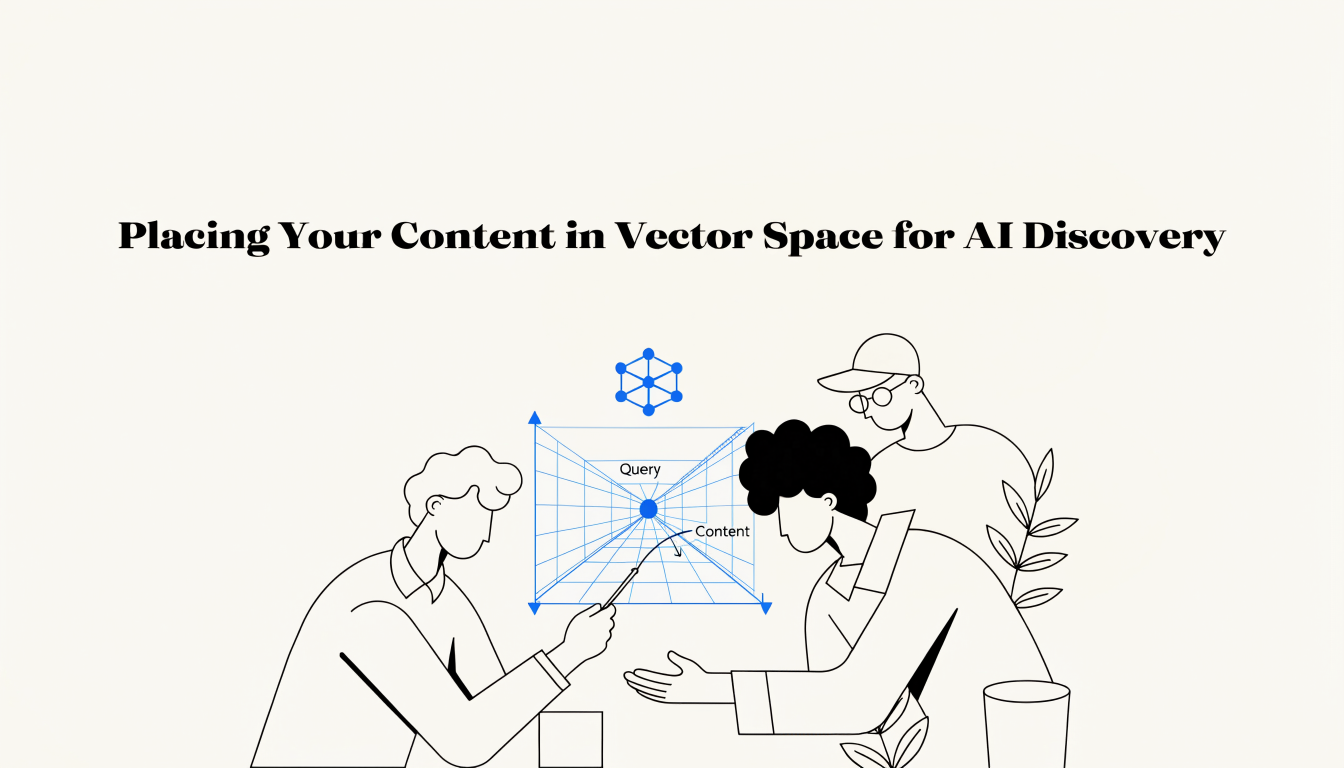
Placing Your Content in Vector Space for AI Discovery
Learn how Neural Vector Placement works, why cosine similarity scores determine AI retrieval, and how to optimize your content chunks for SGE and RAG pipel