The Best CMS Platforms for Enterprise B2B Companies
Last updated: 25 November 2026
Sitecore, Contentful, and Adobe Experience Manager dominate enterprise B2B deployments because they handle multi-site governance, deep CRM integration, and role-based access controls that procurement teams require. Each excels in different areas: Sitecore leads in personalization at scale, Contentful prioritizes headless flexibility, and Adobe bundles marketing automation tightly with content management. If your vendor shortlist lacks at least two of these names, you may be evaluating mid-market tools against enterprise-grade problems that will surface during implementation.
Which CMS Is Best for Enterprise-Level B2B Companies?
For most enterprise B2B companies, Sitecore, Contentful, and Adobe Experience Manager are the platforms that consistently meet the full requirements: multi-site governance, deep CRM and marketing automation integrations, granular role-based permissions, and the kind of vendor SLA that a procurement team can actually sign off on. If your shortlist has fewer than two of those three names on it, you may be evaluating mid-market tools against enterprise-scale problems.
Five Criteria That Separate Enterprise-Grade CMS from Mid-Market Tools
The gap between enterprise and mid-market CMS shows up in five specific areas, not in raw feature count.
| Criterion | Enterprise-Grade | Mid-Market |
|---|---|---|
| Multi-site and multilingual management | Native, with shared asset libraries and locale-specific workflows | Plugin-dependent or manual |
| Permissions and governance | Role-based access with audit logs and approval chains | Basic user roles |
| Integration depth | Pre-built connectors for Salesforce, SAP, Marketo, and headless APIs | REST API, limited native connectors |
| Security and compliance | SSO, SOC 2 Type II, GDPR tooling, SLA contracts | Varies; often self-managed |
| Scalability | CDN-backed, multi-region, 99.9%+ uptime guarantees | Shared hosting or self-hosted |
A 2026 LinkedIn analysis of enterprise CMS selection criteria found that multi-site management and CRM integration rank as the two most cited requirements among large B2B organizations evaluating platforms. That tracks. B2B companies typically run product lines, regional sites, and partner portals simultaneously, and a CMS that cannot manage all three from a single control plane creates editorial debt fast.
Why Your Existing Stack Matters More Than Vendor Rankings
Vendor comparison charts rank platforms in isolation. Your buying decision cannot afford to.
A company already running Salesforce Marketing Cloud and SAP Commerce will get more usable value from Adobe Experience Manager's native connectors than from a platform that requires custom middleware to bridge the same gap. Contentful's headless-first architecture, on the other hand, fits teams that have already invested in a composable stack and want the CMS to behave like a content API rather than a monolithic publishing tool.
No single platform wins every scenario. AEM carries significant implementation cost and typically requires a certified partner to deploy. Sitecore's licensing model is not light. Contentful's content modeling flexibility is real, but it shifts more configuration work onto developers than some editorial teams expect. The enterprise CMS landscape for leading brands reflects this: the platforms that support complex digital ecosystems do so because they are built to be configured, not because they work out of the box.
Start with your integration requirements, your editorial team's technical fluency, and your deployment model (cloud-managed vs. self-hosted). The right platform follows from those answers. A tool like SEORav can help you audit how well your current content infrastructure is performing before you commit to a migration, but the stack audit comes first.
Enterprise CMS Platforms at a Glance: Master Comparison Matrix
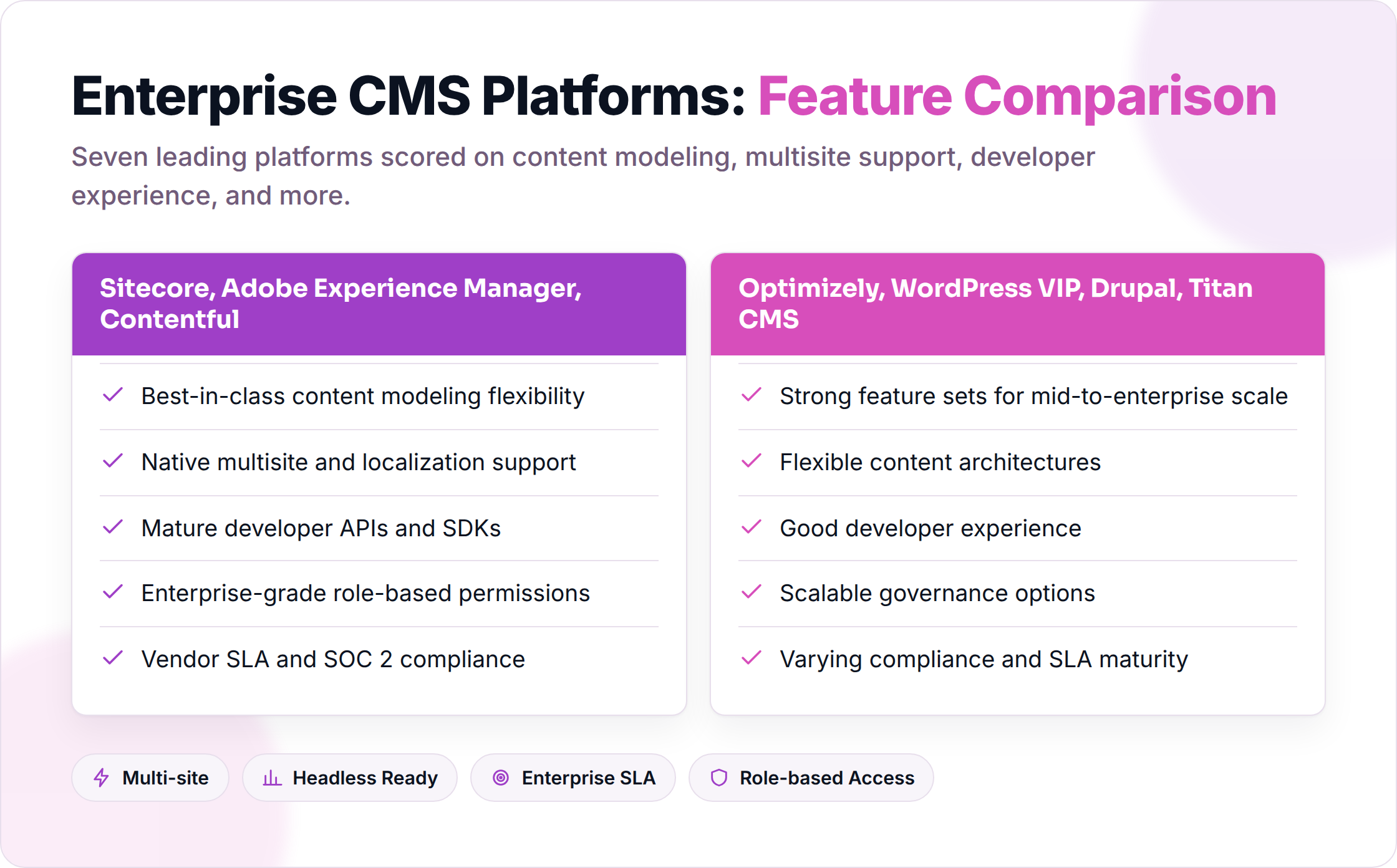
Seven enterprise CMS platforms dominate B2B shortlists in 2026: Sitecore, Adobe Experience Manager, Contentful, Optimizely, WordPress VIP, Drupal, and Titan CMS. Each targets a distinct profile of team size, technical depth, and budget. The matrix below maps them across the attributes that actually drive selection decisions.
How to Read This Matrix
Each platform is scored across six attributes on a 1-5 scale, where 5 is best-in-class for enterprise B2B use. Scores reflect a composite of vendor documentation, independent analyst coverage, and practitioner benchmarks. The attributes are:
- Content modeling flexibility: How well the platform handles structured, headless, or hybrid content architectures.
- Multisite and localization: Native support for multiple brands, regions, and languages from a single instance.
- Developer experience: API quality, SDK maturity, local development tooling, and deployment options.
- Editorial UX: How fast a non-technical editor can publish, preview, and manage workflows without developer involvement.
- Security and compliance: SSO, role-based access, audit logging, SOC 2 / GDPR readiness.
- Total cost of ownership: Licensing, implementation, and ongoing maintenance burden relative to delivered value.
One honest limitation upfront: TCO scores are the hardest to pin down. Implementation costs for platforms like AEM or Sitecore routinely run 3x to 5x the annual license fee depending on system integrator choice and existing infrastructure. A score of 3 here does not mean "affordable," it means "average complexity for enterprise tier." Teams with lean engineering capacity should weight the developer experience and editorial UX columns more heavily than the raw TCO score.
For context on timelines: ButterCMS's enterprise CMS analysis puts implementation timelines for full-featured enterprise deployments between 6 and 18 months, a range wide enough to materially affect budget planning.
Platform-by-Platform Attribute Grid
| Platform | Content Modeling | Multisite + L10n | Developer Experience | Editorial UX | Security + Compliance | TCO |
|---|---|---|---|---|---|---|
| Sitecore | 4 | 5 | 3 | 4 | 5 | 2 |
| Adobe Experience Manager | 4 | 5 | 3 | 3 | 5 | 1 |
| Contentful | 5 | 4 | 5 | 3 | 4 | 3 |
| Optimizely | 4 | 4 | 3 | 4 | 4 | 2 |
| WordPress VIP | 3 | 3 | 4 | 5 | 4 | 4 |
| Drupal | 5 | 5 | 4 | 2 | 5 | 3 |
| Titan CMS | 3 | 3 | 3 | 4 | 3 | 5 |
A few patterns stand out.
Contentful and Drupal both score 5 on content modeling, but for opposite reasons. Contentful gets there through a clean API-first architecture that lets developers define content types without touching a database schema directly. Drupal earns it through decades of contributed modules and a configuration system that can model almost any content relationship, though that flexibility comes with a steeper editorial learning curve, reflected in its editorial UX score of 2.
AEM and Sitecore sit at the expensive end of the TCO column (scores of 1 and 2 respectively), and that gap is real. Motiontactic's comparison of top enterprise CMS platforms notes that enterprise CMS solutions built around deep personalization and workflow require significant ongoing investment in both tooling and specialist talent, not just the initial license. Organizations without a dedicated digital experience team should factor that into any AEM or Sitecore evaluation before the procurement conversation starts.
WordPress VIP scores highest on editorial UX (5) because the underlying WordPress editor is what most content teams already know. The trade-off is content modeling flexibility: WordPress's block-based approach works well for page-level content but becomes awkward when you need deeply structured, reusable content objects across channels. Teams running a pure publishing operation will find it excellent. Teams building a headless content layer feeding multiple front-ends will hit its ceiling faster than the score suggests.
Titan CMS earns its TCO score of 5 by targeting mid-market B2B organizations that need a managed, opinionated platform without the overhead of a Sitecore or AEM implementation. The limitation is scope: it does not compete on content modeling depth or developer extensibility, and organizations expecting to scale into complex personalization or commerce integrations will likely outgrow it.
Drupal's multisite and compliance scores (both 5) reflect its long track record in regulated industries and government deployments. The open-source enterprise CMS landscape analysis from Useryze confirms Drupal remains the safest open-source pick for organizations where security audits and long-term community support are firm requirements. The cost is editorial friction: content teams without CMS training consistently rate Drupal's authoring interface as the least intuitive of the seven platforms here.
How to Choose the Right Enterprise CMS: A Decision Framework
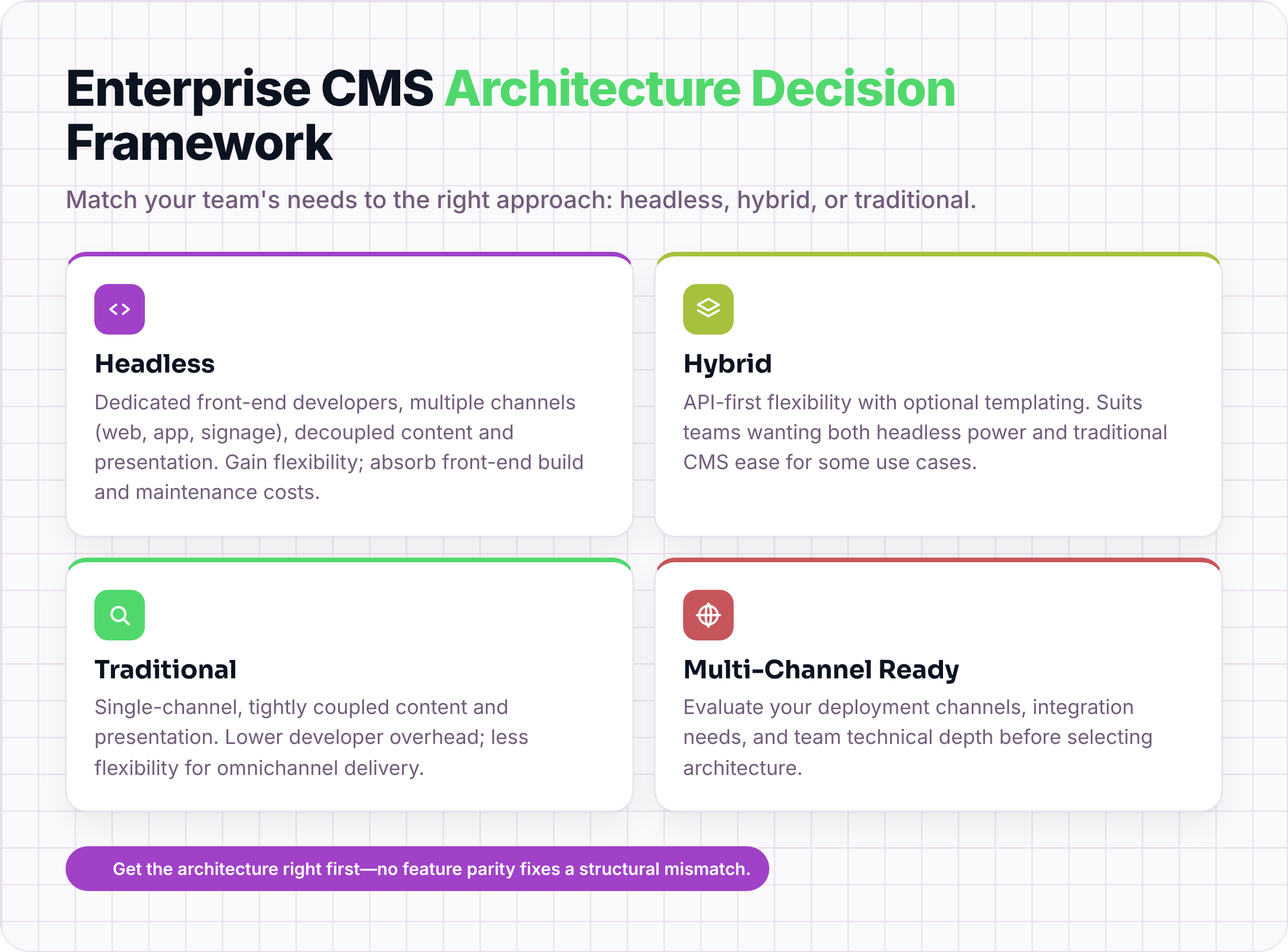
Choosing the right enterprise CMS starts with architecture, not features. The core question is whether your team needs a headless, hybrid, or traditional CMS, and that answer depends on how your developers deploy content, how many channels you serve, and how tightly your CMS must integrate with your existing marketing and commerce stack. Get the architecture wrong and no amount of feature parity fixes the mismatch.
Headless vs. Hybrid vs. Traditional: The Architecture Decision
The decision tree is simpler than most vendor decks suggest.
Headless fits teams with dedicated front-end developers, multiple delivery channels (web, app, digital signage, partner portals), and a need to decouple content from presentation. You gain flexibility; you absorb the cost of building and maintaining your own front-end layer.
Hybrid suits organizations that want API-first flexibility for some channels but still need a built-in rendering layer for their primary web presence. Most mid-to-large B2B teams land here.
Traditional (coupled) works when your content team is non-technical, your channel footprint is a single website, and speed-to-publish matters more than front-end control.
Brightspot's enterprise CMS shortlist criteria make the case that starting with a vendor shortlist gets the evaluation backwards. Define your architecture requirements first, then filter vendors, not the other way around.
Matching Platform Capabilities to B2B Buyer Journey Complexity
B2B buyer journeys are longer and more content-intensive than B2C. A typical enterprise deal involves 6 to 10 stakeholders and spans months, which means your CMS needs to serve gated content, account-specific personalization, multi-language variants, and integration with your CRM and marketing automation in parallel.
Map your content operations against three checkpoints before shortlisting:
- Workflow depth. Can editors route content through multi-stage approvals with role-based permissions? B2B compliance and legal review requirements make this a hard requirement at scale.
- Personalization hooks. Does the platform expose APIs or native rules that let you serve different content to a CFO versus a technical evaluator visiting the same URL?
- Integration surface. How many native connectors exist for your existing stack (Salesforce, Marketo, CDP)? Custom connectors add months to implementation timelines.
The trade-off is real. Platforms with deep personalization and workflow capabilities, Sitecore and Optimizely being the common examples, carry implementation timelines of 6 to 18 months and six-figure services costs. If your content operation is smaller than 10 editors or your buyer journey is relatively linear, that overhead erases the capability gain. A lighter hybrid platform often delivers 80% of the value at 30% of the cost and timeline.
Red Flags in Vendor Demos
Vendor demos are optimized to impress, not to reveal limitations. Watch for these signals that a platform is a poor enterprise fit:
- The demo runs entirely in a pre-built sandbox. Ask to see a live customer environment or a raw content model, not a polished showcase.
- The vendor cannot name a reference customer in your industry with a comparable integration footprint.
- Multisite setup requires a separate license or a professional services engagement to activate.
- The "out-of-the-box" personalization demo relies on a third-party tool that is sold separately.
- Implementation timelines quoted are under six months for a full enterprise deployment. That number is almost always wrong.
Frequently Asked Questions
What makes a CMS "enterprise-grade" for B2B?
Enterprise-grade means the platform can handle multi-site management, role-based permissions with audit trails, and native integrations with CRM and marketing automation tools like Salesforce or Marketo. It also means the vendor offers contractual SLAs, SOC 2 Type II compliance, and a support tier that goes beyond a community forum. Mid-market platforms can check some of those boxes, but rarely all of them at the scale a large B2B organization requires.
How long does an enterprise CMS implementation typically take?
Most full-featured enterprise CMS deployments take between 6 and 18 months from contract to go-live, according to ButterCMS's enterprise platform analysis. The wide range reflects differences in integration complexity, data migration scope, and whether your team is working with a certified system integrator or handling implementation internally. Budget for the longer end if you are migrating from a legacy platform with significant content volume.
Is Contentful a good fit for enterprise B2B?
Contentful works well for enterprise B2B teams that have already committed to a composable, API-first architecture and have front-end developers who can build and maintain the presentation layer. Its content modeling flexibility and developer experience are best-in-class. The limitation is editorial UX: non-technical content teams often find the interface less intuitive than WordPress or Sitecore, and the platform requires more developer involvement to configure workflows than some organizations expect.
How does Drupal compare to Sitecore for enterprise use?
Drupal and Sitecore both score at the top for multisite management and compliance, but they serve different organizational profiles. Drupal is open-source, which eliminates licensing costs but shifts more responsibility onto your internal team or agency for maintenance and upgrades. Sitecore carries a significant licensing fee but provides a more managed experience with stronger out-of-the-box personalization and marketing automation tooling. Organizations in regulated industries with strong internal development capacity often prefer Drupal; those prioritizing personalization at scale with a dedicated digital experience team tend to choose Sitecore.
Can WordPress VIP handle enterprise B2B requirements?
WordPress VIP handles enterprise B2B requirements well for content-heavy publishing operations, and its editorial UX is the strongest of any platform in this comparison. Where it struggles is structured content modeling: if you need deeply reusable content objects feeding multiple channels or a headless architecture with complex content relationships, you will hit its ceiling. It is a strong choice for a company whose primary need is a fast, familiar authoring environment for a single web presence, and a weaker choice for teams building a composable content layer.
What should I ask a CMS vendor before signing a contract?
Ask for a reference customer in your industry with a comparable integration footprint, and ask to speak with them directly. Request the actual SLA terms in writing, including uptime guarantees, support response times, and escalation paths. Ask what the total cost looks like at 24 months, including implementation, training, and any add-on modules your use case requires. Finally, ask what a platform migration away from their product looks like, because vendors who make that answer difficult are telling you something important about lock-in.
Before you commit to a platform migration, it helps to know exactly where your current content infrastructure is underperforming. See how SEORav's integrations work to audit your existing stack against the requirements any enterprise CMS selection will surface, so you go into vendor conversations with data rather than assumptions.
Keep reading
Which Enterprise CMS Will Still Matter in 2030
Find out which enterprise CMS is most future-proof. Compare headless, composable, and coupled architectures to avoid costly migrations through 2030.
How to Track Your Content's Visibility in LLM-Powered Search
Learn how llm seo tracking works, which tools to use, and how to measure your content's citation rate across ChatGPT, Perplexity, Gemini, and Claude.
AI Citation Monitoring Tools That Actually Work in 2025
Compare the best AI citation monitoring tools for 2026. Profound, Otterly.AI, Brandwatch, and more, tested across ChatGPT, Perplexity, Claude, and Gemini.