How to Track Your Brand Mentions Across AI Search Engines
Last updated: 24 October 2026
Track brand mentions in AI search by running identical queries across ChatGPT, Perplexity, Claude, and Gemini, then recording which sources cite your brand versus competitors in the results. Document the exact prompts, timestamps, and citation patterns to identify where your brand appears, where it's missing, and which competitors dominate specific search contexts. This reveals gaps in your AI visibility that traditional search tracking misses entirely.
What You Will Build and Why It Matters
By the end of this tutorial, you will have a repeatable system for querying ChatGPT, Perplexity, Claude, and Gemini with your target prompts, logging every citation, and spotting the gaps where competitors get named instead of you.
The fastest way to see AI citations today requires no paid tool. The simplest starting point is manually querying AI platforms with your target commercial prompts and recording whether your brand appears in the response. That baseline, done consistently across four engines, is more useful than any dashboard you haven't configured yet.
This differs from traditional brand monitoring in one concrete way: Google Alerts and social listening tools crawl published URLs. AI engines don't cite pages the way journalists do. They synthesize, paraphrase, and sometimes name a brand without linking anywhere. A mention in a ChatGPT response leaves no referral traffic in your analytics, no ping in your monitoring tool, and no record anywhere unless you go looking.
The numbers make that gap concrete. After an AI assistant mentions a brand, users visit that brand's website at 1.5 to 2.5 times their baseline rate, meaning invisible citations are costing real traffic.
This tutorial builds the manual tracking layer first, then layers in tooling (including SEORav's weekly prompt polling) for teams who need coverage at scale.
Before You Start: What You Need in Place
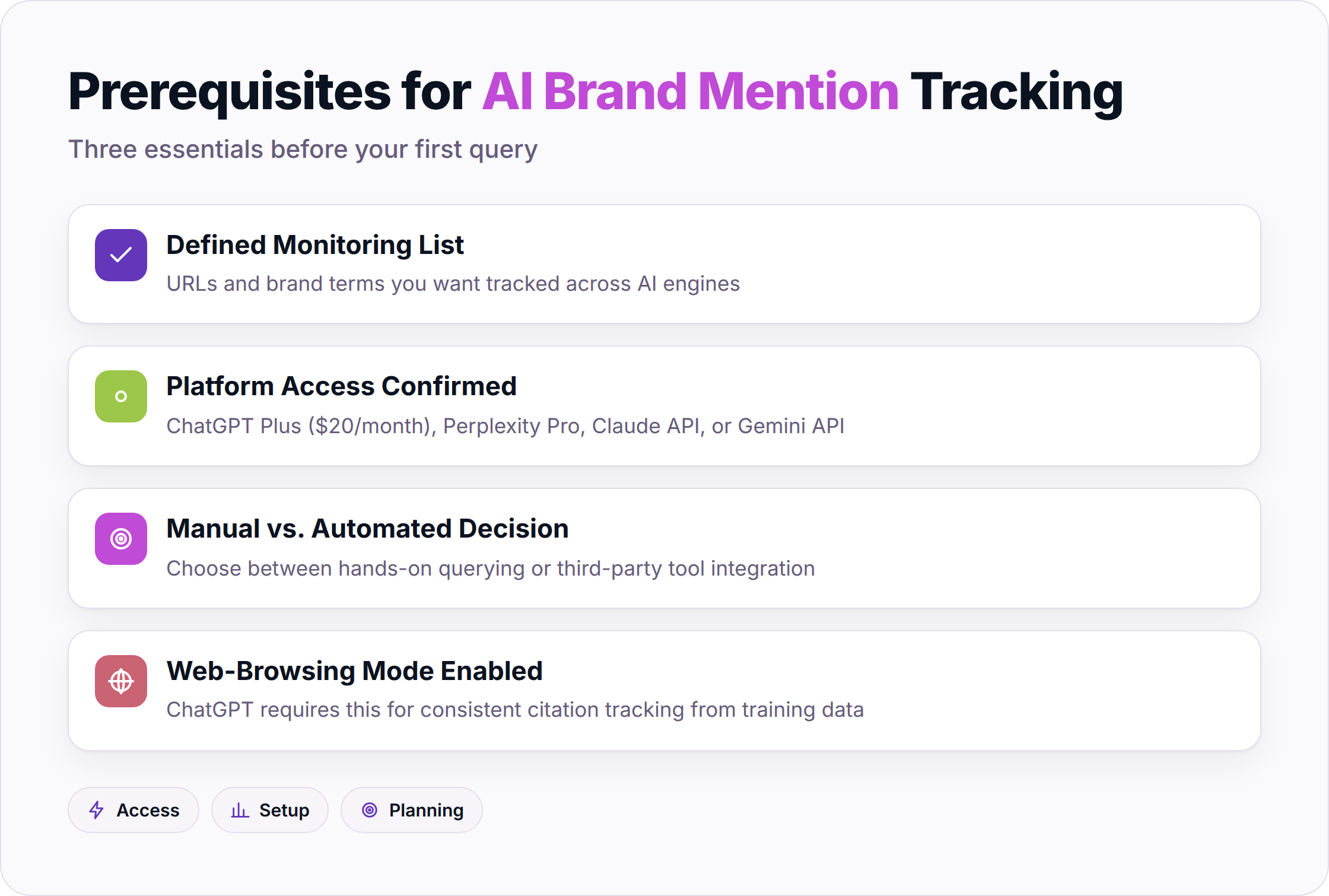
To track brand mentions in AI search, you need three things ready before you run a single query: a defined list of URLs and brand terms you want monitored, confirmed access to each platform you plan to query, and a clear decision on whether you're doing this manually or with a dedicated tool.
Access Requirements
Each AI platform handles external access differently. ChatGPT requires a Plus subscription ($20/month as of 2026) or an OpenAI API key to reliably surface cited sources. Without web-browsing mode enabled, the model pulls from training data only, which makes citation tracking inconsistent at best. Perplexity's free tier does cite sources, but rate limits make systematic querying impractical. Claude and Gemini both have API access options if you want to automate queries at scale.
One limitation worth naming upfront: none of these platforms expose a native "brand mention" feed. You are querying them the same way a user would, then parsing the responses yourself. This breaks down when you're tracking hundreds of prompts across four engines simultaneously. Manual spot-checking works for small sites; anything larger needs tooling.
Baseline Content Inventory
Before you start querying, build a flat list of the URLs you actually want cited. This is not your full sitemap. It's the 10 to 30 pages that represent your core claims: product pages, comparison articles, original research, and any content where a citation would carry commercial weight.
The numbers here are sobering. Research aggregating 23 AI search studies found that a brand's own website accounts for only 1 to 6% of what AI engines read when forming a response about that brand. Most of what shapes your AI-visible reputation lives on third-party sites, review platforms, and publisher coverage you don't directly control. Knowing which of your own URLs you want tracked is still essential, but go in with realistic expectations about how often they'll surface.
Budget and Tooling Decisions
Manual querying costs time, automated tooling costs money, and neither is free.
If you're starting with a manual approach, budget two to four hours per week per engine to run a consistent prompt set and log results in a spreadsheet. That's workable for a small brand tracking 10 to 15 prompts. The trade-off is that manual logs drift. People skip weeks, prompt wording changes slightly, and the historical record becomes unreliable fast.
Dedicated monitoring tools typically run $40 to $200 per month depending on prompt volume and engine coverage. AirOps documents the core metrics worth tracking across major AI platforms, including citation frequency, share of voice by engine, and content gap identification. Those categories are a useful checklist when evaluating whether a tool's output actually maps to decisions you can act on.
Make the tooling decision before step one, not after. Switching from manual to automated mid-project means your early data and your later data aren't directly comparable, which undermines the trend analysis you're building toward.
Step 1: Check Native Monitoring Options Inside AI Platforms
Before buying any third-party tool, check what the AI platforms themselves expose. Perplexity offers the most publisher-facing data of any major AI engine right now: Pro subscribers and Pages creators can see referral traffic signals and basic engagement metrics on content they publish directly through Perplexity Pages. ChatGPT provides no equivalent. Gemini and Bing Copilot surface partial signals inside Google Search Console and Bing Webmaster Tools, but with significant gaps.
Perplexity Pages and Pro Analytics
Perplexity Pages, launched in mid-2024, lets users publish long-form content that Perplexity's engine can then cite in responses. If your brand has published a Page, the analytics tab shows view counts and referral sources. That is useful as a baseline, but it only covers traffic to your own Perplexity-hosted content. It tells you nothing about how often Perplexity cites your main domain in answers to third-party queries.
The distinction matters operationally: a Page with 4,000 views does not mean your brand was cited 4,000 times in Perplexity search results.
ChatGPT: No Publisher Dashboard Exists
OpenAI has not released a publisher-facing citation dashboard as of 2026. There is no Search Console equivalent, no referral tag in GA4 traffic from ChatGPT, and no API endpoint that returns "your domain was cited in X responses this week." Adobe's brand monitoring guidance confirms that tracking ChatGPT citations currently requires manual prompt testing or third-party polling tools, because OpenAI exposes no native signal to site owners. For brands where ChatGPT is a primary discovery channel, this is a real gap in the monitoring stack.
Gemini and Bing Copilot: Partial Signals in Existing Tools
Gemini AI Overviews do generate some referral traffic that lands in Google Search Console under organic search, but Google does not yet break out "cited in AI Overview" as a distinct traffic source in standard property reports. You can infer it by filtering for queries where your site ranks lower than expected but still receives clicks, though that method is imprecise.
Bing Copilot is marginally more transparent. Bing Webmaster Tools logs referral clicks from Copilot-generated responses under a "Copilot" source label in some markets, though coverage is inconsistent across regions and query types.
The trade-off with native tools across all four platforms is the same: they are free and require no setup, but they measure outputs you already control rather than the broader question of how often AI engines mention your brand unprompted. For that, you need a different approach.
Step 2: Set Up a Third-Party AI Citation Tracking Platform
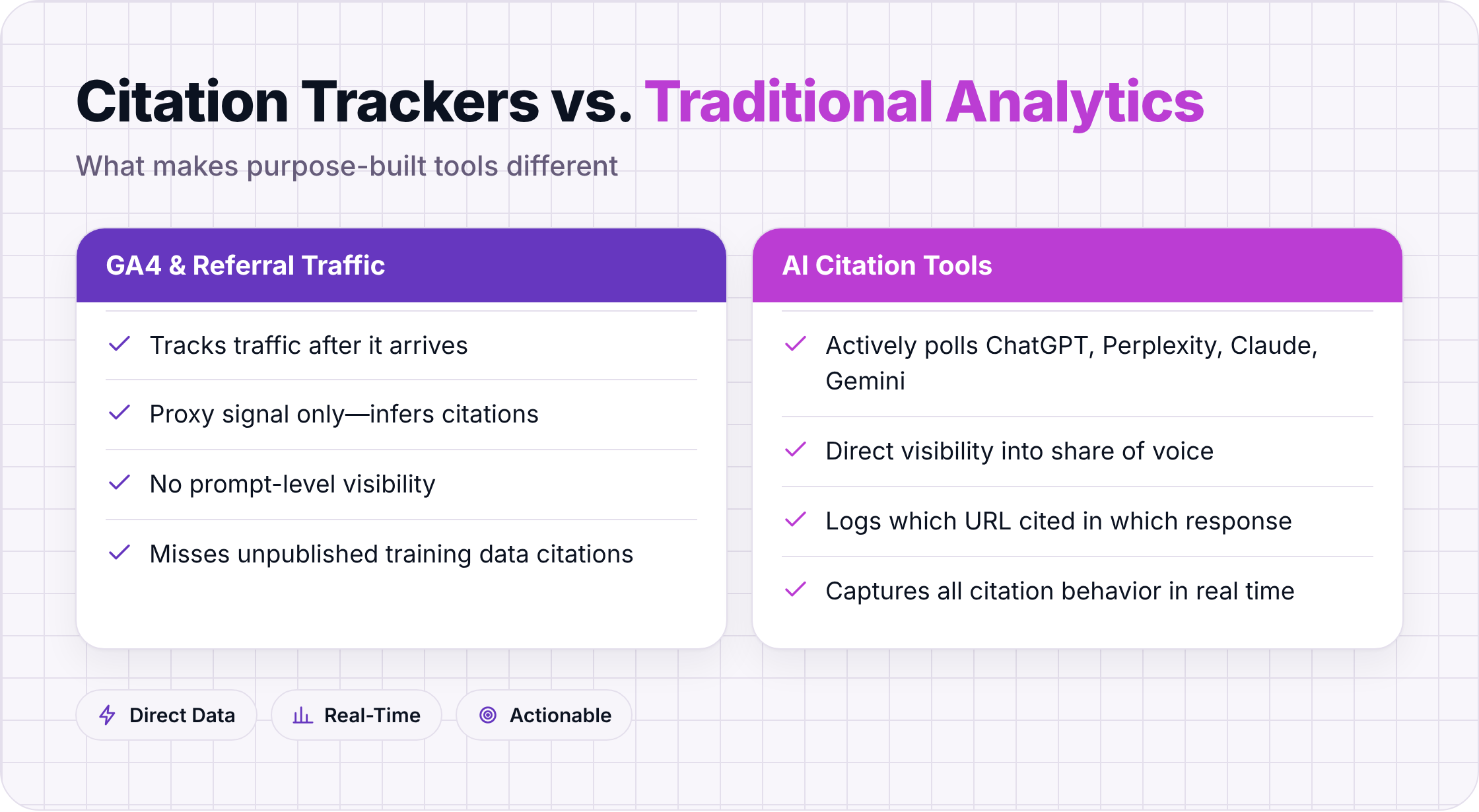
Purpose-built AI citation tools do something GA4 cannot: they actively poll ChatGPT, Perplexity, Claude, and Gemini with your chosen prompts and parse which URLs each engine cites in response. That means you get direct visibility into share of voice across AI search, not just a proxy signal from referral traffic. For most teams, this is the layer that makes citation tracking genuinely actionable rather than inferential.
Choosing the Right Tool
Three platforms dominate this category right now, and they differ in meaningful ways.
A 2025 comparison of 13 AI citation tools found that purpose-built platforms consistently outperform repurposed SEO tools on one specific metric: prompt-level citation attribution. Generic rank trackers log impressions; citation trackers log which source URL appeared in which AI response to which exact query.
| Tool | Engines Tracked | Prompt Slots (entry plan) | Standout Feature |
|---|---|---|---|
| Profound | ChatGPT, Perplexity, Gemini, Claude | 50 prompts | Enterprise share-of-voice dashboards |
| Otterly.AI | ChatGPT, Perplexity, Bing AI | 20 prompts | Lightweight setup, fast onboarding |
| Brandwatch AI | ChatGPT, Perplexity, and social AI | Custom | Sentiment classification at scale |
Profound suits teams running competitive intelligence across a large prompt set. Otterly.AI is the faster path to a working setup if you have fewer than 30 queries to track. Brandwatch adds sentiment layering that the other two don't match, though its pricing reflects that.
Configuring Your Tracked Queries
The query list you build here determines everything downstream, so spend 30 minutes on it before you touch any platform settings.
Start with three buckets:
- Brand terms: your company name, common misspellings, and product names as buyers actually type them (not as your marketing team writes them).
- Category queries: the "best [category] for [use case]" prompts your buyers type before they know your name exists.
- Competitor comparisons: "[Your brand] vs [Competitor]" and "[Competitor] alternative" queries, because AI engines frequently cite third-party review pages in response to these, and you want to know which ones.
Most platforms let you tag queries by intent. Use that feature. It makes filtering the citation report by funnel stage much faster later.
Reading a Citation Report
A standard citation report surfaces three things: share of voice, source URL frequency, and sentiment flags.
Share of voice is the percentage of tracked prompts where your brand or a page from your domain appeared in the AI response. A score of 12% means that across your full prompt set, you were cited in roughly 1 in 8 queries. That number is only useful relative to a baseline or a competitor's score in the same prompt set.
Source URL frequency tells you which specific pages are getting pulled. If your pricing page appears in 40% of citations but your comparison guide appears in 2%, that's a content gap, not a traffic problem.
Sentiment flags are where Brandwatch separates itself. Most tools classify a citation as present or absent. Brandwatch attempts to classify the surrounding context as positive, neutral, or negative, which matters when AI engines cite a critical review alongside your homepage.
The trade-off here is coverage versus cost. No platform polls every AI engine at every query frequency for a flat fee. Otterly.AI's entry plan runs weekly polling cycles rather than daily, which means a sudden drop in citations after a content change won't surface for up to seven days. Teams tracking fast-moving competitive queries should budget for a higher polling frequency, or accept that the data will lag real-world changes by a week or more.
Step 3: Run Manual Prompt-Based Testing to Catch What Tools Miss
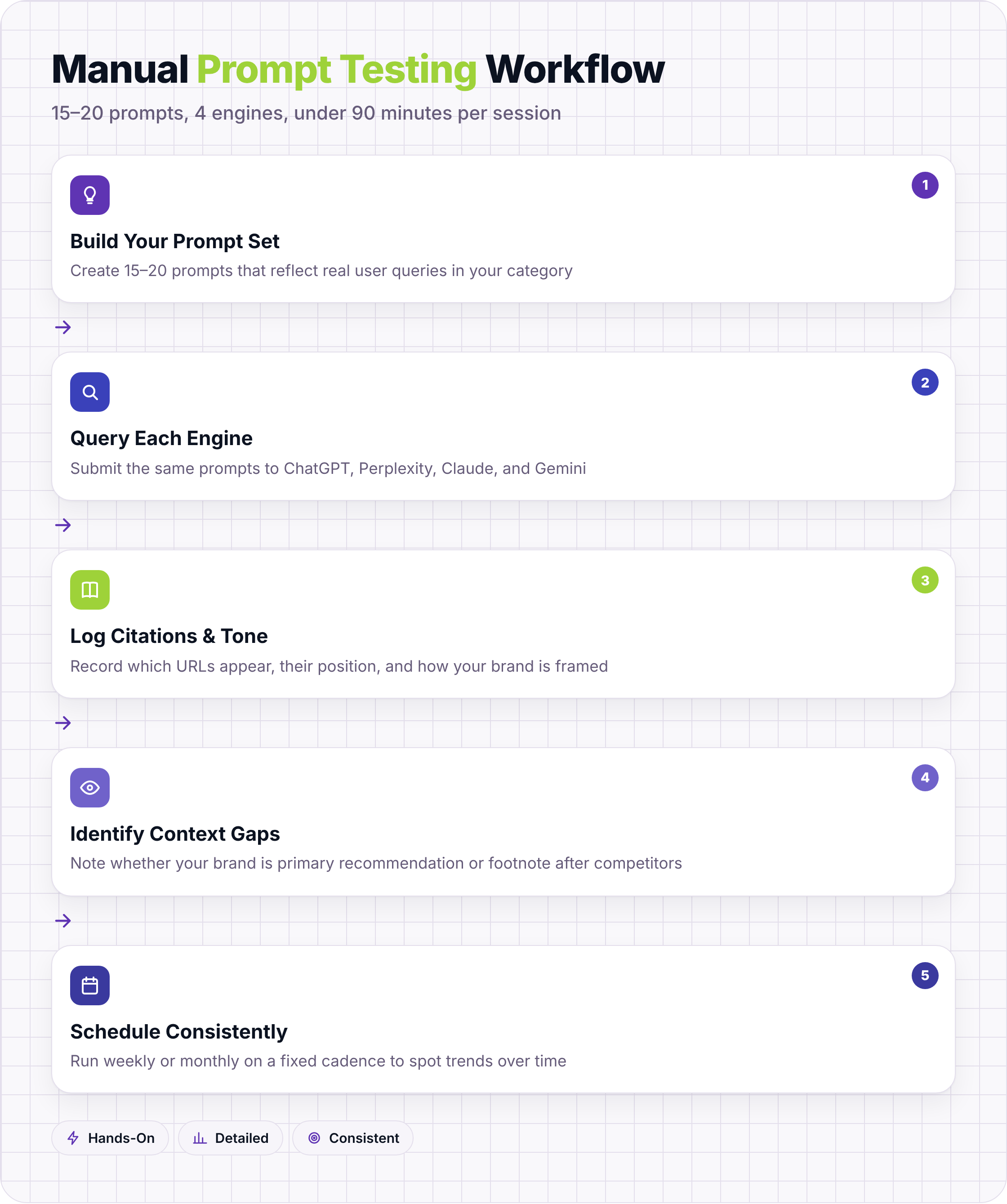
Manual prompt testing means submitting carefully chosen queries to ChatGPT, Perplexity, Claude, and Gemini yourself, then logging exactly what each engine says about your brand. No tool intermediary, no sampling lag. You see the raw citation behavior directly.
Done on a consistent schedule with a stable prompt set, manual testing catches two things automated tools often miss: response tone (how the engine frames your brand, not just whether it appears) and citation context (whether your brand is the primary recommendation or a footnote after a competitor).
Building Your Manual Prompt Set
Keep your manual prompt set small enough to run in under 90 minutes per session. Fifteen to twenty prompts across four engines is a realistic ceiling for a weekly cadence. Any more than that and the process becomes unsustainable, which means it stops happening.
Structure each prompt the way a real buyer would phrase it. "What's the best project management tool for remote teams under 50 people?" will surface different citations than "project management software." The conversational phrasing is closer to how AI engines actually get queried, so it produces more representative results.
Logging Results Consistently
Use a spreadsheet with one row per query per engine per date. Columns should include: the exact prompt text, the engine, the date, whether your brand appeared (yes/no), where in the response it appeared (first mention, secondary mention, not mentioned), which URL was cited if any, and a brief note on framing (positive, neutral, negative, or mixed).
That structure lets you run a simple pivot table after four to six weeks and see which engines cite you most, which prompts never surface your brand, and whether your position in responses is improving or declining over time.
What Manual Testing Won't Tell You
Manual testing has a real ceiling. You can't run 200 prompts per week by hand. You can't test the same prompt 10 times to account for response variability (AI engines don't return identical answers to identical queries). And you can't easily compare your citation rate against a competitor's without running a parallel prompt set for them, which doubles your time investment.
For those gaps, automated tooling is the practical answer. Manual testing and tool-based monitoring work best together: tools handle volume and consistency, manual testing handles depth and context.
Step 4: Interpret Your Data and Close the Gaps
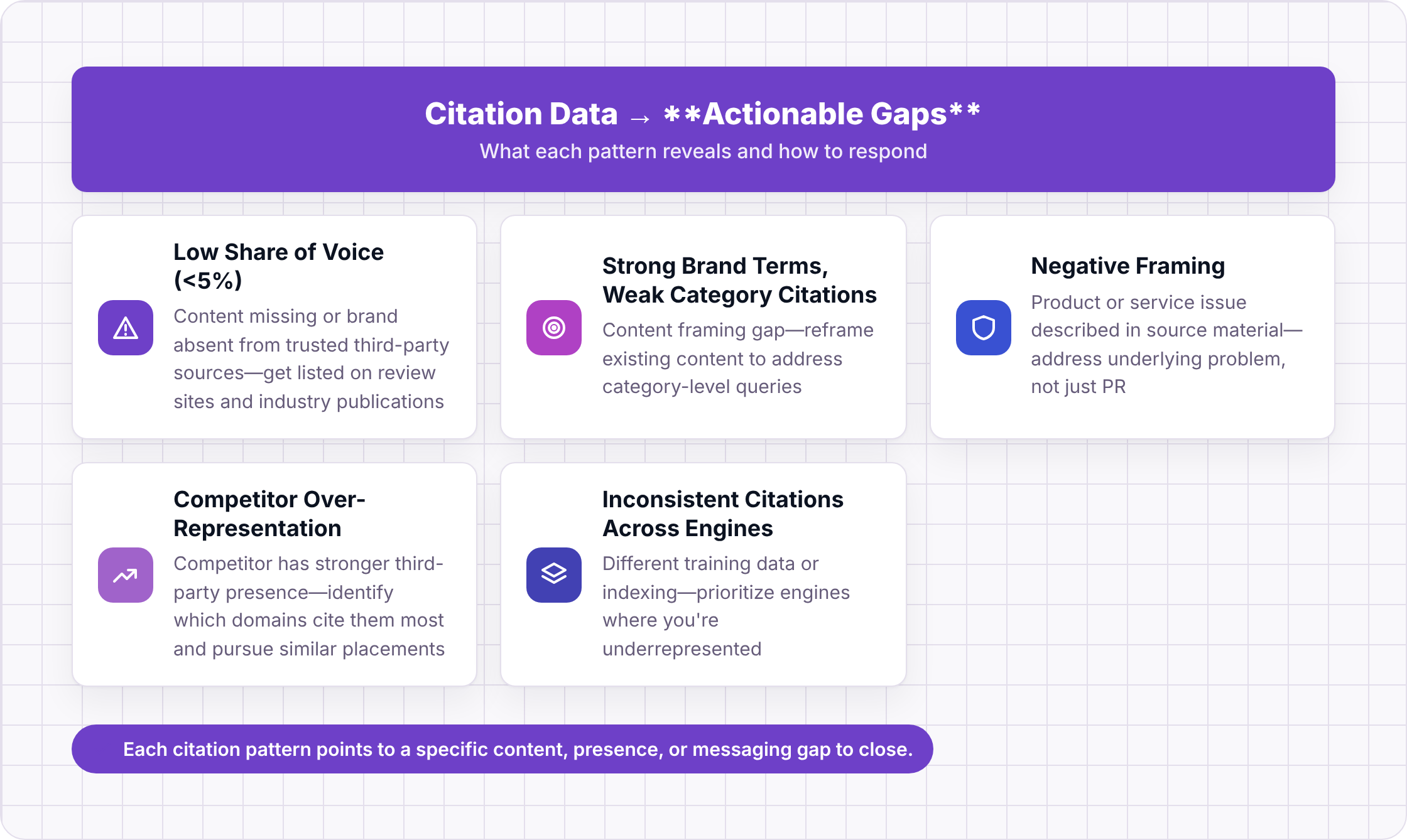
When citation data reveals patterns, each one points to a specific action. Low share of voice suggests missing third-party presence; strong brand terms with weak category citations indicate a content framing gap; negative framing requires addressing underlying product or service issues that source material describes.
Low Share of Voice Across All Prompts
If your brand appears in fewer than 5% of tracked prompts, the problem is usually one of two things: your content doesn't exist in a form AI engines can parse and cite, or your brand isn't mentioned on the third-party sources those engines trust.
Check which domains appear most frequently in the citations for your category queries. If the same five review sites, industry publications, or comparison pages appear repeatedly, those are the properties where your brand needs a presence. Getting listed, reviewed, or quoted on those specific domains will do more for your AI citation rate than publishing additional content on your own site.
Strong Brand-Term Citations, Weak Category Citations
This pattern means AI engines know who you are but don't connect you to the broader category. A buyer who already knows your name will find you; a buyer who doesn't won't.
The fix is category-level content: detailed guides, original data, and comparison articles that address the "best [category] for [use case]" queries directly. AI engines tend to cite content that answers a question completely, not content that promotes a product. Reframe your existing content around the buyer's question rather than your product's features.
Cited but Framed Negatively
This is the hardest pattern to address quickly. If AI engines are citing your brand in the context of complaints, pricing concerns, or negative comparisons, the source material driving that framing is almost certainly on third-party review sites or forums.
Identify the specific URLs appearing in those negative citations. Then work on the underlying issue those sources describe, and pursue updated reviews or coverage that reflects the current state of your product. AI engines update their citation behavior as the source landscape changes, but that process takes months, not days.
Step 5: How to Track Brand Mentions in AI Search at Scale
Scaling brand mention tracking requires separating manual depth checks from automated volume monitoring, refreshing your prompt set as the market evolves, and maintaining historical data outside your tracking platform to protect against tool discontinuation.
A few practices that hold up over time:
- Run your full manual prompt set once per month, not weekly. Use the tool data for weekly trend-watching and reserve manual testing for monthly depth checks.
- Add new prompts to your tracked set whenever a competitor launches a new product or a new comparison query starts appearing in your keyword research. The prompt set should evolve with the market.
- Export your citation reports monthly and store them outside the tool. Platforms change pricing, discontinue features, or shut down. Your historical data should live somewhere you control.
- Cross-reference citation data with your GA4 referral traffic quarterly. If a tool reports rising citation share but referral traffic from AI sources isn't moving, either the tool's methodology has a gap or the citations aren't driving clicks. Both are worth investigating.
The honest limitation of any tracking system right now is that AI search is changing faster than the monitoring infrastructure around it. New engines launch, existing engines change how they cite sources, and the relationship between citations and traffic is still being mapped. Build your system to be adjustable, not permanent.
Frequently Asked Questions
Can I track AI brand mentions for free?
Yes, with significant constraints. Manual querying across ChatGPT, Perplexity, Claude, and Gemini costs nothing beyond a ChatGPT Plus subscription ($20/month) if you want web-browsing mode enabled. The real cost is time: a consistent manual process across four engines and 15 prompts takes roughly two to three hours per week. Free approaches also can't match the prompt volume or polling frequency that paid tools provide.
How often should I run brand mention checks across AI engines?
Weekly is a reasonable cadence for tool-based monitoring; monthly is realistic for manual prompt testing. The right frequency depends on how fast your competitive landscape moves. If a competitor launches a new product or a major review site publishes new coverage of your category, run an unscheduled check rather than waiting for your next scheduled session.
Do AI engines cite the same sources consistently?
No. AI engines, particularly ChatGPT and Claude, show meaningful response variability even when given identical prompts. The same query can return different citations on different days, or even in different sessions on the same day. This is one reason tracking a prompt over multiple weeks matters more than any single result. Patterns across 10 or more data points are reliable; individual responses are not.
What's the difference between a brand mention and a citation in AI search?
A mention means the AI engine named your brand in its response. A citation means it linked to or specifically attributed a claim to a URL from your domain. You can be mentioned without being cited (the engine names you but doesn't link to you), and you can be cited without being prominently mentioned (your URL appears as a source but the response doesn't emphasize your brand). Both matter, but they require different fixes: mentions are driven by brand awareness in the training data and source ecosystem, while citations are driven by the quality and structure of specific pages.
Which AI engine is most important to track first?
ChatGPT has the largest user base among general-purpose AI assistants as of 2026, which makes it the highest-priority starting point for most brands. Perplexity is the second priority for brands in research-heavy or B2B categories, because Perplexity's user base skews toward buyers actively comparing options. Claude and Gemini are worth adding once your ChatGPT and Perplexity tracking is stable, rather than trying to cover all four engines from day one.
Why doesn't my brand appear in AI search results even though I rank well on Google?
Google rankings and AI citation behavior are related but not the same thing. AI engines weight factors like how often your brand is mentioned across multiple independent sources, whether your content directly answers the type of question being asked, and how recently your information has been indexed or referenced. A page that ranks well for a keyword but doesn't directly answer a conversational question may not get cited. Third-party mentions on review sites, industry publications, and forums often carry more weight in AI citation decisions than your own domain's search ranking.
If you want a tool that handles the polling, logging, and reporting automatically, visit SEORav's GEO tracking page to see how it monitors your brand mentions across AI search engines on a weekly schedule. It's a practical starting point for teams who need consistent coverage without building the manual process from scratch.
Keep reading
Writing Content That LLMs Actually Want to Cite
Learn how to write distinctive content LLMs will cite: original data, expert attribution, structured formatting, and freshness signals that clear the retri
CMS Platforms With Native Analytics and SEO Tool Integrations
Which vendors provide turnkey connectors to common CMS and analytics stacks? Compare WordPress VIP, HubSpot, Contentful, Webflow, and more in one matrix.
AI-Powered SEO Tools That Actually Move the Needle
Compare the top ai-powered seo tools for content scoring, technical audits, and AI citation tracking. See which platforms actually move traffic in 2026.