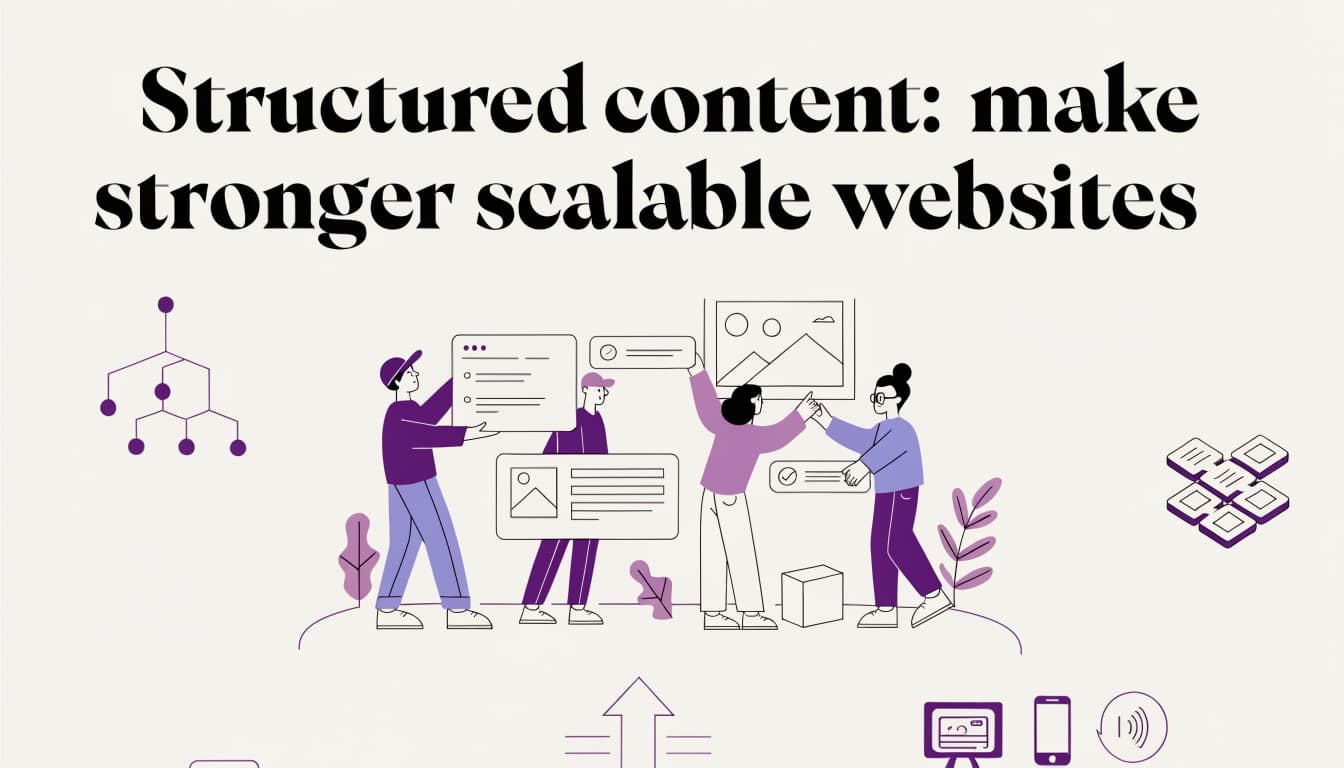
Structured content: make stronger scalable websites
Last updated: 23 July 2026
Structured content means organizing web content by its component parts — headline, body copy, image, author, date — rather than as one undivided blob of HTML. When content is stored this way, any channel (website, app, voice assistant) can pull exactly the pieces it needs. The result is faster publishing, fewer errors, and sites that scale without constant rebuilding.
How structured content works
Think of a product page on an e-commerce site. An unstructured approach stores the entire page as one rich-text field: the product name, price, description, and image are all fused together in a single HTML block. Change the layout and you rewrite every page manually.
A structured approach breaks that same page into discrete fields:
product_name(plain text, 80 characters max)price(number, currency code)description(rich text, 300 words max)hero_image(asset reference)availability(boolean)
Each field has a defined type and validation rule. A content management system (CMS) stores these fields separately in a database. When the front end requests a product, it fetches only what it needs via an API — typically JSON or GraphQL. If the company later launches a mobile app, the same API feeds that app without any content re-entry.
This is the core mechanic behind headless CMS platforms, where the content repository (the "body") is fully decoupled from the presentation layer (the "head").
A concrete worked example
Imagine a news publisher with 50,000 articles. Each article is stored as structured fields: headline, standfirst, bodytext, authorid, publishdate, primarytopic, related_articles[]. When the publisher redesigns its website, the design team builds a new front end that calls the same API. Zero content migration. The 50,000 articles appear in the new design the moment the new front end goes live — because the content was never tied to the old template.
Why structured content: make stronger scalable websites a real priority
Three concrete benefits drive adoption.
Reusability. A single structured content item — say, a legal disclaimer — can appear on 200 pages simultaneously. Update it once in the CMS and every page reflects the change instantly. With unstructured content, editors hunt through 200 pages manually.
Multichannel delivery. Structured content can be broken down into its component parts and reassembled for any surface: web, mobile, digital signage, chatbot, or voice search. Each channel consumes the same source data, formatted for its own constraints.
Search and AI readiness. Search engines and large language models both prefer content with clear semantic signals. When a headline field is explicitly labeled headline rather than buried inside a <div>, the machine reading it has no ambiguity. Google's structured data guidelines (schema.org markup) are essentially an extension of this same principle — attach explicit labels so crawlers understand context, not just text.
Where structured content is used
| Industry | Typical use case | Key benefit |
|---|---|---|
| E-commerce | Product catalog, pricing, specs | Sync across web, app, marketplaces |
| Publishing | Articles, authors, topics | Template-free redesigns |
| Healthcare | Drug information, clinic details | Regulatory accuracy at scale |
| SaaS / tech | Documentation, release notes | Single source for docs + in-app help |
| Travel | Destinations, itineraries, pricing | Real-time updates across booking channels |
Enterprise teams with large content libraries gain the most. A site with 200 pages and one channel can survive unstructured content. A site with 20,000 pages across four channels almost certainly cannot.
The real limits of structured content
Structured content is not a universal fix. It requires upfront investment: content modeling (deciding which fields exist and what rules they follow) is a design discipline that takes time and specialist knowledge. Get the model wrong early and you pay for it in migration costs later.
Small teams or solo publishers often find the overhead disproportionate. A personal blog with one author and one template rarely benefits from a headless CMS. The tooling is also more complex — developers need to build or configure the front end separately, which raises the technical bar compared to a traditional CMS like WordPress where themes handle presentation automatically.
Finally, structured content does not solve content quality. Fields and validation rules enforce format, not meaning. A well-structured page can still contain thin, unhelpful text.
Common misconceptions
"Structured content means schema markup." Schema.org markup (the JSON-LD snippets that power rich results) is one output of structured content thinking, not the definition of it. You can have perfectly modeled structured content in a CMS with no schema markup on the page, and vice versa.
"You need a headless CMS to use structured content." Traditional CMSs like WordPress support structured content through custom post types and Advanced Custom Fields (ACF). Headless architecture makes multichannel delivery easier, but structured content modeling is possible without it.
"Once structured, content never needs maintenance." Content models evolve. A field added three years ago for a feature that no longer exists clutters the model and confuses editors. Regular audits — at least annually for large sites — keep the model aligned with actual publishing needs.
What to do with this understanding
If your site struggles with inconsistent formatting, slow redesigns, or content that can't reach new channels, the root cause is likely unstructured content. Start with a content audit: list every content type you publish, then identify which fields each type genuinely needs. Even moving from one monolithic rich-text field to four or five typed fields is a meaningful improvement.
For teams ready to go further — modeling content for AI discoverability, multichannel APIs, or large-scale personalization — the architecture decisions become more consequential. Getting them right the first time saves significant rework.
See how seorav.com can help you audit, model, and optimize your content structure for search, scale, and the channels your audience actually uses.
Frequently Asked Questions
What is the difference between structured and unstructured content?
Unstructured content stores a page as one block of HTML or rich text — all elements fused together. Structured content separates each element (headline, image, author, date) into its own labeled field with defined rules. That separation allows the same content to be reused across multiple channels and updated in one place rather than many.
Do I need a headless CMS to implement structured content?
No. Structured content is a modeling approach, not a technology requirement. Traditional CMS platforms like WordPress support it through custom post types and field plugins such as Advanced Custom Fields. A headless CMS makes multichannel delivery more straightforward, but the core practice of breaking content into typed, labeled fields can be applied in most platforms.
How does structured content affect SEO?
Search engines interpret content more accurately when fields carry explicit labels. Structured content also makes it easier to generate schema.org markup (JSON-LD), which powers rich results like FAQ snippets, product ratings, and article bylines in Google Search. Sites with clear content models tend to produce more consistent, crawlable markup across thousands of pages.
How long does it take to build a content model?
A basic content model for a small site — three or four content types with five to ten fields each — can be drafted in a day or two by an experienced content strategist. Enterprise models covering dozens of content types across multiple regions typically take four to eight weeks, including stakeholder reviews, validation rules, and localization requirements.
What happens if my content model is wrong from the start?
A poorly designed model creates technical debt. Fields may be misused, editors work around rules, and adding new channels becomes harder than expected. Fixing it later requires a migration: mapping old fields to new ones, often with manual cleanup. That is why a short discovery phase — auditing existing content before modeling — is worth the time investment upfront.
Keep reading
Ranking in Google's AI Search: The Deterministic Signals That Actually Move the Needle
Learn how do you rank in SGE with the three signals Google's AI uses to cite sources: schema markup, entity salience, and structured factual claims.
Why AI Ignores Your Content (And How to Fix It)
Learn how to avoid AI content that gets ignored by LLMs. Covers RAG retrieval signals, schema, entity salience, and an answer-first structure checklist.
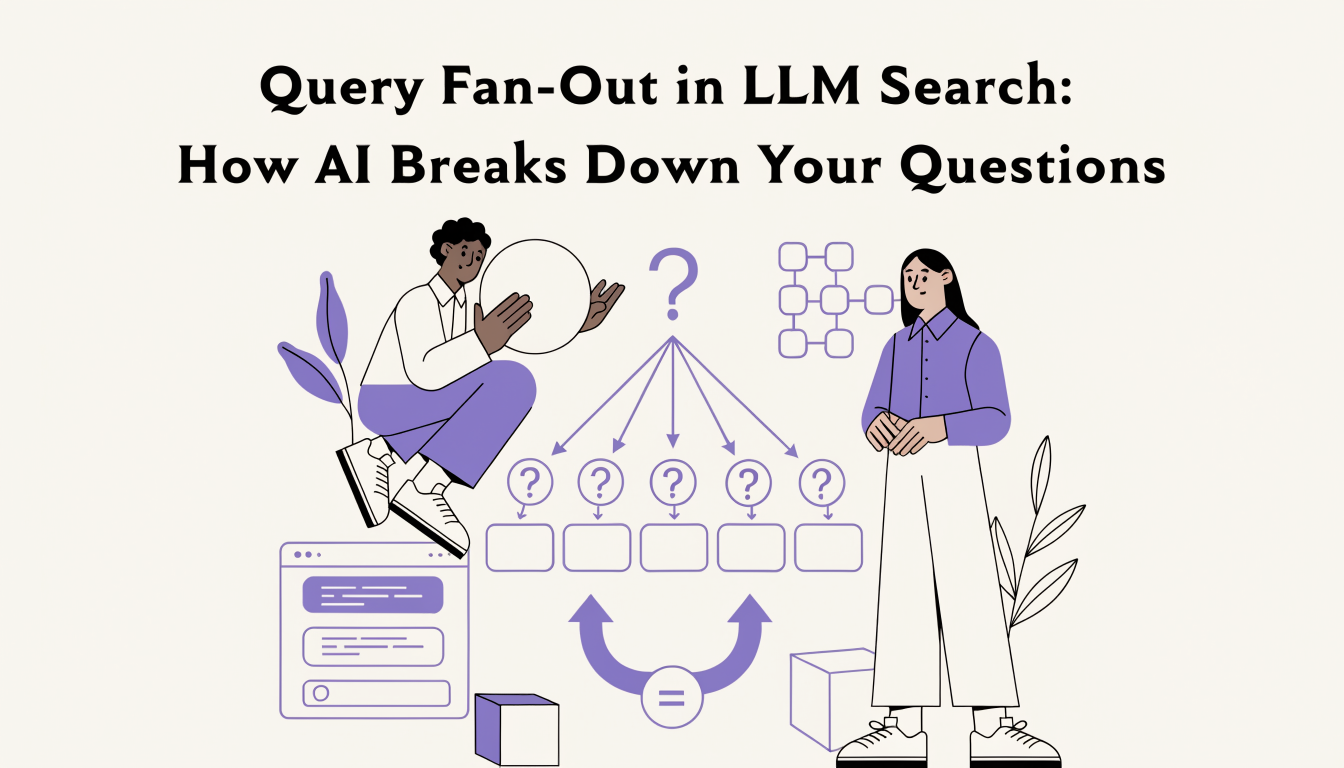
Query Fan-Out in LLM Search: How AI Breaks Down Your Questions
Learn what query fan-out in LLM search is, how AI splits your prompt into 3-8 sub-queries, and how to structure content to win more citation passes.