Siteimprove for SEO: What It Does (and What It Doesn't)
Last updated: 20 September 2026
Siteimprove SEO combines technical auditing, accessibility scanning, and content quality checks in a single platform, making it strongest for large enterprises managing governance-heavy websites. The tool excels at finding crawl errors, broken links, and compliance issues across thousands of pages. However, it lacks depth in AI-driven keyword research and content optimization compared to specialized SEO platforms like Semrush or Ahrefs, which matters if your primary focus is ranking improvement rather than site health.
What it does well out of the box: Siteimprove's crawl-based auditing catches broken links, readability issues, duplicate metadata, and on-page SEO gaps at scale. Saint Joseph's University's web team uses its scoring system as a live benchmark, targeting 90+ across quality, SEO, and accessibility to flag pages that need editor attention. That kind of continuous monitoring is genuinely useful for distributed content teams managing thousands of URLs.
The one gap that sends content teams elsewhere: Siteimprove does not score content for AI-engine citation readiness. It has no mechanism to tell you whether ChatGPT, Perplexity, or Gemini would extract and quote your article. Reviews across 432 verified G2 submissions consistently praise the accessibility and technical audit features while noting the keyword and content strategy tooling feels secondary to the compliance core.
If your organization prioritizes WCAG compliance, governance reporting, and technical site health across a large CMS, Siteimprove fits well. If your content team measures success by getting cited in AI-generated answers rather than ranking on page one, you will need something else, or something additional.
At a Glance: Siteimprove vs. AI-Native SEO Platforms
Siteimprove is a digital governance platform that bundles accessibility auditing, on-page SEO scoring, and content quality checks into one dashboard. AI-native SEO platforms skip the governance layer entirely and focus on content structure, citation signals, and AI-engine visibility. The two categories solve different problems.
| Dimension | Siteimprove | AI-Native SEO Platforms |
|---|---|---|
| Pricing | Enterprise contract (custom quote) | Typically $99-$500/month SaaS |
| Best For | Compliance-heavy orgs, large CMS estates | Content teams targeting AI engine citations |
| Deployment | Crawler + dashboard, often IT-managed | Self-serve, marketer-managed |
| Key Feature | WCAG accessibility auditing + SEO scoring | Answer-first content scoring, citation tracking |
| Strength | Governance and accessibility | AI visibility and content optimization |
Siteimprove's own SEO automation landscape matrix notes that 83% of marketers use AI tools, but only 4% use them strategically. That gap is exactly where the two platform types diverge in practice.
The trade-off is real. Siteimprove's breadth means teams with genuine WCAG compliance obligations get genuine value from a single vendor. An AI-native platform won't flag a missing alt attribute on a PDF or catch a broken internal link buried in a policy document. For regulated industries, including healthcare, government, and higher education, swapping Siteimprove for a leaner content tool means rebuilding the accessibility monitoring layer from scratch somewhere else.
What Siteimprove Actually Does for SEO
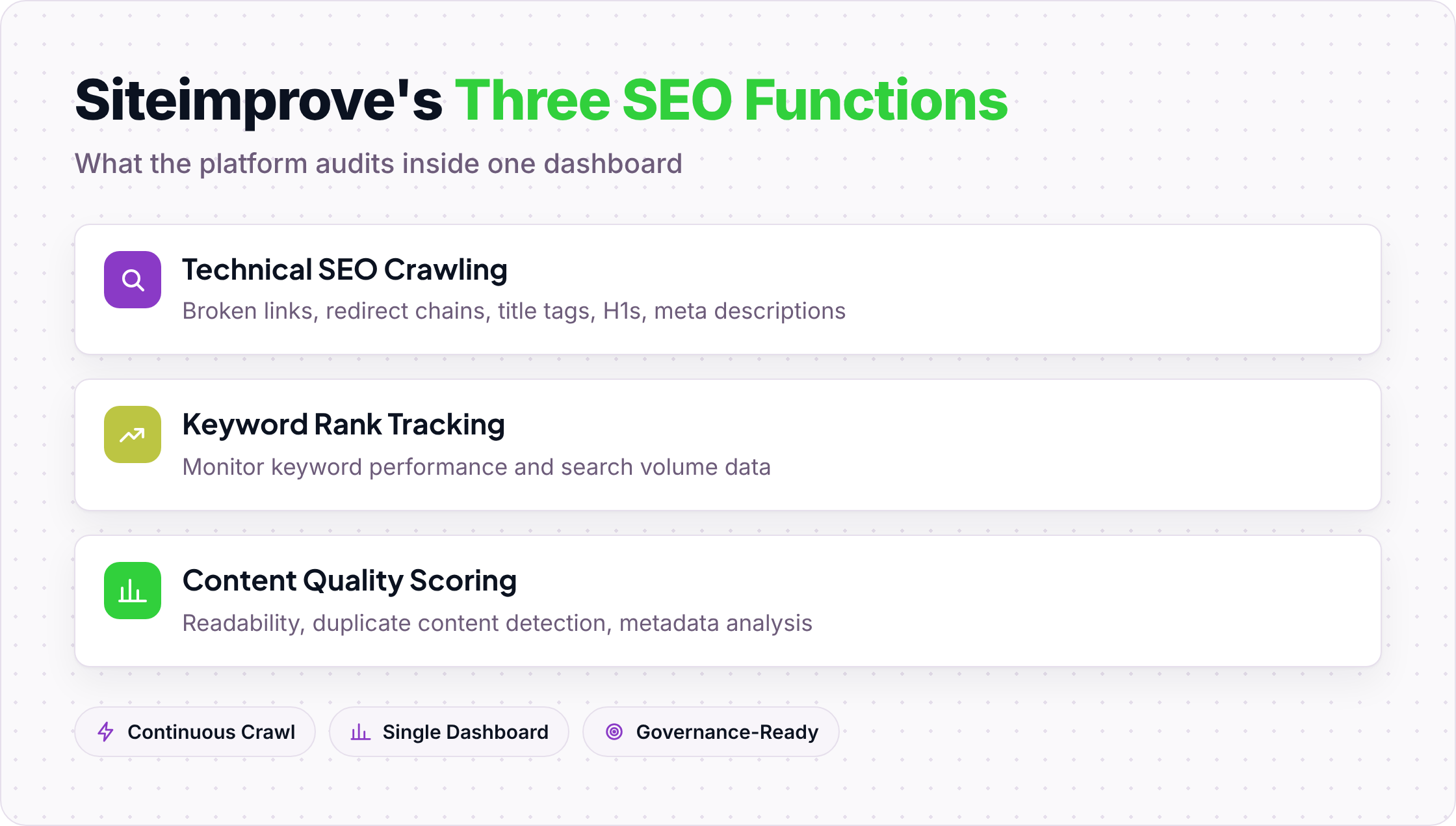
Siteimprove covers three SEO functions inside one dashboard: technical crawling (broken links, redirect chains, on-page signals), keyword rank tracking, and content quality scoring across readability, duplicate content, and metadata. It is built for teams that need a single audit environment rather than a stack of point tools, and its crawl runs continuously rather than on a one-off schedule.
Technical SEO Crawling
The crawler surfaces broken internal and external links, flags redirect chains that exceed two hops, and checks on-page signals including title tag length, missing H1s, and pages with no meta description. Siteimprove's SEO Insights documentation describes the module as designed to identify "important trends to kickstart your SEO efforts," which is accurate framing: the output is a prioritized issue list, not a root-cause analysis.
One real limitation here: Siteimprove's crawler does not render JavaScript the way a dedicated technical auditor like Screaming Frog or a headless-browser crawler does. Sites that rely heavily on client-side rendering may see incomplete crawl results, and redirect chain detection can miss server-side hops that only appear after JS execution.
Keyword Monitoring and Rank Tracking
Rank tracking sits inside the same platform as the crawl data, so you can connect a keyword's position movement directly to a page-level issue flagged in the same week. That linkage is useful for reporting: a single dashboard view shows a keyword dropping from position 6 to 14 alongside the redirect chain Siteimprove flagged on the same URL.
The limitation is depth. Siteimprove tracks rankings but does not surface search intent classification, SERP feature breakdowns (featured snippets, People Also Ask boxes), or AI-engine citation data. For teams whose buyers are increasingly finding answers inside ChatGPT or Perplexity rather than clicking organic results, rank position alone is a narrower signal than it was 18 months ago.
Content Quality Scoring
The content layer checks readability using the Flesch Reading Ease scale, flags near-duplicate pages above a configurable similarity threshold, and audits metadata completeness: missing alt text, duplicate title tags, descriptions that exceed character limits. These checks run at scale across the full site, which makes Siteimprove genuinely useful for large content libraries where manual review is not realistic.
Treat the readability score as a directional signal rather than a target. A page written for a technical B2B audience will score poorly on Flesch Reading Ease by design, and chasing a higher score can push writers toward simpler language that undersells the product. Use it to catch genuinely unreadable pages, not to homogenize tone across the site.
Siteimprove SEO vs. AI-Native Platforms: How the Gap Widened
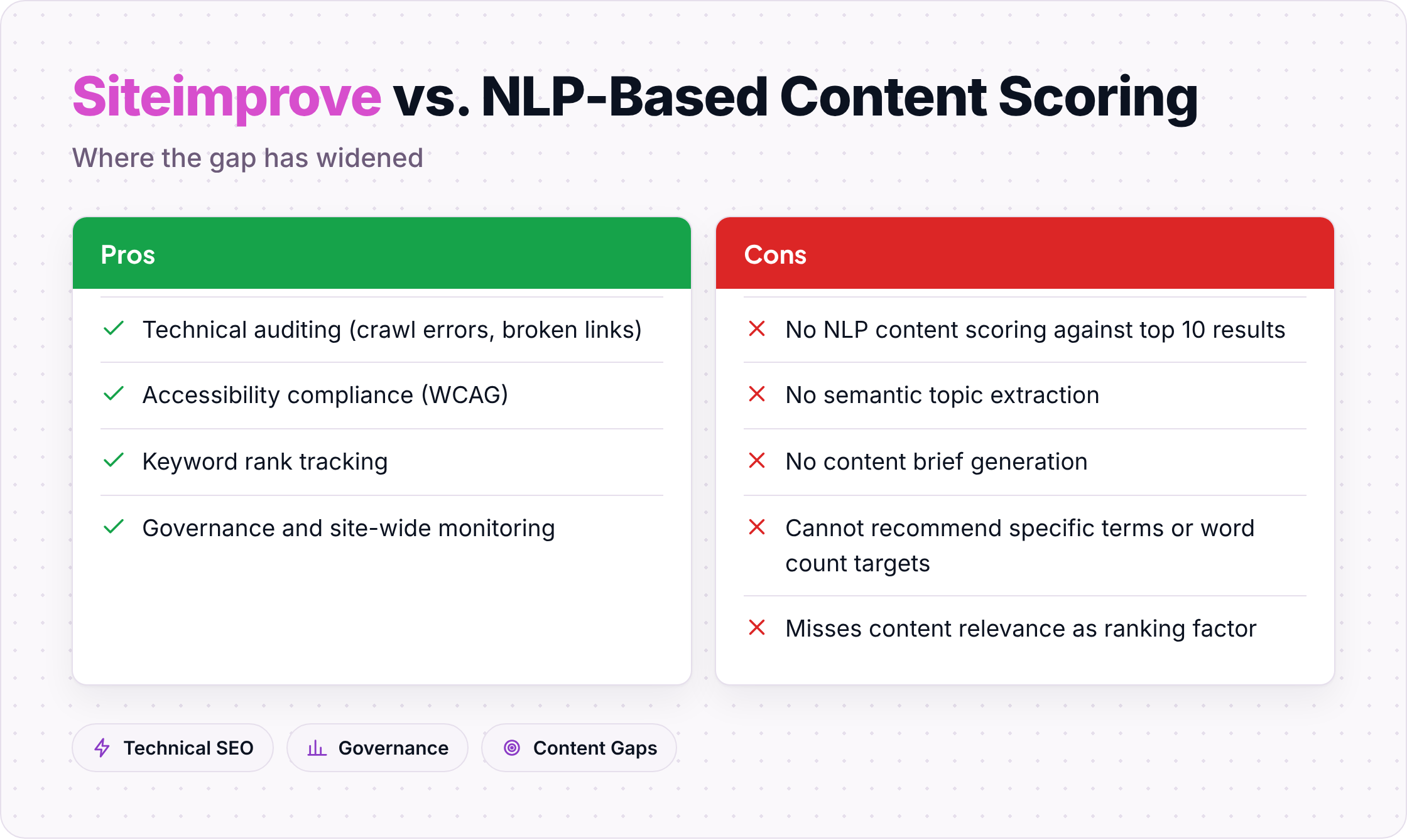
Siteimprove handles technical auditing, accessibility compliance, and keyword tracking well. AI-native platforms like Frase and Surfer do something structurally different: they use NLP to score your content against the top-ranking pages for a given query, then generate a brief that tells you exactly what to add, cut, or restructure. Siteimprove does not do that. The gap between the two categories has widened as content relevance became a bigger ranking factor than crawlability alone.
What NLP-Based Scoring Actually Does
Tools in the Frase and Surfer category pull the top 10 or 20 results for a target keyword, extract the topics, entities, and semantic patterns those pages share, then score your draft against that corpus. The output is a content brief with specific term targets: "cover 'data retention policy' at least three times," or "your word count is 40% below the median for this SERP." That kind of instruction is generative and context-dependent. No rule-based crawler can produce it.
AI search traffic grew 527% in a single year, according to Semrush's AI SEO benchmark data, which means the content quality bar AI engines use to decide what to cite is rising faster than most audit-focused tools can track.
Where Siteimprove's Keyword Data Stops
Siteimprove surfaces keyword rankings, search volume, and on-page signals like missing H1s or thin meta descriptions. That is useful for maintaining a site's technical baseline. What it does not produce is a ranked list of semantically related topics your page is missing, a readability comparison against competing pages, or a suggested outline built from SERP analysis.
In a 2025 press release, Siteimprove's own content intelligence announcement acknowledged the shift directly, framing the update around "purpose and relevance, not just speed." The language signals that even Siteimprove recognizes its historical positioning was closer to quality control than content strategy.
The Case for Pairing the Two
The practical answer for most teams is not to replace Siteimprove but to layer a dedicated content optimization tool on top of it. Siteimprove catches the structural problems: broken links, duplicate content, accessibility failures, crawl errors. A content brief tool handles the question Siteimprove cannot answer: does this page cover the topic thoroughly enough to compete?
Running two platforms means two data models, two sets of recommendations, and occasionally conflicting signals. A content brief tool might recommend expanding a page to 2,000 words while Siteimprove flags the same page for thin content based on a different threshold. Teams without a clear editorial workflow to reconcile those inputs can end up with more noise, not less.
This pairing works best when one person or team owns the technical audit layer and a separate content team owns the brief-to-publish workflow, with a shared definition of what "done" looks like before either tool signs off.
Pricing Compared: Enterprise Contracts vs. Subscription Tiers
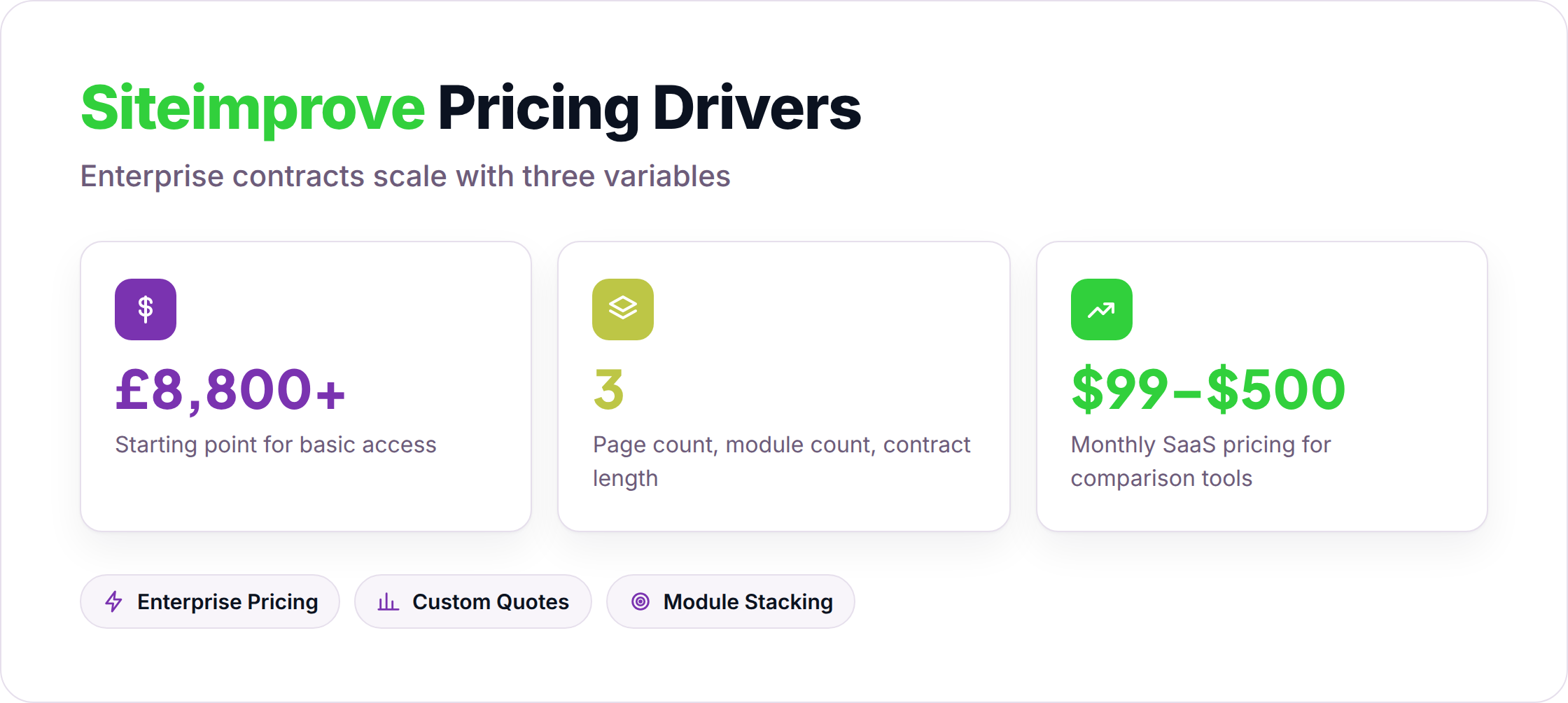
Siteimprove does not publish a price list. Contracts are quote-based, scoped to page volume, number of modules, and user seats, and structured as annual subscriptions. Independent estimates put entry-level access around £8,800 per year, with costs rising sharply once you add accessibility, SEO, and analytics modules together. Content optimization tools like Frase and Surfer run on flat monthly tiers, which makes the cost comparison less about sticker price and more about what you actually need to run.
What Drives Siteimprove's Cost Up
Three variables move the number: page count, module count, and contract length. A site with 10,000 pages crawled weekly costs more than one crawled monthly at 2,000 pages. Add the SEO module on top of accessibility and data privacy, and you are stacking line items. Vendr's procurement data on Siteimprove notes that pricing is highly negotiable, particularly at renewal, which signals that the published estimates are ceilings rather than floors. Teams with procurement leverage can move the number, but smaller organizations rarely have it.
Where Frase and Surfer Become Cost-Effective
Surfer and Frase both publish tiered pricing starting well under $200 per month for individual or small-team plans. The math shifts around the 5-to-10 writer mark, where per-seat costs on those platforms start to approach what a mid-market Siteimprove contract costs annually for SEO features alone. Neither tool touches accessibility compliance, WCAG auditing, or the governance reporting that public-sector teams are often contractually required to produce.
Total Cost of Ownership When You Need Both
An organization that genuinely needs WCAG 2.2 compliance monitoring and content optimization cannot replace Siteimprove with Surfer. It needs both. A realistic stack for a mid-size enterprise might include a Siteimprove contract for accessibility and governance plus a separate content tool for keyword research and brief generation. Budget accordingly: the combined annual spend can exceed $20,000 for a team of moderate size, and that figure does not include the internal hours required to reconcile outputs from two separate platforms.
Frequently Asked Questions
Is Siteimprove good for SEO?
Siteimprove is a solid choice for technical SEO auditing, particularly for large sites where broken links, duplicate metadata, and crawl errors accumulate faster than any team can catch manually. Its SEO module is genuinely useful for governance-level monitoring, though it does not match the content depth of dedicated tools like Surfer or Frase for keyword-level optimization.
How does Siteimprove handle keyword research?
Siteimprove tracks keyword rankings and surfaces basic search volume data, but it does not generate keyword suggestions, cluster topics, or analyze SERP intent the way a dedicated research tool does. If keyword discovery and content gap analysis are central to your workflow, you will need a separate tool alongside it.
Does Siteimprove track AI search visibility?
No. As of 2026, Siteimprove does not offer citation tracking for AI-generated answers in ChatGPT, Perplexity, or Gemini. Its 2025 content intelligence update moved toward relevance scoring, but AI-engine citation readiness remains outside the platform's current scope.
Can small teams afford Siteimprove?
Siteimprove's pricing model is built for enterprise contracts, and entry-level estimates start around £8,800 per year before module add-ons. For small teams without WCAG compliance obligations, the cost-to-value ratio is difficult to justify against subscription-based alternatives that run under $200 per month.
What is the difference between Siteimprove and Semrush?
Siteimprove leads with accessibility auditing and governance reporting, then layers SEO on top. Semrush leads with keyword research, competitive analysis, and backlink data, then layers technical auditing on top. The two tools overlap on rank tracking and on-page SEO checks, but their primary audiences are different: Siteimprove targets compliance-driven organizations, Semrush targets growth-focused marketing teams.
Does Siteimprove check for duplicate content?
Yes. The content quality module flags near-duplicate pages above a configurable similarity threshold and audits metadata for duplicate title tags and descriptions. It does not, however, compare your content against external pages to identify cannibalization across competing domains.
If you are weighing Siteimprove against other tools in your SEO stack, or trying to figure out where AI-engine visibility fits into your current setup, see how Seorav can help with integrations built to close the gaps that audit-only platforms leave open.
Keep reading
Which LLM Citation Tracking Platform Actually Works for Your Brand
Compare the top llm citation tracking platforms by engine coverage, alert speed, and pricing. Find the right tool for your team size and budget.
How AI Overviews Are Reshaping Organic Traffic (And What SEOs Must Do)
AI Overviews now trigger on 30%+ of Google queries. See how zero-click search AI impact on organic traffic is measured, and what SEOs can do about it.

How to Monitor Your Brand Across AI Search Engines
Learn how to track brand mentions in AI search engines like ChatGPT, Perplexity, and Gemini. Tested tools, real data, and honest trade-offs for SMB teams.