How to Measure and Improve Your AI Citation Rate
Last updated: 19 October 2026
Citation rate optimization means increasing how often AI systems like ChatGPT, Perplexity, and Claude cite your content as a named source in their responses. Your citation rate is calculated by dividing your cited appearances by total tracked prompts across these platforms. Most websites have no baseline measurement, which makes improvement impossible. Establishing your current citation rate requires tracking tools that monitor when your domain appears as a reference, not just when it ranks in search results.
What Citation Rate Means for AI Search Visibility
Citation rate measures how often an AI engine selects your content as a named source when generating a response. Calculated as cited appearances divided by total tracked prompts, it gives you a direct read on how frequently ChatGPT, Perplexity, Claude, or Gemini treats your pages as reference material. Citation rate optimization starts here: you cannot improve a number you have not defined.
Most brands tracking this metric land somewhere between 1% and 5% across their full prompt set. That range reflects the structural reality of how AI engines answer questions: a single response typically cites two to five sources, drawn from a much larger candidate pool. Rankability's AI search statistics analysis found top-10 citation rates ranging from 15.8% to 22.9% depending on content type, meaning even well-optimized pages miss the citation window the majority of the time.
One honest caveat: citation rate is prompt-dependent. A 4% rate across broad industry queries can coexist with a 30% rate on a narrow topic where you hold clear authority. Averaging across too wide a prompt set flattens that signal.
AI citation also works differently from traditional backlink authority. A high-domain-authority page can rank on Google without ever being cited by an AI engine, because AI engines select for answer-fit and structural clarity, not link equity. The selection mechanism, as this two-stage GEO measurement framework from Arxiv describes, separates citation selection from citation prominence: getting chosen and getting quoted prominently are two distinct outcomes worth tracking separately.
What You Need Before You Start Tracking
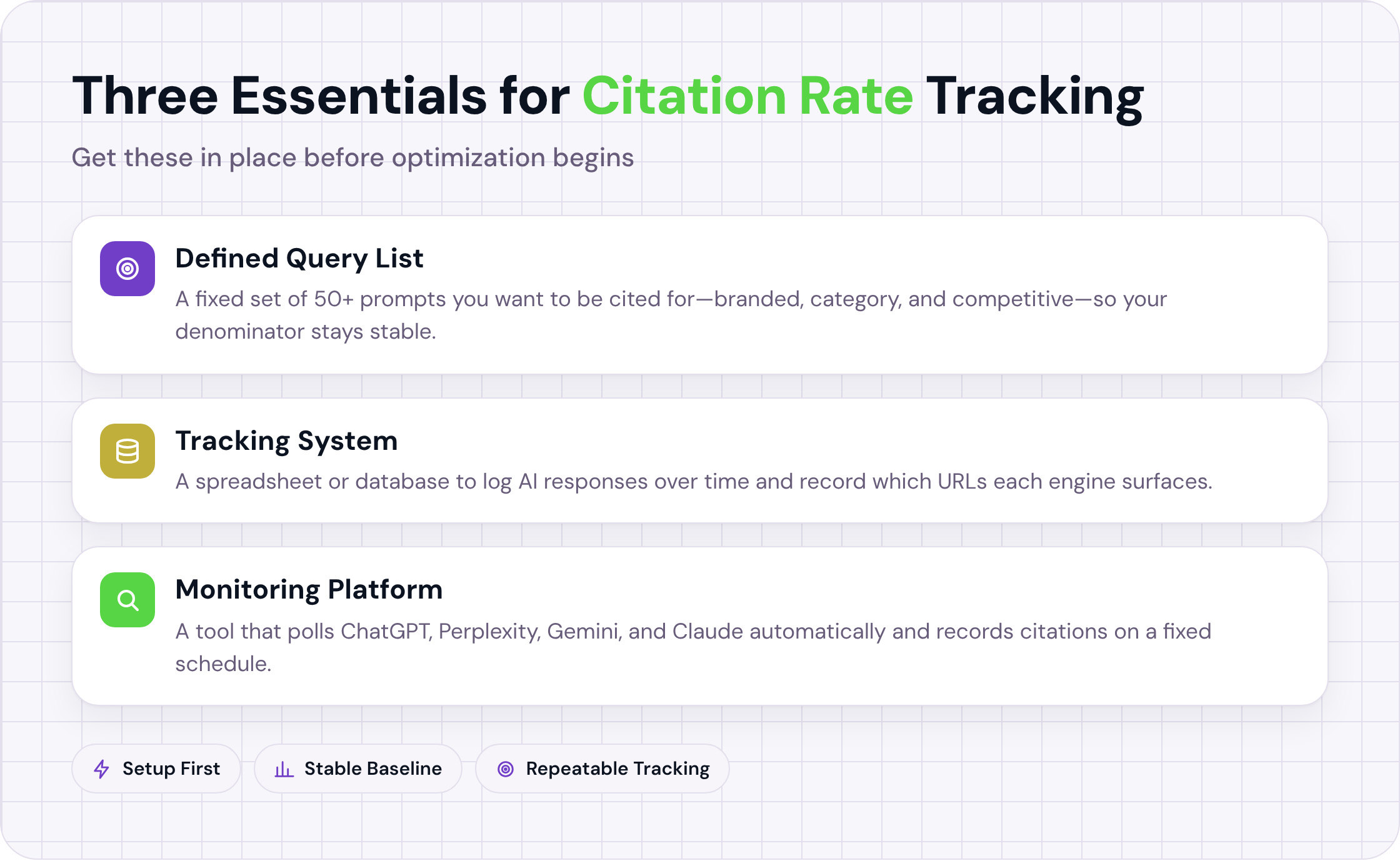
To track AI citation rate, you need three things in place before you touch any optimization: a defined list of queries you want to be cited for, a spreadsheet or database to log responses over time, and at least one platform that polls AI engines and records which URLs they surface.
Most teams skip the query list and go straight to tooling. That is the wrong order. Without a fixed query set, you have no stable denominator, and your citation rate becomes a number that shifts every time someone adds a new prompt. Settle on your queries first.
Building Your Tracked Query Set
A workable query set covers three prompt types:
- Branded prompts: queries that include your company or product name ("how does [your product] handle X")
- Category prompts: the generic questions your buyers ask before they know your name ("best tools for tracking AI citations", "how to reduce SaaS churn")
- Competitor-adjacent prompts: queries where a rival is named but you want to appear alongside them ("X vs Y for enterprise teams")
Thirty to fifty prompts is a reasonable starting point for most B2B companies. Fewer than twenty gives you too thin a sample to spot patterns; more than a hundred creates a tracking burden that most teams abandon within six weeks.
The numbers on tool coverage matter here. A comparison of 13 AI citation analysis tools found that no single platform tracks all four major engines (ChatGPT, Perplexity, Claude, Gemini) with equal fidelity, which means your platform choice directly affects which citations you can see and which you miss.
The Minimum Toolset
| Layer | What it does | Cost floor |
|---|---|---|
| Query list | Defines your tracked prompt universe | Free (a doc or sheet) |
| Tracking spreadsheet | Logs citation presence per query, per engine, per week | Free |
| AI monitoring platform | Polls engines automatically and parses cited URLs | Paid (most start ~$50-200/mo) |
| GA4 referral tracking | Catches direct traffic from AI engines that do pass referrer data | Free |
The spreadsheet layer is worth keeping even if you pay for a monitoring platform. Platforms change their polling logic, update their parsers, and occasionally drop historical data during migrations. A local log you control is your fallback.
The trade-off is time. Manual logging across four engines and fifty prompts takes two to three hours per week without automation. That is sustainable for a small team running a focused experiment, but it breaks down when you scale to hundreds of prompts or need daily frequency. At that point, a monitoring platform becomes the only practical path.
Set a cadence before you start. Weekly polling is the standard baseline. Daily is only worth the cost if you are running active A/B tests on page structure and need fast feedback loops. Monthly is too slow to catch the prompt-level shifts that happen when AI engines update their retrieval behavior.
Step 1: Build a Prompt Set That Reflects Real User Queries
A prompt set is the foundation of any repeatable AI citation measurement program. Start by collecting 50 or more test prompts drawn from keyword research, sales call transcripts, and customer support logs. Categorize each prompt by intent: informational, comparative, or transactional. Run this same library on a fixed cadence, and you have a structured baseline that shows citation movement over time rather than a one-off snapshot.
Where the 50 Prompts Actually Come From
Keyword tools give you volume data, but they rarely surface the phrasing real users type into ChatGPT or Perplexity. The gap matters. Similarweb's prompt research methodology outlines a five-step fan-out process that maps anchor queries across seven sub-query types, pulling real prompts from customer interviews, support tickets, and community forums alongside traditional search data. That combination is worth replicating.
In practice, a 50-prompt library typically breaks down like this:
| Intent Type | Share of Library | Example Prompt Form |
|---|---|---|
| Informational | ~50% | "How does [category process] work?" |
| Comparative | ~30% | "What's the difference between X and Y?" |
| Transactional | ~20% | "Which [product type] is best for [use case]?" |
Informational prompts tend to generate the most citations because AI engines default to explanatory sourcing. Comparative prompts are where competitive displacement happens most visibly. Transactional prompts are the hardest to get cited in, but the highest value when you do.
Structuring the Library for Reuse
Each prompt entry should carry four fields: the prompt text, the intent category, the target page on your site you expect to be cited, and a "last run" date. That structure lets you spot patterns across monitoring cycles, not just within a single week's results.
The trade-off is real. A 50-prompt library takes two to three hours to build properly and another hour per monitoring cycle to run and log manually. Teams that skip the customer interview step and pull prompts only from keyword tools often end up with a library that reflects how they describe their product, not how buyers ask about the problem. Those prompts consistently underperform in citation tests because AI engines are trained on conversational phrasing, not SEO-optimized keyword strings.
Keep the library version-controlled. Add new prompts when a product line changes or a new competitor enters the space, but retire old ones deliberately rather than letting the set grow without pruning. A bloated library of 200 prompts run inconsistently is less useful than 60 prompts run every 30 days without fail.
Step 2: Set Up Tools to Track AI Citations Across Engines
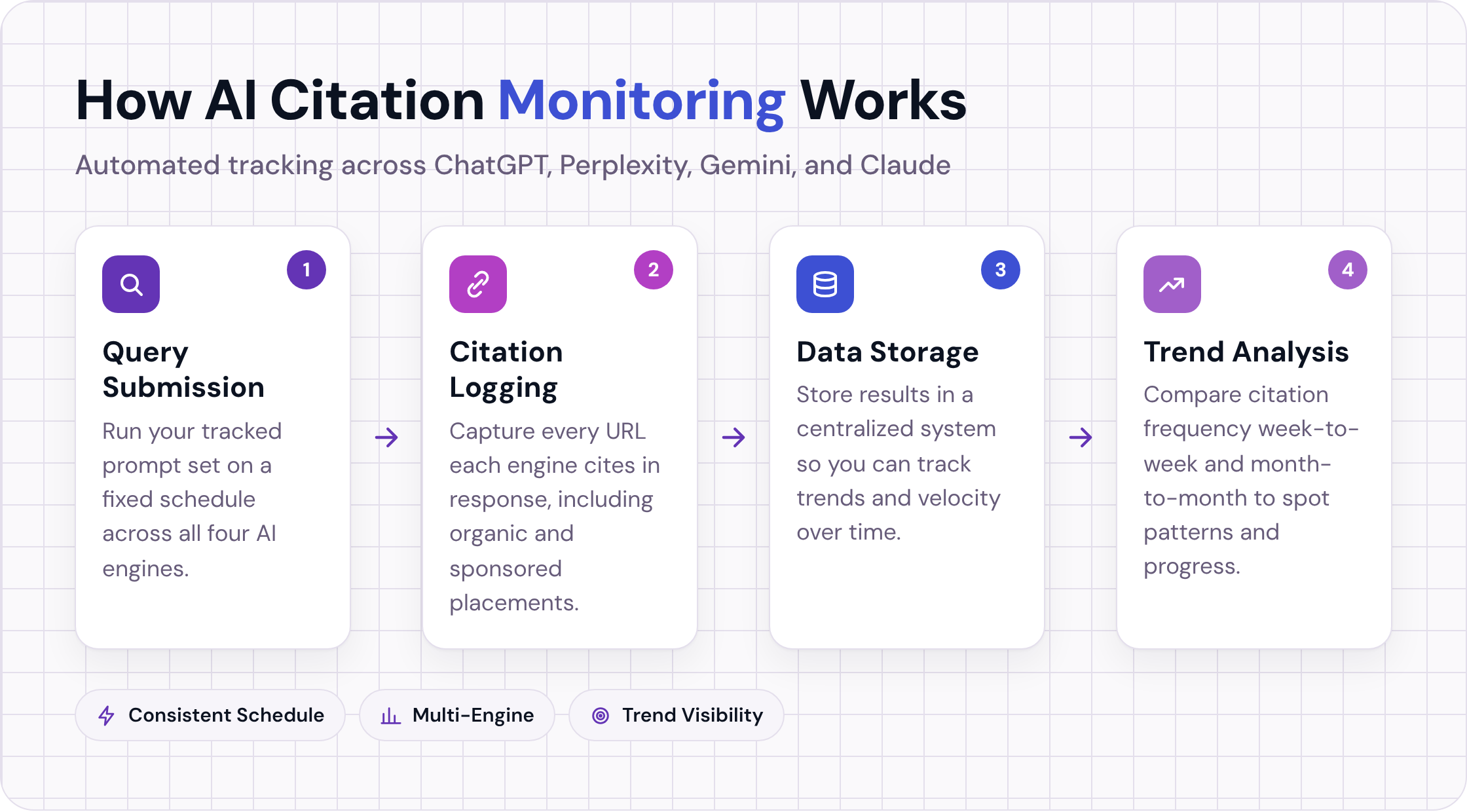
To track AI citations reliably, you need a system that queries ChatGPT, Perplexity, Gemini, and Claude on a fixed schedule, logs every URL each engine cites, and stores that data somewhere you can actually spot trends. Without a consistent logging layer, you are left with one-off spot checks that tell you nothing about direction or velocity.
Platforms That Monitor Automatically
Several tools now run this process without manual intervention. Slatehq's 2026 roundup of citation tracking tools identifies the leading platforms as monitoring brand citations across ChatGPT, Perplexity, Gemini, and Google AI Overviews, then separating organic citations from paid placements. That distinction matters: a citation inside a sponsored AI answer carries different weight than one pulled from organic training or retrieval.
For teams with budget, a dedicated tool handles the query scheduling, response parsing, and competitor surfacing automatically. For teams without one, the manual path is still viable, just slower.
Manual Spot-Checking on a Budget
Run your 20 to 40 tracked queries across each engine once a week, copy the full response into a shared doc, and highlight every URL cited. Log the date, the engine, the query, and the cited domain in a spreadsheet. It takes roughly 90 minutes per week for a 30-query set across four engines.
The trade-off is consistency. Manual checks break down when a team member is out, when query phrasing drifts between runs, or when response length varies enough that a citation gets missed on a skim. Automated tools solve for all three; manual checks solve for none of them. If your budget is genuinely zero, the manual method still produces usable data, but treat it as a starting point rather than a permanent setup.
Logging Citation Data So Trends Become Visible
Raw citation logs are not useful until they are structured. Otterly's framework for tracking AI search engine citations recommends connecting citation data to your existing analytics setup so you can correlate citation frequency with traffic and conversion changes over time.
At minimum, your log should capture: the query, the engine, the date, the cited URL, and whether the citation was first-position or buried in a longer response. With four weeks of data, you can calculate a per-engine citation rate for each tracked query. With twelve weeks, you can see whether a content update moved the needle. Without the log, you are always guessing.
Step 3: Analyze Citation Patterns to Find What AI Engines Prefer
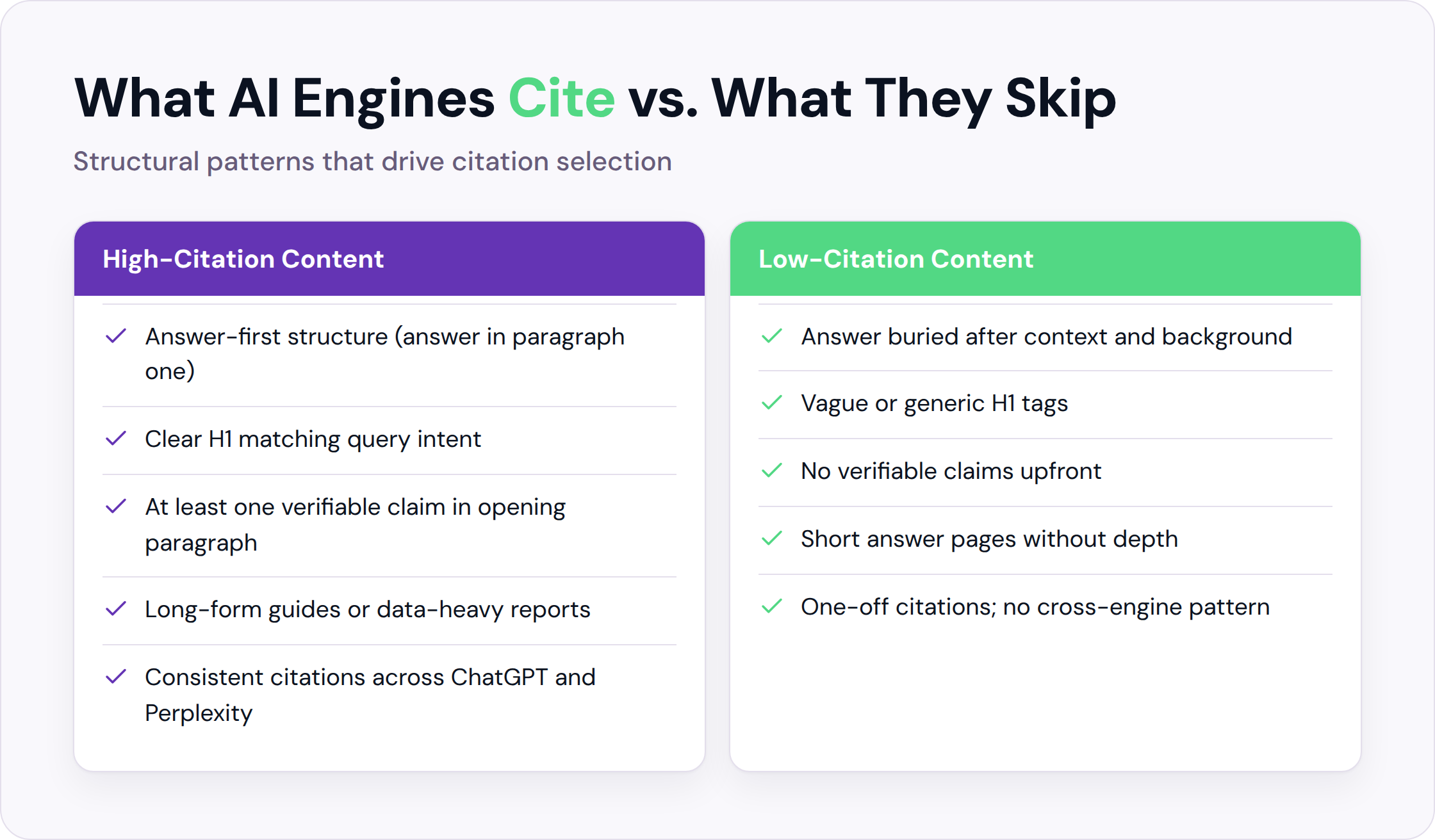
Analyzing citation data means looking for structural patterns in which content formats, domains, and query types earn references across AI engines. The goal is to separate coincidence from signal: a page cited once might be luck, but a page cited consistently across ChatGPT and Perplexity on the same query type is telling you something about format, authority, or specificity that you can replicate.
Reading Your Citation Data: Formats and Domains
Start by sorting your citation log by content type. Are the pages getting cited long-form guides, data-heavy reports, or short answer pages? Most teams find the pattern concentrates fast. A handful of pages, usually those with a clear answer-first structure and at least one verifiable claim in the opening paragraph, account for the majority of citations across all tracked queries.
Domain authority still matters, but less uniformly than traditional SEO would suggest. Tinuiti's citation pattern research shows that AI platforms weigh topical specificity and structural clarity alongside raw domain metrics, meaning a focused niche page can outperform a broader authority site on a specific query.
How Perplexity and ChatGPT Differ in Source Selection
These two engines do not pull from the same pool. Only an estimated 11% of domains are cited by both ChatGPT and Perplexity, according to 5WPR's State of AI Citations 2026 research. That overlap figure is low enough that treating them as interchangeable is a real strategic mistake.
Perplexity skews toward recently indexed pages and sources with explicit citations of their own. ChatGPT's retrieval, particularly in browsing mode, favors pages with clean heading hierarchies and answer-first paragraph structure. Claude tends to cite longer-form content with clear authorship signals. Gemini pulls heavily from Google-indexed properties and favors pages that already appear in featured snippets.
Knowing this, you can prioritize your citation rate optimization effort by engine. If Perplexity is your weakest engine, focus on freshness: update your top pages quarterly and add a published date to every post. If ChatGPT is the gap, audit your heading structure and move your core answer to the first 100 words of each page.
Spotting the Pages Worth Fixing First
Sort your citation log by query, then by engine. Any query where you are cited by two engines but not a third is a structural signal, not a content gap. The content is good enough to earn citations; something about the page's format or indexing is blocking the third engine specifically.
Pages cited zero times across all engines and all queries after eight weeks of tracking are a different problem. Those pages either lack the topical specificity AI engines need, or they are not being retrieved at all. Check whether they are indexed, whether they have a clear H1 that matches the query intent, and whether the opening paragraph answers the question directly rather than building to an answer.
Step 4: Optimize Content Structure for Higher Citation Rates
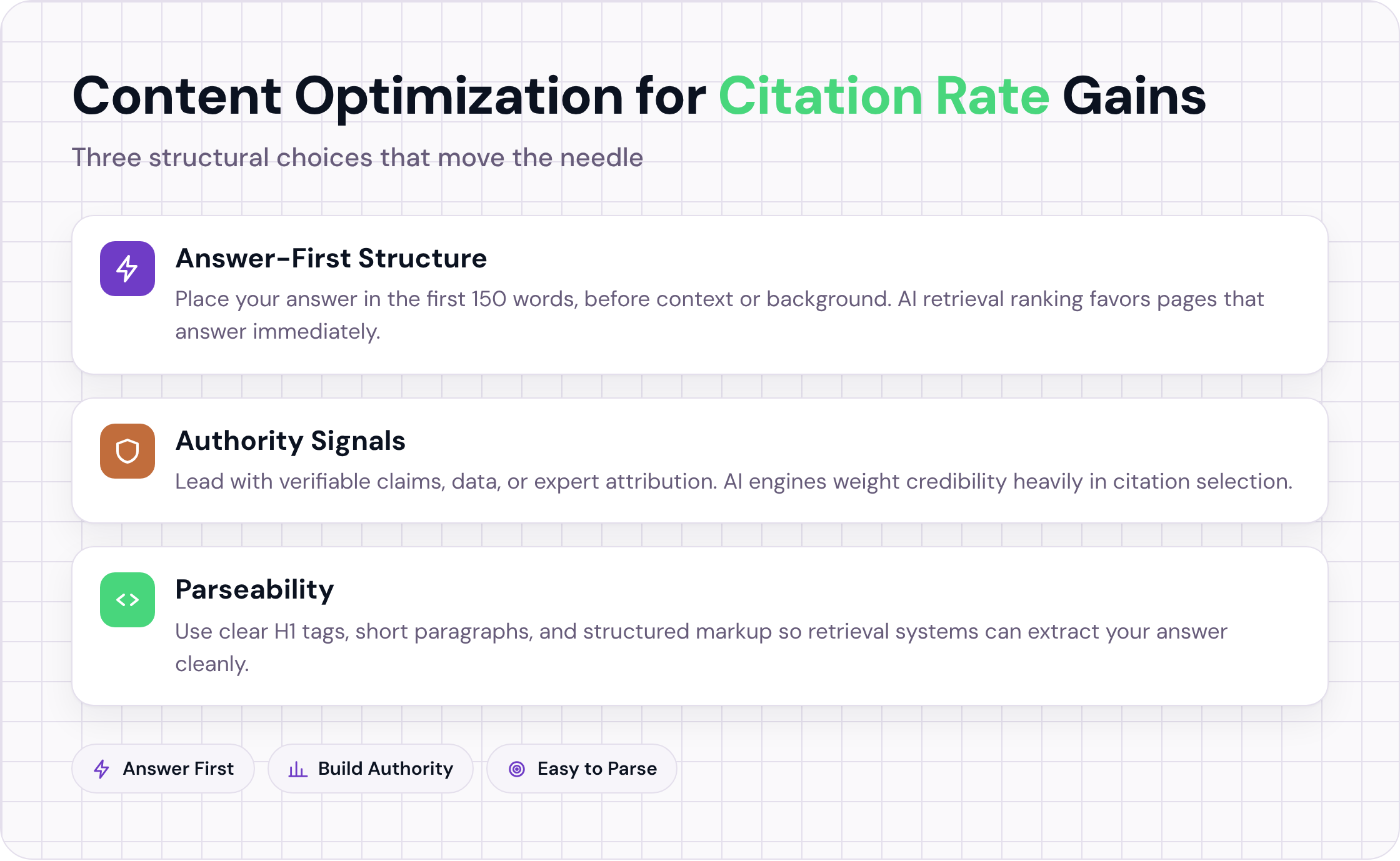
Citation rate optimization at the content level comes down to three structural choices: where you put the answer, how you signal authority, and whether the page is easy for a retrieval system to parse.
Answer-First Structure
AI engines retrieve content to answer a question. Pages that bury the answer in paragraph four, after context-setting and background, get passed over in favor of pages that answer in paragraph one. This is not a stylistic preference; it is how retrieval ranking works. The Arxiv GEO framework referenced earlier explicitly separates retrieval selection from response prominence, and answer placement affects both.
A practical test: paste your page's first 150 words into a blank document. Does it answer the query you want to be cited for? If not, restructure before you do anything else.
Authority Signals That AI Engines Read
Verifiable claims with inline citations, named authors with visible credentials, and a published or updated date all function as authority signals that AI engines weight during source selection. Pages with none of these are competing against pages that have all three.
One counter-case worth acknowledging: adding citations to thin content does not fix thin content. A 400-word page with five footnotes will still lose to a 1,200-word page with two footnotes if the longer page answers the question more completely. Authority signals amplify good content; they do not substitute for it.
Structural Clarity for Retrieval Systems
Use descriptive H2 and H3 headings that match the phrasing of real queries. Keep paragraphs short (two to four sentences). Use tables for comparative data rather than prose comparisons. These choices make it easier for a retrieval system to identify which section of your page answers which question, which increases the probability that the right section gets surfaced for the right prompt.
Step 5: Track Competitors' Citation Rates to Benchmark Your Progress
Your citation rate only tells you part of the story. A 6% rate looks strong until you find out your closest competitor is at 18% on the same query set. Competitive benchmarking gives you the context to know whether your optimization work is keeping pace, falling behind, or pulling ahead.
How to Pull Competitor Citation Data
Most AI monitoring platforms surface competitor citations alongside your own. When you run your tracked query set, log every domain cited, not just yours. After four weeks, you have a citation frequency ranking for every domain appearing in your query set. That ranking is your competitive benchmark.
The 5WPR State of AI Citations 2026 research found that citation share concentrates heavily at the top: the most-cited domains in a given category capture a disproportionate share of total citations, similar to how the top three organic results capture most clicks in traditional search. If a competitor holds that position, you need to understand why before you can displace them.
What to Do With the Gap
If a competitor is cited more frequently than you on informational prompts, pull their top-cited pages and audit the structure. Look at heading hierarchy, answer placement, and whether they cite primary sources. If they are doing something structurally that you are not, that is a replicable fix.
If the gap is on comparative prompts, the problem is usually brand presence: AI engines cite sources that explicitly compare the options in the query. Creating a dedicated comparison page that names the competitors and provides a structured breakdown often moves citation rate on those prompts within six to eight weeks.
Frequently Asked Questions
What is a good citation rate for AI search?
Most brands land between 1% and 5% across a broad prompt set. Top-performing pages in well-defined categories reach 15% to 22%, based on Rankability's 2026 analysis. A "good" rate depends on your query set: narrow, high-authority topics will always outperform broad category queries, so compare your rate against a consistent prompt set rather than an industry average.
How long does it take to see results from citation rate optimization?
Structural changes to page content, such as moving the answer to the first paragraph or adding a clear H1 that matches query intent, can show up in citation logs within two to four weeks. Broader authority-building work, like earning external citations or building topical depth across a cluster of pages, typically takes three to six months to register as a measurable shift in citation rate.
Does domain authority still matter for AI citations?
Yes, but less uniformly than in traditional search. Tinuiti's research shows that topical specificity and structural clarity carry significant weight alongside domain metrics. A focused page on a niche topic can outperform a high-authority generalist page on that specific query. Domain authority matters most when two pages are otherwise comparable in structure and specificity.
Can you track AI citations without a paid tool?
Yes. A manual process, running your tracked queries weekly, copying responses into a shared doc, and logging cited URLs in a spreadsheet, produces usable data at zero cost. The limitation is consistency: manual tracking breaks down when team members are unavailable or query phrasing drifts between runs. Treat the manual method as a starting point and move to an automated platform once you have validated that citation tracking is worth the ongoing investment.
Why do ChatGPT and Perplexity cite different sources?
The two engines use different retrieval architectures. Only about 11% of domains appear in both engines' citation sets, according to 5WPR's 2026 research. Perplexity favors recently indexed pages and sources that themselves cite primary data. ChatGPT in browsing mode favors clean heading hierarchies and answer-first structure. Optimizing for one engine does not automatically improve your rate on the other, so track them separately.
Should you optimize for all four AI engines at once?
Start with the engine where your target audience is most active, then expand. Trying to optimize for ChatGPT, Perplexity, Claude, and Gemini simultaneously spreads your effort thin and makes it harder to attribute what is working. Once you have a repeatable process on one engine, the structural improvements, answer-first writing, clear headings, verifiable claims, transfer reasonably well to the others.
If you want a clearer picture of where your content stands across AI engines, visit Seorav's GEO service page to see how citation rate optimization fits into a broader generative engine optimization strategy.
Keep reading
Which Enterprise CMS Platforms Actually Deliver at Scale
Compare the best enterprise CMS platforms on SEO toolchain fit, analytics depth, and total cost. Contentful, AEM, Sitecore, and WordPress VIP evaluated.
Schema Markup Validators: How to Test and Fix Your Structured Data
Learn how to use a schema markup validator to catch missing properties, type mismatches, and duplicate markup before they cost you rich result eligibility.
AI Visibility Tools for Ecommerce Brands That Actually Move the Needle in 2025
We tested 11 ai visibility tools for ecommerce brands over 8 weeks. See which platforms track citations, cover your catalog, and justify their cost.