How to Get Your Products Into AI Chatbot Shopping Suggestions
Last updated: 29 October 2026
Tools that help improve visibility in AI chatbot shopping suggestions fall into three categories: data structuring platforms like Schema.org markup validators and product feed optimizers, content analysis tools such as Semrush and Ahrefs that identify question-based keywords chatbots prioritize, and attribution trackers like UTM parameters and conversion APIs that measure chatbot referral performance. The most effective approach combines all three, regardless of budget.
The tools that actually move the needle are not SEO platforms repurposed for AI. They are purpose-built for tracking brand mentions, citation frequency, and product-level visibility inside ChatGPT, Perplexity, Google AI Overviews, and similar engines. Triple Whale's ecommerce AI visibility breakdown puts it plainly: the relevant metrics are brand mentions, citations, product results, sentiment, and share of voice inside the answer itself, not in the blue-link results below it.
This tutorial is written for ecommerce operators and marketing managers running product catalogs on any major platform. You do not need a developer on standby, but you do need access to your product feed, your CMS or product pages, and ideally a basic analytics setup. One honest caveat: if your catalog has fewer than 20 SKUs or you have no existing content presence, some of the citation-building steps will take longer to show results than the tracking steps will.
By the end, you will know which tools to use, how to structure your product pages for AI citation, and how to measure progress without guessing.
Before You Start: What You Need in Place
To get products surfaced in AI chatbot shopping suggestions, you need a structured product feed with valid GTINs, accurate pricing fields, and schema markup in place before any optimization work will stick. Without these foundations, AI engines have no reliable data to pull from.
Catalog and Feed Requirements
The minimum bar is higher than most teams expect. Your product feed needs:
- GTINs (Global Trade Item Numbers) on every SKU. AI shopping engines cross-reference GTINs against external databases to verify product identity. A missing or malformed GTIN is a hard stop.
- Structured data markup (Schema.org
Producttype) on your product detail pages, includingname,description,offers,price,priceCurrency, andavailabilityfields populated correctly. - Real-time or near-real-time pricing. Stale price fields are one of the fastest ways to get dropped from AI-generated recommendations. If your feed updates once a day and a flash sale runs overnight, the data AI engines cached will be wrong.
- High-quality product descriptions written in plain language. AI engines parse these directly when generating comparative answers.
Semrush's study on AI tools and the modern buyer journey found that shoppers now use tools like ChatGPT and Gemini to compare options and evaluate products before visiting a retailer's site. That means your feed data is effectively your first impression, not your product page.
One trade-off worth acknowledging: even a perfectly structured feed does not guarantee inclusion. AI engines apply their own relevance and trust filters on top of feed data, and smaller catalogs from newer domains often get deprioritized regardless of technical compliance. This approach works best for brands with at least 6 months of indexed history and a product catalog above roughly 50 SKUs. Below that threshold, the signal-to-noise ratio for AI engines is low enough that feed optimization alone rarely produces measurable citation gains.
Access Levels You'll Need
Before anyone touches a feed or a schema template, confirm you have the right permissions across three systems.
Ecommerce platform: You need admin-level access (or a role that includes feed management and theme/template editing) to modify structured data on product pages. Editor-only roles typically cannot push schema changes.
Google Merchant Center: Full account access, not read-only. You'll be editing feed rules, fixing disapprovals, and potentially configuring supplemental feeds.
Analytics stack: At minimum, you need access to Google Search Console (to monitor rich result errors) and whatever tag management system controls your site's JSON-LD output. If your team uses a third-party feed management tool like Feedonomics or DataFeedWatch, you'll need credentials there too.
One practical note: in larger ecommerce orgs, feed management and site development often sit in separate teams with separate access controls. Getting both sets of credentials aligned before starting saves a week of back-and-forth once you're mid-implementation.
Step 1: Understand Why AI Engines Pick Certain Products Over Others
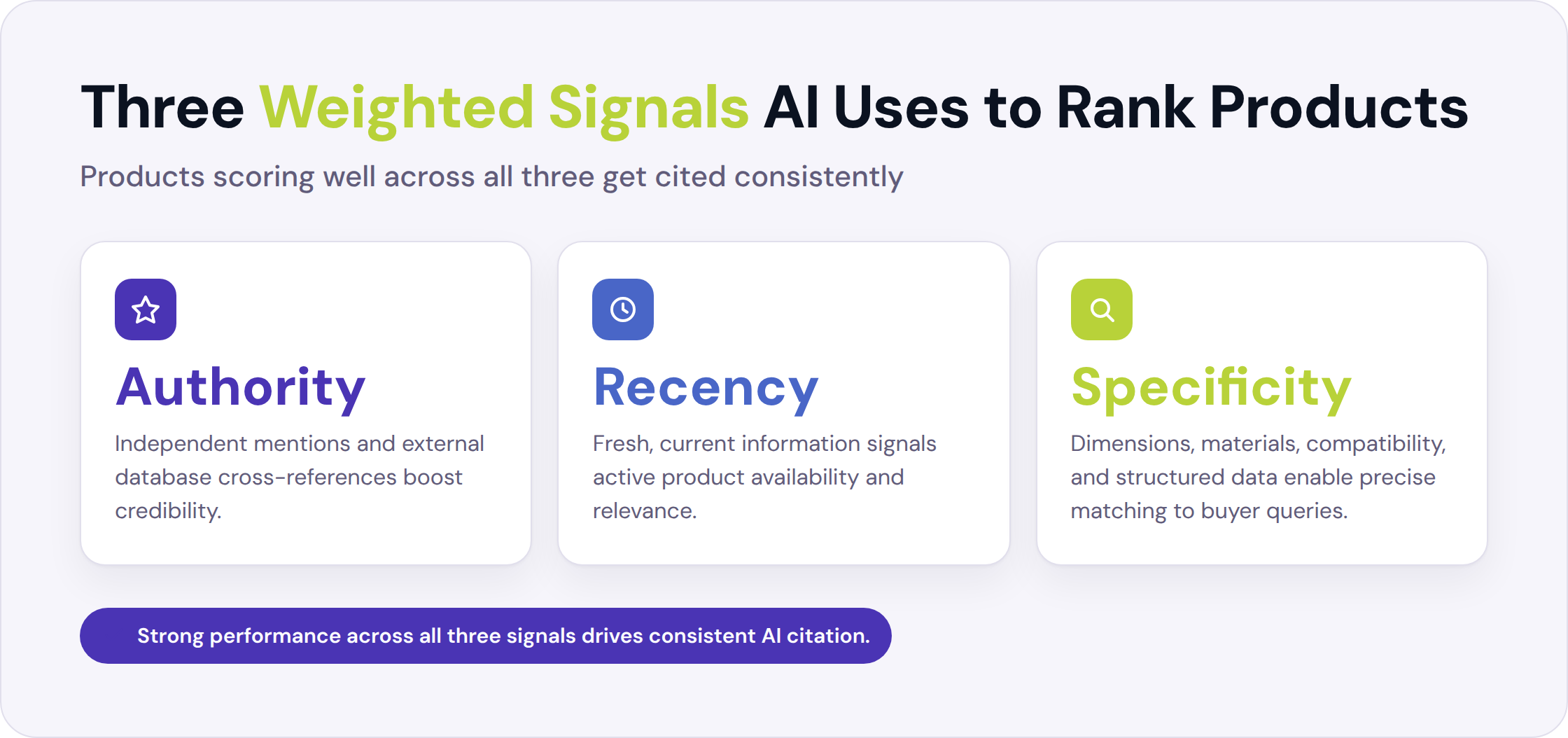
AI shopping assistants retrieve product information from pre-indexed, structured sources using three weighted signals: authority (third-party mentions and citations), recency (content updated within 6, 12 months), and structured specificity (exact attributes like dimensions, materials, and compatibility). Products scoring well across all three get cited consistently; those strong in only one rarely appear in shopping suggestions.
How RAG Actually Pulls Product Data
Retrieval-augmented generation works by querying a vector index of pre-processed documents, pulling the most relevant chunks, and feeding them into the language model as context before it generates a response. The model does not "know" your product from training alone. It retrieves a passage about your product, evaluates whether that passage answers the user's query with enough specificity, and either cites it or discards it.
This means the content that gets retrieved has to be self-contained. A product page that says "premium build quality" gives the retrieval layer almost nothing to work with. A page that says "6061 aluminum frame, 2.3 kg, compatible with 75mm VESA mounts" gives it something it can actually match against a query like "lightweight monitor arm under 3 kg."
McKinsey's 2025 analysis of AI search behavior makes this explicit: winning brands in AI-driven discovery are those that optimize for structured, attributable content across both AI summaries and AI platforms, not just traditional search rankings.
The Three Signals That Drive Citation Frequency
Authority is not just domain rating. For AI shopping contexts, it reflects how often your product is mentioned in third-party editorial content: review roundups, comparison articles, forum threads, and press coverage. A product cited in 12 independent sources carries more retrieval weight than one with a single well-optimized product page.
Recency matters more than most product teams expect. AI engines tend to favor content updated within the last 6 to 12 months, particularly for categories where specs, pricing, or availability change frequently. A product page last touched in 2022 is a liability in a 2026 shopping query, even if the product itself is unchanged.
Structured specificity is where most brands leave the most ground on the table. Vague benefit language does not parse well in retrieval. Concrete attributes do. This maps to what Plug and Play Tech Center's retail AI visibility research identifies as a core gap: brands that describe outcomes ("feel more comfortable") consistently underperform brands that describe specifications ("memory foam density of 4 lb/ft3, 10-inch profile").
Why Google Rankings Do Not Transfer Automatically
A strong Google ranking tells you that your page is well-linked, loads fast, and matches keyword intent. It does not tell you whether your content is structured for retrieval, whether third-party sources corroborate your claims, or whether your product attributes are specific enough to satisfy a conversational query.
The retrieval layer in an AI engine does not care about PageRank. It cares about passage-level relevance and source credibility within its own index. A page ranked third on Google for "best ergonomic chair" can be completely absent from a ChatGPT shopping suggestion if the content is thin, the attributes are vague, or the page has no meaningful third-party citation footprint.
The feedback loop here is slow. Unlike Google Search Console, most AI engines do not expose citation data directly, so you often cannot tell whether a content change improved your retrieval rate for weeks or months. Brands with smaller catalogs and limited editorial relationships will find this harder to move quickly, and there is no shortcut that reliably bypasses the authority signal.
Step 2: Choose and Configure the Right Tools That Help Improve Visibility in AI Chatbot Shopping Suggestions
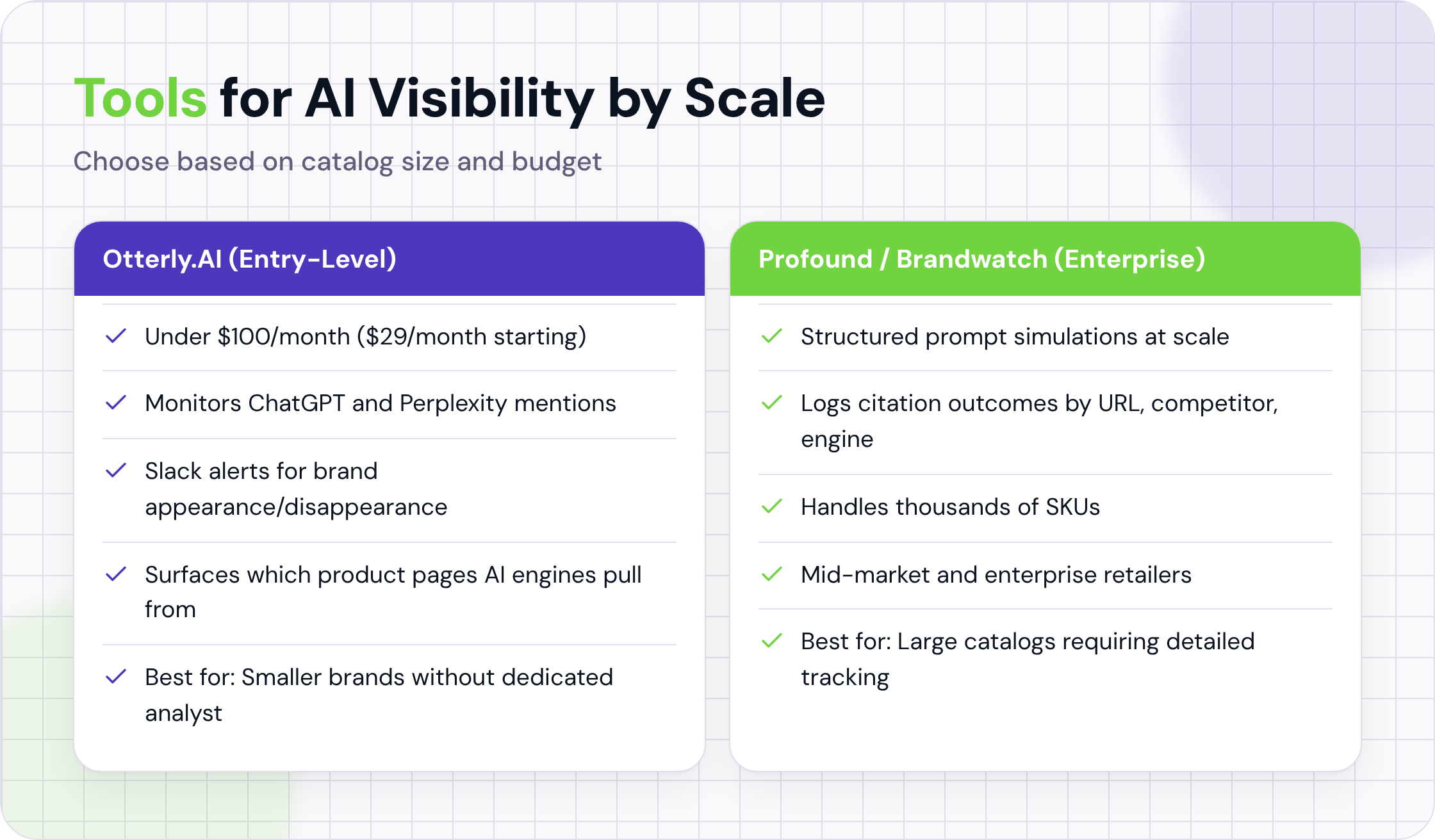
The right tool depends on catalog size and budget. Smaller brands can start with Otterly.AI (under $100/month) to track product and brand mentions across ChatGPT and Perplexity. Mid-market and enterprise retailers managing thousands of SKUs need platforms like Profound or Brandwatch, which run structured prompt simulations at scale and log citation outcomes by URL, competitor, and engine.
Otterly.AI: Entry-Level Tracking That Ships Actionable Data
Otterly.AI is the clearest starting point for brands that want citation data without an analyst on payroll. It monitors brand and product mentions inside ChatGPT and Perplexity, sends Slack alerts when your brand appears or disappears from an answer, and surfaces which specific product pages AI engines are pulling from. Paid tiers start around $29/month. Zapier's roundup of AI visibility tools flags Otterly specifically for affordability among teams that need actionable data fast, not a six-figure platform contract.
Setup takes under an hour: connect your domain, add the product keywords and branded queries you want tracked, and let it run weekly cycles. The output is a citation log, not a dashboard full of vanity metrics.
Profound and Brandwatch: Enterprise Options for Catalog-Scale Monitoring
For retailers with 10,000+ SKUs, lighter trackers break down. Profound runs structured prompt simulations across ChatGPT, Perplexity, Gemini, and Claude, logs which URLs get cited per query, and flags where a competitor is being picked instead of you. That competitive displacement signal is what separates it from simpler tools.
Brandwatch layers in social and conversational data alongside AI engine monitoring, which matters for brands where product perception is shaped across multiple channels simultaneously. A 2025 comparison of leading AI visibility platforms shows enterprise tools like these covering four or more AI engines natively, while most sub-$100 tools cap at two.
The trade-off is real. Profound and Brandwatch are built for teams with dedicated analysts. If you don't have someone to act on the citation gap reports they generate, you're paying for data that sits in a dashboard. Smaller brands often overbuild this layer before they've fixed the underlying content problems that caused the citation gaps in the first place.
Cheapest Entry Point: Perplexity API Logs and Manual Prompt Testing
If budget is the constraint, the floor is free. Perplexity's API lets you run queries programmatically and log the citations returned. Pair that with a simple spreadsheet tracking which of your product URLs appear, how often, and against which query types. It takes more manual effort than a paid tool, but it gives you real citation data rather than estimated visibility scores.
The limitation: manual prompt testing only covers the queries you think to test. Paid platforms run hundreds of simulated buyer queries automatically, which surfaces citation gaps you would never find by hand. For brands just starting out, the manual approach is a reasonable first 60 days. After that, the time cost usually justifies moving to a paid tier.
Step 3: Structure Your Product Pages for AI Citation
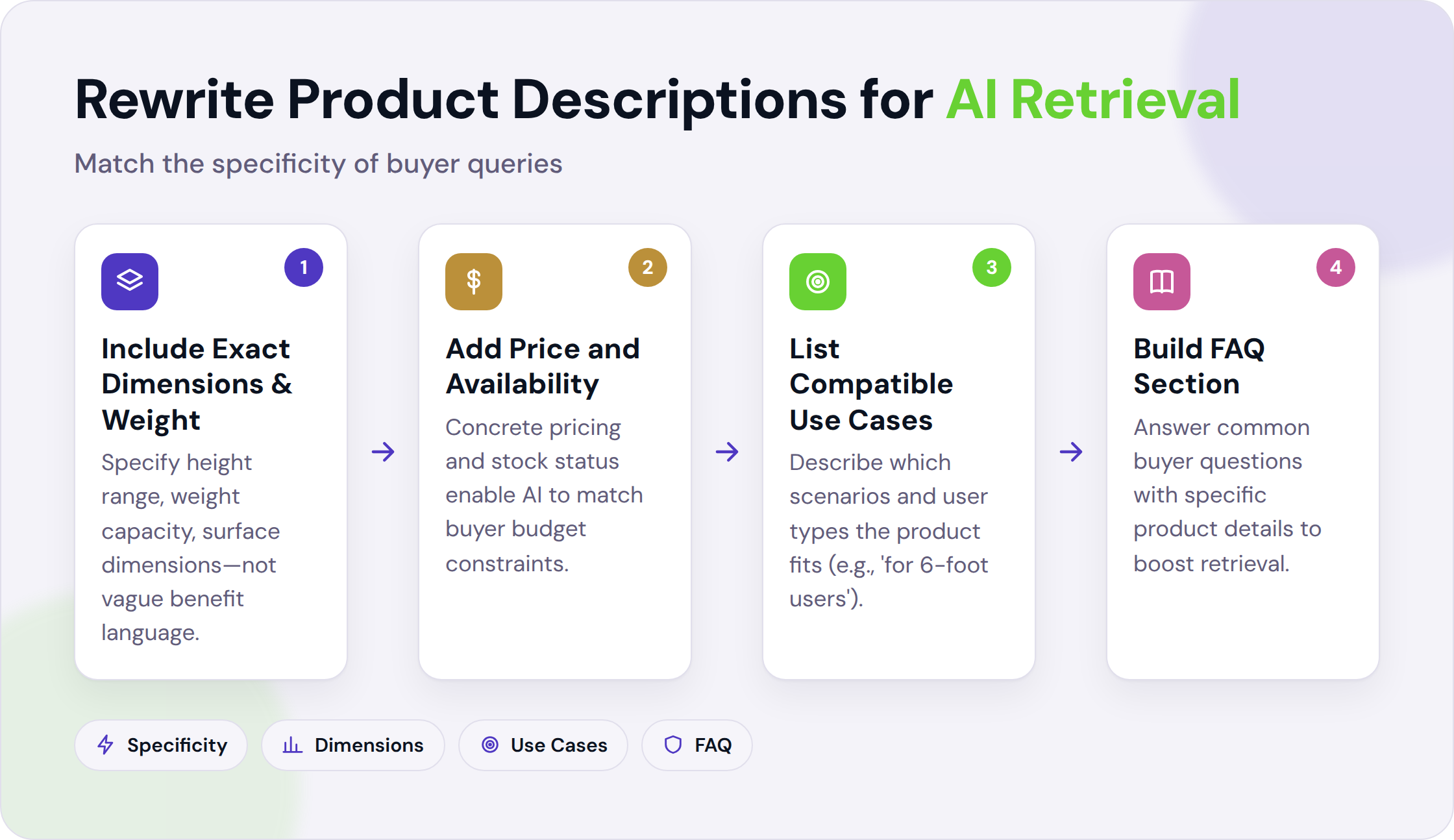
Product pages must contain specific, verifiable attributes, exact dimensions, weight, materials, price, and compatible use cases, rather than vague benefit language. AI retrieval systems match concrete product details against buyer queries, so pages with detailed specifications and FAQ sections answering common questions have significantly higher citation rates than generic product descriptions.
Write Descriptions That Answer Specific Buyer Questions
AI engines retrieve content that matches the specificity of the query. A buyer asking "what's the best standing desk under $600 for a 6-foot user" needs a page that mentions height range, weight capacity, price, and surface dimensions. If your product page only says "adjustable height desk with premium finish," it will not get retrieved for that query.
Rewrite your top 20 product descriptions to include:
- Exact dimensions and weight
- Compatible use cases or user profiles (height ranges, room sizes, device compatibility)
- Materials with specific grades or ratings where relevant
- Price range or starting price
- One or two direct comparisons to common alternatives, written in plain language
This is not about keyword stuffing. It is about giving the retrieval layer enough specific, verifiable content to match against a real buyer query.
Add FAQ Sections to High-Priority Product Pages
FAQ sections are retrieval gold. A buyer asking "does this desk fit in a 10x10 room" is running a conversational query. If your product page has a FAQ that answers "What are the minimum room dimensions for this desk?" with a specific answer, that passage has a high chance of being retrieved and cited.
Add 5 to 8 FAQs per product page, each written as a complete question and a 2 to 3 sentence answer. Use the exact phrasing buyers use, not internal product language. Pull question phrasing from your customer support tickets, Amazon Q&A sections for similar products, and Reddit threads in your product category.
Keep Schema Markup Current
Schema markup is not a one-time setup. Price changes, availability changes, and new product variants all need to be reflected in your structured data within 24 hours of going live on the page. Stale schema is one of the most common reasons a well-described product stops appearing in AI shopping suggestions after initially being cited.
Run a Google Rich Results Test on your top 50 product pages every 30 days. Fix any errors flagged under the Product or Offer types before moving on to content work. A schema error on a high-traffic product page will undercut everything else you do.
Step 4: Build Third-Party Citation Coverage
Your product page alone is rarely enough. AI engines weight third-party mentions heavily because they treat independent sources as a credibility signal. A product mentioned in a Wirecutter roundup, a Reddit thread, and two independent review blogs carries more retrieval authority than a product with a single optimized product page, even if that page is technically perfect.
Target Editorial Roundups First
Roundup articles ("best standing desks under $600," "top ergonomic chairs for remote workers") are the highest-value citation targets. A single placement in a well-trafficked roundup can generate dozens of retrieval events across multiple AI engines over months.
Identify 10 to 15 roundup articles in your category that are currently ranking on Google and being cited in Perplexity or ChatGPT responses. Reach out to the authors or editors with a specific pitch: your product's specs, a comparison to what they already listed, and a reason why their readers would find it relevant. Generic PR pitches do not work here. Specific, data-backed pitches do.
Use Forum and Community Mentions Strategically
Reddit, Quora, and niche community forums are indexed by AI engines and frequently cited in shopping responses. Authentic participation in these communities, where you answer questions about your product category with specific, helpful information, builds citation coverage that paid placements cannot replicate.
The constraint: this only works if the participation is genuine. Promotional posts get flagged and removed. Helpful, specific answers that happen to mention your product in context get upvoted and indexed. The distinction is obvious to any moderator and to most AI retrieval systems, which weight engagement signals alongside content.
Frequently Asked Questions
How long does it take to see results after optimizing for AI chatbot visibility?
Most brands see initial citation data within 4 to 8 weeks of fixing schema errors and updating product descriptions. Building third-party citation coverage takes longer, typically 3 to 6 months before it produces consistent retrieval gains. The tracking tools give you data faster than the content changes produce results, so expect a gap between when you start measuring and when the numbers move.
Do I need a separate strategy for each AI engine (ChatGPT, Perplexity, Gemini)?
The underlying content requirements are largely the same across engines: specific attributes, current schema, and third-party citation coverage. The differences show up in how each engine weights recency versus authority, and in which sources each engine indexes most heavily. Perplexity indexes the open web aggressively and cites sources visibly. ChatGPT's shopping suggestions draw more heavily from structured product feeds and partner data. Running prompt tests across both engines with a tool like Profound or Otterly.AI will show you where your gaps are engine-specific versus content-wide.
Can small brands with limited budgets realistically compete for AI chatbot citations?
Yes, but the path is narrower. Small brands with fewer than 50 SKUs and limited editorial coverage should focus on two things first: fixing schema errors (free, high-impact) and targeting 3 to 5 specific long-tail buyer queries where the competition for AI citations is lower. Broad category queries like "best ergonomic chair" are dominated by brands with years of citation history. Specific queries like "ergonomic chair for petite users under $400" are more winnable for a newer brand with a well-described, correctly priced product.
What's the difference between AI visibility tools and traditional SEO tools?
Traditional SEO tools measure rankings, backlinks, and on-page signals for Google's blue-link results. AI visibility tools measure citation frequency, brand mention sentiment, and share of voice inside AI-generated answers. The data sources are different, the metrics are different, and a high score in one system does not predict performance in the other. You need both if you want full coverage of how buyers find your products.
Is schema markup enough on its own to get into AI shopping suggestions?
Schema markup is necessary but not sufficient. It tells AI engines what your product is and gives them structured data to retrieve. But without third-party citation coverage and specific, query-matching content in your product descriptions, schema alone will not produce consistent citation results. Think of schema as the entry ticket: it gets you considered, but the content and authority signals determine whether you actually get cited.
Start Measuring Before You Optimize
The single most common mistake brands make with AI chatbot visibility is spending months on content and schema work before setting up any tracking. You end up with no baseline, no way to attribute what worked, and no signal telling you which product pages are already being cited versus which ones need the most attention.
Set up a tracking tool first, even if it's just manual Perplexity API logging. Run your top 20 product queries. Record which URLs get cited and which competitors appear instead of you. Then use that data to prioritize your schema fixes, description rewrites, and outreach targets. The tools that help improve visibility in AI chatbot shopping suggestions work best when they're informing your content decisions, not just measuring them after the fact.
If you want a clearer picture of where your products stand in AI-generated results right now, visit Seorav's GEO service page to see how they approach AI visibility audits and citation gap analysis for ecommerce catalogs.
Keep reading
When to Refresh Your Content for AI Search Engines
Learn how often to update content for AI search, with cadence by content type, signals that trigger re-indexing, and metrics that show whether your refresh
How AI Search Is Changing the Business of News Publishing
AI search is cutting news publisher traffic by 35% or more. See how citation-without-click works, which content survives, and what the licensing deals actu
How to Measure Your Brand's LLM Citation Share Across AI Search Engines
Learn how to measure LLM citation share across ChatGPT, Perplexity, and Gemini with a step-by-step tracking system, prompt library, and scoring method.