Reference Rate vs. Click-Through Rate: Which Metric Actually Drives Growth in AI Search
Last updated: 25 September 2026
Reference rate and click-through rate measure fundamentally different outcomes in AI search. Reference rate tracks how often an AI engine cites your content in generated responses, while click-through rate measures clicks from traditional search results pages. Reference rate matters more for AI visibility since it determines whether your content reaches users inside AI interfaces, whereas CTR reflects traditional search behavior. Content teams now need both metrics because they indicate success in separate distribution channels with distinct user journeys and conversion paths.
The two metrics can move in opposite directions at the same time. An AI engine may cite your article in a detailed answer, satisfying the user's query without them ever visiting your site. Your reference rate climbs; your CTR drops. The reverse is equally possible: a page that ranks visibly in traditional search draws clicks but never gets pulled into an AI-generated response. Mailchimp's email benchmark data frames CTR as a measure of "actual engagement and conversion potential," which is accurate for link-based channels but misses the value that comes from being cited without a click ever happening.
One honest caveat before going further: neither metric alone tells you whether you are growing. A high reference rate with zero CTR can mean your content is genuinely authoritative, or it can mean AI engines are summarizing you out of the funnel entirely. Context is the only way to tell the difference.
TL;DR
Reference rate measures how often AI engines cite your content in their responses. CTR measures how often users click a link in traditional search results. In AI search, reference rate is the earlier and more consequential signal: a citation can drive brand awareness and downstream conversions even when no click occurs.
- Reference rate: The share of AI engine responses across ChatGPT, Perplexity, Claude, and Gemini that include a citation to your content. No click required. Visibility happens at the answer layer.
- CTR: The percentage of users who click your link after seeing it in a results page. SEOProfy's 2026 channel benchmarks show organic CTR varies sharply by position, with top-ranked results capturing the bulk of clicks while lower positions see fractions of a percent.
- Why AI search shifts the weighting: AI engines synthesize answers before a user ever sees a list of links. If your content is not cited in the synthesis, CTR is irrelevant. A brand cited repeatedly but never clicked still needs a conversion path somewhere downstream.
- The one action to take first: Audit which prompts your buyers actually type, then check whether AI engines cite you or a competitor in those responses. That gap is more actionable than any CTR optimization you can run today.
The Core Difference Between Reference Rate and Click-Through Rate
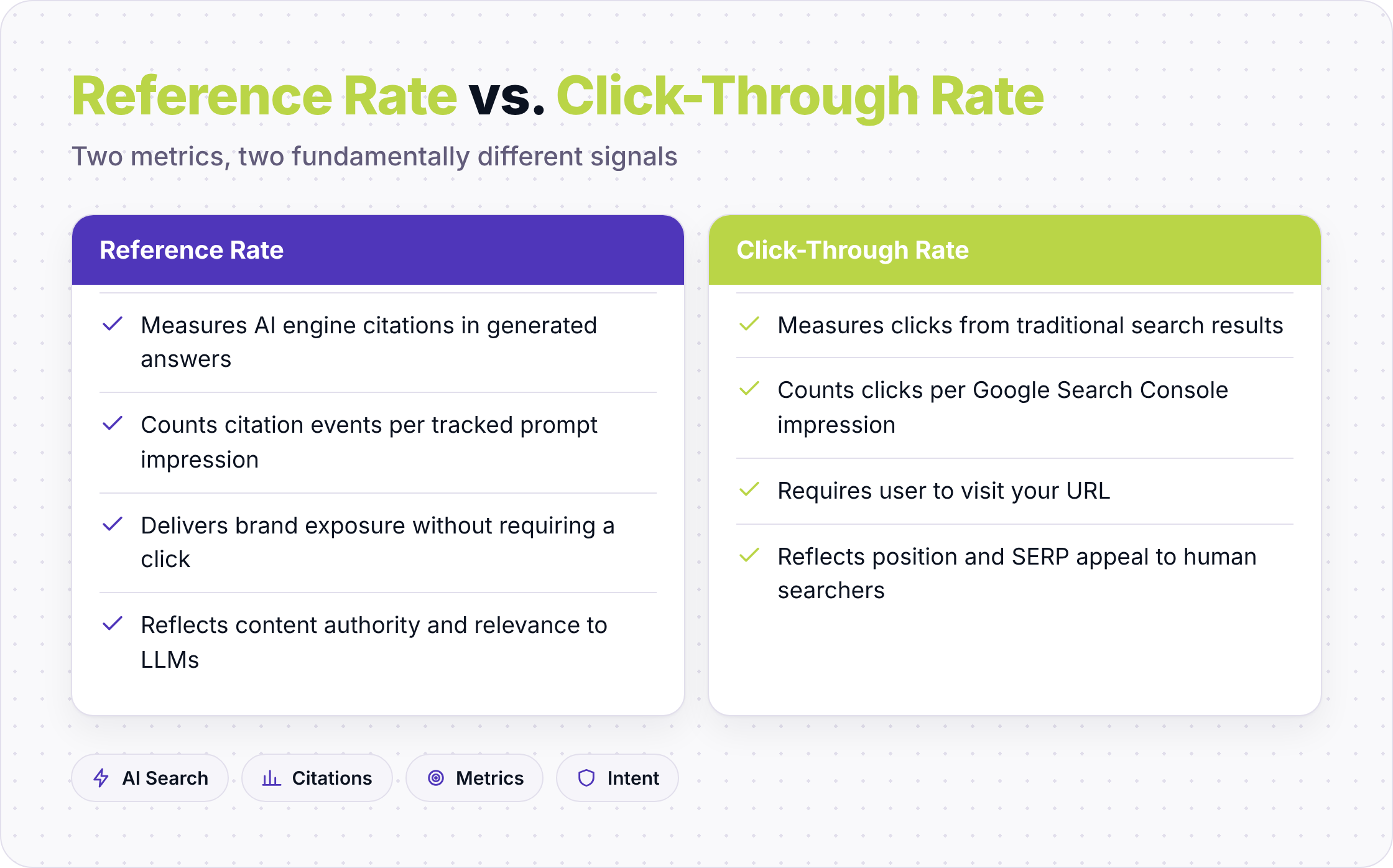
Reference rate measures how often an AI engine (ChatGPT, Perplexity, Claude, Gemini) cites your content inside a generated answer, expressed as citations per tracked prompt impression. CTR measures the share of Google Search Console impressions that result in a click to your URL. One tracks whether AI engines quote you; the other tracks whether human searchers click you. As zero-click search expands, these two metrics increasingly point in opposite directions.
How Reference Rate Works
When an AI engine generates a response, it pulls from indexed sources and surfaces some of them as citations. Reference rate counts those citation events against the total number of times your tracked prompts were answered. A page with a 12% reference rate appeared as a cited source in roughly 1 in 8 AI-generated answers for the prompts you monitor.
That is a fundamentally different signal from organic visibility. The AI engine is not just ranking your page; it is quoting it.
The metric does not exist in Google Search Console. It requires polling AI engines directly, logging responses, and parsing which URLs appear. That is a meaningful operational cost worth naming: teams without a systematic polling workflow will have no reference rate data at all, which means they are flying blind on a channel already driving substantial discovery traffic.
How CTR Is Calculated
CTR in Google Search Console is straightforward: clicks divided by impressions, expressed as a percentage. A page shown 10,000 times and clicked 400 times has a 4% CTR. Choozle's CTR reference guide notes that CTR only tracks direct clicks, not downstream engagement, brand recall, or any interaction that happens without a URL visit. That ceiling matters when you are trying to measure influence rather than traffic.
CTR is a reliable signal for one specific thing: whether your title tag and meta description are compelling enough to earn a click from a SERP listing. It says nothing about whether your content shaped a buyer's thinking before they searched, or whether an AI engine quoted your definition in an answer the user never clicked through from.
Why the Two Metrics Diverge
The structural cause is zero-click search. When Google surfaces a featured snippet, an AI Overview, or a knowledge panel, users get their answer without visiting any URL. CTR drops. Impressions may hold steady or even rise, but clicks do not follow. Estimates from 2024 put zero-click searches at roughly 60% of all Google queries, a figure that has climbed steadily as SERP features have expanded.
AI-generated answers accelerate this dynamic. A user who asks Perplexity "what is a reference rate in AI search" and gets a cited, complete answer has no reason to click through. Your reference rate goes up; your CTR stays flat or falls.
This breaks down as a strategy for content types where conversion requires a click: pricing pages, demo requests, transactional landing pages. For those, CTR remains the metric that connects most directly to revenue. Reference rate is most meaningful for top-of-funnel, definitional, and research-oriented content where influence precedes intent.
Why AI Search Is Shifting the Value of Citations Over Clicks
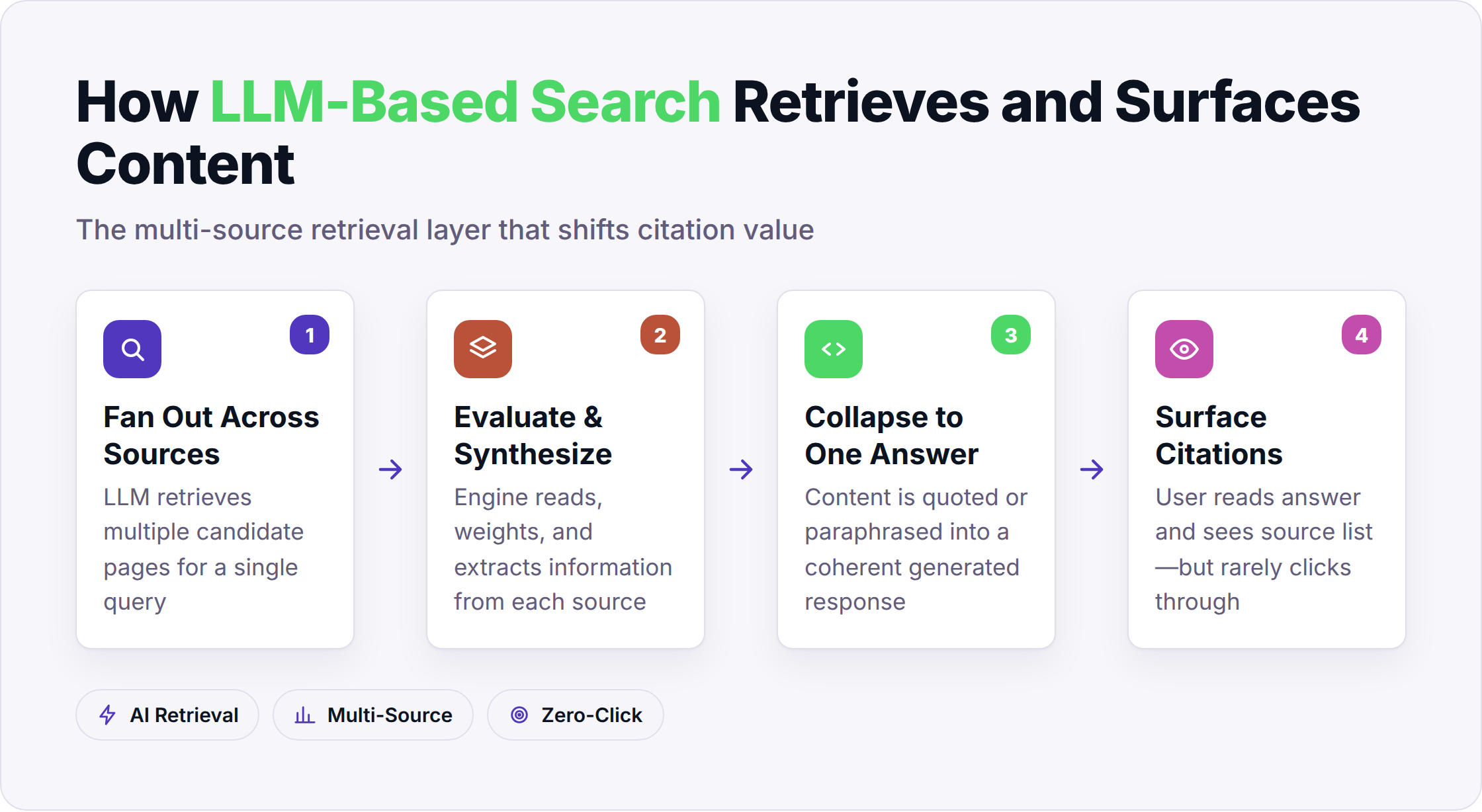
When an LLM answers a query, it retrieves and synthesizes multiple sources before surfacing a single response. The user reads the answer, not the source list. That structural shift means a citation inside a generated answer now delivers brand exposure and authority signal without producing a click, and for informational queries, that exposure is increasingly the only exposure available.
Query Fan-Out and the Multi-Source Retrieval Layer
LLM-based search engines do not fetch one page and stop. They fan out across several candidate sources, evaluate them, and collapse the results into one coherent answer. Your page may be read, weighted, and quoted without the user ever visiting it. The click was never on the table.
This matters because click-through rates on informational queries have been falling for years, and AI Overviews accelerated the drop sharply. Ahrefs found in April 2025 that AI Overviews reduced clicks to top-ranking organic results by 34.5%, even as Google publicly maintained that AI-generated answers support click behavior. The gap between what Google says and what the traffic data shows is wide enough to build a strategy around.
The numbers are consistent across measurement approaches. Arcalea's analysis puts AI Overviews as the primary driver of zero-click behavior, appearing on more than 20% of searches and cutting CTR by roughly 60% when present. Informational queries, the ones where your content is most likely to rank, are the most exposed.
The E-E-A-T Signals LLMs Weight at Selection Time
Getting retrieved is not the same as getting cited. LLMs apply a selection layer after retrieval, and the signals that determine which sources survive into the final answer map closely to Google's E-E-A-T framework: experience, expertise, authoritativeness, and trustworthiness.
In practice, first-person accounts with named authors, pages with verifiable credentials, content that cites primary data, and domains with consistent topical depth all outperform thin aggregator pages, even when those aggregator pages rank higher in traditional search. An LLM is not optimizing for keyword density. It is pattern-matching for the kind of source a careful human researcher would trust.
One real trade-off: a page optimized purely for citation signals (dense citations, formal register, structured claims) can underperform on traditional CTR metrics because it reads less like a landing page and more like a reference document. Teams that need both click traffic and citation presence often have to maintain two content types rather than one. This is especially true for transactional queries, where users still click through to complete a purchase or sign up, and where citation presence matters far less than conversion-optimized copy.
What SGE Rollout Data Reveals About Informational CTR Loss
The trajectory was visible before AI Overviews launched at scale. Zero-click search on Google reached 64.82% in 2026, up from roughly 50% in 2019. Digitalapplied's longitudinal data tracks this across seven years of query behavior. SGE did not create the zero-click problem. It compressed the timeline.
For content teams, the practical implication is direct: optimizing exclusively for click-through rate on informational queries is optimizing for a shrinking pool. The audience that reads your content through an AI-generated answer and never clicks is now larger than the audience that clicks. Reference rate measures the reach that CTR no longer captures.
How to Measure Reference Rate Across AI Platforms
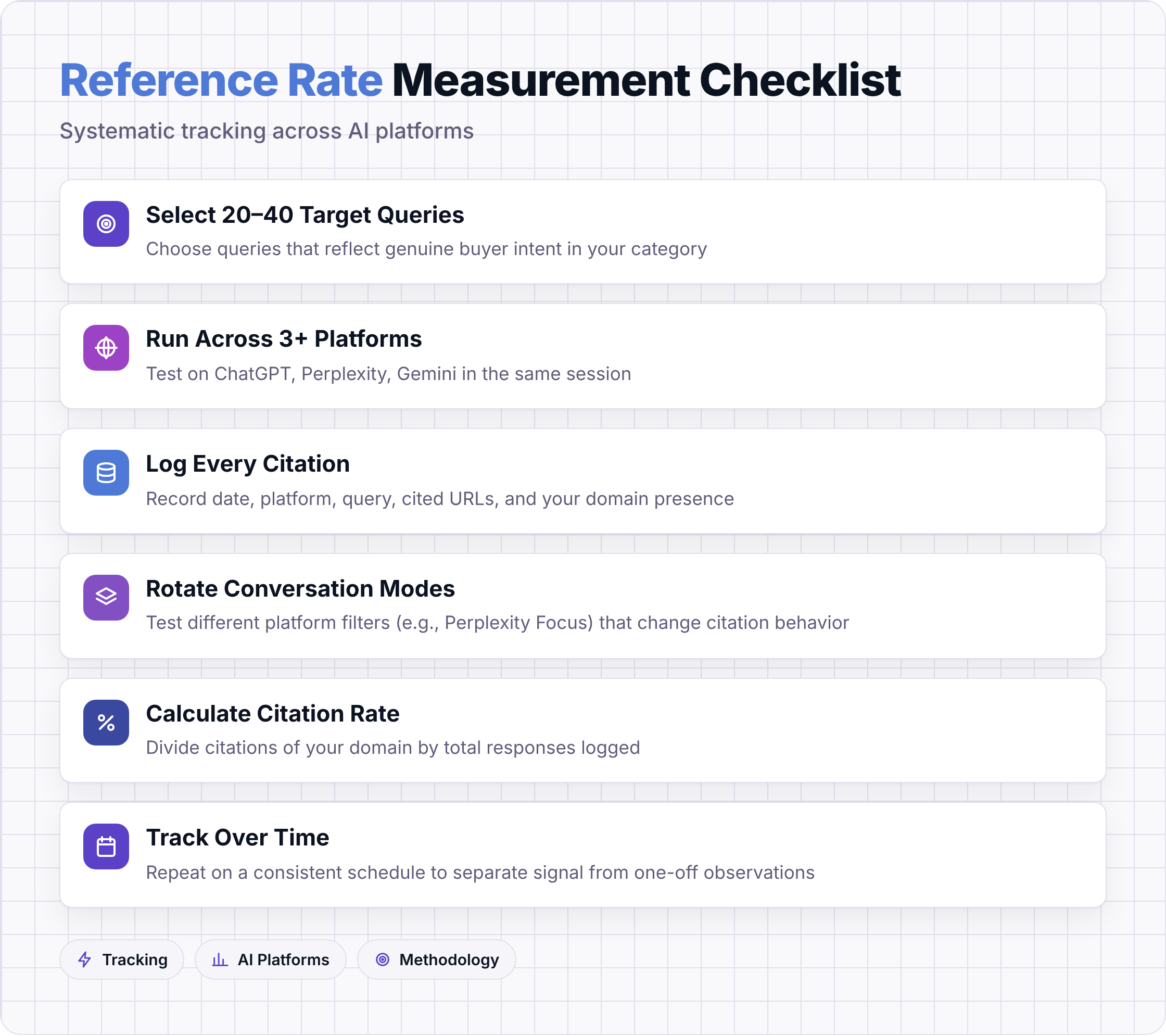
Measuring reference rate means systematically tracking how often AI engines cite your content when answering the queries your buyers actually use. The core method: run a fixed set of target queries across ChatGPT, Perplexity, and Gemini on a consistent schedule, log which URLs each engine surfaces, and calculate a citation rate per query set over time. That baseline is what separates a real signal from a one-off observation.
Manual Spot-Checking
Start with 20 to 40 queries that reflect genuine buyer intent in your category. Run each one across at least three platforms in the same session, and record the results in a shared log: date, platform, query, URLs cited, and whether your domain appeared. Rotate between conversation modes where the platform offers them (Perplexity's "Focus" filters, for example, change citation behavior meaningfully).
The trade-off with manual spot-checking is obvious: it does not scale. Running 30 queries across three platforms weekly takes roughly two to three hours, and human logging introduces inconsistency. If a team member forgets to run a query one week, you lose a data point you cannot recover. Manual checks are best used to validate automated results, not replace them.
Automated Tracking Options
Automated tools fall into two categories: brand mention monitors that alert you when your domain appears in AI-generated responses, and AI-answer scrapers that poll specific queries on a schedule and parse the full citation list from each response. The scrapers are more useful for reference rate measurement because they capture competitor citations alongside yours, and that competitive view is where the actionable intelligence lives.
Dataslayer's 2025 Search Console analysis provides a useful baseline for comparing your traditional CTR against category norms before you layer in reference rate data. Running both in parallel gives you a clearer picture of where AI search is cannibalizing click traffic versus where it is generating net-new awareness.
Building a Repeatable Measurement Cadence
Pick a fixed day each week. Run your query set. Log results in a spreadsheet with columns for platform, query, cited URLs, and a binary flag for whether your domain appeared. After four weeks, you have enough data to calculate a baseline reference rate per query and per platform.
From there, you can track movement: did a content update improve your citation rate on a specific query? Did a competitor's new page displace you? Those are the questions reference rate answers that CTR cannot.
How to Optimize for Both Metrics Without Sacrificing Either
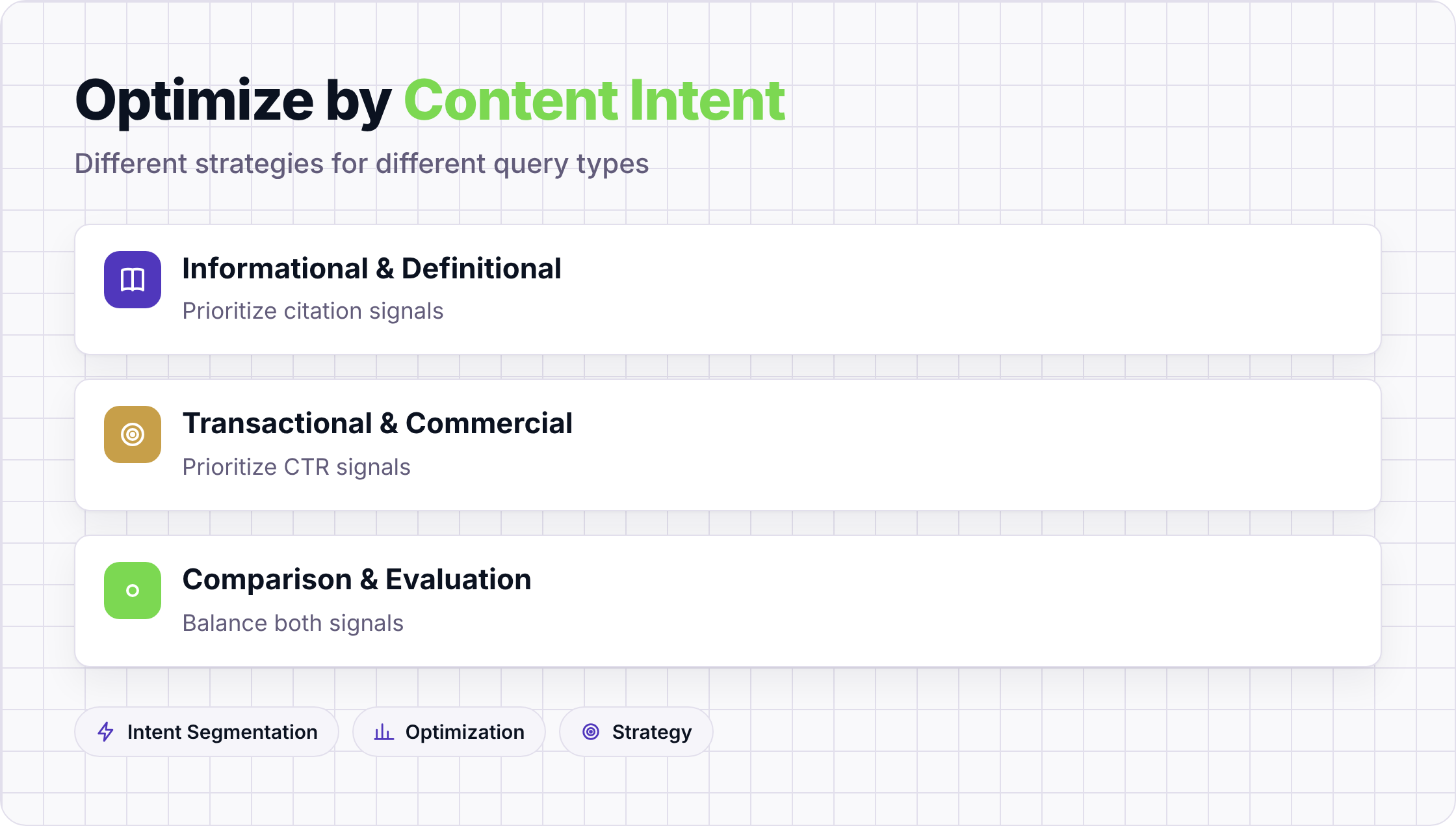
The tension between reference rate and CTR is real, but it is manageable if you segment your content by intent before you optimize.
For informational and definitional content, prioritize citation signals: named authors with verifiable credentials, primary data citations, structured claims with clear sourcing, and consistent topical depth across your domain. These pages are unlikely to drive direct clicks at scale regardless of how you optimize them, so chasing CTR on them is a losing trade.
For transactional and commercial content, prioritize CTR signals: compelling title tags, meta descriptions that match the user's next action, and page structures that convert after the click. These pages are less likely to appear in AI-generated answers anyway, because LLMs tend to avoid surfacing pages that read as sales material.
The middle ground is comparison and evaluation content, the kind of page a buyer reads when they are close to a decision. These pages can serve both goals if structured carefully: a formal, cited introduction that earns AI citation, followed by a conversion-oriented body that earns the click. It requires more editorial discipline than most teams apply, but the payoff is visibility at both layers of the funnel.
Frequently Asked Questions
What is a reference rate in AI search?
Reference rate is the percentage of AI-generated responses, across platforms like ChatGPT, Perplexity, Claude, and Gemini, that include a citation to your content when answering a specific set of tracked queries. You calculate it by dividing the number of responses that cite your domain by the total number of responses logged for those queries. A 15% reference rate means your content appeared as a cited source in 15 out of every 100 AI-generated answers you tracked.
How is reference rate different from click-through rate?
CTR measures the share of SERP impressions that result in a click to your URL. Reference rate measures the share of AI-generated responses that cite your URL, regardless of whether any click follows. A page can have a high reference rate and a low CTR simultaneously, which is common for informational content that AI engines summarize completely enough that users have no reason to visit the source.
Does a high reference rate actually drive business results?
It depends on your funnel. For top-of-funnel content, a high reference rate builds brand familiarity with buyers who may not be ready to click yet but will recognize your name when they are. For bottom-of-funnel content, reference rate matters less because those queries tend to produce clicks regardless of AI involvement. The risk is assuming reference rate translates to revenue without tracking whether cited users eventually convert through another channel.
Which AI platforms should I track for reference rate?
Start with Perplexity, ChatGPT (with Browse enabled), and Gemini. These three account for the majority of AI-assisted search behavior as of mid-2026. Claude is worth adding if your audience skews toward technical or research-heavy use cases, where Anthropic's model sees heavier usage. Tracking all four gives you a more complete picture, but if you are resource-constrained, Perplexity and ChatGPT cover the most ground first.
Can I improve my reference rate without hurting my CTR?
Yes, with content segmentation. Pages built for citation (formal structure, named authors, primary data, clear sourcing) and pages built for clicks (strong title tags, conversion-oriented copy, clear next steps) serve different functions and should be treated as separate content types. Trying to optimize a single page for both simultaneously usually produces a page that does neither well. The exception is comparison and evaluation content, where a structured introduction can earn AI citation while a well-written body still earns the click.
How often should I measure reference rate?
Weekly is the right cadence for most teams. AI engine behavior shifts with model updates, index changes, and competitor content, so monthly measurement misses meaningful movement. Run your fixed query set on the same day each week, log results consistently, and look for trends over four-week rolling windows rather than reacting to single-session fluctuations.
Is reference rate a Google ranking factor?
No. Google's ranking algorithm operates independently of how often other AI engines cite your content. However, the signals that improve reference rate (E-E-A-T compliance, primary data, named authorship, topical authority) overlap substantially with the signals Google uses to evaluate page quality. Improving one tends to improve the other, but they are separate systems with separate measurement requirements.
If you want to track your reference rate across ChatGPT, Perplexity, Gemini, and Claude without building a manual logging system from scratch, visit Seorav's GEO tracking tool to see how it measures AI citation presence alongside traditional search performance in one place.
Keep reading

SEO Agency Services in London: Pricing, Packages, and How to Pick the Right One
Compare London SEO agency pricing, packages, and AEO services. Real data from 24 agencies reviewed. Find the right seo services agency for your budget.
How Often Is Your Content Actually Cited in AI Overviews?
Learn how AI Overview citation frequency works, why organic rank no longer predicts it, and how to measure and improve your content's visibility in AI-gene
Backlink Freshness and LLM Citation Frequency: What Actually Matters
Does backlink freshness matter for LLM citation frequency? It helps, but topical authority and content structure are stronger drivers. Here's what the data