Reference Rate vs Click-Through Rate: What AI Search Actually Measures
Last updated: 8 October 2026
Reference rate measures how often AI engines cite your content in generated answers, while click-through rate tracks users who visit your site from those citations. A high reference rate means your content reaches millions through AI summaries, but generates zero traffic if users accept the AI's answer without clicking. The two metrics diverge because AI search rewards authoritative sources differently than traditional search, making it possible to gain significant brand visibility while losing direct website visits. Optimizing for both requires understanding which content types each channel actually values.
The numbers make the urgency concrete. AI overviews now appear in 47% of informational queries, a figure BrightEdge tracked across millions of searches in 2024. Nearly half of all informational searches now produce a page where the engine answers the question directly, and the click to your site becomes optional.
A March 2025 Pew Research analysis found that Google users who saw an AI summary were measurably less likely to click through to external sites than users who saw standard results. Less clicking does not mean less reading. It means the reading happens inside the engine's response, not on your page.
The one concrete shift that protects your reach in both worlds: write answer-first. Open every article with a self-contained paragraph (40 to 60 words) that states the direct answer, names a specific figure, and requires no surrounding context to make sense. That structure serves the human reader who clicks through and gives AI engines a clean, quotable passage to extract.
When Traffic Drops but Impressions Keep Climbing
Organic clicks can fall sharply while your actual search presence grows. In Q1 2025, one content team recorded a 31% drop in Google organic clicks alongside a 4x increase in brand mentions inside AI-generated answers. Those two numbers moved in opposite directions because they measure different things entirely.
The gap is not a fluke. Zero-click behavior has been climbing for years: Digitalapplied's 2026 zero-click report puts the share of Google searches ending without any click at 64.82%, up from roughly 50% in 2019. When AI Overviews appear, the effect sharpens further. Arcalea's analysis of AI Overview impact shows click-through rates dropping by roughly 60% on queries where an AI Overview is present.
For that content team, declining Google traffic was not a ranking failure. Their pages were being pulled into AI-generated summaries, cited as source material, and surfaced to users who never needed to click because the answer arrived pre-assembled. Visibility had shifted format, not disappeared.
The trade-off is real, though. A brand mention inside an AI answer does not carry the same downstream value as a click that lands a user on your pricing page or email capture. Reference rate measures reach; it does not guarantee conversion. For teams with revenue targets tied directly to session volume, a 4x lift in AI citations may not offset a 31% traffic decline in the short term. This approach works well for awareness-stage content and definitional queries. It breaks down when the goal is bottom-of-funnel action, where the user still needs to arrive on your site to complete anything.
What the anomaly reveals is that search success now requires two separate scorecards. One tracks clicks, sessions, and on-site behavior. The other tracks citation frequency, brand mention context, and which AI engines are pulling your content. Running only the first scorecard means measuring half the picture.
How AI Search Measures Success Differently Than Google
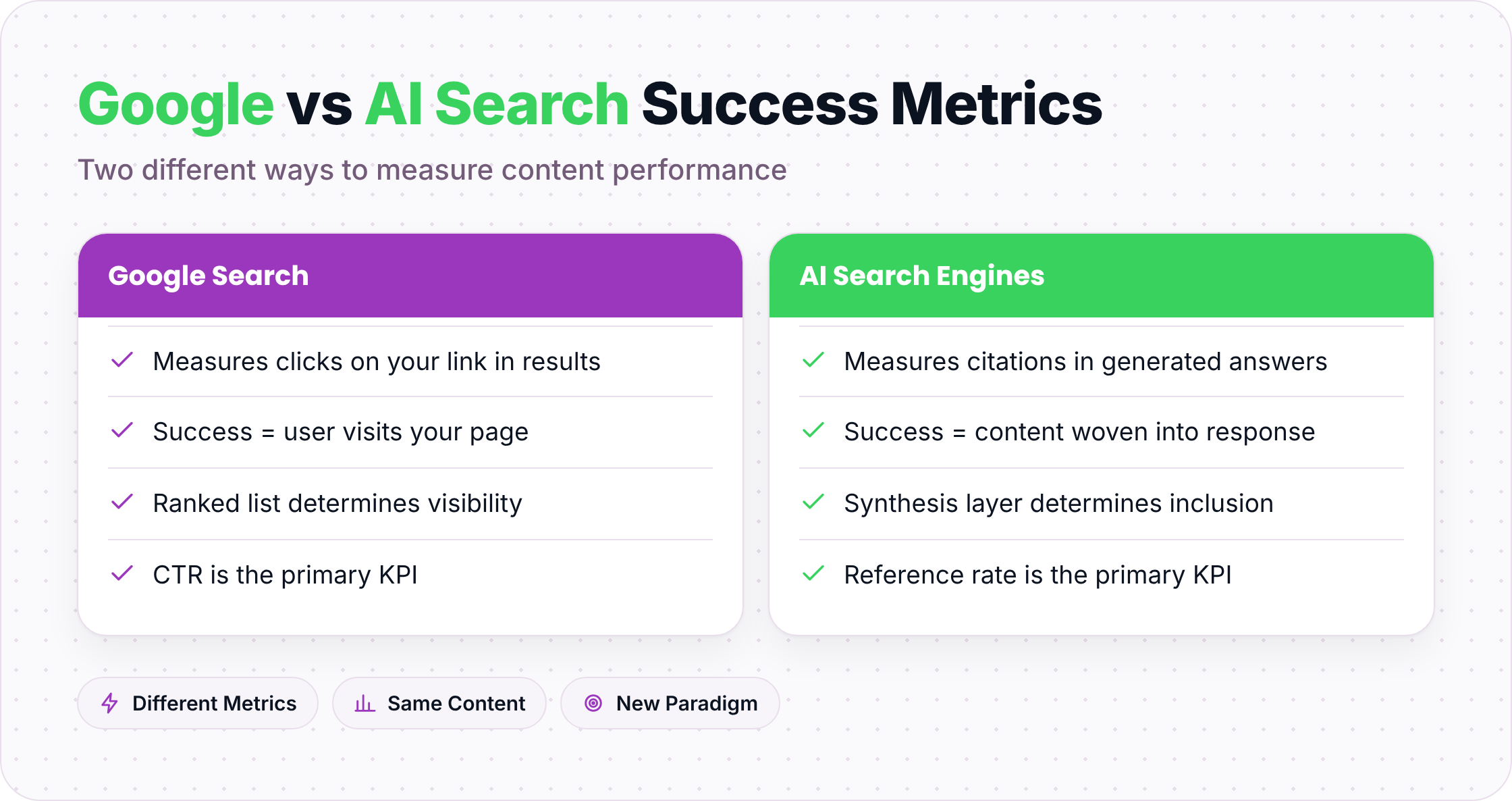
Google measures success by whether a user clicks your link. AI search engines measure success by whether your content gets woven into a generated answer, regardless of whether anyone clicks anything afterward. That distinction reshapes every metric that matters.
A page ranked third on Google with a 4% CTR is performing well by traditional standards. The same page cited in 60% of Perplexity responses on a given topic is performing differently, and by most brand-visibility measures, better.
The Mechanics Behind Reference Rate
When an LLM generates a response, it does not retrieve a ranked list and hand it to the user. It synthesizes an answer from multiple retrieved passages, then attributes those passages as citations. Reference rate captures how often your content appears in that synthesis layer, expressed as citations per tracked prompt impression.
The selection criteria differ from Google's ranking signals in a few concrete ways. Recency, topical authority, and structural clarity (headers, defined terms, direct answers near the top of the page) all carry weight. So does the density of verifiable claims. A page that opens with a clear, citable statement is more likely to be pulled into a generated answer than one that buries its thesis in paragraph four.
Loudspeaker Marketing's AI search statistics roundup puts Google's AI Mode at a 93% zero-click rate. Users are getting answers without ever visiting a source. Reference rate is the only metric that captures whether your content contributed to that answer.
Query Fan-Out: Why One Question Becomes Many
LLM search engines do not process a user query as a single lookup. They decompose it. A question like "what's the best way to reduce SaaS churn" might fan out into 5 to 12 sub-queries: definitions, benchmark data, case studies, counterarguments, and related concepts. Each sub-query pulls from different sources. Your content might satisfy one sub-query and miss the other eleven entirely.
This matters because a single user question creates multiple citation opportunities, and winning all of them requires topical breadth, not just one well-optimized page. A competitor who has published on churn definitions, cohort analysis methods, and retention benchmarks separately will accumulate more reference rate across that fan-out than a competitor with one comprehensive guide.
The trade-off is real, though. Producing content at the sub-query level requires significantly more output, and not every sub-query carries equal weight in the final generated answer. Some sub-queries feed the LLM's background reasoning without producing a visible citation at all. You can invest in coverage that never surfaces as a reference.
How Generative Engine Optimization Differs From Traditional Ranking
Traditional SEO optimizes for ranking signals: backlinks, page authority, keyword density, Core Web Vitals. Generative engine optimization (GEO) targets a different layer entirely. The question is not "does Google trust this domain?" but "does this passage answer a specific sub-query clearly enough to be extracted and synthesized?"
Structural signals matter more than domain authority in this context. Answer-first formatting, schema markup, and explicit sourcing of claims all increase the probability that an LLM extracts your passage rather than a competitor's. This is a meaningful departure from traditional SEO, where a high-authority domain could rank a mediocre page above a better-written one from a newer site.
Domain authority is not irrelevant, though. LLMs trained on web data still reflect the authority signals baked into their training corpora. A well-structured page on a low-authority domain will often lose to a moderately structured page on a high-authority one, particularly for competitive queries. GEO shifts the weighting, but does not eliminate the baseline.
The practical implication: teams optimizing for reference rate need to track citation outcomes at the prompt level, not just monitor organic rankings. Those are measuring two different things, and increasingly, they point in opposite directions.
Reference Rate vs Click-Through Rate in AI Search: What Each Metric Actually Captures
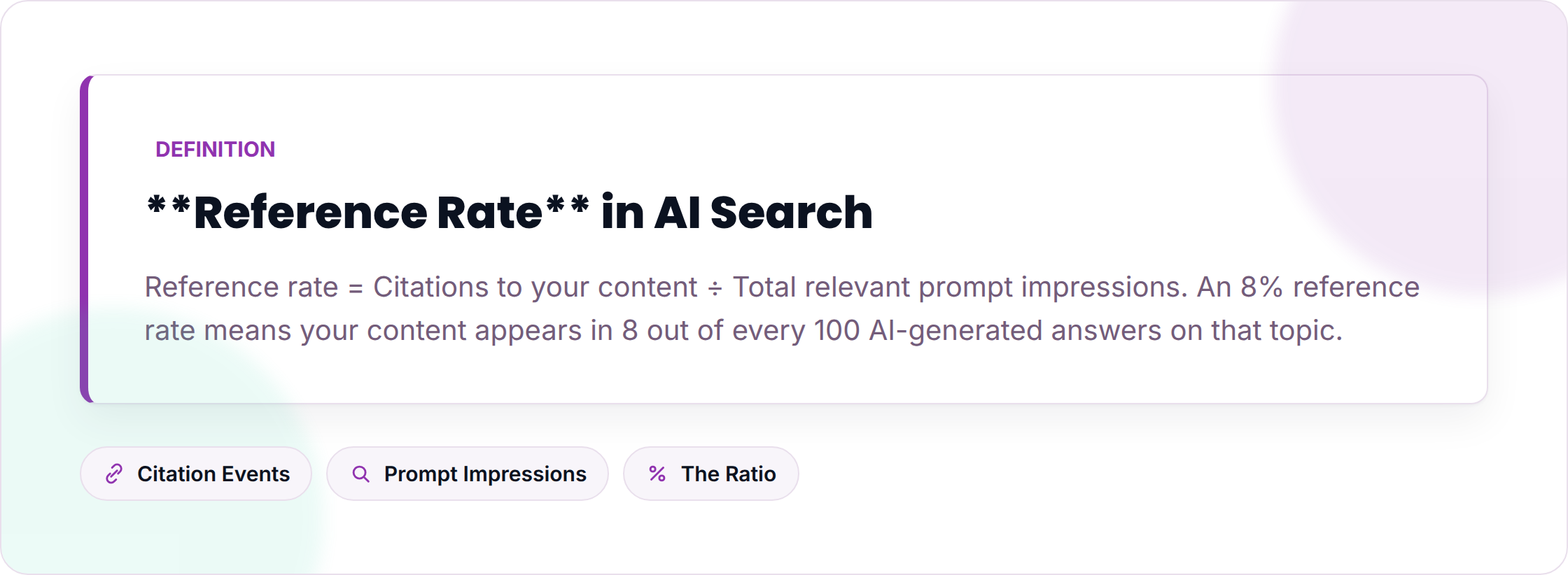
Reference rate measures how often your content appears as a cited source inside AI-generated answers, expressed as a ratio of citations to total query impressions for a given topic. When ChatGPT, Perplexity, Claude, or Gemini generates a response and links or attributes your URL, that counts as one citation event. Divide that by the number of times the engine fielded a relevant prompt, and you have your reference rate for that topic cluster.
Click-through rate, by contrast, measures the share of users who saw your link in a results page and chose to visit your site. Both metrics matter. They just measure different stages of a search interaction that, in AI-driven environments, may never overlap.
How the Calculation Actually Works
The math is straightforward, but the inputs are not. You need two numbers: how many times an AI engine cited your content across a set of tracked prompts, and how many total impressions those prompts generated. The ratio gives you reference rate. A page cited 12 times across 200 prompt impressions has a 6% reference rate for that topic.
Otterly's citation frequency research shows LLMs typically cite only 2 to 7 sources per response, regardless of how many relevant pages exist. That ceiling makes reference rate a genuinely competitive metric. There is a fixed number of citation slots per answer, and every slot your content occupies is one a competitor does not.
One important limitation: reference rate is only as reliable as the prompt set you track. If your tracked prompts skew toward branded queries or narrow long-tail terms, your reference rate looks artificially high. The metric breaks down when teams build their prompt lists around queries they already rank for, rather than the full universe of questions their buyers actually ask AI engines.
Where E-E-A-T and LLM Optimization Overlap
Most SEO teams treat E-E-A-T (Experience, Expertise, Authoritativeness, Trustworthiness) as a Google-specific concern. It is not. The signals that help Google assess credibility overlap heavily with the signals LLMs use to select citation sources, because many LLMs are trained on or retrieve from the same web corpus Google indexes.
Authoritativeness signals that matter to both: named authors with verifiable credentials, institutional affiliations, primary data, and consistent citation by other authoritative sources. A page that earns backlinks from .edu and .gov domains is also more likely to appear in LLM training data and retrieval pools. This maps to the same pattern Ziptie's breakdown of citation rate vs. mention rate documents: brand mentions and URL citations often diverge precisely because a brand has authority recognition without the structured, linkable content that earns a direct citation.
Improving E-E-A-T for Google is not a separate workstream from LLM optimization. They share inputs. The trade-off is time: E-E-A-T improvements (building author credibility, earning editorial links, publishing original research) compound slowly. Teams looking for faster reference rate gains often prioritize content format changes instead, which is the right short-term lever but does not replace the authority foundation.
Content Formats That Earn Citations Most Reliably
Format matters more than most teams expect. LLMs are pattern-matching systems trained to extract clean, attributable answers. Content that is structurally easy to extract gets cited more often than content that buries its claims in narrative prose.
Three formats consistently outperform in citation frequency:
Structured data and schema markup. Pages with FAQ schema, HowTo schema, or clearly marked definitions give AI engines a pre-parsed answer to pull. The engine does not have to infer where your claim starts and ends.
Primary research with named figures. A sentence like "our analysis of 1,200 SaaS accounts found a 23% reduction in churn when onboarding exceeded 14 days" is far more citable than "onboarding improvements reduce churn." Specificity is what makes a passage extractable.
Direct-answer openings. Pages that state the core answer in the first 60 words, before any context-setting or narrative, give LLMs a clean extraction target. Pages that build to their conclusion force the model to infer the answer, and inference introduces error. A clean passage wins the citation slot more often.
One format that underperforms: long-form narrative without structural breaks. A 3,000-word essay with no headers, no defined terms, and no answer-first structure may contain excellent information and still earn zero citations, because the LLM cannot cleanly attribute a specific passage to a specific claim.
Frequently Asked Questions
What is reference rate in AI search?
Reference rate is the percentage of AI-generated responses, across a tracked set of prompts, that include your content as a cited source. It is calculated by dividing the number of citation events by the total number of relevant prompt impressions. A reference rate of 8% means your content appeared as a citation in 8 out of every 100 times an AI engine fielded a query on that topic.
How does reference rate differ from click-through rate?
Click-through rate measures the share of users who saw your link in a search results page and clicked it. Reference rate measures how often your content is pulled into an AI-generated answer, regardless of whether any user clicks through to your site afterward. The two metrics can move in opposite directions: your CTR can fall while your reference rate climbs, because AI engines are answering questions with your content before users ever see a link to click.
Does a high reference rate actually drive business results?
It depends on where in the funnel the cited content sits. For awareness-stage and definitional content, a high reference rate builds brand recognition at scale, reaching users who would never have found your site through a traditional search click. For bottom-of-funnel content (pricing pages, product comparisons, conversion-focused landing pages), reference rate alone does not replace the session. Users still need to arrive on your site to take action, and an AI citation does not deliver that. Track both metrics, and weight them according to the content's actual goal.
Which AI engines should I track for reference rate?
The four engines with the largest query volume as of mid-2026 are ChatGPT (including GPT-4o with browsing), Perplexity, Google's AI Mode, and Microsoft Copilot. Perplexity and Google's AI Mode are the most citation-transparent, meaning they surface source URLs in a way that is trackable. ChatGPT's browsing citations are visible in individual responses but harder to aggregate at scale without tooling. Start with Perplexity and Google AI Mode for the most reliable baseline data, then expand tracking as your tooling allows.
How do I improve my content's reference rate?
Four changes produce the most consistent lift. First, move your core answer to the first 60 words of the page. Second, add FAQ schema and HowTo schema where relevant, so AI engines have pre-parsed answer units to extract. Third, include at least one named, specific data point per major claim (a percentage, a date, a named study) rather than general assertions. Fourth, build topical coverage across the sub-queries that fan out from your target topic, not just one comprehensive page. None of these changes guarantee citation, but they remove the structural barriers that cause AI engines to skip your content in favor of a competitor's.
Is generative engine optimization replacing traditional SEO?
No. GEO and traditional SEO share enough inputs (domain authority, backlink quality, E-E-A-T signals) that treating them as separate disciplines wastes effort. The difference is in what you optimize at the content level. Traditional SEO prioritizes keyword placement, page authority, and Core Web Vitals. GEO prioritizes passage extractability, structural clarity, and topical breadth. A team that improves both simultaneously will outperform one that treats them as competing priorities.
If you want to see where your content currently stands on reference rate across the major AI engines, visit Seorav's GEO tools to start tracking citation frequency alongside your existing SEO metrics. Measuring both gives you a complete picture of your actual search presence in 2026.
Keep reading
Writing Answer Paragraphs That AI Systems Will Quote
Learn how to write self-contained answer paragraphs for AI with a four-part structure that improves extraction probability and gets your content quoted by
The FAQ Structure That AI Systems Actually Extract
Learn how to structure FAQs for AI answer extraction with self-contained answers, FAQPage schema, and a repeatable testing process across ChatGPT, Perplexi
How to Verify Your Brand's Authority in Knowledge Graphs
Learn how knowledge graph authority verification works, why AI engines skip unverified brands, and how to build structured entity presence that gets you ci