Placing Your Content in Vector Space for AI Discovery
Last updated: 3 October 2026
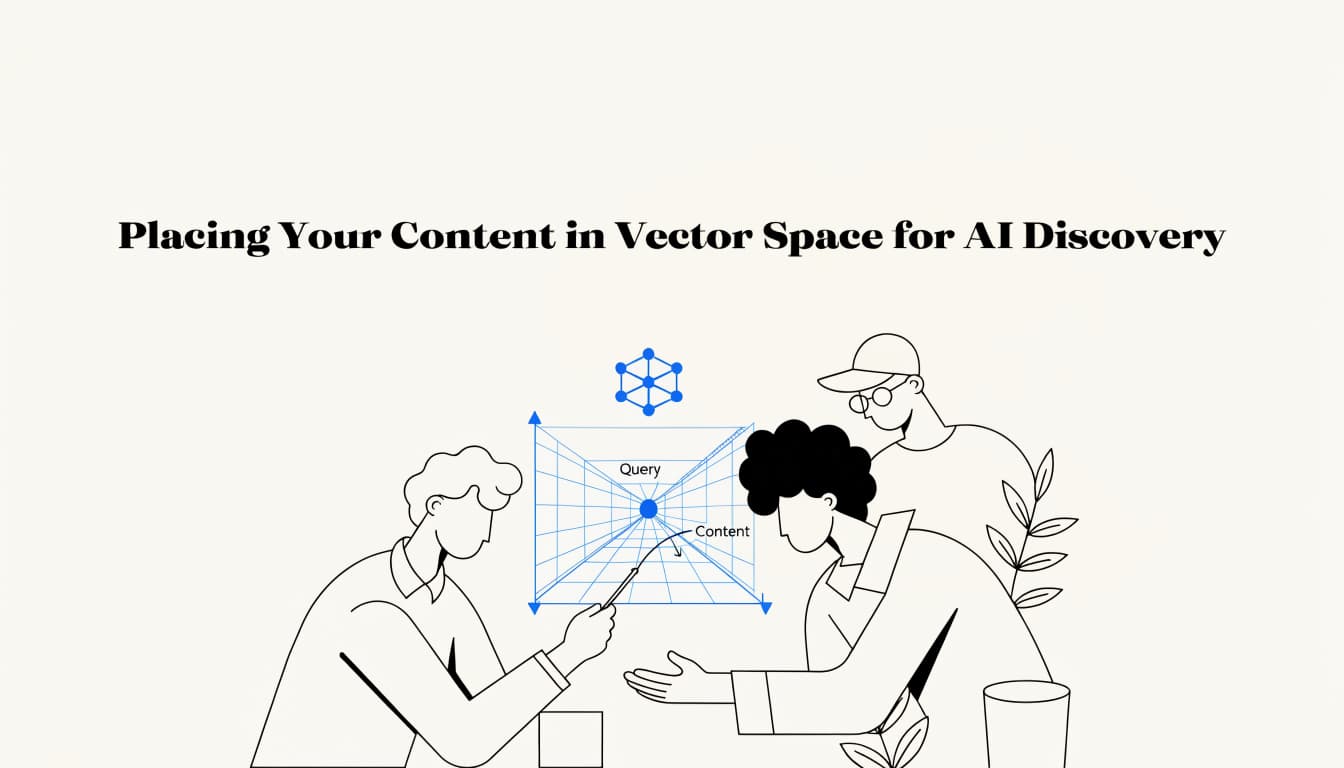
Neural Vector Placement means positioning your content so its semantic embedding aligns with the query vectors that AI retrieval systems generate when users ask related questions. When an AI model processes your page, it converts sentences into fixed-length numerical arrays called embeddings. Content with similar meaning clusters together in high-dimensional space, and retrieval systems find answers through geometric proximity rather than keyword matching. This shift from keyword-based search to meaning-based discovery fundamentally changes how visibility works in AI-powered systems.
Keywords tell a search engine what words appear on your page. Vector coordinates tell an LLM what your page means, and those are different things. A page about "reducing customer churn" and a page about "improving retention rates" can occupy nearly the same position in vector space even if they share zero vocabulary. Neural search systems, as Meilisearch's technical overview explains, retrieve results by measuring the distance between the query vector and document vectors, so the closest neighbors win regardless of exact phrasing.
One honest caveat: embedding models differ by architecture and training data, so the same content can land in slightly different positions depending on which model the AI engine uses. There is no single universal coordinate system to target.
Four Things to Know Before You Read On
- Vector proximity drives retrieval. When a language model pulls context to answer a query, it compares embedding vectors, not keyword counts. A page that uses varied but semantically consistent language around a topic will sit closer to the query vector than a page stuffed with exact-match phrases.
- Semantic coherence matters at the page level. Scattered topics on a single URL dilute the embedding. IBM's neural network documentation notes that pattern-recognizing models learn from weighted relationships across inputs, not isolated tokens. Mixed signals produce a muddled vector.
- Both SGE and RAG pipelines use similarity scores. Google's Search Generative Experience and retrieval-augmented generation systems share the same underlying mechanic: retrieve the chunks whose embeddings score highest against the query, then generate from those chunks. If your content doesn't score well on similarity, it doesn't get read.
- Rank tracking won't tell you what's wrong. A page can hold a top-five organic position and still sit far from the relevant cluster in vector space. The diagnostic tool is embedding inspection, not a rank report.
The trade-off worth naming: embedding inspection requires technical access most content teams don't have by default. Running your pages through an embedding model and visualizing clusters takes engineering time, and the output is only as useful as the query set you test against. If your query list is too narrow, you'll optimize for proximity to a handful of prompts and miss adjacent retrieval opportunities entirely.
Neural Vector Placement: The Fundamentals
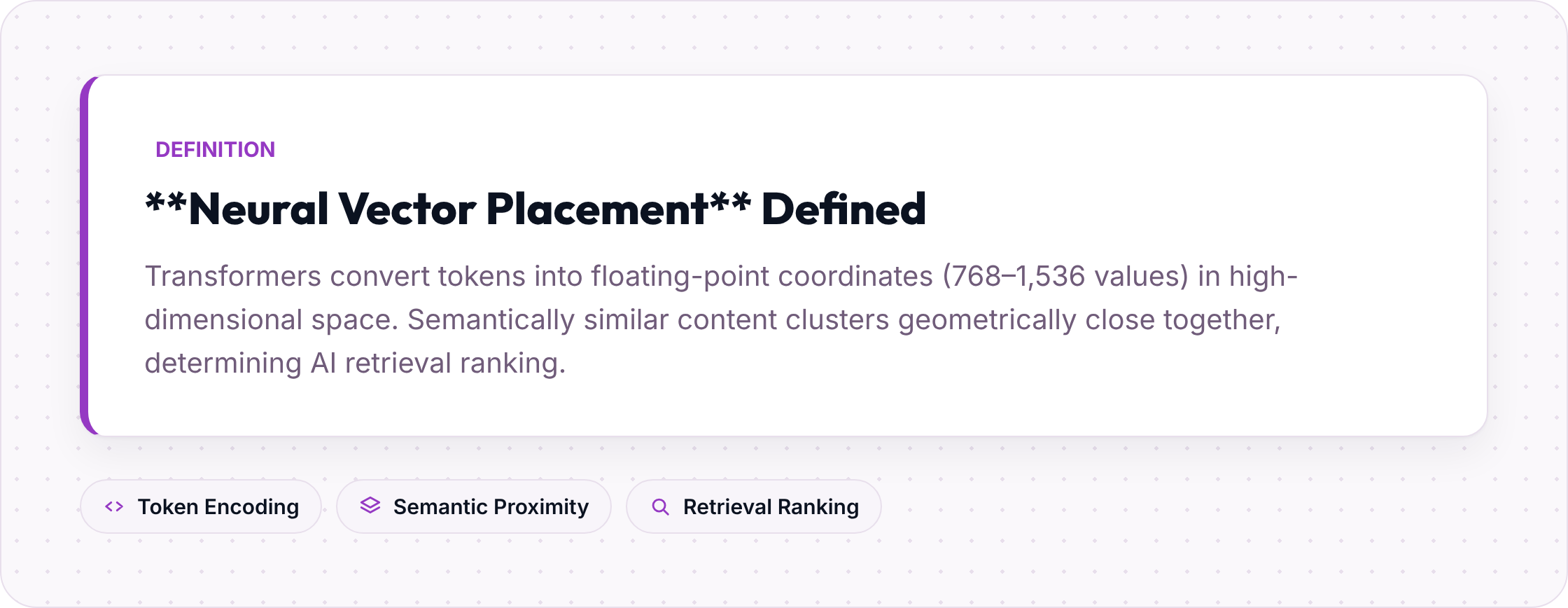
When a transformer model reads your content, it converts every token into a list of floating-point numbers, typically 768 to 1,536 values per token depending on the model architecture. Those numbers are coordinates in a high-dimensional space. Content that covers similar concepts ends up geometrically close together. AI retrieval systems query that space directly, so where your content lands in that geometry determines whether it gets surfaced, not whether it ranks on a keyword.
How Transformers Encode Meaning as Coordinates
Each layer of a transformer refines its internal representation by attending to relationships between tokens. By the final layer, the model has collapsed a full passage into a single dense vector, a point in space that captures the aggregate meaning of everything it read. A 2024 narrative review published in Cognitive Systems Research covering vector database fundamentals and use cases found that modern embedding models routinely operate in spaces with 768 or more dimensions, with each dimension encoding a latent semantic feature rather than any human-readable concept.
Two articles that use completely different vocabulary can land at nearly identical coordinates if they address the same underlying concept. Synonyms, paraphrases, and related examples all pull the embedding toward the same region. This is the mechanism that makes semantic search feel smarter than keyword matching.
Cosine Similarity and the Retrieval Decision
AI retrieval systems almost universally rank candidates by cosine similarity: the angle between two vectors rather than the raw distance between their endpoints. A cosine score of 1.0 means perfect alignment; 0.0 means orthogonal, no meaningful overlap. Most production retrieval pipelines apply a similarity threshold somewhere between 0.70 and 0.85 before a chunk is even considered for inclusion in a generated response.
This threshold behavior is the part most content teams underestimate. A piece that scores 0.68 against a query vector is effectively invisible to the retrieval layer, regardless of how well-written it is. Getting above the threshold requires that your content's embedding cluster tightly around the concepts the query encodes, not just mention them in passing.
Why One Off-Topic Paragraph Can Sink Your Embedding
Embeddings for retrieval are typically computed at the chunk level, usually 256 to 512 tokens per chunk. Within that window, every sentence contributes to the final vector. A single paragraph that drifts into an unrelated topic pulls the centroid of that chunk away from the target concept cluster.
The trade-off is real and worth planning around. Comprehensive, long-form content often covers adjacent topics to serve the reader, and that breadth is genuinely useful for human readers. From a vector placement standpoint, though, a 400-token chunk that mixes your core topic with a loosely related digression will score lower against a focused query than a tighter 300-token chunk that stays on-concept throughout. The fix is structural: keep tangential context in separate chunks rather than embedded mid-section. That way the retrieval layer can surface the precise chunk that matches the query without the off-topic material dragging the similarity score below threshold.
How Vector Embeddings Determine Content Ranking in AI Search
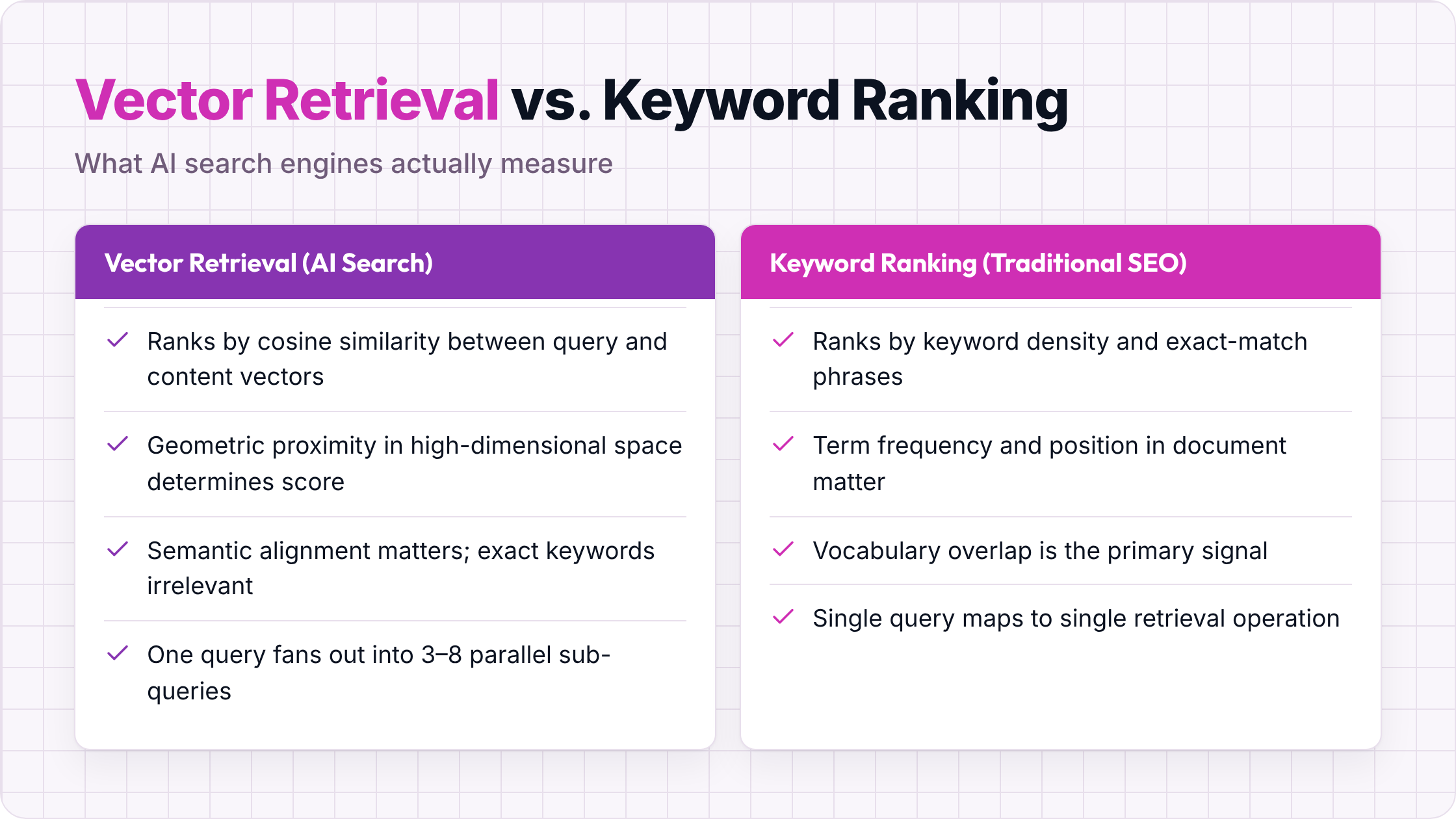
When an AI search engine processes a query, it converts both the query and every candidate document into high-dimensional numeric vectors, then ranks content by cosine similarity: how closely your content's vector aligns with the query vector. The closer the angle between the two, the higher the retrieval score. Traditional keyword density is largely irrelevant here. What matters is whether your content occupies the right region of vector space for the concepts a user is exploring.
Query Fan-Out: One Search, Many Vectors
A user rarely submits a query that maps to a single retrieval operation. LLMs decompose the original prompt into between 3 and 8 parallel sub-queries, each targeting a distinct facet of the intent, before a single word of the answer is drafted. A question like "how do I reduce SaaS churn" might fan out into sub-queries covering pricing psychology, onboarding gaps, customer success benchmarks, and cancellation flow design, all running simultaneously against the vector store.
Each sub-query generates its own embedding and its own ranked list of chunks. The system then synthesizes those lists into one response. A single piece of content can be retrieved for multiple sub-queries if it covers adjacent concepts with enough semantic depth. Thin content that answers only the surface question gets retrieved for one sub-query at best, then dropped from the synthesis.
Ziptie's technical breakdown of AI content retrieval confirms that cosine similarity between your content's embedding and the query embedding is the operative ranking signal, not keyword frequency or backlink count.
Where Google SGE and RAG Pipelines Pull From
Google's Search Generative Experience and most enterprise RAG pipelines share the same basic retrieval architecture. Documents are pre-chunked, typically into 256 to 512 token segments, embedded, and stored in a vector index. At query time, the system retrieves the top-k chunks by similarity score, passes them to the LLM as context, and the LLM generates a response grounded in those chunks.
The ranking inside that retrieval step is not a single similarity score. Multi-vector search approaches encode documents into multiple high-dimensional embeddings per document, as proposed in a 2024 arxiv study on retrieval optimization, which significantly improves retrieval precision over single-vector approaches. In practice, a long-form article with clearly differentiated sections can generate multiple strong embeddings and get retrieved across several sub-queries simultaneously, while a short, undifferentiated page competes on one embedding only.
E-E-A-T Signals and Embedding Confidence
Google's E-E-A-T criteria (Experience, Expertise, Authoritativeness, Trustworthiness) are not just human editorial guidelines. They correlate with signals that influence how confidently a retrieval system scores a chunk. Author credentials, citation density, structured factual claims, and consistent entity references all contribute to the semantic richness of an embedding. A chunk from a page with strong E-E-A-T signals tends to cluster near other high-authority content in vector space, which reinforces its retrieval score when the query embedding lands in that neighborhood.
Marie Haynes' analysis of vector search optimization notes that the mathematical representation of words and phrases captures multiple semantic dimensions simultaneously, meaning a page that demonstrates genuine subject-matter depth encodes differently than one that merely repeats target phrases.
One trade-off to name directly: optimizing for vector similarity can push writers toward comprehensive, encyclopedic coverage at the expense of a clear point of view. A document that tries to occupy every adjacent concept in vector space risks becoming semantically diffuse, which can actually lower its similarity score for any specific sub-query. Focused, well-structured chunks that answer one facet precisely will often outperform a sprawling page that gestures at everything.
Optimizing Content for Vector Database Retrieval: A Step-by-Step Approach
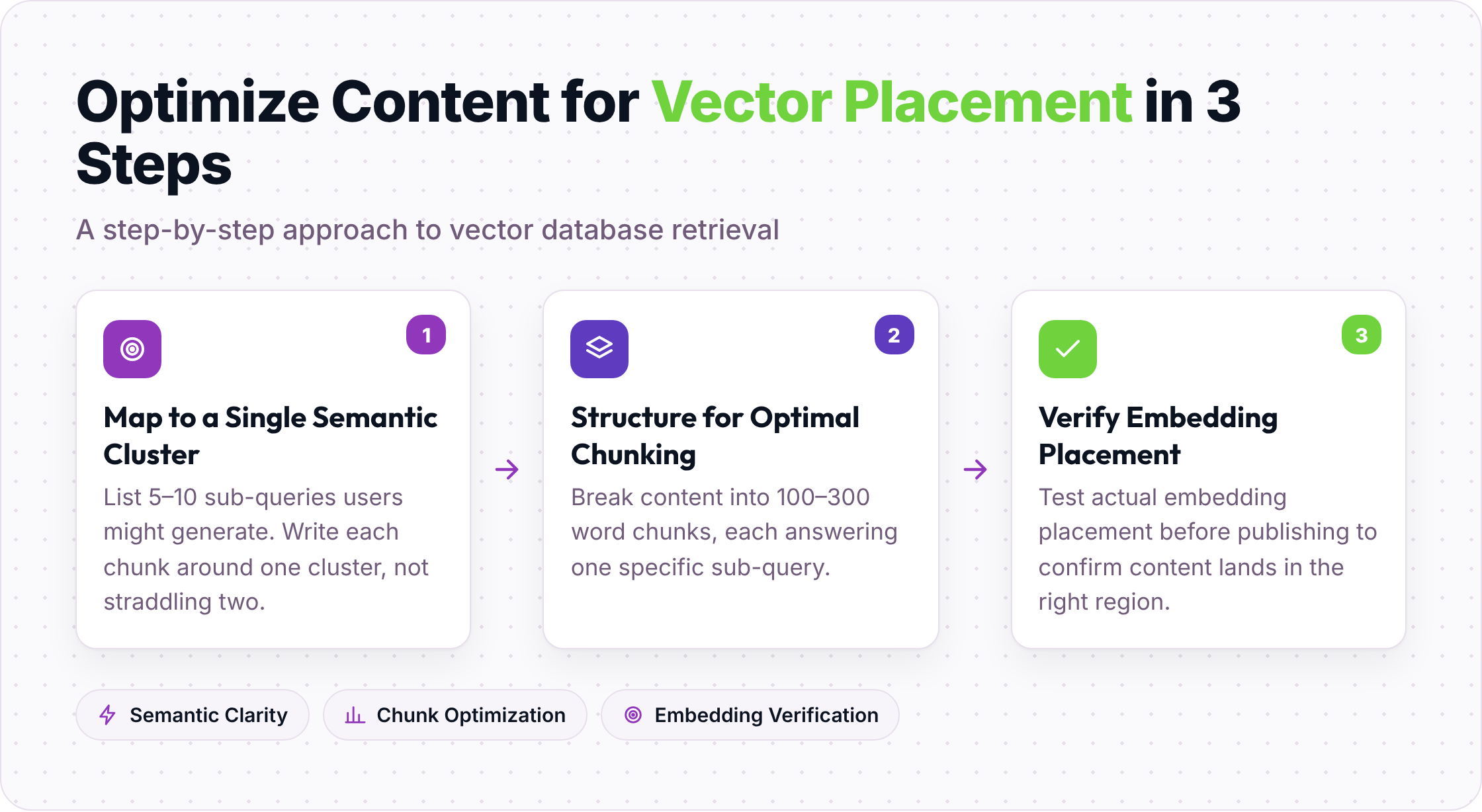
To place content reliably in vector space, write each passage around a single semantic cluster, structure it so every 100 to 300 word chunk answers one specific sub-query, and verify actual embedding placement before publishing. These three steps address the full retrieval pipeline: what you write, how it gets chunked, and where it lands in the index relative to the queries you want to win.
Step 1: Map Your Content to a Single, Tight Semantic Cluster
Start by listing the 5 to 10 sub-queries a user might generate when exploring your topic. For a page on Neural Vector Placement, those might include "how embeddings are computed," "cosine similarity thresholds in RAG," "chunk size and retrieval accuracy," and "how to test embedding quality." Each sub-query defines a semantic cluster. Your job is to write a chunk that sits squarely inside one cluster, not straddling two.
A practical test: paste your draft chunk into an embedding tool (OpenAI's text-embedding-3-large or Cohere's embed-english-v3.0 both work well for this), then compute cosine similarity against each of your target sub-queries. If the highest-scoring sub-query scores below 0.75, the chunk is either too broad or too thin on the target concept. Rewrite before moving on.
Step 2: Structure for Chunk Boundaries, Not Just Headings
Most CMS platforms and RAG pipelines chunk content by token count, not by heading. A heading break does not guarantee a clean chunk boundary. If your H3 section runs 600 tokens, it will be split mid-paragraph, and the second half will carry a weaker embedding than the first because it lacks the topic-establishing sentences.
Write sections that are 250 to 400 tokens long. Open each section with a sentence that states the concept directly, not a transitional phrase. The opening sentence carries disproportionate weight in the embedding because it sets the semantic context for everything that follows. A section that opens with "As we discussed above..." encodes that transitional intent into the chunk vector, diluting the topical signal.
Step 3: Verify Placement Before You Publish
Publishing without checking your embedding placement is the equivalent of publishing without checking your page speed. You need at minimum three data points:
- Cosine similarity against your primary target sub-queries (aim for 0.78 or above)
- Cosine similarity against two or three adjacent sub-queries you want to be retrieved for
- Cosine similarity against one clearly out-of-scope query, to confirm you haven't drifted
If your primary score is strong but your adjacent scores are below 0.65, your content is too narrow and will miss retrieval opportunities on related prompts. If your out-of-scope score is above 0.70, your content has drifted and will compete for retrieval slots it shouldn't occupy, which wastes index capacity and can confuse the synthesis layer.
The limitation here is real: this workflow requires API access to an embedding model and either a script or a tool that computes cosine similarity. It is not a one-click audit. For teams without engineering support, the practical alternative is to use a semantic similarity tool like Sentence Transformers locally, or to work with an AEO specialist who can run the inspection as part of a content audit.
Frequently Asked Questions
What is Neural Vector Placement and why does it matter for AI search?
Neural Vector Placement refers to the position your content occupies in the high-dimensional embedding space that AI retrieval systems use to match queries to documents. When your content's embedding lands close to the query vector, the retrieval system scores it highly and includes it in the generated response. Content that sits far from the relevant cluster gets ignored, regardless of its organic search ranking.
How is vector-based retrieval different from traditional keyword search?
Keyword search matches terms that appear in the document to terms in the query. Vector retrieval compares the geometric position of the query embedding to the geometric position of each document chunk, so two pieces of content can match even if they share no vocabulary. A query about "employee attrition" can retrieve a document about "staff turnover" because both phrases map to nearby coordinates in embedding space.
What chunk size works best for vector retrieval?
Most production RAG pipelines perform best with chunks between 256 and 512 tokens, but the optimal size depends on your content type and the embedding model in use. Shorter chunks (150 to 250 tokens) tend to produce more precise embeddings for narrow factual queries. Longer chunks (400 to 600 tokens) capture more context and perform better when the query requires synthesizing multiple related points. Testing both against your actual query set is the only reliable way to find the right balance for your use case.
Can I improve my vector placement without changing my content?
Chunking strategy alone can shift your placement meaningfully. Re-chunking existing content so that each segment opens with a strong topic sentence and avoids mid-section topic drift can raise cosine similarity scores without rewriting a word of the body text. Metadata enrichment, such as adding structured summaries or entity tags that get embedded alongside the chunk, can also improve retrieval scores in systems that support hybrid indexing.
How do I know if my content is already well-placed in vector space?
You need to run your content through an embedding model and compute cosine similarity against a representative set of target queries. A score above 0.78 against your primary sub-queries is a reasonable baseline for strong placement. Scores between 0.65 and 0.78 suggest the content is in the right neighborhood but not tightly clustered. Below 0.65 typically means the content is either too broad, too thin on the target concept, or covering a different semantic territory than the query expects.
Does page authority or backlink count affect vector placement?
Not directly. The embedding is computed from the text content of the chunk, not from external link signals. However, pages with strong E-E-A-T signals tend to use more precise, entity-rich language, which produces denser, more accurate embeddings. The correlation between authority and good vector placement is real, but the mechanism is content quality, not link equity.
Ready to See Where Your Content Actually Sits?
Most content teams optimize for rankings they can see and ignore the vector coordinates that determine AI retrieval. If you want to know exactly where your pages land in embedding space and what it would take to move them closer to the queries that matter, visit Seorav to learn more. The audit covers chunk-level similarity scores, cluster gap analysis, and a prioritized rewrite plan based on your actual query set.
Keep reading
Finding and Fixing the Semantic Gaps Costing You AI Citations
A semantic gap deficit stops AI engines from citing your content. Learn how to identify missing concept clusters and fix them before a competitor does.

How to Get Your Content Cited Across Multiple AI Models
Learn how decentralized footprint expansion gets your content cited across ChatGPT, Claude, Gemini, and Perplexity with structured, multi-model content str

Keeping Your Content Fresh Enough for AI Search Rankings
Learn how Freshness Decay Deflection keeps your content eligible for AI citations. Audit, update, and measure with a proven quarterly process.