Martech stack evolution: adapting for AI in 2026
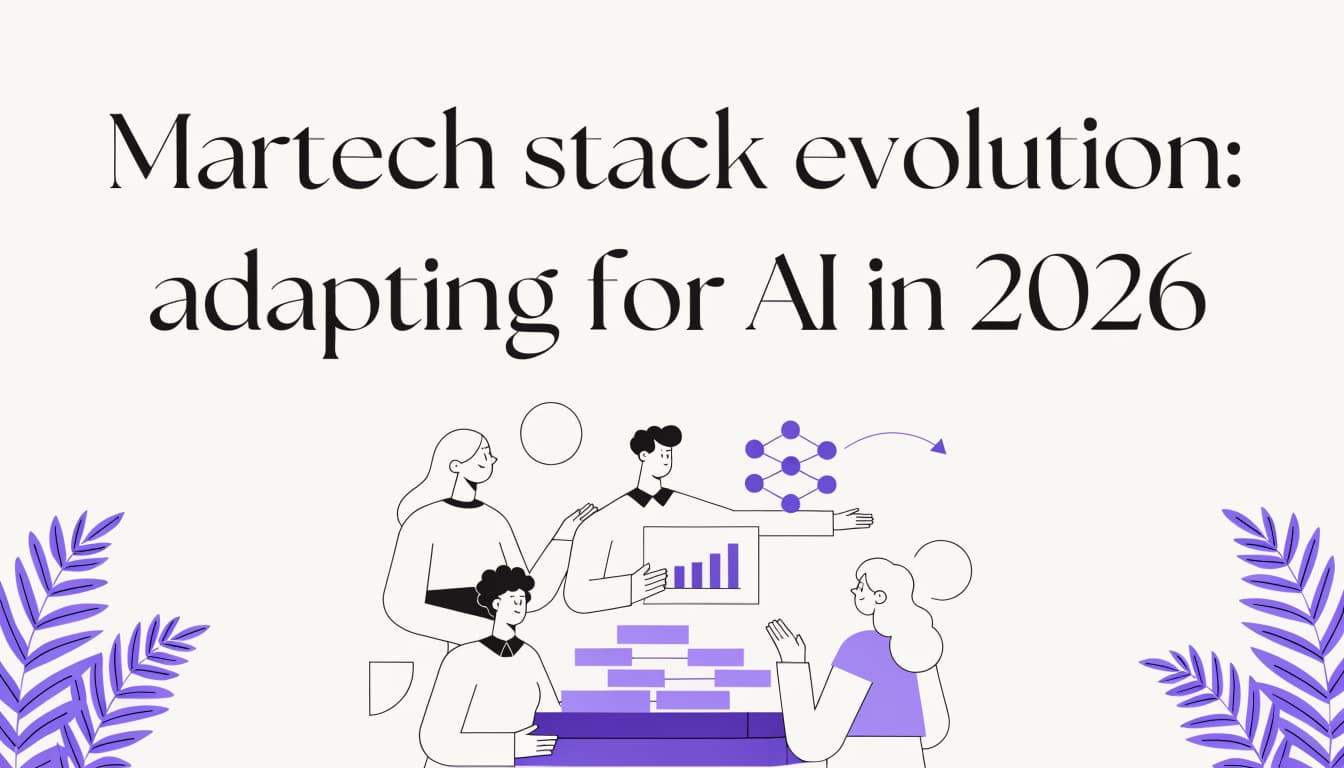
Last updated: 25 July 2026
Martech stack evolution: adapting for AI in 2026 requires more than adding an AI feature to existing tools. The single most important thing to get right is your data layer — AI models are only as useful as the data you feed them, and most stacks have data scattered across disconnected platforms.
Scott Brinker's widely cited Martech 5000 (which now tracks closer to 14,000 solutions) shows that the sheer number of available tools has not shrunk — but the way teams use them is shifting fast. According to martech.org, flat budget growth in 2025 masked a deeper structural reset: AI is moving from a bolt-on feature to the core value-creation engine inside marketing platforms. That means a stack built around 2022 assumptions — siloed point solutions, manual workflows, third-party cookie targeting — needs a deliberate rebuild, not a patch.
Before you start: assess your current state
Before touching any vendor contract or procurement process, map what you already have. Pull a full inventory of every paid martech platform, including tools that individual teams have licensed without central approval. A realistic audit usually surfaces 20–40% redundancy in mid-size organizations.
For each tool, record three things:
- What data it holds (first-party, behavioral, transactional, or none)
- Whether it exposes an API that other systems can read in real time
- Who actually uses it — a tool used by fewer than two people monthly is a consolidation candidate
This inventory becomes the foundation for every AI integration decision that follows.
Step 1: Build a unified data layer before buying AI tools
AI agents and predictive models require clean, centralized data. Without it, you are training models on incomplete signals and automating bad decisions at scale.
The practical approach most enterprise teams now use is a cloud data warehouse or lakehouse — Snowflake's modern marketing data stack model is one well-documented example — that pulls from CRM, CDP, web analytics, and ad platforms into a single queryable layer. From there, your AI tools query one source of truth rather than each pulling from its own silo.
What a unified data layer looks like in practice
A mid-market B2B company might pipe Salesforce CRM data, HubSpot engagement data, and Google Analytics 4 event data into a central warehouse using a tool like Fivetran or Airbyte. A reverse-ETL tool (Census or Hightouch are common choices) then pushes enriched segments back into activation platforms. That round-trip — ingest, enrich, activate — is the backbone of any AI-ready stack.
The realistic trade-off: building this infrastructure takes three to six months and requires either a data engineer or a vendor that handles the plumbing for you. Teams without that capacity should prioritize a CDP with native AI features over a custom warehouse build.
Step 2: Audit your stack for AI-native vs. AI-washed tools
Many platforms added "AI" to their dashboards between 2023 and 2025 without changing underlying architecture. The distinction matters because AI-washed tools use machine learning as a reporting layer — they show you predictions but do not act on them. AI-native tools embed models into the workflow so that decisions (send this email, suppress this ad, score this lead) happen automatically.
When evaluating any platform, ask the vendor for three specific things:
- A live demo of an autonomous action — not a recommendation, but an action the system took without human approval
- The latency between a trigger event and the system's response (sub-second is table stakes for behavioral triggers)
- Where the model is trained — on your data, on industry benchmarks, or on a generic LLM with no domain context
If a vendor cannot answer all three clearly, treat the AI capability as a roadmap item, not a current feature.
Step 3: Prioritize agentic workflows over single-task automation
The most significant shift in martech stack evolution: adapting for AI in 2026 is the move from rule-based automation (if X then Y) to agentic workflows where an AI model selects the next best action from a range of options based on real-time context.
A practical starting point is lead scoring and routing. Instead of a static point-based score, an agentic system continuously re-ranks leads based on recency, intent signals, and pipeline velocity — then routes them to the right sales rep or nurture sequence without manual intervention. Companies that have implemented this report sales cycle reductions of 15–25%, though results vary significantly by industry and data quality.
Where agentic workflows break down
Agentic systems require guardrails. Without defined boundaries, an AI agent optimizing for short-term conversion can suppress long-term brand-building content, over-contact high-intent leads, or allocate budget to channels that perform well in the model's training window but poorly in real conditions. Set hard limits: maximum contact frequency, minimum spend floors per channel, and mandatory human review for any action above a defined budget threshold.
Step 4: Restructure your team around AI outputs, not AI inputs
Technology changes faster than org charts. Most martech teams are still structured around tool ownership — one person owns the MAP, another owns the CRM, another owns analytics. That model breaks when AI collapses those boundaries.
A more durable structure organizes around outcomes: pipeline generation, retention, and brand reach. Each outcome team owns the data, the AI model, and the activation channel together. This is sometimes called a "pod" model, and it forces cross-functional accountability that siloed tool ownership never did.
Retraining matters too. Marketers who understand prompt engineering, model evaluation, and data quality checks are meaningfully more effective with AI tools than those who treat them as black boxes. Budget at least 20 hours per person per year for structured AI literacy training — not vendor webinars, but hands-on practice with your actual stack.
Step 5: Build for privacy compliance from the data layer up
Third-party cookies are effectively gone for most browsers. Regulatory pressure from GDPR, CCPA, and emerging state-level laws in the US means that consent management is no longer a legal checkbox — it is a data quality problem. If your AI models train on data collected without proper consent, the model itself becomes a liability.
The fix is architectural: consent signals need to flow into your data warehouse alongside behavioral data, so that any segment or model built downstream automatically excludes non-consented records. This requires a consent management platform (CMP) with an API — not just a cookie banner — integrated into your data pipeline.
The Snowflake blog on AI, data gravity, and privacy covers how leading teams are embedding privacy logic at the warehouse layer rather than patching it on at the activation stage, which is the more reliable approach.
Common mistakes that stall AI adoption
- Buying AI tools before fixing data quality. A model trained on duplicate, incomplete, or stale CRM records will produce worse outcomes than a simple rule-based system.
- Treating AI as a cost-cutting tool first. Teams that eliminate headcount before AI is proven in production lose the human judgment needed to catch model errors.
- Ignoring latency. An AI recommendation delivered 48 hours after a trigger event is not personalization — it is noise.
- Skipping change management. Sales teams that do not trust AI-generated lead scores will ignore them. Involve end users in model design, not just deployment.
- Over-consolidating too fast. Replacing five tools with one AI platform sounds efficient but creates a single point of failure. Consolidate in phases, not all at once.
What a realistic 2026 stack looks like
| Layer | Function | Example category |
|---|---|---|
| Data warehouse | Central storage and computation | Cloud lakehouse |
| CDP | Identity resolution and segment activation | Real-time CDP |
| Consent management | Privacy signal propagation | API-first CMP |
| AI orchestration | Agentic workflow management | Marketing AI platform |
| Activation channels | Email, paid, web, sales | Channel-specific tools |
| Analytics | Attribution and model monitoring | BI + ML observability |
No single vendor covers all six layers well. The goal is clean handoffs between layers, not a single-vendor lock-in.
According to martech.org's 2026 analysis, the stacks that are winning are not the ones with the most tools — they are the ones where data flows without friction from collection to decision to action.
If you want help auditing your current stack and identifying where AI integration will deliver the fastest return, see how seorav.com can help. The team works with marketing organizations to cut through vendor noise and build data-first strategies that hold up as AI capabilities continue to shift.
Frequently Asked Questions
How do I know if my martech stack is ready for AI integration in 2026?
The clearest signal is your data layer. If customer data lives in four or more disconnected systems with no single queryable source, your stack is not AI-ready. Run a basic audit: can you pull a unified customer timeline — web visits, email opens, CRM activity, purchase history — in one query? If not, that infrastructure gap will limit every AI tool you add on top of it.
What is the difference between AI-native and AI-washed martech tools?
AI-native tools embed models into the decision workflow so the system takes autonomous actions — suppressing an ad, routing a lead, adjusting send time — without human approval. AI-washed tools surface predictions or recommendations in a dashboard but still require a human to act. Ask vendors for a live demo of an autonomous action, not a screenshot of a prediction score, to tell the difference quickly.
How many tools should a modern martech stack have in 2026?
There is no universal right number, but research consistently shows that mid-market B2B companies average 20–30 active martech tools, with 20–40% redundancy. The goal is not minimizing tool count — it is minimizing data friction between tools. A stack of 15 well-integrated platforms outperforms a stack of 8 disconnected ones. Audit for data handoffs, not headcount.
What is an agentic workflow in a martech context?
An agentic workflow is one where an AI model selects and executes the next best marketing action from a defined set of options, based on real-time context, without waiting for a human trigger. Examples include dynamic lead routing based on intent signals, autonomous budget reallocation across paid channels, and real-time content personalization. Unlike rule-based automation, agentic systems adapt their logic as conditions change.
How does third-party cookie deprecation affect AI-powered martech stacks?
Without third-party cookies, behavioral data from outside your owned properties disappears. AI models that relied on cross-site tracking for targeting or lookalike modeling lose significant signal. The fix is building first-party data collection into every owned touchpoint — website, email, events — and using a CDP to unify those signals. Consent management must also integrate at the data layer so models only train on compliant records.
What team structure supports a modern AI-enabled martech stack?
The most effective structure organizes teams around business outcomes — pipeline, retention, brand — rather than tool ownership. Each pod owns its data pipeline, AI model, and activation channels together. This breaks the siloed dynamic where the CRM owner, the MAP owner, and the analytics owner rarely collaborate. It also forces accountability: if the AI model underperforms, the whole pod owns the fix.
Keep reading
Ranking in Google's AI Search: The Deterministic Signals That Actually Move the Needle
Learn how do you rank in SGE with the three signals Google's AI uses to cite sources: schema markup, entity salience, and structured factual claims.
Why AI Ignores Your Content (And How to Fix It)
Learn how to avoid AI content that gets ignored by LLMs. Covers RAG retrieval signals, schema, entity salience, and an answer-first structure checklist.
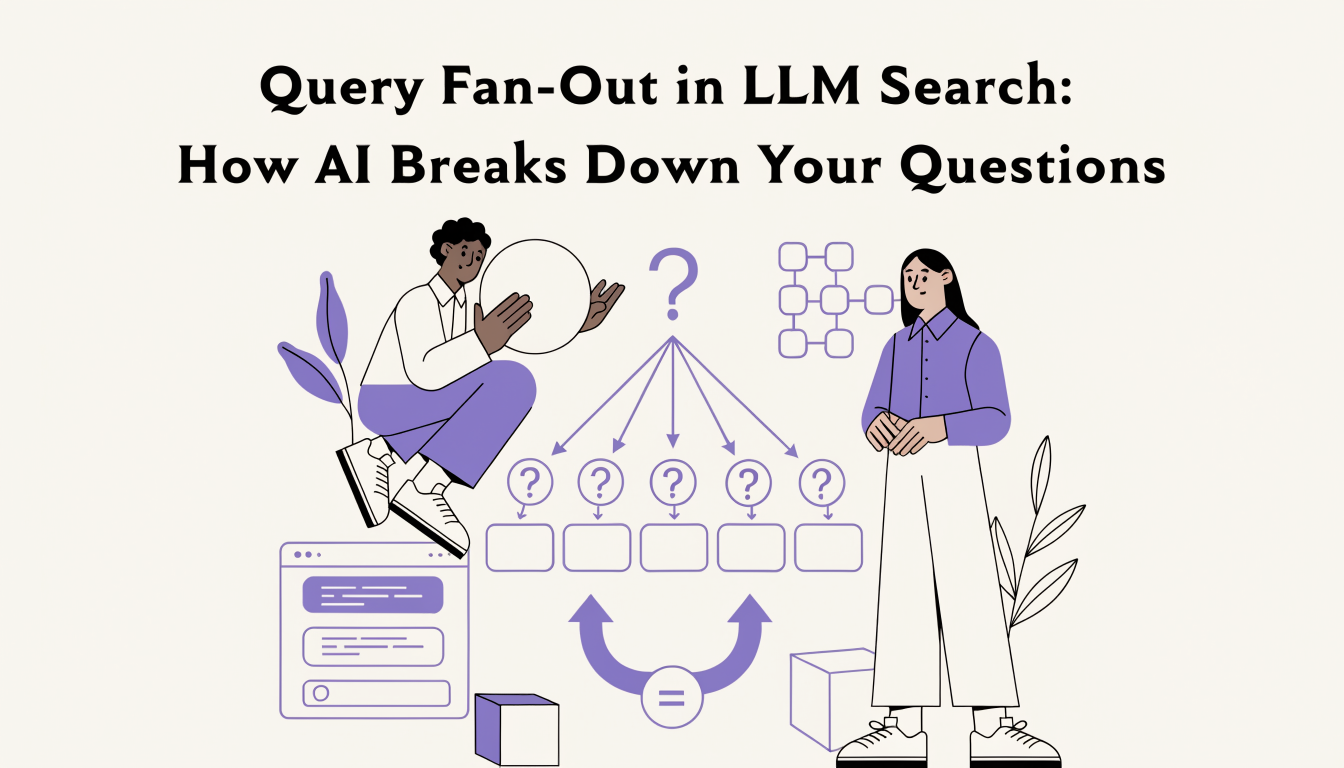
Query Fan-Out in LLM Search: How AI Breaks Down Your Questions
Learn what query fan-out in LLM search is, how AI splits your prompt into 3-8 sub-queries, and how to structure content to win more citation passes.