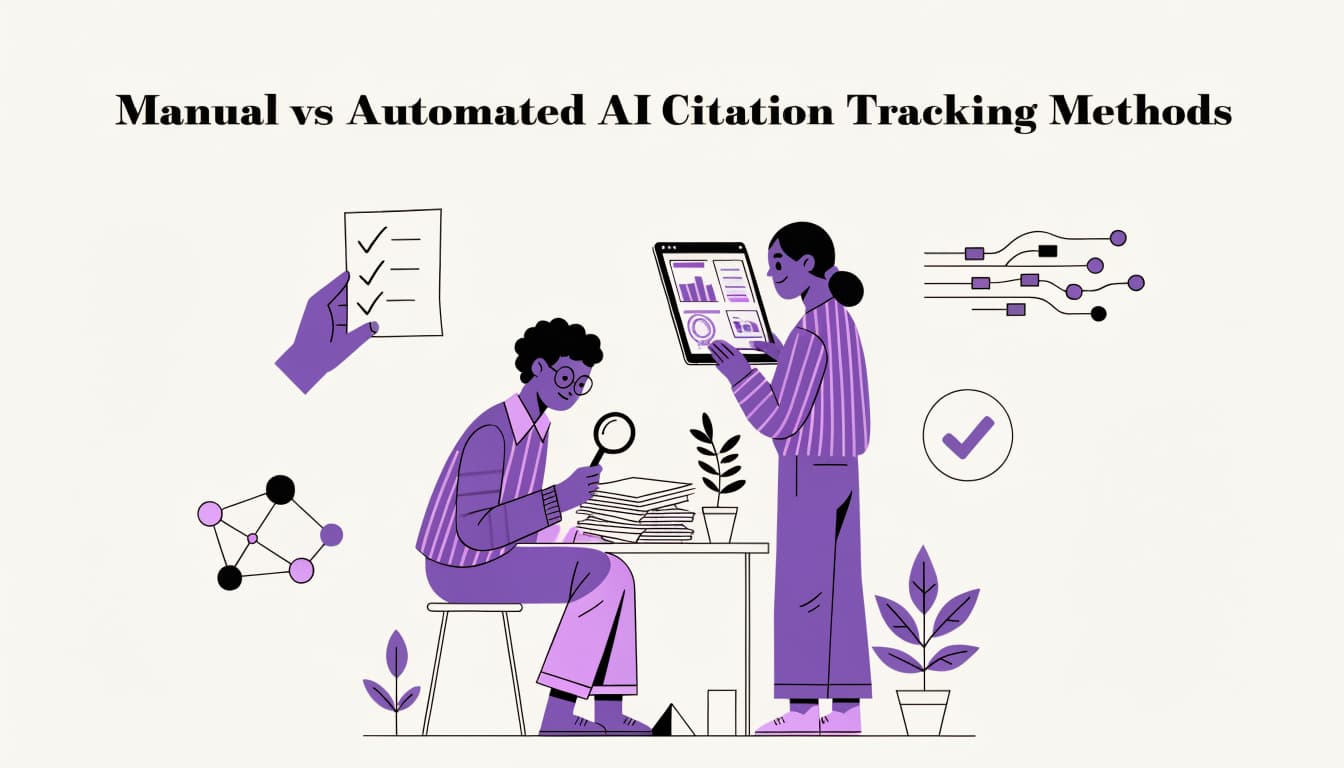
Manual vs Automated AI Citation Tracking Methods
Last updated: 23 July 2026
Manual vs automated AI citation tracking methods serve different needs: manual works for small, high-stakes projects where every source must be verified by a human; automated tools handle volume, speed, and continuous monitoring at a scale no individual can match. Your choice depends on how many queries you track, how often you check, and how much error tolerance you have.
How to Frame the Decision
The core tension is control versus scale. A researcher tracking five branded queries across three AI engines can do it manually — slowly. A brand monitoring hundreds of product mentions across ChatGPT, Perplexity, Google's AI Overviews, and Gemini cannot. Volume is the first filter.
The second filter is what you are tracking. Academic citation tracking — verifying that a paper correctly cites a source — rewards manual review because context and intent matter. Brand citation tracking in generative AI outputs rewards automation because the landscape changes daily and no human can query every engine at every hour.
Third, consider error tolerance. Manual review catches nuanced misattribution that automated tools often miss. Automated tools catch volume-level trends that manual review never sees because the sample size is too small.
Comparison Table: Manual vs Automated AI Citation Tracking Methods
| Criterion | Manual Tracking | Automated Tracking |
|---|---|---|
| Scale | Practical up to ~20 queries/week | Handles thousands of queries continuously |
| Speed | Hours to days per audit | Near real-time or scheduled intervals |
| Accuracy (nuance) | High — human judges context | Moderate — depends on parsing logic |
| Accuracy (coverage) | Low — sampling bias likely | High — systematic, repeatable |
| Cost (time) | High ongoing labor cost | Low per-query after setup |
| Cost (tools) | Minimal or free (Google Scholar, spreadsheets) | Subscription fees vary widely |
| Sentiment detection | Strong — human reads tone | Variable — NLP-dependent |
| Competitor tracking | Impractical at scale | Core feature of most platforms |
| Auditability | Full — reviewer logs every decision | Depends on vendor transparency |
| Setup complexity | Low | Moderate to high |
Manual Tracking: Honest Assessment
Manual citation tracking means a person directly queries AI engines, records the outputs, and checks whether a brand, paper, or claim was cited correctly. For academic systematic reviews, this has been the gold standard for decades. Tools like Google Scholar and Elicit AI are often used to assist manual review — surfacing candidates that a human then evaluates.
The strength is precision. A human reviewer notices when a citation is technically present but contextually wrong — when an AI engine mentions a brand negatively, or when a paper is cited to support a claim it actually contradicts. No automated parser reliably catches that.
The limits are severe. A 2025 study published in ScienceDirect found that AI-assisted methods dramatically reduced the time needed to complete systematic reviews compared to traditional manual approaches — a finding that reflects a broader truth: manual processes do not scale. One Reddit thread on WordPress SEO forums put it plainly: manual tracking doesn't scale past a handful of SKUs, and that's a structural problem, not a workflow one.
For a solo researcher auditing their own brand across two or three AI platforms once a month, manual is viable. For anyone doing more, the math breaks down fast.
Automated Tracking: Honest Assessment
Automated AI citation tracking platforms send programmatic queries to generative AI engines on a schedule, parse the responses, and flag whether a target brand or entity appeared — and in what context. Core capabilities typically include brand mention detection, competitor share-of-voice comparisons, sentiment tagging, and trend reporting over time.
The speed advantage is real. An automated system can query dozens of AI engines hundreds of times per day, something no manual process approaches. For brands concerned about how ChatGPT or Perplexity describes their product versus a competitor's, this continuous monitoring is the only practical option.
The limits matter, though. Automated tools depend on how well their NLP layer interprets AI-generated prose. Sarcasm, hedged language, and indirect references are frequently miscategorized. A citation that says "Brand X is sometimes mentioned, though its efficacy is disputed" may register as a positive mention in a basic sentiment model. Vendor transparency also varies — some platforms do not clearly document which engines they query, how often, or how they handle engine-side rate limiting and output variation.
Setup is another real cost. Configuring entity lists, competitor sets, and alert thresholds takes time, and misconfigured tracking produces noisy, misleading reports.
Which Should You Choose
Choose manual tracking if: - You are conducting an academic systematic review where every citation decision must be defensible and documented. - Your brand or entity list is small (under 20 terms) and you audit infrequently. - You need to catch subtle misattribution — tone, context, or framing — that automated tools regularly miss. - Budget is constrained and query volume is low enough that a spreadsheet and a few hours monthly covers it.
Choose automated tracking if: - You manage a brand with multiple product lines, and you need to know how AI engines describe you versus competitors — continuously. - Your team cannot dedicate manual hours to querying and logging outputs at scale. - You want trend data: is your citation share growing or shrinking over the past 90 days? - You need competitor benchmarking, which is structurally impossible to do manually at any meaningful frequency.
A hybrid approach often makes the most sense for mid-sized brands: automated tools handle volume monitoring and surface anomalies, while a human reviewer investigates flagged outputs that seem contextually off. This keeps labor focused on high-value judgment calls rather than repetitive querying.
The honest trade-off is that neither method is complete on its own. Automated tools give you coverage; manual review gives you confidence. The question is which gap costs you more.
See how seorav.com can help you build a citation tracking strategy that fits your actual scale — whether that means structuring a manual audit process or evaluating which automated approach delivers real signal rather than noise.
Frequently Asked Questions
Can manual citation tracking keep up with how often AI engines update their outputs?
No, not at any meaningful scale. Generative AI engines like ChatGPT and Perplexity update their responses based on model changes, retrieval updates, and prompt variation. A brand that was cited positively last week may not be cited at all this week. Manual audits are snapshots; automated tools provide the continuous monitoring needed to catch these shifts before they affect traffic or reputation.
Are automated AI citation tracking tools accurate enough to trust?
Accuracy depends heavily on the platform's NLP quality and how it handles hedged or indirect language. Most tools perform well on direct brand mentions but struggle with sarcasm, negation, and contextual misattribution. For high-stakes decisions — say, a product launch or a legal matter — automated output should be spot-checked manually before acting on it. Use automated tools for trend direction, not as a final audit.
What is the difference between citation tracking for academic papers and for AI brand mentions?
Academic citation tracking verifies that a published paper correctly references a prior source — a task requiring human judgment about context and intent. AI brand citation tracking monitors whether generative AI engines mention a company, product, or claim in their outputs. Both benefit from automation for coverage, but the accuracy standard for academic review is typically higher, making manual verification more important in that context.
How often should I run a manual citation audit if I cannot afford automated tools?
For most small brands, a monthly manual audit across two to three major AI engines — ChatGPT, Perplexity, and Google's AI Overviews — is a reasonable baseline. Document your exact prompts, record the full output, and compare month over month. This gives you a trend line even without automation. Anything more frequent than weekly becomes unsustainable without dedicated staff or tooling.
Does using Elicit AI or Google Scholar count as automated citation tracking?
Not in the brand-monitoring sense. Elicit AI and Google Scholar are research tools that help surface academic papers and assist human reviewers — they do not continuously monitor how commercial AI engines cite your brand. They are best understood as manual-assist tools for academic work, not as replacements for dedicated AI citation monitoring platforms that track generative AI outputs in real time.
Keep reading
Ranking in Google's AI Search: The Deterministic Signals That Actually Move the Needle
Learn how do you rank in SGE with the three signals Google's AI uses to cite sources: schema markup, entity salience, and structured factual claims.
Why AI Ignores Your Content (And How to Fix It)
Learn how to avoid AI content that gets ignored by LLMs. Covers RAG retrieval signals, schema, entity salience, and an answer-first structure checklist.
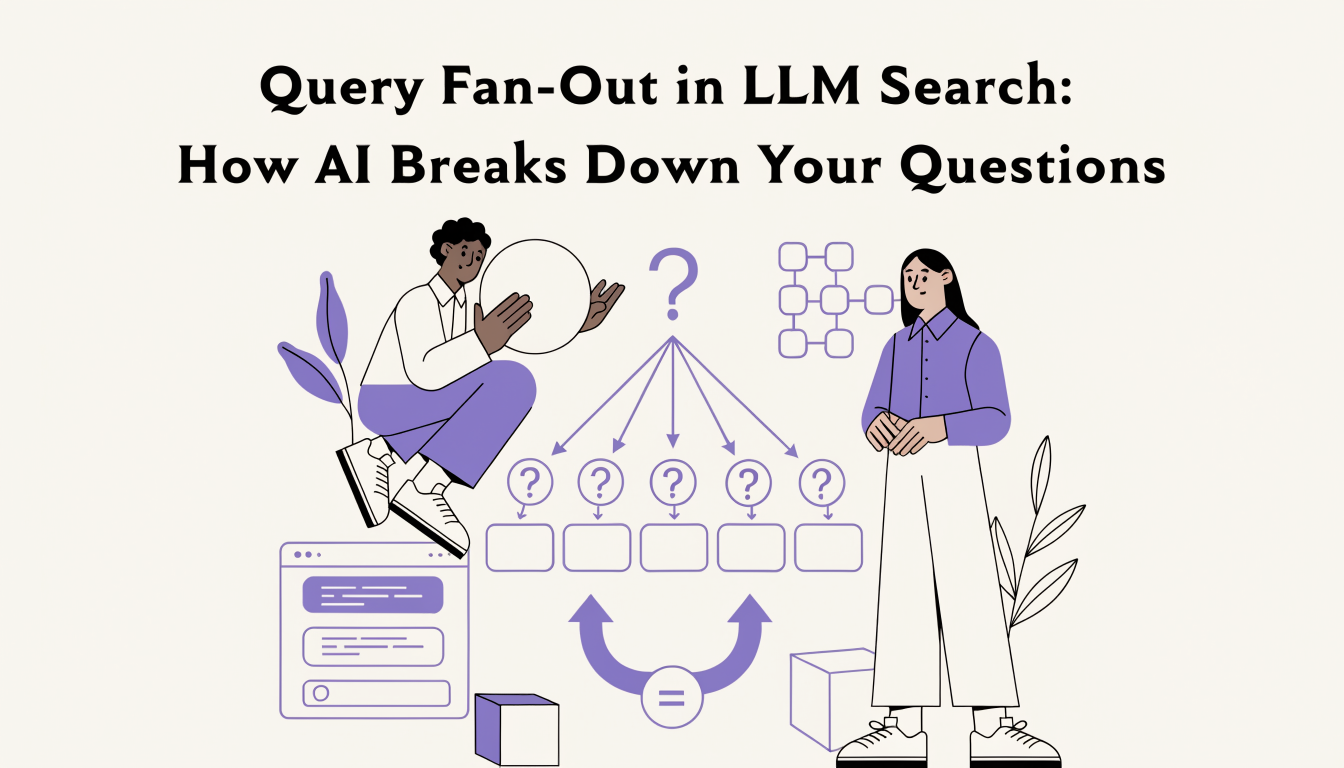
Query Fan-Out in LLM Search: How AI Breaks Down Your Questions
Learn what query fan-out in LLM search is, how AI splits your prompt into 3-8 sub-queries, and how to structure content to win more citation passes.