Making Your Website RAG-Compatible: A Technical Playbook

Last updated: 26 September 2026
Make your website RAG-compatible by structuring content so AI systems can retrieve and chunk it without losing context. RAG engines pull external pages at query time and break them into semantic units for the model's context window. If your HTML is bloated, your paragraphs are fragmented, or your key information is buried in navigation elements, retrieval systems fail to extract your content cleanly. The fix involves clean semantic markup, logical paragraph breaks, and removing layout noise that confuses chunking algorithms.
What "RAG-Compatible" Means for AI Citations
A RAG-compatible page is one that an AI engine can retrieve, chunk, and slot into its context window without losing meaning. Retrieval-augmented generation works by pulling external content at query time, not from memory baked in during training. If your page structure breaks that retrieval step, the model never sees your content, regardless of how well it ranks in Google.
How Retrieval-Augmented Generation Pulls Content Into AI Answers
When a user submits a query to ChatGPT with web access, Perplexity, or Google's AI Overviews, the system runs a retrieval pass before generating a response. It fetches candidate pages, splits them into chunks (typically 200 to 500 tokens each), scores those chunks for relevance, and passes the top-scoring ones into the model's context window alongside the original query. The model then synthesizes an answer from that retrieved material, often citing the source directly.
The key mechanism is vector similarity search: each chunk is embedded as a numerical representation, then matched against the query embedding. RAG systems produce free-form answers while still grounding responses in retrieved, non-parametric memory, as this 2025 survey on RAG architectures documents. That grounding is exactly what creates a citation opportunity. If your content never makes it into the retrieved set, no citation follows.
Why Chunk Size and Context Window Fit Determine Citation Eligibility
Most site owners lose the plot here. A page that buries its core claim inside a 1,200-word introduction will get chunked in ways that separate the claim from its supporting context. The retrieval system scores each chunk independently, so a self-contained, well-structured passage scores higher than a fragment pulled from the middle of a dense paragraph.
Your most citable content should front-load its answer within the first 100 to 150 words of any section. Subheadings help chunk boundaries align with topic shifts. Dense walls of text, nested clauses, and long preambles all reduce the probability that any single chunk passes the relevance threshold. One honest caveat: chunk boundaries vary by retrieval system, and no public documentation from Google or OpenAI specifies exact token counts for their production pipelines. You are optimizing for a range, not a precise target.
The Link Between RAG Indexing and AI Overview Citation Frequency
Google's AI Overviews pull from a separate indexing layer that prioritizes pages with clear answer structures, schema markup, and high crawl frequency. RAG systems need hybrid retrieval, combining vector search with keyword matching and metadata filtering, to surface the right content reliably. The RAGFlow 2025 review of retrieval architectures makes this explicit. Pages that satisfy all three signals (semantic relevance, keyword match, and structured metadata) appear in AI Overviews at measurably higher rates than pages optimized for keyword ranking alone.
Structured data (FAQ schema, HowTo schema, Article schema) acts as metadata that retrieval pipelines can filter on before they even run a similarity search. A page without schema is not disqualified, but it competes at a disadvantage in systems that use metadata as a pre-filter. Getting that infrastructure right is the foundation everything else in this playbook builds on.
How to Make Your Website RAG-Compatible: Data Format, Metadata, and Accessibility
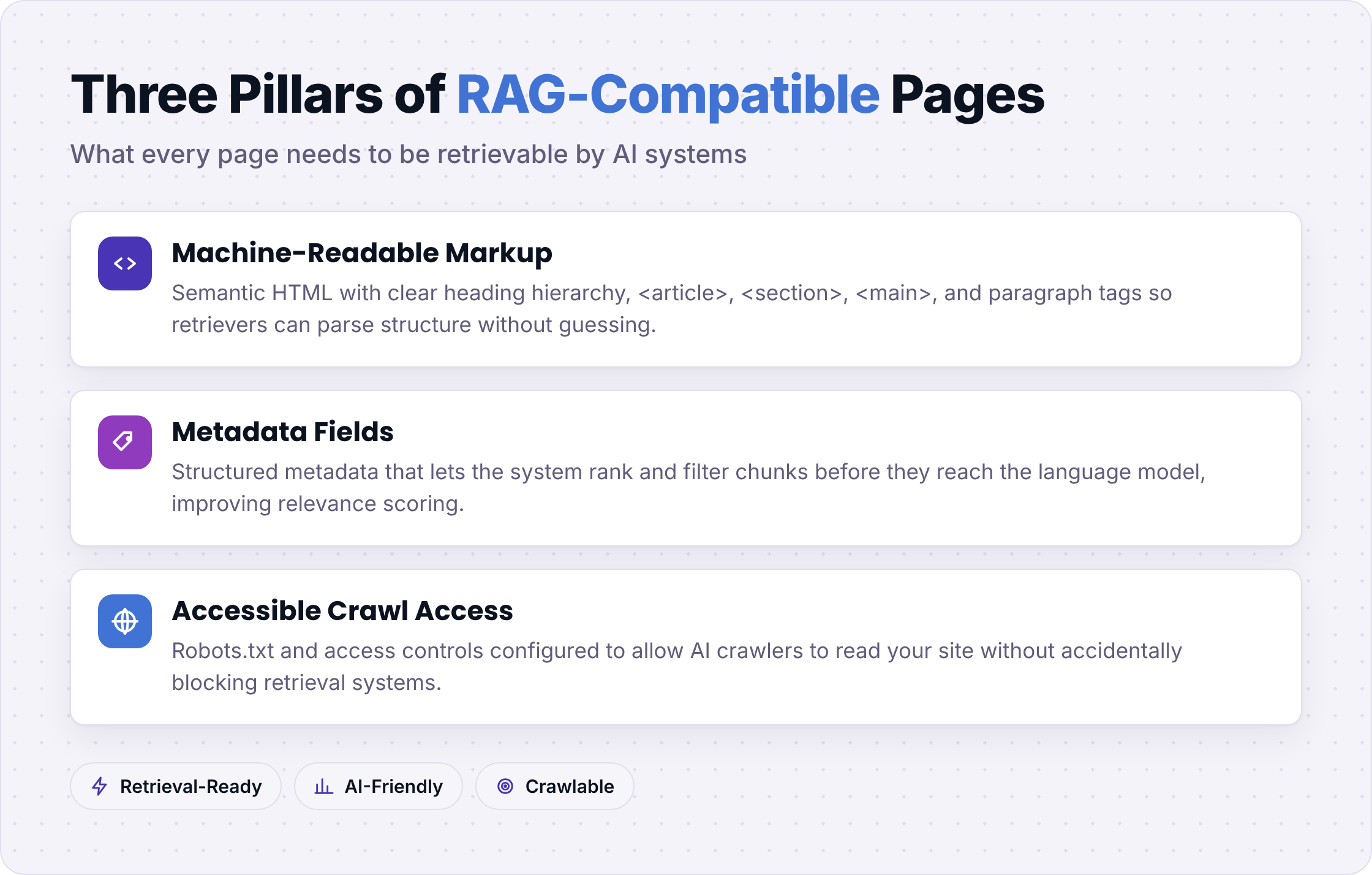
For a RAG system to retrieve your content reliably, your pages need three things in place: machine-readable markup that a retriever can parse without guessing, metadata fields that let the system rank and filter chunks before they reach the language model, and access controls that do not accidentally block the crawlers you want reading your site. Get all three right and your content becomes a viable retrieval target. Miss any one of them and even well-written pages get skipped.
File Formats and Markup AI Crawlers Can Actually Parse
HTML is still the baseline, but semantic HTML is what separates parseable content from noise. Retrievers chunk your pages into passages, and they use structural signals (heading hierarchy, <article>, <section>, <main>, paragraph tags) to decide where one chunk ends and the next begins. A page built entirely out of <div> soup produces chunks with no coherent boundaries. The retriever cuts mid-sentence, mid-argument, mid-table, and the resulting passages answer nothing cleanly.
JSON-LD schema sits on top of that. An Article schema block tells a retriever the content type, the author, the publish date, and the headline before it reads a single word of body copy. FAQPage schema is particularly useful: each question-answer pair maps almost perfectly to a retrieval chunk, a structural pattern that modern RAG pipelines actively exploit. HowTo schema works the same way for procedural content.
Plain text fallbacks matter more than most teams expect. PDFs, JavaScript-rendered content, and content locked behind interactive tabs are effectively invisible to many retrieval pipelines. If your most authoritative content lives in a PDF white paper or a React component that only renders after a user click, assume it will not be retrieved. The fix is straightforward: publish an HTML equivalent alongside any non-HTML asset.
Metadata Fields That Help Retrievers Rank Your Chunks
Retrieval is not just about finding relevant text. It is about ranking relevant text, and metadata is the primary ranking input before semantic similarity even runs. The fields that matter most in practice: title, datePublished, dateModified, author, and entity tags (topics, named entities, product names).
The numbers here are specific. In a 2024 analysis of modern RAG component design, time-decay scoring on dateModified was identified as one of the highest-leverage metadata signals for freshness-sensitive queries, with stale documents actively penalized in retrieval ranking. If your pages carry no publish date in their schema, a retriever has no way to apply that decay function. Your 2021 guide competes on equal footing with a 2024 update, and often loses to the newer page on pure semantic grounds anyway.
Entity tags deserve attention beyond basic keyword meta tags. Structured entity annotations, whether through schema about properties or explicit topic taxonomy fields, let retrievers filter your content by subject before running vector similarity. That pre-filtering step cuts retrieval latency and improves precision, as the enterprise RAG architecture patterns documented by Performalytic make clear.
The trade-off is maintenance overhead. Keeping dateModified accurate requires discipline: it should reflect genuine content updates, not cosmetic edits. Teams that auto-update modification dates on every CMS save, regardless of whether the content changed, end up with metadata that actively misleads retrievers. The signal becomes noise, and freshness scoring stops working in your favor.
Robots.txt, Sitemaps, and API Access
Access configuration is where technically sound content gets quietly blocked. A robots.txt file that disallows major crawlers, or that uses wildcard rules broad enough to catch AI agents, removes your site from retrieval consideration entirely, regardless of how well-structured your pages are.
The specific user agents to check: GPTBot (OpenAI), ClaudeBot (Anthropic), PerplexityBot, and Google-Extended (Google's AI training and retrieval crawler). Each requires an explicit allow rule if your robots.txt uses a restrictive default. A blanket Disallow: / under User-agent: * blocks all of them unless you add individual overrides.
Sitemaps serve a different function. They do not grant access, but they do accelerate discovery. An XML sitemap with accurate <lastmod> timestamps helps crawlers prioritize which pages to re-fetch when content changes. For large sites, a sitemap index that segments by content type (blog posts separate from product pages separate from documentation) gives retrieval crawlers a cleaner signal about where your authoritative content lives.
API access is the more advanced option, and not every team needs it. Exposing a structured content API (a headless CMS endpoint, for example) lets retrieval systems pull clean JSON directly rather than parsing rendered HTML. The upside is precision. The downside is that it requires authentication decisions, rate limiting, and versioning that add real engineering cost. For most content-heavy sites, well-structured HTML with a clean sitemap gets you 90% of the way there without opening an API surface.
Structuring Content for LLM Extraction and Citation
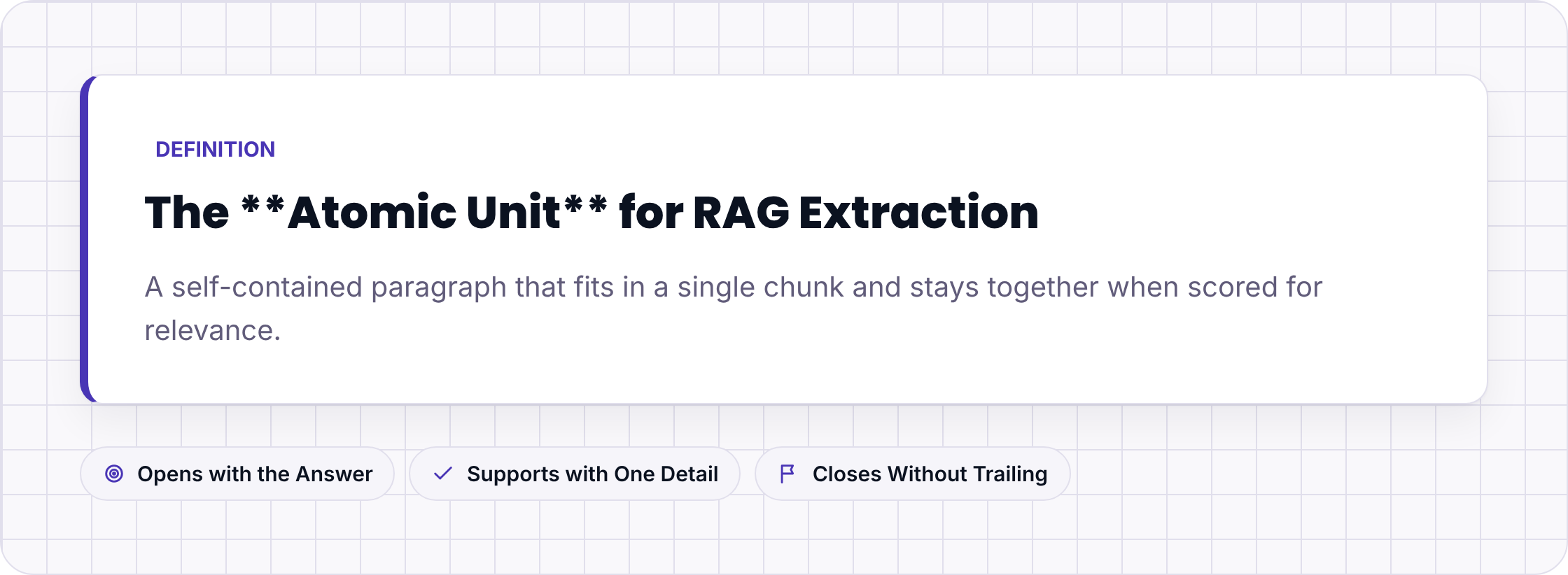
To get cited by an AI engine, your content needs to be written in discrete, self-contained units. Each paragraph should answer one question completely, without requiring the reader (or the retrieval system) to pull context from surrounding text. RAG pipelines chunk pages into passages of roughly 100 to 300 tokens, score each chunk independently, and discard anything that reads as a fragment. Structure your writing to match that unit, and your content becomes extractable by design.
The 40-80 Word Atomic Unit
The 40-80 word paragraph is the practical target for a retrievable answer block. Short enough to fit inside a single chunk, long enough to carry a complete claim, context, and conclusion. A paragraph that opens with the answer, supports it with one specific detail, and closes without trailing into the next thought is structurally identical to what a retrieval system is looking for.
Kime's 2026 content structure guide identifies answer-first paragraphs as one of nine patterns that measurably increase LLM citation share. The mechanism is direct: when the answer appears in the first sentence, a retrieval model can confirm relevance without reading the full chunk. Paragraphs that bury the answer in sentence three or four score lower on retrieval confidence, even when the underlying information is identical.
FAQ and Definition Blocks
Explicit FAQ sections and definition blocks perform well in retrieval for a structural reason: they pre-format content in the same question-answer shape that retrieval systems use to score relevance. A definition block that opens with "X is..." and runs 50-70 words gives the model a clean extraction target. A FAQ entry that mirrors a natural-language query (not a keyword-stuffed heading) maps directly to the prompt the engine received.
The trade-off is real. Pages built entirely from FAQ blocks can lose narrative coherence, which matters for human readers who arrive from organic search. A page that reads like a disconnected list of Q&A pairs may rank and get cited, but it tends to have higher bounce rates and lower time-on-page. The practical fix is to use FAQ blocks as anchors within longer sections, not as a replacement for prose.
Capsule Content Patterns
Capsule content is modular writing taken one step further. Each section is drafted to function independently: its own context, its own claim, its own resolution. No pronouns that reference earlier sections. No "as noted above." The section heading carries enough information that the chunk makes sense without the surrounding page.
This maps directly to how document preprocessing works in citation-aware RAG pipelines. As Tensorlake's RAG citation guide explains, chunking and embedding decisions made during document preprocessing determine whether your content surfaces as a citation or disappears into the retrieval noise. Writing each section to stand alone is the single most reliable way to survive that preprocessing step intact.
Technical Signals That Increase Retrieval Confidence
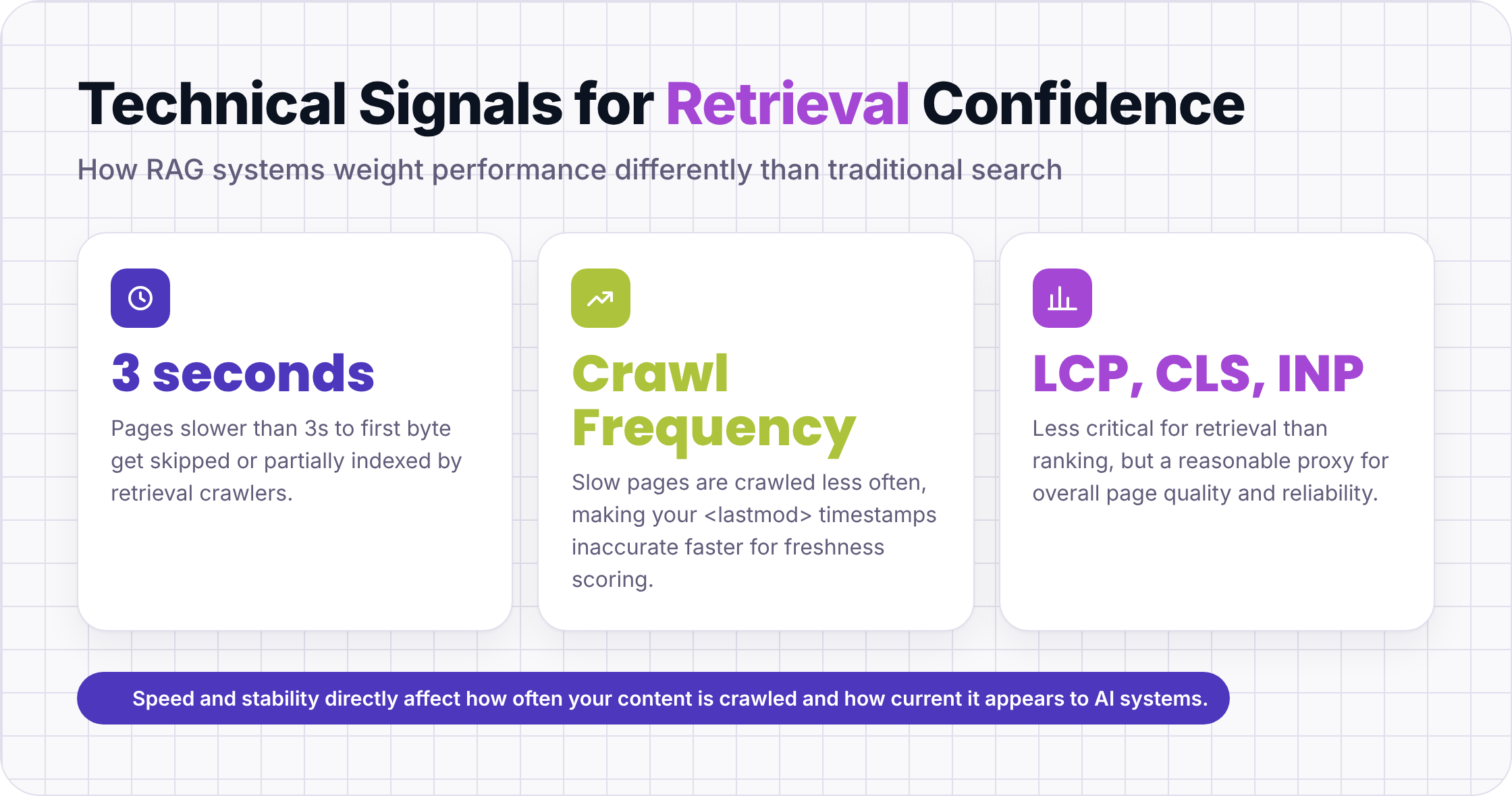
Beyond structure and metadata, a handful of technical signals push your pages toward the top of the retrieved set. None of them are secret. Most are already part of standard SEO practice. The difference is that RAG systems weight them differently than traditional search engines do.
Page Load Speed and Core Web Vitals
Retrieval crawlers time out. A page that takes more than three seconds to return its first byte of HTML is a page that gets skipped or partially indexed. Google's own crawler documentation notes that slow pages are crawled less frequently, which means your <lastmod> timestamps become inaccurate faster. For RAG purposes, crawl frequency directly affects how current your retrieved content appears to freshness-scoring systems.
Core Web Vitals (LCP, CLS, INP) matter less for retrieval than for ranking, but they are a reasonable proxy for page quality. A page with a 4-second LCP is usually a page with render-blocking JavaScript, which is also a page where your body content may not be in the initial HTML response. Fix the performance problem and you often fix the parsability problem at the same time.
Canonical Tags and Duplicate Content
RAG systems that index multiple versions of the same content (HTTP vs. HTTPS, www vs. non-www, paginated variants) split retrieval signal across duplicates. A canonical tag pointing to your preferred URL consolidates that signal. More practically, it prevents a retriever from embedding two near-identical chunks that compete with each other in the vector index, diluting the relevance score of both.
Pagination is a specific case worth handling explicitly. If your content spans multiple pages, a rel="next" / rel="prev" chain helps crawlers understand the sequence. For RAG purposes, consider whether paginated content should also exist as a single-page version. A retriever that only fetches page one of a five-part guide misses 80% of your content.
Internal Linking as a Relevance Signal
Internal links between topically related pages create a graph that retrieval systems can use to assess authority and context. A page about RAG-compatible content structure that links to your page on schema markup, and receives links from your page on AI SEO, sits in a cluster that signals topical depth. Retrieval systems that use graph-based ranking (similar to PageRank but applied to the retrieval index) reward that clustering.
The practical limit: internal links only help if the linked pages are also well-structured and retrievable. A dense internal link graph pointing to thin, poorly-structured pages does not improve retrieval performance. Fix the destination pages first, then build the link structure.
Frequently Asked Questions
What file format works best for RAG-compatible content?
Semantic HTML is the most reliable format for retrieval. It gives chunking algorithms clear structural signals (headings, paragraphs, sections) to work with. PDFs and JavaScript-rendered content are frequently missed by retrieval crawlers, so if your authoritative content lives in those formats, publish an HTML version alongside them.
How long should each paragraph be for optimal RAG chunking?
Aim for 40 to 80 words per paragraph. That range fits comfortably within a single retrieval chunk (typically 200 to 500 tokens), which means your full claim, context, and conclusion stay together when the system scores relevance. Longer paragraphs risk being split at arbitrary points, separating your answer from its supporting detail.
Does schema markup directly affect whether AI systems cite my page?
Schema markup does not guarantee a citation, but it gives retrieval systems structured metadata to filter and rank on before running vector similarity search. FAQPage, HowTo, and Article schema are the most directly useful types. Pages with accurate schema consistently appear in AI Overviews at higher rates than equivalent pages without it.
Which AI crawler user agents should I allow in robots.txt?
At minimum, allow GPTBot (OpenAI), ClaudeBot (Anthropic), PerplexityBot, and Google-Extended. If your robots.txt uses a restrictive default (Disallow: / under User-agent: *), each of these needs an explicit override. Check your access logs periodically to catch new agents that emerge after you set your initial configuration.
Does page speed affect RAG retrieval?
Yes, indirectly. Slow pages are crawled less frequently, which means your content stays stale in the retrieval index longer. Pages with render-blocking JavaScript may also return incomplete HTML to crawlers, hiding body content from the retriever entirely. A page that loads in under two seconds and returns full HTML on the first response is a page that gets indexed accurately and refreshed often.
Can I make my website RAG-compatible without a developer?
Partially. Content structure (paragraph length, answer-first writing, FAQ blocks) and metadata accuracy (dateModified, datePublished) are things a content editor can control directly in most CMS platforms. Schema markup and robots.txt configuration typically require at least basic technical access. The access control and sitemap work is where a developer becomes genuinely necessary.
If you want to see exactly how your pages perform against retrieval criteria before you start rewriting, visit Seorav's integrations page to see how Seorav can help you audit and improve your site's RAG compatibility. Running a structured audit first means you fix the highest-impact issues rather than guessing at what the retrieval system sees.
Keep reading

SEO Agency Services in London: Pricing, Packages, and How to Pick the Right One
Compare London SEO agency pricing, packages, and AEO services. Real data from 24 agencies reviewed. Find the right seo services agency for your budget.
Reference Rate vs. Click-Through Rate: Which Metric Actually Drives Growth in AI Search
Learn how reference rate vs. click-through rate differ in AI search, why citations now outweigh clicks for informational content, and how to measure both.

How Often Is Your Content Actually Cited in AI Overviews?
Learn how AI Overview citation frequency works, why organic rank no longer predicts it, and how to measure and improve your content's visibility in AI-gene