LLM SEO: The Ultimate Guide to Ranking in AI Search
Last updated: 23 July 2026
LLM SEO: The ultimate guide to ranking in AI search comes down to a single fork in the road: traditional SEO optimizes for a ranked list of blue links, while LLM SEO optimizes for being quoted inside a generated answer. If your content is not structured as a citable, authoritative source, AI engines will simply paraphrase a competitor who is.
Why LLM Search Changes the Rules — and What Stays the Same
Google's AI Overviews, Perplexity, ChatGPT Search, and Microsoft Copilot all pull from the web, but they consume content differently from a crawler ranking pages. They look for passages that can be lifted verbatim or closely paraphrased to answer a specific question. A page that ranks #4 for a keyword can still appear in an AI answer if it contains the clearest, most specific passage on the topic. Conversely, a page sitting at #1 can be ignored entirely if its content is vague or buried in padding.
What has not changed: domain authority still matters. A study tracking AI Overview citations found that roughly 70% of cited pages came from domains already ranking in the top 10 organic results. Technical health — crawlability, page speed, clean markup — remains a baseline requirement. Schema markup, which was optional for many sites in 2022, is now a near-mandatory signal for structured content to be parsed correctly by LLMs.
The Criteria That Actually Decide LLM Visibility
Before comparing tactics, you need a framework. These are the factors that research and direct observation consistently show matter for LLM citation:
- Answer density: Does a single paragraph answer a complete question without requiring the reader to scroll?
- Named-entity specificity: Does the content name tools, dates, people, and figures — not just describe concepts?
- Source credibility signals: Are there bylines, publication dates, citations to primary sources, and author credentials visible in the HTML?
- Structured markup: Is FAQ, HowTo, or Article schema present and valid?
- Topical authority: Does the domain publish consistently on the subject, or is the article a one-off?
- Content freshness: LLMs weight recency for fast-moving topics; a post last updated in 2022 loses ground on anything tech-related.
Traditional SEO vs. LLM SEO: A Direct Comparison
| Criterion | Traditional SEO | LLM SEO |
|---|---|---|
| Primary goal | Rank in a results list | Be cited inside a generated answer |
| Content unit | Full page | Paragraph-level passage |
| Keyword role | Exact-match and LSI terms | Semantic intent; question-answer pairs |
| Link signals | Backlinks raise domain authority | Authority still matters, but passage clarity is weighted separately |
| Schema markup | Helpful but optional | Near-mandatory for structured content |
| Freshness | Important for news; moderate elsewhere | High importance across most topics |
| Measurement tool | Google Search Console, rank trackers | LLM visibility checkers, prompt testing, citation monitoring |
| Content length | Long-form often wins | Concise, dense passages win inside longer pages |
| Internal linking | Strong signal | Moderate; LLMs parse individual passages, not site architecture |
| User intent matching | Title + meta + body | First 100 words of each section must answer the question independently |
How to Optimize Content for LLM Citation
The most reliable tactic is writing what practitioners call "answer-first passages" — paragraphs where the first sentence states the complete answer, and the rest of the paragraph adds supporting evidence. This mirrors how LLMs construct responses: they retrieve the best-matching passage, then use it as the anchor of a generated answer.
Practical steps:
- Audit your top 20 pages. For each H2 section, ask: does the opening sentence answer the implied question fully? If not, rewrite it so it does.
- Add FAQ schema to any page that addresses three or more distinct questions. Google's Rich Results Test validates schema in under 60 seconds.
- Replace vague claims with specific ones. "Many companies use this approach" becomes "According to a 2024 BrightEdge survey, 68% of enterprise SEO teams had begun tracking AI Overview impressions by Q3."
- Include a "Last updated" date in your HTML, not just in a footer. Some LLM crawlers parse the
dateModifiedfield in Article schema to assess freshness. - Build topical clusters. A domain with 15 interlinked articles on a subject signals depth to both traditional crawlers and LLM retrieval systems.
What a Real LLM SEO Checklist Looks Like
Most published checklists stop at "write quality content" and "use structured data." Here is a more operational version:
- [ ] Every H2 section opens with a direct answer sentence (≤ 25 words)
- [ ] At least one verifiable statistic or named example per 200 words
- [ ] FAQ schema implemented and validated
- [ ] Article schema includes
author,datePublished, anddateModified - [ ] Page passes Core Web Vitals (LCP under 2.5 seconds)
- [ ] Content addresses the question at multiple levels: quick answer, detailed explanation, edge cases
- [ ] At least one comparison table or structured list that can be parsed as a discrete unit
- [ ] Byline links to an author page with verifiable credentials
- [ ] Internal links point to pages with complementary topical coverage
- [ ] Page has been tested in at least two AI search tools by entering the target question and checking whether the page is cited
Where This Approach Has Limits
LLM SEO is not a complete replacement for traditional SEO, and treating it as one leads to mistakes. AI Overviews and Perplexity still draw heavily from pages that rank organically — you cannot skip link-building and technical optimization and expect AI citation alone to drive traffic. Additionally, AI citation does not always produce a click. A user whose question is fully answered inside a generated response has no reason to visit your page. For transactional content — product pages, pricing, demos — traditional click-through SEO remains more directly tied to revenue. LLM optimization is most valuable for informational content where being the cited source builds brand authority over time, even when the click never comes.
Tools like LLM visibility checkers (several are available as standalone SaaS products) can show you which prompts surface your domain, but they sample a narrow slice of queries. Treat their output as directional, not definitive.
Which Approach Should You Prioritize?
The honest answer depends on your traffic mix and content type.
Prioritize LLM SEO tactics first if: - More than 40% of your organic traffic comes from informational queries - Your domain already has baseline authority (DR 30+) but is losing impressions to AI Overviews - You publish in a fast-moving vertical where freshness and specificity are differentiators
Prioritize traditional SEO first if: - Your site is new (under 12 months old) with few backlinks — authority building must come first - Most of your revenue-driving pages are transactional (product, pricing, checkout) - You have significant technical debt: slow pages, crawl errors, duplicate content
Run both in parallel if: - You have an established domain and a content team that can implement structural changes at scale - Your editorial calendar already produces 4+ pieces per month on a defined topic cluster
For most sites past the startup phase, the practical answer is to layer LLM optimization on top of a functioning traditional SEO foundation — not instead of it. Rewriting existing high-traffic pages to use answer-first section openers and adding FAQ schema takes less than a day per page and can produce measurable citation gains within 4-8 weeks.
See how seorav.com can help you audit your current content against both traditional and LLM SEO criteria and build a prioritized action plan. The gap between ranking and being cited is narrower than most teams realize — and it is mostly a content structure problem, not a domain authority problem.
Frequently Asked Questions
What is LLM SEO and how is it different from regular SEO?
LLM SEO is the practice of structuring content so that large language models — the engines behind tools like ChatGPT Search, Perplexity, and Google AI Overviews — cite your pages inside generated answers. Regular SEO targets a ranked list of links. LLM SEO targets passage-level retrieval, meaning a single well-written paragraph can get your content cited even if your page does not rank first.
Does my page need to rank on Google to appear in AI search results?
Not necessarily, but domain authority still matters. Research tracking AI Overview citations found roughly 70% of cited pages came from domains already in the top 10 organic results. A strong passage on a lower-ranking page can still get cited, but building baseline domain authority through links and technical SEO remains important. LLM optimization works best layered on top of a functioning traditional SEO foundation.
What schema markup matters most for LLM SEO?
FAQ schema and Article schema are the two highest-impact types. FAQ schema packages question-and-answer pairs in a machine-readable format that LLMs can parse directly. Article schema — specifically the author, datePublished, and dateModified fields — signals credibility and freshness. Both can be validated free using Google's Rich Results Test. HowTo schema is useful for procedural content.
How do I check if an LLM is citing my website?
The most direct method is manual prompt testing: enter your target questions into ChatGPT, Perplexity, and Google AI Overviews and check whether your domain appears in citations or source panels. Several SaaS tools — sometimes called LLM visibility checkers — automate this across a larger query set. Treat automated tools as directional; they sample a limited slice of possible prompts.
Which type of content gets cited most often by AI search engines?
Informational content with answer-first structure gets cited most often. Pages that open each section with a direct, complete answer to an implied question — followed by supporting evidence, named examples, and verifiable figures — match how LLMs construct responses. Vague or heavily padded content is rarely cited even when it ranks well. Comparison tables and FAQ sections are also frequently pulled into generated answers.
How long does it take to see results from LLM SEO changes?
Structural changes like rewriting section openers to be answer-first and adding FAQ schema can produce measurable citation gains in 4-8 weeks, based on typical recrawl and reindexing cycles. Freshness signals update faster — updating a dateModified field and revising stale statistics can shift AI citation behavior within days on high-crawl-frequency domains. Results vary by domain authority and topic competition.
Keep reading
Ranking in Google's AI Search: The Deterministic Signals That Actually Move the Needle
Learn how do you rank in SGE with the three signals Google's AI uses to cite sources: schema markup, entity salience, and structured factual claims.
Why AI Ignores Your Content (And How to Fix It)
Learn how to avoid AI content that gets ignored by LLMs. Covers RAG retrieval signals, schema, entity salience, and an answer-first structure checklist.
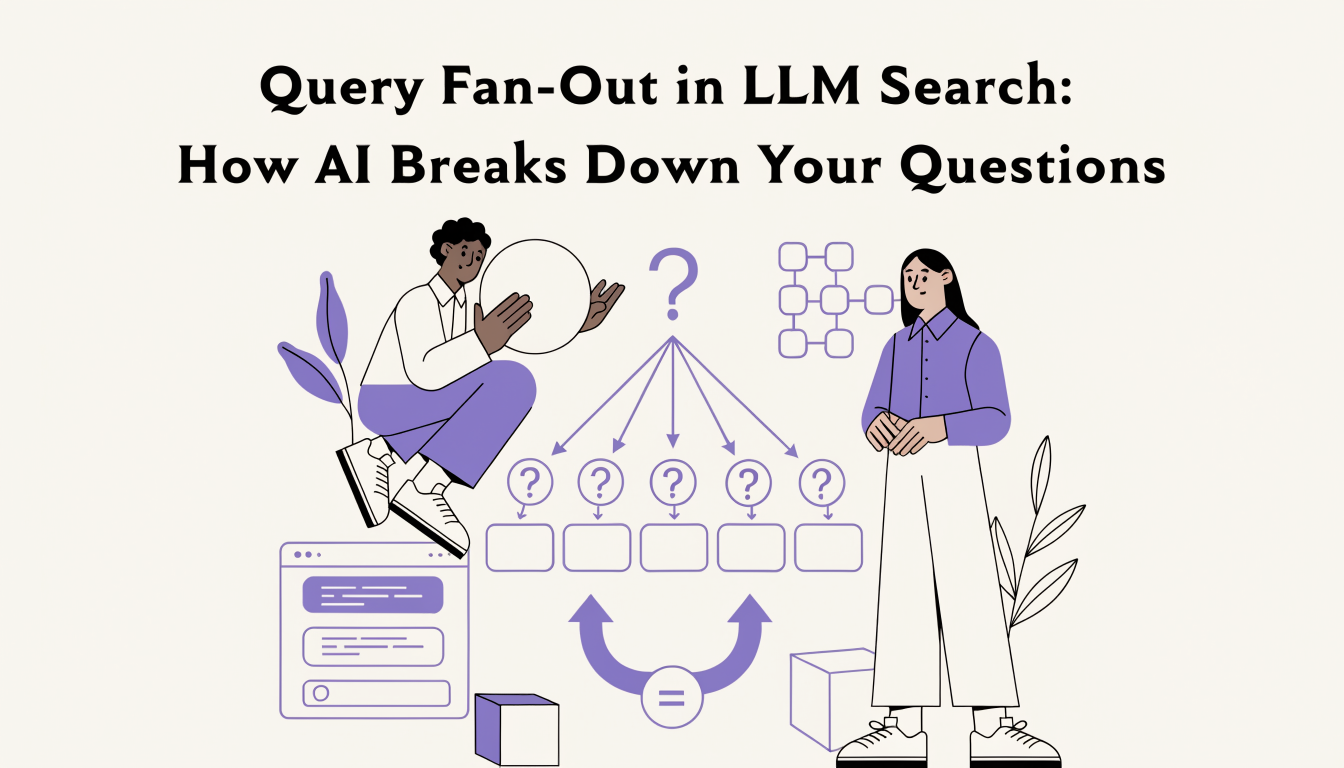
Query Fan-Out in LLM Search: How AI Breaks Down Your Questions
Learn what query fan-out in LLM search is, how AI splits your prompt into 3-8 sub-queries, and how to structure content to win more citation passes.