LLM Search Adoption for Ecommerce SEO Strategies Explained
Last updated: 23 July 2026
LLM search adoption for ecommerce SEO strategies refers to the shift in how online stores must structure content, product data, and authority signals so that large language model-powered search engines surface their pages — not just traditional crawlers ranking blue links. In plain terms: AI reads your store differently than Google's 2015 algorithm did, and your tactics need to match.
How LLM Search Adoption for Ecommerce SEO Strategies Actually Works
Large language models like those powering Google's AI Overviews, Bing Copilot, and Perplexity don't just match keywords to pages. They reason across documents, synthesize answers, and cite sources they consider authoritative. For an ecommerce store, this means a product page that only lists specs may be skipped in favor of a competitor's page that explains why a spec matters to a specific buyer.
Here is a concrete worked example. Imagine you sell running shoes. A traditional SEO approach optimizes the page title as "Men's Trail Running Shoes – Buy Online" and stuffs the description with keyword variants. An LLM-optimized approach instead answers the question a runner would ask an AI assistant: "What's the best trail shoe for someone with wide feet who runs on wet terrain?" The page includes a structured FAQ, a comparison table of outsole materials, and a paragraph explaining waterproofing trade-offs. When a shopper types that conversational query into an AI search interface, the model has dense, citable content to pull from — and your page earns the citation.
The mechanics behind this are rooted in how LLMs are trained and prompted. They weight content that is factually specific, internally consistent, and structured in a way that maps to natural questions. Schema markup (particularly Product, Review, and FAQPage schema) gives the model explicit signals about what your page contains.
Why This Shift Matters for Online Retailers
Traffic patterns are already changing. AI-generated answer boxes in Google Search have been shown in multiple studies to reduce click-through rates on organic results by 20–60% for informational queries. For ecommerce, that creates a two-sided problem: shoppers get product guidance from AI without visiting your store, and your competitors who appear inside those AI answers gain brand recall that converts later.
The upside is real, though. Stores that appear as cited sources inside AI Overviews or Perplexity answers often see higher-intent visitors — people who already trust the recommendation and arrive closer to a purchase decision.
Where LLM-Driven Search Is Being Used Right Now
LLM-powered search is not a future scenario. As of 2024, Google's AI Overviews roll out to over 1 billion users monthly. Bing's Copilot integration handles a material share of product research queries. Perplexity has reported tens of millions of monthly active users, many of whom use it specifically for shopping research.
For ecommerce, the highest-impact touchpoints are:
- Category and buying-guide pages — LLMs frequently synthesize these into comparison answers
- Product FAQs — direct question-and-answer format maps cleanly to how models retrieve content
- Review summaries — structured aggregate review content (with
AggregateRatingschema) is cited in AI answers more often than raw star ratings - Brand authority pages — About pages, press mentions, and editorial coverage help LLMs classify a brand as trustworthy
Practical Changes to Ecommerce Content Structure
Shifting to an LLM-ready content structure does not mean abandoning what works. It means layering new elements onto existing pages.
Answer the question before selling the product
Every product category page should open with a 50–100 word paragraph that directly addresses the most common buyer question for that category. If you sell air purifiers, that paragraph should explain what CADR rating means and which range suits a bedroom versus a living room — before listing products.
Use structured data aggressively
Google's documentation confirms that FAQPage, HowTo, and Product schema increase eligibility for rich results. More importantly, structured data gives LLMs a machine-readable map of your content. A product page with complete Product schema — including material, size, color, and offers — is far easier for a model to cite accurately than a page where that information is buried in unformatted paragraphs.
Build topical depth, not just keyword breadth
LLMs assess whether a site is a credible authority on a topic by checking whether its content covers the subject comprehensively. A shoe retailer that publishes detailed guides on pronation, stack height, and drop — not just product pages — signals domain expertise. This is sometimes called "topical authority," and it influences which sources an LLM treats as citable.
The Real Limits of LLM SEO Optimization
LLM search optimization is not a guaranteed traffic lever, and several honest caveats apply.
First, LLMs hallucinate. Even well-structured pages are sometimes cited inaccurately or not cited at all, because model behavior is probabilistic, not deterministic. You cannot "force" a citation the way you can force a keyword ranking with enough backlinks.
Second, the approach works best for considered purchases — electronics, outdoor gear, home goods, health products — where buyers ask research questions before buying. For impulse categories like fashion accessories or low-cost consumables, shoppers still tend to search, click, and buy without consulting an AI assistant.
Third, measuring LLM-driven traffic is genuinely hard right now. Tools for tracking AI citation share are early-stage, and most analytics platforms do not yet distinguish "arrived from AI Overview" from "arrived from organic search."
Common Misconceptions About LLM Search and Ecommerce
Misconception 1: LLM optimization replaces traditional SEO. It does not. Backlinks, page speed, crawlability, and Core Web Vitals still determine whether a page is indexed and trusted. LLM optimization is an additional layer, not a replacement.
Misconception 2: You need to rewrite all your product pages. Most stores benefit more from adding FAQ sections and improving schema markup on existing pages than from full rewrites. Start with your top 20 category and buying-guide pages.
Misconception 3: AI search hurts ecommerce universally. The evidence is mixed. Informational queries may generate fewer clicks, but transactional queries — "buy X under $Y" — still drive users to product pages. The risk is concentrated in the research phase, not the purchase phase.
What to Do With This Understanding
Start by auditing your ten highest-traffic category pages. Check whether each one opens with a direct answer to a buyer question, carries complete schema markup, and includes a structured FAQ. Those three changes, applied consistently, represent the most defensible investment an ecommerce team can make as LLM search continues to grow.
If you want a structured assessment of where your store stands against LLM-era search criteria, see how seorav.com can help. The team works specifically with ecommerce brands navigating this shift and can identify the highest-leverage changes for your catalog.
Frequently Asked Questions
What does LLM search mean for ecommerce product pages?
LLM-powered search engines synthesize answers from multiple sources rather than just ranking pages. For product pages, this means content that directly answers buyer questions — with structured data, FAQs, and factual specifics — is more likely to be cited in AI-generated answers. Pages that only list specs without explaining their significance are less likely to appear in AI-driven results.
How is LLM SEO different from traditional ecommerce SEO?
Traditional SEO focuses on keyword density, backlinks, and technical signals to rank pages in a list of blue links. LLM SEO focuses on making content citable by AI reasoning systems — which means structured answers, topical depth, and schema markup matter more than keyword repetition. Both approaches share a foundation in quality content and technical health, but LLM SEO adds a conversational, answer-first layer.
Which schema markup types matter most for LLM search in ecommerce?
Product, AggregateRating, FAQPage, and HowTo schema are the most impactful for ecommerce. Product schema gives AI models a structured map of your item's attributes. FAQPage schema maps directly to the question-and-answer format LLMs use to generate answers. AggregateRating signals credibility. Implementing all four on category and product pages is a practical starting point.
Can I measure how much traffic comes from AI-powered search?
Not precisely, yet. Most analytics platforms group AI Overview clicks under organic search, making attribution difficult. Some third-party tools are beginning to track AI citation share — meaning how often a domain appears in AI-generated answers — but these are early-stage. Monitoring branded search volume trends and direct traffic alongside organic can provide indirect signals of AI-driven awareness.
Does LLM search optimization work for all ecommerce categories?
It works best for considered purchases where shoppers research before buying — electronics, outdoor equipment, health products, and home goods. For impulse-buy categories like low-cost fashion accessories, the research phase is shorter and AI search has less influence. Prioritize LLM optimization for your highest-consideration product lines first, then expand based on results.
Keep reading
Ranking in Google's AI Search: The Deterministic Signals That Actually Move the Needle
Learn how do you rank in SGE with the three signals Google's AI uses to cite sources: schema markup, entity salience, and structured factual claims.
Why AI Ignores Your Content (And How to Fix It)
Learn how to avoid AI content that gets ignored by LLMs. Covers RAG retrieval signals, schema, entity salience, and an answer-first structure checklist.
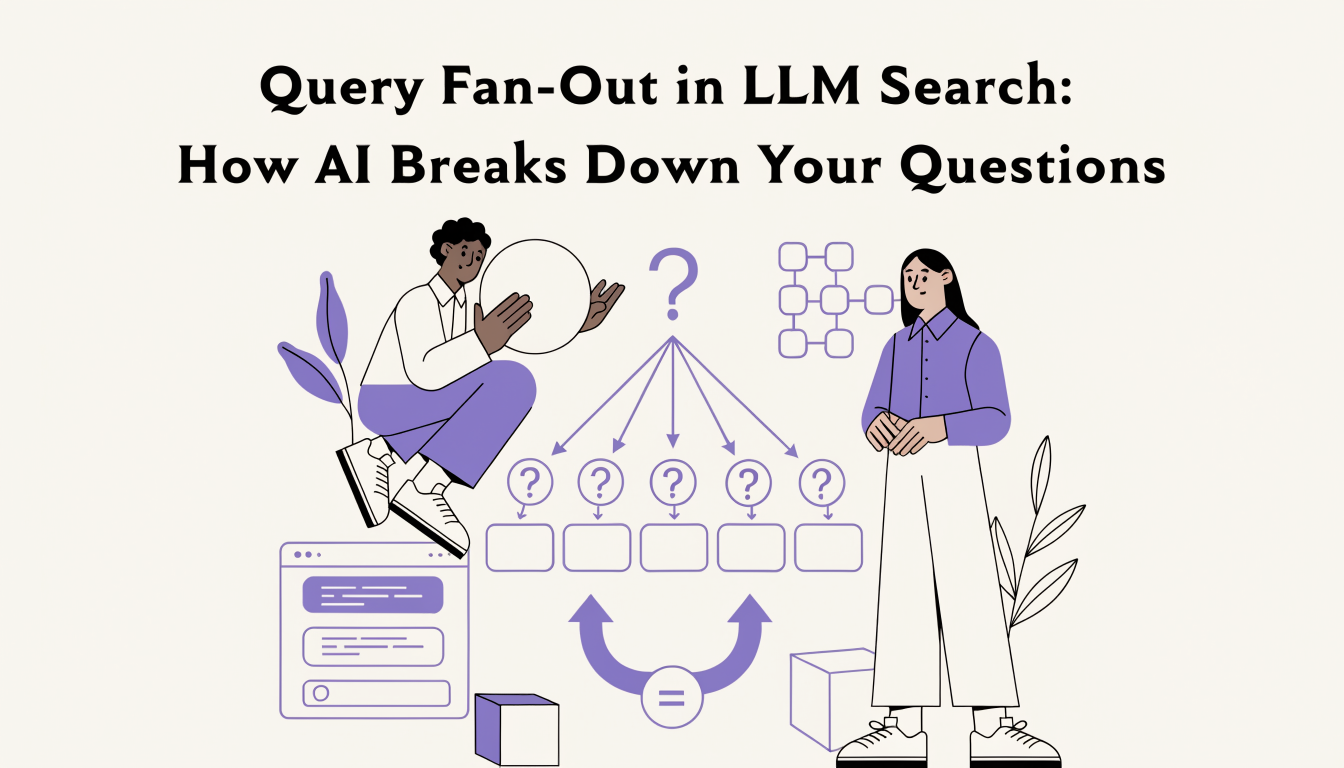
Query Fan-Out in LLM Search: How AI Breaks Down Your Questions
Learn what query fan-out in LLM search is, how AI splits your prompt into 3-8 sub-queries, and how to structure content to win more citation passes.