Keeping Your Content Fresh Enough for AI Search Rankings
Last updated: 30 September 2026
Freshness Decay Deflection means updating existing content with new information, data, or examples before AI search systems deprioritize it in favor of newer sources. AI engines continuously re-rank pages based on publication recency and relevance signals, and a page that ranked well last month can fall out of candidate results within three to four weeks if competitors publish fresher coverage. Simply changing the publish date does not trigger this reset; the update must contain substantive additions that justify the new timestamp.
This article walks through four practical steps: audit what's stale, update what matters, measure citation outcomes, and repeat. Specific signals to target are named throughout, along with a way to track whether updates are actually working.
One honest caveat upfront: not every refresh produces a measurable lift. Stale content gets filtered before an AI engine ever evaluates its substance, as Authoritytech's 2026 freshness analysis makes clear, but substance still has to be there once you clear that filter. Freshness is the entry ticket, not the whole game.
Four Things to Know Before You Go Deeper
AI engines apply a freshness filter that standard PageRank signals do not fully capture. Pages updated within the past 90 days consistently outperform stale equivalents on time-sensitive queries. A targeted update covering 20-30% of a page's content can reset its freshness score while preserving accumulated backlink equity.
- Freshness decay is measurable. AI models weight recency signals differently than traditional link-based ranking. AI-cited content is 25.7% fresher on average than pages ranking in standard organic results, a gap that widens on queries where the answer changes over time.
- Partial updates work. Rewriting 20-30% of a page, not the whole thing, is generally enough to register a freshness reset without stripping the link equity the original page earned.
- Audit tools catch decay early. Flagging at-risk pages before rankings slip is more efficient than rebuilding after the fact.
- Quarterly beats annual. A quarterly refresh cadence outperforms annual rewrites for AI citation retention, because AI engines re-evaluate sources continuously, not once a year.
One trade-off worth naming upfront: this approach breaks down for evergreen content where recency is irrelevant. A page explaining how compound interest works does not benefit from quarterly edits, and forcing updates onto stable content can introduce inconsistencies that hurt credibility more than stale timestamps do. Apply freshness strategy selectively, not uniformly across a site.
What Freshness Decay Deflection Means in Practice
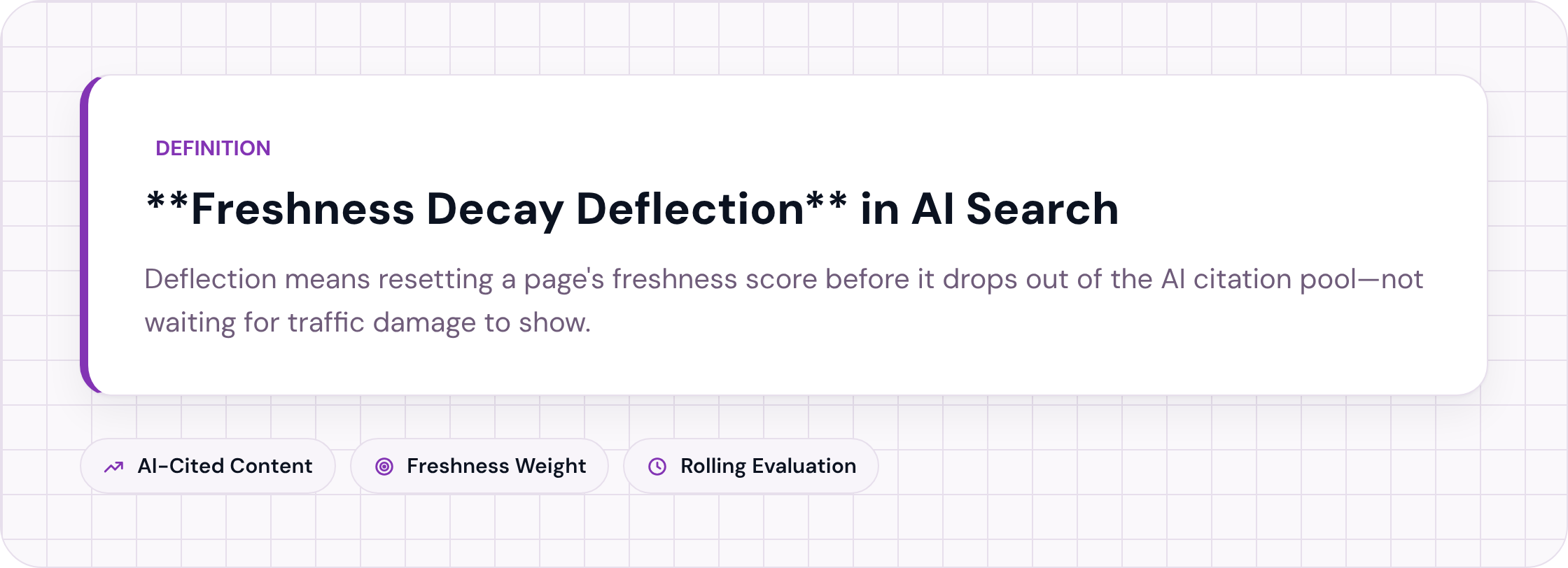
AI citation engines score indexed pages against competing sources on a rolling basis. A page that earned a citation last month can drop out of the candidate pool within weeks if a competitor publishes a more recent treatment of the same topic. Deflection means intervening early enough to reset that score, not waiting for traffic to signal the damage.
How AI Retrieval Systems Score Freshness
AI citation engines do not treat all content as equally time-sensitive. They apply a freshness weight that scales with query intent: a question about a regulatory change or a market rate gets a much heavier recency filter than a question about a stable concept. Two pages with identical depth and structure can produce very different citation rates depending on when each was last meaningfully updated.
The numbers are specific here. AI-cited content is 25.7% fresher on average than pages ranking in traditional organic results, a gap that suggests AI engines are already running a recency filter that standard SEO metrics do not capture.
The Decay Curve
Decay does not happen gradually. Amicited's analysis of AI visibility patterns puts the timeline in weeks rather than months, because AI systems actively compare your content's publication date against competing sources in real time. A page that earns a citation in week one can lose it by week six if a competitor publishes a more recent treatment of the same topic.
The curve is steepest for content in fast-moving categories: pricing, statistics, regulatory guidance, and product comparisons. A page covering SaaS pricing benchmarks from 18 months ago is not just slightly stale. It is structurally ineligible for citation on any prompt where recency is a retrieval criterion.
Deflection as an Active Strategy
A passive publishing schedule assumes decay is linear and predictable. It is neither.
Deflection treats freshness as a signal that requires active maintenance, not a byproduct of a content calendar. A passive schedule publishes new articles on a fixed cadence and leaves existing pages alone until a traffic drop triggers a review. An active deflection strategy monitors which pages are losing citation frequency, identifies the specific claims or data points that have aged out, and updates those elements before the page falls below the retrieval threshold.
Seer Interactive's 2026 study on content recency and AI visibility found that the type of update matters as much as the timing. Surface edits, like changing a date in the title or reformatting a list, do not reset the freshness score in a meaningful way. Updates that introduce new data, replace outdated statistics, or add a section addressing a recent development are the ones that move the needle.
The trade-off is real. Deflection requires editorial judgment that does not scale easily. A team managing 200 published pages cannot meaningfully update every one on a rolling six-week cycle without either cutting quality or cutting scope. This approach works best when applied selectively, prioritizing pages that already earn citations and are at risk of losing them, rather than treating the entire content library as equally urgent.
How LLMs Evaluate Content Freshness Differently Than Google
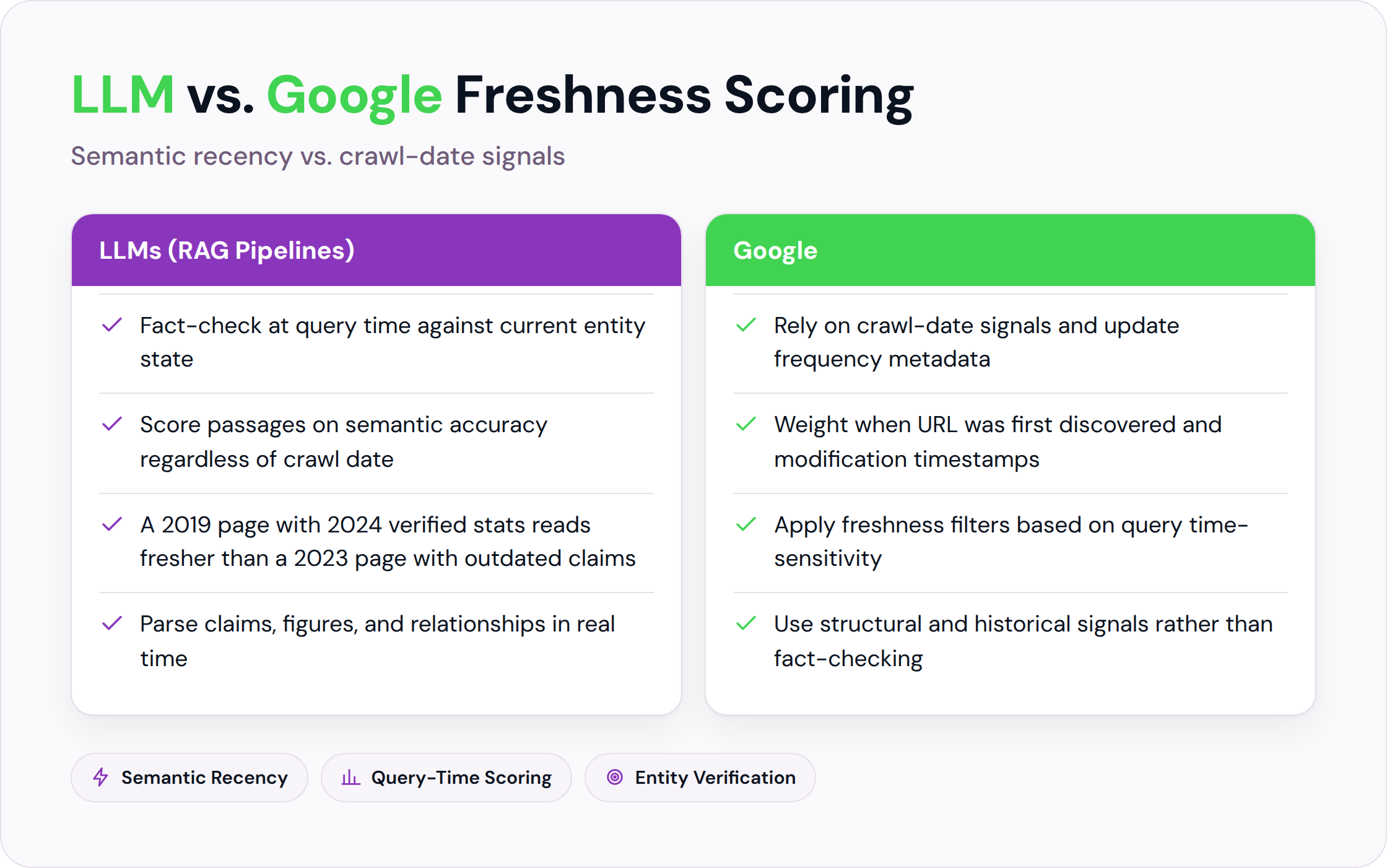
LLMs evaluate semantic recency by parsing whether claims, figures, and entities reflect current reality, regardless of crawl date. Google relies on crawl-date signals and update frequency. A 2019 page with verified 2024 statistics can read fresher to an LLM than a 2023 page built on outdated assumptions, because LLMs fact-check at query time rather than relying on metadata timestamps.
Semantic Recency vs. Crawl-Date Recency
Google's freshness algorithm leans on signals like the date a URL was first discovered, the frequency of updates, and whether the query itself is time-sensitive. LLMs in retrieval-augmented generation (RAG) pipelines do something closer to fact-checking at query time: they score passages against what they know about the current state of named entities, figures, and relationships.
The numbers support this distinction. Regularly updated content is cited 1.6x more often than outdated content in AI Overviews, with Google's own citation patterns favoring sources updated within the past 12 months. But "updated" here means semantically updated, not just re-crawled with a new timestamp in the HTML.
A practical example: a 2019 guide to cloud storage pricing that was revised in late 2024 to include current per-GB rates and vendor comparisons will outperform a 2023 guide that still cites 2021 pricing benchmarks. The LLM is not reading the publish date in the byline. It is reading the claims and cross-referencing them against what it knows to be true.
Why a 2024 Stat Update Beats a Stale 2023 Page
The mechanism is entity verification. When an LLM encounters a claim like "AWS S3 standard storage costs $0.023 per GB," it has a prior on whether that figure is plausible given its training data. A figure that aligns with recent reality scores higher as a citation candidate than one that conflicts with it, even if the conflicting page is technically newer.
Surgical updates to older, high-authority pages often outperform publishing a fresh article from scratch. The older page carries accumulated structural signals (internal links, schema, inbound references) while the updated claim gives the LLM a reason to prefer it semantically.
The trade-off is real, though. This approach breaks down when the update is cosmetic rather than substantive. Changing a date in the meta description or adding a single sentence at the top of an article does not rewrite the semantic profile of the page. LLMs parse the full passage, not just the lede. If 80% of the body still references outdated figures, the page reads as stale regardless of what the header says.
Entity Consistency: Keeping Named Facts Internally Coherent
A less-discussed freshness failure is internal inconsistency. A page that references "Q3 2023 revenue of $4.2B" in one paragraph and "fiscal year 2023 revenue of $3.9B" in another creates a contradiction that LLMs flag as low-confidence. The model cannot resolve which figure to cite, so it often cites neither.
Entity consistency means every named fact, figure, date, and proper noun on a page should agree with every other instance of that entity on the same page, and ideally with the structured data in the page's schema markup. When a company rebrands, releases updated financials, or changes a product name, every reference across the page needs to update together. Partial updates are worse than no update at all, because they introduce the kind of internal conflict that signals unreliable sourcing to a retrieval system.
Auditing for entity consistency is not a one-time task. Any page that covers time-sensitive topics (pricing, regulatory status, named leadership, version numbers) needs a review cadence tied to how frequently those entities change in the real world, not to an arbitrary editorial calendar.
Identifying Content at Risk of Freshness Decay
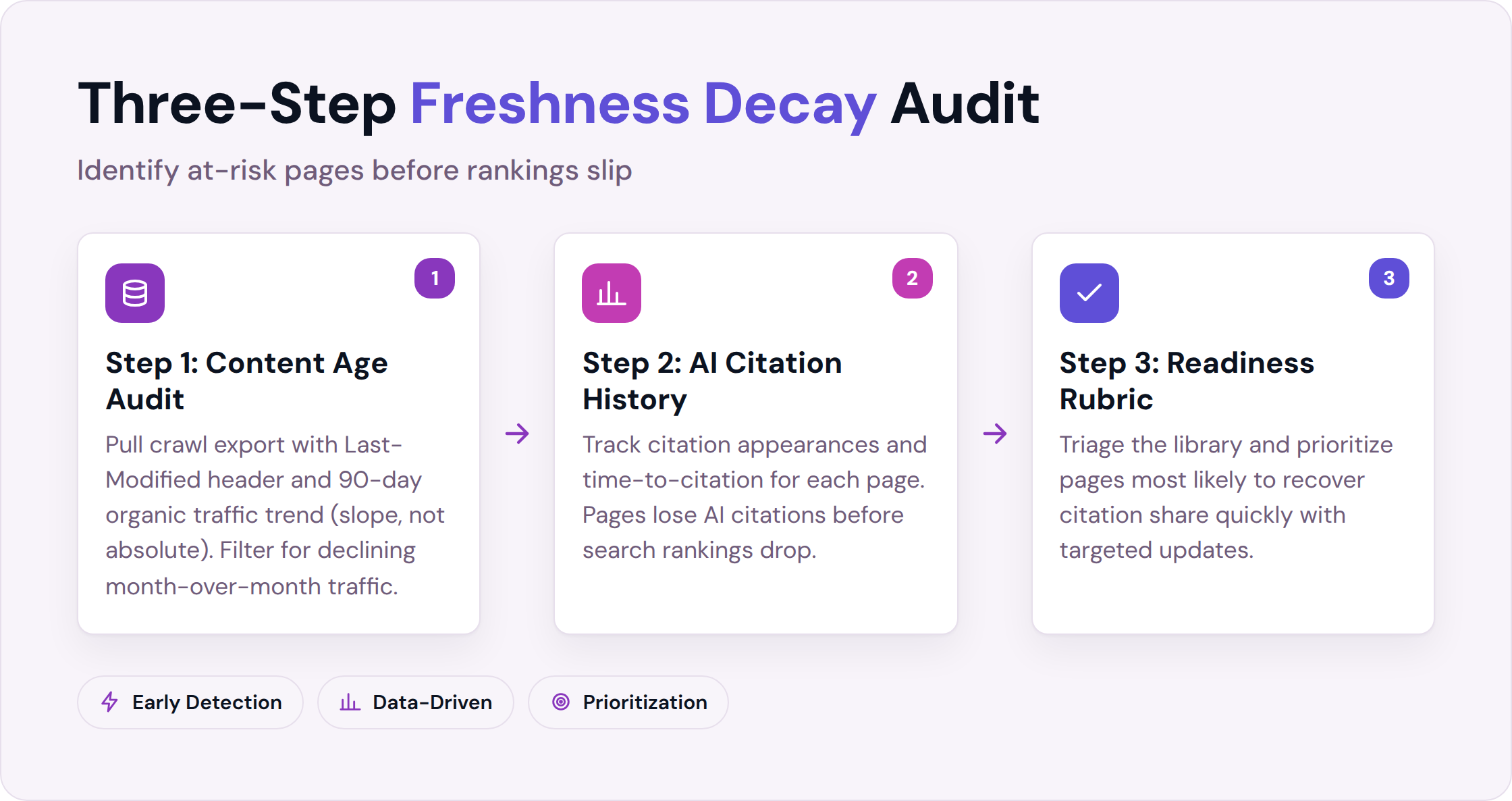
Pages lose AI citation appearances before they lose search rankings. The earliest warning signs show up in traffic trend data and last-modified timestamps, not in rank trackers. A structured three-step audit, combining content age, AI citation history, and a readiness rubric, lets you triage a large content library and direct update effort toward the pages most likely to recover citation share quickly.
Step 1: Pull a Content Age Audit Filtered by Traffic Trend and Last-Modified Date
Start with a crawl export that includes two fields most teams ignore: the HTTP Last-Modified header and a 90-day organic traffic trend (not absolute traffic, the slope). A page published three years ago but updated six months ago is not the same risk as a page that has not been touched since its original publish date.
Filter for pages where traffic is declining month-over-month for at least two consecutive periods AND the last-modified date is more than 12 months ago. That intersection is your first-pass risk list. In a typical 200-page content library, this filter usually surfaces 30 to 50 pages worth examining further.
One limitation worth naming: last-modified headers are unreliable if your CMS updates them on every template deploy or plugin change. If that is the case in your stack, use your CMS's internal "content last edited" field instead, or cross-reference Git commit history for docs-as-code setups.
Step 2: Cross-Reference AI Citation Reports to Find Pages Losing Answer-Box Appearances
Traffic decline alone does not tell you whether a page has lost AI citation share specifically. A page can hold steady in Google organic rankings while quietly disappearing from AI Overviews and LLM-generated answers. These are separate signals and they require separate tracking.
Tools like Semrush's AI Toolkit, Authoritytech's citation tracker, and Amicited let you monitor which of your URLs appear in AI-generated responses for target queries. Pull a 60-day citation trend for each page on your risk list. Pages where citation frequency dropped by 30% or more in the past two months are your highest-priority candidates for a Freshness Decay Deflection update.
Cross-referencing traffic decline with citation decline also helps you separate freshness problems from authority problems. A page losing organic traffic but holding citation share probably has a different issue (thin content, cannibalization, a competitor's new backlink profile). A page losing citation share while holding organic rank is almost certainly a freshness problem.
Step 3: Score Each Page Against a Freshness Readiness Rubric
Before committing editorial resources to a page, score it against four criteria:
- Does the page contain statistics, pricing, or regulatory data that has a known shelf life?
- Is the primary query intent time-sensitive (current rates, recent events, version-specific guidance)?
- Does the page already hold some citation history, meaning it has been cited at least once in the past six months?
- Is the last-modified date more than six months ago?
Pages that score yes on three or four of those criteria are your update queue. Pages that score yes on one or two are candidates for a lighter review. Pages that score yes on zero (stable concepts, methodology explanations, historical content) should be left alone. Forcing freshness updates onto stable content wastes editorial time and can introduce the kind of inconsistency that hurts citation eligibility rather than helping it.
Executing a Freshness Decay Deflection Update
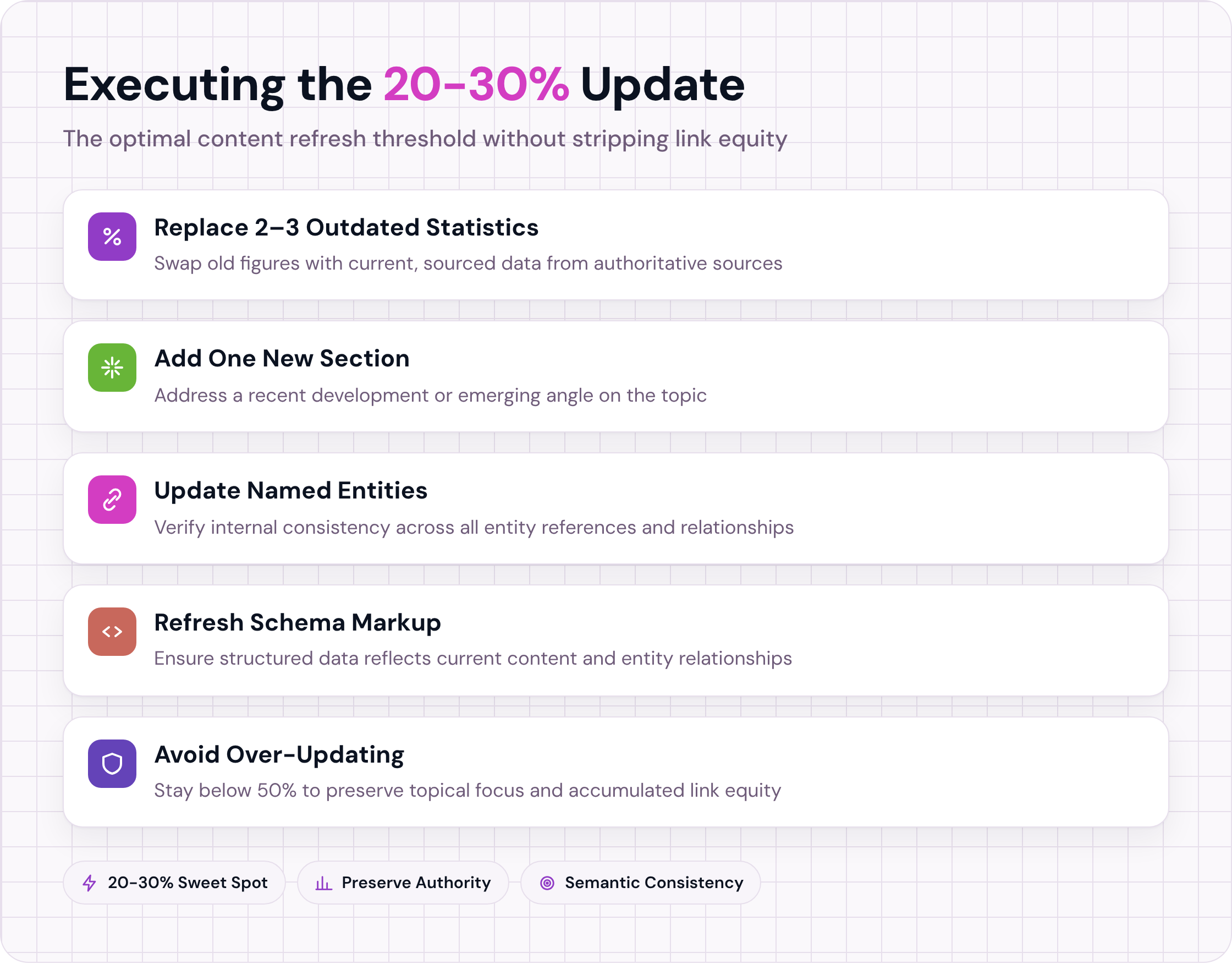
Executing a Freshness Decay Deflection update requires targeting the right content volume and prioritizing verifiable claims over general prose. Replace 20-30% of outdated material with current, sourced figures, update schema markup, and verify internal consistency across all named entities.
Target the 20-30% Threshold
Research consistently shows that updating 20-30% of a page's content is enough to register a meaningful freshness signal without disrupting the structural and semantic profile that earned the page its original authority. Below 20%, the update reads as cosmetic. Above 50%, you risk changing the page's topical focus in ways that can confuse retrieval systems and strip accumulated link equity.
The 20-30% target translates roughly to: replace two or three outdated statistics with current figures, add one new section addressing a recent development, and update any named entities (product versions, company names, regulatory references) that have changed since the original publish date.
Prioritize Data Points Over Prose
LLMs weight specific, verifiable claims more heavily than general prose. A paragraph that says "cloud storage costs have dropped significantly over the past few years" contributes almost nothing to freshness. A paragraph that says "AWS S3 standard storage dropped from $0.026 per GB in 2021 to $0.023 per GB in 2024, a 12% reduction" gives the LLM something to verify and cite.
When you audit a page for update candidates, look for:
- Statistics with a year attached that is more than 18 months old
- Named products or services that have released new versions
- Regulatory or compliance references that may have been superseded
- Pricing figures that are likely to have shifted
Replace each of those with a current, sourced figure. That is the core of a Freshness Decay Deflection update.
Update Schema Markup to Match
Schema markup is not optional in this workflow. If your page's dateModified field in its JSON-LD does not reflect the actual date of the content update, you are leaving a signal on the table. More importantly, if your schema references entities (organization names, product names, version numbers) that conflict with the updated body text, you have introduced the kind of internal inconsistency that LLMs flag as low-confidence.
After every content update, verify that:
dateModifiedreflects the current update date- Any
mentionsoraboutentities in the schema match the updated body text authorandpublisherfields are current and consistent with your site's other schema
This takes about 10 minutes per page and is one of the highest-leverage steps in the process.
Measuring Whether the Update Worked
Track citation frequency and time-to-citation to validate whether your freshness updates are working. Citation frequency should increase 20-40% within 60 days of a substantive update, while time-to-citation measures how quickly pages re-enter the citation pool after changes are published.
Citation Frequency
Citation frequency is the number of times your URL appears in AI-generated responses for your target queries over a rolling 30-day window. Measure it before the update and again 30 and 60 days after. A successful update typically shows a 20-40% increase in citation frequency within 60 days, based on patterns documented in Seer Interactive's 2026 recency study.
If citation frequency does not move within 60 days, the update was likely too cosmetic. Go back to the page and check whether the changes you made actually replaced outdated claims with current, sourced figures, or whether they were structural edits that did not change the semantic profile.
Time-to-Citation
Time-to-citation measures how quickly a page re-enters the citation pool after an update. For pages with existing citation history, this is typically faster than for pages starting from zero. Tracking this metric across multiple updates gives you a baseline for your site: if your average time-to-citation after a substantive update is 14 days, you can plan your update cadence accordingly.
One honest limitation: these metrics require access to AI citation tracking tools, which are not free and are not yet standardized across the industry. If you do not have access to a dedicated citation tracker, you can approximate citation frequency by manually querying your target prompts in ChatGPT, Perplexity, and Google AI Overviews on a weekly basis and recording whether your URL appears. It is slower and less precise, but it gives you directional data without a tool subscription.
Frequently Asked Questions
How often should you run a Freshness Decay Deflection audit?
Quarterly is the right cadence for most content libraries. AI engines re-evaluate sources continuously, so a page that cleared the freshness filter in January can fall below the threshold by April if competitors have published more recent treatments of the same topic. For pages in fast-moving categories (pricing, regulatory guidance, product comparisons), a six-week review cycle is more appropriate.
Does updating a page's publish date count as a freshness signal?
No. Changing the publish date in your CMS without making substantive changes to the content does not reset the freshness score in a meaningful way. AI retrieval systems parse the claims and figures inside the text, not just the metadata. A date change with no corresponding content update is a cosmetic edit that LLMs will not register as a recency improvement.
How do you know if a page has lost AI citation share vs. organic ranking?
These are separate signals that require separate tracking. A page can hold its position in Google's organic results while disappearing from AI Overviews and LLM-generated answers. Use a dedicated AI citation tracker (Semrush's AI Toolkit, Authoritytech, or Amicited) to monitor citation frequency independently of rank tracking. If citation frequency drops while organic rank holds, the problem is almost certainly freshness-related rather than authority-related.
What types of content benefit most from Freshness Decay Deflection?
Pages covering time-sensitive topics benefit most: pricing benchmarks, regulatory guidance, product comparisons, market statistics, and version-specific technical documentation. Evergreen content (conceptual explanations, historical analysis, methodology guides) does not benefit from forced freshness updates and can actually suffer if updates introduce inconsistencies into otherwise stable, well-cited content.
Can you over-update a page and hurt its citation eligibility?
Yes. Updating more than 50% of a page's content risks changing its topical focus in ways that confuse retrieval systems and can strip the accumulated structural signals (internal links, schema, inbound references) that made the page a citation candidate in the first place. The 20-30% threshold exists for this reason. Treat each update as a targeted intervention, not a rewrite.
What is the minimum update needed to register a freshness signal?
There is no precise threshold, but the research points to substantive changes rather than cosmetic ones. Replacing two or three outdated statistics with current, sourced figures, adding one new section addressing a recent development, and updating any named entities that have changed since the original publish date is generally enough to register a meaningful freshness reset. Surface edits (reformatting, date changes in the title, adding a sentence to the introduction) do not move the needle.
If you want a structured way to track which pages are losing citation share and when to intervene, visit Seorav's GEO tools to see how the process can be applied to your content library.
Keep reading
How to Audit Your Content's Stability in AI Search Results
Learn how to run agentic SERP volatility audits that track AI citation stability across ChatGPT, Perplexity, and Google AI Overviews, with scoring and fix
How to Track Your Brand's Mentions Across AI Search Results
Learn how to measure brand mention share across ChatGPT, Perplexity, Gemini, and Copilot, with a step-by-step formula, tool guide, and FAQ.
Measuring the Real Value of Zero-Click Visibility in AI Search
Learn how to calculate Zero-Click Visibility Yield, track AI citations across ChatGPT and Perplexity, and convert brand impressions into defensible ROI num