How to Verify Your Brand's Authority in Knowledge Graphs
Last updated: 5 October 2026
Knowledge graph authority verification confirms that structured data about your brand appears in the sources AI systems reference when deciding what to cite. Google Knowledge Graph, Microsoft Academic, and similar databases store entity information that AI assistants cross-check for credibility. When your brand data is present, consistent, and properly sourced across these platforms, AI systems recognize you as a verified entity rather than an unconfirmed mention. This distinction directly affects whether AI tools recommend your business to users.
Google's documentation on entity understanding makes this explicit: structured data helps search and AI systems connect a named entity to a defined set of attributes, relationships, and authoritative sources. Without that scaffolding, even a well-trafficked site can be invisible at the entity resolution layer.
The numbers matter here. Brands with verified knowledge graph presence are cited by AI engines at measurably higher rates than those without structured entity records, a pattern Graphwise's research on knowledge graphs and information integrity attributes to the way AI systems use semantic frameworks to filter credible sources from unverified ones.
One honest caveat: verification is not a one-time fix. Entity records drift as your brand evolves, and inconsistencies across sources can erode the signal you built. The sections below cover how to audit, correct, and maintain that record over time.
Four Things That Determine Knowledge Graph Authority
Brand authority in a knowledge graph depends on four factors: entity disambiguation (one unambiguous node for your brand), corroborating sources across Wikipedia and Wikidata, schema markup using Organization and SameAs properties, and measurable citation frequency in AI-generated answers.
Entity disambiguation is the foundation. A knowledge graph organises entities according to a defined schema and applies reasoning to derive relationships between them, as the Alan Turing Institute's knowledge graph research group describes. If your brand name resolves to multiple competing nodes (a common problem for brands that share names with people, places, or older companies), AI engines cannot confidently surface you. One node, one meaning, no ambiguity.
Corroborating sources are what give that node credibility. Wikipedia, Wikidata, Crunchbase, and authoritative press mentions act as cross-references. AI systems triangulate across these sources rather than trusting any single one. A brand with a Wikidata entry, a Wikipedia stub, and consistent third-party coverage is structurally easier to verify than a brand with only its own domain as evidence.
Schema markup connects the dots programmatically. Organization schema with SameAs properties pointing to your Wikidata QID, LinkedIn page, and Crunchbase profile tells crawlers and AI retrieval layers that these records all refer to the same entity. Without it, even a well-documented brand can appear as several loosely related fragments rather than one coherent node.
Citation frequency is the output signal. How often AI models surface your brand in generated answers, unprompted, is a direct proxy for how confidently the model has resolved your entity. You can measure this: run a consistent set of category-level prompts weekly and log which responses include your brand name versus a competitor's.
The trade-off worth naming: smaller or newer brands often lack the Wikipedia footprint to anchor their entity node, and Wikidata entries for non-notable companies get deleted. In those cases, schema markup and third-party press coverage carry more weight, but they are slower to accumulate. For early-stage companies, the timeline to meaningful knowledge graph authority is typically 12 to 18 months of consistent corroboration-building.
Knowledge Graph Authority Verification: What It Is and How It Works
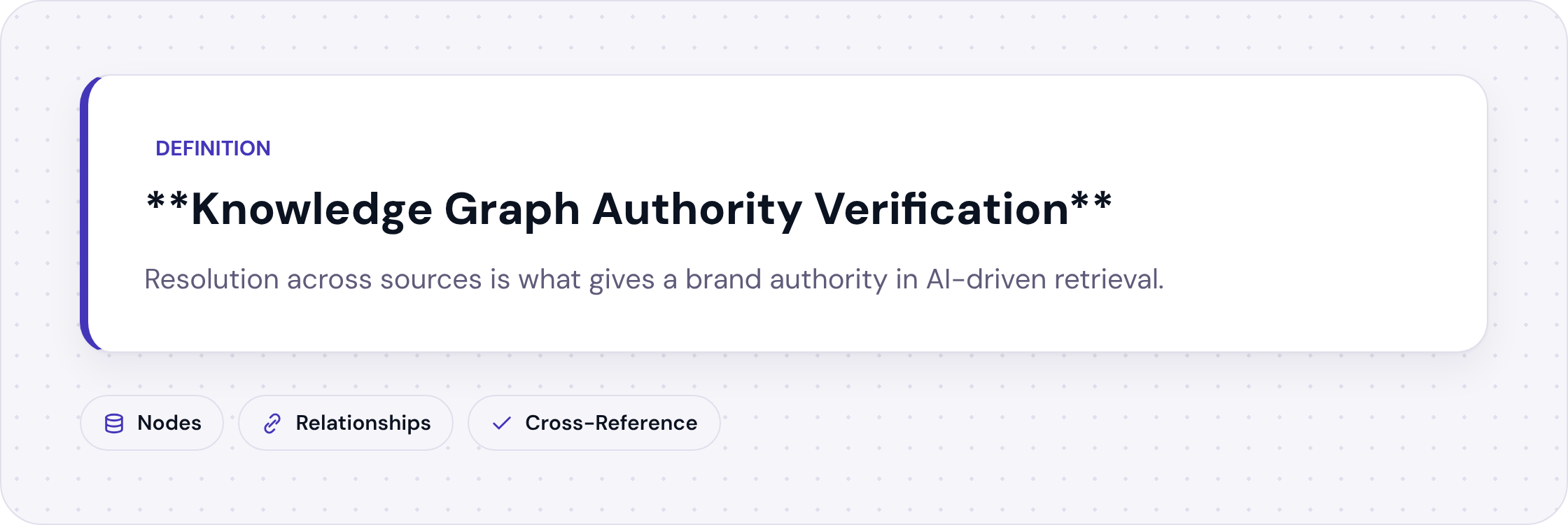
Knowledge graph authority verification is the process by which AI systems confirm that a brand exists as a distinct, structured entity, not just a collection of web pages. A knowledge graph stores brands as nodes, each connected to other nodes through typed relationships: "founded by," "headquartered in," "operates in sector." When those relationships can be cross-referenced across independent sources, the entity is considered resolved. That resolution is what gives a brand authority in AI-driven retrieval, not its domain age or backlink count.
Nodes, Relationships, and Why Structure Matters
Knowledge graphs encode facts as triples: a subject node, a predicate (the relationship type), and an object node. Your brand might sit at the center of dozens of these triples, connected to its founders, its product categories, its industry classification, its geographic presence. Structured factual knowledge linked through typed relationships is precisely what makes an entity machine-readable rather than just human-readable.
The practical consequence: two sources describing your brand in plain prose do not automatically create entity authority. The graph needs typed, consistent connections. A Wikipedia article that names your CEO creates one triple. A Wikidata entry that links your brand to an industry classification creates another. A Crunchbase profile that connects you to a funding round creates a third. Each independent triple strengthens the node.
Knowledge Panels vs. Verified Entity Authority
A Google Knowledge Panel is visible evidence that a knowledge graph has resolved your brand, but the panel and the underlying entity authority are not the same thing. The panel is a display artifact. The authority is the structured record that feeds it, and that same record feeds AI retrieval systems that never surface a panel at all.
This distinction matters practically. A brand can have a Knowledge Panel generated from thin or ambiguous data, and that panel can disappear or misattribute facts if the underlying triples conflict. Verified entity authority means the graph's record of your brand is internally consistent, cross-referenced by multiple independent sources, and stable enough that automated systems resolve it to the same entity every time. Building this kind of structured presence takes deliberate, sustained effort across third-party platforms. A brand that only publishes content on its own domain, even high-quality content, gives the graph almost nothing to triangulate against.
Why RAG Systems Depend on Entity Resolution
Retrieval-augmented generation (RAG) systems retrieve external documents at query time and pass them to a language model as context. The retrieval step relies on entity resolution: the system needs to know that "Acme Corp," "Acme Corporation," and "Acme" all refer to the same node before it can pull the right documents. GraphRAG, a specific architecture for this, operates in two phases: an offline indexing phase that builds the knowledge graph and community summaries, and an online query phase that uses those summaries to retrieve relevant context, as Kloia's technical breakdown of GraphRAG explains.
If your brand's entity is ambiguous or unresolved, the retrieval step either skips your content or surfaces it inconsistently. The model then cites a competitor whose entity is clean. This is why brands with strong traditional SEO footprints sometimes get ignored by AI engines: the pages rank, but the entity behind them is fuzzy.
One limitation worth acknowledging: entity resolution quality varies by knowledge graph. Google's graph, Wikidata, and the graphs embedded in specific LLMs are built and updated on different schedules with different source priorities. A brand that is well-resolved in Wikidata may still be ambiguous in a proprietary LLM's internal graph if that model's training data predates the brand's structured presence. Verification across one graph does not guarantee authority across all of them.
How AI Models Use Knowledge Graphs to Select Which Sources to Cite
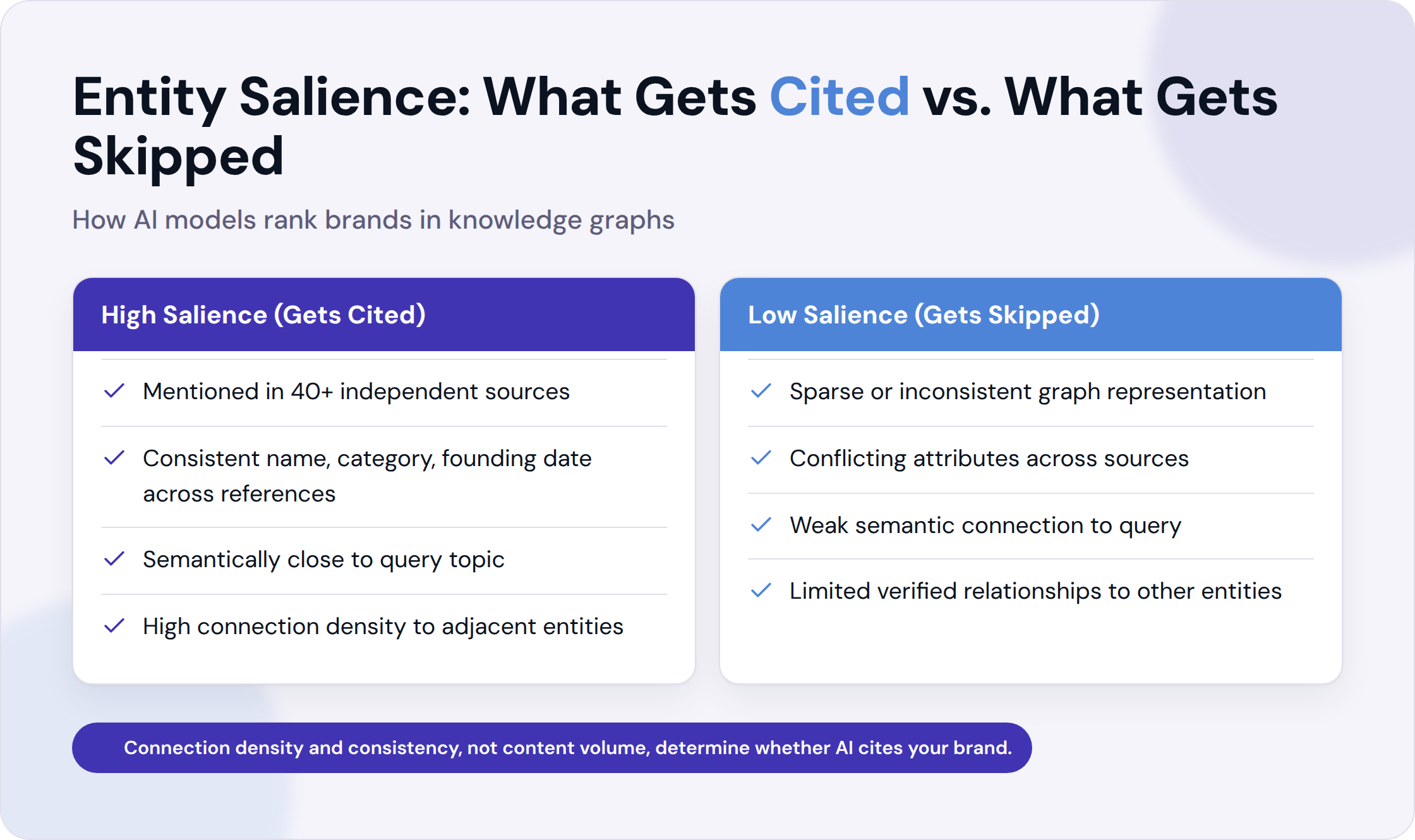
When an AI model decides which brand to cite, it consults its knowledge graph to check whether that brand exists as a verified node with measurable connection density. Brands with more confirmed relationships to adjacent entities, topics, and sources score higher on entity salience and get pulled into responses. Brands with sparse or inconsistent graph representations get skipped, regardless of how much content they have published.
Entity Salience Scoring: Connection Density Decides Rank
Entity salience is not a single score. It is a composite signal built from how many other verified entities point to yours, how consistently your attributes appear across those references, and how semantically close your node sits to the query topic. A brand mentioned in 40 independent sources with consistent name, category, and founding date will outrank a brand mentioned in 400 pages on its own domain. The graph rewards triangulation, not volume.
The underlying mechanism is graph-based retrieval: the model traverses entity relationships to find the most structurally central source for a given query. Knowledge graphs supply verified relational structure that LLMs cannot generate on their own, which is precisely why brands with thin graph presence get paraphrased or replaced by a competitor whose node is better connected.
Co-Citation Patterns Across Source Types
Where your brand gets mentioned matters as much as how often. AI models weight co-citation patterns across source types differently. An academic citation in a peer-reviewed paper carries more entity-confirmation weight than a blog mention. A Reddit thread where your brand is compared directly to competitors by name builds a different kind of signal: community-level salience, which models use to infer real-world relevance.
The practical implication: a brand cited in an industry publication, discussed in a relevant subreddit, and referenced in a conference paper is structurally more citable than a brand with ten times the backlinks but all from a single source category. Diversity of source type is a co-citation quality signal, not just a quantity one. Research on knowledge graph enrichment published in a 2023 study indexed by PMC with over 1,140 citations confirms that inferring new facts from existing relational data is central to how these systems extend and validate entity records.
When Knowledge Graph Gaps Cause AI Models to Skip Your Brand
The failure mode is straightforward. If your brand node lacks confirmed relationships to recognized topic clusters, the model has no structural path to reach you during retrieval. It does not make a judgment call against you. You simply do not appear in the traversal.
This breaks down most visibly for newer brands, niche B2B companies, and organizations that have published heavily on their own domains but generated little third-party entity confirmation. A company can have a technically excellent product page with full schema markup and still be invisible to an AI engine's citation layer because no external source has confirmed the entity's core attributes independently.
The trade-off worth acknowledging: building graph presence takes time and depends partly on third-party editorial decisions you cannot fully control. A brand that earns a mention in a major industry report gets a graph signal that no amount of on-site optimization replicates. That asymmetry is real, and it means graph authority accrues unevenly across industries and company sizes.
Frequently Asked Questions
What is knowledge graph authority verification?
Knowledge graph authority verification is the process of confirming that your brand exists as a structured, unambiguous entity node in the graphs that AI systems consult during retrieval. It involves cross-referencing your brand's attributes (name, category, founding date, key relationships) across independent sources like Wikidata, Wikipedia, and Crunchbase. When those sources agree, AI engines can resolve your brand confidently and cite it in generated answers.
How do I check if my brand has a knowledge graph entry?
Search your brand name on Google and look for a Knowledge Panel on the right side of the results. You can also search directly on Wikidata using your brand name to see whether a structured entity record exists. Keep in mind that a Knowledge Panel is a display artifact; the absence of one does not mean your entity record is empty, and its presence does not guarantee the underlying data is accurate or complete.
Does schema markup alone create knowledge graph authority?
No. Schema markup on your own site tells crawlers how to interpret your pages, but it does not create the independent corroboration that knowledge graphs require. Authority comes from multiple external sources, each confirming your brand's attributes through their own structured records. Schema markup is a necessary signal, but it only becomes meaningful when third-party sources independently confirm the same entity attributes.
How long does it take to build knowledge graph authority?
For established brands with existing press coverage and Wikipedia eligibility, meaningful graph authority can develop within three to six months of deliberate structured-data work. For newer or niche brands that need to build third-party corroboration from scratch, the realistic timeline is 12 to 18 months. The bottleneck is usually editorial: you cannot force a major publication or Wikidata editor to create or confirm your entity record on your schedule.
Why does my brand rank well in search but get ignored by AI engines?
Traditional search ranking depends heavily on on-page signals, backlink volume, and domain authority. AI citation depends on entity resolution: whether the graph can confirm your brand as a distinct, well-connected node. A brand can accumulate thousands of backlinks while remaining structurally ambiguous at the entity layer. If your brand name is shared with another entity, or if your attributes are inconsistent across sources, AI retrieval systems will skip you even when your pages rank on page one.
What sources carry the most weight for entity verification?
Wikipedia and Wikidata carry the most weight because they are explicitly structured and widely used as training and retrieval sources by major AI systems. After those, authoritative industry publications, peer-reviewed research mentions, and structured profiles on platforms like Crunchbase and LinkedIn contribute meaningfully. Blog mentions and social posts contribute the least, though they can add community-level salience signals when they appear at scale across diverse, independent sources.
If you want to see where your brand stands in AI retrieval and what structured-data gaps are holding back your citations, visit Seorav's AEO service page to get a clear picture of your current entity authority and what to fix first.
Keep reading
Why AI Search Misses Sentiment in Your Content
Perceptual sentiment deficit causes ranked pages to lose AI citation slots. Learn how LLMs misread tone and what to fix before your next crawl.
Placing Your Content in Vector Space for AI Discovery
Learn how Neural Vector Placement works, why cosine similarity scores determine AI retrieval, and how to optimize your content chunks for SGE and RAG pipel
Finding and Fixing the Semantic Gaps Costing You AI Citations
A semantic gap deficit stops AI engines from citing your content. Learn how to identify missing concept clusters and fix them before a competitor does.